Source: Edward Behr. Prohibition: 13 Years That Changed America (2013)

Women's Temperance was the first mass-movement involving women in U.S. History. It also featured the world's first large-scale non-violent protest movement (like Gandhi' efforts decades later). These "Women Crusaders" used arrests and insults in the early-1870s as a way to gain guilt-ridden converts to their cause. The behind-the-scenes mentors were men, and the logistics came from Protestant churches. There was some success in the Midwest in terms of non-stop picketing and protesting, but while awareness was raised, only a relatively small percentage of saloons actually closed their doors.
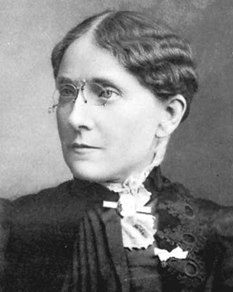
While this specific "Women's Crusade" was a a media success, it had a short shelf-life. When the interest from the media waned, the Crusaders went back home, and the affected saloons reopened. As a result, the Women's Christian Temperance Union (WCTU) was formed in 1874. Frances Willard (pictured) was eventually elected as WCTU President; she was not only an ex-Crusader, but also a university professor.
The WCTU believed that moderation was a "shoddy lifebelt", which promised safety, but only tempted danger. Willard was one of the first to work for nationwide Prohibition; she organized a petition effort to lobby Congress in 1875. The WCTU made every effort to educate kids on the evils of alcohol, featuring such Sunday School publications as "Counting Fingers".
The WCTU believed that moderation was a "shoddy lifebelt", which promised safety, but only tempted danger. Willard was one of the first to work for nationwide Prohibition; she organized a petition effort to lobby Congress in 1875. The WCTU made every effort to educate kids on the evils of alcohol, featuring such Sunday School publications as "Counting Fingers".
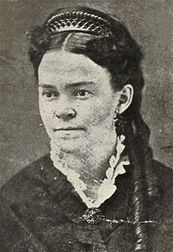
At the turn-of-the-century, Carry Nation would steal the WCTU's formidable thunder. Nominally a member of the WCTU, Carry Nation was determined to protest in her own way. Born into an eccentric (insane?) and rebellious family, Carry Moore (pictured) was very likely a mentally unbalanced person. Carry spent a lot of time with African slaves, looking for human connections, since her mother didn't want much to do with her at all.
She married Charles Gloyd in 1867, who was a heavy drinker, and her life took a major turn as a result. Gloyd's two main vices were drinking and smoking, which were the very vices that Nation attacked in the future. She married again, this time to a man named David Nation, partly so she could legitimately call herself Carry Nation. David was not a strong man, and failed at most everything, including preaching. During unsuccessful sermons, Carry would embarrass him by saying such things out loud as "That will be all for today, David".
She married Charles Gloyd in 1867, who was a heavy drinker, and her life took a major turn as a result. Gloyd's two main vices were drinking and smoking, which were the very vices that Nation attacked in the future. She married again, this time to a man named David Nation, partly so she could legitimately call herself Carry Nation. David was not a strong man, and failed at most everything, including preaching. During unsuccessful sermons, Carry would embarrass him by saying such things out loud as "That will be all for today, David".
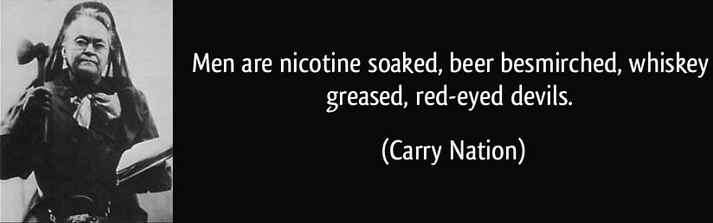
Carry Nation soon started busting up saloons in St. Louis, Cincinnati, Philadelphia, and New York City, and as a result, she became a "Media Star". By 1901, Nation was so far removed from reality that she publicly celebrated the Assassination of President William McKinley; it was at that point that she started her sharp decline. Soon, the WCTU stopped funding her, and the media stopped covering her "Hatchetations".
Nation resorted to reenacting her "Hatchetations" on stage, but there were no crowds of note. She even tried stage performances in Britain, and tried to break up pubs, but was arrested and heavily fined. Nation was totally unaware that she had become a complete caricature, a figure of ridicule. Soon after her unsuccessful "tour" in Britain, Nation had a mental breakdown, and died at the age of 65 in a mental institution.
Nation resorted to reenacting her "Hatchetations" on stage, but there were no crowds of note. She even tried stage performances in Britain, and tried to break up pubs, but was arrested and heavily fined. Nation was totally unaware that she had become a complete caricature, a figure of ridicule. Soon after her unsuccessful "tour" in Britain, Nation had a mental breakdown, and died at the age of 65 in a mental institution.
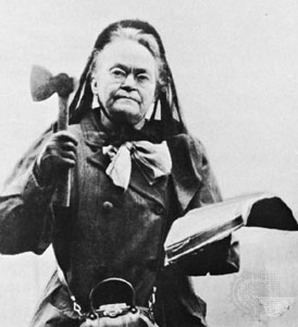
One day, Nation entered a Kansas saloon with another WCTU woman, and a sledgehammer; she smashed a keg of whiskey, and hurled invectives in a rage . . . no one dared trifle with her. After busting up a few saloons in Kiowa, she bought a large hatchet, which was to become her signature. Her raids on saloons were sudden, fierce, and violent: few dared face her directly as she destroyed bars and furniture.
Law enforcement was in a dilemma as to what to do with Carry Nation, since Kansas was officially a "Dry" state. Nation was destroying property, but those properties were violating state law. Nation rarely stayed in jail more than one night; very often, she used her short periods of incarceration for media exposure.
(Below: if the embedded video doesn't play, click on "Women of Prohibition Carry Nation")
Law enforcement was in a dilemma as to what to do with Carry Nation, since Kansas was officially a "Dry" state. Nation was destroying property, but those properties were violating state law. Nation rarely stayed in jail more than one night; very often, she used her short periods of incarceration for media exposure.
(Below: if the embedded video doesn't play, click on "Women of Prohibition Carry Nation")
