Source: Lynne Olson. Those Angry Days: Roosevelt, Lindbergh, and
America's Fight Over World War II, 1939 - 1941 (2013)
America's Fight Over World War II, 1939 - 1941 (2013)
British Prime Minister Winston Churchill was convinced that if FDR won re-election in 1940, then massive military assistance would surely follow. Not only did Britain need far more military aid, but they also needed a new way to finance the aid, since they were running out of dollars (Britain had been borrowing from their gold reserves, even from Belgium's reserves, which they held, to pay the U.S.). However, FDR proved to be very lethargic in terms of increasing direct military aid to Great Britain beyond the "Destroyers for Bases" Deal, which was very perplexing and frustrating for Churchill and Parliament.
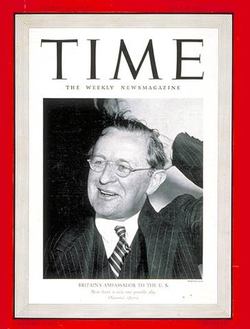
Lord Lothian (pictured), the British Ambassador to the U.S., came to the rescue; he didn't see Election Day as a magic day at all - he saw the following day (6 Nov) as the day that Britain could once again pressure America for aid, and he knew he would be the one to run point. What Britain needed was a comprehensive plan for aid, not the patchwork aid of the past.
Lothian knew that FDR wouldn't budge unless he was forced to do so; he asked Churchill to write a personal letter to the President. Churchill's letter was a frank wake-up call to the reality facing Britain against Nazi Germany. To Lothian, the letter was an insurance policy if FDR ignored the crisis facing England; if FDR didn't act, he knew he could at least expose FDR's inaction after the fact.
Lord Lothian (pictured), the British Ambassador to the U.S., came to the rescue; he didn't see Election Day as a magic day at all - he saw the following day (6 Nov) as the day that Britain could once again pressure America for aid, and he knew he would be the one to run point. What Britain needed was a comprehensive plan for aid, not the patchwork aid of the past.
Lothian knew that FDR wouldn't budge unless he was forced to do so; he asked Churchill to write a personal letter to the President. Churchill's letter was a frank wake-up call to the reality facing Britain against Nazi Germany. To Lothian, the letter was an insurance policy if FDR ignored the crisis facing England; if FDR didn't act, he knew he could at least expose FDR's inaction after the fact.
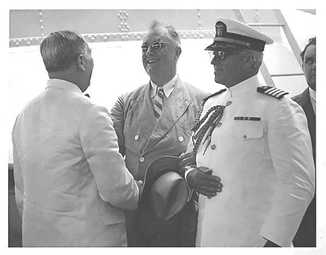
On 7 December, 1940, Churchill's letter was delivered to the State Department, and then it was delivered to FDR by seaplane, since FDR was on vacation in the Caribbean aboard the U.S.S. Tuscaloosa (pictured below: FDR on the bridge of the Tuscaloosa). The British strategy was to let FDR read the letter, and be able to ruminate on its implications away from the hullabaloo of Washington, D.C.
Lord Lothian also worked on U.S. public opinion; he flat-out told the American media that Britain was broke. This admission was designed to force FDR into action, which the White House resented, to say the least. But Lothian's strategy worked to stoke public opinion in favor of increasing direct military assistance to Britain (Internationalism); as a result, FDR started to slowly move forward.
During FDR's Caribbean vacation, Lothian worked on a speech that he planned to give in Baltimore, to which he had invited the media. However, Lord Lothian was exhausted and he was confined to bed; a trusted subordinate delivered the speech - the main idea was that Britain would defeat Nazi Germany if given enough aid. As the subordinate gave the speech, Lothian died at the British Embassy in Washington, D.C. from kidney failure. Lothian's ashes were interred at Arlington National Cemetery at the base of the mast of the U.S.S. Maine. Lothian's unexpected death was a serious blow to both the British and American governments.
Lord Lothian also worked on U.S. public opinion; he flat-out told the American media that Britain was broke. This admission was designed to force FDR into action, which the White House resented, to say the least. But Lothian's strategy worked to stoke public opinion in favor of increasing direct military assistance to Britain (Internationalism); as a result, FDR started to slowly move forward.
During FDR's Caribbean vacation, Lothian worked on a speech that he planned to give in Baltimore, to which he had invited the media. However, Lord Lothian was exhausted and he was confined to bed; a trusted subordinate delivered the speech - the main idea was that Britain would defeat Nazi Germany if given enough aid. As the subordinate gave the speech, Lothian died at the British Embassy in Washington, D.C. from kidney failure. Lothian's ashes were interred at Arlington National Cemetery at the base of the mast of the U.S.S. Maine. Lothian's unexpected death was a serious blow to both the British and American governments.
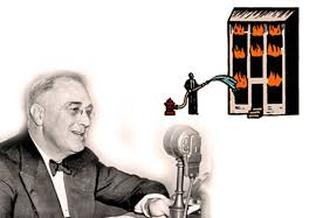
It was during his Caribbean cruise that FDR pulled all his ideas together for what would become the Lend-Lease Act. On 29 December, 1940, two weeks after Lord Lothian's death, FDR gave a Fireside Chat outlining his plans for Lend-Lease to the U.S. public (a few days earlier during a White House press conference, FDR likened the Lend-Lease proposal to loaning a neighbor a garden hose). FDR emphasized his desire to keep the U.S. military out of the War in Europe, despite the massive proposed increase in aid to Great Britain.
However, FDR's address couldn't hide the fact that the Nazi Wehrmacht (Army) was ten times that of Britain. If defeating Hitler was the goal, Isolationists asked, then how was that possible without direct U.S. military involvement? Isolationists saw FDR's radio address as another scheme to get the U.S. in the European war.
Secretary of War Henry Stimson, Chief of Staff General George C. Marshall, Secretary of the Navy Frank Knox, and Admiral Harold Stark all agreed that the U.S. would never become the "Arsenal of Democracy" if it didn't become a belligerent in Europe. But they were ordered by FDR to publicly support him, despite their deep misgivings and reservations. For Stimson and Knox, this was especially painful since they were the President's Men that had to deal with Congress on Lend-Lease.
However, FDR's address couldn't hide the fact that the Nazi Wehrmacht (Army) was ten times that of Britain. If defeating Hitler was the goal, Isolationists asked, then how was that possible without direct U.S. military involvement? Isolationists saw FDR's radio address as another scheme to get the U.S. in the European war.
Secretary of War Henry Stimson, Chief of Staff General George C. Marshall, Secretary of the Navy Frank Knox, and Admiral Harold Stark all agreed that the U.S. would never become the "Arsenal of Democracy" if it didn't become a belligerent in Europe. But they were ordered by FDR to publicly support him, despite their deep misgivings and reservations. For Stimson and Knox, this was especially painful since they were the President's Men that had to deal with Congress on Lend-Lease.
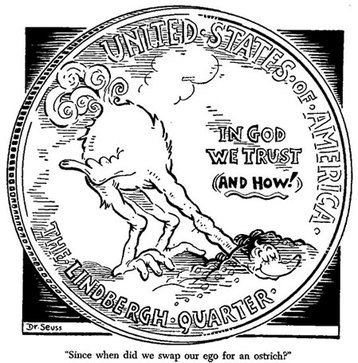
In mid-January, 1941, Congressional hearings began on Lend-Lease; the atmosphere was similar to that of a major sporting event. The two star witnesses were Charles Lindbergh (Isolationist) and Wendell Willkie (Internationalist; the Republican candidate in 1940). Lindbergh testified first; he was applauded often, with only a few outbursts of opposition (pictured: another Theodor Geisel political cartoon attacking Lindbergh). Willkie had come out in favor of Lend-Lease in opposition to the Republican Isolationists; the split between him and the party traditionalists was now permanent. And to add to the divide, Willkie announced that he would soon be FDR's envoy to Britain.
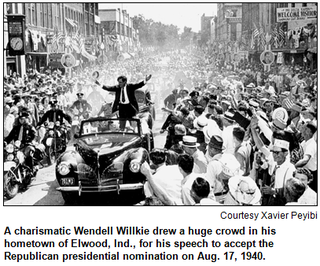
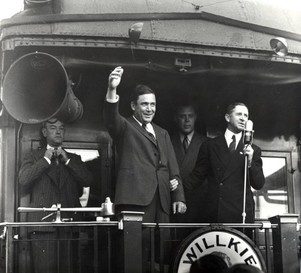
By January, 1941, Willkie had become FDR's most important foreign policy ally. FDR liked Willkie, but Willkie didn't succumb to FDR's charm; to Willkie, duty and patriotism far outpaced any kinship he had with FDR. When Willkie was in Britain in January, he took the nation by storm, becoming by far the most popular American in England. Willkie cut his trip to Britain short in order to testify in support of Lend-Lease on 11 February, 1941. The day he testified, the Senate Foreign Relations Committee voted 15-8 to forward the bill for debate on the Senate floor.
(Below: Wendell Willkie testifies in front of the Senate Foreign Relations Committee)
By January, 1941, Willkie had become FDR's most important foreign policy ally. FDR liked Willkie, but Willkie didn't succumb to FDR's charm; to Willkie, duty and patriotism far outpaced any kinship he had with FDR. When Willkie was in Britain in January, he took the nation by storm, becoming by far the most popular American in England. Willkie cut his trip to Britain short in order to testify in support of Lend-Lease on 11 February, 1941. The day he testified, the Senate Foreign Relations Committee voted 15-8 to forward the bill for debate on the Senate floor.
(Below: Wendell Willkie testifies in front of the Senate Foreign Relations Committee)
The battle in Congress over Lend-Lease was eerily similar to the Court-Packing fracas of 1937. The question again was whether to give FDR unprecedented Executive power; Lend-Lease would give FDR the authority to decide on the type and amount of aid, and which nations would receive that aid. It wasn't just a battle within Congress; for the next two months, Americans would debate and clash over Lend-Lease - it would far surpass the rancor experienced during the debate over the Selective Service Act in 1940.
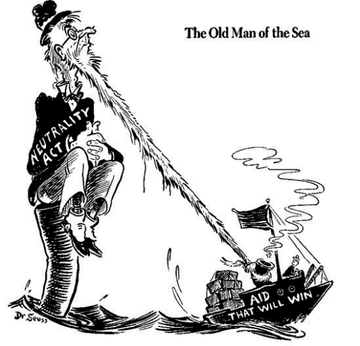
Isolationists knew it was their last chance to keep the U.S. from becoming fully involved in the War in Europe at least in terms of financial commitment. Leading the attack on Lend-Lease was the America First Committee - the debate caused membership and involvement in the organization to explode. Due to their efforts, Lend-Lease was debated virtually everywhere in America. While the debate was "Democracy in Action", it occurred with a high degree of acrimony. Despite overwhelming public support for Lend-Lease, the battle would come down to the relatively few votes in Congress. (Pictured: a political cartoon by Theodor Geisel (a.k.a. Sr. Seuss) on the Lend-Lease debate)
Isolationists knew it was their last chance to keep the U.S. from becoming fully involved in the War in Europe at least in terms of financial commitment. Leading the attack on Lend-Lease was the America First Committee - the debate caused membership and involvement in the organization to explode. Due to their efforts, Lend-Lease was debated virtually everywhere in America. While the debate was "Democracy in Action", it occurred with a high degree of acrimony. Despite overwhelming public support for Lend-Lease, the battle would come down to the relatively few votes in Congress. (Pictured: a political cartoon by Theodor Geisel (a.k.a. Sr. Seuss) on the Lend-Lease debate)
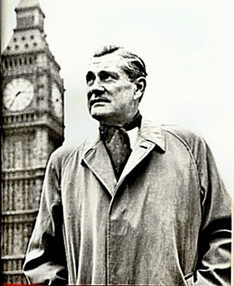
Two days prior, the House passed Lend-Lease 260-165, but with a two-year time limit. In the Senate, Republican Isolationists filibustered for hours on end, which appalled CBS news correspondent Eric Sevareid (pictured by "Big Ben" in London). He had been in Britain, and saw first-hand the devastation and desperation . . . he was physically revolted by the filibuster.
Finally, on 8 March, 1941, Lend-Lease passed in the Senate by a vote of 60-31, with many amendments in tow. Even though FDR signed Lend-Lease into law, it would never have been enacted without the efforts and influence of Lord Lothian and Wendell Willkie. With a stroke of his pen, FDR erased all pretense of U.S. neutrality in the War in Europe; America was now an official ally of Britain, albeit a non-combatant ally (in Churchill's words, it was the true beginning of the "Special Relationship").
Finally, on 8 March, 1941, Lend-Lease passed in the Senate by a vote of 60-31, with many amendments in tow. Even though FDR signed Lend-Lease into law, it would never have been enacted without the efforts and influence of Lord Lothian and Wendell Willkie. With a stroke of his pen, FDR erased all pretense of U.S. neutrality in the War in Europe; America was now an official ally of Britain, albeit a non-combatant ally (in Churchill's words, it was the true beginning of the "Special Relationship").
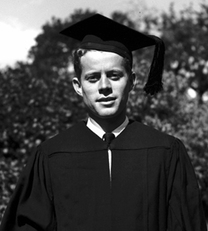
Some Isolationists abandoned the cause after Lend-Lease became law: obstruction was no longer logical or patriotic. Among them was a young John Fitzgerald Kennedy (soon to graduate from Harvard); to JFK, the U.S. must be Britain's savior - in a letter, he wrote "America must get going".
Passing Lend-Lease was one thing, but actually becoming the "Arsenal of Democracy" was another. Churchill knew that to be true, and constantly queried FDR about the logistics of restructuring America's industry for military production. Churchill would soon find out that yet another round of FDR-led inertia would follow passage of the Lend-Lease Act . . . the dark, desperate days for Great Britain would only come to an end when Japan attacked Pearl Harbor on 7 December, 1941.
Passing Lend-Lease was one thing, but actually becoming the "Arsenal of Democracy" was another. Churchill knew that to be true, and constantly queried FDR about the logistics of restructuring America's industry for military production. Churchill would soon find out that yet another round of FDR-led inertia would follow passage of the Lend-Lease Act . . . the dark, desperate days for Great Britain would only come to an end when Japan attacked Pearl Harbor on 7 December, 1941.