Mr. Jensen's U.S. History Website
  • U.S. History Blog
    • U.S. History Blog (May 2025 - May 2026)
    • U.S. History Blog (May 2024 - May 2025)
    • U.S. History Blog (May 2023 - May 2024)
    • U.S. History Blog (May 2022 - May 2023)
    • U.S. History Blog (May 2021 - May 2022)
    • U.S. History Blog (May 2020 - May 2021)
    • U.S. History Blog (May 2019 - May 2020)
    • U.S. History Blog (May 2018 - May 2019)
    • U.S. History Blog (May 2017 - May 2018)
    • U.S. History Blog (May 2016 - May 2017)
    • U.S. History Blog (May 2015 - May 2016)
    • U.S. History Blog (May, 2014 - May, 2015)
  • About

Governor Ronald Reagan and Campus Turmoil in California

2/21/2016

0 Comments

 
                Source: H.W. Brands. Reagan: The Life (2015)
Picture
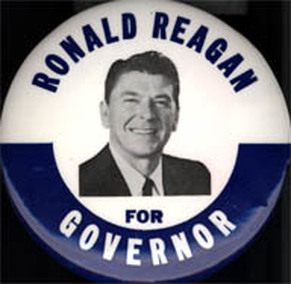
      Governor Reagan took special pleasure in attacking UC-Berkeley whenever possible (even when he was campaigning for Governor in 1966). Reagan vowed to "clean up" the campus at the University of California at Berkeley, citing a need to change the university's administration, which in his view was enabling a minority of beatniks and malcontents to disrupt the education of the majority of students.
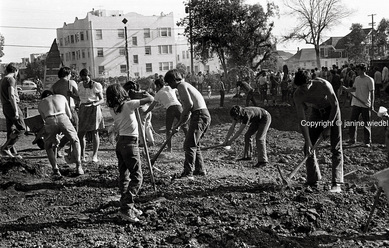
     In February 1969, the "3rd World Liberation Front" attempted to close down Berkeley's campus. Reagan responded by declaring the situation an "extreme emergency", and he sent state troopers to assist local law enforcement. In the spring of 1969, a property dispute erupted, where a recently purchased lot by the university sat idle, and hippies and radicals squatted in the area proclaiming the lot to be the "People's Park"
(pictured: squatters working to create the "People's Park" in the idle lot). Reagan had taken some criticism in California that he wasn't a decisive governor, and Reagan was itching to show his decisiveness to the entire nation.

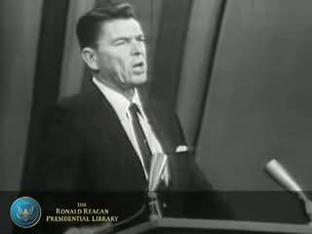
     Governor Reagan unilaterally ordered the area cleared, and then a fence erected to the out the protesters. The fence was quickly constructed, but a march to "take back" the People's Park started to move towards the area. Protesters threw rocks, concrete, and metal at the police, while police used tear gas and and in some situations, used shotguns with birdshot (or buckshot, which was worse). Dozens of protesters were wounded, and one was killed. Reagan called in the California National Guard, and they remained until the crisis ended. Reagan officially blamed the "street gangs" and campus radicals for the violence. (Below: a short video segment that summarizes Reagan's response in Berkeley in May 1969)
      Reagan's rhetoric exacerbated the crisis at Berkeley; helicopters were called in to spray more tear gas to disperse the protesters. The Berkeley faculty demanded an audience, and denounced Reagan’s “military occupation” on the campus. Reagan held firm as he addressed the Commonwealth Club in San Francisco, which was carried on live television. 
     Reagan cited many examples of lawbreaking in the past year at Berkeley, and he specifically identified the leaders of the riots as political agitators; Reagan also blamed those that followed the riot's leaders. Reagan also called out the faculty for creating the current polarized atmosphere on campus.
Picture
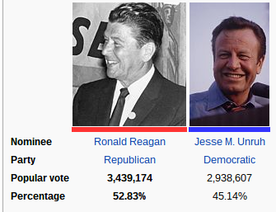
      In the gubernatorial  election in California in 1970, Reagan ran for re-election. Campus turmoil continued, this time at UC-Santa Barbara, where radicals were protesting against the Military-Corporate Complex. Reagan once again declared a state of emergency, and once again called in the National Guard.
     Reagan thought he knew the cause of the riots in Berkeley and Santa Barbara: a small group of revolutionaries that enjoyed creating a crisis. Reagan was quoted as saying, on 7 April 1970, "If it's to be a bloodbath, let it be now" . . . Reagan regretted saying those words, especially since they were publicly reported. But a majority of voters liked Reagan and his pragmatism, but they weren't as enthusiastic in 1970 as in 1966. In 1970, Reagan garnered 53% of the popular vote, while in 1966 it was 58%. Reagan's margin of victory was about half of what it was in 1966, but Reagan accepted the results, saying a "win is a win". 
Picture
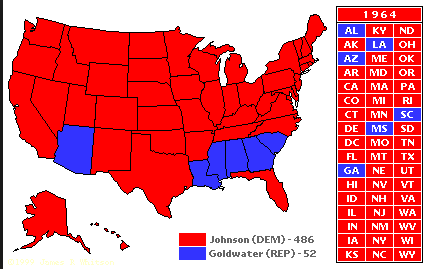
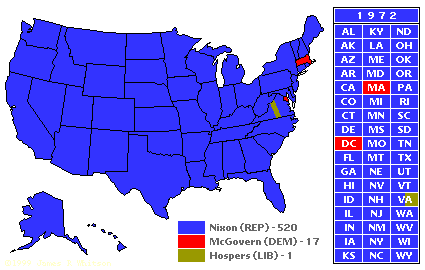
      University and college campuses erupted in protest nationwide when President Nixon ordered the invasion of Cambodia; Governor Reagan continued to take a hard line against campus protests, regardless of the motivations. In 1964, American voters soundly rejected Barry Goldwater's ultra-conservatism; in 1972, American voters resoundingly rejected George McGovern's ultra-liberalism. Richard Nixon was right in the middle between the two political extremes, and he often appealed to both sides. To Nixon, big government was not the enemy, but it wasn't a best friend, either . . . most Americans wanted a predictable and stable status quo by the early-1970s. In the Election of 1972, Nixon won 49 states; only Massachusetts (and Washington, D.C.) the most liberal state in the nation at that time, voted for McGovern.
0 Comments

Ronald Reagan: 1964 to July 1968

2/14/2016

0 Comments

 
                     Source: H.W. Brands. Reagan: The Life (2015)
Picture
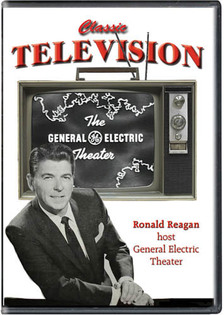
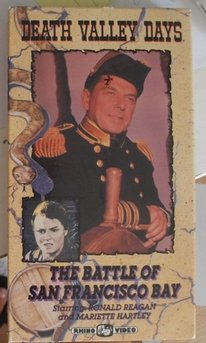
      In 1964 Ronald Reagan needed work, and he was hired as the host of "Death Valley Days", a television show that had its roots in radio. Reagan was able to travel much as he did when he was the host of "General Electric Theater", but this time in service of his own political brand: "Reagan the Conservative". 
     Opinion polls had Reagan far ahead of any other challenger for the Election of 1966 for Governor of California, and the national media had started to notice. Reagan's main problem at this point was that he needed to keep the conservative wing of the Republican Party happy without scaring the devil out of everyone else in California, which was what Barry Goldwater was unable to do in 1964. Even though Reagan had previously attacked Republican moderates, he toned down his rhetoric in early-1966 concerning that wing of the party.

Picture
     On 4 January 1966, Reagan felt it was time to formally announce his candidacy for Governor of California. Reagan did so with a 30m TV special that was broadcast to 16 stations around California. In the California Republican primary, Reagan won by a 2:1 margin; conservatives now had real hope for Reagan winning the gubernatorial election. 
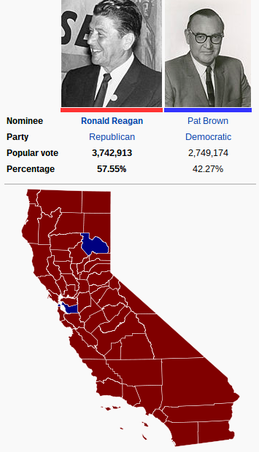
     Reagan had a winning personality to go with his conservative credentials. Governor Pat Brown, by comparison, looked stodgy and slow. In a June 1966 poll, Reagan held an eleven point lead over Brown, and the Governor was never able to close the gap. On 8 November 1966, Reagan crushed Brown by tallying one million more votes; Republicans swept the statewide offices as well. Nationally, seven other Republicans were elected governor, and Republicans won three Senate seats, and forty-seven seats in the House of Representatives.

Picture
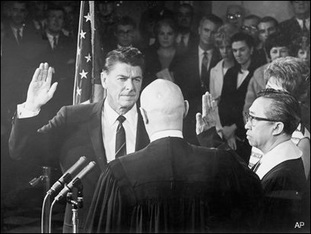
      Reagan started his term as Governor on 2 January 1967, with his public Inauguration occurring a few days later (pictured). The details of governing would rarely interest Reagan; he was a man of ideas and principles . . . the details he left to others. The typical person that worked for Reagan did whatever he/she could to make life easier for Reagan, even though he never asked them to do so. Such was Reagan's personality - niceness, integrity, vision, etc.; people worked hard for him. Reagan's vision and philosophy was his strength, while an over-reliance on many others to carry out the necessary details of government was a weakness . . . both his strengths and weaknesses became apparent as he tried to balance California's budget.

Picture
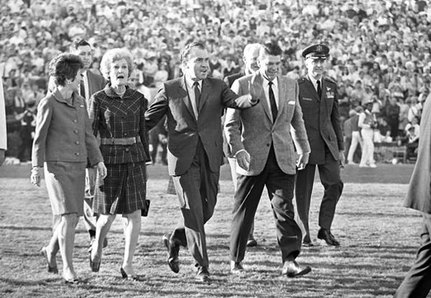
     Although California law prohibited the state from running a deficit, accounting gimmicks from Governor Brown's administration meant that Reagan inherited a budget that was wildly out-of-balance. Reagan proposed a 10% overall slash in the budget; that proposal antagonized anyone that looked to state programs for assistance . . . Reagan's budget proposal created far more losers than winners. (pictured: Governor Reagan and President-Elect Richard Nixon at the 1969 Rose Bowl)
     The Governor of California was expected to socialize, but Reagan was more of a loner by nature. Reagan went home every night, while state legislators, who were away from home in Sacramento, would "howl and the night". Reagan made some efforts at socializing, for example inviting legislators over for dinner, but his efforts didn't close the "social gap" between the branches of state government.
     California Democrats in the legislature attacked Reagan's budget proposal; it turned out that the Democrats paid far more attention to details than the new Governor. Democrats pointed out that Reagan's proposed 10% cuts across-the-board wouldn't eliminate the state budget deficit, and therefore a tax increase was needed. Reagan was forced to compromise with the legislature; a $1 billion tax increase was featured, which went against Reagan's fiscal philosophy (two of his basic principles were smaller government and less taxes), but he had to take what he could get with the state legislature so soon after taking office.

Picture
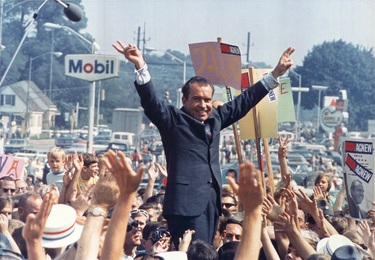
     As the Republican National Convention (RNC) in Miami approached in the summer of 1968, Richard Nixon (pictured, in "Campaign Mode"), a moderate Republican, had positioned himself nicely for the nomination. Reagan looked around for the party's #1 conservative, and discovered that he was that man. Reagan allowed the California delegation to the RNC to nominate him as a "Favorite Son" candidate. With 86 delegates from California, Reagan hoped to develop momentum before the RNC.
     Reagan, like Nixon, went on a multi-state speaking tour before the convention. Reagan campaigned like a candidate for President, even though he was technically non-committal. When Robert Kennedy was assassinated in June 1968, Nixon, the moderate, politically benefited far more than Reagan. Moderate Republicans evoked less emotional passions in the extremely polarized social and political landscape of 1968 compared to the conservative Reagan, who to many was still a very scary proposition, even among Republicans.

Picture
      Nixon had enough delegates from the primaries to win the nomination as the Presidential candidate for the Republican Party on the first ballot. As the Republican National Convention convened in August 1968 in Miami, Nelson Rockefeller and Ronald Reagan both tried to sap Nixon's strength; Reagan's people tried to get a speaking appearance for Reagan in front of the entire convention before any balloting took place. 
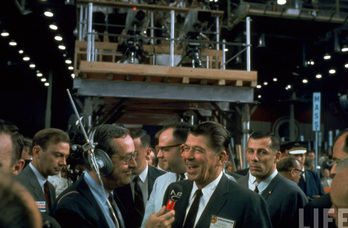
    But Nixon was a savvy politician, and he was able to keep Reagan off the stage before the balloting while courting Southern delegates by promising that he wouldn't nominate a liberal Republican for the Vice-Presidential slot (Nixon selected Spiro Agnew as his running mate). As predicted, Nixon won the nomination on the first ballot with 692 delegates, while Reagan finished third with 182 (Nelson Rockefeller finished second with 277); only then did Nixon allow Reagan on the stage to address the convention, for the sole purpose of recommending that Nixon's nomination be unanimous (the final ballot, after "switching", was Nixon with 1238 delegates, Rockefeller with 93, and Reagan with 2; pictured above - NBC anchorman John Chancellor interviewing Reagan on the floor of the convention).

0 Comments

Ronald Reagan: 1961 - 1965

2/3/2016

1 Comment

 
                     Source: H.W. Brands. Reagan: The Life (2015)
Picture
      Some enter politics seeking power, but Ronald Reagan entered politics wanting attention. Unlike Lyndon Johnson and Richard Nixon, who were about power and making their marks on history, Reagan merely wanted a large audience, notice, and applause . . . he craved the political stage.
     In the early-1960s, the ratings for General Electric Theater were slipping; the format was outdated compared to most other programs. In 1961, the Justice Department launched a probe into price-fixing, and GE was the prime target; JFK's election as President had shifted the political landscape towards Liberalism and Big Government. Reagan was bucking the political tide with his conservative speeches, and GE didn't want their profile to be any greater than what it already was with the government. GE offered to let Reagan do GE commercials if he would stop talking conservative politics when he was representing the company. In 1962, Reagan formally refused GE's offer, and GE canceled their TV show, completely severing ties with Reagan.

Picture
      Reagan was unemployed during the most dire moment of the Cold War: the Cuban Missile Crisis in October 1962. The Cold War was in Europe, Asia, Southeast Asia, Africa, and Latin America, especially with Fidel Castro in Cuba. Soviet missiles in Cuba gave U.S. leaders a sobering taste of the elixir that the USSR was drinking in terms of the proximity of enemy nuclear missiles. 
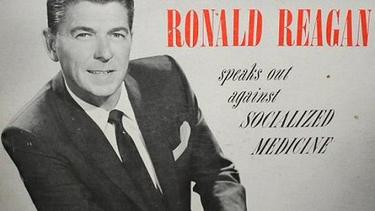
     In the midst of the Cuban Missile Crisis, the growing US involvement in Vietnam, and JFK's Assassination, Reagan had the opportunity to publicize his conversion to Republican Conservatism (he had long been a "New Deal Democrat"). Republicans were split, some believing that the moderate President Eisenhower was too accommodating, not only to liberals, but also to the USSR. These conservatives pointed to the expanded role of the federal government, the main reason being Social Security. These conservative Republicans were concerned that the Grand Old Party was actually losing its political soul. (Pictured: an ad promoting a conservative speech by Reagan while he was still employed with General Electric)

Picture
      Senator Barry Goldwater (AZ) was the best of the conservative Republicans to promote for high office. While he rode Eisenhower's coattails to the Senate, Goldwater called Ike's policies "A Dime Store New Deal". Easily re-elected to the Senate in 1958, Goldwater appealed to millions of American conservatives; he lamented the growth of Big Government, but supported a large military in order to meet the threat of international communism, especially from the USSR.
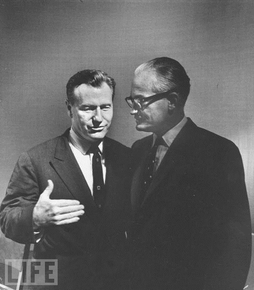
     Goldwater favored equality, but he opposed Civil Rights on the political belief that the states should have the authority with legislation on that issue, not the federal government. Goldwater was contested in the Republican primaries by Nelson Rockefeller (pictured: Goldwater is to the right), the Governor of New York. Goldwater edged Rockefeller in the California primary, which gave Goldwater a decided advantage in the Republican National Convention in the Cow Palace in San Francisco.

Picture
      The Republican National Convention of 1964 was perhaps the ugliest in the 108 year history of the party. Western conservatives howled and heckled the moderate Rockefeller, and then used his divorce and remarriage as an issue to sidetrack his nomination; conservatives were not about to let a divorced man be their party's nominee for President.
     Moderates tried every trick they knew to keep Goldwater from becoming their party's candidate, even during the "11th Hour", but Goldwater and his supporters had a lock on the nomination. Goldwater became the nominee with 883 delegates, William Scranton (Governor of PA) finished second with 214, and Rockefeller finished a very distant third with 114 delegates.
     During his acceptance speech, Goldwater stated "extremism in the defense of liberty . . . is no vice . . . and moderation in the pursuit of justice is no virtue"; conservative Republicans were elated. But conservatives soon discovered that they had nominated an unelectable candidate for the Election of 1964: President Lyndon Johnson received the highest percentage of the popular vote in history, .611, to Goldwater's .385.

Picture
      Goldwater's main motivation for asking Reagan to give the "Time For Choosing" TV/radio address (27 October 1964) so close to the election was to try and woo as many Southern Democrats to vote for Goldwater as possible. The speech was a huge success for Reagan; no speech in US History did more to launch a political career. True, William Jennings Bryan's "Cross of Gold" Speech in 1896, and Abraham Lincoln's "Cooper Union Address" in 1860 were significant, but both were already in politics . . . Reagan had never held any elected office . . . he had never even run for an elected office.
     Reagan had only been a Republican for two years, and with one speech, he was viewed as the #1 conservative Republican after Goldwater's disastrous showing in the Election of 1964. Almost immediately, Reagan was being mentioned as a Republican candidate for the Governor of California. Democratic Governor Pat Brown's second term expired in 1966, and many California Republicans viewed Reagan as their chance to win the state's highest political office.

Picture
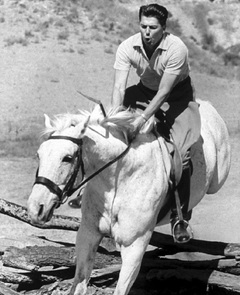
      Reagan (pictured riding a horse at his ranch in 1965) and the Republicans in California faced obstacles, especially because the state had overwhelmingly voted for LBJ in 1964. Also, Reagan didn't have political experience, and he had been a Democrat for most of his 53 years . . . and many still viewed him as too conservative. Added to the hurdles in place was that Reagan hated flying, and preferred to travel by train, which drastically reduced the number of campaign appearances he could make.
     But Reagan was a Southern Californian, and that's where most of the votes were located, and his apparent Republican opponent for the nomination was a Northern Californian. Reagan had the advantage of coming through great on television, and when Reagan spoke, it was on broad principles instead of political details. Reagan did attack moderate Republicans, stating that the moderates were the main reason for Goldwater's defeat. Despite his popularity in California, Reagan remained noncommittal about running for governor.

Picture
      For conservatives in the 1960s, the decade was the worst of times; tradition and stability were challenged as had rarely occurred before. But at the peak of Liberalism, when LBJ signed the Civil Rights Act of 1964 into law, he commented to journalist Bill Moyers that he thought that he just delivered the South to the Republicans for a very long time. 
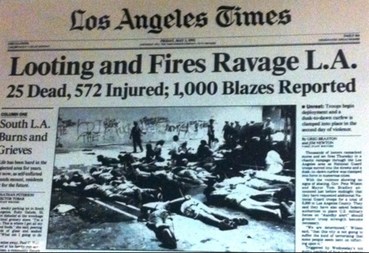
     But, ironically, the 1960s were the best of times for conservatives as well, in that there was a sense of lawlessness and disorder that galvanized conservatives into action across the nation. Race riots occurred in Harlem, Philadelphia, Rochester (NY), and Jersey City in 1964, and then the Watts Riot (headline pictured to the left) started just days after LBJ signed the Voting Rights Act of 1965 into law. (the only African-Americans that were safe during the riot were those that shouted "Burn Baby Burn"). Until 1965, the main complaint of conservatives was that the federal government was too large, but with the race riots, conservatives actually started to think that the federal government might be too small to secure law and order.

Picture
      Conservatives blamed "Bleeding-Heart Liberals" for the lack of law and order in America. Conservatives didn't see poverty and inequality as the main causes of lawlessness and disorder; to conservatives, Liberalism corroded the US character, and the race riots were confirming evidence. 
     And then, there were the Baby Boomers; they represented the first huge wave of students that hit colleges / universities in the 1960s. These Baby Boomer students demanded autonomy and protested such issues as freedom of speech. The University of California at Berkeley was the first flashpoint; a combination of anti-Establishment and anti-Vietnam activists protested the restrictions of freedom of speech on campus. Conservatives were especially irked by the anti-Vietnam War protesters, whose war model was World War II; many conservatives branded resistance to the draft as sedition, or even treason.
     Conservatives, such as Reagan, wondered who was more responsible for what was wrong with America: the over-sized liberal government under LBJ, or the "Long Hair" protesters on college campuses. The question that was most-often asked by conservatives was this: why didn't the federal government do something about the disorder in America? Due to this frustration and anxiety, the stage was set for a conservative backlash to Liberalism, and with the right candidate, Conservatism could rise again . . . the stage was set for Ronald Reagan's entry into politics in the California Gubernatorial Election of 1966.

1 Comment

    Archives

    May 2016
    April 2016
    March 2016
    February 2016
    January 2016
    December 2015
    November 2015
    October 2015
    September 2015
    August 2015
    July 2015
    June 2015
    May 2015

    Categories

    All
    18th Century
    19th Century
    20th Century
    Biography
    History

Powered by Create your own unique website with customizable templates.