Source: Manning Marable. Malcolm X: A Life of Reinvention (2011)
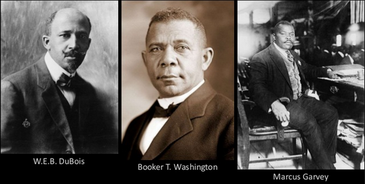
The most famous African-American Civil Rights leaders of the late-1800s / early-1900s were Booker T. Washington and W.E.B DuBois, but there was a third major leader during that era; by 1916, Marcus Garvey had become an influential civil rights and political figure.
Garvey, from Jamaica, was actually recruited to come to the U.S. by Booker T. Washington; they shared the same general philosophy in terms of "Separate But Equal". Their main difference was that BTW was willing to work with whites (he needed funding for the Tuskegee Institute), while Garvey advocated total separation of the races. Garvey was the main founder of the UNIA (United Negro Improvement Association); in the U.S., membership in the UNIA reached into the hundreds of thousands.
Garvey, from Jamaica, was actually recruited to come to the U.S. by Booker T. Washington; they shared the same general philosophy in terms of "Separate But Equal". Their main difference was that BTW was willing to work with whites (he needed funding for the Tuskegee Institute), while Garvey advocated total separation of the races. Garvey was the main founder of the UNIA (United Negro Improvement Association); in the U.S., membership in the UNIA reached into the hundreds of thousands.
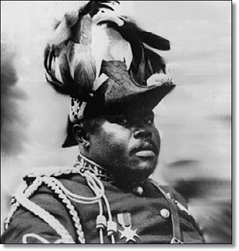
Garvey's philosophy was basically what came to be known in the 1960s as "Black Pride"
and "Black Power", but he wanted those goals to be achieved within African-American communities. To illustrate how serious he was in pursuit of his philosophy, he started the "Black Star Line", a passenger ship service for African-Americans. Garvey claimed that the UNIA was a religious organization, mostly to be able to attract as many members as possible; with that declaration, Garvey operated in the political, religious, and economic spheres of African-American life.
Marcus Garvey's main mistake, one that would be made decades later by Malcolm X and the Nation of Islam, was that he met with Ku Klux Klan leaders. The UNIA and the KKK actually had some common interests, since they both advocated total racial segregation. By the early-1920s, Garvey had reached the conclusion (as had many others) that the KKK was the de facto secret government of the U.S., and confrontation was useless. When news of that meeting leaked, many UNIA followers left the organization, but those that remained were beyond-steadfast in their loyalty to Garvey (among them were Earl and Louise Little, the parents of Malcolm X).
and "Black Power", but he wanted those goals to be achieved within African-American communities. To illustrate how serious he was in pursuit of his philosophy, he started the "Black Star Line", a passenger ship service for African-Americans. Garvey claimed that the UNIA was a religious organization, mostly to be able to attract as many members as possible; with that declaration, Garvey operated in the political, religious, and economic spheres of African-American life.
Marcus Garvey's main mistake, one that would be made decades later by Malcolm X and the Nation of Islam, was that he met with Ku Klux Klan leaders. The UNIA and the KKK actually had some common interests, since they both advocated total racial segregation. By the early-1920s, Garvey had reached the conclusion (as had many others) that the KKK was the de facto secret government of the U.S., and confrontation was useless. When news of that meeting leaked, many UNIA followers left the organization, but those that remained were beyond-steadfast in their loyalty to Garvey (among them were Earl and Louise Little, the parents of Malcolm X).
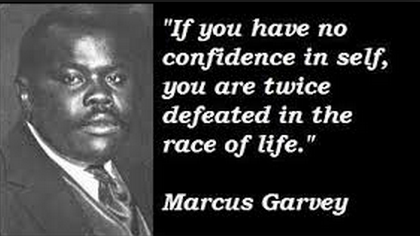
By the early-1920s, Marcus Garvey was on the radar of the federal government, and viewed as a threat; Garvey was arrested for mail fraud (a very serious charge back then) concerning his "Black Star Line". After two years of exhausting appeals, he entered a federal prison in Atlanta. Despite his arrest, the UNIA was still strong in the South and the Midwest / Great Plains, but by 1927 had largely disintegrated in Urban America. President Calvin Coolidge commuted Garvey's sentence in 1927, and ordered him deported to Jamaica.
"Garveyism" flourished in the Caribbean, and in the rural South and enclaves of African-American populations outside urban areas after his deportation. One of the main reasons why the UNIA lost followers in urban areas was due to the rise of the NAACP - the National Association for the Advancement of Colored People, with its largely middle-class membership, viewed the UNIA as an inferior organization, increasing the level of divisiveness within the African-American Civil Rights Movement of the early Twentieth Century.
"Garveyism" flourished in the Caribbean, and in the rural South and enclaves of African-American populations outside urban areas after his deportation. One of the main reasons why the UNIA lost followers in urban areas was due to the rise of the NAACP - the National Association for the Advancement of Colored People, with its largely middle-class membership, viewed the UNIA as an inferior organization, increasing the level of divisiveness within the African-American Civil Rights Movement of the early Twentieth Century.
The UNIA in some ways was the precursor to the Nation of Islam, in that the basic tenet of the NOI was total separation of the races. Garvey also provided a model for Malcolm X to follow; Malcolm X, like Garvey before him, wanted to positively impact the lives of African-Americans in terms of religion, politics, and economics.
The 2nd KKK started to become manifest by the early-1900s, and after WW I, this "New-and-Improved" hate group had millions of members. This Klan, totally unrelated to the original KKK which died out in the 1870s, had millions of members (the main reason why this hate group chose to call themselves the KKK was for name brand recognition).
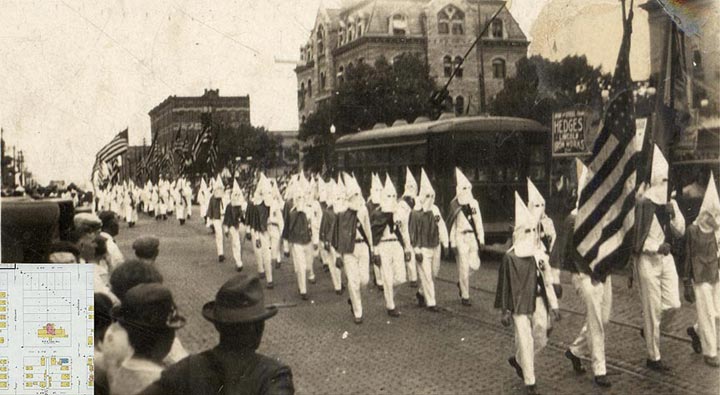
The 2nd KKK was xenophobic n that they hated not only African-Americans, but also Jews, Catholics, and recent Immigrants. Nebraska's first branch of the KKK, Klavern #1, was established in 1921; 24 more KKK groups were started in Nebraska by the end of the year. (pictured: a KKK rally in McCook, 1924). By 1923, membership in the Ku Klux Klan in Nebraska was over 45,000. In January of 1923, an anti-KKK coalition petitioned the Legislature to outlaw KKK members from holding any public office, but their effort didn't come close to appearing on a ballot. In 1924, the KKK held a state convention in Lincoln; over 1,100 Klansman paraded down "O" Street in plain sight, showing their faces for all to see.
The 2nd KKK started to become manifest by the early-1900s, and after WW I, this "New-and-Improved" hate group had millions of members. This Klan, totally unrelated to the original KKK which died out in the 1870s, had millions of members (the main reason why this hate group chose to call themselves the KKK was for name brand recognition).
The 2nd KKK was xenophobic n that they hated not only African-Americans, but also Jews, Catholics, and recent Immigrants. Nebraska's first branch of the KKK, Klavern #1, was established in 1921; 24 more KKK groups were started in Nebraska by the end of the year. (pictured: a KKK rally in McCook, 1924). By 1923, membership in the Ku Klux Klan in Nebraska was over 45,000. In January of 1923, an anti-KKK coalition petitioned the Legislature to outlaw KKK members from holding any public office, but their effort didn't come close to appearing on a ballot. In 1924, the KKK held a state convention in Lincoln; over 1,100 Klansman paraded down "O" Street in plain sight, showing their faces for all to see.
The parents of Malcolm X, Earl and Louise Little, lived in Omaha in 1923. With Earl out of town, the KKK surrounded their house; only a pregnant Louise with small children were home. After the requisite intimidation and threats concerning their efforts with the UNIA, the KKK broke all of the windows in the Little's house before they departed.
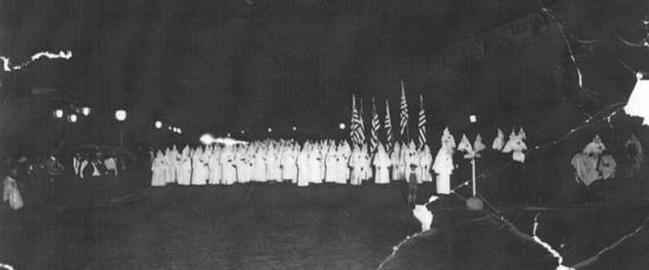
(Pictured below: the KKK marches on "O" Street in Lincoln on 4 July, 1924)
The year 1925 marked the apex of the KKK in Nebraska, in that the Klan had the greatest number of members in a variety of social classes, a women's branch of the KKK was established, thousands of boys were part of the "Junior Klan", while more-and-more girls were in "Tri-K Clubs". The KKK decided to hold its annual convention at the same time as the Nebraska State Fair, and even held events that were included in the State Fair, such as parades - a public KKK picnic held right by the State Fair attracted 25,000 people. Also, in the year 1925, Louise Little gave birth to another son, which she and Earl named Malcolm . . .
(Pictured below: the KKK marches on "O" Street in Lincoln on 4 July, 1924)
The year 1925 marked the apex of the KKK in Nebraska, in that the Klan had the greatest number of members in a variety of social classes, a women's branch of the KKK was established, thousands of boys were part of the "Junior Klan", while more-and-more girls were in "Tri-K Clubs". The KKK decided to hold its annual convention at the same time as the Nebraska State Fair, and even held events that were included in the State Fair, such as parades - a public KKK picnic held right by the State Fair attracted 25,000 people. Also, in the year 1925, Louise Little gave birth to another son, which she and Earl named Malcolm . . .
