Mr. Jensen's U.S. History Website
  • U.S. History Blog
    • U.S. History Blog (May 2026 - May 2027)
    • U.S. History Blog (May 2025 - May 2026)
    • U.S. History Blog (May 2024 - May 2025)
    • U.S. History Blog (May 2023 - May 2024)
    • U.S. History Blog (May 2022 - May 2023)
    • U.S. History Blog (May 2021 - May 2022)
    • U.S. History Blog (May 2020 - May 2021)
    • U.S. History Blog (May 2019 - May 2020)
    • U.S. History Blog (May 2018 - May 2019)
    • U.S. History Blog (May 2017 - May 2018)
    • U.S. History Blog (May 2016 - May 2017)
    • U.S. History Blog (May 2015 - May 2016)
    • U.S. History Blog (May, 2014 - May, 2015)
  • About

Clay & Calhoun: Slavery and the Election of 1844

8/8/2019

0 Comments

 
                         Source: H.W. Brands. Heirs of the Founders (2017)
Picture
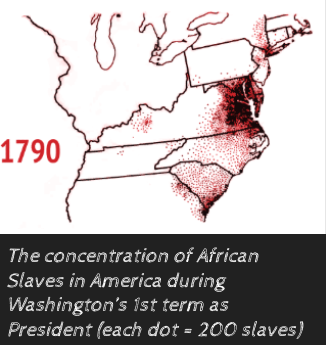
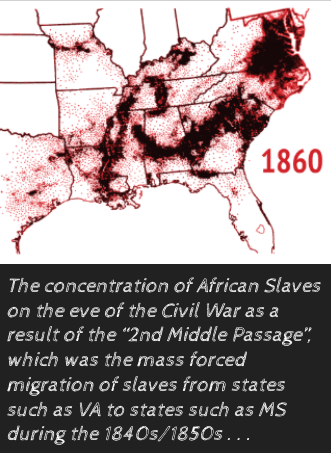
    The African slave population in the US according to the 1840 census was 2.5 million out of a total population of 17 million. In terms of the number of slaves, Virginia had the most, followed by South Carolina, and then basically a tie for third with North Carolina, Alabama, and Georgia. However, Virginia’s slave population in 1840 was smaller compared to 1830. In comparison, the slave populations in the Gulf Coast states were rapidly increasing due to the rising global demand for cotton. In VA, tobacco had worn out the soil, but that wasn’t the case with the states on the Gulf Coast. Jackson’s military campaigns against the Natives before, during, and after the War of 1812 opened up vast tracts of land for the Planter class in the Gulf Coast.
    The Second Middle Passage soon occurred, meaning that a mass forced migration of African slaves from states such VA to the Gulf Coast occurred. Planters in VA remained viable in large part because they had what planters in the Gulf Coast badly needed . . . slaves. Demand for slaves in the Gulf Coast soon became insatiable, and the value of slaves on large plantations exceeded the value of everything else on the plantation. Slaves were used as collateral for loans, which meant that any thought of freeing slaves were off the table until the debt had been paid. So, by the early-1840s, Southern states were beyond all-in in terms of keeping slavery, and also all-in with their opposition to even the hint of emancipation.
Picture
     Planters in the East ironically supported and sought protections in the form of abolishing the slave trade, which meant that the price of slaves remained high, to their benefit. So while the planters in the Gulf Coast had the land, the planters in the East still had tremendous political clout. Due to the economics of the increased demand for cotton, and therefore slaves, the Southern desire for expanding slavery west was great.
    In time, the Gulf Coast would have more than enough slaves, and the value of slaves would regress to market value. However, before that point was reached, there was the issue of the Republic of Texas and other territories being added as slave states. The rising value of slaves led to Free Blacks being kidnapped if they were in a precarious situation, and it reached the point where Free Blacks just minding their own business in the North were taken against their will.
Picture
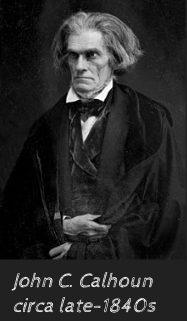
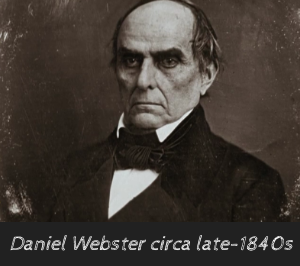
     Calhoun still had political ambitions, though he could not really define them. Becoming President was no longer a possibility, and his estrangement from the two major political parties left him on the outside-looking-in. However, the death of WHH and the ascension of Tyler opened things up a bit for Calhoun, in that Tyler was only a Whig in name only. The proud Calhoun was not going to take anything less in the government than SecState, and Tyler was not going to get rid of SecState Webster, who had stood by the President.
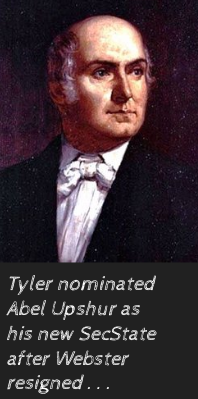
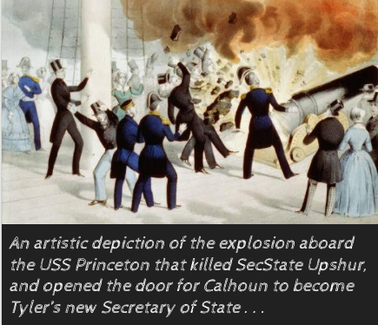
    But Webster decided to step down after the Senate ratified the Webster-Ashburton Treaty, and event then Calhoun was passed over for SecState; Tyler nominated a fellow Virginian, Abel Upshur. Tyler figured he didn’t need to add to his already bulging list of political enemies by bringing Calhoun into his Cabinet. Upshur, like Tyler, was in favor of the annexation of Texas, and Upshur was quietly weaving his magic in the Senate, winning over even Thomas Hart Benton . . .and then tragedy struck. Over 400 DC dignitaries were on board the USS Princeton on an inspection cruise on the Potomac River. The ship had the largest gun on board any ship at that time, and it was nicknamed the “Peacemaker”.  Two mighty blasts from the gun were ordered, and were heard from ten miles away. President Tyler and the other dignitaries, once they got their hearing back, had lunch on the deck.
Picture
     Later, as the Princeton was near Mount Vernon, the captain ordered the gun fired to honor Washington. The 400 dignitaries were scattered all over the ship, on and below deck when the captain pulled the lanyard to fire the gun. There was too much powder in the gun, whether by order or miscalculation, and when it fired searing flame and shrapnel blew to the side, and among the few instantly killed was SecState Upshur.  Tyler had been below deck and was coming up the ladder when the explosion occurred, escaping death by a few seconds.
    The tragedy on board the Princeton was significant, in that Tyler needed to find a new SecState, and the odds were low that he would find someone as skilled as Upshur in terms of working to annex Texas quietly . . . and Tyler needed to find a new SecState quickly. Tyler’s only real ally in Congress wrote Calhoun that SecState was his, and that he just needed to head to DC to make it official. However, Tyler did not know about the letter, and was aghast when he found out what had happened. As Tyler feared, Upshur’s careful work in massaging the annexation of Texas through Congress was undone the moment Calhoun became SecState, in that now opponents of Calhoun in Congress saw conspiracy concerning Texas.
Picture
      Calhoun not only wanted Texas admitted as a slave state, but also international recognition of the moral righteousness and permanent legitimacy of slavery . . . and maybe another chance at the Presidency. Where Upshur worked quietly and behind the scenes, Calhoun banged the drums of Texas annexation as loudly has he could in order to place the focus on the expansion of slavery, whereas Upshur focused on closing a “real estate deal”.  In short order, the annexation treaty in the Senate was doomed, in that there was nowhere near the 2/3’s necessary to annex Texas, which Calhoun knew would happen. Calhoun also knew that one could become President with much less that 2/3’s of a popular vote.
    Clay still had his eyes on the White House, and he made the most of his break with Tyler in the Whigs. Clay resigned his seat in the Senate in the Spring of 1842 to rest, but also to ponder a final run for President. Clay gambled that if he was out of the spotlight for an appropriate amount of time, he might gain support and votes. Soon enough, Clay was the only Whig mentioned as a legitimate Presidential candidate.

Picture
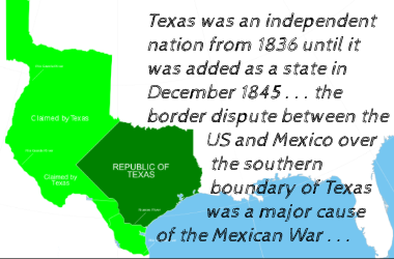
    In early-1844, Clay toured the South, and talked about everything except Texas. Clay discovered that the South was less opposed to protection (a protective tariff) as it was a decade earlier. Clay’s theme was compromise over confrontation, and Clay might have been successful in putting Texas on the backburner if it wasn’t for SecState Calhoun. Public support for the annexation of Texas, an independent nation since 1836, increased when former President Andrew Jackson weighed in. Jackson didn’t want Britain to gain any foothold in or with Texas, and Jackson demanded that the Democrats make Texas their top priority.
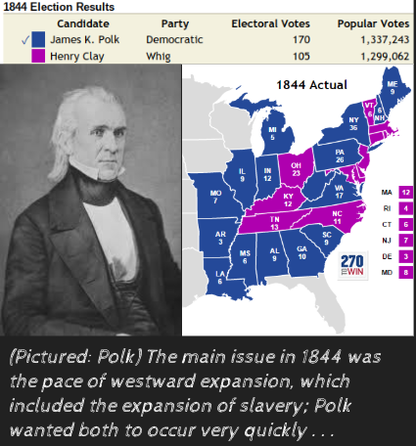
    Former President Martin Van Buren, who was pursuing the Democratic nomination, didn’t want to alienate Northerners, and Jackson abruptly rescinded his support of his first protege and swung it to his second protege, fellow Tennessean James Knox Polk. At the Democratic National Convention, the Dark Horse candidate Polk (who had only planned on pursuing VP) prevailed, and he made it clear that he was all-in on annexing Texas as well as further expansion West. Clay had expected to run against MVB, but now Clay had to restructure his stance on Texas. softening his previous statements against annexation. As before, Clay now found himself exposed and politically vulnerable by moving towards the middle. Clay’s moderate position on slavery cost him Michigan and New York, barely losing both states, and giving the very close election to Polk.
0 Comments

Clay, Calhoun, and Webster: The Compromise of 1850, Part One

8/8/2019

0 Comments

 
                           Source: H.W. Brands. Heirs of the Founders (2017)
Picture
     The Whigs did not ostracize Daniel Webster for staying on board as President John Tyler’s Secretary of State for awhile, but many in the party thought that he made a serious mistake by not resigning in a time frame of their liking. There was nothing devious about Webster’s actions, but Clay and his Whig followers pounced nonetheless, openly questioning Webster’s loyalty to the party. Webster pondered retirement from politics, but financially he could not do so, and he still felt he had a mission to fulfill. Once again elected to the Senate from Massachusetts, Webster made sure that he stood for the Union and the Constitution when so many in the nation didn’t seem to be doing so.
    Webster continued to oppose the annexation of Texas, and agreed with many others in government that if Texas was added as a state, war with Mexico would be the result. Webster kept questioning the idea that the Three-Fifths Compromise in the Constitution should apply to any additional slave state, and he openly opposed the idea of even adding slave states. Webster was actually behind the times in that the North had long before acquiesced in terms of agreeing to additional slave states with the Missouri Compromise (1820). The election of James Knox Polk in 1844 guaranteed the annexation of Texas, which was a development that hadn’t yet truly registered with Webster. Polk’s election also put the final nail in the coffin of Calhoun’s Presidential hopes, but Calhoun angled to claim that Texas had been annexed on his watch as SecState, in that the lame duck Tyler could be the President that annexed Texas.

Picture
    There was nowhere near a 2/3’s majority in the Senate to annex Texas, so Tyler and Calhoun chose the route of a joint resolution in both houses which only required simple majorities. The disadvantage of that strategy was that nobody knew for certain if annexing Texas via a joint resolution was constitutional. The US had never before annexed an independent nation, and Texas would be a slave state. The Constitution itself was silent on the matter of adding territory, but that didn’t stop President Thomas Jefferson, who, based on the advice of John Quincy Adams, used the treaty process in the Senate to officially add the Louisiana Territory.
    The joint resolution on annexing Texas passed on 2 March 1845, a couple of days before Tyler’s term as President ended. In the succeeding months, Texas had to ratify annexation, and then write a constitution that would pass muster in Congress. Webster, knowing that Texas statehood was a fait accompli, spoke out in opposition nonetheless; Texas was added as the 28th state in December 1845, which moved the US and Mexico closer to war. 
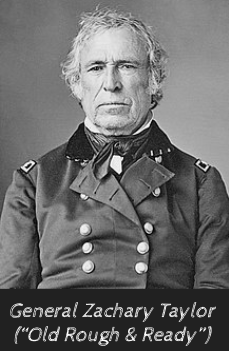
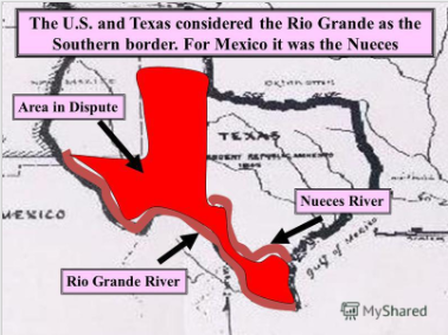
    President Polk’s war with Mexico was a land-grab packages as self-defense due to a border dispute between the Nueces and Rio Grande Rivers. Polk wanted to add California as well, but was rebuffed when no Mexican official of consequence would even meet with his envoy, John Slidell. Polk sent troops under the command of General Zachary Taylor to the Rio Grande to provoke an attack by Mexico, but Mexico wouldn’t take the bait for many weeks.

Picture
     President Polk had a flimsy war message ready to sent Congress when Mexico crossed the Rio Grande, which allowed Polk to claim that Amerian blood had been shed on America soil by the Mexican army. Polk wanted unilateral control and authority to wage war (which Congress gave LBJ with the Tonkin Resolution), but among others, Calhoun refused to be stampeded to war. Calhoun and others were only able to slightly slow the march towards war in the Senate.
    The only real opposition to the war in Congress came from the Whigs, but Polk understood that in creating a situation in which he could claim US blood was shed on US soil, there was no way that the war could be stopped. Webster did his best to dodge the entire issue, since his constituents and conscience opposed the war, but he knew the price the Federalists paid for opposing the War of 1812, so when the vote was taken in the Senate, Webster was not in the chamber. But Webster reserved the right to complain as sis others such as Congressman David Wilmot (PA), whose Wilmot Proviso twice passed the House and twice failed in the Senate, but it became the lighting rod for the expansion of slavery west.
    Webster knew that unlike Clay and Calhoun, he still had a chance at the Presidency, and since Polk had in essence declared that he would only serve one term, the Election of 1848 seemed to be wide open. Almost by default, Webster had become the leading Whig in terms of Presidential timbre, which meant that Webster couldn’t risk alienating the various Whig factions, so he tried to walk the political fence on slavery. ​

Picture
     General Zachary Taylor’s successes in the Mexican War, in particular Buena Vista, catapulted him into the conversation for Whig nomination in 1848. Although Polk didn’t plan to run again, he disliked the idea that Taylor could use his military success in the war as a platform to propel himself and the Whigs to the White House. In part to blunt Taylor’s political momentum, Polk positioned General Winfield Scott (and Taylor’s superior officer), to be the main war hero by landing at Vera Cruz and taking the war to Mexico City. Scott was also a Whig, but Polk gambled that two Whig war heroes would split the party in 1848, which would benefit the Democrats. On the sidelines, Webster hoped that the division of military fame and credit between Taylor and Scott would work in his favor for the Whig nomination.
    Polk’s envoy to Mexico City, Nicholas Trist, in essence decided to negotiate his own treaty with the Mexican government in defiance of Polk’s orders, which infuriated Polk to the point where he explored the possibility of taking all of Mexico. The US was tiring of the war, and the possibility that Taylor and Scott could become even more popular if he kept prosecuting the war led Polk to grudgingly decide to send Trist’s treaty to the Senate for ratification.
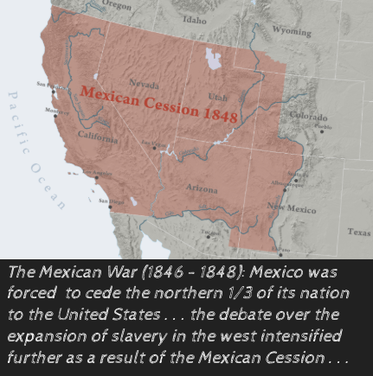
    The Treaty of Guadalupe-Hidalgo (a.k.a. the Mexican Cession) provided that potentially seven states could be added to the US, which meant 14 Senators, equal to New England’s contingent, but the population of those states would not even equal that of Vermont. Webster and the other Senators that opposed the treaty were outvoted by a total of 38 - 14, and the ratified treaty went into effect on 4 July 1848 (during the process, Congressman John Quincy Adams died in the Capitol on 23 February 1848).

Picture
     If communication was faster in 1848, then Mexico would have known about gold in California before negotiations with Nicholas Trist ended. But the news didn’t reach Mexico City until it war far too late, and it didn’t reach Washington, D.C. until after the Senate had ratified the treaty. The California Gold Rush turned the territory of California into perhaps the most diverse region in Earth, but Americans were by far the largest in number. It was beyond obvious that California needed a government as soon as possible and that it would be a free state since it didn’t have the necessary climate/terrain for plantations. California’s effort for quick statehood was the impetus for what became known as the Compromise of 1850.
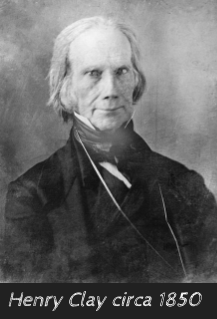
    By 1849, Henry Clay was 73 years old and feeling poorly, and consumption would claim him before long. Clay assumed that his political life was over, and he had retired, like Jefferson at Monticello, to his happy place outside of Lexington (KY). Clay had many visitors, which he enjoyed entertaining and being flattered and complimented, but he also valued that those visitors kept him updated on what was going on in DC. Clay had meant to leave the affairs of the nation in the hands of the New Guard, but after the death of his son, Clay figured that the best tonic for his grief was to head back to the DC trenches, unsure if his health could stand the stress. Yet again, Kentucky elected Clay to the Senate, and outside of Calhoun and Webster, only a few from his generation remained in Congress.

Picture
     Clay, ever the main-in-the-middle, had a much tougher time finding that ever-shrinking middle in Congress. Clay was an advocate of gradual emancipation liked to colonizing freed slaves in Africa, but Clay’s recommendation failed, and he was seen as an enemy by most Southerners. What Clay was really after was time, not emancipation, when he addressed the Senate in January 1850, where he formally introduced his compromise via a series of proposed resolutions. The first resolution was that California be admitted as a free state, the second wanted to establish one-or-more territorial governments in the remaining areas taken from Mexico. Other resolutions proposed the ban of the African Slave Trade in DC, and what would eventually become the Fugitive Slave Act. In total, Clay previewed eight resolutions.
    Clay hoped to mount his usual behind the scenes magic to get the resolutions passed, but the uproar in response to his floor speech meant that he had to be public in his defense of his resolutions, which he did on
5 & 6 February 1850. Clay argued that CA becoming a free state did not violate the Missouri Compromise as Southerners claimed. Clay argued that the 36/30 line did not guarantee slavery south of the line, but merely allowed it while forbidding slavery north of the line. Clay stated that slavery was being barred in CA by Californians, not Congress, and if Virgina voted to end slavery, or Ohio voted to have slavery, Congress would be powerless to act in either case. For the return of fugitive slaves, Clay vigorously agreed with the South, but in almost the same breath Clay stated that there was no constitutional right for secession.

Picture
     Calhoun was not moved by Clay’s appeal for the Union above all else, and was also unimpressed with Clay’s proposed resolution concerning fugitive slaves. Calhoun wanted nothing to do with Clay’s compromise. Calhoun’s consumption was much further along than Clay’s, and he simply didn’t have the ability to stand and directly rebut Clay on the Senate floor. Days later, however, In early-March 1850, Calhoun dragged himself to the Senate where Senator James Mason (VA) read Calhoun’s missive.
   According to Calhoun, it was the actions and agitations of the radical Abolitionists that were the main threat to the Union, not the South. Calhoun went on to say that Clay’s proposed compromise would not save the Union, and that CA as a free state was totally unacceptable. Calhoun claimed that Clay wanted compromise, but he was after justice. Calhoun blamed the Missouri Compromise for leading the nation astray as well as placing the South in jeopardy, and that any compromise must first deal with the damage done by the Missouri Compromise (e.g. repeal). Calhoun demanded that the North must give the South the right to track down fugitive slaves as well as crack down on the radical Abolitionists.

0 Comments

Clay, Calhoun, and Webster: The Compromise of 1850, Part Two

8/8/2019

0 Comments

 
                       Source: H.W. Brands. Heirs of the Founders (2017)
Picture
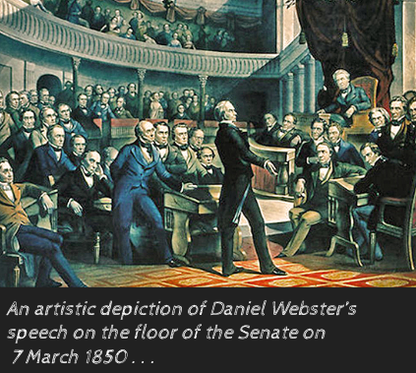
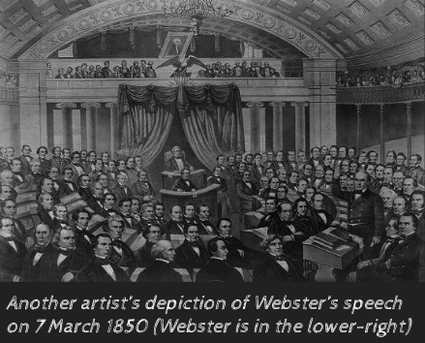
    The most daunting task of Webster’s political career awaited him; after Calhoun’s diatribe, it seemed that there was no hope for compromise since many in the Senate assumed that Calhoun had simply chosen secession as his solution. Webster wasn’t ready to reply to Calhoun right away, telling fellow Senators that he would respond in a couple of days. Webster spoke on the Senate floor on 7 March 1850, and expectations were incredibly high after the speeches of Clay and Calhoun.
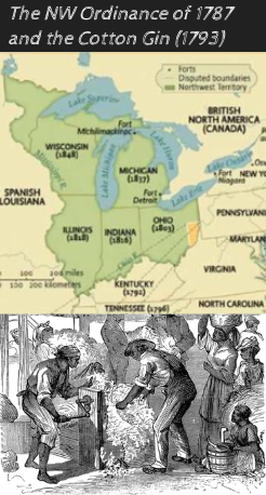
    Webster started by reviewing the history of how the North and South had reached the current crisis. Webster then went on to say that he wished others shared his level of tolerance since those that did not on all sides were the reason why the nation had reached such a precarious moment. Webster mentioned that when the Constitution was written, both the North and South had similar perspectives concerning slavery, seeing it as at least a necessary evil, and had tolerated it because at that time slavery seemed to be on the decline. Webster pointed out that the Northwest Ordinance of 1787 had the entire support of the South, but that was before the cotton gin (1793) and the expansion of the Cotton Kingdom.

Picture
     Webster refuted Calhoun’s assertion that the federal government had been pro-North in recent years, arguing that if anything, the government had enabled the South with the addition of 9 slave states. The annexation of Texas showed that things were going the South’s way for sure, Webster stated.  Webster caused a stir in the audience when he said he did not support the Wilmot Proviso, which in effect meant he was defying the Massachusetts state legislature that sent him to the Senate, contradicting his earlier vote in favor of the measure, and breaking ranks with the North as well as most of his fellow Whigs. Webster ignored the fuss and kept speaking.
    On the topic of fugitive slaves, Webster agreed with Clay and Calhoun, saying that the South was right and the North was wrong, and the gasps in the Senate were audible. Webster argued that Congress had the power to enact a fugitive slave provision, and it seemed to Northerners that Webster was in league with the slave catchers. Webster went on to say that Abolitionist societies caused more harm than good. Webster attributed positive motives on their end, but Webster stated that the negative consequences of their actions far exceeded any benefit in terms of their principles.


Picture
     Webster went on to say that due to the machinations of the Abolitionists, the South created even more restrictions on their slaves and dug into their trenches even further. Webster said that the grievances from both the North and South should be acknowledged, but hey should not be encouraged, especially in the form of justifying disunion. Webster went on to say there was no such possibility as a peaceful secession. Webster didn’t want to finish on a grim note, and he said that it was the duty of all assembled, at this crucial turning point, to do their best to keep the Union going.
    Webster’s speech stunned the Senate and outraged New England, who in no way believed that the defense of slavery should be tolerated. It became conventional wisdom in the North that Webster was trying to position himself for a run at the Presidency in 1852, and Northern Whigs were highly motivated to do whatever they could to deny Webster the nomination. It reached the point where Calhoun was portrayed in a more honorable light than Webster because Calhoun didn’t stab his supporters in the back. It was difficult to tell whether Webster’s support of Clay’s compromise did any good for several weeks, in part because Calhoun died on 31 March 1850; Calhoun’s death deprived the opposition to Clay’s compromise its most powerful voice.

Picture
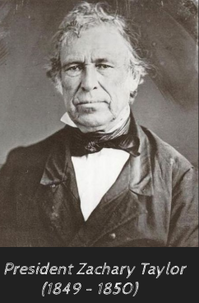
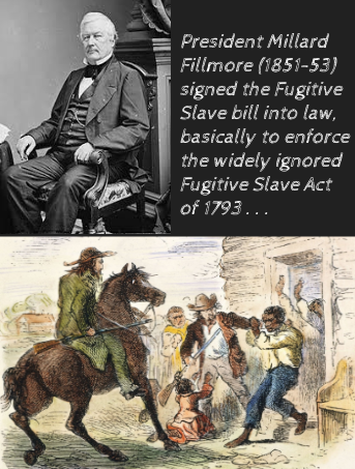
     A second death came into play: President Zachary Taylor died of natural causes. Taylor was in opposition to Clay’s compromise, in large part because HE viewed himself the leader of the Whigs, not Clay. Clay had not asked or deferred to him on party matters, and Taylor felt upstaged by Clay. Taylor’s death left Clay the unchallenged leader of the Whigs, which meant the odds of his compromise moving forward greatly increased. Clay had been convinced to combine his resolutions into an omnibus bill, and with President Millard Fillmore, a veto was basically off the table.  
    A first term Democratic Senator from Illinois, Stephen Douglas, found majorities in the Senate for various parts of the bill. When Clay returned after the sweltering summer, he found that Douglas had done all the necessary work and all that really needed to be done was to get the bill to Fillmore. Clay believed that the Compromise of 1850 had bought the nation time, maybe 20 years, and by then, Clay hoped the sectional discord would be defused.

Picture
     The Fugitive Slave Act greatly polarized the already existing tensions, in that it shifted the burden of proof from the slave hunters to the alleged escapees. Also, the act compelled the cooperation of Northern law enforcement and civilians, and miscarriages of justice under the act would result in many acts of kidnapping innocent Free Blacks.
    Southerners resented the Compromise of 1850, since with the admission of CA the North had a +2 advantage in the Senate, and with the political martyrdom of Calhoun, the idea of secession gained momentum. Clay’s compromise further agitated both the North and South, and both regions held Clay responsible as Abolitionism grew more powerful and influential. Clay watched as the anger grew worse, but he was powerless to stop it this time; Clay died of consumption in July 1852. In 1852, the Whigs again went with a war hero, nominating Winfield Scott, and again Webster was on the outside looking in. But Webster knew he didn’t have a chance, so he agreed to be Fillmore’s SecState, which gave Webster the out he needed to escape a still very angry Massachusetts.

Picture
    In October 1852, Webster died of complications from a carriage accident that occurred in May. The deaths of Calhoun, Clay, and Webster marked the end of the second generation of America’s nationhood. Clay became the first American to lie in state in the rotunda of the Capitol, and before Lincoln’s Mourning Train back to Springfield (Ill) in 1865, Clay’s train back to Lexington (KY) was the train Americans waited on the tracks to mourn.
    The honors towards Calhoun were sectional; he in essence was given the honor of lying in state in the state capitol building in Richmond (VA), and Massachusetts had forgiven Webster, acknowledging the contributions of the state’s most famous adopted son (Webster was originally from New Hampshire). In battling the unfolding events that were the legacy of Calhoun, Lincoln turned to Clay and Webster, where Clay gave Lincoln his philosophy, and Webster gave Lincoln the words.


0 Comments

Henry Clay: Abolitionism and the Elections of 1836 & 1840

8/1/2019

0 Comments

 
                      Source: H.W. Brands. Heirs of the Founders (2017)
Picture
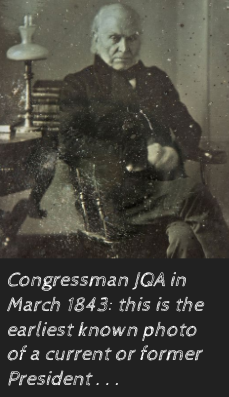
     John Quincy Adams didn’t care much about the 2nd National Bank of the United States, but he did care about Abolitionism. Soon after losing the Election of 1828 to Jackson, JQA was sent to Congress by the 12th District in Massachusetts. It didn’t take long for John C. Calhoun and the South to find out that JQA was their polar opposite, and what both men had in common was their fear of what could happen in the future
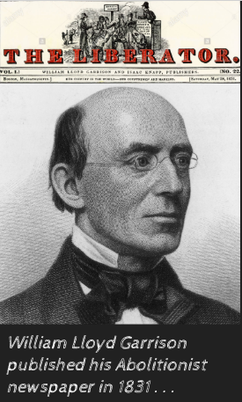
    One result of the Nat Turner Revolt (1831) in Virginia was that Southern plantation owners cracked down even more on denying education to slaves (Turner probably was better educated that the vast majority of poor Southern whites). Virginia actually debated whether or not to abolish slavery in the aftermath of the Nat Turner Revolt, but the Planters perspective on gaining even more control over the “peculiar institution” won out. Among the restrictions enacted was that Abolitionist propaganda (e.g. William Lloyd Garrison's “The Liberator”) was not allowed in the South, which meant controlling the mail service.

Picture
    JQA’s attacks on slavery, in the face of the Gag Rule in the House, provoked more extreme Southern reactions in the chamber. Calhoun led the Southern contingent in Congress, and he encouraged the the entire South to band together in defense, in that Abolitionism and the Union could not coexist. Calhoun asserted that slavery was not a necessary evil, but a positive good, which meant that the South claimed moral parity with the North, and therefore had nothing for which to apologize.
    However, Calhoun claimed more than parity, stating that slavery enhanced the stability of Southern society. Therefore, according to Calhoun, the Abolitionists were a major threat to the social structure of the South. Calhoun asserted that the Abolitionists would not stop with emancipation, but would pursue equal rights for the former slaves with Southern whites, which would mean that Southern whites would be at the mercy of their former slaves.


Picture
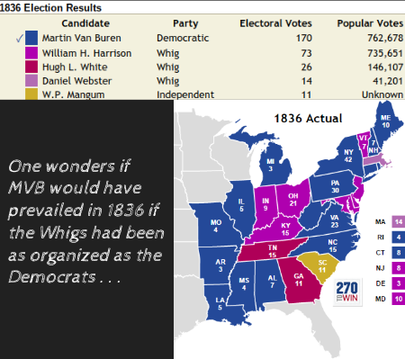
     By the Congressional Elections of 1834, the combination of anti-Jackson factions, the National Republicans (of which Clay was part), and the Anti-Masons started to call themselves Whigs. In the Election Year of 1836, the strategy of the Whigs (who weren’t quite yet organized enough to hold a convention)  was to have four stout regional candidates that would draw enough Electoral Votes away from MVB, and then win the Presidency in the House of Representatives. Daniel Webster was one of those four, but he only won his home state of MA as the regional candidate of New England. The Whigs learned the hard way that their strategy of “Divide and Conquer” didn’t work when they were a divided and unorganized party.
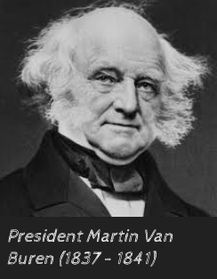
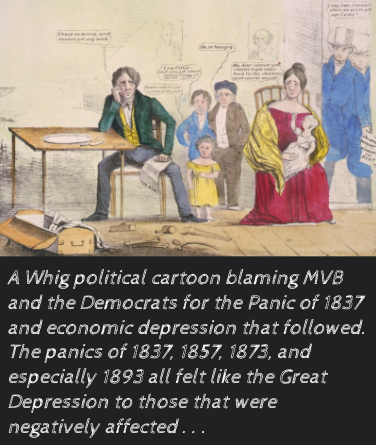
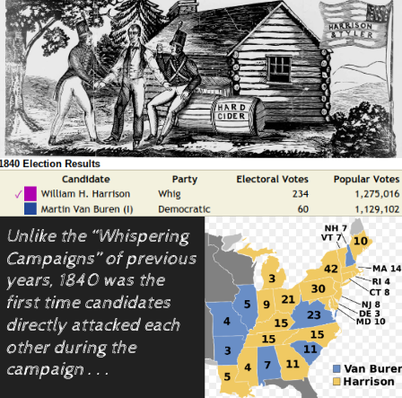
    Martin Van Buren’s Presidency, like Herbert Hoover’s, didn’t take long to sink into the economic abyss; in MVB’s situation, it was the delayed impact of the destruction of the 2nd Nat’l Bank of the US. State banks, especially in the West, had expanded credit far too rapidly, which created a speculative bubble on Western lands, which was a major cause of the Panic of 1837 and the subsequent economic depression. Another cause of the depression was Jackson’s “Specie Circular”, which was an effort to restrain all that speculation by reducing the money supply. Americans turned against MVB in droves, and the Whigs felt that the Election of 1840 should go their way. Clay had spent much of his time since his defeat in 1832 trying to unify and organize the Whigs, and he became an early favorite for the nomination in 1840. Clay’s chances looked very good, in that Webster had not proven to be a national vote-getter in 1836, and former general William Henry Harrison, one of the four Whigs that ran in 1836, didn’t exactly run away and separate himself from the closest two pursuers. A hopeful/cautious Henry Clay, in short, liked his chances for the nomination of the Whigs in 1840.

Picture
     Clay moved to politically isolate Calhoun as much as possible so he couldn’t be a serious threat. Webster continued to refuse to withdraw as a regional candidate, so Clay next targeted him. However, and unexpected event in 1838 dealt Clay’s hopes for the Whig nomination a serious blow. In Maine’s state elections, the Democrats prevailed soundly over the Whigs, and the resulting conventional wisdom was that the Whigs needed a war hero to get them over the hump in 1840, and the only Whig candidate that fit that bill was William Henry Harrison. Clay rejected out of hand that political diagnosis and prescription, and he suspected Webster as the originator of the web of deceit that threatened his nomination.
    Clay had been encouraged by those close to him that he should come out in favor of Abolitionism, but Clay didn’t want to offend either New England or the South. Clay hoped that taking a middle position on emancipation would be favored by a majority of Americans, but there was no guarantee that Clay’s strategy would lead to the nomination he so coveted. As the economic depression continued, the chances of the Whigs being victorious in 1840 increased, and to insure victory, more-and-more Whig leaders started to support the least-controversial candidate, William Henry Harrison (WHH) over Clay.


Picture
    With his political fortunes failing, Clay decided to speak his conscience. Clay identified the radical Abolitionists as the branch of Abolitionism that represented a true threat, stating that the rights of property meant nothing to them, nor did the rule of law. Clay went on, saying that the radical Abolitionists were heedless of any consequences to their actions. The radical Abolitionists by that point had demanded an end slavery in the District of Columbia, and in the Florida Territory, as well as a ban on interstate commerce that involved slaves. The radicals also insisted that Congress bar the entry of any slaves from abroad.
    Clay argued that the goal of the radical Abolitionists, if peaceful Abolition wasn’t achieved, was to use violence to emancipate the slaves. To Clay, the radical Abolitionists dreamed of a world that couldn’t possibly exist. As a result of the rhetoric and actions of the radicals, Clay argued that slaves had it worse in the South. Clay mentioned that the radicals believed that they could change the world overnight, but Clay stated that emancipation would take time, but emancipation would come more swiftly and permanently if the movement was led by the federal government.

Picture
     Clay now waited to see if he gained support in the South while not losing too much support in the North. Due to the confusion and lack of organization among Whigs, the convention kept getting delayed, which was exactly what WHH wanted. The longer he was able to sit on the political sideline, the better he believed his chances would be to win the nomination. As a result of the delays, Clay felt his support drift away from him and towards WHH, and reluctantly accepted the inevitable, and he endorsed WHH after the former general won the Whig nomination. From JQA’s point of view as a former President, it would take more than the Whigs winning the Election of 1840 to cure what ailed America.
    By 1840, candidates for public office had to display a common touch, in that voters expected to be wooed, entertained, and feted upon. In the days of George Washington, the people were willing to defer to their leaders, but now, the people expected their leaders to defer to them. WHH was no commoner, but he allowed himself to be portrayed as such, in what many historians call a “Log Cabin Campaign” (e.g. an artistic depiction of WHH with a dog). 4 March 1841, Inauguration Day: WHH not only didn’t bundle up during the longest-ever Inaugural Address, but at the age of 68, WHH also greeted well-wishers when he was still cold, wet, and shivering, despite being urged by many to at least change his clothes.
William Henry Harrison died of pneumonia and/or fever, or from other complications just one month into his Presidency.

Picture
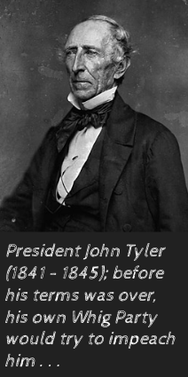
     The status of Vice-President John Tyler wasn’t clear, in that the Constitution didn’t exactly specify that the VP would automatically become President due to a death in office. Additionally, none of the Whig leaders intended that Tyler become President. Tyler acted as if he was President since he wielded Executive power, and in acting as President, Tyler became the 10th President of the United States. Webster was WHH’s SecState, and he suggested to Tyler that decisions from the Executive be through the Cabinet, with the President getting one vote. Tyler had none of that, and told Webster and the other members of the Cabinet that other than giving him advice, if they didn’t like following his lead, he would be more than happy to accept their resignations. As a result, relations between Tyler and his Cabinet deteriorated.
    Tyler didn’t do very well with the Whig leadership in Congress either. When a new bank bill worked its way through both houses, largely due to the efforts of Clay, Tyler vetoed it, even though it appeared that he had been in favor of the bill. Clay, now the de facto leader of the Whigs in Congress, publicly chastised Tyler, and he bent over backwards to try and convince both houses that Tyler was not a legitimate President.

0 Comments

    Archives

    May 2020
    April 2020
    March 2020
    February 2020
    January 2020
    December 2019
    November 2019
    October 2019
    September 2019
    August 2019
    July 2019
    June 2019
    May 2019

    Categories

    All
    18th Century
    19th Century
    20th Century
    History

Powered by Create your own unique website with customizable templates.