Source: William K Klingaman. The Darkest Year -
The American Home Front, 1941 - 1942 (2019)
The American Home Front, 1941 - 1942 (2019)
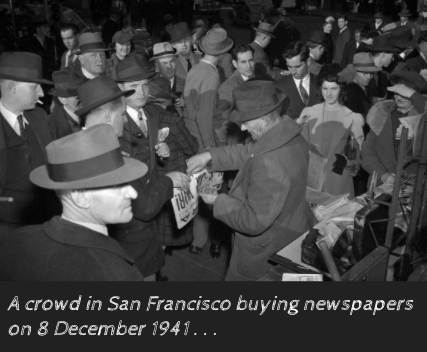
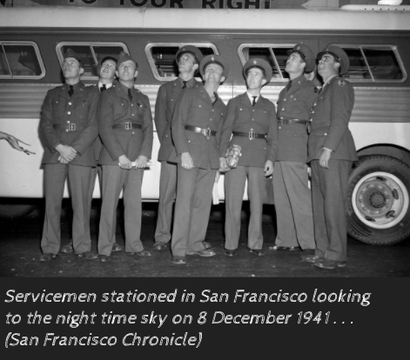
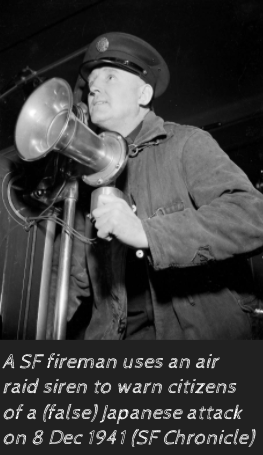
On 8 December 1941, all hell broke loose in San Francisco, whose white residents for the last two days had expected Japanese planes to bomb their city. By noon that day, the white citizens of San Francisco had worked themselves into a panic; rumors of Japanese submarines/bombers heading their way convinced city leaders to close the schools. Just after sunset, Army posts around San Francisco picked up signals on their radar which were mistakenly interpreted as Japanese planes 100 miles west of the city. At about that same time came unverified reports of a Japanese submarine near the Golden Gate Bridge. Army commanders ordered all radio stations in the city to shut down so the Japanese planes couldn’t home-in on their signals.
All of a sudden at dinnertime in San Francisco, radios went dead and puzzled/confused residents waited for any information, but there was none forthcoming. San Francisco was still ablaze with its lights, since there was no way for power company technicians to turn off all the lights at once.. Even though airplane spotters didn’t see a single plane that night, Army officials from the Western Defense Command announced that two squadrons of Japanese planes (30x) had been launched from Japanese aircraft carriers 500 miles west of San Francisco.
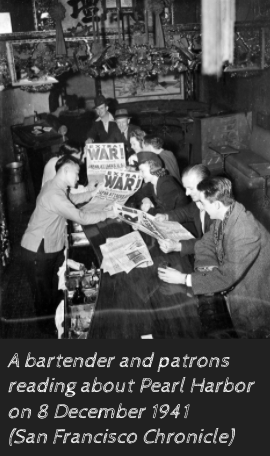
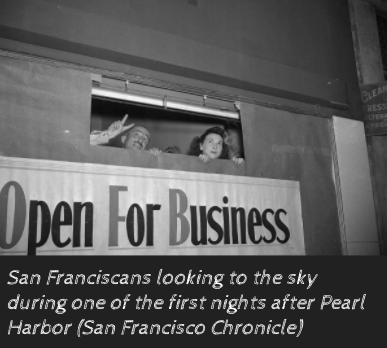
San Francisco police ordered a city blackout by 7:30 pm, and at that point the vigilante tradition of the city was ignited. Citizens destroyed as many lights as possible (e.g. with rocks) and trolley cars were stopped, and thousands of San Franciscans screamed “The Japs are coming”. Rumors were rampant that the Golden Gate Bridge had been bombed. Civilian sentries fired on innocent civilians, killing a man who didn’t hear the commands to stop. Rumors kept spreading, such as that The Presidio had been taken by Japanese forces. On the morning of 9 December 1941, the residents of San Francisco flocked to newstands to find out what really happened overnight.
All of a sudden at dinnertime in San Francisco, radios went dead and puzzled/confused residents waited for any information, but there was none forthcoming. San Francisco was still ablaze with its lights, since there was no way for power company technicians to turn off all the lights at once.. Even though airplane spotters didn’t see a single plane that night, Army officials from the Western Defense Command announced that two squadrons of Japanese planes (30x) had been launched from Japanese aircraft carriers 500 miles west of San Francisco.
San Francisco police ordered a city blackout by 7:30 pm, and at that point the vigilante tradition of the city was ignited. Citizens destroyed as many lights as possible (e.g. with rocks) and trolley cars were stopped, and thousands of San Franciscans screamed “The Japs are coming”. Rumors were rampant that the Golden Gate Bridge had been bombed. Civilian sentries fired on innocent civilians, killing a man who didn’t hear the commands to stop. Rumors kept spreading, such as that The Presidio had been taken by Japanese forces. On the morning of 9 December 1941, the residents of San Francisco flocked to newstands to find out what really happened overnight.
Seattle experienced its own nightmare when military authorities mistakenly thought they had detected Japanese planes heading their way. During the ordered blackout, over a thousand Seattle citizens ran amok in the city’s center, smashing storefronts and looting stores. The mob was lead by a 19 year old wife of a Navy sailor, who proudly announced that it was her patriotic duty to make sure there were no lights on during the blackout. It took a contingent of Army soldiers and British sailors to restore order in the city. On 9 December 1941, Ernie Pyle arrived in San Francisco and found a city that still expected to be bombed at any moment, but at least that night there wasn’t any repeat of the previous night’s panic.
A thorough search by Navy ships and planes off the coast of northern California revealed zero Japanese ships, planes, or submarines. Lt. General John DeWitt, the leader of the Western Defense Command, refused to admit any error in his actions or judgments (DeWitt also thought that those that didn’t honor the blackout deserved what the mob did to their businesses). A couple of days later Los Angeles city leaders ordered a full-scale blackout. Army observers during the first night of the blackout reported unidentified aircraft in the vicinity of the city, which spurred military officials to extend the blackout from Bakersfield to the Mexican border and eastward to the border with Nevada. Los Angeles radio stations stopped broadcasting, and mobs the first night in Los Angeles ran roughshod over parts of the city as mobs had done in San Francisco and Seattle. One columnist from the Los Angeles Times labeled the first few days after the attac on Pearl Harbor as the “Era of the Grand Bungle”.
A thorough search by Navy ships and planes off the coast of northern California revealed zero Japanese ships, planes, or submarines. Lt. General John DeWitt, the leader of the Western Defense Command, refused to admit any error in his actions or judgments (DeWitt also thought that those that didn’t honor the blackout deserved what the mob did to their businesses). A couple of days later Los Angeles city leaders ordered a full-scale blackout. Army observers during the first night of the blackout reported unidentified aircraft in the vicinity of the city, which spurred military officials to extend the blackout from Bakersfield to the Mexican border and eastward to the border with Nevada. Los Angeles radio stations stopped broadcasting, and mobs the first night in Los Angeles ran roughshod over parts of the city as mobs had done in San Francisco and Seattle. One columnist from the Los Angeles Times labeled the first few days after the attac on Pearl Harbor as the “Era of the Grand Bungle”.
Military authorities kept finding ways to make situations worse by making dangerous errors. On 12 December 1941, a 2.5 hour blackout in San Francisco was due to an erroneous military claim of unidentified planes flying over the city, and it was mob rule again in the city. On the evening of 13 December 1941 in Los Angeles, anti-aircraft artillery opened fire on phantom enemy planes. California’s governor declared a state of emergency and condemned the marauding gangs of self-appointed “wardens” masquerading as patriots.
At 11 am on 9 December 1941, New York City had its first air raid alarm from the Army stationed at Governor’s Island; soldiers there had received a call from the War Department, and were told that reports of unidentified planes approaching Manhattan were being checked out. The contingent of soldiers on Governor’s Island misinterpreted the phone call and took it as a warning, and ordered planes stationed at Mitchell Field in Long Island into the air. All radio stations within 100 miles of NYC went silent, and civilian planes were grounded and incoming flights were diverted. Unlike San Francisco, Seattle, and Los Angeles, NYC citizens were just confused, not panicked. Across New York City, movie theaters kept running their films. Predictably, the only panicked part of the city was the New York Stock Exchange; the stock market suffered its worst decline since the Fall of France in 1940.
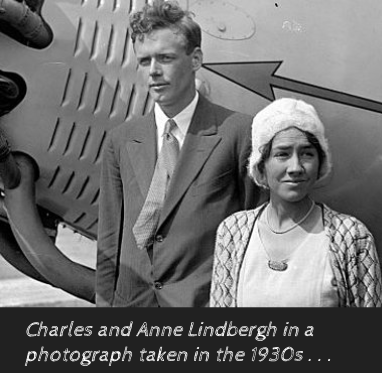
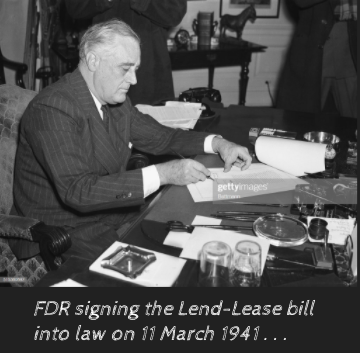
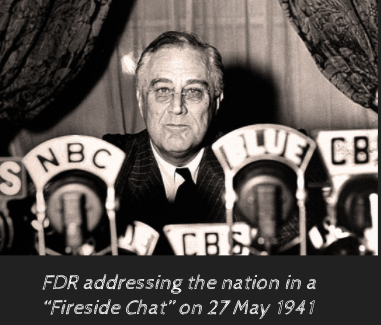
On 10 December 1941, President Franklin Roosevelt addressed the nation by radio, speaking for 90 minutes. FDR assured the nation of eventual victory, but he stated that the road ahead would be very long and arduous. On 12 December 1941 Germany and Italy declared war on the United States. In his diary, Lindbergh wrote that the US was at war all over the world and totally unprepared materially and spiritually.
At 11 am on 9 December 1941, New York City had its first air raid alarm from the Army stationed at Governor’s Island; soldiers there had received a call from the War Department, and were told that reports of unidentified planes approaching Manhattan were being checked out. The contingent of soldiers on Governor’s Island misinterpreted the phone call and took it as a warning, and ordered planes stationed at Mitchell Field in Long Island into the air. All radio stations within 100 miles of NYC went silent, and civilian planes were grounded and incoming flights were diverted. Unlike San Francisco, Seattle, and Los Angeles, NYC citizens were just confused, not panicked. Across New York City, movie theaters kept running their films. Predictably, the only panicked part of the city was the New York Stock Exchange; the stock market suffered its worst decline since the Fall of France in 1940.
On 10 December 1941, President Franklin Roosevelt addressed the nation by radio, speaking for 90 minutes. FDR assured the nation of eventual victory, but he stated that the road ahead would be very long and arduous. On 12 December 1941 Germany and Italy declared war on the United States. In his diary, Lindbergh wrote that the US was at war all over the world and totally unprepared materially and spiritually.
Gradually, radio networks resumed their normal programming while also starting to issue information on the war via bulletins that featured far more than facts, even if the made-up information was bad. Alarmed by the distressing ignorance of Americans not being able to tell the difference between a person of Japanese or Chinese ethnicity, Time and Life magazines published a photo spread on how to “tell the difference” (which by today’s standards were not scientific, and basically ignorant and racist).
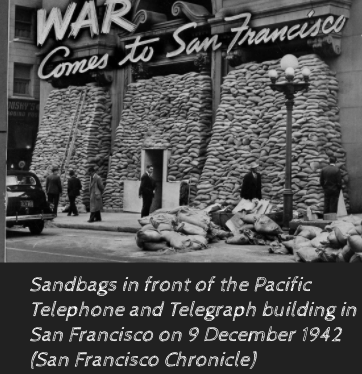
After Pearl there was a growing sense that the nation needed to make up for lost time and opportunities. Every federal government office had a visible sign that said “Time is Short” in block letters a foot high. Local residents in the District of Columbia stocked up on pistols and rifles, presumably to fend off enemy parachutists. The first “Shelter Craze” hit parts of the US, with some of them traditional bunker shelters, while others were a kind of zig-zag trench with sloping sides using plywood as a roof. Critics loudly shouted that spending money on worthless bomb shelters took money away from the nation’s war effort.
The idea that Japan or Germany would attack cities (by plane or submarine) on the Atlantic and Pacific Coasts didn’t go away in the weeks/months following the attack on Pearl Harbor; the demand for the materials to build bomb shelters as a result didn’t drop by much. While many Americans saw the panic as irrational war jitters, few citizens deemed their city “un-bomb worthy”. It soon became clear that almost every city was unable to defend their citizens, and it started to slowly dawn on Americans that they needed to fend for themselves in order to do so.
After Pearl there was a growing sense that the nation needed to make up for lost time and opportunities. Every federal government office had a visible sign that said “Time is Short” in block letters a foot high. Local residents in the District of Columbia stocked up on pistols and rifles, presumably to fend off enemy parachutists. The first “Shelter Craze” hit parts of the US, with some of them traditional bunker shelters, while others were a kind of zig-zag trench with sloping sides using plywood as a roof. Critics loudly shouted that spending money on worthless bomb shelters took money away from the nation’s war effort.
The idea that Japan or Germany would attack cities (by plane or submarine) on the Atlantic and Pacific Coasts didn’t go away in the weeks/months following the attack on Pearl Harbor; the demand for the materials to build bomb shelters as a result didn’t drop by much. While many Americans saw the panic as irrational war jitters, few citizens deemed their city “un-bomb worthy”. It soon became clear that almost every city was unable to defend their citizens, and it started to slowly dawn on Americans that they needed to fend for themselves in order to do so.
As a result, vigilante groups rose in order to pick up the slack. For example, 40 Chippewa women in Pontiac (MI) formed a rifle brigade in case of an Axis attack. In San Diego County a group formed, calling themselves the Minute Men Rifle Corps, and outside Arlington (VT) local patriots prepared for Hitler’s panzers by patrolling and blocking Route 7. The vast majority of Americans knew in their gut that they weren’t in any immediate danger of attack from the Axis powers, but in the back of their minds, the whisper “so you’re telling me there’s a chance” of an attack wouldn’t go away.
Coastal cities started to issue organized instructions for blackouts, which included a detailed list of what needed to be purchased for the home, such as any kind of black cloth to cover windows. Also on the list for what was needed were candles, flashlights, radios, and garden hoses. Of course supplies recognized a great opportunity, and increased their prices given the increased demand. Merchants advertised specific items for purchase that were beyond-wonderful for a home blackout, convincing many consumers that it was essential to buy high-priced luxury items (or that the consumer would be much better off buying a more expensive version). Con men went door-to-door, taking advantage of the gullible.
Coastal cities started to issue organized instructions for blackouts, which included a detailed list of what needed to be purchased for the home, such as any kind of black cloth to cover windows. Also on the list for what was needed were candles, flashlights, radios, and garden hoses. Of course supplies recognized a great opportunity, and increased their prices given the increased demand. Merchants advertised specific items for purchase that were beyond-wonderful for a home blackout, convincing many consumers that it was essential to buy high-priced luxury items (or that the consumer would be much better off buying a more expensive version). Con men went door-to-door, taking advantage of the gullible.
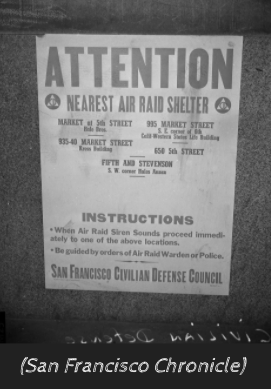
The War Department was alarmed at how many Americans took civilian defense warnings seriously, in that far too many flashlight and batteries were purchased by consumers that were needed for the military; the Office of Price Administration (OPA) froze the prices on both items. The OPA also tried to get Americans to use cloth they already owned to cover their windows instead of buying new cloth that was needed for uniforms. When that failed, the OPa tried to enlist the help of the Better Business Bureau to try and convince Americans that there was no such thing as “official” materials for blackouts, but to no avail.
On 21 December 1941, the New York Times reported that sales of blackout cloth remained strong nationwide and that supplies were scarce. By the third week after Pearl on the West Coast, most Americans were waiting for something to happen, which only increased the level of irrational fear of an imminent attack of some sort. Army officials discouraged any gathering of people on the West Coast that exceeded 10,000, fearing that large crowds would attract Japanese bombers and that highways would be clogged. The War Department even insisted that the Rose Bowl (Oregon State vs. Duke University) be canceled or relocated. Very reluctantly, the Rose Bowl Committee agreed to hold the game at Duke’s stadium, even though it would cost California at least $1.4m in lost tourism revenue. Any sporting event in the US that attracted decent-sized crowds would soon face the same dilemma as the Rose Bowl.
On 21 December 1941, the New York Times reported that sales of blackout cloth remained strong nationwide and that supplies were scarce. By the third week after Pearl on the West Coast, most Americans were waiting for something to happen, which only increased the level of irrational fear of an imminent attack of some sort. Army officials discouraged any gathering of people on the West Coast that exceeded 10,000, fearing that large crowds would attract Japanese bombers and that highways would be clogged. The War Department even insisted that the Rose Bowl (Oregon State vs. Duke University) be canceled or relocated. Very reluctantly, the Rose Bowl Committee agreed to hold the game at Duke’s stadium, even though it would cost California at least $1.4m in lost tourism revenue. Any sporting event in the US that attracted decent-sized crowds would soon face the same dilemma as the Rose Bowl.
On 15 December 1941, Secretary of the Navy Frank Knox released in initial report of the American losses at Pearl Harbor. Knox’s report stated that one battleship and three destroyers were sunk, and that there had been 2731 KIA and 656 WIA. The report was only released due to threats of Congressional investigations, and for most Americans, the numbers in Knox’s report were not as bad as expected. The FDR administration made a concerted effort to keep as much of the reality of what happened at Pearl Harbor in the shadows, not wanting to deal with why the Navy was so unprepared for Japan’s attack on 7 December 1941. One of FDR’s methods to do so was to authorize each department in the Executive branch to analyze and release news from the war, which only added to the overall confusion. The press didn’t help, in that they published stories that far overstated US achievements in the war to that point.
In explaining the losses at Pearl, SecNav Knox exaggerated the impact of intelligence provided by Hawaii’s Japanese-Americans/nationals to Tokyo, stating that government/military authorities in Hawaii had been “much too generous” in their treatment of the two groups. Knox’s baseless charges added fuel to the hysteria on the West Coast, which now fully focused on innocent Americans of Japanese ethnicity, as well as legal Japanese nationals. Already in California there was a conspiracy theory that ran rampant that all whites just knew was true: Japanese-American farmers had poisoned the produce sold to whites. Not one example was uncovered to show a scintilla of truth to the conspiracy theory.
Addendum: Closing Out December 1941 . . .
In explaining the losses at Pearl, SecNav Knox exaggerated the impact of intelligence provided by Hawaii’s Japanese-Americans/nationals to Tokyo, stating that government/military authorities in Hawaii had been “much too generous” in their treatment of the two groups. Knox’s baseless charges added fuel to the hysteria on the West Coast, which now fully focused on innocent Americans of Japanese ethnicity, as well as legal Japanese nationals. Already in California there was a conspiracy theory that ran rampant that all whites just knew was true: Japanese-American farmers had poisoned the produce sold to whites. Not one example was uncovered to show a scintilla of truth to the conspiracy theory.
Addendum: Closing Out December 1941 . . .