Mr. Jensen's U.S. History Website
  • U.S. History Blog
    • U.S. History Blog (May 2026 - May 2027)
    • U.S. History Blog (May 2025 - May 2026)
    • U.S. History Blog (May 2024 - May 2025)
    • U.S. History Blog (May 2023 - May 2024)
    • U.S. History Blog (May 2022 - May 2023)
    • U.S. History Blog (May 2021 - May 2022)
    • U.S. History Blog (May 2020 - May 2021)
    • U.S. History Blog (May 2019 - May 2020)
    • U.S. History Blog (May 2018 - May 2019)
    • U.S. History Blog (May 2017 - May 2018)
    • U.S. History Blog (May 2016 - May 2017)
    • U.S. History Blog (May 2015 - May 2016)
    • U.S. History Blog (May, 2014 - May, 2015)
  • About

Nixon: From Senator to Vice-President (1950 - 1952), Part Two

12/24/2019

0 Comments

 
                     Source: John A. Farrell. Richard Nixon - The Life (2017)
Picture
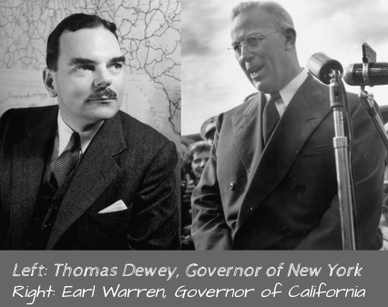
     Those in Ike’s Circle of Trust, such as Thomas Dewey, liked what they saw/heard from Nixon, and Nixon was told by Ike et al  that if he was able to be a strong presence for Ike with the CA delegation, then his chances for being VP would increase. California’s 70 Republican delegates for the convention would be decided in the primary in June 1952 (the only larger GOP delegation was NY). The best deal that Nixon could manage, due to Warren’s power/influence in CA, was to unite with the various GOP factions to defeat the renegade conservative in the primary, and then the CA delegation would be divided into thirds for Warren, Knowland, and Nixon. 
     Warren agreed to the plan since as the Favorite Son of CA, by tradition, he held all 70 delegates unless he released them. Nixon seemed content that he did the best he could for Ike with the CA delegation. However, Nixon did all he could to rain on Warren’s parade, issuing a mailer that stated that Warren had no chance of winning the nomination while also pointing out that the only candidates that had a chance were Ike and Taft. At the last minute, a few delegates were replaced, and they were pro-Nixon; even Kyle Palmer became irritated with Nixon and his tactics.
Picture
     Nominating conventions are run by the party’s faithful to reward the loyal, which proved to be at least somewhat of an impediment in that Ike had only recently entered the Republican fold. Ike had undeniable popularity, but Taft had a large lead/advantage in the Inside Game in terms of the delegate count.  Dewey and Henry Cabot Lodge, Jr. secured the delegates from the northeastern states for Ike, and Warren had CA, so that left the Southern delegates; that meant going in that the nomination at the convention could very well be contested. 
     Ike played the “Boss Card”, stating that Americans were sick of political bosses, and that Taft’s Inside Game was the epitome of the Boss system, meaning that Taft was trying to thwart the will of the people.  Nixon was on the Platform Committee, and he chimed in saying that if Taft was nominated, he would be a sure loser to the Democratic candidate. Nixon was not alone believing that the Republicans needed a hero like Ike to get as many voters as possible to vote the GOP ticket. 
     Nixon then left Chicago and joined the CA delegation so he could enter Chicago with them for the start of the convention. As the train continued east, Nixon’s men kept telling delegates that if they believed that Warren could keep Ike from a 1st ballot victory, they were living in a fantasy land. The Nixon folks kept at it, saying that it would be wise to support Ike so CA wouldn’t be left out in the cold, politically speaking. Warren was furious at Nixon’s attempt to recruit delegates for Ike under his nose, and it became known as the “Great Train Robbery”, which added support for Ike at Warren’s expense.
Picture
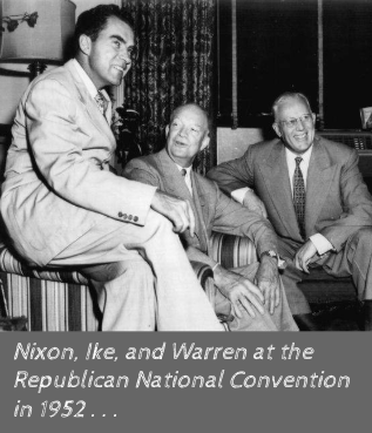
     The first showdown of the GOP convention was over the credentials of the contested delegates, which were mostly from the South. In this situation, Nixon and Warren had a common interest, in that they both wanted to block contested delegates loyal to Taft. But Warren misread the tea leaves, in that Taft wasn’t the one he needed to worry about . . . it was Ike and Nixon. 
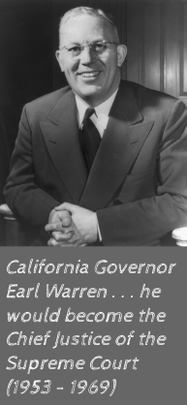
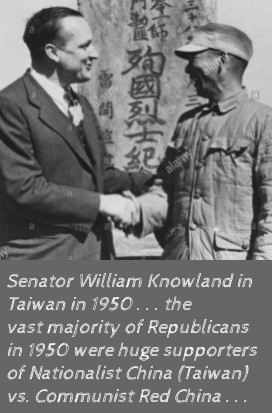
   The Taft GOP Old Guard steamroller became stalled, and then it was too late when Warren figured out what really happened, that Nixon had sold out Warren to advance Ike’s nomination. Warren and Senator William Knowland (R; CA) were beyond-bitter; a seething Warren sent a mutual friend to Ike to express his extreme displeasure at having an Eisenhower spy in their midst. But Ike didn’t need the CA delegation in order to win the nomination, and he basically ignored Warren while also telling him, via intermediaries, that Nixon looked good for VP.
Picture
     The next showdown was whether to seat Ike’s Southern delegates, but by then Ike was driving the GOP steamroller. Ike’s popularity and charisma, combined with Nixon’s well-received remarks concerning Ike, meant that the CA delegation voted 62 - 8 to seat Ike’s Southern delegates, and the other state delegations followed CA’s lead in a scene that played out over television. Ike would not forget what Nixon had accomplished with the CA delegation.
     Warren eventually saw (and rued) his folly, in that by focusing on Taft he had not only hurt himself, but also advanced the cause for Ike and Nixon; from that day on, Warren’s hate for Nixon was epic. Ike let Warren have his moment with the CA delegation, letting all 70 vote for their Favorite Son. Ike could do so since he knew that Warren Burger, a Stassen man, had succeeded in switching the Minnesota delegation to put Ike over the top for the nomination. 
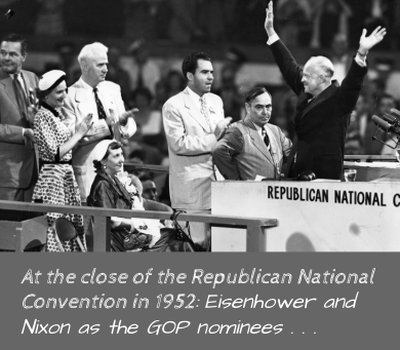
   Given how often a Vice-President became President, it was odd that Ike didn’t give much thought to his running mate. Since Martin Van Buren in 1836, the Vice-Presidency had become a political Boot Hill unless there was a death in office (George H.W. Bush in 1988 was the first sitting Vice-President since MVB to win a Presidential Election). What Ike et al wanted was for the General to take the high road, and the VP candidate (Nixon?) would be the campaign’s attacking pit bull. Chotiner advised Nixon to take the VP if offered, arguing that the worst thing that would happen was that Nixon would have four more years of his term as Senator if Ike lost the election. Shortly after Ike was nominated as President, Nixon was nominated as VP by acclamation.
Picture
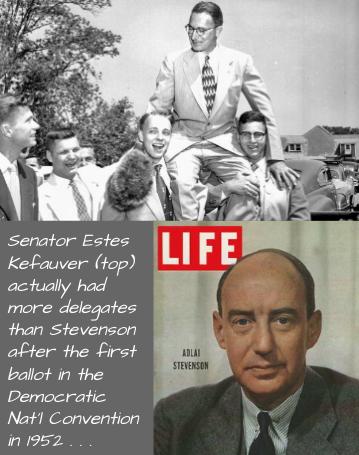
     Television had become an American mainstay by 1951, but viewership was still concentrated in the big cities in the East. Milton Berle, Roy Rogers, and the first politician to use TV to promote an agenda (and himself), Estes Kefauver, chaired Senate hearings on organized crime and juvenile delinquency. Both political conventions were huge ratings hits on TV as well, with millions watching the real-time political drama play out (conventions were nearly as scripted then as they are today). Also due to TV, Americans watching CBS were introduced to Walter Cronkite during those conventions. 
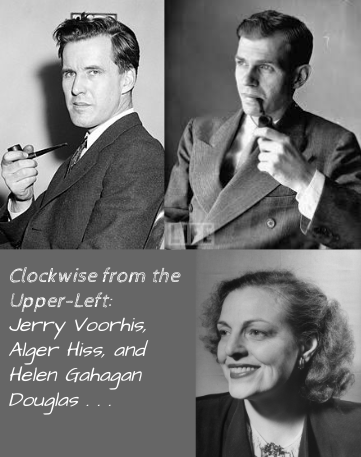
   By the General Campaign of 1952, Nixon had nailed four political scalps to his wall: Voorhis, Hiss, Gahagan Douglas, and Warren . . . and Nixon had his sights on a fifth, Adlai Stevenson, the nominee of the Democrats. Nixon was eager to go after Stevenson in part because he had been a character witness for Alger Hiss during the HUAC hearings in the late-1940s. With the blessing of Ike’s inner circle, Nixon et al compiled information in a file called “Stevenson’s Communist Affiliations”. Nixon refused to use any personal information that was gained (e.g. the possibility that Stevenson was a homosexual). In the years that followed, Nixon developed an intense hatred for Stevenson, who to Nixon was the epitome of the liberal intellectual elites that had a condescending attitude to any politician that they considered below their level/status. Also, Nixon hated it that Stevenson was a political messiah to the Georgetown Set in DC as well as the Ivy Leaguers. Nixon saw Stevenson as all veneer and no substance; in essence, without even knowing it, Nixon was perhaps triple-dog-daring his political foes to strike.    
0 Comments

Nixon: From Senator to Vice-President (1950 - 1952), Part One

12/14/2019

0 Comments

 
                    Source: John A. Farrell. Richard Nixon - The Life (2017)
Picture
  Defeating Jerry Voorhis in the Congressional race in  1946, exposing Alger Hiss in the late-1940s, and then defeating Helen Gahagan Douglas for the Senate in 1950 came with a cost in that Nixon had destroyed three high-profile (and very admired to the Left) New Deal liberals; Nixon became the enemy of that liberal bloc. The DC press disliked Nixon even before they met him due to his campaign tactics against Voorhis in 1946. Nixon’s unmasking of Alger Hiss rocked the foundation of the liberal set in DC, and after his campaign against Gahagan Douglas in 1950, the DC liberal jackals had Nixon in their crosshairs.
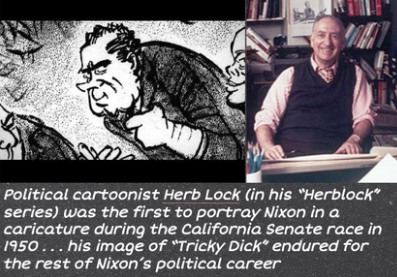
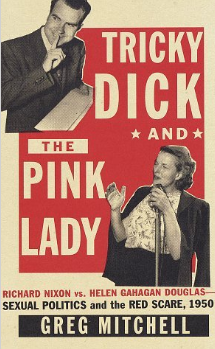
     In California, Nixon’s name had been smeared as well due to his campaign attacks/strategies. Those in Nixon’s corner felt that perhaps it was his years of debate training that made him so aggressive and relentless in pursuit of an issue/goal. Nixon even admitted to some that his tactics/strategies in 1950 against Gahagan Douglas were a “shoddy” way to win. Gahagan Douglas blamed the Korean War as the main reason for her defeat against Nixon, believing that Nixon would have won anyway without resorting to character assassination (e.g. “The Pink Lady”). Left-Wing editorialists accused Nixon of petty malice, and Herblock’s portrayals of Nixon in his very influential and widely syndicated political cartoons illustrated Nixon’s dirty tactics. By early-1951, “Tricky Dick” had become a political caricature.

Picture
     On 4 December 1950, Nixon was sworn in as a United States Senator since Downey resigned before his term ended to become a lobbyist. Even though Downey was a Democrat, he was also a Californian, and he wanted Nixon to have a tie-breaker in his advantage in terms of seniority compared to the other freshmen Senators yet to be sworn in. 
     In his much larger and expensive Senate office, Nixon brought 33 year old Rose Mary Woods on board as his secretary, whom he met while serving on the Herter Committee as a Congressman. Woods and others around Nixon started to develop a fierce loyalty to the Senator that was comparable to vows taken by nuns; Woods would top that list of loyal surrogates all the way to the end of Nixon’s Presidency. Woods became a gatekeeper, a detail person, and a keeper of secrets for Nixon.
  When the Senate wasn’t in session, Nixon traveled the nation and gave speeches in 21 states, which not only provided additional income, but doing so also meant that Nixon established connections with state and local level Republicans. Nixon’s rapid ascent to national level politics in just a few years had taken a toll on Nixon. With the Alger Hiss investigation, Nixon became melancholy and worked himself to the point of exhaustion. Then physical problems such as a painful neck and back occurred, as well as facial tics, sleeplessness and chronic stomach troubles. The times of Nixon being lighthearted in the company of others started to sharply and noticeably decrease.

Picture
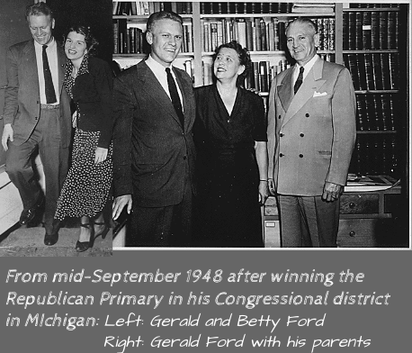
     Gerald and Betty Ford arrived in DC in 1948, and the Fords befriended the Nixons. Ford discovered that Nixon could be in a very good mood and then instantly become dour. Even when both were still in the House, Ford saw that Nixon’s moodiness drained much from him. At the root of what made Nixon tick was that he threw himself into work in a furious fashion in order to deal with deep insecurities that were a product of his past. In part, Nixon refused to lose because in no way did he want to disappoint his mother. 
     In 1951, Senator George Smathers (D; FL) introduced Nixon to Bebe Rebozo, a Cuban-American real estate businessman, and Nixon went out on Rebozo’s boat for a short jaunt. Smathers and Rebozo were renown in the Senate for providing a relaxing time in Florida for Senators. Interestingly, among Smather’s closest friends were JFK and LBJ. Rebozo’s initial feedback to Smathers concerning Nixon was that he really didn’t want Nixon back in Florida, since the freshman Senator didn’t drink, chase women, or play golf . . . in time, though Rebozo in essence became Nixon’s best friend. 
     Nixon’s first speech on the Senate floor was to deride President Truman for firing General Douglas MacArthur while also pressing Truman to expand the war in Korea by bombing Chinese supply lines. By doing so, he was following the official Republican line supporting MacArthur while also taking aim at Red China. Nixon was already exchanging letters with Kyle Palmer of the Los Angeles Times analyzing the upcoming Election of 1952.

Picture
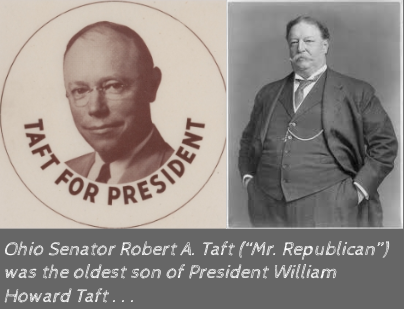
  Nixon understood that the Republicans placed a high priority on backing party members from the Sunbelt, especially from CA and TX. Beginning in 1948 the Republicans would nominate a candidate from the Sunbelt for President or Vice-President for 14 of the next 16 conventions. It seemed likely that whoever won the Republican nomination in 1952, Ike or Senator Robert A. Taft, he would look West for his Vice-President. Nixon liked the chances of former general Dwight Eisenhower to win the nomination, and Ike’s stand on the issues mostly matched Nixon’s. In 1951, Nixon became an overt supporter of Ike, thinking that by doing so he might make the short list for VP. 
     In May 1951 while in Paris, Ike (the #1 NATO general) reached out to Nixon, who was in Geneva for a World Health Organization (WHO) conference. Nixon presented himself to Ike as a loyal subordinate, and they talked for 45 minutes. Nixon liked that Ike paid just as much attention when he listened as when he talked. Nixon was strong on the three major issues the Republicans would focus on in 1952: Korea, corruption in the Democratic Party and the battle against Communism. Nixon shared Ike’s internationalism, while Taft was basically an isolationist. Ike didn’t categorize Nixon in the same way as he had Senator Joseph McCarthy and his thugs, or with the Old Guard Conservatives of the GOP.

Picture
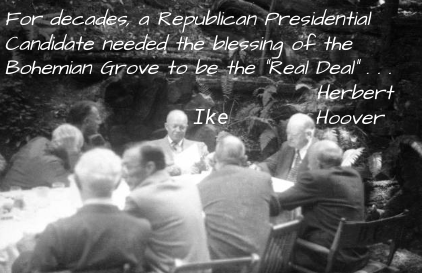
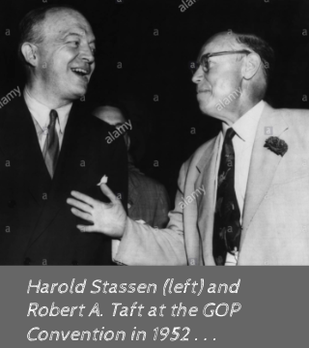
     Three weeks later, Nixon was part of a confidential strategy meeting in which Harold Stassen would announce his candidacy, and then drop out when Ike formally announced in order to try and deny Taft the nomination in Chicago. During a gathering at the Bohemian Grove, most of the power brokers agreed that Ike/Nixon would be a solid ticket for the Republicans in 1952. The skunk in Nixon’s garden party was Earl Warren, who wanted to be President, but like Herbert Hoover, he didn’t want to get his hands dirty in pursuit of the office. Warren wanted the status that Ike enjoyed, being the statesman far above the fray. Warren always wanted the help of others to pursue his political goals, but when he saw someone coming up the ranks, he did his best to keep him down.
     Ike remained in Europe, waiting to be drafted for the Republican nomination by an adoring public. Warren played coy, hoping that, as a Favorite Son from CA, the convention would turn to him if there was a deadlock among the delegates. Heading into the Republican National Convention of 1952, Nixon and Warren were on a collision course. Warren hoped that he could keep CA’s delegation in his corner, and therefore deny Taft or Ike the nomination on the 1st ballot. Nixon wanted Ike, with his conspicuous help, to secure the nomination on the 1st ballot, and then perhaps be offered the other spot on the ticket.

0 Comments

"Tricky Dick" vs. the "Pink Lady" (1950), Part One

12/1/2019

0 Comments

 
                    Source: John A. Farrell. Richard Nixon - The Life (2017)
Picture
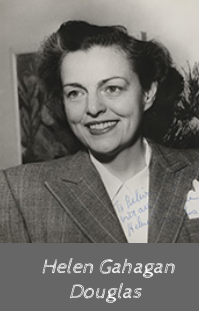
     The Central Valley Project in the San Joaquin Valley (1935) was designed to bring water to small farms in order to encourage rural development; the project featured a 160 acre limit on water usage per unit (farm). The senior Senator from California, Sheridan Downey (Democrat), was against the New Deal plan from its inception.  However, Representative Helen Gahagan Douglas, a Republican from a district in Los Angeles and a staunch supporter of FDR, kept the original vision of the Central Valley Project in her heart. That meant that Gahagan Douglas wanted the project to focus/benefit the small family farmer instead of corporate agriculture. 
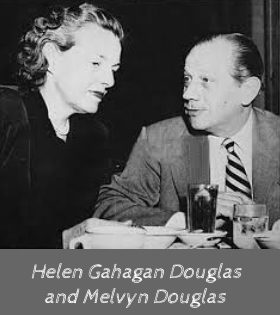
   Gahagan Douglas concluded that Downey needed to be taught a lesson for becoming conservative as a Democrat during the Great Depression, so she challenged Downey in the Democratic primary. By that time, Gahagan Douglas had married the famous movie actor Melvyn Douglas, and they had become the classic liberal couple in Hollywood. Gahagan Douglas had won a seat in Congress in 1944, and she was a favorite of both FDR and Eleanor Roosevelt. Helen Gahagan Douglas, like Jerry Voorhis, was more of a show horse than a workhorse, but she was an earnest diva, putting in enough hours to become familiar with a range of issues. 

Picture
    Gahagan Douglas was an enthusiastic supporter of SecAg Henry Wallace (the most liberal New Deal Democrat in the FDR’s administration), the United Nations, and for international control of atomic energy; she was against the Truman Doctrine (Containment) and HUAC (the House Un-American Activities Committee).  Gahagan Douglas was in a political conundrum, in that the well-to-do saw her as a traitor to her class (as they did with FDR), and conservatives simply believed she was a dupe for Stalin. Added to the mix was the antipathy she faced simply because she was a woman in a “man’s job”. 
     Gahagan Douglas had become used to the spotlight and criticism, but she failed to see the coming seachange in the political landscape after World War II, and that’s where Nixon would have her beat. California Democratic leaders wanted her to drop her challenge to Downey in 1950, and if she did so, she would be rewarded with the state party’s support to pursue the other CA Senate seat in 1952, held by William Knowland. The supporters of Gahagan Douglas assumed that her aura would carry the day, no matter the challenger or the situation. and perhaps Gahagan Douglas viewed herself in the same way since she refused to withdraw from the Senate Democratic primary in 1950. 
     The CA Democratic leadership asked Gahagan Douglas to reverse her stand on the Tidelands Oil issue, and she refused to do so, even though that would have meant more than enough money for her campaign. As a result, money poured in against her from conservative industrial/commercial oil interests, which meant she was totally dependent on New Deal liberals from the start of her campaign. During October 1949, Gahagan Douglas officially declared herself a candidate for the US Senate from California.

Picture
     In the meantime, Representative Richard Nixon’s rising star on Capitol Hill had dimmed since Truman won re-election and the Democrats took control of both houses as a result of the Election of 1948 (there was no way that Nixon could know that the Republicans would only control the House for two of the next forty years). To Nixon, the only plausible chance for advancement in politics was running for the Senate in 1950; already, Nixon was thinking of the White House. Pat Nixon viewed a Senate seat more positively in that with a six year term there would be far more permanency in their lives. 
    Nixon had to get the blessings of CA Governor Earl Warren and Senator Knowland, and the Lt. Governor of CA needed to stay out of the race altogether. Nixon also knew that he needed the political editor of the Los Angeles Times, Kyle Palmer, in his corner. Palmer hadn’t fully supported Nixon in 1946 until the campaign was at its end, but he had kept track of Nixon since, and he wasn’t going to wait too long in 1950. Palmer also knew that Warren and Knowland owed the LA Times for its support of their winning campaigns, so that meant that Palmer was able to get both CA politicians on board the Nixon train. It was the start of a sort of political bromance between Nixon and the LA Times that would continue while Nixon was in the Senate. 
     Palmer’s vision was that there would be a President from California that was at least partially beholden to the Los Angeles Times . . . and Kyle Palmer. Palmer’s #1 guy for that dream was Earl Warren, but Palmer decided to hedge his bet with Nixon, who he viewed as an excellent backup. Palmer helped clear the way for Nixon on the CA Republican Party, telling those that needed to know that the LA Times was only going to support Nixon; the clear implication was that if the CA Republicans wanted the support of the LA Times, find another election in which to run. 

Picture
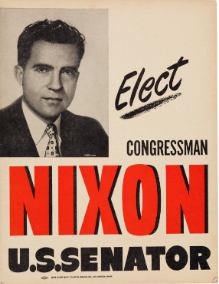
    When Nixon heard that Gahagan Douglas was challenging Downey, that made Nixon’s decision to run for the Senate permanent.  The Senate campaign of 1950 was when Nixon and Murray Chotiner (his main campaign strategist/detail man) seamlessly meshed together; both were ruthless, righteous, very hard-working, and liked to be on the attack. Nixon and Chotiner believed that Downey needed to be culled from the political herd, and that Gahagan Douglas was a Socialist stooge for Joseph Stalin. 
   Chotiner was paid $937.50/month to be Nixon’s point man, and his first order of business was to make Nixon’s name known to all of California instead of only in the 12th Congressional District. Chotiner set up two separate campaign committees for Nixon, one in Southern CA and the other in Northern CA, since each were politically different regions. Early in the campaign, Chotiner warned Nixon that the Republican party couldn’t be the “Party of No”, and that Nixon would have to be able to answer questions and communicate solutions (e.g. Truman’s plan for health care vs. Republican outcries that it was Socialism). Chotiner kept reminding Nixon that, as a Republican, he needed to do more than just point out the evils of a Democratic plan or strategy.

Picture
     Chotiner knew that in order to win Nixon had to get thousands of CA Democrats to vote for him, since CA was 60% Democratic to a (rising) 40% Republican. Nine months before the election, the Los Angeles Times fully and enthusiastically endorsed Nixon for the Senate. 
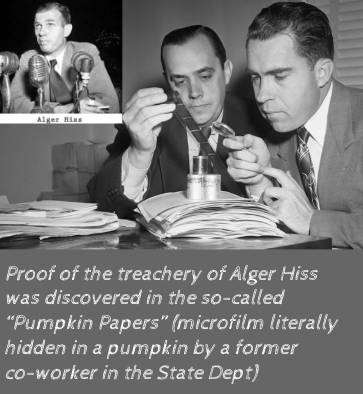
     Then, a federal judge in essence set aside the perjury conviction of Alger Hiss, and Nixon demanded an investigation of the judge. Given this great opportunity for a retrial, Hiss, who always thought he was smarter than everyone else, changed his lawyer . . . the very lawyer that had succeeded in reversing his perjury conviction.
​     On 21 January 1950, Alger Hiss, with his new lawyer, was again found guilty of perjury. Nixon could breathe easier, since his crowning achievement that had made him a national political figure, the discovery that Alger Hiss had given information to the USSR while working in the State Department, was still valid    (the statute of limitations had expired for espionage, so the best Nixon and HUAC could do was to go after Hiss for perjury). Nixon wanted/needed his Cold War Communist-hunting credentials to be immaculate for his campaign against Helen Gahagan Douglas for the US Senate in California in 1950, so on the House floor, Nixon retraced what he had always called the “Hiss Case”.

0 Comments

"Tricky Dick" vs. the "Pink Lady" (1950), Part Two

12/1/2019

0 Comments

 
                       Source: John A. Farrell. Richard Nixon - The Life (2017)
Picture
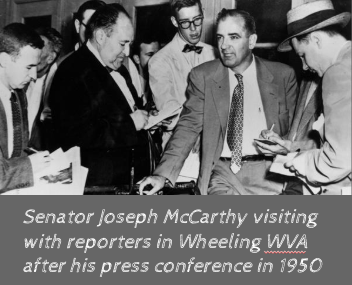
   The junior Senator from Wisconsin, Joseph McCarthy (Republican), used some of Nixon’s phrases from his review of the “Hiss Case” just a few days later on 9 February 1950, when he launched a Communist witch hunt that would bear his name in a press conference in Wheeling (WVA). The Associated Press picked up McCarthy’s claim that there were Communists in the State Department, and just like that McCarthy became a national political figure without having to actually find a Communist spy, which Nixon had painstakingly done with Hiss. 
    From Truman-on-down, the Democrats attacked McCarthy, but the Republicans rallied around a bully, since by 1950 the GOP had concluded that there were more votes to be had via the Red Scare. The year 1950 proved to be pivotal, in that Hiss had been convicted for a second time in January, and later that month Truman announced that the US would develop the hydrogen bomb (a.k.a. the “Super”).  A few days later the government released details about Klaus Fuchs and other USSR spies that had stolen US atomic secrets, and soon Julius and Ethel Rosenberg were arrested for espionage. Fear of Communists in the US (the “Enemy Within”) had officially reached epidemic levels in 1950, and McCarthy’s witch hunt would fan the flames.

Picture
     In the midst of all of this, Truman ignored FDR’s sage advice to avoid taking sides in an anti-colonial war of independence; Truman approved the first million dollar aid package to French Indochina. Nixon viewed McCarthy as a reckless ally in the hunt for Communists in the US, and he urged McCarthy to make an extra effort to be accurate with his accusations. 
     As the Spring of 1950 progressed, Nixon and Chotiner were convinced that they needed to ramp up their strategy from 1946 against Voorhis for the Senate race. Nixon was advised by a prominent CA Republican that he should portray Gahagan Douglas as an actual member of the Communist Party instead of a dupe for Stalin. Downey pulled out of the Democratic primary for health reasons (he was 65), and a Democrat in the primary that had no chance of winning called Gahagan Douglas the “Pink Lady”. Even though he had withdrawn, Downey chimed in, loudly stating for the media that Gahagan Douglas had opposed the Truman Doctrine and had also opposed additional funding for HUAC, which according to Downey, assisted Soviet tyranny.

Picture
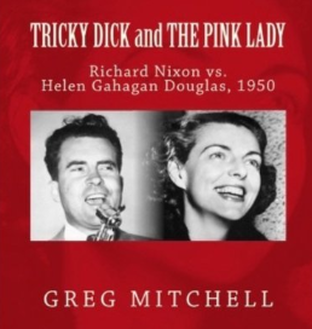
     Due to CA rules and the squabbles among the Democrats, Nixon saw an opportunity and ran in both the Democratic and Repubican primaries for the Senate. It was actually a kooky unelectable Democratic candidate that was trying to deny Gahagan Douglas victory that gave Nixon the nickname that would stick with him forever: “Tricky Dick” (it was in a full page newspaper ad). When the dust settled, it was Gahagan Douglas vs. Richard Nixon in general campaign for a seat in the US Senate in 1950. Chotiner believed that women voters would not flock to Gahagan Douglas in droves, since women were (and are) hard on other women and that she was an upper-class liberal. Almost twenty years before the Feminist Movement gained traction, millions of women still believed that women should remain in the private sphere, and those, like Gahagan Douglas that dared to dabble in the public sphere, were usually punished in one way or another. That being said, Nixon and Chotiner both believed that the “Pink Lady” strategy was the surest route to victory.
     On 24 June 1950, Nixon was on his way to CA after finishing a session of Congress when news broke of North Korea’s surprise attack on South Korea; the US would again be at war, and Communism was no longer a theoretical danger. Gahagan Douglas wasn’t an idiot; she was fully aware of the damage done to her in the Democratic primary in terms of distorting her record as well as the “Pink Lady” label, and she believed that a preemptive strike on Nixon would be her best strategy. Gahagan Douglas focused on Nixon’s vote against a $60m aid package to South Korea in January 1950, arguing that Nixon had helped cause the Korean War. Nixon fumed, in that he voted against the bill because it didn’t include aid for Chiang Kai-Shek and Taiwan. Nixon played the accepted game of not voting for the original bill in order to extract something better for later.

Picture
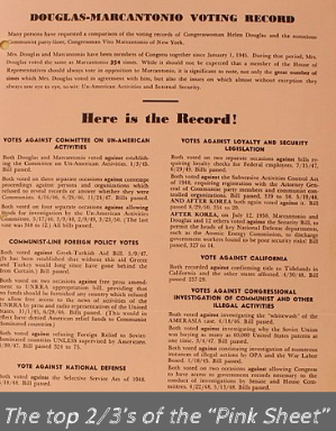
     Gahagan Douglas didn’t have the media on her side (in particular the LA Times) to make the charges stick in the memory of the voters. Also, by striking first, she was fair game for Nixon’s full attack; Gahagan Douglas gave Nixon the gift of being the aggrieved party seeking redress from an unfair charge. To start, Nixon portrayed Gahagan Douglas as a stooge for Stalin, but soon the “pink sheet” was issued at Nixon campaign rallies that distorted the record of Gahagan Douglas. 
   Contained in the pink sheet was a comparison of the voting records of Gahagan Douglas and a fellow representative from NYC who followed the Communist Party’s line. NIxon outlined the times that Gahagan Douglas voted the same as the NYC representatives; his goal was to get all of CA talking about the treachery of Helen Gahagan Douglas.

Picture
   During August 1950, the old Mundt-Nixon bill was introduced under the new title of the Subversive Activities Control Act, and Gahagan Douglas was one of only 20 in the House that voted against the bill. At that point, Kyle Palmer started to warm up to the idea of going after Gahagan Douglas, and in his op/eds, he constantly used the word “emotional” when referring to her, as well as other keywords such as “dramatic” and “superficial”.  During October 1950, Nixon made it clear that he was accusing Gahagan Douglas of actions that were inspired and/or approved by the Communist Party. 
     Gahagan Douglas was limited by a lack of funding and mostly negative attention by the media. Gahagan Douglas reported campaign spending of $156k, while Nixon reported $750k (which was probably too low). Neither the White House or the Democratic National Committee made much of an effort on behalf of Gahagan Douglas, but her campaign was inept/inefficient compared to Nixon’s juggernaut. During the weeks before the election, news from Korea was awful, in that US troops were not holding their own against the North Korean and Chinese armies, which benefited Nixon's campaign. In the days before the election, Nixon attacked Gahagan Douglas for her opposition to ban Communist China from the United Nations. Nixon crushed Gahagan Douglas in the election, garnering 59% of the vote; at the tender age of 37, Richard Nixon was a United States Senator.

0 Comments

    Archives

    May 2020
    April 2020
    March 2020
    February 2020
    January 2020
    December 2019
    November 2019
    October 2019
    September 2019
    August 2019
    July 2019
    June 2019
    May 2019

    Categories

    All
    18th Century
    19th Century
    20th Century
    History

Powered by Create your own unique website with customizable templates.