Source: John A. Farrell. Richard Nixon - The Life (2017)
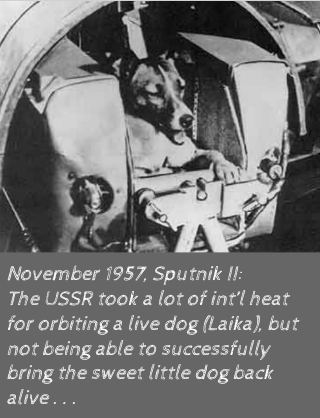
The true impact of Sputnik, which was launched on 4 October 1957, was political. The perception of a “Missile Gap” with the USSR would not go away anytime soon (even though the USSR in fact hardly had any operational ICBMs into the 1960s). America’s prestige suffered, as did Ike’s as a military genius. The intellectual elites and their supporters viewed the “Happy Days” of the 1950s as pure complacency, During November 1957, Ike suffered a stroke (and the USSR orbited Sputnik II), and he was in far worse shape that the public was told. But again Ike recovered, and again VP Nixon won accolades for his loyalty.
The Democrats decided it was time to play the “change card”, and JFK would take full advantage. In many ways, JFK was the opposite of Nixon, but they had some things in common, such as family troubles and a desire for glory. But JFK (and his campaign manager RFK) had far fewer scruples than Nixon in terms of politics and campaigning, and they targeted Nixon’s #1 campaign guy, Murray Chotiner, for destruction. RFK was counsel to a Senate committee which went after Chotiner for trading access to Nixon for personal gain. Chotiner was forced to leave the Nixon fold, and the Vice-President would be without his valuable help and expertise in 1960.
The Democrats decided it was time to play the “change card”, and JFK would take full advantage. In many ways, JFK was the opposite of Nixon, but they had some things in common, such as family troubles and a desire for glory. But JFK (and his campaign manager RFK) had far fewer scruples than Nixon in terms of politics and campaigning, and they targeted Nixon’s #1 campaign guy, Murray Chotiner, for destruction. RFK was counsel to a Senate committee which went after Chotiner for trading access to Nixon for personal gain. Chotiner was forced to leave the Nixon fold, and the Vice-President would be without his valuable help and expertise in 1960.
There were many serious impediments to JFK being a serious contender for the Democratic nomination, such as his relative youth, uninspiring legislative record, religion (Catholic), having a possible traitor for a father, and being friends with Senator Joseph McCarthy. When JFK made a spirited and competitive bid for the VP slot at the Democratic National Convention in 1956 (losing out to Senator Estes Kefauver), JFK and RFK realized that those impediments were surmountable.
To JFK, Sputnik was sent from Heaven, since it made Ike vulnerable on national security. Nixon advised Ike and his Circle of Trust that things would get worse on the national security front before it improved. To Nixon’s frustration, Ike’s overall approach as his second term ended was to be a caretaker, holding serve before he left the White House.
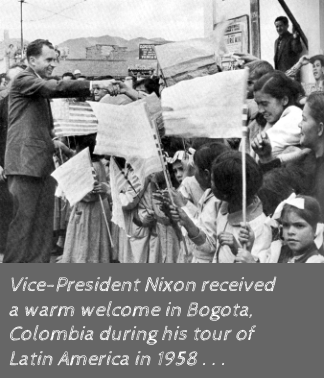
Nixon’s march to the Republican nomination in 1960 featured hard-won ascents, slip-ups, and resiliency. One of the events that enhanced Vice-President Nixon’s political street cred was getting ambushed in his motorcade in Caracas (Venezuela) by a mob in the Spring of 1958. Trouble during VP Nixon’s South America Goodwill Tour started in Peru, where Nixon was told by the US Ambassador to Peru that if he made a public appearance, a violent mob almost certainly would be waiting. Nixon’s dilemma: should he cancel his appearance, where he and the US would look weak, or should risk his safety and make his appearance. Nixon actually walked into the crowd, and rocks were thrown, with at least one hitting Nixon on the shoulder. Nixon demanded a dignified walk back to the cars, and as the convertible drove away, a Secret Service agent held down Nixon’s ankles to keep him in the car.
To JFK, Sputnik was sent from Heaven, since it made Ike vulnerable on national security. Nixon advised Ike and his Circle of Trust that things would get worse on the national security front before it improved. To Nixon’s frustration, Ike’s overall approach as his second term ended was to be a caretaker, holding serve before he left the White House.
Nixon’s march to the Republican nomination in 1960 featured hard-won ascents, slip-ups, and resiliency. One of the events that enhanced Vice-President Nixon’s political street cred was getting ambushed in his motorcade in Caracas (Venezuela) by a mob in the Spring of 1958. Trouble during VP Nixon’s South America Goodwill Tour started in Peru, where Nixon was told by the US Ambassador to Peru that if he made a public appearance, a violent mob almost certainly would be waiting. Nixon’s dilemma: should he cancel his appearance, where he and the US would look weak, or should risk his safety and make his appearance. Nixon actually walked into the crowd, and rocks were thrown, with at least one hitting Nixon on the shoulder. Nixon demanded a dignified walk back to the cars, and as the convertible drove away, a Secret Service agent held down Nixon’s ankles to keep him in the car.
The reporters that had tagged along with Nixon wrote glowingly about the audacity/bravery of the VP, and Ike sent Nixon a congratulatory cable. When Nixon was back safely in his hotel, he was informed that two figures from the State Department stated that Nixon’s foray into the mob was a bad idea. Nixon demanded that he be connected to the two by phone, and while losing his temper he called them cowards. Nixon demanded that everyone should laud him for his bravery that day.
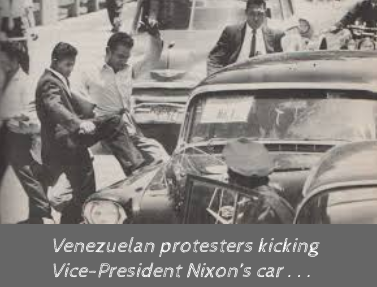
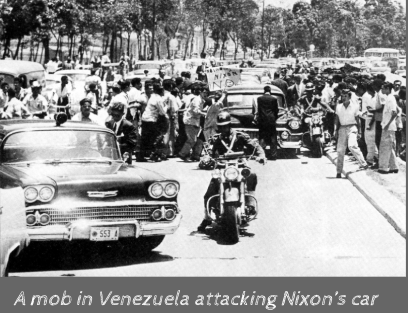
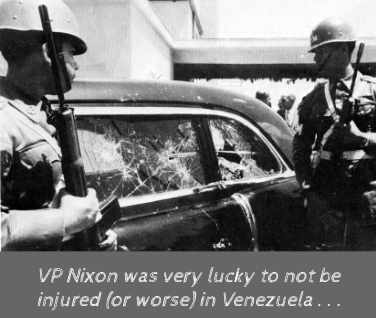
On 13 May 1958, Nixon arrived in Venezuela, where a crowd welcomed the VP by spitting at/on him, a far worse reception than what he experienced arriving in Peru. While Nixon’s motorcade was heading to the grave of Simon Bolivar so Nixon could lay a wreath, the convoy was attacked by demonstrators that rushed up to the cars. Secret Service agents pushed away the demonstrators who had hate in their eyes, and in that mob were hardened battle-tested Communist insurgents. The mob started to rock Nixon’s car, and Nixon ordered the Secret Service detail in his car to not do anything unless he was forcibly removed from the car. Finally, the Venezuelan police ended the sham traffic jam which had forced the motorcade to stop, and the US contingent sped away. Later, when Nixon processed what had happened, he concluded that he had gone through a near-death experience.
On 13 May 1958, Nixon arrived in Venezuela, where a crowd welcomed the VP by spitting at/on him, a far worse reception than what he experienced arriving in Peru. While Nixon’s motorcade was heading to the grave of Simon Bolivar so Nixon could lay a wreath, the convoy was attacked by demonstrators that rushed up to the cars. Secret Service agents pushed away the demonstrators who had hate in their eyes, and in that mob were hardened battle-tested Communist insurgents. The mob started to rock Nixon’s car, and Nixon ordered the Secret Service detail in his car to not do anything unless he was forcibly removed from the car. Finally, the Venezuelan police ended the sham traffic jam which had forced the motorcade to stop, and the US contingent sped away. Later, when Nixon processed what had happened, he concluded that he had gone through a near-death experience.
Media accounts in the US portrayed Nixon as cool under fire while in Peru and Venezuela, while also defending the nation’s honor. Nixon was warmed/thrilled to see a large and enthusiastic crowd welcome him back to the National Airport in DC, and among those in the crowd was President Eisenhower. Nixon’s experience in South America was the cover story of Life magazine, and Nixon’s popularity surged since he was seen as a genuine American hero. One of the reasons why the public’s imagination was captivated by Nixon’s actions in South America was that the public wanted/needed leadership and decisiveness, which Ike wasn’t providing.
During the Fall of 1958, Nixon experienced a valley instead of a pinnacle, with the Republicans getting their hats handed to them in the Congressional Elections of 1958. The Republicans were about as dispirited as they had been after FDR and the Democrats drubbed them in 1932. The furor over Sputnik had been followed by a recession, rising unemployment, trouble in the agricultural sector, and corruption in the federal government, which included Chief of Staff Sherman Adams (he had accepted gifts in ways that looked dishonest). Ike couldn’t bring himself to fire Adams, so he enlisted VP Nixon (among others) to do his dirty work. Nixon absolutely hated face-to-face confrontation, but he did his best to convince Adams to fall on his sword for Ike. Nixon called dealing with Adams the single-most difficult task ever given to him by Ike.
During the Fall of 1958, Nixon experienced a valley instead of a pinnacle, with the Republicans getting their hats handed to them in the Congressional Elections of 1958. The Republicans were about as dispirited as they had been after FDR and the Democrats drubbed them in 1932. The furor over Sputnik had been followed by a recession, rising unemployment, trouble in the agricultural sector, and corruption in the federal government, which included Chief of Staff Sherman Adams (he had accepted gifts in ways that looked dishonest). Ike couldn’t bring himself to fire Adams, so he enlisted VP Nixon (among others) to do his dirty work. Nixon absolutely hated face-to-face confrontation, but he did his best to convince Adams to fall on his sword for Ike. Nixon called dealing with Adams the single-most difficult task ever given to him by Ike.
The Republicans lost 48 seats in the House and 13 seats in the Senate. Nixon saw it coming, but he campaigned hard nonetheless, trying to minimize the damage of the train wreck instead of safely sitting on the sidelines. But self-destructing scheming, especially in CA, dearly cost the GOP. It was called the “Big Switch”, where Senator Knowland’s ambition and stupidity collided. Knowland believed that being elected governor of CA would be a much better platform from which to pursue the White House than the Senate, and his wife wanted to leave DC and return to CA.
California already had a Republican governor, Goodwin Knight, who also had designs on the White House and an ambitious wife. Since Ike’s heart attack, Knowland and Knight had done their best to keep Nixon from ascending to the pinnacle of the GOP, and the “Big Switch” was in effect their strategy to deny Nixon the nomination in 1960 while advancing their own ambitions. In the Fall of 1957, Knowland announced that he was running for CA governor no matter what Knight planned on doing. To avoid a destructive Republican primary, Palmer and Nixon convinced Knight to pursue Knowland’s soon-to-be vacant Senate seat. Knight resisted until the CA Republican Party threatened to cut off campaign funds. The whole affair played out in public, with even the wives going at each other in the media.
California already had a Republican governor, Goodwin Knight, who also had designs on the White House and an ambitious wife. Since Ike’s heart attack, Knowland and Knight had done their best to keep Nixon from ascending to the pinnacle of the GOP, and the “Big Switch” was in effect their strategy to deny Nixon the nomination in 1960 while advancing their own ambitions. In the Fall of 1957, Knowland announced that he was running for CA governor no matter what Knight planned on doing. To avoid a destructive Republican primary, Palmer and Nixon convinced Knight to pursue Knowland’s soon-to-be vacant Senate seat. Knight resisted until the CA Republican Party threatened to cut off campaign funds. The whole affair played out in public, with even the wives going at each other in the media.
In the midst of all that scurrilous hoo-haw, Knowland came out in support of a “right to work” initiative that labor unions absolutely hated. Edmund “Pat” Brown (D), the California Attorney General, hammered Knowland by over one million votes, and Knight lost his Senate race by a similar margin. The CA Republican Party, who held so much power in the state for so many years, was gutted. While Nixon enjoyed seeing to CA GOP rivals do themselves in, it was now far more difficult to get California in his column if he ran for President in 1960.
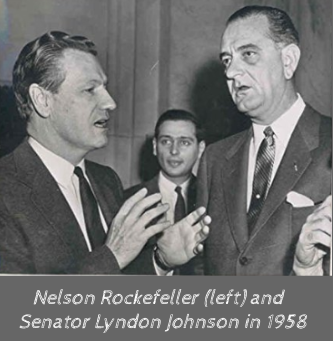
In New York, liberal Republican Nelson Rockefeller was elected governor, and he would prove to be the main obstacle for Nixon’s pursuit of the GOP nomination in 1960. As 1958 closed, Nixon had serious doubts that he could win the nomination, whereas JFK/RFK were very optimistic of their prospects, since they had been campaigning in effect since 1956. Then, all of a sudden, Nixon found himself at another pinnacle with the “Kitchen Debate” with USSR Premier, Nikita Khrushchev, in 1959.
In New York, liberal Republican Nelson Rockefeller was elected governor, and he would prove to be the main obstacle for Nixon’s pursuit of the GOP nomination in 1960. As 1958 closed, Nixon had serious doubts that he could win the nomination, whereas JFK/RFK were very optimistic of their prospects, since they had been campaigning in effect since 1956. Then, all of a sudden, Nixon found himself at another pinnacle with the “Kitchen Debate” with USSR Premier, Nikita Khrushchev, in 1959.