Mr. Jensen's U.S. History Website
  • U.S. History Blog
    • U.S. History Blog (May 2026 - May 2027)
    • U.S. History Blog (May 2025 - May 2026)
    • U.S. History Blog (May 2024 - May 2025)
    • U.S. History Blog (May 2023 - May 2024)
    • U.S. History Blog (May 2022 - May 2023)
    • U.S. History Blog (May 2021 - May 2022)
    • U.S. History Blog (May 2020 - May 2021)
    • U.S. History Blog (May 2019 - May 2020)
    • U.S. History Blog (May 2018 - May 2019)
    • U.S. History Blog (May 2017 - May 2018)
    • U.S. History Blog (May 2016 - May 2017)
    • U.S. History Blog (May 2015 - May 2016)
    • U.S. History Blog (May, 2014 - May, 2015)
  • About

John Adams vs. Thomas Jefferson & James Madison, Part Two

11/2/2019

0 Comments

 
  Source: Joseph J. Ellis. Founding Brothers - The Revolutionary Generation (2000)
Picture
     During Abigail’s absence (she was ill back in Quincy, MA), on 18 February 1799 Adams announced that he was sending another delegation to France, and he did so without consulting a single Federalist. Scuttlebutt in the newspapers was that Adams made the decision because Abigail wasn’t there to talk him out of it. That decision proved to be Adams’ greatest as President in that the delegation was able to end the quasi-war with France. In addition, Adams was the first to implement one of Washington’s main points from his Farewell Address. Also, Adams’ decision established a precedent of US isolationism from European wars that would last until WW I. But Adams’ unilateral (and historically correct) decision cost him politically, in that Adams alienated himself from almost all the Federalists since his decision was viewed as pro-French. 
   Adams sent the delegation for three reasons. The first reason
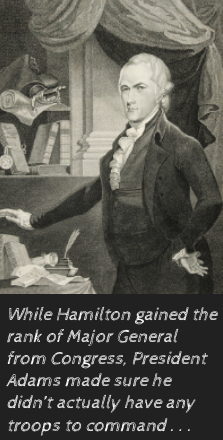
centered on Hamilton, who in 1798 pressed hard for the creation of a vastly expanded Provisional Army (“New Army”) of 10,000 - 30,000 men to be ready for war against France. Adams was more-than-fine with an expanded Navy, but he saw an expanded Army as dangerous, expensive, and utterly unnecessary/useless against France. Adams came to realize that Hamilton was trying to become an American Caesar with the New Army, with the ultimate goal of installing himself as a military dictator. So, if there was no war with France, there would be no need for the New Army, which would then de-fang Hamilton. Secondly, JQA had even more intelligence than Gerry, telling his father that Talleyrand himself was eager for peace with the US, which meant that the peace delegation would ultimately be successful. Thirdly, Adams found great personal satisfaction in succeeding in the face of what both rival parties wanted, and that his decision must have been the right one since both parties railed against his action. Like President Jimmy Carter, Adams valued long-term national interest over short-term politics.
Picture
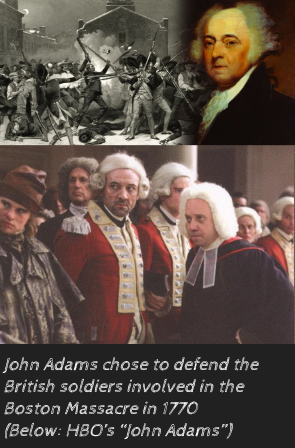
     It wasn’t the first time that Adams had run counter to what was expected of him . . . don’t forget that Adams decided to serve as the defense attorney for the British soldiers after the Boston Massacre in 1770, and that Adams had insisted on independence a full year before others came around. At his core, Adams was an iconoclastic contrarian who relished alienation (JQA and Henry Adams, his great-grandson, exhibited the same traits). In sending the delegation to France, Adams had basically declared himself to be politically independent from both parties. 
     Where Adams saw problems that needed to be solved for the good of the nation, Jefferson and Madison saw opportunities to advance the Republican cause at the expense of the Federalists, a political party that they believed was the enemy to the principles of the Revolution. To Jefferson and Madison, it was a Zero Sum Game, in that if the Republicans gained, the Federalists lost. Even though Adams alienated himself from the Federalists, Jefferson and Madison targeted Adams in the Republican newspapers nonetheless. Jefferson and Madison had talked themselves into believing that Adams actually wanted war with France, and they also believed that Adams had fabricated the entire XYZ Affair in order to mobilize public opinion for war (Interestingly, Jefferson knew better, since he knew that Washington had endorsed Adams’ decision, but he went along with Madison). Adams did his best to isolate himself from the ideological warfare between the two parties, while Jefferson and Madison focused on building momentum at the expense of Adams and the Federalists for the Election of 1800.
Picture
     In Jefferson’s mind, he was taking the high road, but he contracted James Callender to be his pit bull publisher to go after Adams and the Federalists in 1798 (which made it easier for Adams to sign the Alien and Sedition Acts). Jefferson complained that the debate over the Alien and Sedition bills was aimed directly at him; he admitted to Madison that he had passed information to the French government via a pro-French Republican. That being said, Jefferson truly felt that he was in the right, in that the Alien and Sedition Acts and the New Army were Federalists power grabs that violated the tenets of the Revolution.  By today’s standards, Jefferson’s actions in giving information to the French would be an impeachable offense, but Hamilton was guilty of similar actions before/during the negotiations on the Jay Treaty with Great Britain (and Hamilton’s shenanigans with Adams’ Cabinet would have landed him in jail today). During the mid-to-late-1790s, there was no political center because that center simply didn’t exist. 
    The capstone of Jefferson’s and Madison’s opposition to the Federalists were the
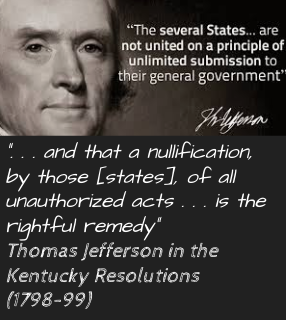
Kentucky and Virginia Resolutions of 1798 - 1799. Jefferson visited Madison at Montpelier on 2 & 3 July 1798 in order to discuss strategy. The Alien and Sedition Acts passed on 4 July 1798; to the Federalists, it was the perfect day-and-way to celebrate the nation’s independence. During August/September 1798, Jefferson worked alone at Monticello in order to write the Kentucky Resolutions (in effect, Jefferson was a ghostwriter using the Kentucky state legislature as his publisher). Jefferson took what would become the classic states’ rights position, arguing that a state had the right to interpret, and then if desired, nullify an Act of Congress (and if ultimately necessary . . . secede). Fortunately for Jefferson, the Kentucky state legislature removed the passages concerning overt nullification and secession, in that such open defiance of federal authority was deemed too risky given the current political landscape.
Picture
     Madison’s more judicious Virginia Resolutions claimed that the Alien and Sedition Acts violated the 1st Amendment. Madison went on to argue that the federal courts, not the states, were the ultimate arbiters of the Constitution. Jefferson’s arguments became the core gospel of the Confederacy in 1861, whereas Madison’s arguments trended towards judicial review. After a personal visit from Madison in September 1799, Jefferson softened his stand on secession, once again deferring to Madison’s judgment. Madison’s intervention may have saved Jefferson’s political future while also concealing a large difference in their interpretations of the Constitution relative to states’ rights. 
     The desire to project a unified Republican front against the Federalists trumped any differences Jefferson and Madison had over the question of where sovereignty should be located in the new republic. Jefferson and Madison had the extra advantage in that they didn’t have to do too much to tear down the Federalists, since the Federalists were doing a nice job of going down the road to ruin enforcing the Alien and Sedition Acts. Had the Election of 1800 in the Electoral College occurred a week or two later, Adams may have defeated Jefferson in that the news of the treaty that ended the quasi-war with France arrived after the election, and too late to help Adams. 
Picture
     The expense of the New Army strained the federal budget to the point where the federal government needed new revenue, which meant that the cost of raising the New Army would be the responsibility of the voting public, but that revelation came too late to help Adams as well. Adams didn’t receive the political rewards that he deserved, and he took the blame for things that had been initiated/done by others. When Napoleon took power in France in 1799, Jefferson flipped his view on France on a dime, and went down the same path of neutrality as Washington and Adams had done. 
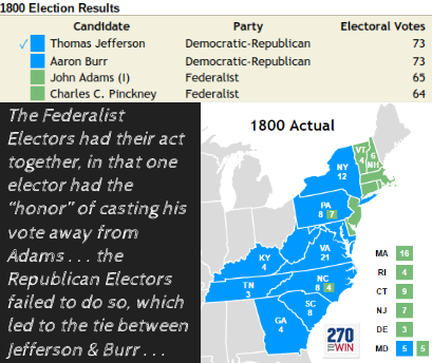
 In the end, the maneuverings/shenanigans of Aaron Burr in New York that gave Jefferson 12 Electoral Votes proved to be the difference in the Election of 1800 (Jefferson 73; Adams 65). Too late to have made a difference in the election as Hamilton’s 54 page diatribe against Adams in a pamphlet (Hamilton saw Adams as the villain that denied him glory as an American Caesar). Hamilton showed the deep divisions within the Federalists, and that he was out of his mind; writing that pamphlet was just as reckless as deciding to face Burr in The Duel.
     Jefferson saw his victory as a recovery (renewal) of the principles of the Revolutionary War. It turned out that Adams had it wrong, in that he could have separated the long-term collective national interest from partisan politics if he had chosen to do so, which in effect lost him re-election. Now that Jefferson was President, he no could no longer claim to be above the (political) fray. Meanwhile, Adams had to move to the new Presidential mansion in the new capital while the House of Representatives tried to sort out the tie in the Electoral College
between Jefferson and Burr (each received 73 Electoral Votes). Adams and Jefferson didn’t exchange another word for twelve years . . .
0 Comments

John Adams vs. Thomas Jefferson & James Madison, Part One

11/2/2019

0 Comments

 
  Source: Joseph J. Ellis. Founding Brothers - The Revolutionary Generation (2000)
Picture
     As the Election of 1796 approached, to the Electors in the Electoral College the real meaningful difference between the major candidates were their Revolutionary War credentials. In other words, the main qualification for the Presidency was the candidate’s historic role in the Revolution. Only the 30 or so that stepped forward at the national level for the good of the fledgling nation were eligible to be President. But by 1796, two clear front runners had emerged from the 30+, John Adams and Thomas Jefferson. 
     By 1796, Adams and Jefferson were political rivals, but they earned their impeccable credentials concerning the Revolution together. Choosing between the two was like trying to select the head or the heart of the Revolution. Adams became active in Boston during the Stamp Act in 1765, and soon he was a constant opponent of British policies in the Colonies, especially by 1774 with the Intolerable Acts. Despite his tremendous contributions, Adams’ reputation fell in large part because he was the first Vice-President, which proved to be a meaningless elected post. Adams deeply resented being marooned and muted in the Senate, and President Washington rarely consulted his Vice-President.

Picture
     Adding to the troubles of Adams was that based on the essays he published as VP, his support for a strong Executive was taken by many as support for a monarchy in the US, which was a misunderstanding to be sure, but the way Adams worded his essays left him open to such attacks. It was then, if not before, that the friendship of Adams and Jefferson became seriously stressed, which could be seen in their correspondence. Jefferson believed that Adams had been inadvertently taken in by the Federalist monarchists. Jefferson and Adams remained cordial during Washington’s first term, in large part because Vice-President Adams was muted and Secretary of State Jefferson was part of Washington’s Cabinet. 
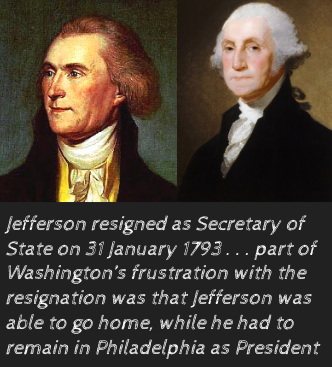
     It was Jefferson’s over-the-top support of the French Revolution that did it for Adams, who though it was lunacy that anyone could see similarities between the American and French Revolutions. Adams began to describe Jefferson as a “dangerous dreamer” and a man “poisoned by ambition”. By the time Washington accepted Jefferson’s resignation as SecState on 1 January 1794, only a remnant remained of Jefferson’s and Adams’ friendship. By the mid-1790s, Jefferson and Madison had become the Republican dynamic duo, and the only true confidant Adams had was his wife Abigail.

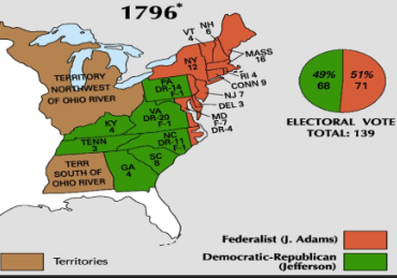
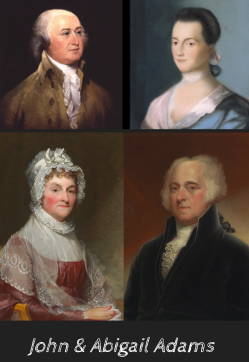
     To Adams, being the second President was his ‘Revolutionary Right” that he had earned not only by his many years of distinguished service before/during/after the Revolutionary War, but also for languishing for eight years as Vice-President. In March and April 1796, John and Abigail Adams did the Electoral College math state-by-state; Adams predicted a very tight election, even a tie. Abigail still believed that Jefferson as VP would work out okay with her husband as President. After many nervous moments and many temper tantrums, Adams found out that he had prevailed over Jefferson 71 - 68 in the Electoral College (two months prior, Jefferson told Madison that he would lose by 3 Electoral Votes).

Picture
     Adams and Jefferson were back together, this time as President and Vice-President, but they had incompatible political ideals and strategies. Adams wanted to bring Jefferson into his Circle of Trust where Adams would treat Jefferson as Washington should have treated VP Adams. But trust from Jefferson was no longer on the table in that as early as 1793 Jefferson and Adams had been on opposite sides politically with foreign policy.  A major difference between Adams and Jefferson was that Adams, when push-came-to-shove, was far more willing to negotiate/compromise than Jefferson, who by 1797 had become ideologically rigid (a luxury he would not be able to maintain once he became President). 
     Adams wanted to collaborate with Jefferson, but the Federalists did not want Jefferson in any way on the inside. Jefferson’s first instinct was to accept Adams’ proposal, but Madison would have none of it. Madison threw the gauntlet at Jefferson’s feet, saying he needed to decide on renewing his friendship with Adams or advancing the prospects of the Republicans. Madison made it clear to Jefferson that in no way should he be drawn into the decisions of Adams’ Presidency in that he could hurt the Republicans. Jefferson almost always took Madison’s advice when it was given, but he told Madison that there would be a cost, which would be his dealings with President Adams (added to the mix was Jefferson’s absolute fear of personal confrontation). Adams made a political blunder, keeping Washington’s Cabinet from his second term intact after they had threatened to resign if the President had involved Jefferson in any way. Adams would have been much better off had he got rid of all of them, since not only were they still loyal to Washington, but they were in effect informants for Hamilton.

Picture
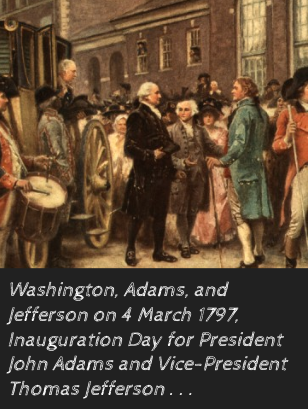
    On 6 March 1797, Adams and Jefferson dined with Washington at the Presidential mansion in Philadelphia. During that dinner, Adam learned that Jefferson would not be a part of his Cabinet and that Jefferson and Madison would not be part of the peace delegation to France.  On 13 March 1797, Adams was sworn in as President in the Senate (the “official” inauguration in those days), and immediately after the inaugural ceremony, Vice-President Jefferson departed for Monticello. Adams soon discovered that his only true political confidant was Abigail. 
     Looking back, it’s hard to find another Presidency more dominated by a single foreign policy problem while at the same time the nation was divided on how to solve it. Adams was the victim of inherited circumstances, as all Presidents have been, for better and for worse. The US was waging an undeclared war on the Atlantic and the Caribbean against French privateers, and Adams faced the dilemma of declaring war on France or go all-in to find a diplomatic solution. Adams opted to build up the US Navy for defensive reasons in case negotiations broke down with France, which was by far the wisest move, but that strategy depended on a normal government in France, and there simply wasn’t one. 
     The Directory was like the shifting sands of the desert, unable to form any kind of cohesion, direction, or consensus concerning the quasi-war with the US. Also, America was seen as only a minor distraction (Britain felt the same) and irrelevant. So the conditions for finding a workable solution to the quasi-war didn’t exist, and President Adams bore the cost. Making the problem worse was the raging ideological debate in America between the Federalists (pro-Britain) and the Republicans (pro-France), with each side viewing the other as traitors to the core principles of the nation as defined by the Revolution.

Picture
     Jefferson was very good at lamenting the chasm between former fellow Revolutionaries, and then doing his best to build walls from his side of the debate. The idea of legitimate political opposition didn’t exist in the late-1790s, and there wasn’t yet any vocabulary to describe the development of political parties as they were growing.  Adams’ Vice-President was the leader of the opposition party, and the President’s Cabinet was loyal to Hamilton (and the memory of Washington), and the emerging role/influence of public opinion was off the rails in the press in terms of attacking the other party and/or its members. The authority of the federal government was not yet formed, and the emerging political parties were too new and ill-formed/informed to effectively cope with the challenges of the new nation. 
     Adams ignored his Cabinet, and in effect Abigail became his one-person administration. Jefferson remained in Philadelphia as VP leading the Republicans while Madison was home at Montpelier. So Adams and Jefferson went their separate political ways with separate Circles of Trust. Adams had no prior experience as an Executive, never having served as a governor (as had Jefferson) or as a military leader. The idea that he should, as President, manage his Cabinet and factions in Congress never occurred to Adams, so he relied on his own judgment (as well as Abigail’s). 
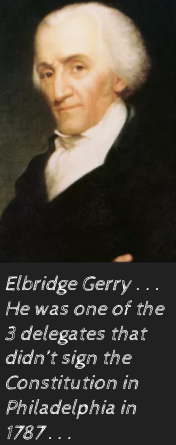
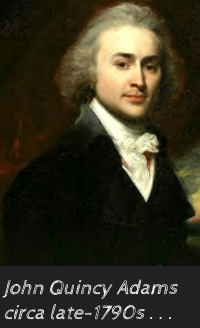
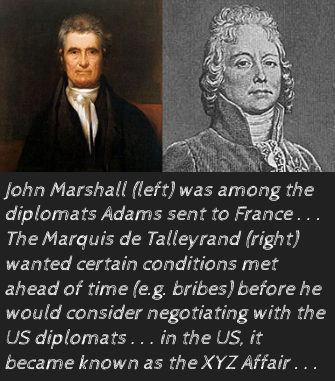
    One of Adams’ unilateral decisions was to include Elbridge Gerry on the delegation he was sending to France. By that point, Gerry saw the French Revolution in the same way as Jefferson, but even so, Adams saw Gerry as someone he could trust. plus he knew that Gerry could be bipartisan. Adams appointed his son, John Quincy Adams, to be the US Minister to Prussia despite the obvious nepotism (JQA was more than qualified for the post). In effect, Adams decided to serve as his own Secretary of State, and he wanted trusted men in Europe to let him know what was really going on with the negotiations with France.

Picture
     Gerry informed Adams of the XYZ Affair, and Adams decided to keep it quiet/secret as long as possible in order to buy time in the face of increasing tensions between the US and France, as well as the increasing rhetoric/actions in the US. Gerry remained in Paris, and through him Adams found out that he needed to be patient with the mess that was the French government. Gerry also told Adams that the Marquis de Talleyrand’s shenanigans (e.g. demanding $$ for a bribe) were seen as a gross miscalculation. Gerry, JQA, and other trusted contacts in Europe also counseled patience with France, so Adams decided to hold out for peace in the face of very strong pressure from the pro-British Federalists (e.g. Hamilton) to declare war on France. 
     The Republican newspapers, controlled/influenced by Jefferson, savaged and vilified Adams, which in large part led  Adams (with Abigail’s blessing) to sign into law the Alien and Sedition Acts (1798), which was Adams’ biggest blunder as President. Adams went to his grave arguing that he signed those four bills into law very reluctantly under intense pressure from Federalist extremists, and that those laws never had his support once put into effect, which was all true enough. Moderate Federalists like
John Marshall urged Adams to not sign the bills; even Hamilton was lukewarm about the Sedition Act. It was perhaps the one time where Abigail led her husband astray in terms of political advice.

0 Comments

Washington's Farewell Address, Part Two

10/19/2019

0 Comments

 
  Source: Joseph J. Ellis. Founding Brothers - The Revolutionary Generation (2000)
Picture
     There was a constitutional crisis in terms of ratifying the Jay Treaty in 1795. Washington had the secret minutes of the Constitutional Convention in his possession by agreement of all those that participated. According to Washington, those minutes stipulated that treaties were negotiated by the President, and ratified by 2/3’s of the Senate. James Madison had his own notes of the convention, and he went to Monticello to consult with Jefferson. They discovered that Washington was correct, and also that Madison had been one of the staunchest supporters of a strong Executive. 
     Nonetheless, Jefferson concluded that the House was an equal partner in the proceedings concerning the Jay Treaty; if Jefferson had his way, there would have been the kind of gridlock/inaction that he had decried from afar while in France.  Hearings on the House took place in the Fall/Winter of 1795 under Madison’s direction as well as his more narrow interpretation of the Constitution. Madison argued that the House was involved in the ratification of the Jay Treaty in terms of funding. Madison was able to block the treaty while avoiding a frontal assault on the Executive branch. As 1796 dawned, Madison’s bloc of opposition to the Jay Treaty in the House looked to be beyond-solid, but James Madison soon discovered that anyone that went head to head with Washington was bound to lose.

Picture
   Madison’s majority in the House started to melt during March 1796, and he lost the vote in the next month. James Madison blamed the banking interests and the Anglophiles. Jefferson concluded that the Jay Treaty passed in the House due to the immense prestige and influence of President Washington. What was strong Executive leadership that took into account the national interest in the long run looked to Jefferson and Madison as the arbitrary decisions of a king, and the betrayal of the principles of the Revolutionary War. To Jefferson, his vision of the world would only be achieved when the last king was strangled with the entrails of the last priest. 
     As early as 1790, Jefferson believed that the Revolution as he understood it had been hijacked by hostile forces from within, and the chief enemy was the Secretary of the Treasury, Alexander Hamilton.  Initially, Jefferson didn’t see Washington as being anything other than a Colonel Blake (MASH) that wondered what was happening around him, and Jefferson also knew that Washington was untouchable in terms of criticism. But all that changed with the Whiskey Rebellion (1794), where a federal law was enforced for the first time. Jefferson believed that Hamilton had taken over the Executive and that Washington had become senile.

Picture
  Still, Jefferson wasn’t directly accusing Washington of anything, and he did not say or write any criticisms about the President publicly. But his private letters to those that were in his Circle of Trust show that the Jay Treaty was the breaking point for former Secretary of State. Jefferson saw the French Revolution as a continuation of the American Revolution as well as a continuing chapter in the global revolution. Where Washington did not see the war between Britain and France as a threat to the nation’s vital interests (other than trade), Jefferson saw the war in Europe as vital to the future of America.  Jefferson consistently either ignored or glossed over the horrors of the French Revolution, seeing France as a Revolutionary hero and Britain as the counterrevolutionary villain.

Picture
  To Jefferson, Britain was an inherently corrupt society, the bastion of monarchical power. Jefferson’s Anglophobia and other-worldly support of the French Revolution was virulent because it was based on philosophy/theory. Jefferson simply believed that the Jay Treaty put the US on the wrong side of history. For Washington, part of why he left the Presidency after two terms was that he was done with the shenanigans and machinations of fellow Elites such as Jefferson. Washington wanted to harness the energies of the US after the Revolution to nation-building, while Jefferson saw that effort/focus as a betrayal of the Revolution. 
   Washington wanted to accomplish three things with his Farewell Address. First, he wanted to demonstrate that he was still very much in charge and nowhere near senile. Second, he wanted to chart a middle course in order to push his critics to the fringes of the ongoing debate over what the Revolution meant. Third, Washington, the master of grand exits, wanted to explain what the Revolution really meant, especially coming together as an increasingly unified nation (much like how the Continental Army hung in there during the Revolutionary War).

Picture
     Washington planted his standard squarely in the field of political combat, inviting citizens to rally behind him even though he was retiring to Mount Vernon. The words of the Farewell Address may have mostly been Madison’s (from 1792 when Washington seriously considered going home) and Hamilton’s, but the ideas were all Washington’s (Hamilton gave nearly perfect wording, phrasing, and tone to Washington’s ideas). Washington strongly hinted that in his absence the federal government would need to become more powerful. 
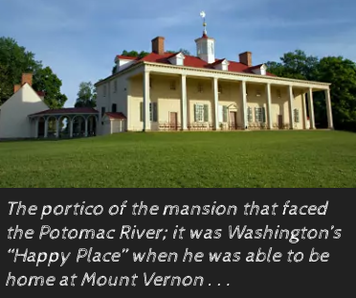
     Reactions to his Farewell Address in public was overwhelmingly positive, with much tearful exuberance, missing the man but embracing his message. Republican newspapers that were a mouthpiece for Jefferson dismissed it as the “loathings of a sick mind”. Washington’s last years at Mount Vernon were spent knowing he was right, but he was also apprehensive that his wisdom would be ignored. Part of Washington’s problem was that his beloved Mount Vernon was located in Virginia, which was the headquarters for Jefferson, Madison, Monroe, and the Republicans . . . in effect, Mount Vernon was an enclave in enemy territory.
0 Comments

Washington's Farewell Address, Part One

10/19/2019

0 Comments

 
  Source: Joseph J. Ellis. Founding Brothers - The Revolutionary Generation (2000)
Picture
    Since 1776, George Washington had been the center of gravity that kept the nation from flying into random orbits and decaying. For twenty years, Washington, from the Revolutionary War and the crucial years afterward, Washington had been at the center of the ring. On September 1796, in the American Daily Advertiser (Philadelphia’s #1 newspaper), Washington announced that he wasn’t going to serve a 3rd term as President. The Courier of New Hampshire gave the article the title of “Washington’s Farewell Address”. Over time, the Farewell Address joined the Declaration of Independence and the Gettysburg Address in the pantheon of America’s documents that outlined the principles of the nation. While historians have many interpretations of what Washington stated, in 1796 the only major takeaway was that Washington was done and going home.
     Washington told Americans that they were on their own since he was going home, and he had some other things to say in addition to his retirement from public life. By the Spring of 1796, the government elites had known Washington was probably leaving  the Presidency. But did Washington actually mean it, since he had, like every other major politician (other than Aaron Burr), had used the Cincinnatus model of appearing to not want the job . . . doing so had become a rhetorical ritual among the political elites. 
    At 6’ 4” and 200 pounds, Washington was always the tallest man in any room. Washington, in almost any other setting or era, would come off as an ugly ogre: he had a pockmarked face (from smallpox), decaying teeth, oversized eye sockets, a massive nose, heavy hips, and huge feet and hands. But the full package that was Washington oozed majesty. Washington didn’t just occupy space, he organized the space around him with an electric presence.

Picture
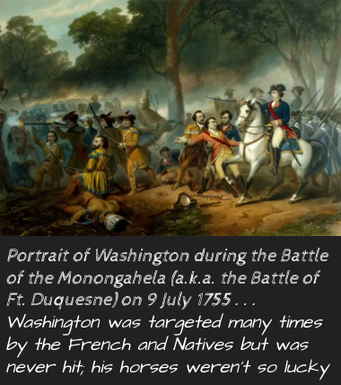
      During the French & Indian War and the Revolutionary War, Washington was constantly targeted and fired upon, but amazingly was never hit (the same couldn’t be said for his horses), and he never got sick while others dropped like flies around him. Washington had an unmatched aura and incredible stamina, and he also had the gift of eloquent silence. It wasn’t until before the Constitutional Convention in 1787 that Washington really had to deal with an illness (not counting his bout with smallpox before the F & I War), and then in 1790, he nearly died of complications from influenza. Washington needed to have a carbuncle removed (a cyst) from his upper thigh in his 1st term, and in 1794 he wrenched his back horseriding when he was touring the area that would become the District of Columbia. So, Washington’s age and health were primary reasons why he wanted to retire and go home to Mount Vernon. 
     By leaving after two terms, Washington established a precedent that the office should outlive the man, which was not the global tradition. In addition to age/health, Washington wanted to leave the Presidency since he had been politically wounded by the harsh political rhetoric in newspapers and pamphlets, the result of the rival political parties (Federalists v. Republicans).

Picture
   Even though egomaniacal idiots like Thomas Paine accused Washington of being a traitor during the Revolutionary War, and that Benedict Arnold beat him to the punch, it was only a vocal minority that criticized Washington. The surest way to destroy one’s reputation as to attack Washington, as Paine soon discovered. Part of the reason Washington was very touchy about any criticism that came his way (after the Revolutionary War) was that he had been on Mount Olympus for so long, and hadn’t faced much if any public criticism for many years. But the attacks by 1795 were harsh and more numerous, and sometimes preposterous (e.g. Paine).
     Washington was an obsessive reader of newspapers, not books, subscribing to ten newspapers at Mount Vernon. The main charge levied against Washington was that he had made himself a quasi-king. Washington’s natural aloofness and excellent manners fed these charges, most of which were false (it was true that Washington didn’t like shaking hands). Also in play was that the Declaration of Independence had planted into the American bloodstream that all kings were inherently evil.
     In his Farewell Address, Washington wanted to give his fellow citizens advice on how to maintain/improve national unity without him, or a king. 
Washington, after stating he was done serving as President, went on for a few paragraphs about the need for national unity, especially on how the two political parties were focusing on the partisan/sectional instead of the national. Washington then spent time advocating strict neutrality concerning Europe (the phrase “Entangling Alliances” was from Jefferson during his first Inaugural Address). The sum total of Washington’s Farewell Address was that he was going home, and that unity at home and independence abroad were of paramount importance. ​

Picture
    So much can be read into Washington’s Farewell Address since the landscape has dramatically changed since 1796, but when taken in the context of 1796, the address was firmly grounded on the principles of the Revolutionary Era. Also in play was Washington’s extraordinary ability to make a great exit (e.g. going home after the Revolutionary War). 
     Speaking of the Revolutionary War, it wasn’t until 1778 that General Washington truly understood the strategy of keeping his army from being captured. The British could take and hold New York City, Philadelphia, and other cities . . . so what. The British could bombard the American seaports . . . so what. The British could force the Continental Congress to run for their lives . . . so what. As long as Washington’s armies stayed in the field as an effective fighting force, he knew the British would eventually tire of fighting the war. Hannibal, Napoleon, and Robert E. Lee were all eventually defeated because they thought in order to win a war they had to win battles. Washington’s goal was space and time, not winning battles, until he could gain an advantage (e.g. Yorktown 1781). Also, Washington knew that virtue alone wasn’t enough to win the Revolutionary War, when in 1778 the Patriots started to seriously churn out their propaganda. As a result of all his experiences on-and-off the battlefields, Washington knew there was so such thing as a permanent national alliance, only permanent national interests. Also, Washington had the character trait of seeing things for what they really were, not for what he would wish them to be.
Picture
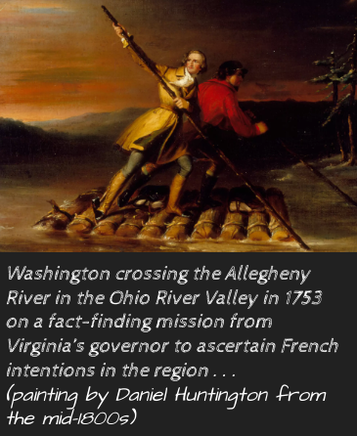
  Washington believed that the main national interest was expanding to the west; he had come to that conclusion by 1783 due to the forests he had explored/surveyed as a young man starting in the 1750s. So the last thing that Washington wanted for the nation was a war that would interfere with expanding west, which in large part explained his policy of neutrality towards the French Revolution. 
    The Jay Treaty (1795), while incredibly unpopular with the masses, was sheer genius on the part of Washington, in that he gambled that Britain and its Royal Navy would prevail against France, which would lead to tremendous benefits from trade with Britain. In other words, national security and economic development were advanced due to the British navy. But all that was invisible to 99%+ of Americans in 1795; any agreement with the British was seen as a betrayal of the Revolution.

0 Comments

The Congressional Debate on Slavery in 1790, Part One

10/5/2019

0 Comments

 
  Source: Joseph J. Ellis. Founding Brothers - The Revolutionary Generation (2000)  
Picture
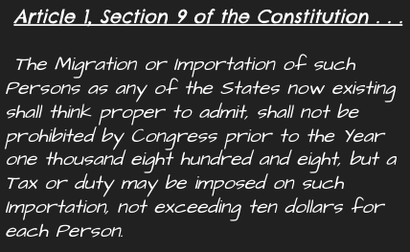
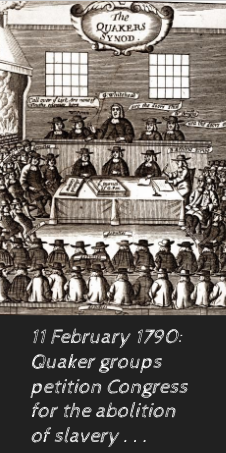
    On 11 February 1790, two Quaker delegations (from MA and NY) presented petitions to the House to immediately abolish the African Slave Trade. Most members of Congress considered the petition an embarrassing interruption to their debates on assumption and residency. The Constitution specifically prohibited Congress from passing any law restricting/abolishing the slave trade until 1808. Although protected by the Constitution, Southern representatives were apoplectic and made many speeches against the petitions, accusing the Quakers of trying to force the nation towards emancipation. 
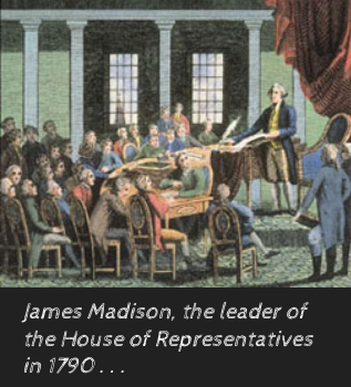
     James Madison (the leader of the House) again was the voice of reason, saying that those freaking out, while impassioned and sincere, were actually stirring up the pot for no reason. Madison suggested that the petitions be forwarded to the proper committee and dealt with like any other petition, believing that the scurrilous hoo-haw would evaporate. Madison counseled those that were up in arms that they were actually playing into the hands of the Quakers, in that the issue of slavery would be openly debated for the first time. On 12 February 1790, another petition arrived in Congress from the Pennsylvania Abolition Society, and just as some Southern representatives had predicted the previous day, the slave trade was linked to the abolition of slavery.

Picture
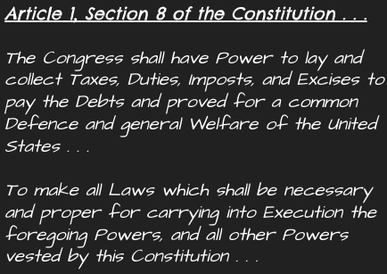
   The Pennsylvania petition argued that slavery ran counter to the principles of the Revolutionary War, and also stated that the “general welfare” and the “necessary and proper” clauses of the Constitution allowed Congress to restrict/abolish slavery before 1808. And to top it off, the petition was signed by Benjamin Franklin, which meant that Madison’s strategy of ignoring the petitions was not going to work. Already, Southern members in Congress accused the petitioners of blowing the trumpets of sedition, and even civil war. 
   As far as those Southern representatives were concerned, the Constitution meant that the petitions were not even supposed to be read aloud on the floor and entered into the public record, which was an argument they were destined to lose. Representative Thomas Scott (PA) spoke on behalf of the petitioners, and admitted that the Constitution kept Congress from abolishing the slave trade until 1808. but not slavery itself. Representative James Jackson (GA), the most outspoken of the Southerners in the House, countered that slavery was God’s will and that the Southern economy couldn’t function without slavery. Jackson went on to argue that every white person in the South automatically understood those two basic points, and that no white Southerner would do the worst of the work that African slaves did (e.g. draining swamps). 

Picture
   Representative William Loughton (SC) stated that the delegates at the
Constitutional Convention had come to an understanding in that the Northern delegates agreed to not interfere with the property rights of the South. Loughton went on to say that all of the Southern states ratified the Constitution with the knowledge that the new federal government couldn’t touch slavery, at least until 1808. The sum argument of the Southern representatives was that the Bible and the Constitution sanctioned slavery; interestingly, the position of the Virginia delegation in the House was equivocal. 

     Despite the sharp sectional debate, the vote to send the petitions to committee was
​43 - 11, with 7 of the negative votes from Georgia and South Carolina, and no member from those states was willing to serve on the committee that would deal with those petitions. The differing perspectives on slavery were largely rooted on which founding moment the person focused, the Declaration of Independence (1776), or the Constitutional Convention and Ratification (1787-88), as well as geography. 

     In 1782, Virginia passed a law that gave planters the ability to free their slaves, and by 1790 there were 12.000 Free Blacks in Virginia. In the only book that Jefferson had published,
Notes on the State of Virginia (1784), he outlined a plan that slaves would eventually be freed if they were born after 1800.  So then, to many Americans in 1790, it appeared that slavery was on its descendancy, given its tremendous cost and expense, and it was a question of when, not if, slavery would come to an end.

Picture
​     By 1790, the African Slave Trade was seen by most as a criminal enterprise, slavery was dead/dying in northern states, and the expansion of slavery to the West seemed uncertain. In addition, Virginia looked to be the forerunner of the rising anti-slavery impulses in the South. Therefore, looking back, it seemed to be the right time to match the ideals of the Revolutionary War with the post-war realities. 
     All that being said, slavery in fact was too intertwined on too many levels, including in the North, at least indirectly (e.g. textile mills). The false optimism of  the inevitable decline of slavery led to inaction. Also, the major Revolutionary War problems were political, not economic like slavery, which to many Northerners was also seen as a property rights issue. 
    With the passage of the Northwest Ordinance of 1787 (under the Articles of Confederation), slavery was prohibited north of the Ohio River, which was interpreted by the South as an endorsement of the spread of slavery below the Ohio in the future. The NW Ordinance of 1787 was probably the main reason why the Northern and Southern delegates at the Constitutional Convention felt that they didn’t have to directly deal with slavery. 
     The “Great Compromise” (a.k.a. the “Sectional Compromise”) during the Constitutional Convention in 1787 basically came down to this agreement: New England agreed to back an extension of the African Slave Trade for 20 years in return for the Deep South (the Carolinas and Georgia) agreeing to make the federal regulation of commerce a simple majority vote instead of a super-majority (2/3’s). Both sides claimed victory, and then moved on to other items on the agenda. Although Virginia was relatively moderate on its stand on slavery compared to the Deep South (mostly because they dominated the cotton market and had enough slaves), the state was adamantly against ceding any control over their slave populations to the federal government.

Picture
      The slavery debate in 1790 had three sides: the 1776 POV, the 1787 POV, and the moderate POV (VA). The debate in Congress during February 1790 exposed these differences of opinion on slavery to the public for the first time. On 8 March 1790, the House committee that dealt with the petitions prepared to submit its report, which guaranteed the debate would see the light of day. On 16 March 1790, the committee made its report to the House, and members from the Deep South were ready to give the greatest pro-slavery argument yet, with Jackson alone speaking for two hours. 
     Among Jackson’s arguments was that in terms of future emancipation, where would all the freed slaves go, being that there was no answer to that question, nor would there be one in the foreseeable future. On 17 March 1790, another Southern representative held the floor for two hours echoing Jackson’s points. The full pro-slavery argument was now out in the open and in the national bloodstream. 
     If one looked to the future based on the debate on slavery in 1790, one could see those Southern arguments becoming the bulwark of John C. Calhoun's defense on slavery in the 1840s. If one looked back, Jackson and his fellow Southerners in Congress gave the most defiant and systematic defense of slavery in the short history of the republic.  That being said, no American politician in 1790 seriously considered that the US should be a biracial nation/society, but the rising tenor of Anglo-Saxon dominance/superiority that had always been lurking in the background came to the forefront in the Spring of 1790. For the first time, publicly anyway, racial superiority/inferiority had become part of the justification of slavery. What had also been lurking in the background for quite some time was the somewhat silent agreement that slavery not be discussed at all in Congress . . . and that was thrown out the window in the Spring of 1790.

0 Comments

The Congressional Debate on Slavery in 1790, Part Two

10/5/2019

0 Comments

 
  Source: Joseph J. Ellis. Founding Brothers - The Revolutionary Generation (2000)  ​
Picture
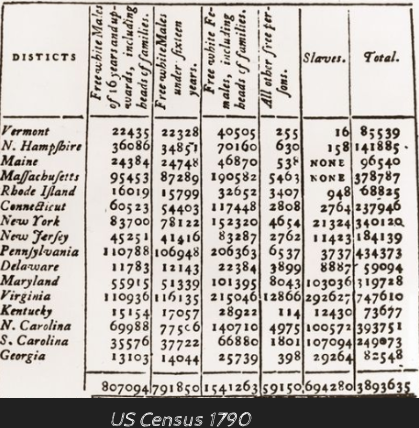
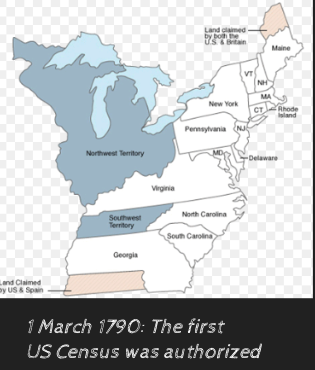
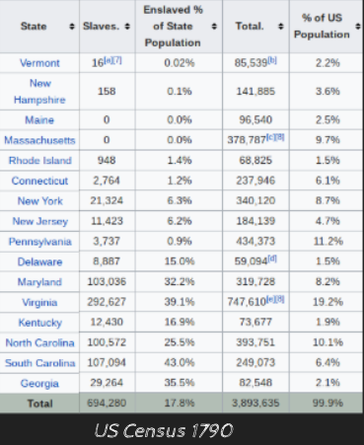
       What was new on the topic of slavery in 1790 was that it was actually being publicly debated in Congress, which meant that the debate would spread from the nation’s capital. Based on the (first) Census of 1790, the attitudes towards slavery could be seen in large part statistically, in that where the ratio of slaves (blacks) to whites was the highest, then the attitudes towards slavery were more entrenched. To the South, slavery was the only way to guarantee segregation of the races. 
     But the Census of 1790 also showed that if any state was going to show the way towards emancipation, it would be Virginia. Also, the window of ending slavery was not opening, per the conventional wisdom of the era, but closing, even before the invention of the cotton gin in 1793. The fading Revolutionary War ideology was arrayed against the growing racial demography, which bolstered the Deep South’s contention that emancipation was wildly unwise and impractical. The Census of 1790 showed, even before the cotton gin, that those that believed slavery would slowly die a natural death were naive. In addition, the relocation of even the existing slaves to various regions of the nation was also a naive notion that had no plan.
     While there were no specifics concerning emancipation, the idea was being publicly debated nonetheless. All the plans for gradual emancipation rested on the assumption that slavery was a moral/economic problem that needed a political solution. Also, any plan for gradual emancipation needed to combine speed and slowness, since the window was closing. Speed was necessary to act quickly before the slave population increased, and slowness was necessary in order to absorb the costs of emancipation.

Picture
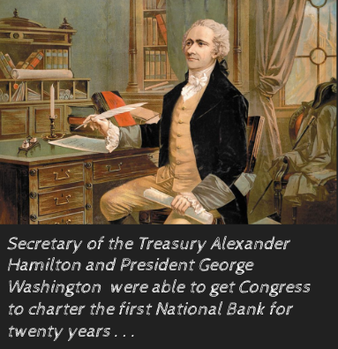
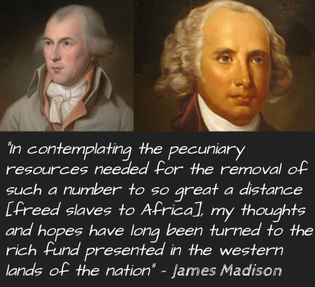
     It was assumed that slave owners would be compensated with funds coming from some kind of taxation combined with the sale of Western lands. It was also assumed that the bulk of freed slaves would be transported elsewhere, either to Africa or some designated location in the West. The cost of freeing slaves in 1790 was generally estimated to be $140 million; further thought of actual emancipation decreased dramatically as a result of that estimated cost (the federal budget for that fiscal year was $7m). However, the Hamiltonian approach with the federal government leading the fiscal side of things with a
National Bank could have managed such a discrepancy. 

     So the actual question in 1790 wasn’t the total cost of emancipation, but the initial capital cost. The ability to accrue debt with a public debt and a National Bank became a reality in the early-1790s, but the desire to incorporate gradual emancipation with that fiscal systems network fizzled and went nowhere. It was much easier to talk about emancipation in an ideological (and remote) sense in a Northern state such as Massachusetts compared to a state in the Deep South such as Georgia (90% of the black population in the US was below the Potomac River). Any plan for gradual emancipation had to feature WHERE the freed slaves would be relocated, and that was a problem that had no solution. Added to the mix was the reality that only the federal government could run point on gradual emancipation, and to the South, that smacked of even more “consolidation”.

Picture
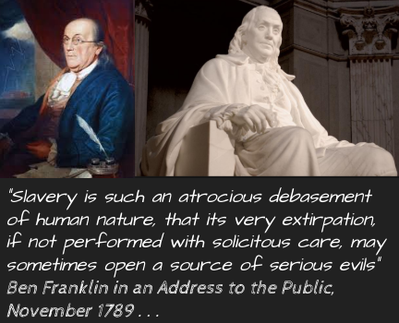
     So then, by the Spring of 1790 it was already basically impossible to make any major decision against slavery, and in some ways it came down to leadership. In addition to being named a delegate from Pennsylvania to the Constitutional Convention in 1787, that same year he agreed to serve as the new president of the Pennsylvania Abolitionist Society. Franklin made gradual emancipation his last great cause And unlike being an almost-too-late Patriot in the 1770s, Franklin had been against slavery since at least 1729, even speaking out against claims that blacks were racially inferior. But Franklin had never before thrown his full weight against slavery until the late-1780s during the Constitutional Convention. 
     Vice-President John Adams, his anti-slavery credentials long-standing, agreed to avoid the anti-slavery petitions read on the Senate floor. Hamilton didn’t support the debate against slavery in the House since it could further complicate/delay passage of this fiscal plan. President Washington wanted the House debate to be terminated, since it was a “nuisance”. Where Franklin was basically all big ideas, James Madison was concerned with details, and by the Spring of 1790, he decided to become involved in the slavery debate. If Franklin and Madison were on the same team, they would have been unbeatable, but on the slavery debate in 1790, they were on opposite sides.

Picture
     Madison’s strategy could be described as the “Virginia Straddle”. Madison had no patience for the Deep South, but he favored self-imposed paralysis on slavery, despite using some anti-slavery rhetoric. In effect, Madison thought the whole subject of slavery on either side was taboo. So Madison favored a strategy of “enlightened obfuscation” to try and remove the explosive issue of slavery from the political agenda. Madison had worked his magic behind the scenes to the point where some Northern representatives that had sided with the Quakers expressed regret that the matter had got out of hand. 
     In terms of the committee, the Deep South, now with support from Massachusetts and Virginia, tried to have the report tabled, wanting to avoid future debate. But Madison wanted more than just to end the debate: he wanted to establish a precedent that made clear the power (or lack of) that Congress had on the issue. Madison welcomed the 29 - 25 vote to release the committee’s report. Before the existence of judicial review, Madison wanted to use the vote on the committee report to create the equivalent of a landmark decision that would prohibit any plan of emancipation. 
     The report gave the Deep South the protection they demanded by denying Congress the power to pass any gradual emancipation legislation. The report also aligned the year 1808 concerning the slave trade with emancipation, so in effect, the Deep South got what it wanted for a limited time, since after 1808, Congress wcould do whatever it wished concerning slavery.

Picture
    Madison’s magic worked as the report went through the conference committee so the same version was presented to both houses. The Virginia delegation in the House had its marching orders to support the amended report from the conference committee, and the delegations from Massachusetts and New York were pressured to do the same. Seven resolutions from the original report were reduced to three by the conference committee, with the tax on the slave trade dropped altogether. 
     The final report passed the House by a vote of 29 - 25, making clear that the states had the power concerning slavery, not Congress, which in effect extinguished any federal plan/effort towards emancipation. Gradual emancipation disappeared from the political agenda in Congress, as both Madison and Washington wanted. It wasn’t until John Quincy Adams entered Congress after his term as President that the debate over slavery in the House would resume. The major piece of unfinished business from the Revolutionary War Era, slavery, remained unfinished.

0 Comments

Jefferson, Madison, and Hamilton: "The Dinner", Part One

9/14/2019

0 Comments

 
  Source: Joseph J. Ellis. Founding Brothers - The Revolutionary Generation (2000)
Picture
    By chance in mid-June 1790, Secretary of State Thomas Jefferson encountered the Secretary of the Treasury, Alexander Hamilton, outside of President George Washington's office. Jefferson discovered that Hamilton was not his normal confident and resplendent self, and looked like a “beaten man”. Hamilton admitted to Jefferson that his financial plan for public credit was trapped in the House due to the opposition  of assumption that had been organized by the leader of the House, James Madison. Hamilton was simultaneously fatalistic and melodramatic, believing that the gridlock over assumption would force him out of the political arena. To Hamilton, if his financial plan for the nation didn’t become a reality, then the nation itself wouldn’t last very long. 
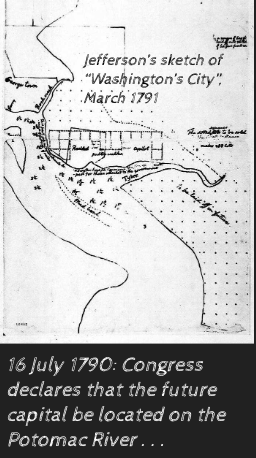
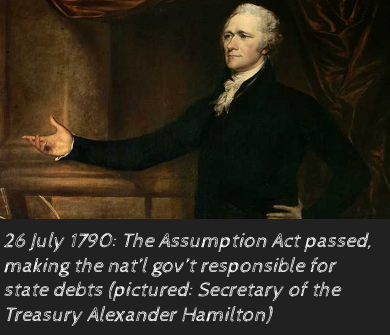
     Jefferson suggested that perhaps he could be of assistance. Jefferson thought that if he could get Hamilton and Madison together on a friendly discussion of the topic, then some sort of an agreement might be made. Jefferson offered to host a private dinner party for the three of them. Jefferson’s account was the only one that survived, and it no doubt was at least partially self-serving and misleading. But Jefferson was able to broker a political bargain of far-reaching historical significance, in that Madison agreed to allow Hamilton’s fiscal program to pass the House (with Madison remaining in public opposition), while Hamilton agreed to use his influence to get the nation’s permanent capital on the Potomac River. In many ways, this dinner party was the Compromise of 1790.

Picture
     But is the story of the dinner party hosted by Jefferson and attended by Madison, and Hamilton true? Most historians see it as essentially true, in that the dinner party did occur in late-June 1790. Then on 9 July 1790, the House passed the Residence Bill, in which the future permanent capital would be located on the Potomac after ten years on Philadelphia on a vote of 32 - 29. On 26 July 1790, the House passed the Assumption Bill by a vote of 34 - 28, and newspapers commented that there must have been some sort of behind-the-scenes deal to get that result since some representatives changed their vote.  Also, on the day the bargain was struck, Jefferson wrote James Monroe to prepare him for future developments concerning both bills, since Monroe adamantly opposed assumption. 
    Monroe responded to Jefferson writing that as far as Virginia was concerned, Hamilton’s fiscal plan was viewed as toxic. Monroe went on to say that the location of the permanent capital was of no real consequence or concern to Virginia; in two years, Jefferson would see things the same way as Monroe, telling Washington that the dinner party was the biggest political mistake of his life. 
     Actually, Jefferson’s version of the dinner party was written in 1792, where his great regret is evident. In fact, several secret meetings occurred in the same general time frame surrounding the debates on the assumption and residence bills. The overriding questions: why were brilliant and sensible men such as Jefferson, Madison, and Hamilton all convinced that the newly established government under the Constitution was so precarious and problematic? Why was the passage of assumption so threatening to so many? What was the Potomac River so symbolic?

Picture
    The answers of course varied based on the perspective of each participant, which meant that Jefferson, Madison, and Hamilton arrived at that dinner with different agendas, experiences, and stories to tell afterwards. Madison was the most centrally situated as the leader of the House, having led the debates over both assumption and residence. Madison enjoyed his reputation as a preeminent nationalist and a favored son of Virginia. By 1790,
Madison had already proven to be the most shrewd and politically savvy veteran of the tumultuous constitutional battles of the 1780s, culminating with his authorship of the Bill of Rights.

     Madison had become the master of the inoffensive argument, which again and again proved to be effective and decisive. Madison was so obviously gentle and eager to give credit to others, especially his opponents, that it was very difficult to unleash one’s full fury on Madison without coming off as a brute and/or an idiot. Madison also would wait until someone gave him permission to address what he knew, and then Madison would often go on for hours until the person threw in the towel. Madison was practically invisible and entirely unthreatening, and he used both traits very effectively. Eventually, Jefferson would provide the sweeping vision while Madison would focus on the details to make it happen. But in 1790, Madison’s invisibility didn’t mean subservience to Jefferson, and Madison, behind the scenes, exercised quite a bit of independence from Jefferson.

Picture
    Also, by 1790 Madison had collaborated far more with Hamilton as a fellow nationalist during the years of the Articles of Confederation and the Constitutional Convention/Ratification. While Madison would soon become the most important, influential, and ardent Jeffersonian of his era, before 1790 Madison and Jefferson were on opposite sides in terms of how powerful the new national government should become. But in the months before the dinner, Madison had started to see the interests of Virginia as equal-or-greater than national interests, and that changed started to occur before Jefferson returned from Paris. 
     If there was a specific point in time that started Madison to change, it occurred in January 1790 when Hamilton released his Report on the Public Credit to Congress. Hamilton’s fiscal goals matched up with Madison’s nationalism as recently as Ratification. What troubled Madison wasn’t the goal of properly dealing with the nation’s public credit crisis, but Hamilton’s methods. First up was Hamilton’s plan to reimburse the current holders of securities (the old Continental Dollars). Speculators, having inside information, had purchased who knows how many securities at a fraction of their original value from citizens that had no idea what was coming. Hamilton was surprised when on 11 February 1790 Madison, on the House floor, denounced Hamilton’s reimbursement plan (Madison labeled it as a “scheme”) as a repudiation of the principles of the Revolutionary War.

Picture
     Madison proposed to either pay the original AND the current holder, or make some sort of shared payout, or don’t pay anyone. Unlike Jefferson, who hated to lose, Madison was always gracious in defeat (and great at adjusting his strategy as a result), but Madison hated it that those that served in the Revolutionary War were getting fleeced by those that hadn’t.  Also in the picture was that Madison’s idealistic vision of principled virtuous men running the new national government was not going to happen. In other words, to Madison the last phase of the Revolution was falling into the hands of the parasites, the enemy. The debate over assumption made things more stark for Madison, to the point where he felt a sense of betrayal.
     On the surface, assumption seemed simple enough, in that the federal government would take on (assume) all the accumulated debts of the states (most of which were due to the Revolutionary War). Instead of 13 separate state ledgers, there would only be a national ledger. On 24 February 1790, Madison spoke on the House floor arguing that Hamilton’s plan for assumption was far more complicated than it looked. Madison’s core argument seemed to be economic (but it was largely pro-VA), in that states such as Virginia had paid off most of the wartime debt, and that assumption would force Virginia, via a large tax payment to the national government, to bail out the states that didn’t have their act together.   

Picture
    Madison continued, saying that there wasn’t an official estimate yet of the specific amount each state would have to pay in the form of a federal tax to fund assumption. To Madison, knowing how much came before voting on assumption; according to Madison’s calculations, Virginia would transfer about $3m in debt to the federal government, and then be taxed $5m. To Madison, this was just as unfair as repaying the current holders of the securities. 
     Madison realized that if Hamilton’s fiscal plan passed, then the new national government would have economic sovereignty over the 13 states. Madison didn’t want his beloved Virginia to trust its future to the new national government. To Madison, assumption was more about power than economics, about true independence. Madison was getting hit by shrill accusations from all sides, with Hamiltonians slamming him for not working towards building a government that would last, to others that called Madison a hypocrite since he had been a nationalist, but now he had reservations. 
     The key word that Jefferson, Madison, and the South focused on was “consolidation”, which meant to them that the states would be absorbed by the national government. That being said, in letters Madison kept telling confidants that Virginia was safe, in that Washington was President, Jefferson was the Secretary of State, Edmund Randolph was the Attorney General, and that he was the leader in the House. In many ways, Madison was the calm at the center of the storm.

Picture
     Hamilton didn’t have any of Madison’s reservations or ambiguities, since he believed his fiscal plan would rescue the nation from financial disaster. Once faced with an obstacle, Hamilton went on the offensive and never looked back. Hamilton’s pattern was to unleash his formidable energies and talents on a blitzkrieg of overt productivity, which meant that in essence he was the storm. Hamilton did not believe in stealth as did Madison, and therefore he became a convenient lightning rod of controversy and a man easy to despise and distrust. Hamilton’s opponents became even more incensed when Hamilton was proven right. 
     Like Madison, in 1790 Hamilton had amassed the most power and influence he had experienced up to that point. What Hamilton believed he was doing was simple: to bring the mess that was the US economy out of the abyss and to transform the nation into a global economic player with a great credit rating. To Hamilton, that meant that he not only needed a financial plan, but also ways to tap into the potential of US economic production. Hamilton didn’t have the slightest concern as to whether his plan negatively affected any individual or state. 
     Hamilton saw Madison’s plan to reimburse the original holders of the securities as unrealistic and naive, and Hamilton criticized Madison that he had not bore arms in the Revolutionary War as he had. Hamilton added that the original holders of the securities had not been forced to sell to those speculators for a multitude of reasons. To do what Madison proposed would have been a bureaucratic nightmare, and Hamilton wanted to get the nation past those kind of entanglements. Hamilton wanted to create trust by placing the debt into the hands of those that would use it to foster the national interest.

0 Comments

Jefferson, Madison, and Hamilton: "The Dinner", Part Two

9/14/2019

0 Comments

 
 Source: Joseph J. Ellis. Founding Brothers - The Revolutionary Generation (2000)
Picture
      Madison’s opposition to assumption struck Hamilton as even more naive than his plan on reimbursing the holders of securities, and even sinister, Hamilton felt that way since Madison had advocated smaller versions of assumption in the 1780s when they were both ardent nationalists. As far as the amount of taxes Virginia would pay under assumption, Hamilton felt that the amount could always be negotiated. Hamilton was shocked that Madison had accused him of trying to lure the states into some kind of Faustian bargain that was designed to destroy the sovereignty of the states. Hamilton firmly believed that a nationalized economy would benefit all Americans. 
     It didn’t help matters that in Hamilton’s offensive to promote public credit and assumption he used words like “consolidation” and “nationalize”, which raised alarm bells to Madison and the Southern states. Hamilton’s plan was a projection of his own audacious personality during the fluid conditions that existed in the early years of the nation under the Constitution. Hamilton was unique in that he recognized that to unleash the beast that was the US economy, there needed to be strategic management and orchestration, which could only be done if the federal government had the power to do so. Jefferson and Madison believed that the government should just get out of the way and the natural economic forces would work. But Hamilton, long before John Maynard Keynes, saw that a national government could play a role in managing a nation’s economy, and then perhaps to achieve unparalleled prosperity.

Picture
     Hamilton’s model for his fiscal plan centered largely on the Bank of England; both he and Washington believed that a national bank was the key for America to develop and prosper. To Jefferson and Madison, the Bank of England was an institution that should have been forever repudiated as a result of the Revolutionary War. To Hamilton, consolidation was a wonderful idea, not a threatening menace. In short, Hamilton was thinking economically while Jefferson and Madison were thinking politically (States' Rights). 
   To Hamilton, when money was spread out, it was only money, but when it was concentrated, it was capital. To Hamilton, a national debt would be a “national blessing”, but to Madison a “Public Debt was a Public Curse”. Hamilton saw America’s urban elites (merchants, bankers, business owners) as the central figures in the ascendancy of the nation. Hamilton’s financial plan was a total endorsement of commerce as the lifeblood of America. Hamilton wanted to channel the self-interest of the urban elites into promoting the national interest. 
     But Virginians such as Jefferson and Madison were psychologically incapable of getting their minds around basic economic concepts, since to them land, not fluid capital, was the center of all things. Bankers and speculators didn’t add to an economy, to Jefferson and Madison they were a bane; to them, the real problem was commercial sources of wealth crowding out agricultural wealth. Also, many in the planter class, such as Jefferson, , were heavily in debt to British and Scottish creditors; the planter class simply believed that they were being bled to death by a conspiracy. The refusal to bring their behavior into economic reality, of denying that they were the reason for their own predicament led to the willful ignorance of the economic systems of which Hamilton was expert. In a strange way, Jefferson and Madison took great pride in not having the slightest understanding of what Hamilton was trying to accomplish.

Picture
    Jefferson had been abroad during the constitutional reforms of the 1780s; his views on national vs. state sovereignty were largely unknown due to his lengthy absences in Europe. Jefferson deferred to Madison’s superior judgment on those matters when he accepted Washington’s offer to be the first Secretary of State. Jefferson believed that foreign policy was the one area where the nation should speak with only one voice. Jefferson had vowed to never again accept public office after his miserable run as Virginia’s military governor during the Revolutionary War. Jefferson wasn’t too keen on becoming SecState, but Madison convinced him that he was the only and best one to serve Washington and the nation in that capacity. 
   Inviting Madison and Hamilton to a dinner party fit Jefferson’s personality in large part because he absolutely hated (and avoided) face-to-face confrontation. Jefferson was miserable in a debate because the whole tone of arguing freaked him out. To Jefferson, argument was a dissonant noise that served to do nothing but distract and to upset the natural order of things. Madison knew there was an invisible line inside of Jefferson that when crossed, out came Jefferson the Tiger where he was engaged in a Holy War, not an argument. Short of that invisible line, Jefferson was endlessly polite and accommodating, and genuinely pained with the process of partisan politics, at least in 1790. As SecState, Jefferson understood the need to rescue America’s credit rating since the US would never be taken seriously in Europe (e.g. Dutch bankers). The Jefferson of 1790 saw Hamilton’s plan overall as a good thing for the nation. To Jefferson then, the more important issue was the debate over where the future permanent national capital would be located, which by September 1789 had started to become fierce.

Picture
 The Constitution had set the parameters for a future location of the national capital which could not exceed 100 square miles, and that the land would be purchased from the proximate states. But the residency debate centered around WHERE the permanent capital would be located, and there seemed to be no possible consensus. All the regions claimed that they were the most important region, and therefore the future capital should reside in their orbit. The location had to be passed by both the House and the Senate, which had been proven to be impossible. 
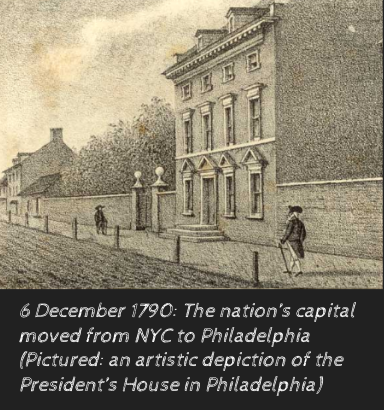
     Complicating the situation was that it was agreed that there should be a temporary capital while the future permanent capital was built; but there was serious concern that the temporary capital would become the permanent capital. When Jefferson arrived in New York City in March 1790, there had been 16 proposed sites for the future capital, and all had failed to pass, among them were: Annapolis, Baltimore, Carlisle (PA), Frederick (MD), Germantown (PA), New York City, Philadelphia, Trenton (NJ), and the Susquehanna and Potomac Rivers. Geographically, it seemed that Philadelphia had the edge over all the other sites. 
     By June 1790, Madison was not promoting the Potomac, but rallying opposition against Philadelphia. Madison had pointed out that from northern Maine (which was part of Massachusetts) to southern Georgia, the geographic midpoint of the nation was Mount Vernon. Non non-Virginians, Madison’s (and Washington’s) preference for the Potomac was seen as a “Wigwam Place”. Madison kept the Potomac in the mix, promoting it as the link to the interior of the US via the Ohio River Valley (Virginians viewed themselves as the Gateway to the West).  But that perspective was confined to Virginia, and was viewed as nothing more than a fancy of Madison’s imagination by non-Virginians. By June 1790, Madison had largely given up hope that the Potomac would win out in the residency debate . . . and then came the possibility of making a deal.

Picture
     Pennsylvania had tried to work out a deal with Hamilton in that the Pennsylvania delegations in the House and Senate would support assumption while Hamilton would steer Philadelphia through as the temporary, and then permanent capital. Unsurprisingly, Hamilton was unable to get the necessary votes in Congress. Other dinner parties had Pennsylvania and Virginia discuss a potential deal where Philadelphia was the temporary capital, and the Potomac would be the permanent location; Pennsylvania believed that once they had the national capital, temporary it may be, the capital would remain in that city. 
     In effect, the dinner party hosted by Jefferson was the final chapter after many other meetings on the topic, which in essence meant that the groundwork for a bargain had already been laid out. In actuality, the Potomac had already been secured as the location of the future capital before Jefferson’s dinner party, which meant that Hamilton didn’t have to work to change any votes in Congress on residency, which he had already shown that he could not do. Instead, Hamilton needed to convince members in Congress from Massachusetts and New York to not change their vote. It was Madison that had to work to get fellow members in Congress to change their votes on assumption. Madison needed at least three representatives to change their vote, and eventually four switched, all of them from districts that bordered the Potomac. 
     Therefore, the major business of Jefferson’s dinner party was something else, most likely determining the debt/tax total for Virginia concerning assumption. So Madison got what he wanted, a specific financial calculation for Virginia before the vote on assumption, and Hamilton did what he said he would do, be flexible to make Virginia more comfortable with assumption. Jefferson left that out of his account of the dinner party in 1792 since it wasn’t very romantic, but he immediately sent out letters to confidants telling them that Virginia’s debt and tax amount had been recalculated (conveniently, the Virginia debt assumed and the taxes paid to the federal government each amounted to $3.5m).

Picture
  For Virginia then, assumption became a non-issue, and with the future permanent capital on the Potomac, in 1790 Jefferson and Madison had every reason to smile. Virginia won on each point of the bargain with residency, the debt assumed, and the tax settlement for assumption. Jefferson and Madison made their contribution in the months afterward, making sure that the Potomac held as the future capital, in that they made sure that the residency question would never again be brought in front of Congress, where the Potomac would have been killed by a thousand cuts. 
   In August 1790, Jefferson proposed that the details and decisions concerning the actual location, size, and shape of the future capital on the Potomac be made by the Executive branch (meaning Washington). Jefferson and Madison toured the Potomac River, and made their decision on the location by January 1791. So, the District of Columbia (featuring "Washington’s City") was created by an army under the command of George Washington, with Jefferson and Madison as loyal lieutenants. 
     By the Fall of 1790, Jefferson advised Washington to start construction as soon as possible, arguing that once government buildings were completed, Philadelphia would have no more cards to play. Interestingly, during that same fall, a joint resolution was passed in the Virginia Assembly that denounced assumption, and even featured language that strongly hinted at secession. During the Constitutional Convention, Hamilton predicted that the nation would endure only if the national government forced the states into a subservient status, and by the Fall of 1790, Hamilton’s prediction seemed to have merit. 

Picture
     The Compromise of 1790 averted a crisis that could have ended the long-term survival of the nation. However, it also exposed differences that would not abate in the following decades, showing again that winning a revolution is easier than securing one. The Compromise of 1790 didn’t resolve any of the disputes, but rather kept them from exploding, and bought time so future debates/arguments could continue as designed by the Constitution. And due to Jefferson and Madison, the ongoing/future debates would have a strong Southern point-of-view. To be fair to Jefferson and Madison, by 1790 Virginia had 20% of the population and the state generated 33% of the nation’s commerce. 
     By selecting the Potomac, the nation had decided to split its political capital from its economic capital (NYC), which was a departure from the European norm. So the main focus of Jefferson’s dinner party should not be on assumption, but rather more on the Potomac. That dinner party in June 1790 also signaled the resumption of the Jefferson/Madison partnership which had been on hold for five years, so the “Great Collaboration” by 1790 was an alliance worthy of its lofty label. 
      Jefferson and Madison may have shared Virginia’s dominant view that Hamilton was trying to take down the state, but in 1790 they did not share in the secessionist sentiments. The strategy of Jefferson and Madison was that they were not going to abandon the federal government but to capture it, gambling that the new capital on the Potomac would become an extension of Virginia. In the following decade as the leaders of the Republicans and then as 
President/Secretary of State, Jefferson would be the visionary leader and Madison would be the detail man in the trenches.

0 Comments

    Archives

    May 2020
    April 2020
    March 2020
    February 2020
    January 2020
    December 2019
    November 2019
    October 2019
    September 2019
    August 2019
    July 2019
    June 2019
    May 2019

    Categories

    All
    18th Century
    19th Century
    20th Century
    History

Powered by Create your own unique website with customizable templates.