Mr. Jensen's U.S. History Website
  • U.S. History Blog
    • U.S. History Blog (May 2026 - May 2027)
    • U.S. History Blog (May 2025 - May 2026)
    • U.S. History Blog (May 2024 - May 2025)
    • U.S. History Blog (May 2023 - May 2024)
    • U.S. History Blog (May 2022 - May 2023)
    • U.S. History Blog (May 2021 - May 2022)
    • U.S. History Blog (May 2020 - May 2021)
    • U.S. History Blog (May 2019 - May 2020)
    • U.S. History Blog (May 2018 - May 2019)
    • U.S. History Blog (May 2017 - May 2018)
    • U.S. History Blog (May 2016 - May 2017)
    • U.S. History Blog (May 2015 - May 2016)
    • U.S. History Blog (May, 2014 - May, 2015)
  • About

Henry Clay: The 2nd National Bank & The Election of 1832

7/25/2019

0 Comments

 
                        Source: H.W. Brands. Heirs of the Founders (2017)
Picture
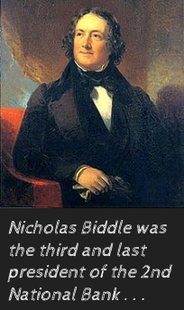
     It proved to be the 2nd National Bank of the United States, the third pillar of Clay’s American System, that would be the battleground between Clay and Jackson as the Election of 1832 approached. Clay’s support of the BUS (Bank of the US) was public, steadfast, and longstanding, while Jackson’s opposition was well-known, but recent. The President of the BUS, Nicholas Biddle, had spent years trying to educate Americans on the workings and benefits of banks, and now he tried to do the same with Jackson.
    Biddle had done his best to stay out of the political area and to keep his focus on the financial systems of the nation. If Biddle saw Jackson has uneducated in banks, Clay saw Biddle as naive in terms of politics, and Clay set out teach Biddle the ways of DC. The charter of the BUS was set to expire in 1836, and Jackson was intent on allowing the charter to run out. But the investors and customers of the BUS wanted reassurance that the institution would last beyond 1836, which led to support for an early renewal of the charter.

Picture
      In 1830, Clay counseled patience in regards to the charter’s early renewal, in large part because at that point Jackson hadn’t decided on running for a 2nd term. Clay told Biddle that pushing for an early renewal during the Campaign of 1832 might play into MVB’s hands, so the best strategy was to wait until after the election. But the general rise of the propaganda campaign in support of the BUS continued, and Congress appeared to be in support of the renewal. And then Jackson decided to run again in 1832, and Biddle now saw that patience was not a virtue in order to save the BUS, and Clay had reached that very same conclusion as well. To Clay and Biddle, the only hope was to press for the renewal of the BUS before the Election of 1832.
    Clay thought he could manage the renewal through Congress, and even though Jackson would veto the bill, the BUS would become an even greater campaign issue, and perhaps Jackson’s veto might cost him re-election. It was Clay’s only hope since Jackson looked to be virtually unbeatable, so getting Jackson to veto the BUS bill might not only politically damage Jackson, but his veto might create an anti-Jackson coalition that would support Clay. Clay didn’t show all his cards to Biddle, especially his knowledge of how Jackson would react to being openly challenged during the campaign.


Picture
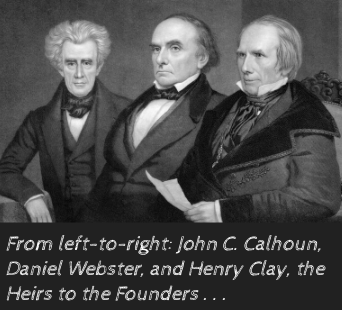
     Senator Daniel Webster's interest in the BUS was different from Clay, but just as intense. Biddle paid Webster for legal work, which in effect meant that Biddle kept Webster on retainer as an advisor concerning the politics of the BUS. Webster kept speaking in the Senate on behalf of the BUS, and Biddle kept him on a retainer. Webster made it clear to Biddle that the retainer needed to remain ongoing. Webster told Biddle that there was strong support for the BUS renewal, and that it would be wise to start the process right away. So, on the separate advice from Clay and Webster, Biddle took the fateful step of starting the renewal of the charter of the 2nd National Bank of the United States in early-1832.
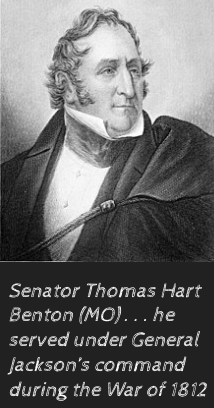
    Webster congratulated Biddle on his decision to do so and did his best to get the bill through the Senate. The enemies of the BUS were galvanized, and Senator Thomas Hart Benton (MO) called the BUS unconstitutional, immoral, and a conspiracy. Benton’s tirade played well in the West and among the vast majority of Jacksonians. However, Clay was able to get the votes in both houses to renew the charter of the BUS. The margin was comfortable in the House, but in the Senate is was a close call, which led to charges of bribery and shenanigans by the opponents of the BUS.

Picture
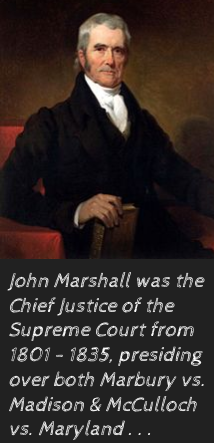
     All the while Jackson knew he was being “set up”. As far as Jackson was concerned, he hadn’t picked the fight; Clay was the aggressor seeking political gain. Jackson was not going to back down in the slightest way, and he vetoed the renewal bill, and he sent Congress a stern message why he had done so. Jackson argued that the BUS was unconstitutional. To Jackson, Marbury v. Madison (1803) and
McCulloch v. Maryland (1819) only meant that the lower courts had to follow the Supreme Court decisions, not Congress. Jackson stated that each branch of the government could have its own interpretation of the Constitution.

    Jackson simply didn’t believe that the “necessary and proper” clause authorized a national bank. In Jackson’s time, the precedent and practice of judicial review in the hands of the Supreme Court hadn’t yet been set in stone. Jackson’s statements against the BUS were bold, but not original. Jackson went on to say that the BUS was a monopoly that enriched its shareholders at the expense of regular Americans, which aggravated the nation’s inequalities.

Picture
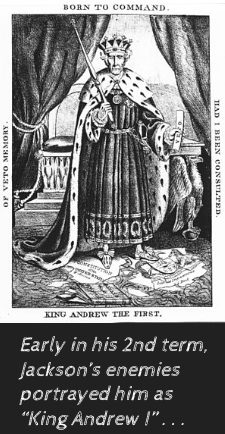
     Webster knew the veto was coming, but he still appeared to be shocked, telling many that Jackson’s veto defied logic, law, and reason; in effect, Webster argued that Jackson had said, “I am the state”. Biddle was not surprised by the veto at all, but he wasn’t discouraged. Biddle felt that Jackson had cooled himself out of business with his veto message to Congress. Biddle also thought the veto would benefit Clay, who Biddle believed was the instrument of survival for the BUS. Clay however, understood that Jackson’s veto had solidified anti-Jackson sentiment in the predictable places, but among the growing number of “Average American” populist voters, the veto could do nothing but help Jackson.
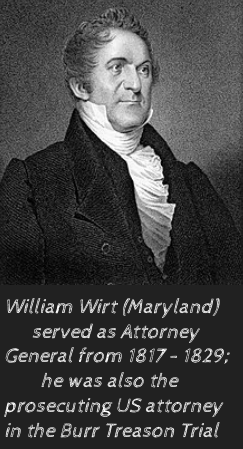
   1832 marked the first year of political party nominating conventions, and the Anti-Masons were first, nominating Maryland’s William Wirt (what Clay had done in terms of revolutionizing the role of Speaker, Wirt had done with the Cabinet post of Attorney General). The idea of a convention caught on, with the National Republicans nominating Clay . . . the Democrats (nee Republicans), had officially started to fracture apart. A convention of Jacksonians (now calling themselves Democrats for the first time), officially, nominated Jackson as President and MVB as VP.  The
Election of 1832 was not close, with Jackson tallying 219 Electoral Votes to Clay’s 49, and Jackson won 16 states to Clay’s 6 (Wirt carried one state, and a Nullification candidate carried South Carolina).

Picture
     To Jackson, Clay was despicable and corrupt, and that was that; not even his compromise concerning the Tariff of 1828 made a dent on Jackson’s negative opinion. The battle over the BUS continued into Jackson’s 2nd term. Clay and Biddle hoped to salvage something from the crisis that they knew they had created, thinking that if somehow the BUS outlasted Jackson, it would survive. But Jackson was determined to strike first and deliver the crushing blow to the BUS.
    Jackson calculated that the BUS would collapse if he
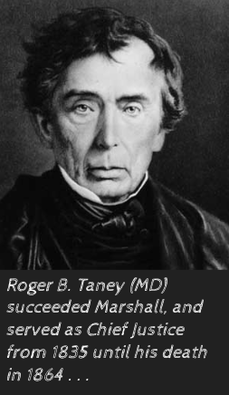
removed government deposits. Jackson had to remove SecTreas William Duane, who refused to remove the deposits, and moved Roger Taney (Attorney General) in as Acting SecTreas to do so. Biddle was neither alarmed nor surprised, knowing that the crisis would come to exactly that point. Biddle believed that he held the advantage using strategic bribes to keep the people in the BUS system that would not cooperate with Jackson’s goal of removing the deposits. At the same time, Biddle ordered the BUS to call in loans and to stop issuing loans. Biddle’s idea was that he would starve the economy of the money it needed to flourish; in essence, Biddle tried to show that the US could not possibly survive without the BUS.

Picture
   Clay was not surprised at Jackson’s decision to remove government deposits from the BUS, but he was appalled. Clay formally asked the Senate to censure the President. In a speech on the Senate floor, Clay asserted that Jackson’s actions were a move to grab more power. Most of the Senators enthusiastically agreed with Clay, and Vice-President MVB (like VP Calhoun had tried to do after Webster’s spellbinding floor speech) tried to use his gavel to lessen the impact of Clay’s speech.
    Calhoun joined Clay in opposition to Jackson’s attempt to remove government deposits. Benton believed that Jackson was in the right, since he also distrusted banks. From the moment the deposits were removed, Benton observed that the BUS and Biddle were doing their best to create a crisis that would be to their advantage, especially Biddle’s squeeze on the money supply and credit. Jackson concluded that the shenanigans of the BUS were due to Clay and Biddle, and he viewed it as a personal challenge in that it was either his Presidency or the BUS. Jackson held Biddle responsible for the tactics, but he held Clay responsible for the overall strategy.

0 Comments

Clay, Calhoun, and Webster: The Tariff of 1828

7/22/2019

0 Comments

 
                             Source: H.W. Brands. Heirs of the Founders (2017)
Picture
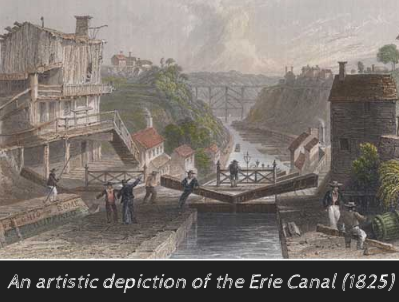
      The opening of the Erie Canal in 1825 in New York was the greatest thing to happen to that state to that point in US History. The Erie Canal transformed the economic geography of the eastern-half of the US, and in effect, Rochester NY became a city-of-the-world. The Erie Canal was 360 miles long (to the Hudson River), 40 feet wide, and 4 feet deep with dozens upon dozens of dams and locks. Transportation costs for such commodities as wheat, corn, pigs, and lumber decreased by 90%, and New York City supplanted New Orleans as America’s #1 port (NYC also eclipsed Philadelphia as America’s financial hub).
    To commemorate the opening of the Erie Canal, cannon fire salutes were carried out, with the next cannon firing after it heard the report from the cannon further up the canal. It took only 82 minutes for the last cannon in NYC to fire to end the sequence, which was to that point the most rapid long distance communication in history. NYC was the most delirious, suddenly finding itself the gateway to the American West. The opening of the Erie Canal started a series of events that would propel the US into the modern era, with the steam engine being used in steamboats and locomotives. The Industrial Revolution truly started in the US when steam power came to the nation’s factories.
    Costs of manufactured goods such as textiles were sharply reduced, which in turn generated more demand, which led to greater investment in new equipment; a continuing cycle of economic growth occurred in the North. In the South, however, the saving of labor held very little appeal, since slavery was a fixed, not a variable, cost. The Southern economy expanded, but only as a result of the increased cotton trade with foreign nations (and the North), not actual transformation. The South experienced additive growth, while the North went through multiplicative growth; by the mid-1820s, it became clear to any objective person that the South would fall behind the North in terms of population and wealth.

Picture
     Senator Daniel Webster (MA) spoke out against protectionism and in favor of free trade, knowing that the differing needs in the various regions of the globe led to reciprocal wants, which meant that free trade was a win-win for the US. Webster dismissed the popular notion advanced by Henry Clay (Speaker of the House) and the other protectionists that trade was a zero-sum game; Webster correctly stated that overall, free trade was a plus-sum game. Webster also pointed out that free trade wasn’t limited to trade between just two nations (bilateral trade).
    Protectionists stated that their main interest was to foster US industries, and to that Webster argued that navigation and commerce were already-existing industries that would be harmed by protectionism. Webster scoffed at the argument from protectionists that every dollar paid by and American for a foreign-produced good went to that specific foreign producer; Webster argued (not using these exact words) that a multiplier-effect was in play. Webster also dismissed the protectionist argument that US security would be improved by high tariffs in that self-sufficiency equaled greater security, and that the US would no longer be susceptible to a foreign power’s interference with US trade.
    Webster stated that it was free trade that had raised the stature of America in the eyes of the world, and protectionism would diminish that stature. Webster made sure his speech in favor of free trade was widely circulated in print, but before too long Webster wished he could take back every copy. Webster realized that while he was right about free trade economically, he had entered a world where protectionism and free trade had become politicized (much like the current debate on global warming), and that he had become politically very vulnerable with his constituents.


Picture
    As the Election of 1828 approached, both the Jacksonians and those supporting John Quincy Adams/Henry Clay fashioned tariff schedules and policies to their political views in order to garner votes, ignoring (or not knowing) the economic ramifications. What emerged from that political scrum was the Tariff of 1828, which raised the tariff on competing imports of US manufactured goods by 50%. Little thought was given to the American consumer who had to pay the increased cost of the imported good.
    The tariff drew strong support in the North due to the importance of industry in the region, and Northern support in Congress meant that the tariff would be enacted. Southerners felt that they had simply been used-and-abused, since there was no offsetting benefit for their region. There was also the prospect that Great Britain could retaliate by purchasing less cotton. The Tariff of 1828 served its main political purpose in undermining
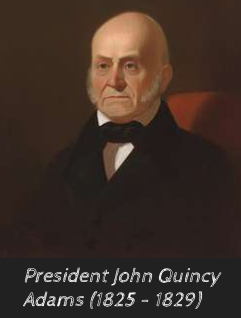
John Quincy Adams' administration, while Andrew Jackson became a hero to both sides of the tariff debate in virtually every state. John Quincy Adams’ only hope in winning re-election in 1828 hinged with a possible coalition with New England and the South, but the Tariff of 1828 doomed that prospect.

    Webster was caught in the maelstrom of the tariff debate and almost politically drowned. Webster found himself moving towards partial protectionism due to the demands of his constituents in his district, even though doing so went against his economic beliefs/knowledge. In the end, the Tariff of 1828 strongly benefited and protected such New England industries as wool, which in theory would keep the South and the West addicted to New England’s wool industry for many decades to come.

Picture
     Webster agonized on how he would vote in the Senate on the tariff bill, in that his free trade conscience wrestled with his political ambitions. Webster dreaded the possibility that his vote could be the deciding vote, and he felt that the eyes of the nation were upon him. After the Tariff of 1828 became law, Webster rationalized his vote in favor of the tariff, saying he was glad New England benefited, but in the future changes would have to be made.
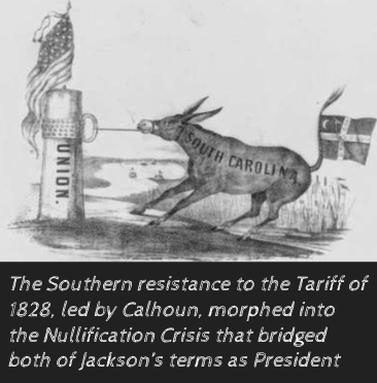
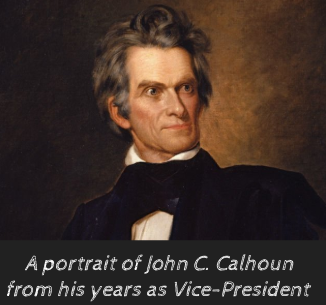
    To Vice-President John C. Calhoun (SC), it was the sectionalism of the vote in both houses of Congress that rankled him. The VP had nothing against protectionism in the abstract, but as far as Calhoun was concerned, the Tariff of 1828 was a sword that the North had swung against the South. Calhoun had witnessed the glee that emanated from Northern members of Congress as they worked the tariff through the legislative process. Soon, Calhoun and the South referred to the Tariff of 1828 as the “Tariff of Abominations”.
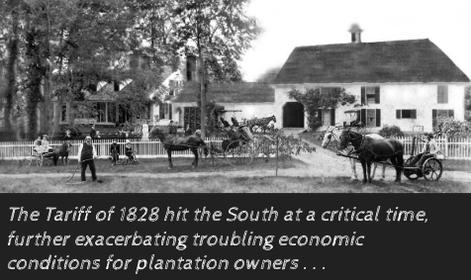
    Calhoun noted that the tariff hit the South at a very vulnerable time, in that the textile industry in the North had rebounded from the Panic of 1819, and cotton prices had soared which led to Southern planters borrowing more money to plant/cultivate/harvest more cotton on additional lands. Planters in other cotton producing nations had done the same, and the price of a bale of cotton in the world market plummeted from the resulting glut, falling 2/3’s between 1828 and 1828.  Sugar and rice planters were not affected, but cotton planters were hit hard, over their heads in debt. The Tariff of 1828 made hard times even worse in the South, and Southerners were desperate to find someone to blame for their misfortune. Proud Southerners such as Calhoun simply wouldn’t stand for that treatment, and as far as the South was concerned, the North had declared economic warfare on their region.


Picture
     During the Summer of 1828, South Carolina voiced their resistance to Northern tyranny, seeing the North as the “New Great Britain in Town”, and their resistance akin to that of the Patriots during the Revolutionary War Era. South Carolina sought a single voice to air their grievances, and VP Calhoun was their man. Calhoun soon wrote a manifesto of over 35,000 words, but unlike Webster, he didn’t publish right away, since Calhoun knew his words could have unintended consequences concerning the Election of 1828; in no way did Calhoun want President John Quincy Adams to win re-election.
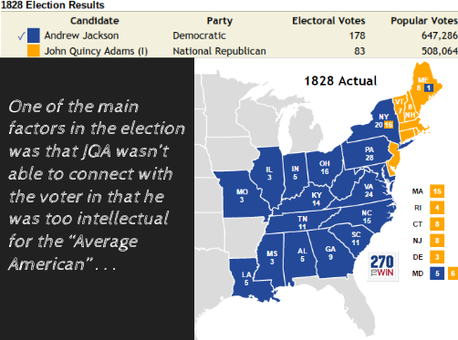
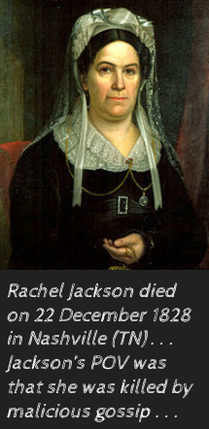
   Calhoun knew he couldn’t overcome the tidal wave of support behind Jackson, so once again Calhoun ran for Vice-President and again easily prevailed in the Electoral College. The Campaign of 1828 was easily the nastiest to that point in US History, with Clay behind much of the anti-Jackson attacks. In a Kentucky newspaper, Rachel Jackson was referred to as a “dirty black wench” . . . Jackson seethed. In the end, Jackson won by a large margin in the Electoral College, 178 to 83 over JQA, and Jackson saw the result as confirmation of the rising tide of democracy. Soon thereafter, Jacksonians started to call themselves Democrats, and not only did the Average American elect Jackson as President, but the Democrats also had a majority in both houses in Congress.

Picture
     After the election (while Rachel was dying with Jackson at her side), Calhoun released his manifesto against the Tariff of 1828. Calhoun’s name was not on the document; instead, prominent South Carolinians signed lengthy diatribe. Calhoun didn’t want his name on the document since he believed his arguments needed to stand on their own merits, and that as VP it would have been unseemly to be seen arguing against federal law.
    Additionally, Thomas Jefferson had withheld his identity as the author of the Kentucky Resolution in 1799, and Calhoun figured that was good for Jefferson was good for him. Calhoun argued that the Tariff of 1828 was unconstitutional, in that it went beyond the powers granted to the federal government in the Constitution. The power to tax was for revenue, Calhoun argued, not for protecting/promoting the commerce of one region of a nation over another. Calhoun also argued that the Tariff of 1828 would actually lead to less revenue for the federal government.

Picture
   Calhoun stated that there was nothing to keep the North from raising the price of goods they sold to the South, while the South had no comparable advantage. Also, Southern cotton growers may lose their global market share, perhaps permanently. According to Calhoun, the only power to counter the Tariff of 1828 was the power of the states, and that the arguments of Jefferson and Madison in the Kentucky & Virginia Resolutions were still valid.
    Calhoun went on to say that a state such as South Carolina could declare a federal law null and void in their state. Calhoun admitted that the Constitution didn’t give a state the right to review/interpret federal law, but neither did the Constitution give the Supreme Court that right. Yet the Court asserted for themselves the right to interpret the Constitution in terms of Acts of Congress, and the states should have that same right, Calhoun stated. Calhoun also argued that the states had a much greater argument in their favor compared to the Supreme Court due to the 10th Amendment.

0 Comments

Clay & Calhoun: The Eaton Affair and DC Politics

7/18/2019

0 Comments

 
                         Source: H.W. Brands. Heirs of the Founders (2017)
Picture
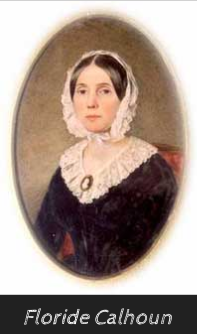
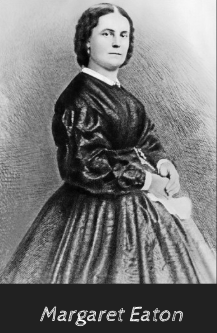
     Floride Calhoun, rarely became involved in her husband’s political life, but the main exception to that was when she took an immediate dislike to Margaret Eaton during her husband’s swearing-in ceremony as Vice-President. Peggy Eaton was considered to be the most beautiful woman in DC, and she acted the part, drawing the attention of the DC men and the ire/hatred of the DC women.
    Peggy and William Eaton hadn’t married until 1829, and before then they were an item until Peggy’s husband died. They married very soon afterwards, too soon as far as the Nashville/Tennessee and DC Elites were concerned. Since there was no First Lady, Floride was the DC tone-setter in terms of the social landscape; Floride refused to return a visit to Peggy Eaton, and the rest of the DC women followed her lead . . . “The Shunning" had started, and soon Jackson would enter the DC fracas on the side of SecWar Eaton and his wife.

Picture
     Floride saw herself as the defender of the family, and Peggy Eaton had carried on in a way up to her marriage that hadn’t been family-friendly enough for Floride and the DC women. In Floride’s point-of-view, she had taken a stand against indecency by shunning Peggy Eaton. Calhoun knew that Jackson was loyal to a fault, and that the William Eaton was in Jackson’s Circle of Trust, so he remained silent . . . but Floride’s boycott of the Eatons had spread throughout DC society, and soon DC was divided between “Team Floride” and “Team Peggy”.  Cabinet meetings were unable to be held since the two camps refused to even be in the same room as the other . . . in the midst of the DC political machine shutting down, Jackson’s support of Peggy Eaton was unwavering.
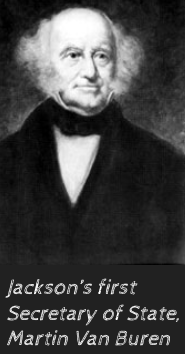
    SecState Martin Van Buren joined Jackson on “Team Peggy”. MVB saw the great divide as an opportunity to ingratiate himself even further with Jackson. As far as Jackson was concerned, Calhoun was working against him on the Eaton Affair, indirectly using others to attack/distract him. The Eaton Affair was still in full bloom as Congress convened in 1830. The main issue before Congress was the Tariff of 1828, and the impact of Calhoun’s manifesto had been felt by then. The battle lines were drawn, and soon Senator Daniel Webster (MA) would be forced into the fray.

Picture
      Calhoun assumed that Jackson would only serve (or last) a single term, believing like many others that the former general would want to return to Tennessee to tend to his wife’s grave and to deal w/ his myriad of health problems. In contrast, Calhoun was in top shape in his late-40s, and his eyes glowed, even changing color depending on his mood and/or the lighting. Calhoun was a strikingly impressive figure, and Calhoun simply saw himself as the next President, and he assumed that millions of Americans saw him in that light as well.
    But Clay also saw himself as a future President, and his ambition was no secret. Even though Clay was in temporary political exile after the Election of 1828 (as was JQA until he was
elected to the House from his home district in MA), Clay knew he would return . . . he also knew he would stand in opposition to either Jackson or his successor. MVB also saw himself as a future President, and unlike Calhoun or Clay, he had good reason for that belief, since he was a rising star in DC in the Jackson administration.

Picture
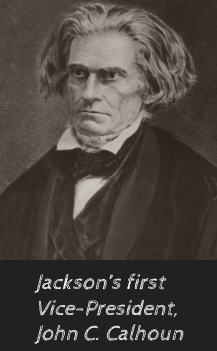
     One result of the Eaton Affair was that MVB emerged as Jackson’s logical successor, and MVB figured that he’d run and win in 1832, since of course Jackson would head back to TN. But as early as 1830, Jackson caught the “2nd Term Bug”, which forced MVB, Clay, and Calhoun to adjust their time frames. Calhoun and MVB had to decide whether to wait until 1836 or to challenge Jackson in 1832, and MVB decided to wait four years. Calhoun decided on 1832, which was more than somewhat logical in that the Vice-President was no longer in Jackson’s favor, since Jackson had blamed the Eaton Affair on Calhoun, and had seriously questioned his loyalty to the Union.
   The rift between President and Vice-President became public in the Spring of 1830 during a celebration of Jefferson’s birthday on 13 April by the (no longer calling themselves Republicans) Democrats. After dinner came the toasts, with each toaster airing his beliefs, preferences, and grievances. Places were arranged for 100, but there was serious doubt as to whether all 100 invited Democrats would attend given the rancor over the Tariff of 1828. The
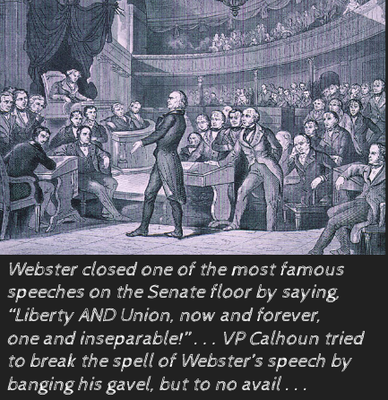
Webster-Hayne Debate earlier that year had clearly drawn the line between pro-Union and States’ Rights supporters.

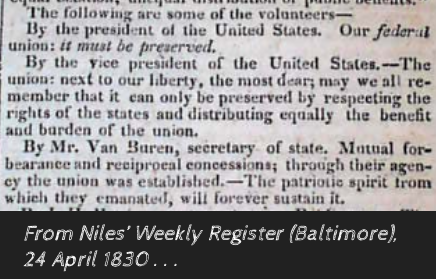
    But the immediate question was the attitudes that the President and Vice-President held towards each other. Both were to speak that night, and the air was electric with anticipation. As the 24 scheduled toasts unfolded, slowly the focus trended towards states’ rights. The unscheduled toasts were to follow, and President Jackson had the prerogative to deliver the first toast if he so chose.   

Picture
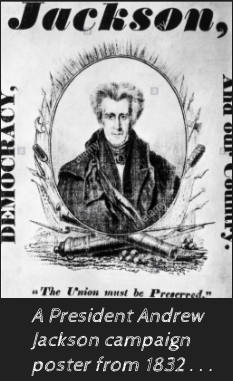
     Jackson did not speak loudly, but his words had force, and they felt like rifle shots fired across the room: “Our Federal Union - it must be preserved”. That was all Jackson said, easily the shortest toast of the evening to that point. Everyone assumed that Jackson was just warming up, but the President sat down, and all heads swiveled to Calhoun. The Vice-President was in a position where he had to respond; up to that point, Calhoun had done all his talking via the written word, and semi-anonymously at that. Jackson had called out Calhoun in a political equivalent of challenging someone to a duel.
    Calhoun simply could not match Jackson’s brevity/clarity, in large part due to the impossibility of communicating the essence of states’ rights in few words. Calhoun had prepared himself that night to respond on multiple fronts, since he didn’t know what Jackson would say, and he adjusted on the spot. Calhoun raised his glass and started to say “The Union . . .”; for a split second, it appeared to some that Calhoun had caved, but he continued. “ . . . next to our liberty the most dear”. Calhoun went on by stating that the rights of the states needed to be respected. Heads swiveled back to Jackson to see if he would counter with a toast of his own, but he did not, as was customary with toasts such as these. Also, Jackson knew better than to debate Calhoun, and Jackson simply let his statement stand as it was.

Picture
    Jackson knew that Calhoun had been behind the Eaton Affair with Floride, and was behind the growing Nullification Crisis. But after the Jefferson Birthday Dinner, Jackson discovered that Calhoun, as SecWar during the Seminole campaign, had worked and spoke out against Jackson. Jackson knew that SecState JQA had defended him and his actions concerning Spanish Florida, and the general assumed that Calhoun had done so as well.
    Two weeks after the diner, Jackson received a copy of a letter written by Crawford that such was not the case, in that Calhoun had wanted Jackson to be publicly punished and humiliated. In the letter, Crawford indicated that Calhoun had set him up to face the wrath of Jackson. Jackson sent a copy of the letter to Calhoun, demanding a response, this time calling out Calhoun in private. Jackson offered Calhoun a chance to explain himself and his actions; in the back of Jackson’s mind, he had wondered about Calhoun in the succeeding years, but now he had proof that he could not dismiss.
    Jackson’s challenge to Calhoun was to disprove the charge if you can, but Calhoun could not do so, so he really didn’t bother to try. Calhoun refused to answer for his actions taken as SecWar; Calhoun understood that Jackson was using Calhoun to help launch his campaign for re-election in 1832 by slamming the door shut on Calhoun’s candidacy. Calhoun knew by then that the real audience was the American public, and so Calhoun, after stating that he wouldn’t defend his actions in public, of course did exactly that. In a series of long and tedious letters, Calhoun did his best tl defend his actions against Jackson as SecWar. Jackson publicly responded by, in effect, labeling Calhoun as a Brutus.

Picture
     Clay monitored Calhoun’s dilemma with quiet satisfaction, since among those associated with Congress, Calhoun had worried Clay the most in terms of running against him for President. Between them, Calhoun was the first to be in the Cabinet, and then the first to win a national election (VP). Clay thought Calhoun was finished because he had been too clever for his own good, and too principled and unmoving with state’s rights. Clay had expected to run in 1832 against Calhoun or MVB, but then Jackson decided to run again, and by 1836 Clay would be almost 60 years old. The Democrats were splintering into factions, and Clay believed that worked to his advantage if he acted quickly.
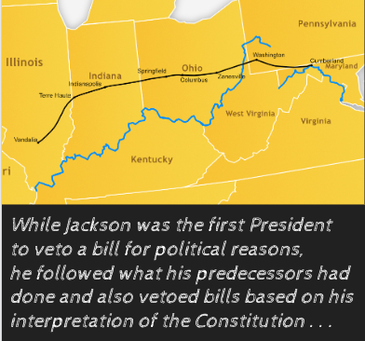
    President Jackson had blocked and undermined Clay’s American System since he had entered office, with Jackson opposing protective tariffs and federally-funded internal improvements (e.g. roads). Clay saw Jackson’s hostile opposition to his American System as insulting and narrow-minded. Jackson had vetoed the Maysville Road Bill which would have greatly benefited Kentucky, and Jackson refused to support a bill that would in essence tax MA, whose roads were finished, to help a state like KY. To Jackson, even roads between states were for individual states to fund and build; Clay believed that Jackson would keep the US mired in the 18th Century.


0 Comments

Henry Clay: The Election of 1824

7/9/2019

0 Comments

 
                           Source: H.W. Brands. Heirs of the Founders (2017)
Picture
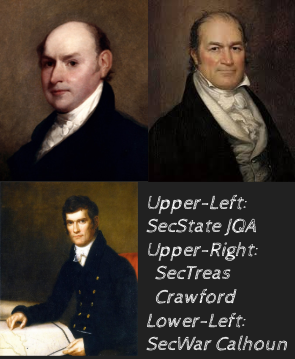
     The candidates for the Election of 1824 were the first that didn’t have a direct role in the Revolutionary War, and by then it had become a political requirement for a candidate to portray himself as a man-of-the-people, both of which favored Jackson. The general let it be known that if he was drafted to run for President, he would do so. Meanwhile, those in Monroe’s 2nd Term Cabinet, Crawford (SecTreas), JQA (SecState), and Calhoun (SecWar), signaled their interest to run to their respective states, since it was a state that officially nominated a candidate (there were not nationally organized political parties yet).
    What had changed by 1824 was that the voting requirements in most states had been liberalized, in that in essence one was eligible to vote if he was a white man. So for the first time in US History, Presidential candidates in 1824 had to campaign for votes. Crawford packaged himself as the candidate of the South, while JQA used the same strategy in the North. Calhoun was unable to inspire many voters into his fold, in that he was too intellectual for most voter. JQA was an intellectual as well, but he was able to attract voters in his region, while Crawford stole Calhoun’s thunder in the South. Henry Clay was also running for President in 1824, and he openly spoke on his own behalf as a candidate, which was something the other candidates did not do.

Picture
     Clay had returned as Speaker in 1823, and by January 1824, Clay had resumed his efforts at nation-building with his American System. Clay had the advantage of giving what was, in effect, campaign speeches from the House floor while also reinforcing and building connections with members of Congress, the DC Elite, and powerful state level figures.
    Clay did his best to keep the Republican (there was only one political party in 1824, the Party of Jefferson, who was still alive in 1824) caucus from selecting a candidate via a majority, and at the same time, Clay did his best to tear down Crawford. The Republican caucus did not nominate Crawford, and surveying the field of candidates, Clay predicted that no one would win a majority in the Electoral College. Republican state conventions were held, and in the Pennsylvania state Republican convention, Jackson garnerd 124 delegates to Calhoun’s 1. As a result, Calhoun started to focus on pursuing the Vice-Presidency in support of Jackson, which was what Clay had predicted Calhoun would do after losing badly in Pennsylvania.

Picture
     SecState JQA simply did not engage in the intriguing of SecWar Calhoun and SecTreas Crawford in pursuing the Presidency. JQA believed that the campaigns orchestrated by both men would cancel each other out to his benefit, which was apparently his sole strategy in that he didn’t have an organized campaign where he could attack other candidates and defend himself. JQA was especially bothered that Crawford and Calhoun used their Cabinet positions to enhance their bid for the Presidency instead of actually doing their job.  JQA was quietly pleased when Calhoun’s campaign fizzled out.
    During the Summer/Fall of 1824, Jackson gained momentum with the multitude of new eligible voters, and Crawford, the early frontrunner, suffered a stroke. New England was solidly behind JQA, but Clay had difficulty gaining support in the West due to Jackson’s popularity, and also in the South since Calhoun was running for Vice-President in support of Jackson. Of the 24 states, 18 allowed the popular vote to determine the state’s electors, while 6 states kept their electors under the control of their legislature.

Picture
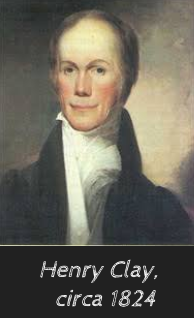
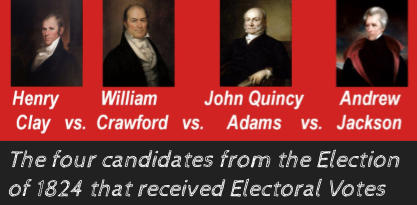
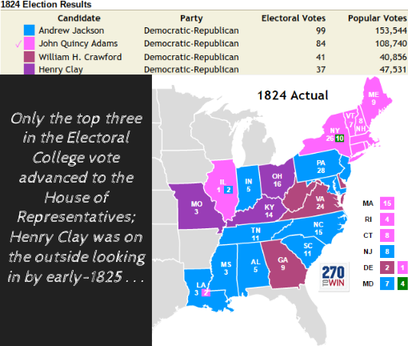
     None of the four candidates (Jackson, JQA, Crawford, and Clay) received a majority in the Electoral College in the Election of 1824. But Clay’s fourth-place showing (37 Electoral Votes) proved significant, in that Clay would not be one of the top three candidates forwarded to the House of Representatives; if Clay had finished 3rd, almost certainly, given his clout/influence in the House, he would have been the next President.
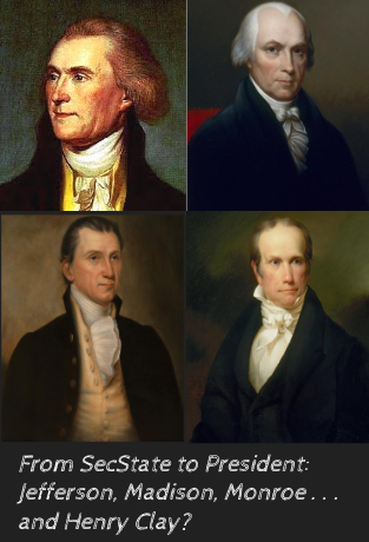
    Clay focused his energies in the House to get JQA the necessary support, meaning 13 states, and in exchange, he would be JQA’s SecState, which had been the stepping-stone to the Presidency for Jefferson, Madison, and Monroe. Clay’s conscience was clear, and in addition he simply saw Jackson as a threat to the nation’s future; Clay had positioned himself, he believed, to become President in the next four to eight years.
    The conscience of John Quincy Adams  was not as clear as Clay’s, in that he viewed Clay’s strategy as nothing more than self-serving political shenanigans, and his opinion of Clay since Ghent hadn’t changed at all. However, it soon became clear to JQA that the only path he had to become President was through Clay. Then Calhoun indicated that he would throw his support behind the candidate that endorsed him as their Vice-President; so JQA faced a decision . . . would he deal with Clay or Calhoun or both?

Picture
     By the time the Electoral Vote had officially been counted in the Senate, JQA decided he would go with Clay. The majority of the members of the House wanted an early resolution on the first ballot. JQA’s diary for the crucial day when Clay outlined his plan was left blank at the crucial juncture, and Clay didn’t keep a diary. However, Clay’s letters of that time frame show that his hopes of becoming President in 1824-25 had dimmed, and then evaporated he finished fourth in the Electoral College.
    What hurt and irritated Clay was that he narrowly lost Louisiana (he suspected shenanigans had been afoot); had he won the state, he would have finished ahead of the still-incapacitated Crawford. In the House, Clay found himself under siege by backers of JQA, Crawford, and even Jackson had powerful friends in the chamber . . . such was Clay’s influence and power in the House of Representatives. In the end, Clay viewed JQA as the “safe” choice, and in addition he would be well-placed as SecState to win the Presidency in 1828 or 1832.

Picture
    To Clay, Jackson’s military background bothered him the more he thought about it, and he referred to Jackson in many letters as a “Military Chieftain”.  Sure enough, his label for Jackson found its way into the Washington National Intelligencer, after which it was only a matter of time until Jackson found out. Jackson arranged for one of his letters that criticized Clay to be leaked, where he pointed out that Clay had never been in the military to defend his nation, and therefore knew nothing about being a true patriot.
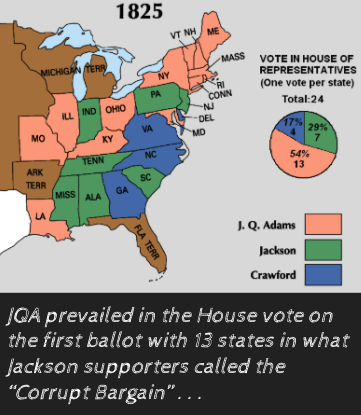
    The pressure on Clay increased, so much so that one had to go back to the Burr-Hamilton Duel to find a situation where a public figure had so much pressure placed on him by another public figure. It became clear to Clay that Jackson and his supporters were thinking in the long term (e.g. 1828), as were all those not in support of JQA. John Quincy Adams was elected on the first ballot with 13 states, Jackson had 7 states, and Crawford had 4 states. Jackson’s supporters, as well as Jackson himself, were beyond-livid at the loss, and the blame and their full fury was focused on Clay.
    The next day, JQA met with Clay and offered him SecState during a 30 minute conversation, and Clay thanked JQA and said he would think about the offer. Very soon thereafter, Clay accepted, knowing that the blowback would be a hurricane. News of the nomination sent the Jacksonians into a frenzy, and they labeled it the “Corrupt Bargain”, and repeated it so often that it became a mantra.

Picture
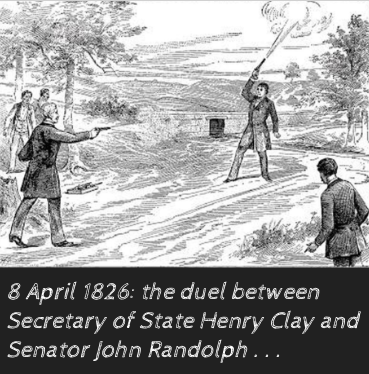
     As SecState, Clay actually was in a duel with Senator John Randolph (VA) on 8 April 1826; Clay was told that Randolph impugned his honor in a speech in Congress. Each man fired three shots, with Randolph’s first shot fired into the ground due to the pistol’s hair-trigger, and Clay’s first shot missed (it’s not known if he intentionally missed). The second shots of both men also missed; it’s worth noting that Randolph was far more nervous and out-of-his-element compared to Clay during the duel.
    Clay’s third shot went through Randolph’s coat but did not injure him, and Randolph fired into the air, and the duel was over. The only debt to be paid afterwards was that Clay had to purchase a new coat for Randolph, but the Affair of Honor had been settled. The duel had been witnessed by Senator Thomas Hart Benton (MO), who had been an intermediary for both men before and during the duel.

0 Comments

Henry Clay & John C. Calhoun: Missouri and Florida

7/1/2019

0 Comments

 
                       Source: H.W. Brands. Heirs of the Founders (2018)
Picture
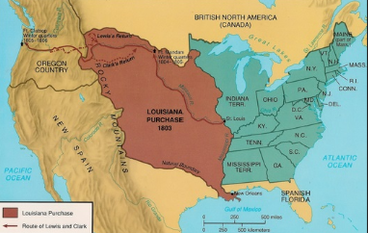
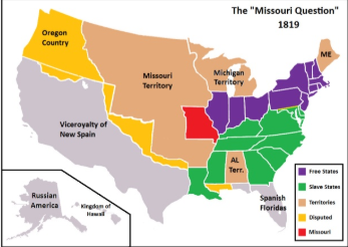
     Missouri was the first territory from the Louisiana Purchase to become a state after Louisiana, which had been added as a slave state in noncontroversial fashion, but not so with Missouri. Both Northerners and Southerners viewed the potential state as a valuable and strategic addition to their own region, at the expense of the other. Slavery was legal in the Missouri Territory, and slaveholders dominated the territory’s politics.
    Congressman James Tallmadge (NY) introduced a bill that would grant Missouri status as a slave state, However, his bill would ban new slaves from entering the state and freedom for existing slaves when they reached the age of 25. To Tallmadge, Missouri could enter as a slave state, but slavery would soon disappear. The Tallmadge Amendment passed the House of Representatives since Northerners outnumbered Southerners, but it stalled in the Senate.
    Southern Senators argued that the amendment was unconstitutional, in that the Constitution in no way gave power to Congress to restrict slavery in the states. As a result, Missouri was not added as a state in 1819, but the territory continued to grow, as did the pressure to find a compromise. The “Missouri Question” was all Washington, D.C. could think about as 1820 dawned.

Picture
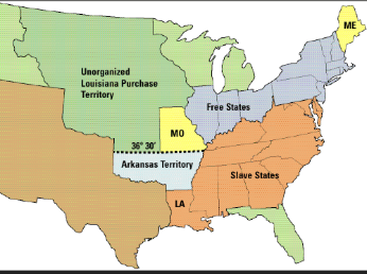
     The compromise that Henry Clay had in mind revolved around Maine, which in a case of excellent timing wanted to be rid of Massachusetts. To Clay, adding Missouri and Maine as states together would make the North and South happy and unhappy all at once, which was usually the sign of an excellent compromise.  Clay’s real problem was dealing with the Tallmadge Amendment, where Clay argued it was not only imprudent, but also unconstitutional. Clay argued that when slavery had to compete against free white labor, slavery would lose, which would advance the reality of emancipation.
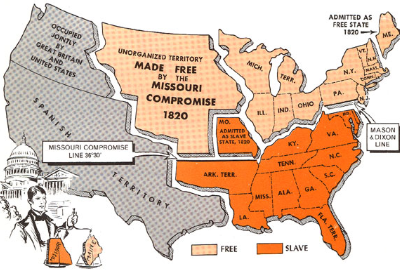
    Clay also in essence scolded the North, arguing that their resistance only emboldened the South. It’s possible that not even Clay truly believed his arguments, and he didn’t change many, if any, minds, but he believed he had put a gloss of respectability on his upcoming compromise. Clay had the Senate go first, and they voted to add Missouri and Maine as states in mid-February 1820, The Senate also voted to allow Missouri to write a state constitution without any restrictions on slavery. An amendment by Senator Jesse Thomas (OH) introduced the 36 Degrees, 30 Minutes North (36/30) concept, which was approximately at the mouth of the Ohio River. Under his 36/30 proposal, states south of the line would be slave states, and north of the line free states, which would in theory keep balance in the Senate between North and South.  Under the proposed amendment, Missouri was the only exception to 36/30.


Picture
      Northern Senators believed that they were giving away very little by voting for 36/30, and even better, they could claim political victory to the opponents of slavery. The Thomas Amendment of 36/30 benefited Clay the most, politically, and Clay believed he could shepherd the various versions of the bill from both houses through the Conference Committee. And Clay did just that: the South gained an unrestricted slave state with Missouri as well as the lower portion of the Louisiana Territory. The North gained a free state in Maine and the upper Louisiana Territory; to Clay, 36/30 was a solution that would last for decades.
    But there were growing voices that opposed any possibility of the expansion of slavery in the West, and Southern zealots were all-in on making sure there were no restrictions on the spread of slavery towards the West. What Clay had bought the US was time, where he hoped the issue of slavery could be decided (peacefully), before the nation expanded all the way to the Pacific Ocean.


Picture
     A panic in 1819 took hold of the nation’s financial system, which caused an economic depression that affected the West the most. A distressed population demanded relief from both state and federal levels of government. Clay held bad debts during the depression which left him exposed when his debtors defaulted. Clay liquidated property, but it wasn’t enough, and he concluded that he couldn’t afford to remain in politics, which meant he wouldn’t run for re-election in his Congressional district in 1820.
    Clay tried to think of ways to get back his fortune, or at the very least stay out of debtors’ prison, and he formed a new law practice in Lexington (KY). Clay even resigned as Speaker before his term in the House ended, but the House floundered as a result, since the chamber was used to his leadership. As a result, the still pending Missouri Compromise seemed to be on the verge of unraveling. So Clay came to the rescue, getting himself appointed to chair a special committee to deal with the “Missouri Problem”. Then came the issue of whether Missouri’s three Electoral Votes in the Election of 1820 actually counted, since technically Missouri was not yet a state.

Picture
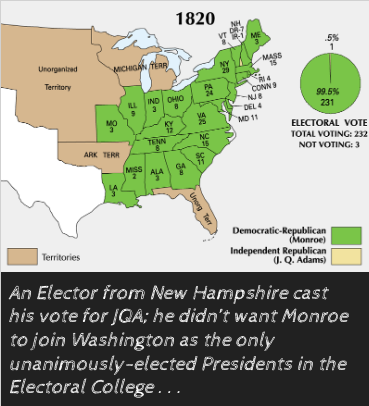
    Clay’s electoral compromise proposal was that two Electoral Vote totals be tallied, one with Missouri, and the other not counting Missouri. Clay knew that Monroe would win re-election by a large margin (the Election of 1820 was the last “closed” Elector election, and Monroe received all but one of the Electoral Votes, with JQA receiving the single vote), so then both totals would be forwarded to and from the Senate in order to certify the election. Both houses approved Clay’s compromise, but while the compromise didn’t fan the flames, it didn’t dissipate hard feelings either.
    Eventually the House and the Senate agreed to admit Missouri as a state on the condition that Missouri’s legislature never adopt legislation abridging the rights of any citizens from any other state, and the votes were close, with the hardliners from both the North and South seeing the situation as intolerable. Missouri gave in, but in the same breath the state legislature denied that Congress had the authority to restrict them in that manner. Clay didn’t care about the close margins, only that the Missouri Compromise, as it became to be called, passed . . . the crisis had passed, but not the underlying causes, or danger.


Picture
    John C. Calhoun became President James Monroe’s Secretary of War because Clay simply refused to accept the post. Monroe sought regional balance in his Cabinet: John Quincy Adams of Massachusetts (SecState), William Crawford of Georgia (SecTreas), and to honor the West, Clay from Kentucky as SecWar. But Clay actually declined the position even before it was officially offered by Monroe. Clay almost certainly would have accepted SecState, and most likely SecTreas, but to Clay, SecWar looked to be the political equivalent of a backwater posting in the military.
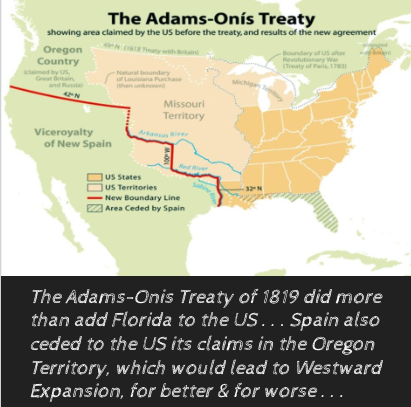
    Monroe considered Andrew Jackson, but the general wanted to remain in the field. Monroe settled on South Carolina’s Calhoun, who was seen as not much more than a proxy for Clay by 1820. Where Clay saw SecWar as an insult, Calhoun saw the Cabinet position as a great opportunity. But Calhoun had no idea what he was getting into, especially with General Jackson. Jackson continued to see Spain in Florida as a threat, and as harborers for the Seminoles . . . so Jackson thought, why not just take Florida from Spain? Monroe reached the same conclusion, albeit more slowly than Jackson. But the crux of the matter was that the President and the nation’s most famous general knew that Florida would need to be taken from Spain by force.

Picture
      President Monroe authorized JQA to pursue the diplomatic possibility of gaining Florida from Spain via negotiations or purchase. At the same time, Monroe indirectly encouraged Jackson to flex his military muscles to show that Spain had no way to control or secure Florida. Jackson’s plan to Monroe was to run roughshod over Spanish Florida, ostensibly in order to deal with the Seminoles. But Jackson also made it clear that his aggressive actions would not implicate the government, and that appealed very much to Monroe.
    Intrigue and controversy ensued once SecWar Calhoun was informed of the plan. Jackson claimed that Calhoun had agreed with Monroe and sent him a letter authorizing him to proceed. However, Jackson said that he had destroyed the letter, claiming that Monroe wanted him to do so in case Jackson was captured or killed. Monroe publicly disavowed Jackson’s actions in Florida, since Jackson had found a way to offend the British in the process.
    Jackson expected that disavowal, but when he caught news that his reputation had been attacked by SecTreas Crawford, who called Jackson uncontrollable and insubordinate, he was infuriated. Jackson had no way of knowing that Calhoun, not Crawford, was the ringleader of the anti-Jackson chorus in DC. Calhoun borrowed trouble in assailing Jackson, but payment would come years later, in that Jackson had no idea of Calhoun’s shenanigans. Calhoun sent Jackson letters which made it seem that the SecWar was in the general’s corner: Calhoun would be able to keep his political gamesmanship secret from Jackson for over a decade.

0 Comments

    Archives

    May 2020
    April 2020
    March 2020
    February 2020
    January 2020
    December 2019
    November 2019
    October 2019
    September 2019
    August 2019
    July 2019
    June 2019
    May 2019

    Categories

    All
    18th Century
    19th Century
    20th Century
    History

Powered by Create your own unique website with customizable templates.