Mr. Jensen's U.S. History Website
  • U.S. History Blog
    • U.S. History Blog (May 2026 - May 2027)
    • U.S. History Blog (May 2025 - May 2026)
    • U.S. History Blog (May 2024 - May 2025)
    • U.S. History Blog (May 2023 - May 2024)
    • U.S. History Blog (May 2022 - May 2023)
    • U.S. History Blog (May 2021 - May 2022)
    • U.S. History Blog (May 2020 - May 2021)
    • U.S. History Blog (May 2019 - May 2020)
    • U.S. History Blog (May 2018 - May 2019)
    • U.S. History Blog (May 2017 - May 2018)
    • U.S. History Blog (May 2016 - May 2017)
    • U.S. History Blog (May 2015 - May 2016)
    • U.S. History Blog (May, 2014 - May, 2015)
  • About

Vice-President Richard Nixon (1955 - 1957)

1/22/2020

0 Comments

 
               Source: John A. Farrell. Richard Nixon - The Life (2017)
Picture
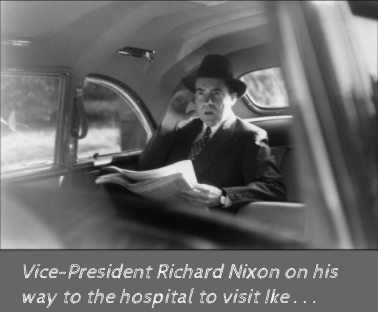
  On 24 September 1955, President Eisenhower, while in Denver, had a heart attack. Ike’s 74 year old doctor misdiagnosed the President’s condition, labeling it indigestion. Ike (64 yrs old) wasn’t taken to a hospital until twelve hours after his heart attack. Vice-President Richard Nixon knew that he was now under an even greater spotlight in the media and government, and he knew that he needed to show in every possible way that he wasn’t “taking over” from Ike. 
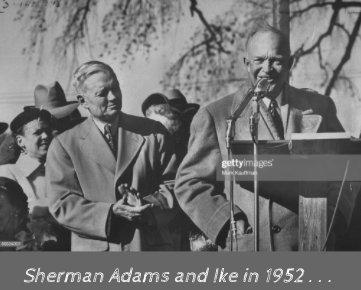
   Nixon and Deputy Attorney General Bill Rogers met with among others Sherman Adams (Ike’s #1 advisor) and the chairman of the Republican National Committee to discuss the politics of Presidential incapacitation. During the days that followed while Ike’s condition improved (despite some setbacks), Nixon showed wisdom and self-control. As the weeks passed, Ike’s Circle of Trust did their best to keep Ike’s power in their hands while keeping a close eye on Nixon. Meanwhile, the government and the media feasted on rumors, most of them not positive concerning Nixon.
     Nixon knew that a repeat of President Woodrow Wilson’s incapacity needed to be avoided, but he also knew that he needed to find a way to show that the government was still in strong/capable hands without Ike at the helm. In effect, Sherman Adams, who joined Ike in Denver, became the de facto President during Ike’s recovery, while Nixon performed wonderfully as the loyal Vice-President.
Picture
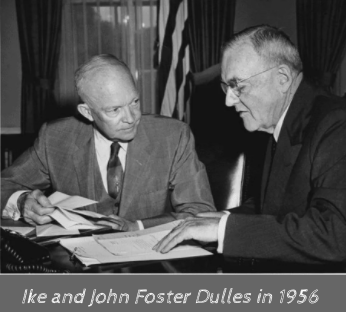
    Ike sent Nixon instructions so he could lead Cabinet and National Security Council meetings, but Ike made it clear to Nixon that SecState John Foster Dulles was in charge of foreign policy.  Nixon performed his duties in Ike’s absence with sensitivity and loyalty. For example, Nixon declined to take Ike’s chair in meetings, and he went to see those he wanted/needed to meet instead of summoning them. Nixon’s actions bolstered confidence in the nation and abroad, and many that were skeptical of Nixon were (at least temporarily) converted. 
     Jack Anderson, the beyond-famous investigative journalist, told Drew Pearson that Nixon was acting like a model Vice-President. Dulles was very grateful since Nixon kept silent concerning communists within the government while Ike recovered. Whatever plans Nixon had to leave politics vanished during this time, and Chotiner even started a “stealth campaign” to gauge interest for a Nixon nomination in 1956 in Ike didn’t run again. 
     No good deed goes unpunished, as Nixon discovered. Ike emerged from his recovery not only ready to run again in 1956, but to also ready get rid of Nixon as his Vice-President. Ike decided to run again in part because he simply didn’t want to give the Democrats a chance to win the White House. Also, as a coronary patient, Ike needed something in which to look forward and to give purpose, which meant another term as President.
Picture
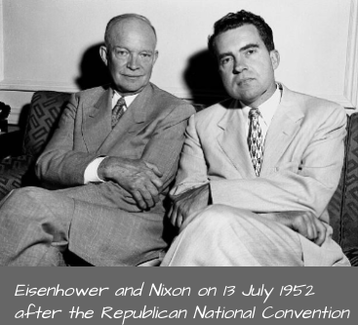
    The major factor why Ike seriously considered dropping Nixon as VP was due to his near-death experience. Ike simply didn’t think that Nixon was Presidential material, especially with what he considered to be repeated political immaturity and opportunism on Nixon’s part. Despite all of the positives Nixon brought to the Vice-Presidency, Ike didn’t think Nixon did that much on his behalf as President. In fact, Nixon had developed  a high level of political maturity and had done everything right and had been totally loyal, but Ike started to freeze out Nixon even more. 
     On 26 December 1955, Ike invited Nixon to the White House and suggested that Nixon serve in the Cabinet during his second term. There seemed to be some sense in that suggestion, since William Howard Taft and Herbert Hoover had become President via that route, while the last sitting VP to be elected President was Martin Van Buren in 1836. Nixon had never been in charge of anything bigger than directing a staff that worked for him (e.g. making sure that Rose Mary Woods kept up with the mail), and therefore, Ike argued, that Nixon could raise his stature by serving in the Cabinet; Ike even dangled the possibility that Nixon could become Secretary of State.
Picture
   Nixon was fully aware of the politics involved, in that if he was reassigned to the Cabinet, it would look like Ike had no confidence in Nixon being President. To Nixon, it was 1952 all over again, with Ike wanting Nixon gone, but also wanting Nixon to cut his own political throat in order to minimize any blow back towards Ike. In late-February 1956, Ike announced that he would run for a second term, but he didn’t commit to Nixon as VP, saying that Nixon had to chart his own political course; the statement wasn’t exactly an endorsement. Senator John Kennedy (D; MA) was appalled at Ike’s public treatment of his Vice-President 
     Nixon’s health was also becoming an issue, in that he needed more pills to regulate his real and perceived ailments. The biggest problem facing Nixon was that he didn’t have a goal on which to focus. Nixon refused to play Ike’s game, and Ike didn’t want to remove Nixon as VP. During late-April 1956, Nixon decided that enough was enough, and he formally informed Ike that he wanted to remain as Vice-President. But Nixon’s status wasn’t yet settled, since in June 1956 Ike had surgery to remove an obstructed section of intestine, and in July 1956, Harold Stassen (among other Republicans), started a “Dump Nixon” movement.
Picture
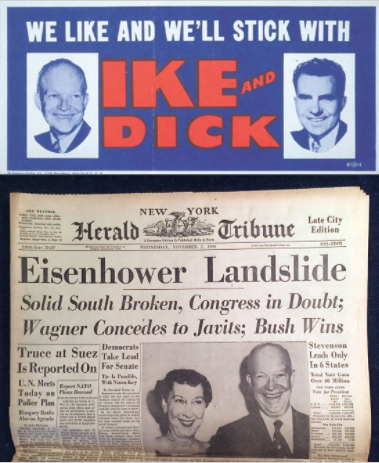
   Ike allowed the insanity surrounding Nixon’s status as VP to continue, and it wasn’t until Ike secured his second nomination at the GOP convention 1956 where the delegates again nominated Nixon as VP. Winning in 1956 looked good for Ike/Nixon since the economy was surging and millions of Americans had entered the middle class after World War II. The Democrats nominated Adlai Stevenson again, who offered no rationale for a change from Ike . . . the result was Nixon again was the target. 
  In his “Nixonland Speech”, Stevenson went on the attack, so much so that key advisors told him that he had gone too far. Stevenson desperately tried to convince voters that Ike’s health was precipitous enough that Nixon could be President during Ike’s second term. Due to the economy and a multitude of global crises that occurred in 1956 (e.g. the Suez Crisis), voters were comfortable taking a chance on Ike’s health than the prospect of a Stevenson Presidency. Nixon campaigned in 36 states, traveling mostly on board a DC-6. Nixon even decided to try and woo reporters by holding over 50 press conferences during the campaign.
Picture
    In private, Nixon would occasionally go bonkers in a rage over something that wasn’t a big deal in the presence of his staffers. Some key staffers told Nixon, after he had calmed down, that his behavior was the opposite of being Presidential. However, what the media saw during the general campaign in 1956 was the first incarnation of the “New Nixon”, with many reporters writing about Nixon’s maturity. Stevenson complained that Nixon had only temporarily put away his switchblade while masquerading as an Eagle Scout.
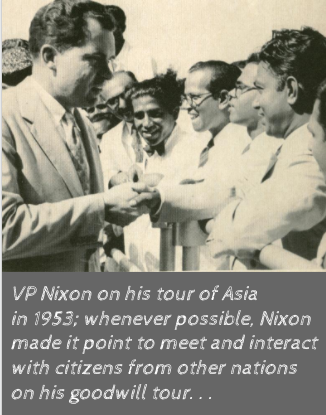
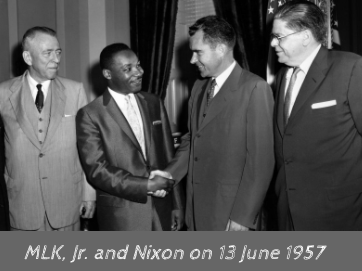
 On 20 January 1957 (Inauguration Day was on a Sunday, so the public Inauguration was on the next day), Nixon was officially sworn-in as Vice-President in a near-empty room in the White House by the Republican Leader of the Senate, William Knowland, and Ike was sworn in for his second term by Chief Justice Earl Warren; Nixon was surrounded by his two biggest enemies from his home state of CA. Soon Ike had his VP traveling abroad. During March 1957, Nixon was in Africa, and while in Ghana, he met Dr. Martin Luther King, Jr., who urged the VP to speak out against segregation. Nixon had dragged his feet in dealing with Senator Joseph McCarthy, but that would not be the case for Civil Rights, where Nixon would be one of the relatively few major politicians that tried to lead the way on that front.
0 Comments

Richard Nixon: The "Checkers Speech" (1952), Part One

1/1/2020

0 Comments

 
                    Source: John A. Farrell. Richard Nixon - The Life (2017)
Picture
     Liberal journalists looked hard for dirt on Nixon in CA, and soon rumors surfaced that Nixon was an anti-Semite (Nixon didn’t care about race or religion as long as people supported him) and that he had a secret slush fund that was maintained by a wealthy businessman. When Nixon was Senator-Elect in late-1950, the political fund called the “Nixon Sustaining Fund”  totaling $18k was created and was administered by a Pasadena banker. The maximum yearly contribution from an individual was $500, and only those that had supported Nixon since 1946 could contribute. 
     The goal was to have the fund reach a range between $20k and $25k so the fund could sustain political expenses and travel. Once Nixon was nominated for VP, the fund started to allot $500/month for household use, which was paid directly to the Nixons, which if nothing else made it easier for Pat to travel with her husband (that $500/mo was also earmarked for house cleaning and for a nanny).

Picture
     The gossip around the area in CA where the Nixons lived was that the $500/mo from the fund was so Pat could hire a maid. Peter Edson (a syndicated columnist) resolved to ask Nixon about the fund when he next had access to Nixon. Edson’s chance came on 14 September 1952 after Nixon’s appearance on Meet the Press, where Nixon urged Edson to contact those in charge of the fund to get all the accurate information he wanted. On 17 September 1952, Edson sent Nixon a draft of his column which was to be published the next day. Edson wrote a message to Nixon that he believed a list of all the donors of the fund should have been included in the information he was given to make sure that everyone knew the fund was above board. 
   The title of Edson’s column was straightforward: “Nixon Aided Financially by Rich Californians”, but his more factual version took a back seat to the New York Post. The Post had a reporter in CA named Leo Katcher that had been “tipped” by loyalists of Earl Warren. The New York Post’s headline was “Secret Rich Men’s Trust Fund Keeps Nixon in Style Far Beyond His Salary”. The story itself wasn’t lurid, but the headline did the damage and a political firestorm ensued. The Post simply didn’t do any fact-checking: the Nixon’s lived the life of typical middle class Americans, living in comfort, but not in luxury.

Picture
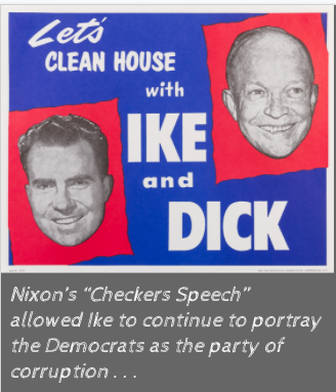
     What infuriated Nixon to no end was the he knew that Adlai Stevenson had a similar fund ($84k), and that he used it for entertaining others, campaign contributions, and staff bonuses. Stevenson’s VP candidate had his wife on the campaign payroll, and even Eisenhower received money from supporters/admirers for private use . . . but the media only hammered Nixon. As far as the media was concerned, the scandal was a test for Ike as much as it was for Nixon in terms of Ike’s judgment and decision-making. The weeks to come could very well knock down Ike to the point where Stevenson could be elected President. 
     Ike heard of the headline when his campaign train was crossing Nebraska, and by the evening, there was “great concern” among Ike’s campaign staff. A statement was drafted for the press that urged Nixon to release all relevant documents concerning the fund. Ike was caught in a political vice, in that he had railed against corruption in the Truman administration, and now corruption was possibly part of his campaign for President. Ike’s campaign had even taken on a tone of righteousness, and now his political crusade was in jeopardy. 
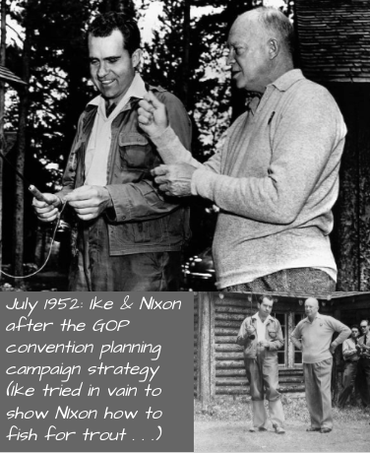
     Ecstatic liberal reporters commented out loud that Ike would have to let Nixon go as VP . The veterans in Ike’s campaign staff wanted to ride out the storm, since it would be disastrous to admit that Ike’s first major Presidential-level decision was a blunder. The less experienced campaign staff members, who were actually closer to Ike, were furious with Nixon and very worried about Ike’s image, and they wanted Nixon to vanish. For the chronically insecure Nixon, the next few days were hell; Eisenhower, Stassen, Dewey, and other powerful Republican patrons abandoned Nixon, and his enemies closed in for the kill. In CA, Warren and Knowland were very active in trying to pressure Ike to dump Nixon.

Picture
     Nixon’s instinct from the first moment was to fight back. Nixon started with stating during campaign speeches that the “Communists and Crooks” were out to get him. It felt good to lash out, and the crowds responded enthusiastically. Then word reached Nixon that the Washington Post and the NY Herald Tribune would call on Nixon to step down as Ike’s VP. Nixon was far more wounded by the Herald Tribune than the Post, since the Herald Tribune had helped Nixon when he went after Alger Hiss. Nixon had even reached the point where he considered the Herald Tribune’s editorial staff to be his friends; Nixon reacted as if the roof had caved in on his political career. 
     The most loyal and truest friends Nixon had at that time were Murray Chotiner and his wife Pat; both told Nixon to rally in the face of the attacks. From his wife especially, Nixon found his resolve to fight back instead of perhaps holding a press conference (that no doubt would have sounded a lot like his meltdown in 1962). By the weekend, the liberal media was sure that Nixon was guilty of income tax evasion. A plan of attack had formed in Nixon’ mind, in that he wanted to present his side straight to the people. Nixon soon learned that Knowland had been summoned by Ike’s staff, which told Nixon that he was about to be cut loose as VP.

Picture
     In Portland (OR) a hostile crowd jostled the Nixon and threw coins at them to the point where he and Pat had to duck. Ike was calm, and he wrote to some powerful people in the media, advising them to not overreact and to give Nixon a chance, and if he needed to make a decision, he would do so. Ike told reporters (off the record) that he would give Nixon a chance to defend himself and to show that he was beyond reproach. Privately, Ike felt that Nixon had to step down to avoid losing the election. 
     Ike found time to talk with Nixon on the telephone soon after the headlines appeared. Ike directly suggested that Nixon go on television and defend himself, which Nixon had already planned to do. What Ike wanted Nixon to do was to perform a “full financial scrubbing” on television; the televised speech had to mend the wound. Ike then told Nixon that he would wait a few days after the televised speech before he let Nixon know where he stood on the ticket. Nixon suspended his campaign on the train and went back to Los Angeles for an unprecedented televised address to the nation by a Vice-Presidential candidate. Once the televised speech was announced, most in the media were sure that Nixon would step down. 
     Nixon’s process for writing his own speeches stayed the same throughout his political career. Nixon used his beloved yellow legal pad to write a series of drafts until he not only was happy with what he would say, but also so familiar with the speech that he really didn’t need to use notes during the speech.

Picture
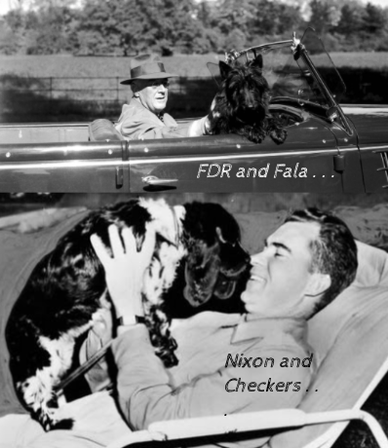
    Nixon decided on a three-part response, with the first being a flat-out refutation of all the allegations concerning the so-called slush fund. Second would be the full financial disclosure on which Ike insisted, and the last part was for going on the attack, blasting the Democrats while lauding Ike. But Nixon wasn’t yet done, in that he remembered the reaction in 1944 when FDR used his beloved dog Fala to ridicule the nonsensical Republican charges made against him. Nixon decided to do the same with their family’s new cocker spaniel puppy, Checkers. 
    Nixon also remembered a phrase he had used after the slush fund charges had come out when in response to a heckler that held a sign that wanted to know where Pat’s mink coat was, Nixon stated that his wife wore a respectable “Republican cloth coat”. Nixon showed his audacity by how he would close his TV speech, in that he would ask the viewers to respond . . . but to whom? If the responses were sent directly to Nixon, the Democrats would accuse him of shenanigans, so Nixon decided that the responses should be sent to the Republican National Committee (RNC). 
     An hour before the telecast, Dewey called Nixon on behalf of Ike’s entourage. Dewey told Nixon that after the broadcast he was expected to step down as Ike’s VP. Under questioning from Nixon, Dewey admitted that he hadn’t actually been told to make that demand to Nixon by Ike. After he asked Nixon what he planned to do, an incredulous, devastated, and furious Nixon told Dewey to find out by watching the broadcast.

Picture
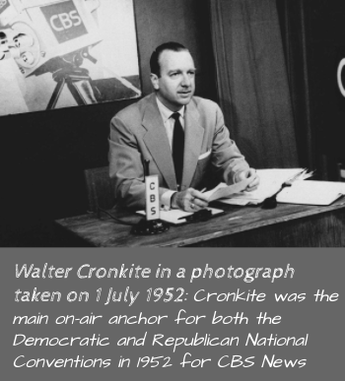
     Due to Dewey’s phone call, Nixon had trouble memorizing his remarks, so he would have to rely on his notes. When Nixon entered the studio, he simply didn’t think his fight would end in a victory. For $75k, the Republican Party had strung together 60+ NBC affiliates and hundreds of radio stations to broadcast Nixon’s speech from 9:30 - 10 pm on the East Coast, 8:30 - 9 pm Central/Mountain, and 6:30 - 7 pm on the West Coast. As an added bonus, Nixon’s speech was on a Tuesday evening, the same night as Milton Berle's show. 
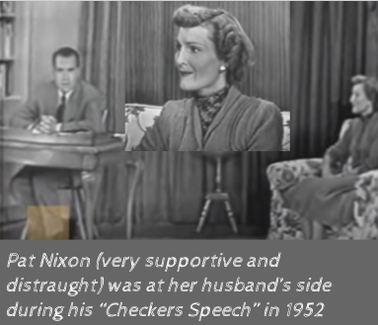
  Ted Rogers was a television producer/director who had met Nixon in 1950, and he was part of Nixon’s campaign staff. Rogers arranged for the “Library Set” to be used in the studio, with a chair for Pat off to the side of the desk. Nixon did not want to rehearse, so everything was planned on the fly by Rogers and his team. After basically flubbing his opening remarks, Nixon got on a roll, and he knew he was in the process of nailing his speech, especially when he stopped looking at his notes. Nixon was again on stage and acting, as he had in high school and college. Soon, Nixon told the television audience that he was going to do something unprecedented in politics by showing his financial standing to all (Pat had begged him not to do so beforehand) . . .

0 Comments

Richard Nixon: The "Checkers Speech" (1952), Part Two

1/1/2020

0 Comments

 
                   Source: John A. Farrell. Richard Nixon - The Life (2017)
Picture
     Nixon detailed his past, making it beyond clear that he worked his way up instead of being born well-off. By the time he reached his service in the US Navy during WW II, his allotted 30 minutes were half gone. Nixon, after the “cloth coat” phrase, used the Checkers puppy line for all it was worth. Nixon used that corny manipulative line to tell the viewers that he was one of them, and “THEY” are messing with US. The Checkers phrase was the end of the second segment of Nixon’s speech. 
   Then Nixon stated that it was fine that Stevenson, who inherited a fortune from his father, could run for President. Nixon added that a man from modest means should also be able to run for high office, and that’s where Nixon mentioned Lincoln and used a quote from the 16th President. In the last ten or so minutes, Nixon went on the attack against his tormentors, accusing Truman, Stevenson, and the Democrats of coddling Communists in the federal government and allowing massive corruption to flourish. Nixon also went after the media, arguing that after the Hiss Case, the media had gone after him very hard and unfairly.

Picture
  Nixon challenged the two Democratic candidates to fully disclose their finances, and if they didn’t, then there must be something to hide. Nixon didn’t mention Ike, but by the end of the campaign, Ike felt obligated to disclose his finances; an intensely private man, Ike never forgave Nixon. Nixon then got up from behind the desk and moved, like a political gladiator in the ring, and spoke about the Korean War, and how Ike was the one to end the war via tough negotiations. With a minute to go, Nixon stated that he refused to step down as VP since he wasn’t a quitter, but he would abide by what the RNC told him based on the viewer responses. 
     Nixon not only refused to resign as VP, but he had in effect taken the power away from Ike and given it to the public and the Republican Party. Nixon fit in a phrase that Ike was a great man, and the picture faded as Nixon was still speaking. Nixon soon learned that he did indeed nail his performance based on the reactions and feedback of those involved in televising his speech. Nixon left the studio through an adoring crowd in order to return to the Ambassador Hotel, where he received congratulatory phone calls and telegrams from people across the nation. 

Picture
     In 30 minutes on television, Nixon had changed his image from that of a liability to an indispensable asset to Ike in the eyes of millions of Americans, while the elites and intellectuals dismissed Nixon’s speech as sentimental dreck. Nixon had looked young, honest, and earnest to millions, and his summary of his accomplishments resonated with Americans that had worked their way to a better life.  To that point in time, Nixon’s speech had the largest audience to watch a TV program. 
    To Ike, Nixon reminded him of Patton, courageous but insubordinate. That being said, Ike sent a telegram congratulating Nixon, who wouldn’t read it right away since it got lost amid the rush of telegrams. Nixon wasn’t happy that he didn’t immediately hear from Ike, and Ike wasn’t happy that Nixon had used the RNC as his clearinghouse for viewer feedback. In an effort to take back at least some control, Ike told the media that keeping or getting rid of Nixon was not his decision alone. Ike let Nixon (and the media) know that the campaign would resume after they had met and Nixon had given his report . . . and then Ike would make the decision whether or not Nixon remained as VP. For Nixon, the agony of not knowing his political fate continued. After using television in a way that would change politics forever, Nixon started to wallow in self-pity (e.g. “what more can he possibly want from me?”).

Picture
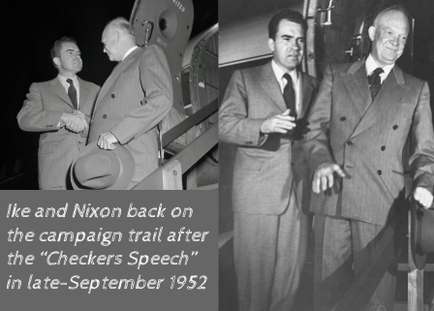
     Nixon dared to think about ignoring Ike’s summons, and Nixon decided to at least make Ike sweat and guess a little by traveling to Missoula (MT). Nixon was told by Chotiner, who had communicated with Ike’s Circle of Trust, that Nixon was still VP, but Ike still wanted to meet face-to-face. Nixon finally realized that the general would soon become President, and it would not be wise to alienate himself even before he took the oath of office as VP. So Nixon flew to Wheeling (WVA) and met with Ike. Ike called Nixon his “boy”, and in the presence of some of the media, they talked and then went to face a crowd of supporters outside. 
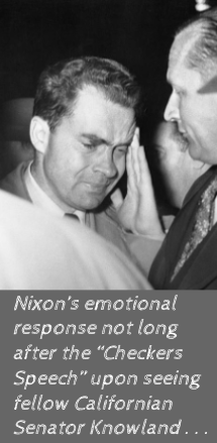
     Later that night, Ike was told that the RNC had voted 107 - 0 to keep Nixon on as VP. At a political rally, Senator Knowland was on the podium, and Nixon, so happy to see a familiar face, even if it was a Republican that was for all practical purposes an enemy, cried on Knowland’s shoulder (a photographer captured that moment). Ike told his brother than Nixon came through with flying colors with what was already being called the “Checkers Speech”. Nixon did more than save his political career, he changed politics by using television to communicate directly to millions of Americans, bypassing the power brokers and apparatus of his political party.


Picture
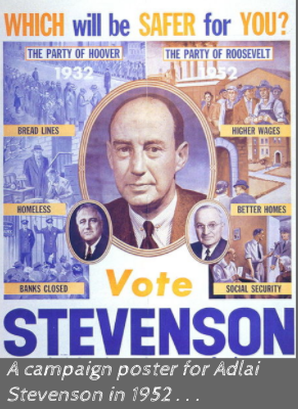
    A previous seachange in the political landscape occurred in the 1890s with the Populists, who were soon enough absorbed by the Democrats. Before the Populists, all the Republicans had to do was to drop Lincoln’s name, or run candidates such as Ulysses S. Grant or Theodore Roosevelt while only paying lip service for those that were at a disadvantage (e.g. immigrant factory laborers).  The Populists/Democrats changed who spoke for the Little Guy, and through the Great Depression, World War II, and the beginning of the Cold War, the Democrats remained the party that spoke for the Common Man. 
     However, amid the post-WW II economic expansion, the New Deal Coalition broke apart, and it was Nixon in 1952 that became the champion for the Little Guy, and the Democrats looked like Elitists in comparion by nominating Adlai Stevenson. While the liberal elites sneered and ridiculed Nixon, his “Checkers Speech” hastened the unraveling of the New Deal Coalition. Nixon came the closest to humanizing the Republican Party than any other national level candidate had done in decades.

Picture
   However, in 1952 it wasn’t the Left Wing Liberal Populists that organized, but instead it was the Right Wing Conservative Populists that did so. That meant that the real political battle was between the Elites and the Intellectuals versus the Common Person, and Nixon was too gifted a politician to miss the opportunity. Nixon shared the background of the Little Guy in terms of values, discontentment, and rancor; in so many ways, politically, the 1950s weren’t the Eisenhower Years, but rather the Nixon Years. So much of the 1950s featured the positive and negative perspectives of the  US lower middle class, as well as its spirit, self-pity, and its envy of those in a higher social/economic class; it was a kind of general collective resentful whine, and Nixon perfectly encapsulated what millions of Americans felt and believed. 
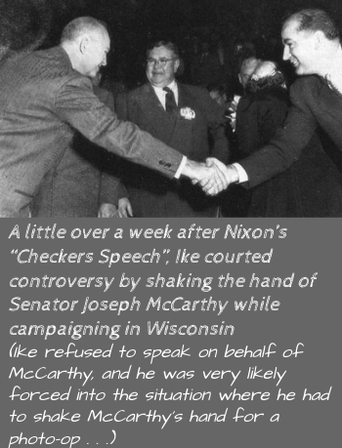
     Nixon knew that the Republicans could win in 1952 if the GOP portrayed the Democrats as the Party of the Elites, which would then by default lead the Republicans to become the Party of the Little Guy. Ike had the common touch, but in a far gentler and benevolent fashion than Nixon. Ike also knew how to lead competing factions and work towards unity (at least in the military), and Ike also knew how to persuade, and when to turn on his charm. That being said, Ike agreed to turn Nixon loose against the Democrats in the General Campaign to be, in essence, a less aggressive/more respectable version of Senator Joseph McCarthy.

Picture
     In mid-October 1952, Ike et al arranged for Nixon to have another 30 minutes on television, where he went after Stevenson for testifying on behalf of Alger Hiss in the late-1940s; Nixon questioned Stevenson’s judgment, not his loyalty. In late-October 1952, Nixon was in Texarkana, and “Tricky Dick” came out when he accused the Truman administration of being traitors to the high principles of their party. Truman, Speaker of the House Sam Rayburn, and other high-profile Democrats never forgave Nixon for labeling them and their party traitors. Nixon may-or-may-not have understood that when he tarred with the widest brush, he would pay a price in the future. 
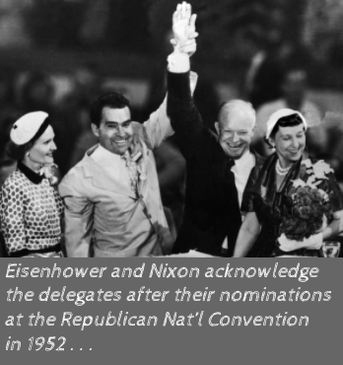
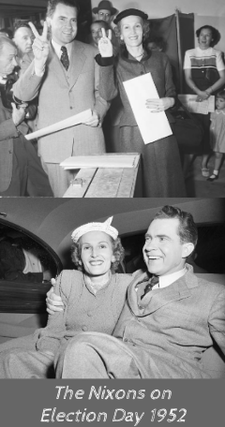
     The results of the Election of 1952 were as follows: Popular Vote - Ike 55%, Stevenson 44% / States Won - Ike 39, Stevenson 9 (Stevenson failed to win his home state of Illinois) / Electoral Votes - Ike 442, Stevenson 89. As an added bonus, the Republicans won narrow majorities in both houses. Nixon knew that Ike won the election because he was a national hero, not because of Nixon’s actions on the President-Elect’s behalf. During 1952, Nixon’s hate of the media reached its highest level so far, and his hatred for the communications systems network through which he needed to communicate would have profound consequences in the years to come.

           
Addendum: Nixon & the Media After the "Checkers Speech" . . . 

0 Comments

    Archives

    May 2020
    April 2020
    March 2020
    February 2020
    January 2020
    December 2019
    November 2019
    October 2019
    September 2019
    August 2019
    July 2019
    June 2019
    May 2019

    Categories

    All
    18th Century
    19th Century
    20th Century
    History

Powered by Create your own unique website with customizable templates.