Mr. Jensen's U.S. History Website
  • U.S. History Blog
    • U.S. History Blog (May 2026 - May 2027)
    • U.S. History Blog (May 2025 - May 2026)
    • U.S. History Blog (May 2024 - May 2025)
    • U.S. History Blog (May 2023 - May 2024)
    • U.S. History Blog (May 2022 - May 2023)
    • U.S. History Blog (May 2021 - May 2022)
    • U.S. History Blog (May 2020 - May 2021)
    • U.S. History Blog (May 2019 - May 2020)
    • U.S. History Blog (May 2018 - May 2019)
    • U.S. History Blog (May 2017 - May 2018)
    • U.S. History Blog (May 2016 - May 2017)
    • U.S. History Blog (May 2015 - May 2016)
    • U.S. History Blog (May, 2014 - May, 2015)
  • About

Red Summer: Omaha (1919)

11/26/2014

0 Comments

 
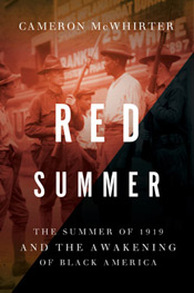
Cameron McWhirter. Red Summer: The Summer of 1919 
                                    and the Awakening of Black America
Picture
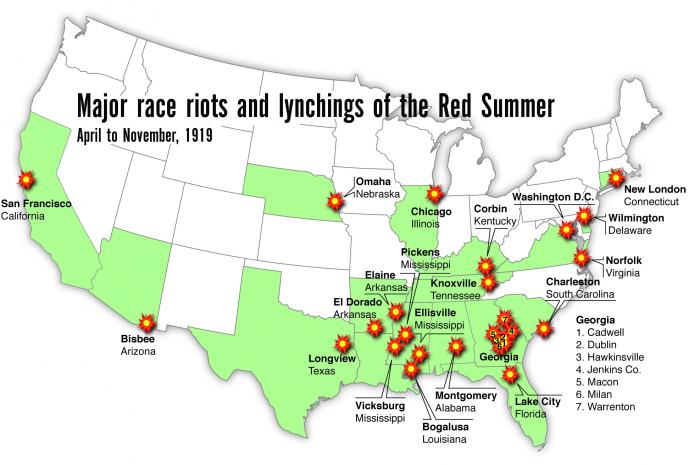
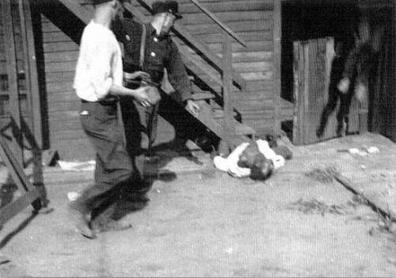
     During the Red Summer of 1919, white mobs viciously attacked/killed African-Americans in such locations as Ellisville (Mississippi), Longview (Texas), Washington, D.C., Chicago, Knoxville (Tennessee), and in late-September, Omaha, Nebraska.
     Omaha's white population featured a large percentage of immigrants (Czechs, Germans, Russian Jews, Swedes, Italians, and Poles), due mostly to the city's meatpacking and railroad industries. The African-American population of Omaha sharply increased during World War I, especially due to the expanding workforce of the meatpacking industry. More than half of Omaha's African-American population worked in the meatpacking industry, and far-more-than-half lived in a segregated area, north of downtown. 
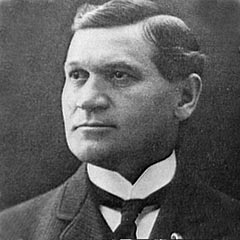
     Omaha's whites were seething over the combination of lost jobs and a higher cost-of-living. Omaha was hit with many strikes from many industries during-and-after World War I, due mostly to a desire for more wages. Businesses used African-Americans as "scabs" to try and break the strikes, which added even more tension between the races in Omaha. Tension increased further due to the newly-elected Mayor Edward P. Smith's (pictured) focus on reducing crime and vice. Whites were unhappy with the mayor since they believed he wasn't arrested nearly enough African-Americans, and African-Americans were unhappy in that most believed that the Mayor Smith was focusing too much attention on them. 
     The Omaha Bee wanted the new mayor out of office (the paper was controlled by the previous "Boss"/mayor), and most of their stories were anti-Smith and anti-African-American. And, as if there wasn't enough tension in Omaha in the Summer of 1919, 21 white women reported being attacked, and 16 of the suspects were African-Americans.
Picture
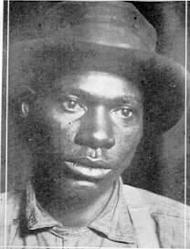
      On 25 September (Thursday), 1919, Agnes Loebeck (19) and her disabled boyfriend, Millard Hoffman (23), were attacked as they were walking home in South Omaha at 11:45 pm; according to both, they were attacked by an African-American with a knife. The assailant knocked down Hoffman, and dragged Loebeck into the bushes, and raped her; the next day, the Omaha Bee stated that Loebeck was attacked by a "Black Beast". On Saturday, police arrested Willie Brown (41), a packinghouse worker, who had recently moved to Omaha from Tennessee. Brown suffered from acute rheumatism, and it was obvious to any neutral observer that he was physically unable to have attacked Loebeck & Hoffman, yet both identified Brown as their attacker.
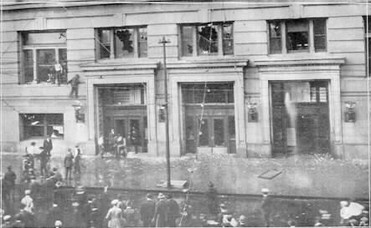
     Millard Hoffman led the call for lynching Brown, and by Sunday afternoon, a mob of 600 whites were in front of the Douglas County Courthouse. In just two hours, the mob reached 4000, yet the Chief Marshal, figuring that the situation would not escalate, sent 50 police officers home. For the officers that remained in the courthouse, they knew they would be unable to keep the mob from entering the building, since there were multiple entrances and too many angry white citizens. The mob became far-more agitated and dangerous when a man on a horse appeared, displaying a noose; almost immediately, officers in the courthouse did their best to hide Willie Brown.
Picture
     With Brown hidden, officers allowed some of the mob to scour the building, but that didn't satisfy the mob. The situation became even uglier when an African-American officer drew his weapon in front of the mob. By Sunday evening, the mob reached 15,000 in front of the courthouse; whites with shotguns monitored every exit, making sure that Brown couldn't be secreted out of the courthouse.
     All the while, the Commander of federal troops at Fort Omaha refused to act; he had the authority to do so, but he refused to use it, claiming among other reasons that he hadn't received orders to intervene from the Secretary of War. By Sunday at 7 pm, rioters and police were exchanging gunfire INSIDE the courthouse. Shortly after that, the mob of whites set fire to the lower floors, destroying official records, furniture, and threatening the rest of the building.
     When firefighters arrived, the mob cut their hoses, and when more police arrived, they were not only overwhelmed, they had their guns taken from them as well. Mayor Smith asked the Commander at Fort Omaha for help, and the Commander refused. Major Smith, who had been in the courthouse, showed remarkable courage as he tried to appeal to the mob. The reward for his courage was that he was brutally attacked, and nearly lynched and killed by the mob.
Picture
     At 11 pm, someone in the building (probably a desperate officer), handed Brown over to the mob. There was a 14 year-old eyewitness to Brown being taken and lynched by the mob; his father made him watch the unfolding horror from the second floor of a nearby building, so he could see the worst of what people were capable of becoming . . . that teenager would become one of the greatest actors in American History, Henry Fonda. 
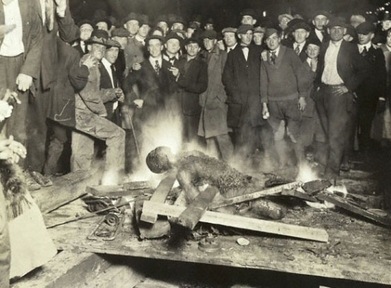
     Brown was beaten, strung up on a lamppost, and then shot, many times over; his corpse was then driven several blocks away, soaked with gasoline, and burned on railroad ties, with at least hundreds of whites watching. After the fire died down, members of the white mob kicked Brown's corpse down the street. The mob started to head towards the African-American section of Omaha, but fell apart before reaching the border, perhaps knowing what was in store for them after what occurred in Chicago, Washington, D.C., and Knoxville. 
     Federal soldiers from Fort Omaha showed up with overwhelming force, and overwhelmingly late; the Commander had finally received orders from the Secretary of War to act. The financial costs from the destroyed Douglas County Courthouse ranged from $750,000 to $1.1 million ($10 million to $14.6 million today).
Picture
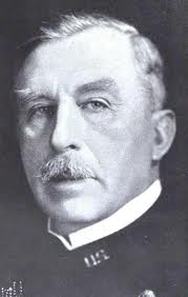
     While Omaha's African-American population boiled with anger, Omaha's whites were beyond-pleased with the "Spectacle Lynching" of Willie Brown. General Leonard Wood descended on the scene in the aftermath: he was one of the most famous military figures in America, from being the Commander of the Rough Riders in the Spanish-American War (Theodore Roosevelt was 2nd in Command), to nearly being named the overall commander of the US Army in World War I (General John J. Pershing was selected over him).
     General Wood (pictured) believed that a highly publicized presence in Omaha would enhance his bid for the Presidency in 1920. General Wood's theory was that the riot was caused by the IWW (the very socialist Industrial Workers of the World, nicknamed the "Wobblies" by their enemies), in that they had inspired African-Americans to start the riot . . . there was never a shred of proof, then or now of that theory. It was lost on General Wood that any sane individual could see that a mob of whites started and carried out the violence. The NAACP praised Mayor Smith, and decried the "assininity" of the police. Mayor Edward P. Smith was the only white that put his life on the line to protect Willie Brown; as a result of his near-death experience with the mob, he served out his term, and refused to seek re-election (the previous "Boss" and his "Machine" returned to power). There was one conclusion that General Leonard Wood got right: he blamed the Omaha Bee for being a primary cause of the mob violence.
     (Below: a brief video segment of the "Spectacle Lynching" of Willie Brown)

   Segment from HBO's "Violence in America"; "Side-Scroll" to the 5 minute mark
0 Comments

The Red Scare and Red Summer (1919)

11/25/2014

2 Comments

 
Cameron McWhirter. Red Summer: The Summer of 1919 
                                    and the Awakening of Black America
Picture
     On 2 June, 1919, Carlo  Valdinoci tried to kill 
Attorney General A. Mitchell Palmer by blowing up his entire house. As investigators later concluded, Valdinoci most likely tripped on the way to the front door , and the nitroglycerin he was carrying exploded, killing him (his spinal cord crashed through a window several houses away), blowing up the front half of the house, but the life of the Attorney General was saved. Among the first neighbors to arrive at the scene to find a dazed A. Mitchell Palmer was the Assistant Secretary of the Navy, Franklin D. Roosevelt, who lived across the street. Ten bombs exploded in eight cities that night, with judges, legislators, and a Catholic church as targets; the only casualty was Valdinoci, even when counting earlier attacks in May.

Picture
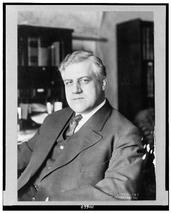
     Palmer, and his General Intelligence Division, headed by a young J. Edgar Hoover, went into action shortly after the bombing. During World War I, Palmer (pictured) was tasked by President Wilson to identify and confiscate as many German assets in America as possible, and had also developed a reputation as a politician that was at least a little flexible on questions of race, but the attack on his life changed him. Palmer decided to stamp out radicalism in America - it became known as the Red Scare. Palmer (and Hoover) defined radicalism very broadly; they also included legitimate political activism by African-Americans. President Wilson was predisposed to such a conclusion as well; he, like Palmer and Hoover, had linked African-American political activism with Bolshevism
     The Red Scare and the Red Summer became intertwined in June, 1919. Soon, the media believed the false connection with African-American activism and Communism; Palmer, Hoover, and the federal government played a huge role in creating and legitimizing that false connection with white citizens.

Picture
      White America had already concluded that African-American aspirations equated radicalism. To the vast majority of whites, African-American progress was a "Zero-Sum Game", in which any gain experienced by African-Americans would mean a corresponding loss for whites. The basis for the racism of whites towards African-Americans in the early-1900s was based on two fronts. First was a traditional racism, in which African-Americans were viewed as inherently inferior in many ways - many historians trace this type of racism to when the first African slaves were introduced to Virginia in 1619. Even though slavery had long ago been abolished, the belief that African-Americans were inherently inferior to whites was still in the American bloodstream.
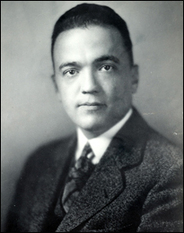
                (Pictured: a very young J. Edgar Hoover)
     The second basis for racism in the early-1900s was a pseudo-scientific racism, in which "scientifically researched" books and journals claimed that African-Americans were inferior to whites, and inherently evil in nature. The authors of these books and journals claimed that non-white (lesser) races were threatening the benign, enlightened rule of whites across the globe. Many of these pseudo-scientific publications claimed that African-Americans possessed a much smaller intellect, as well as uncontrollable lust, which to some meant that the practice of lynching was justified. 

     In addition, the "Lost Cause" (the propaganda that Southern whites were the true victims of the Civil War) had been fully accepted by most whites in the North by 1919. The belief that everything was better in America when there was slavery, when African-Americans were under control (and happy to be slaves), was pervasive in the United States.

Picture
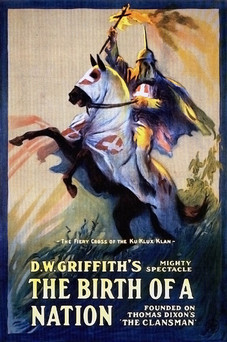
     "The Birth of a Nation" was still packing theaters in 1919, four years after its initial release. The movie blockbuster of its era was based on the best-selling 1905 novel titled The Clansman; in the book and movie, the Ku Klux Klan were portrayed as the heroes, while African-Americans were the villains. "The Birth of a Nation" was the first movie to be shown at the White House, courtesy of President Woodrow Wilson; he was especially enthused to show the movie since some of the "research" from the book came from his published works.
     In 1919, there was a de facto competition among recent European immigrants to be "white", so they could more easily be assimilated. The easiest (and most effective) way was to make life miserable for African-Americans, doing whatever was necessary to deny them success, especially economically. There was a rising belief among US and European whites that they were under siege by non-whites; if America and Western Europe weren't vigilant, according to the belief, non-whites, within or without, would become too powerful. 
     After the attack on A. Mitchell Palmer, radicalism (Bolshevism/Communism) had become coterminous with African-American activism and aspirations in the eyes of the federal government and most whites. American whites feared that their "White Civilization" was under attack at home, especially by African-Americans. What was especially feared was the potential "mixing" of the races, which would mean that there would be fewer "true whites".

    The 2nd Ku Klux Klan exploded on the scene in terms of influence and membership in 1919, packaging itself as "progressive" and "patriotic". It was started by an ex-Methodist minister, William Joseph Simmons, after seeing "The Birth of a Nation". This 2nd KKK believed that African-Americans and recent immigrants imperiled "White America", and its mission was to save the "White Race". By the Summer of 1919, the 2nd Ku Klux Klan had become not only acceptable to white middle class America, but also desirable. 
     American whites wanted to contain the aspirations and activities of African-Americans, while at the same time, an increasing number of African-Americans were pursuing their American Dream with a renewed determination after World War I . . . the seeds were sown for the Red Summer of 1919.

2 Comments

The Chicago Race Riot of 1919

11/13/2014

2 Comments

 
           Cameron McWhirter. Red Summer:The Summer of 1919 
                         and the Awakening of Black America
Picture
The Chicago Race Riot: Background
     By 1919, Chicago had 2.7 million people, up 500,000 from 1909; it was the 2nd-largest city in America behind New York City. The area by Lake Michigan might have been a showcase part of the city, but not far from the lake, much of Chicago was dirty tenements, huge rail yards, sooty factories, slaughterhouses, machine shops, industrial warehouses, and mounds and mounds of coal. In 1919, 30% of Chicago was foreign-born, with a large percentage next-generation immigrants, which largely kept their European traditions & perspectives intact.
     Chicago in 1919 was also a city of gangs, each with their defined territorial borders; robbery & prostitution were rampant . . . a twenty year-old Al Capone came to Chicago in 1919, and he fit right in without any transition. Most of the gangs of Chicago were "ethnic whites"; recent or next-generation immigrants that basically felt that they were above the law.
     World War I cut off the flow of immigrant labor from Europe, which meant that during the Great War, Chicago had a massive labor shortage. Chicago's Big Businesses found a solution: African-Americans from the South. By 1919, Chicago was second only to Washington, D.C. in terms of the population of African-Americans that lived in the city. African-American migrants were used to break strikes, lower wages, and increase tension within and among unions.
       Below: "Up South: African-American Migration in the Era of the Great War

Picture
     By 1915, the migration of African-Americans from the South to Chicago had become a flood: from 45,000 in 1909, the population of African-Americans reached 110,000 in 1919 - from 1917 - 1919, the population increased by 50,000. African-Americans that recently arrived in the city believed that Chicago would be a comparative paradise to the South, but most soon found otherwise. African-Americans were locked in a fierce ethnic competition for jobs, housing, and political power.  African-Americans were seen by Chicago's ethnic groups as alien intruders that needed to be contained. At every turn, ethnic whites did everything they could to insure that they remained socially (and economically) superior to African-Americans.
    Therefore, labor unions didn't like-or-recruit African-Americans, and African-Americans had little use for labor unions. Big Businesses kept bringing in African-Americans to break strikes and lower wages; exacerbating the tension was a recession with inflation . . . 250,000 workers went on strike in Chicago in 1919. 
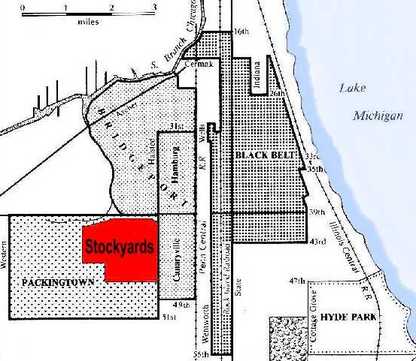
     Ninety percent of African-Americans were confined to the "Black Belt" in Chicago, which was only 27 square miles. That part of Chicago had the worst housing conditions combined with high rents and population density - African-Americans resented being squeezed into substandard/high cost housing. To the southeast was Hyde Park, Kenwood, and the University of Chicago, dominated by wealthy whites that refused to ease their covenants. To the west were Irish, Italian, Polish, and Lithuanian immigrants, and African-Americans were not welcome in their part of the city either. 
     Federal, state, and local governments did little to ease the tension; the situation was untenable. African-Americans faced segregation in housing, had less-than-desirable jobs, and little access to public areas of the city . . . however, African-Americans could vote, and as a result, they were recruited and conspired against at the same time. Chicago politics were very corrupt, and African-Americans were politically powerless in a city that needed them, and hated them at the same time.

Picture
The Chicago Race Riot, 27 July, 1919 (Sunday): The Beach
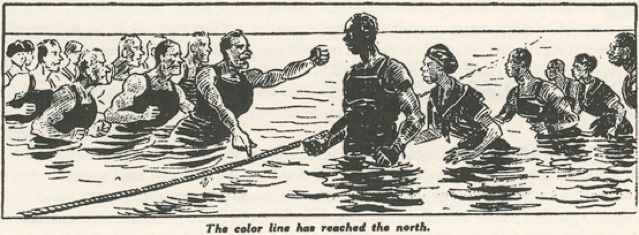
     Thousands in Chicago went to the beachfront in the summer for relief from the heat, as well as for cheap amusement. The South Side Beach was segregated: the white beach went for 11 miles, the African-American beachfront was significantly less. Five African-American teens went to the beach without telling their parents, hitched a ride in the back of truck, going through an Irish section of the city where they had experienced trouble before (pelted with rocks by Irish gangs). 
     None of the five could swim well, yet they didn't go to an African-American beach that had a lifeguard. Instead, they went to a "Secret Beach", an inlet that had an ice cream factory and a brewery on the waterfront, an area that they called "Hot and Cold." At 2 pm, the five teens pushed a makeshift raft in the water, and made for the lake . . . all five were oblivious to the fact that they were drifting towards a white beach.
                      There was already trouble at that particular white beach, in that a few African-Americans tried to enter the water from the beach (which was legal), but they were forced back by angry whites with rocks and verbal insults. Those few African-Americans went to the nearby "Black Beach" to get reinforcements, but the whites had gathered more people, and for the second time, African-Americans were forced off the white beach.
     While this was going on, one of the whites noticed the raft with the 5 African-American teens, and started throwing rocks at them from a fair distance. The teens were far enough away where they believed it was a game (they could see the incoming rocks fairly easily), but one of the teens was hit in the head by a rock, and went underwater.

Picture
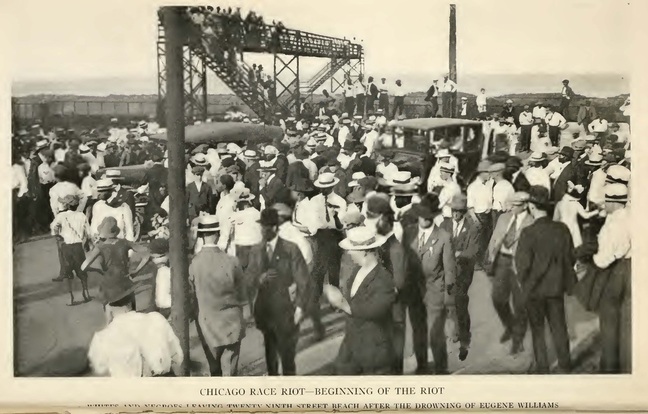
     In a panic, unable to find their friend under the water, the other four African-American teens went to the nearest "Black Beach" for an African-American lifeguard and others to help them. Other whites and police officers joined the search in the water for the missing teen; the police used grappling hooks, dragging the lake. The four African-American teens told many African-Americans about the white "Rock-Thrower", and even pointed him out in the crowd on the white beach. An African-American police officer tried to arrest the "Rock-Thrower", but was stopped by a white officer as well as a crowd of angry white citizens.
     African-Americans, now incensed, went to the "Black Beach" to get more people, and on their return, the white officer arrested an African-American (The cowardly "Rock-Thrower" was hiding in the middle of the much-larger white crowd on the beach, scared to death).  Two hours after the body of the African-American teen was recovered, about 1000 African-Americans gathered at an entrance to the white beach, demanding that the white policeman and the "Rock-Thrower" be turned over to them. A 37 year-old African-American opened fire on white police officers; the return fire killed the shooter, but the crowd of angry African-Americans remained.
     Not only did the crowd remain, it started attacking whites (4 beaten, 5 stabbed, 1 shot). Whites left the beach, but soon stories of what occurred at the beach were exaggerated or outright lies; for example, a rumor spread that an African-American had drowned a white man . . . another rumor was that African-Americans were stockpiling weapons. As a result of these lies and exaggerations, gangs of ethnic whites formed, and started attacking African-Americans that were going through their neighborhoods. By 9 pm that Sunday, through 3 am on Monday, 37 African-Americans had already been beaten, stabbed, or shot . . . The South Side gangs of ethnic whites were on a rampage.

Picture
The Chicago Race Riot, 28 July, 1919 (Monday)
     On Monday morning, Chicagoans started going to work like any other weekday, crossing through neighborhoods. The riot seemed to be over, and everything seemed to be back to normal. Chicago's politicians not only thought the riot was over, they were actually congratulating themselves on their "Enlightened" approach in dealing with "their people" compared to other cities (e.g. New York City and Washington, D.C.). 
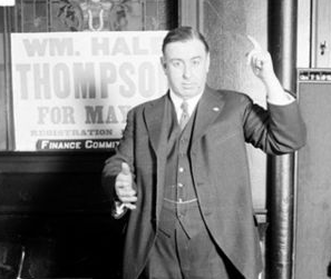
     The heat was still oppressive, and the lies & exaggerations spread by whites claiming that African-Americans were stockpiling weapons had become "viral". As the day progressed, ethnic white gangs joined together in their attacks on African-Americans. Extra police were on duty, and the state militia was nearby, but hadn't yet been asked by Chicago's mayor, "Big Bill" Thompson, to enter the city. Chicago's political leaders believed that the storm had abated, and there was no need to bring in the militia. 
     Monday night, intense rioting occurred on the border with the "Black Belt". Ethnic white gangs roaming that part of the city numbered from 4 or 5, to over 1000, all of them looking to attack any African-American that came across their path. In one encounter, a white Jew with an axe handle confronted an African-American that was an Army lieutenant in WW I. In defending himself, the African-American thrust his pocketknife into the white Jew's heart, killing him. "Mob Logic" dictated vengeance, but it didn't matter which African-Americans paid the price for their revenge.
      Meanwhile, African-American gangs attacked whites trapped in the "Black Belt"; a few white store owners were killed. The overall mood in the city during the riot on Monday night was "Get them before they get you."

Picture
The Chicago Race Riot, 29 July (Tuesday)
     By Tuesday morning, 17 were dead, and 172 African-Americans and 71 whites had suffered serious injuries. It was the Working Classes, ethnic whites and African-Americans, killing each other on the streets of Chicago. Later that day, Chicago's transit workers went on strike; over 200,000 Chicagoans were in a dilemma, needing to go to work, but now basically having to walk a significant distance through now-dangerous neighborhoods. Only 19 of 1500 African-American packinghouse workers at Armour showed up for work on Tuesday. The city government ordered African-Americans to stay home; many did, but many decided to go to work, fearful that they may lose their jobs. 
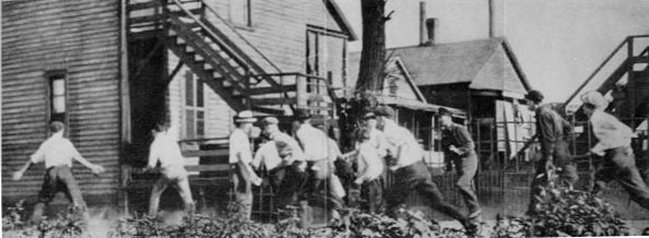
     The transit strike caused massive traffic jams in "The Loop", Chicago's business district. Since most of the city's police were in the South Side trying to get control of the riot, gangs of ethnic whites took over "The Loop", and deadly and brutal attacks against African-Americans occurred in plain sight in the business district. African-Americans were dragged out of rail stations and restaurants by these ethnic white mobs, and badly beaten outside.               
   (Above: A photograph of an ethnic white gang searching for African-Americans)
     Still, the riot continued unabated in the South Side, with whites attacking & killing African-Americans that were heading home from work. Newspapers, both white and African-American, spread false rumors as fact, fanning the flames that fueled the riot. Politicians did their part as well to make matter worse, publicly advocating that whites should get guns to defend themselves. 
     Mayor Thompson and the Illinois State Militia Commander were political rivals, each with aspirations for the Presidency in 1920. Thompson refused to ask the militia to enter the city to end the riot, since he wanted to try and maintain the image of a mayor that was in charge of his city. The State Militia Commander did not want to enter the city without permission, since he believed it would harm him politically . . . both avoided their responsibilities for the public good, in that they both refused to use their authority to end the riot.
     Never before had Chicago seen such unbridled, uncontrolled mayhem by its citizens. Due to the violence on Tuesday, city offices shut down, and public places were closed. Jails and hospitals were overwhelmed with the numbers of detained & wounded people: African-Americans, by far, had the highest number of people arrested and in need of medical attention in the hospitals.

Picture
The Chicago Race Riot, 30 July (Wednesday)
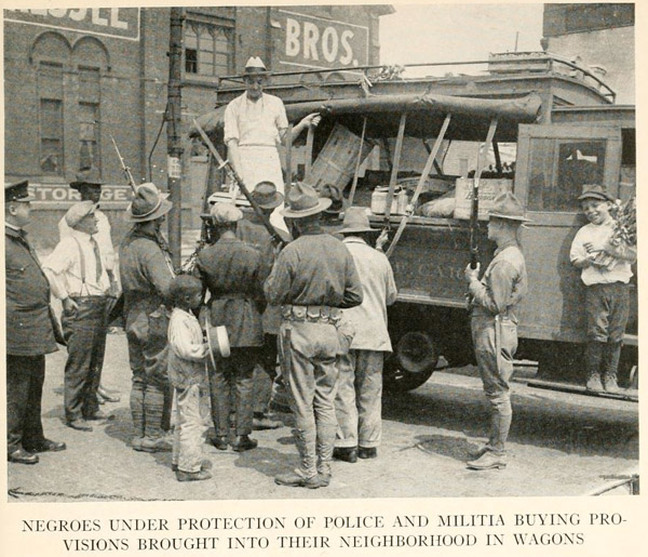
     On Wednesday, 5 more were killed, while 3000 African-Americans showed up for work at a meatpacking plant; they were stopped by a mob of white workers. Wednesday was the start of a series of large arson fires that broke out in the city - the riot had reached a new level of intensity and horror. At 9:30 pm, Mayor Thompson didn't declare martial law, but he asked the state militia for "assistance". 12,000 militia entered the city, under the command of the Police Commissioner: their orders were to maintain the peace, using their bayonet and rifle butt first, but were authorized to fire their weapons if they saw fit to do so.
     The militia effectively dispersed mobs, regardless of race; machine guns were placed at key intersections. Most white soldiers in the militia believed that African-Americans were to blame for the riot, but that belief was altered when they entered the city, seeing how badly African-Americans were outnumbered and brutalized. African-Americans were thankful for the militia, while the ethnic white mobs taunted the soldiers before being forced to leave an area.

Picture
The Chicago Race Riot, 31 July (Thursday)
     On Thursday, the state militia worked to get the city back to normal, but the tension in the city was still sky-high. The militia followed the Cardinal Rule in dealing with mobs: NEVER BLUFF. The militia exercised a constant show of massive force, while also providing a massive influx of aid and protection for African-American workers. 
     Still, on Thursday, a white packinghouse worker killed an African-American worker with a hammer, and a white mob formed as a result. The militia showed up very quickly, and the white mob jeered the militia, but the soldiers advanced with lowered bayonets, and the mob was dispersed. Many incidents that could have rekindled the riot were ended by the state
militia on the last day of July.

Picture
The Chicago Race Riot of 1919: Results
     As Chicago rioted and burned in the last days of July, 1919, the Federal Government did not provide any assistance to a beleaguered city. This was due at least in part to President Wilson's desire to avoid any political embarrassment in publicly admitting that the U.S. did indeed have "Human Rights" problem after returning from Europe and the negotiations that led to the proposed Treaty of Versailles. 
     Overall, 38 Chicagoans were killed (23 African-Americans, 15 whites), 537 seriously injured (342 African-Americans, 178 whites, and 17 of unknown ethnicity). 2000 homes / apartment buildings were damaged or destroyed, leaving many homeless and scared for their immediate and distant futures. Chicago whites were horrified, and African-American leaders were thrilled, that African-American citizens fought back when attacked. Chicago showed America that large-scale white violence could be met with large-scale African-American violence. 
     If Chicago's white citizens (and whites in other Northern cities) believed they could force African-Americans to leave their city, they found otherwise in 27-31 July, 1919 . . . African-Americans were heavily invested in staying in Chicago, and were not going to be forced to leave against their will.


Below: Side-scroll to the 26:20 mark for the Story of U.S. segment on the Chicago Race Riot


America the story of the US - Boom 8/12 by Mikelmaeztu
2 Comments

    Archives

    May 2015
    April 2015
    March 2015
    February 2015
    January 2015
    December 2014
    November 2014
    October 2014
    September 2014
    August 2014
    July 2014
    June 2014
    May 2014

    Categories

    All
    19th Century
    20th Century
    Actor
    Biography
    History

Powered by Create your own unique website with customizable templates.