Source: Jean Edward Smith. FDR (2008)
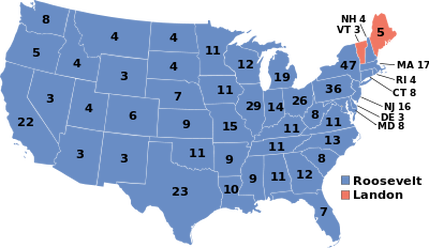
In order to to provide context why the first two-plus years of FDR's second term as President was disastrous, so much so that by the Spring of 1939 he had no chance of being re-nominated for President by his own party, a quick run-down of his first term & the Election of 1936 is helpful. During his first term, FDR could seemingly do no political wrong in the eyes of most of Congress and the American people. 15 major pieces of New Deal legislation were introduced, and 15 New Deal bills became law in the first three months. By the Election of 1936, the major economic indicators were heading to normal levels, and the Republican Party, as with the Democrats in 1928, had no chance at winning the Presidency.
FDR knew he would win re-election, expecting an Electoral College tally of 360 - 71 over the Republican nominee Alfred Landon. FDR was stunned at the results on Election Day,
3 November, 1936: Popular vote, FDR 60.79%, with FDR winning 46 of 48 states - Electoral Vote: FDR 523, Landon 8; overall, it was a margin of victory not seen since James Monroe in 1820. The Democrats gained 11 seats in the House for a majority of 331 - 89, and the Senate stood at 76 - 16 for the Democrats, with 4 Independents (including Nebraska's George Norris) in FDR's corner. It wasn't long after Inauguration Day (on 20 January, for the first time), that FDR made three mistakes that nearly led to political and historical disaster for the 32nd President.
FDR knew he would win re-election, expecting an Electoral College tally of 360 - 71 over the Republican nominee Alfred Landon. FDR was stunned at the results on Election Day,
3 November, 1936: Popular vote, FDR 60.79%, with FDR winning 46 of 48 states - Electoral Vote: FDR 523, Landon 8; overall, it was a margin of victory not seen since James Monroe in 1820. The Democrats gained 11 seats in the House for a majority of 331 - 89, and the Senate stood at 76 - 16 for the Democrats, with 4 Independents (including Nebraska's George Norris) in FDR's corner. It wasn't long after Inauguration Day (on 20 January, for the first time), that FDR made three mistakes that nearly led to political and historical disaster for the 32nd President.
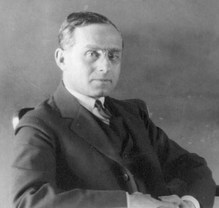
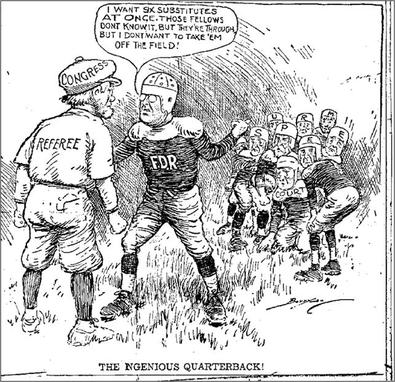
MISTAKE #1 - "Court-Packing" Scheme: Flush from the largest margin of victory since 1820, FDR focused on the Supreme Court. In short, the Supreme Court was the "Skunk in FDR's Garden Party" during his first term. The Supreme Court ruled that the Agricultural Adjustment Act and the National Industrial Recovery Act were unconstitutional (executive branch over-reach), and FDR wanted to settle political accounts in his second term. FDR should have known better as a lawyer, politician, and President . . . hubris (excessive pride) dominated FDR's thinking and behavior.
The Supreme Court was not reactionary, but FDR was not used to resistance; FDR should have focused on the interpretation of the decisions, not the justices themselves. Another problem: FDR plotted his strategy against the Supreme Court in secret, which was a tactical error. FDR had consulted many politicians / advisors on most every matter so far, but not with this strategy . . . that meant that he would not have any political support once resistance crystallized. FDR's biggest mistake in his "Court-Packing" strategy (for every justice over the age of 70, an additional Supreme Court judge position would be created, for a total of 3 new justices) was that he didn't run his idea past Felix Frankfurter, his best legal advisor. Had he done so, Frankfurter (a future Supreme Court justice) would have advised FDR that his plan was unconstitutional and indefensible. The few that FDR directed to research the validity of his strategy were not stellar constitutional researchers by any stretch of the imagination.
The Supreme Court was not reactionary, but FDR was not used to resistance; FDR should have focused on the interpretation of the decisions, not the justices themselves. Another problem: FDR plotted his strategy against the Supreme Court in secret, which was a tactical error. FDR had consulted many politicians / advisors on most every matter so far, but not with this strategy . . . that meant that he would not have any political support once resistance crystallized. FDR's biggest mistake in his "Court-Packing" strategy (for every justice over the age of 70, an additional Supreme Court judge position would be created, for a total of 3 new justices) was that he didn't run his idea past Felix Frankfurter, his best legal advisor. Had he done so, Frankfurter (a future Supreme Court justice) would have advised FDR that his plan was unconstitutional and indefensible. The few that FDR directed to research the validity of his strategy were not stellar constitutional researchers by any stretch of the imagination.
FDR timed his announcement of his "Court-Packing" strategy for maximum impact and media coverage in the late-morning on 5 February, 1937. Chief Justice Charles Evans Hughes
(Republican candidate for President in 1916) took an active role in the public controversy; not since John Marshall in 1819 (in McCulloch v. Maryland) had a Chief Justice done so. Hughes absolutely demolished FDR's claims and views concerning the Supreme Court in the public arena (e.g. showing that the Supreme Court wasn't "overwhelmed" with cases). Hughes proved to be the savior of checks and balances of the three branches and Constitutional law. Soon, though, the Supreme Court started to rule favorably on New Deal legislation, and an associate justice even retired, which meant that FDR could nominate a "New Deal" justice.
It was at this point that FDR was advised to claim victory, and call off the fight, but FDR refused to do so; he continued the Special Session of Congress, and even demanded a discharge petition to get his Court-Packing bill out of committee. Senate Majority Leader Joe Robinson (Arkansas) actually died under the stress placed on him by FDR. FDR refused to go to his funeral, believing that Robinson had let him down; that was a final and tragic error that capped off the whole affair. Robinson was popular in the Senate, and few senators forgave FDR, and his popularity in Congress plummeted.
FDR paid dearly for his Court-Packing scheme, losing much public support, but the fracas ruptured the Democratic Party. From that point in early-1937, the New Deal was just a movement in the Democratic Party, no longer synonymous with economic recovery. In just one year after the Election of 1936, FDR had lost control of his party as President; FDR's legislative agenda was either ignored or blocked despite huge Democratic majorities in Congress.
(Republican candidate for President in 1916) took an active role in the public controversy; not since John Marshall in 1819 (in McCulloch v. Maryland) had a Chief Justice done so. Hughes absolutely demolished FDR's claims and views concerning the Supreme Court in the public arena (e.g. showing that the Supreme Court wasn't "overwhelmed" with cases). Hughes proved to be the savior of checks and balances of the three branches and Constitutional law. Soon, though, the Supreme Court started to rule favorably on New Deal legislation, and an associate justice even retired, which meant that FDR could nominate a "New Deal" justice.
It was at this point that FDR was advised to claim victory, and call off the fight, but FDR refused to do so; he continued the Special Session of Congress, and even demanded a discharge petition to get his Court-Packing bill out of committee. Senate Majority Leader Joe Robinson (Arkansas) actually died under the stress placed on him by FDR. FDR refused to go to his funeral, believing that Robinson had let him down; that was a final and tragic error that capped off the whole affair. Robinson was popular in the Senate, and few senators forgave FDR, and his popularity in Congress plummeted.
FDR paid dearly for his Court-Packing scheme, losing much public support, but the fracas ruptured the Democratic Party. From that point in early-1937, the New Deal was just a movement in the Democratic Party, no longer synonymous with economic recovery. In just one year after the Election of 1936, FDR had lost control of his party as President; FDR's legislative agenda was either ignored or blocked despite huge Democratic majorities in Congress.
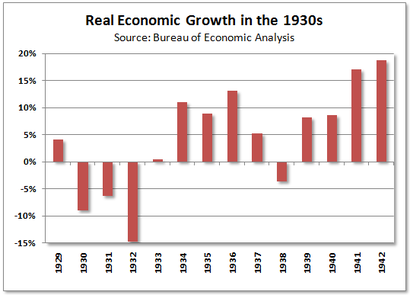
MISTAKE #2 - Balancing the Budget: The "Roosevelt Recession" that started in 1937 was mostly due to FDR's decision to balance the federal budget (in addition to nasty labor strife); in other words, FDR decided to reduce federal spending at the worst possible time. With such economic indicators as unemployment down to 12% (from 25%), FDR assumed that the Great Depression was over, and he dramatically slashed federal spending. FDR's "Inner Thrifty Dutchman" wanted to balance the budget as soon as possible, and he believed that mid-1937 was the perfect time.
To make up for the shortfall, Congress borrowed from Social Security, and The Federal Reserve Board of Governors reduced the money supply. On 19 October, 1937, the Stock Market crash was the worst since October, 1929, and the Dow Jones Average was down 40%. By the end of 1937, steel production was at only 19% of total capacity. Two-thirds of all that was gained in economic terms since 1933 was lost by early-1938. Ironically, FDR was acting much like President Herbert Hoover did in 1930, repeating the mantra in public "Everything will be okay . . ." Then, in the Summer of 1938, the Agricultural sector started to decline, making the "Roosevelt Recession" even more severe. It was at this point that FDR's most trusted advisor, Harry Hopkins, came to the rescue; he was able to convince FDR to start massive federal spending again. The "Roosevelt Recession" was due to FDR's decision to not only balance the federal budget, but also by his delayed decision to resume federal spending per Hopkins advice. When FDR tried to "pack" the Supreme Court, he shot himself in the foot . . . but when he tried to balance the federal budget, he shot the entire nation in the foot.
To make up for the shortfall, Congress borrowed from Social Security, and The Federal Reserve Board of Governors reduced the money supply. On 19 October, 1937, the Stock Market crash was the worst since October, 1929, and the Dow Jones Average was down 40%. By the end of 1937, steel production was at only 19% of total capacity. Two-thirds of all that was gained in economic terms since 1933 was lost by early-1938. Ironically, FDR was acting much like President Herbert Hoover did in 1930, repeating the mantra in public "Everything will be okay . . ." Then, in the Summer of 1938, the Agricultural sector started to decline, making the "Roosevelt Recession" even more severe. It was at this point that FDR's most trusted advisor, Harry Hopkins, came to the rescue; he was able to convince FDR to start massive federal spending again. The "Roosevelt Recession" was due to FDR's decision to not only balance the federal budget, but also by his delayed decision to resume federal spending per Hopkins advice. When FDR tried to "pack" the Supreme Court, he shot himself in the foot . . . but when he tried to balance the federal budget, he shot the entire nation in the foot.
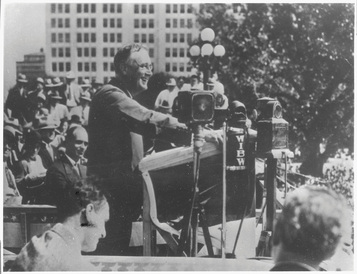
MISTAKE #3: "The Purge" - FDR tried to purge (remove) "traitorous" anti-New Deal Conservative Democrats in state primaries before the Congressional Elections of 1938. FDR personally organized the opposition in terms of candidates and funding; not since Andrew Johnson in 1868 had a President involved himself in opposition to specific members of Congress (at least Johnson, a Southern Democrat, had targeted Northern Radical Republicans).
While FDR was successful in a district in Florida (his candidate, Claude Pepper, won the primary and general election; Pepper served the longest in the history of the House); but the four Conservative Democrats that FDR wanted most to purge from the party won their primaries and re-election. FDR's standing in Congress fell even further, and divisions in the Democratic Party worsened. FDR put his political capital and prestige on the line in the Off-Year Elections of 1938, and he failed miserably; as a result, "New Deal" candidates didn't fare as well as they would have under normal political circumstances.
Republicans picked up 81 seats in the House, and 9 in the Senate; FDR was stunned. There were still Democratic majorities in both houses, but they were not working majorities in any form or fashion for FDR. By early-1939, FDR was a Lame-Duck President, and liberals in the Democratic Party were looking elsewhere for their nominee at the Democratic National Convention; it was clear for all to see that FDR wouldn't win re-nomination in his own party in Chicago in 1940.
While FDR was successful in a district in Florida (his candidate, Claude Pepper, won the primary and general election; Pepper served the longest in the history of the House); but the four Conservative Democrats that FDR wanted most to purge from the party won their primaries and re-election. FDR's standing in Congress fell even further, and divisions in the Democratic Party worsened. FDR put his political capital and prestige on the line in the Off-Year Elections of 1938, and he failed miserably; as a result, "New Deal" candidates didn't fare as well as they would have under normal political circumstances.
Republicans picked up 81 seats in the House, and 9 in the Senate; FDR was stunned. There were still Democratic majorities in both houses, but they were not working majorities in any form or fashion for FDR. By early-1939, FDR was a Lame-Duck President, and liberals in the Democratic Party were looking elsewhere for their nominee at the Democratic National Convention; it was clear for all to see that FDR wouldn't win re-nomination in his own party in Chicago in 1940.
"PERSON TO THE RESCUE FOR FDR" - What, or more accurately, WHO saved FDR from political ruin was Adolph Hitler. In 1938, Hitler annexed Austria, and then The Sudetenland (part of Czechoslovakia), leading to the Appeasement at Munich by Great Britain, in particular. In 1939, Hitler signed a Non-Aggression Pact with Joseph Stalin, and then just days later, invaded the western part of Poland on 1 September, 1939. By early-1940, FDR's political return was complete: in 1933, he was seen as an "Economic Savior", but by early-1940, FDR was seen as the indispensable Commander-in-Chief as the US drifted towards greater involvement in the War in Europe. In the Democratic National Convention in Chicago, 1940, FDR was nominated for a third term basically by acclamation (that didn't mean that the convention wasn't tense and fractious); the Democratic Party had no one else that could win the Presidential Election of 1940.
USA Today Book Review of Jean Edward Smith's FDR
