Mr. Jensen's U.S. History Website
  • U.S. History Blog
    • U.S. History Blog (May 2026 - May 2027)
    • U.S. History Blog (May 2025 - May 2026)
    • U.S. History Blog (May 2024 - May 2025)
    • U.S. History Blog (May 2023 - May 2024)
    • U.S. History Blog (May 2022 - May 2023)
    • U.S. History Blog (May 2021 - May 2022)
    • U.S. History Blog (May 2020 - May 2021)
    • U.S. History Blog (May 2019 - May 2020)
    • U.S. History Blog (May 2018 - May 2019)
    • U.S. History Blog (May 2017 - May 2018)
    • U.S. History Blog (May 2016 - May 2017)
    • U.S. History Blog (May 2015 - May 2016)
    • U.S. History Blog (May, 2014 - May, 2015)
  • About

Dolley Madison: The "First" First Lady

6/23/2014

0 Comments

 
             Source: Catherine Allgor.  A Perfect Union: Dolley Madison and the 
                                 Creation 
of the American Nation (2006).

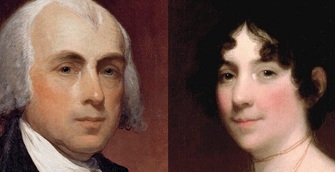
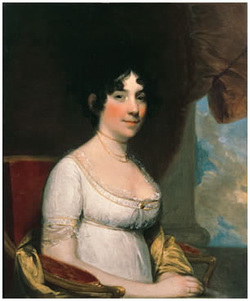
           Dolley Madison is remembered in history by most for securing a portrait of George Washington as thousands of British soldiers advanced on "Washington's City" during the War of 1812 (and sadly, she's remembered by some for snack cakes). In addition to being the "First" First Lady, Dolley Madison should be remembered for introducing the "process" of politics via the "Unofficial Sphere" in the U.S. Government. James Madison was one of the key figures that created political parties, but Dolley Madison was the person that figured out how the political parties could actually conduct the business of government. She, more so than her husband, was the one that created a place with an atmosphere in which politicians of different parties actually talked to each other, and the government was able to function.
Picture
     Dolley would have never felt comfortable combining politics and social events creating the "Unofficial Sphere" if she wasn't an extrovert. The definition I like for an extrovert is an individual that is "recharged" by being with other, even many, people. If Dolley was an introvert (one's energy is "drained away" by being with other people) like her husband, then she would not have been able to "re-invent" American politics. 
     In history, timing is crucial. James Cameron wanted to release "Titanic" in the summer of 1997, but editing delayed the release, and it reached theaters in late-1997. I'm convinced that if "Titanic" had been released in the summer, it would not have become such a mega-hit; it was much-better suited for a "winter release". Other famous examples of excellent timing (whether on purpose or by accident) would include the Beatles in 1964, and "Star Wars" in 1977. Dolley 
entered Washington at the best-possible time, in terms of politics. As the wife of the Secretary of State in 1801, Dolley was in a unique position to diffuse the tension in America's "Honor Culture." 
Picture
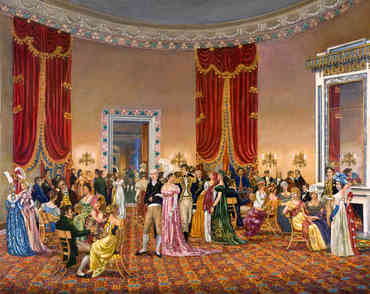
    With the development of the Democratic-Republicans and the Federalists as rival political parties, a "zero-sum game" had been established in American politics, in that if one party gained, the other party thought it experienced a corresponding loss. Every politician had to play the "Virtue Game"; which in the end meant opposing political opinions / philosophies were viewed as a threat to the well-being of the nation. I'm often amused with the mass media when, perhaps a network news anchor, states that American politics have never been more contentious. I have started to, for my own benefit, imagine a crawler below the screen which has words to the effect of "please understand as you are listening to this broadcast that he/she may not know the history of our nation . . ." For those that think our current political climate is contentious, I wish they would be able to go back to the late-1790's / early-1800's, when the "rules of behavior" that are institutionalized today were being created, and the catalyst of those "rules" was Dolley Madison. What Dolley was able to do with her "Drawing Room", among other venues, was to find other avenues to diffuse this political tension. In these social/political gatherings that Dolley started hosting during Jefferson's presidency, the first steps of networking occurred, allowing an atmosphere to develop of "political intimacy", even among some Federalists and Democratic-Republicans. I liked Allgor's comparison of Jefferson's and Dolley's social events. She compared Jefferson's dinner parties to a "protective tariff", while Dolley's were like "the free market." 
Picture
     While Jefferson's dinner parties were remarked upon very favorably in correspondence by its participants in terms of food, drink, and company, it was a tightly-controlled affair in which Jefferson could listen to the dinner party's gossip to gain political advantage, especially against the Federalists. Dolley's "Drawing Room", on the other hand, featured far more guests, due to the fact that she, in essence, put out at open invitation to anyone that wanted to attend. In Jefferson's dinner parties, there wasn't a realistic expectation for a private conversation, while with Dolley, larger crowds meant more private political conversations. The language of the "Unofficial Sphere" was gossip, and whether one was a politician or the wife of one, the end-result of private gossip at Dolley's "Drawing Room" was that political tension had "avenues of escape." Now, political discussions and/or decisions could be made, in a public setting, as required by Republicanism, with a veil of privacy. Not only was Dolley the star attraction with her "Wednesday Nights" in the Drawing Room, but it was the only "guaranteed" time that President James Madison would be available in public space. 
     For James Madison, these "Wednesday Nights" presented a "win-win" situation for 
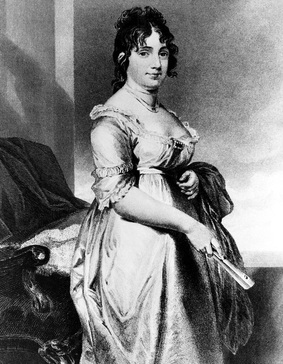
his introverted personality. Dolley was able to institutionalize what progressive reformers decades later would call "Association". Instead of the middle class and working class "mixing" together at an amusement park, which reformers hoped would reduce class conflict, Dolley mixed political parties and genders, and succeeded in reducing political tension and conflict. Dolley knew from the beginning that women needed to be involved in this "Association"; women were key in the "Unofficial Sphere." In this setting (and also with correspondence), women were able to exert their influence in the political arena, without being seen as leaving the private sphere. Dolley positioned herself perfectly, in that she was able to influence politics, and was seen (by most, anyway) as a lady that remained in "her sphere" - Aaron Burr wasn't so lucky. Burr's motives weren't the same as Dolley's, but he also wanted bipartisanship, and was one of the very few politicians in his era that could-and-would work with the other party (John Quincy Adams was another of the few politicians that also worked with the other party). But, Burr was labeled a "traitor to his class", in particular by Jefferson, and, in the East anyway, became a political persona-non-grata. Dolley was not seen as a "traitor to her class", or as a "trespasser in the public sphere." She was able, through great effort, ability, and skill, to conduct a balancing act between aristocracy and democracy. 
Picture
     One of her methods in doing so was to feature "extremes" in her social gatherings. Dolley dressed very well for social events, knowing that clothing was the "vocabulary for power"; but also, she would feature some food items that some people, then-and-now, would refer to as "low-brow". I think P.T. Barnum would have appreciated this kind of combination, as someone that specialized in presenting extremes to attract paying customers. Dolley used her charm to disarm, so to speak, which was a similar charismatic trait shared by other prominent historical figures such as FDR. The difference between Dolley and FDR in this regard is that once FDR was done "turning on the charm", he may not have any need for that person, and was moving on to something else. Dolley was creating a permanent network for information and influence, which meant that very few, if anyone, were dismissed as irrelevant or inconsequential. 
     The importance of Dolley Madison's "Unofficial Sphere" was seen when it ceased to exist for a time during the "Eaton Affair." The "ruling class" feared the rise of democracy, which they perceived as a threat to their power and status, and Margaret Eaton became the "Lighting Rod of Hate." Her social bona fides were not near the equal of these "ladies of quality", and, in essence, Margaret and her husband, Jackson's 1st Secretary of War, were "shunned" from the social events. And, when the Eatons hosted, there were many no-shows, adding insult-to-insult. The result of these actions was that the business of Washington, D.C. ground to a halt; discussions and decisions were not being conducted or made because the "Unofficial Sphere" of government was temporarily absent. Something, or rather, someone else was absent as well - Dolley Madison. It would be hard to fathom how the "Eaton Affair" would have reached this critical point had Dolley, or someone similar, been "running point" in the "Unofficial Sphere" of government. 

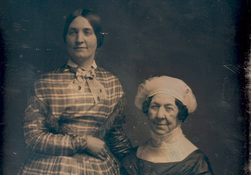
         (Below: a daguerreotype of Dolley Madison (seated) late in her life in the 1840s)
Picture
     James Madison was the last of the Founding Fathers that signed the Constitution to die (in 1836); Dolley Madison (who died in 1849) was the first in a long list of First Ladies that found a way to influence politics and exert political power as well - Dolley Madison proved to be the right First Lady at the right time in American History.
0 Comments

John Quincy Adams Before 1817, Part 1

6/19/2014

0 Comments

 
Picture
             Source: Harlow Giles Unger. 
                           John Quincy Adams (2012).
      The year 1794 was one of the more pivotal years in American History - 1794 was the year of the Whiskey Rebellion, the Battle at Fallen Timbers, when Eli Whitney patented his cotton gin, and the year that President George Washington appointed John Quincy Adams as a Resident Minister in Holland. With that appointment, the most illustrious and significant career in foreign affairs in early American History began.  In effect, JQA became the main diplomatic intelligence-gatherer in Europe for Presidents Washington and Adams, and in that role, he helped America avoid war with France and Great Britain.

Picture
     As a teenager, JQA traveled with his father, John Adams, to France and Great Britain; even when he was thirteen, JQA was very educated and worldly in the culture and affairs of Europe (he even introduced an important Dutch financier to his father, which led to significant and timely loans for the U.S. Gov't). By the time he was sixteen, JQA had made connections with many important Americans, such as Thomas Jefferson in Paris - they actually became quite close in the early-1780s. JQA was as big a celebrity in Paris as John Adams and Thomas Jefferson, and almost as famous as Benjamin Franklin. By the time JQA approached the age of 20, he knew more about European politics and their leaders than any other American.
     John Quincy Adams needed to finish his university studies in America at Harvard, mostly so he could make connections in order to have a political future in America. After his initial difficulties in being formally admitted (Harvard's President was not a fan of his father), he became mostly bored in his studies - European universities were far more erudite. JQA was on "cruise-control" in his time at Harvard, graduating second in his class. JQA faced the same problem that many university graduates experience today: he needed to find employment. 

Picture
     John Adams insisted that his oldest son become a lawyer, as he did in his early-twenties. JQA toiled in obscurity, something he was not used to, until he catapulted himself to political prominence and relevance in Boston in the early-1790s. JQA wrote essays that were widely disseminated, criticizing the political philosophies of Thomas Paine and Thomas Jefferson concerning the French Revolution. In his essays, JQA agreed with President Washington that the Treaty of Alliance (1778) with France was not in force since France was the aggressor in Europe. As a result of his essays in support of Washington (JQA also savaged the actions of the French Minister to America, Charles Ginet), and also no doubt that he was the son of the Vice-President, Washington sent JQA to Holland as a "Resident Minister" in 1794. JQA, at the age of 27, was sent to Holland to be a "listener" and "reporter"; in other words, a diplomatic spy.

Picture
     On his way to Holland, JQA was tasked by Washington to deliver crucial documents to John Jay in Great Britain - JQA actually assisted in the negotiations for what eventually called the Jay Treaty. JQA was perfectly posted in Holland; he seamlessly fit into European diplomatic society. He spent six hours every day writing detailed reports to President Washington detailing what he saw, heard, and thought. In short order, JQA became one of Europe's most skilled diplomats - in essence, he was America's best "Intelligence Gleaner." 
     Washington's new SecState, Timothy Pickering, sent JQA to Great Britain to help finalize the negotiations of the Jay Treaty. JQA had the honor of meeting face-to-face with King George III in 1796, which finalized the Jay Treaty from the British point of view. That same year, Washington promoted JQA to be the American Minister Plenipotentiary to Portugal; it was a huge increase in salary, so JQA finally married Louisa Catherine Johnson. But JQA would never reach Portugal (his personal belongings did, however); the new President, John Adams, decided to send his son to Prussia instead. While it was true that Prussia was a more significant posting, JQA had his heart set on Portugal (in part, due to the climate). JQA's confirmation to Prussia was on hold in the Senate, however; charges of nepotism spread through the chamber. After three postponements, the Senate finally confirmed JQA as the U.S. Minister to Prussia

Picture
     In 1799, JQA negotiated a trade agreement with Prussia, providing the U.S. another strong trading partner, which would help expand America's wealth as well as reduce the national debt. However, the "Quasi-War" with France began to interfere with all American trade to Europe. During the "XYZ Affair" with France, when the Democratic-Republicans (e.g. Jefferson and Madison) scoffed at the allegations against the French, JQA revealed and confirmed the identities of "XYZ"; JQA stifled the pro-French rhetoric in the Democratic-Republicans across the U.S.
     Stifling the "XYZ Affair" was one thing, but dealing with the cries for war against France was another. Even at the national level, the "Honor Culture" demanded satisfaction for the French slight on America's honor from the "XYZ Affair." The pressure on President John Adams to go to war with France was immense; Abigail Adams tried to give Americans an outlet for their rage by starting a fad that spread across the nation: she wore a black feather in her hat which signified opposition to the Tri-Colors (France's flag). In America's first undeclared war, American and French ships attacked each other on the Atlantic in the late-1790s.

Picture
     Instead of calling for a declaration of war, President Adams asked Congress for money for a real navy; twelve warships were built, each carried at least twenty guns. In addition, he issued "Letters of Marque" to American privateers (private ship owners could attack French ships, and keep what they confiscated; over 1000 privateers were in action), and asked Congress to enact an embargo on France. The U.S. controlled the Caribbean, and held their own in the Atlantic, stunning the French; JQA informed his father that the results were so disastrous that France wanted to quickly reconcile with the U.S. JQA, sensing increased respect for the U.S. across Europe, urged his father to negotiate with France. President Adams sent new emissaries to France - they arrived on the cusp of Napoleon's coup-de-tat against The Directory.
     President John Adams lost his bid for re-election in 1800 against Thomas Jefferson; Adams would have easily won if not for Hamilton's (a Federalist) personal attacks and Timothy Pickering's (another Federalist!) political attacks. Instead, Jefferson had 73 Electoral Votes, while Adams had 65 - even more frustrating for Adams was knowledge that if the news of France's reconciliation with the U.S. had reached America a few weeks earlier, he would have been re-elected - Adams was right to avoid a declared war with France. Before he left office, President John Adams recalled JQA from Berlin, saving him the embarrassment of being ordered home by President Jefferson. For JQA, it was a shock-to-the-system that he was back home in Boston as a private citizen after over half-a-decade as a foreign minister. He was bitten by the political bug, however, and it wouldn't be long until JQA found his way back not only into national politics, but also back to the world of European diplomacy, in the most coveted and prestigious of all European postings, American Minister Plenipotentiary to Great Britain.

0 Comments

JFK & His Advisers: Vietnam

6/12/2014

0 Comments

 
                               Source: Robert Dallek. Camelot’s Court: 
                               Inside the Kennedy White House (2013)
    JFK was a very optimistic President in December, 1962. Not only was his approval rating at 74%, but for the first time in about a century, the party in power gained seats in the House and the Senate during an off-year election. JFK had shown to be an effective and decisive president during the Cuban Missile Crisis, and he and the Democratic Party were gathering political momentum, ushering in the "Age of Liberalism" that wouldn't begin its decline until the late-1960s. As 1963 unfolded, the same President that ran point in solving the missile crisis with the USSR in the fall of 1962 was unable / unwilling to do the same in Southeast Asia. Ironically, JFK ceded control of the critical decision-making concerning South Vietnam to his military, diplomatic, and intelligence advisers, which is what he refused to do during the Cuban Missile Crisis. For JFK, the "Siren Song" of winning re-election in 1964 justified tabling crucial decisions concerning the level of America's involvement in South Vietnam . . . eventually, his military, diplomatic, and intelligence advisers felt free to implement their policies in South Vietnam, which exacerbated the conflict in Southeast Asia.
Picture
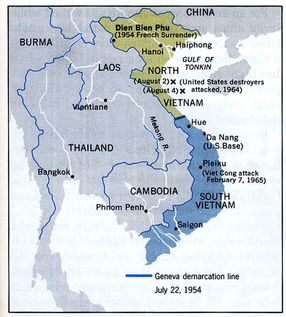
(Map: the demarcation line, created during the Geneva Convention in 1954, at the 17th Parallel which divided North and South Vietnam)
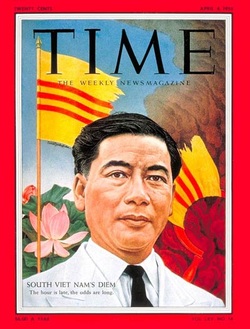
     The French defeat at Dien Bien Phu in 1954 to communist forces in Southeast Asia had disturbing repercussion in D.C.; basically, President Eisenhower decided that the U.S. needed to fill the void left by the French withdrawal. The U.S. refused to sign the Geneva Accords, believing that by doing so, all of Vietnam would become communist. In effect, the temporary border at the 17th Parallel became far more permanent with the creation of South Vietnam, with the backing of the U.S. Gov't.        Among the results of the Geneva Conference was the election of Ngo Dinh Diem as president of the newly created South Vietnam. For almost a decade, he proved to be too weak to rule, but too strong to overthrow; he did as he pleased, much to the frustration of the newly elected President, John Kennedy. With the memories of Appeasement in 1938, and the Bay of Pigs just weeks into his administration, JFK was in a quandry. In the end, JFK didn't act on the advice of the "Hawks" or the very few in Congress that advocated withdrawal . . . he chose to keep South Vietnam on the back-burner for the time-being as 1961 unfolded.

Picture
     JFK was under increasing pressure to send real troops to South Vietnam; by 1962, none of his advisers supported passivity or the withdrawal of the military advisers. With continued tension in Cuba and Berlin, JFK didn't want to further complicate his presidential landscape by increasing America's involvement in South Vietnam. The main reason why JFK was able to do so was that in 1961 and 1962, Southeast Asia was not viewed as a key strategic region, like Western Europe or the Mediterranean; that would change in 1963.
     JFK continued his steadfast refusal to send troops to South Vietnam; he had learned his lesson from the Bay of Pigs that it was unwise to act without all the available information. General Maxwell Taylor, Chairman of the Joint Chiefs of Staff, wanted 200k troops to be sent 
(a 1960s version of "Shock and Awe") in order to gain a quick and decisive victory to contain the spread of communism in Southeast Asia. JFK refused to follow General Taylor's recommendation; the President likened U.S. involvement in South Vietnam to taking a drink - after awhile, you need another, and another. Yet, the specter of Appeasement existed, and more significant was the increasingly rampant belief in the U.S. Gov't that South Vietnam was a key strategic region in the Cold War. Political polls showed that most Americans believed that Red China was behind the trouble in Southeast Asia.
     JFK authorized more military advisers, and publicly stated that there were "plans" to send troops; that public announcement was an effort to get Diem on board with the U.S. goals in the region, but like Union General George B. McClellan, he basically did nothing but protect his position of power. More military advisers in South Vietnam meant more American casualties; JFK desperately tried to hide the truth of those casualties. In not being truthful to the American public about what was happening in South Vietnam, JFK made his greatest error as President, according to Richard Dallek; he ignored the lesson modeled by FDR in being as truthful as possible when it came to American casualties in war. As a logical result, the American media decided to find out what was really happening in South Vietnam . . . 

Picture
     Experienced and responsible American journalists (e.g. James Reston and David Halberstam, pictured) flooded South Vietnam, and reported a much different story than what was coming out of the White House and the Pentagon. James Reston of the NY Times went so far as to claim that America was involved in an undeclared war; JFK and his advisers started to view the media as a major obstacle to success in South Vietnam. 
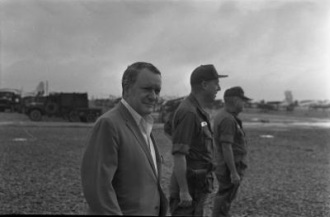
     JFK sent SecDef McNamara to South Vietnam to find out what was "really" happening; McNamara wound up "drinking the Kool-Aid" served by the military, and he reported that South Vietnam was winning the war against the North Vietnamese and the Viet Cong . . . this unmitigated deception spread like a virus, as it was passed down the political chain-of-command from McNamara. As before with the Bay of Pigs, "wishful thinking" blotted out the harsh truths, complicating matters even more for President Kennedy . . . by the summer of 1962, JFK had lost even more confidence in his advisers (except RFK), and he resolved once again to rely only on himself on all-things-Vietnam. At the same point, JFK started to turn over policy-making decisions on South Vietnam to the military, SecDef McNamara, and also to the State Department, which eventually created a situation where JFK's advisers acted on their own in South Vietnam without seeking presidential approval. 

Picture
  (James Reston of the NY Times in Vietnam)
     JFK lived in a fantasy world in terms of South Vietnam (with the exception of sending troops). He believed that he could "turn the corner" if only: a) The press was more pliable and cooperative; b) There was more support for Diem; c) The public would realize that America's national security was at risk in SE Asia. JFK also believed that Vietnam was the only obstacle to winning re-election (he was looking forward to running against the ultra-conservative Barry Goldwater), and he decided to hold-off on any significant decisions concerning South Vietnam until after the election. JFK's goal was to be able to withdraw U.S. advisers from South Vietnam with at least the appearance of a victory, but by the spring of 1963, that goal was politically impossible due to the political atmosphere in the U.S., as well as in South Vietnam.

Picture
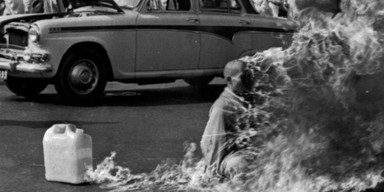
     By the summer of 1963, JFK had reached the peak of his presidency with the nuclear test-ban treaty with the USSR, but events in South Vietnam took a radical turn. A Buddhist revolt in South Vietnam reached a crescendo when a monk immolated himself in public, protesting the Diem regime's harsh actions against freedom of religion (The Diem regime supported Catholicism). The question facing JFK and his advisers was this: Should their be a coup against Diem, and how involved should America be in that coup? JFK wanted to avoid a coup against Diem, since that would almost certainly lead to significantly greater American involvement in South Vietnam. JFK's advisers, each heavily invested in their points-of-view on Diem, were pressuring, not advising, the President, and an increasing number wanted Diem removed from power.

Picture
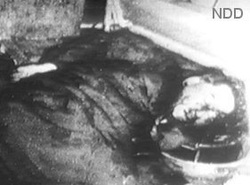
     In the fall of 1963, JFK paid the price for not only indecision, but also for giving policy-making power on South Vietnam to others. On 29 October, 1963, the "Green Light" cable (a.k.a. Cable 243) was sent to Henry Cabot Lodge, Jr., the U.S. Ambassador to South Vietnam. The communique was sent by the CIA and the State Department, authorizing the South Vietnamese generals to remove Diem from power. The CIA and the State Dept. took full advantage of JFK's physical absence and long-standing ambivalence (it wasn't like JFK said they couldn't act), and Ambassador Lodge, in effect, was in control of the coup. On 1 November, the same month that JFK was assassinated in Dallas, the South Vietnamese generals staged their coup, and assassinated Diem. JFK was shocked when briefed on the death of Diem; he didn't think Diem would be killed, and his death weighed on his conscience since he knew the assassination was at least partially due to his actions / inactions. 
     We can only speculate on what would have happened in South Vietnam if JFK had not been assassinated. One thing to consider: JFK had developed a deep distrust with the Joint Chiefs and the CIA, while President Lyndon Johnson fully embraced the military's advice to keep sending more-and-more U.S. troops to South Vietnam until "critical mass" was reached, ensuring victory. If President Kennedy had won re-election in 1964, he almost certainly would have been deeply skeptical of any large-scale mobilization of U.S. forces to South Vietnam, and maybe would have started to ask, at long last, some of the questions that needed to be answered before America committed itself to a war that millions would eventually realize was unwinnable.

      (Below: JFK's personal memo about the Diem Coup, recorded on 4 November, 1963 . . . 
   "John John" will interrupt him during the recording; listen how JFK handles the interruption)

0 Comments

JFK & His Advisers: Cuba

6/7/2014

0 Comments

 
                 Source: Robert Dallek. Camelot’s Court: Inside the Kennedy                                                                           White House (2013)

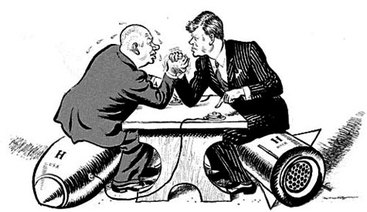
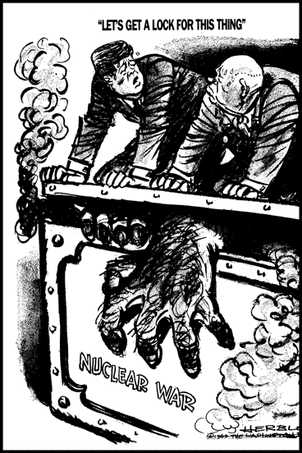
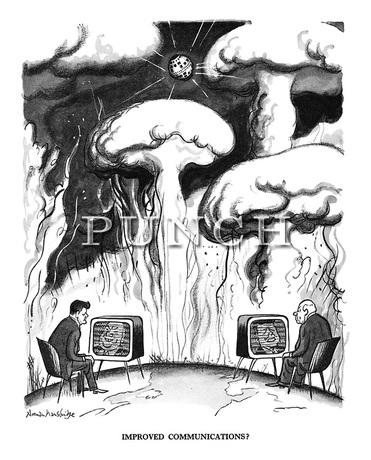
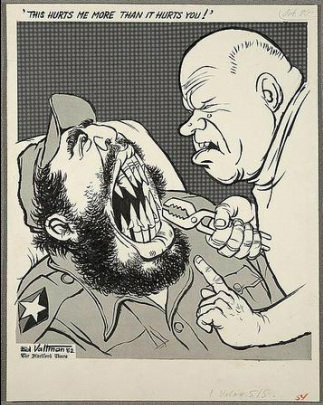
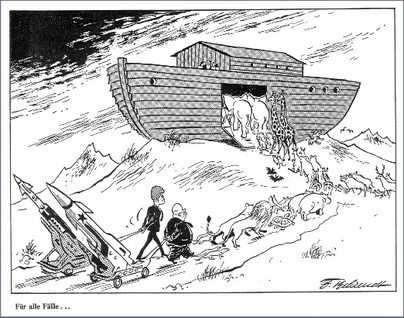
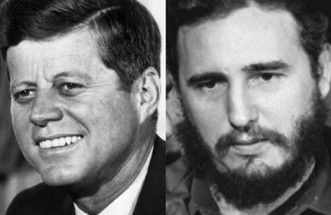
     By September of 1962, one could understand why President Kennedy felt that he was under attack: Nikita Krushchev was implementing a strategy of creating Cold War crises against the U.S., while Fidel Castro (and his beard) was doing his best to agitate and irritate the U.S. in the Western Hemisphere. The antagonism from those two leaders were very real, but a far more significant threat to the national security of the United States that autumn came from an unexpected quarter: the Joint Chiefs of Staff. JFK's true achievement in avoiding nuclear war in October, 1962, was to keep the military "Hawks" from taking over the decision-making on how to resolve the Cuban Missile Crisis.
Picture
    On 3 November, 1961, JFK and RFK set up "Operation Mongoose", which was a covert effort to remove Castro from power; basically, it was "payback" for the Bay of Pigs. In crafting "Mongoose", JFK relied far more on General Maxwell Taylor of the Joint Chiefs, and the CIA as advisers. SecDef McNamara was in essence "locked out" of all-things-Cuba at this point, since he had suggested that JFK was basically obsessed with Castro. Before the Missile Crisis, JFK had allowed his military & intelligence advisers in to his "Circle of Trust" concerning Cuba, while relegating others, such as McNamara, to the sidelines. One of the main reasons why JFK adjusted his line-up of advisers in dealing with Cuba is that he believed that Castro was the greatest danger to freedom in the Western Hemisphere, and that meant he needed military options.
     JFK's faith in his military and intelligence advisers would wane considerably in the second-half of 1962, however. The CIA, in a case of nightmarish deja vu from the Bay of Pigs, again failed Kennedy. In 1959, the USSR, for the first time, decided to locate nuclear missiles outside of their borders in East Germany. At the "11th Hour", Krushchev pulled the plug on the venture, but operatives in the CIA learned about the plan. On the Soviet side, Krushchev assumed that the U.S. didn't detect his plan in East Germany, so therefore he could try again in Cuba. On the U.S. side, the CIA just sat on their intelligence of what they learned in East Germany, and never provided JFK that crucial piece of information when he needed it most.

Picture
     On 21 September, 1962, JFK was briefed on the reality, confirmed, that the USSR had twenty medium-range ballistic missiles in Cuba. JFK's initial response to key advisers was that the USSR "wouldn't dare" use those missiles; as with events in Vietnam, JFK chose to keep events that were unfolding in Cuba as secret as possible. On 14 October, a U2 flight over Cuba confirmed six missile installations, with as many as twenty more ready to erect. National Security Adviser McGeorge Bundy received this information, but decided to wait until 8 am the next morning before briefing Kennedy (he thought it would be better if JFK was rested before being briefed). Once again, experts failed in providing wise (or timely) counsel to President Kennedy.
     Once briefed on the fact that the USSR had active nuclear missiles in Cuba, JFK turned to the group of advisers that had largely failed him so far in his presidency. The number and members of what would become known as the Executive Committee (ExComm) would vary, but the purpose of this group of advisers was to provide a broader base of opinions than what occurred before with the Bay of Pigs. For the nearly two weeks the ExComm met, most favored prompt action, while JFK seemed to be the only one, at times, that urged caution. President Kennedy had to decide which basic military strategy to pursue - Eisenhower's "Mutual Assured Destruction", or General Maxwell Taylor's "Flexible Response".  In the end, JFK chose both - the "Flexible Response" strategy provided his first option, while MAD was tabled as tactic of last resort.  
     JFK had two "agents" in place for the ExComm meetings - RFK and SecDef McNamara. RFK served as JFK's "sounding board" for options in ExComm, which provided freer discussion, whether-or-not JFK was in attendance. McNamara had by far the more crucial role, in that he was the "How Will the Soviets Respond" voice in ExComm; no longer sidelined for Cuba, JFK met with his SecDef before ExComm, making sure he knew his role. 

Picture
      On 18 October, 1962, ExComm recommended four options to JFK: 
a) Give the USSR an ultimatum, and attack if necessary; b) Conduct a surprise air raid on the missile sites; c) Enact a naval blockade on Cuba; d) Execute a large-scale air strike followed by a massive ground invasion.
     JFK also was given counsel from an expert on Krushchev which was probably the most important advice he received during the crisis: make it as easy as possible for Krushchev to back down. That advice, more than anything else, meant that acting on the suggestions from his military advisers would almost have certainly led to nuclear war. Of the four options provided by ExComm, only the blockade provided a potential exit for Krushchev; as the Joint Chiefs kept pressing for one, two, or all three of the other options, JFK's distrust of his military advisers increased. 
     On 22 October, the naval blockade was made public, while a letter was sent to Krushchev, giving him official notice of the blockade. While Krushchev responded the next day with typical bluster (the U.S. was engaging in "aggressive actions"), Arthur Schlesinger told JFK that he had a information that Krushchev wanted out of this crisis as quickly as possible. When JFK sent a follow-up letter based on this information to Krushchev, in essence, the military advisers (and most of ExComm) were no longer relevant to JFK in terms of ending the crisis. Also, by 22 October, since it was no longer possible (or desirable at that point) to keep the crisis secret, JFK arranged for a televised address to the nation that evening. JFK gave this address for at least two reasons: first,it was the only way he was able to communicate directly with Krushchev, and secondly, for political cover, he needed to look and sound like the Ultimate
Cold Warrior.
(Below: a portion of JFK's nationally televised address on 22 October, 1962, where he announces the quarantine (blockade), and states what will happen if any missiles are launched from Cuba . . .)

Picture
     In the days that followed JFK's televised address, the USSR would challenge the blockade line, and turn back. But, given that turning back made Krushchev look weak and impotent, Soviet ships made another run at the blockade, showing no signs of turning around. Anticipating escalation, JFK ordered the blockade to draw closer to Cuba, which put U.S. ships in range of Soviet MiG fighters. The Joint Chiefs were apoplectic in their response to this order, but JFK knew that drawing back the blockade line gave Krushchev more time to find his way out of the crisis.
     On 26 October, at 4:30 pm, JFK received confirmation that Krushchev would remove the missiles from Cuba if the U.S. would pledge to leave Castro alone. As JFK continued to read, however, his heart must have sank - Krushchev demanded that the American Jupiter missiles in Turkey needed to be removed since he was removing Soviet missiles in Cuba. At this point, RFK came to the rescue, in that in personal negotiations with Anatoly Dobrynin (USSR Ambassador to the U.S.), he guaranteed the removal of the outdated Jupiter missiles in the upcoming months, but the USSR could not say anything on the matter . . . it wasn't just Krushchev that wanted to save face for political reasons during the missile crisis.
(Below: scroll in about 55 seconds, and see a great moment for the U.S. during the Cuban Missile Crisis - U.S. Ambassador to the U.N., Adlai Stevenson, confronted his Soviet counter-part, Valerian Zorin, on the global stage on 25 October, 1962)

Picture
     What did JFK learn from the Cuban Missile Crisis? First, he learned that Krushchev didn't have any national security issues at stake, so he was able to find a way out as long as he wasn't provoked; that was a concept that was alien to the Joint Chiefs. Second, JFK (justifiably) considered his military advisers as reckless and irresponsible; JFK's opinion of the Joint Chiefs would have relevance in the growing crisis in South Vietnam. Third, JFK knew he was very lucky to have SecDef Robert McNamara as his civilian "buffer" with the military - that was a role that McNamara would continue to have with the increasing trouble in Southeast Asia. And lastly, Attorney General Robert Kennedy proved to be even more indispensable - he in essence became the "Instrument of the President" during the crisis.

Picture
     After the crisis, JFK was torn between accepting Castro or to renew efforts to end his regime in Cuba. In a way, JFK had little choice on the matter, since election-year politics entered the fray; Conservatives kept their focus on Castro, communism, and the still-present Soviet weaponry in Cuba. JFK kept "Operation Mongoose" in effect until February, 1963 - CIA efforts to poison Castro's cigars with botulism, or to poison his food so his beard would fall out (and therefore Cubans would lose their faith in their leader) proved fruitless and futile.
   During March, 1963, JFK found it impossible to keep a lid on the infighting that was happening among his advisers over Cuba. JFK, as with Vietnam, refused to make a decision on what to do in Cuba, and the situation festered (and Uncle-Festered) . . . JFK wanted Cuba to no longer be a problem, but he couldn't find a way to let "Cuba go" without being accused of appeasement as he was gearing up for re-election. So, JFK continued efforts to weaken or remove Castro without any overt U.S. involvement, basically to maintain a "noise level" for political reasons. Had JFK's advisers been of one mind on letting go of Cuba, JFK would have done so . . . kind of ironic for a "Decider", but to be fair, JFK needed a cooperative Senate for any future nuclear test-ban treaty with the USSR, and he wanted to be re-elected as President, so in essence his hands were indeed tied in dealing with Castro.

Picture
       For JFK, reconciliation with the Cuba was politically impossible, overt attacks to remove Castro were impossible, but secret raids against Castro for political cover at home - possible! Basically, the only real strategy that took root was his informal "Kennedy Doctrine" which stated that the U.S. would not tolerate another leader like Castro in the Western Hemisphere. Interestingly, Castro wanted more normalized relations with the U.S. after the missile crisis, and he even wanted to secretly discuss a better relationship with the U.S. However, politics limited Castro as well, in that he could never figure out how to end hostile relations with the U.S. without abandoning his revolutionary ideals - Castro had hardliners of his own with which to deal in his nation as well.
     Before long, another leader would frustrate and confound JFK to the "Nth Degree", and JFK would again need to deal with his military advisers while he tried to find a way to keep events from escalating out of control, this time in Southeast Asia . . . President Ngo Dinh Diem of South Vietnam would prove to be every bit as difficult as Castro - the difference being that he was supposedly an ally of the United States.

Washington Post Review of Dallek's Camelot's Court: Inside the Kennedy White House
0 Comments

JFK & His Advisers: Berlin & the Nuclear Test-Ban Treaty

6/3/2014

0 Comments

 
                Source: Robert Dallek. Camelot’s Court: Inside the Kennedy 
                                                     White House (2013)

(Below: JFK's promise in 1962 that the US would reach the moon in the 1960s; the speech was
 politically motivated - an attempt to draw attention away from the Bay of Pigs, Civil Rights,
 Vietnam, and also Berlin and the stalled nuclear test-ban treaty with the USSR . . . we also see
 JFK's legendary sense of humor on display . . .)
      In the immediate aftermath of the Bay of Pigs fiasco, West Berlin was easily the most troublesome aspect for JFK in his first year in office. Two European leaders would influence JFK's decision-making the most as President: Nikita Krushchev of the USSR, and Charles de Gaulle of France. For better-or-worse, de Gaulle's advice before the Vienna Summit in 1961 would influence how JFK made foreign policy decisions in Cuba, Vietnam, and in Europe. At least de Gaulle, an ally (nominally, at least), gave advice, and was at in the same realm as JFK in socio-economic status. Krushchev was on the other side of the river relative to JFK as far as his background (a former peasant) and foreign policy. Those differences in background, foreign policy, and also in personality would meet face-to-face on 4 June, 1961 in Vienna, Austria.
     Before the Vienna Summit, President Kennedy met with his counterpart in France, Charles de Gaulle. The meeting was brief; de Gaulle was actually a little put-out by the meeting with the "rookie" president. JFK, on the other hand, thought he was in the presence of a great man (de Gaulle was the last of the major leaders of WW II that was still alive), and was very receptive to any advice offered. De Gaulle's advice would shape the rest of his presidency: listen to your advisers before you make up your mind, but once you've made up your mind, do not listen to anyone. JFK truly believed in the "Great Man" interpretation of history, and he very badly wanted to be such a man. At that point, he decided that he, not his advisers, would have the "total perspective" on any situation, and in effect (although he never used the title), he would be "The Decider". But before he could return home to the role that he envisioned, he needed to deal with the General Secretary of the Soviet Union.
     Krushchev came to the Vienna Summit intent on bullying and intimidating America's youngest-elected president. He was in a foul mood early after his arrival, seeing and hearing Vienna's enthusiastic response to Kennedy compared to his relatively silent reception. What put Krushchev in an even more foul mood was the first "photo op", where JFK controlled the setting, and the "taller", more urbane and handsome JFK stole the show, so to speak, the day before the summit officially started. JFK came to Vienna in order to meet Krushchev face-to-face, and to get a "feel" for him; he hoped to be able to forge a far more productive and useful relationship with Krushchev compared to President Eisenhower.
     The "Battle of the Egos" started, and it was "Advantage Krushchev", especially when the discussion tracked towards competing ideologies. Krushchev believed the new President was out of his league in terms of ability and strength of leadership - unlike with Eisenhower, Krushchev honestly believed he was dealing with an "easy mark" in JFK. It didn't help matters at all that JFK didn't acquit himself very well in his first high-profile international appearance (remember, memories were fresh of Vice-President Nixon more than holding his own with Krushchev in the "Kitchen Debates" of 1959); after Vienna, he told some of his advisers that his exchange with Krushchev was the "roughest thing in my life." It was the first time that JFK had met someone with whom he couldn't have a meaningful exchange of ideas. For political cover at home, JFK decided to portray Krushchev as a "Mad Man", bent on starting World War III. 
      (Below: A short segment detailing part of JFK's official summary of the Vienna Summit . . .
       now, with some context, you can critically appraise at least some of JFK's  comments)
    Construction of the Berlin Wall started in mid-August, just three months after Vienna. JFK, just seven months into his presidency, was facing accusations across the political spectrum that he was "soft" on Communism, especially in Berlin. Very soon after construction started, JFK addressed the nation on television in one of his White House press conferences. As would often be the case with his foreign policy, domestic political pressures influenced his decision-making. In his televised address, President Kennedy basically "drew a line in the sand" for the USSR in Berlin; as it turned out, Krushchev ordered the Berlin Wall to be constructed right up to that line. Krushchev, facing political pressures of his own from the hardliners (especially in the Politburo; imagine if our President's Cabinet outranked him . . .), wanted to end the "exodus" of people escaping Communist East Germany.
  (Below: again facing political pressure at home, JFK gave a speech in West Berlin on 26 June,
      1963; here we see and hear JFK at his finest with his ability to inspire millions of people)
     On the nuclear test-ban front, JFK experienced frustration as well. Despite an agreement in Geneva in the late-1950s that would basically end atmospheric tests of nuclear weapons (largely predicated on the disastrous "Castle Bravo" by the American military in 1954), the USSR resumed testing on Krushchev's orders . . . the Soviets conducted at least thirty-seven atmospheric tests after Geneva. In April, 1962, JFK reluctantly agreed to resume U.S. atmospheric testing in order to keep up with the USSR, and also to deal with political pressure from the Joint Chiefs and conservatives in Congress; the odds were increasingly unlikely of a nuclear test-ban treaty at the end of 1962, which was JFK's goal. As you will discover in far more detail in future "JFK and His Advisers" blogs on Cuba and Vietnam, the Joint Chiefs were far too "hawkish" for JFK, and the they were not in favor of any ban on testing that didn't feature strict verification and enforcement. JFK, as he was wont to do after the Bay of Pigs, and especially after de Gaulle's advice, listened to his military advisers, and had to deal with them politically, but he had learned that their views were far too extreme to be practical.
     In the spring of 1963, JFK was able to determine from a few experts on Krushchev that the USSR would be willing to negotiate and ratify a test-ban treaty as long as the verification wasn't too strict. In the summer of 1963, JFK was able to not only introduce the nuclear test-ban treaty in the Senate, but it was also easily ratified by a vote of 80 - 19, despite the vehement public protests of the Joint Chiefs. 
     By the summer of 1963, JFK and Krushchev had reached a point where they were able to reach some level of compromise on a few foreign policy issues, most notably with the nuclear test ban treaty . . . the main reason why both leaders reached that point was due to the Cuban Missile Crisis, the only time in U.S. History where part of our military reached "Defcon 2" . . . it was also the event that shaped JFK's relationship the most with his advisers; here he had his first historically significant opportunity to use the advice from Charles de Gaulle, and to have a chance to enter the pantheon of the "Great Men in History." 
0 Comments

    Archives

    May 2015
    April 2015
    March 2015
    February 2015
    January 2015
    December 2014
    November 2014
    October 2014
    September 2014
    August 2014
    July 2014
    June 2014
    May 2014

    Categories

    All
    19th Century
    20th Century
    Actor
    Biography
    History

Powered by Create your own unique website with customizable templates.