Mr. Jensen's U.S. History Website
  • U.S. History Blog
    • U.S. History Blog (May 2026 - May 2027)
    • U.S. History Blog (May 2025 - May 2026)
    • U.S. History Blog (May 2024 - May 2025)
    • U.S. History Blog (May 2023 - May 2024)
    • U.S. History Blog (May 2022 - May 2023)
    • U.S. History Blog (May 2021 - May 2022)
    • U.S. History Blog (May 2020 - May 2021)
    • U.S. History Blog (May 2019 - May 2020)
    • U.S. History Blog (May 2018 - May 2019)
    • U.S. History Blog (May 2017 - May 2018)
    • U.S. History Blog (May 2016 - May 2017)
    • U.S. History Blog (May 2015 - May 2016)
    • U.S. History Blog (May, 2014 - May, 2015)
  • About

Steve McQueen: "A Magnificent Actor"

1/24/2015

0 Comments

 
     Source: Marc Eliot. Steve McQueen. 2011 (Steve McQueen's filmography)
Picture
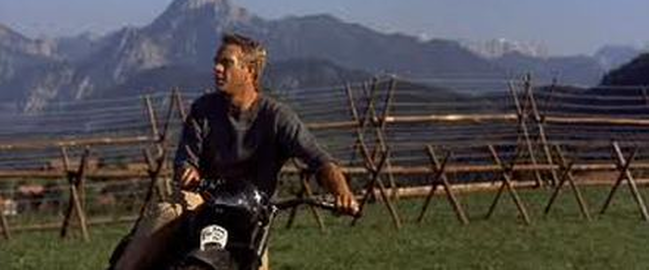
         Screen capture from The Great Escape (1963), my favorite Steve McQueen movie . . .
     Since I was old enough to remember, Steve McQueen was a Hollywood superstar, even though I didn't see any of his movies until after his death from lung cancer in 1980 (at the age of 50).  Among the interesting things I learned from reading Marc Eliot's biography was . . . 

** McQueen had a rough childhood, never really able to experience anything close to a 
     traditional upbringing; basically, he ran away from home, joining a carnival of all things, at      the age of 15, and eventually joined the Marines

** He was a "Method" actor, which basically meant he totally immersed himself with the
     role he was playing (the style was en vogue in the 1950s & 1960s, in particular).  A by-
     product was that he was very difficult to work with on-and-off the set, from the POV's
     of directors, producers, and fellow actors (especially fellow method actors, such as
     Dustin Hoffman in 1973's "Papillion"). It was ironic that he had a life-long antipathy 
     towards authority, but when he had authority, he basically abused it as an actor. He was
     married three times - his second marriage was to the most successful actress of the late-
     1960s/early-1970s, Ali McGraw, and his first marriage lasted over 15 years. 

** McQueen, like most Hollywood superstars, turned down roles in movies that would
     have made him an even bigger star.  A sampling of the roles he turned down for various
     reasons include: Butch Cassidy & the Sundance Kid, 1969 (Robert Redford); Dirty Harry,
     1971 (Clint Eastwood); Play Misty for Me, 1971 (Clint Eastwood); The French 
     Connection, 1972 (Gene Hackman won his first Oscar in this role); Superman, 1978 
     (Marlon Brando); Apocalypse Now, 1979 (Marlon Brando).  To be fair, this kind of 
     thing does happen often enough in Hollywood. Some famous examples include: Tom Cruise
     turned down "Ghost" (1990, Patrick Swayze benefited from that decision), while Julia 
     Roberts turned down both "The Proposal", and "The Blind Side" (2009), to Sandra Bullock's
     great benefit.

** The lung cancer that he died from at the age of 50 was guaranteed to happen, it turns out,
     due to an extended period of time removing asbestos as a Marine, for one of the many
     times he was disciplined in the Corps. The first inkling of that cancer appeared in 1972
     while he was making the movie "The Get Away" w/ Ali McGraw; he made the last few 
     movies of his career, and life, and tremendous pain and discomfort.  The lung cancer
     wasn't diagnosed until he was making the movie "Tom Horn", in 1979.

** He had a chance with 'Bullitt" (1968), to franchise that action "anti-hero" to multiple 

     movies, much like Clint Eastwood did w/ Dirty Harry; no one in Hollywood understood 
     why he didn't take advantage of that role with future sequels, but instead focused on 
     choosing roles that his fans didn't support at the box office (largely through his production 
     company Solar, which was a financial albatross)

** The highest-grossing movie in which he starred was 1974's "The Towering Inferno", in
      which he finally appeared in a movie w/ Paul Newman (McQueen was incredibly jealous
      of Newman's super-stardom).  He chose the role of the chief firefighter, in part, in order
      to literally have the last line in the movie over Newman (Ironically enough, it was Newman
      himself, in 1968, that offered McQueen the role in Butch Cassidy and the Sundance Kid,
      but McQueen apparently didn't want to work w/ Newman at that point)

** McQueen was surprisingly lazy when he wasn't on the set, or racing cars or motorcycles.
     A life-long drug addict, philanderer, and couch potato, he wanted to drift through life
     in his 40s, "letting himself go", never making another movie.  His financial realities kept
     him making movies just to live the life he wanted to live (e.g. his last movie, "The Hunter",
     1980)

** Like Denzel Washington and George Clooney, McQueen was a TV star before he became a
     movie star.  McQueen starred in 94 episodes of "Wanted: Dead or Alive", for CBS in the 
     late-1950s, portraying a bounty hunter, which makes his last movie, "The Hunter", kind of
     an ironic last movie for his career.

** The movies that are considered to be the "Essential McQueen" are:
      - The Magnificent Seven (1960) 
      - The Great Escape (1963)
      - The Cincinnati Kid (1965; a poker-player version of Newman's "The Hustler" in 1961)
      - The Sand Pebbles (1966)
      - The Thomas Crown Affair (1968; a role turned down by Sean Connery)
      - Bullitt (1968; to this day, this movie has what is considered by most movie critics as the 
                  greatest car chase in movie history)
      - Papillion (1973)
      - The Towering Inferno (1974)
0 Comments

Lee Marvin: "The Merchant of Menace" (WW II Marine and Hollywood Icon - buried at Arlington National Cemetery)

7/8/2014

2 Comments

 
            Source: Dwayne Epstein. Lee Marvin: Point Blank (2013)
Picture
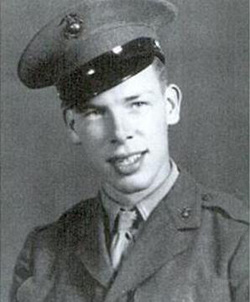
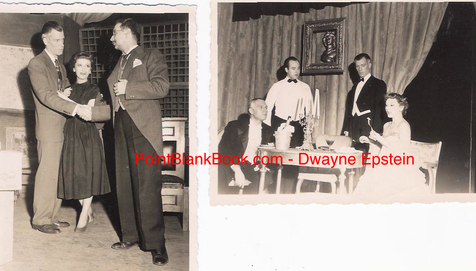
     Lee Marvin is one of two World War II decorated veterans that became Hollywood superstars that are buried at Arlington National Cemetery (the other is the most-decorated soldier in U.S. History, Audie Murphy). As a Marine, Marvin took part in twenty-one assaults on Japanese positions in the Pacific; he was wounded while advancing on an enemy position at Iwo Jima, and was awarded the Purple Heart and the Navy Cross. Acting provided the outlet Marvin needed to release his inner-demons from WW II, first at the Maverick Theater in Woodstock, NY, then in NYC, and then in movies and television in Hollywood. From the mid-1960s to the early-1970s, Lee Marvin was the #1 male film star in America - his screen presence was such that only a Great White Shark in 1975 and a Wookie in 1977 could alter the trajectory of his amazing success and influence in the movies.

Picture
     Lee Marvin's Great-Uncle Ross Marvin was part of Commander Robert Peary's Arctic expeditions in the early-1900s. He died by falling through thin ice, but in 1926, the two Eskimos that were with him confessed that they killed him. In simple terms, Ross Marvin lost his temper, and the Eskimos acted in self-defense in an area with no jurisdiction. That was the most famous of many, many examples of the men in the Marvin clan losing their temper and resorting to violence; it was in Lee's DNA to resort to violence when under stress. On Lee's mother's side of the family, she had lineage that connected her to not only George Washington, but also Robert E. Lee - Lee Marvin was named after the legendary Confederate General. 
     Lee fell in love with the movies at an early age; he claimed that the second movie he ever saw was in 1931, "All Quiet on the Western Front"; he identified with the tough-but-fair German sergeant. As far as school went, Lee didn't connect with formal education at all. In the 1930s, there was no way to diagnose his ADD and dyslexia, and as one would expect, he hated school. Although he was a slow reader, he did like literature and history, but he saw nothing else in school that was remotely relevant, so truancy was common in the many public and private schools in which he was enrolled. 
     Lee Marvin decided to join the Marines in the summer of 1942 (he was 17 when Pearl Harbor was attacked), and finished boot camp in four weeks (it usually took thirteen weeks, but Marines were badly needed in the Pacific). His regiment was sent to the Pacific later in that summer; during his almost two years in the Marines, he saw many horrors of war; he had to kill half-a-dozen Japanese soldiers in a foxhole in order to save the lives of fellow Marines. At Iwo Jima, Lee was shot in the upper-left buttock, but was VERY lucky he wasn't killed or paralyzed; he was very much bothered why he lived and many other Marines died.

Picture
     Lee was mustered out of the Marines on 24 July, 1945, and he suffered from survivor's guilt; it was later determined that his sciatic wound disabled him by 20%. Lee found work as a plumber's apprentice Woodstock in New York; he actually enjoyed most of the work - he kept his union card even when he became a Hollywood superstar. Lee claimed that when he was working in a bathroom at the Maverick Theater, he heard the director of a play say that he needed someone to portray the Texan (the regular actor was sick) in the production. From that moment on, Lee was an actor; acting provided an outlet for him to release the horrors of WW II (he undoubtedly suffered from Post-Traumatic Stress Syndrome, called "Battle Fatigue" in WW II - there wasn't really any treatment for veterans like Lee in those days). 
     The only other actor at the Maverick Theater at that time that went on to stardom was James Doohan ("Scotty" from Star Trek), and they became fairly close friends. It was Doohan that convinced Lee Marvin to move to LA instead of pursuing roles on Broadway in NYC; he told Lee that there were roles waiting for an actor like him in Hollywood.

     By 1952, Lee was in Los Angeles full-time, and found an agent, one of the legends of Hollywood, Meyer Mishkin (he was Lee's agent for 37 years). In the movie "Hangman's Knot" (1952, one of his first movie roles), his scene with Donna Reed terrified her so that she refused to let Lee come anywhere near her off the set.
Picture
       Lee Marvin appeared in television shows as well in the early-1950s, and Jack Webb so loved Marvin's guest role on "Dragnet" that he issued the guest footage to as many directors as possible. Lee was able to carve a niche in TV and movies as a villain, and he did it exceedingly well. Vincent Canby of the LA Times, who became one of the most famous movie critics, called Lee Marvin "The Merchant of Menace" due to his role in "The Big Heat" (1953). The same year, Lee Marvin co-starred with Marlon Brando in "The Wild One", and in 1954, he had a small but crucial role in "The Caine Mutiny". He followed these critically-acclaimed movies with a role in "Bad Day at Black Rock" with an all-star cast, led by Spencer Tracy. 
     Lee also worked in television, even though he hated that medium; he compared working in television to wearing a straitjacket. Ironically, television allowed Lee to showcase the full array of his talents (he was a very good comic actor). Mishkin convinced Lee that TV was the stepping-stone to breaking through to stardom in the movies (he was frustrated that many contemporaries, like Marlon Brando, Ernest Borgnine, and Charles Bronson had broken through). He suffered from a common frustration of character-actors - everyone recognized him, but no one could remember his name . . . television was designed to remedy that situation.
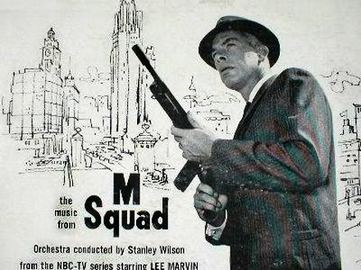
     Lee Marvin was the lead in "M-Squad", which became a hit, and Lee became a TV star (the show was a mix of Columbo and Dragnet). Although he despised working in television, he would constantly return to the small-screen when movie roles were scarce before he hit the big-time. Lee benefited tremendously from the shift in Hollywood to more character-driven fare in the 1960s - he was never out of work for long.

Picture
     Lee's first role in what is now considered a classic movie was in "The Man Who Shot Liberty Valance" (1962). The director, John Ford ("Mr. Western"), just turned Lee lose on the set, giving him minimal direction. Lee portrayed a memorable villain (Liberty Valance), and he more than held his own with John Wayne and James Stewart. Ironically, his critically-acclaimed performance didn't lead to additional movie roles, so he went back to television for a while.
     At the age of 40, Lee Marvin got a break of which most actors would not have benefited; he was prematurely aged - his hair was steely gray, his face was all craggly-and-such. It was a turning point for Lee - he was at the forefront of a new kind of leading role: the "Leading Heavy." In "The Killers" (one of the first made-for-TV movies, but released in theaters due to the feeling it was too violent for TV after JFK's assassination), Lee Marvin finally became the film star he had envisioned. 

Picture
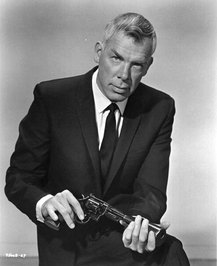
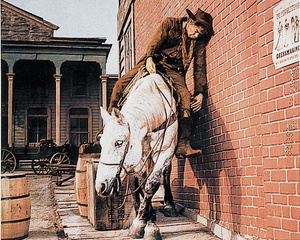
     1965 was the year Lee Marvin became a movie superstar, in that just months apart two movies were released that not only were critically well-received, but they also performed very well at the box office. First was "Ship of Fools", a melodrama, where Lee stood out among a strong cast. Next was "Cat Ballou", which was a comedy-western. "Cat Ballou" allowed Lee to escape being typecast as a villain/heel/heavy - it was a career-changing role, famous for the "leaning horse" scene.
     Lee channeled the angst and violence of the mid-to-late-1960s better than any other actor. Starting in 1965, Lee was in huge demand for interviews, which he never really liked, but saw them as an opportunity to do some more acting. In an upset of sorts, Lee Marvin won Best Actor at the 1966 Oscars, and gave a very brief, memorable, and misunderstood acceptance speech (after all, at the Oscar's, one is expected to thank a very long list of people).

     In 1967, Lee Marvin was the lead in "The Dirty Dozen", the year's top-grossing movie (and one of my favorites), and Lee became the #1 male film star in America. Later that year, he 
linked up with director John Boorman ("Excalibur") for "Point Blank." That movie wasn't embraced for many years, but it has become a cult favorite (Mel Gibson re-made the movie in 1999 with "Payback").
     As with any movie star, sometimes they appear in bombs, and that happened to Lee in 1969 with "Paint Your Wagon", which co-starred Clint Eastwood. Lee earned $1 million for the movie, but far too many chefs stirred the pot, and the movie tried to do too much. Interestingly, Lee Marvin was the lead singer in "Wanderin' Star" (one of the things the movie wanted to be was a musical), which actually replaced a song by The Beatles for the #1 spot in the weekly British music charts.
Picture
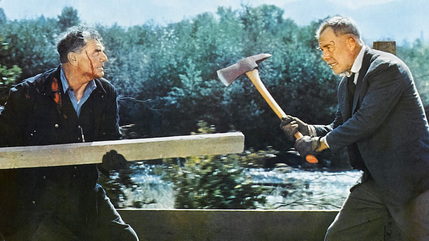
     Next for Lee Marvin was "Monte Walsh" (1970) with Jack Palance. The movie was about old cowboys finding that their way of life is over. Unlike "Paint Your Wagon", "Monte Walsh" was a critical and commercial success. By this point in his career, Lee was able to take time off when he so desired, and it wasn't until 1973 that he starred in two more well-reviewed (now cult favorite) movies. In "The Emperor of the North" , he portrayed a hobo riding the rails in the Great Depression, avoiding-yet-clashing with fellow Oscar-winner Ernest Borgnine (Lee's character was called "A No. 1"). In "The Iceman Cometh", the idea was to make a movie that would be a substitute for a Broadway production. Lee was cast as a salesman in a bar that forced the patrons (one of them a very young Jeff Bridges) to confront their pipe dreams.
     The movie industry changed again in 1975 - "Jaws" brought the blockbuster to the forefront in Hollywood, and that was bad news for Lee Marvin. Character-driven movies were now shelved in favor of blockbusters, and all of a sudden, Lee Marvin had difficulty finding worthwhile scripts and receptive audiences. Lee actually took two years off after "Spike's Gang" (1974) and "The Klansman" (also 1974, and generally considered to be his worst performance in his worst movie).
     Lee tried to resurrect what was all of a sudden a stalled acting career, and he agreed to star in "The Great Scout and Cathouse Thursday" (1976), which was a widely derided as a "Cat Ballou" wannabee. To make matters worse, Lee starred in "Shout at the Devil" (1976), which was an "African Queen" imitation . . . Lee took three more years off from Hollywood. In 1979, he starred in "Avalanche Express", which was viewed as an outdated Cold War spy thriller. It seemed to be official: the kind of movies that Lee Marvin preferred to make were no longer in fashion, not with movie-goers expecting blockbusters like Star Wars (1977) and "The Empire Strikes Back" (1980).

     Lee Marvin wasn't done yet, thankfully - he starred in "The Big Red One" in 1980 (which was the nickname of the Army's First Division, and ironically co-starred Mark Hamill) which proved to be his last great role. The movie never received its due during its theatrical run, in part because the studio cut one hour from the movie, making it a basically incomprehensible war movie.
Picture
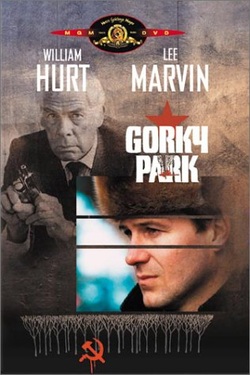
     "Death Hunt" (1981) was Lee's next starring vehicle, with Angie Dickinson and Charles Bronson, where he was a Canadian Mountie pursuing a fugitive in the Yukon in the 1930s. Again, pursuing what he loved, character-driven roles, he co-starred with William Hurt in "Gorky Park" (1983), which was a really good movie about US/USSR political intrigue, but proved to be bad box office. In 1986, Lee Marvin made his last movie at the age of 62, starring with Chuck Norris in "Delta Force", which performed up to expectations at the box office.
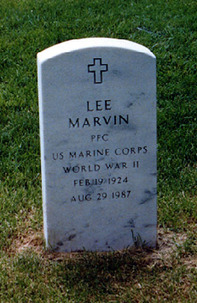
     Lee Marvin died on 29 August, 1987 in Tuscon, Arizona at the age of 63. Smoking 4-5 packs of cigarettes a day plus drinking heavily for decades caused a "perfect storm" of health problems. He was prescribed heavy doses of steroids, which taxed his cardiovascular system to the point where he died of a heart attack. His cremated remains were buried at Arlington National Cemetery on 7 October, 1987; his gravesite is located near the Tomb of the Unknown Soldiers, as well as some three-and-four star generals.
     Two decorated World War II veterans that are buried at Arlington National Cemetery became Hollywood superstars: Audie Murphy, the most decorated soldier in our history, and Lee Marvin, who was awarded the Purple Heart and the Navy Cross. While Audie Murphy was by far the greater war hero, Lee Marvin channeled his experiences from WW II and became one of the greatest actors of his generation, showcasing a range that few actors today can match. If you have never seen "Cat Ballou" or the "The Dirty Dozen", arrange some time to do so, and enjoy (and marvel at) Lee Marvin's screen presence.

2 Comments

    Archives

    May 2015
    April 2015
    March 2015
    February 2015
    January 2015
    December 2014
    November 2014
    October 2014
    September 2014
    August 2014
    July 2014
    June 2014
    May 2014

    Categories

    All
    19th Century
    20th Century
    Actor
    Biography
    History

Powered by Create your own unique website with customizable templates.