Ron Chernow. Titan: The Life of John D. Rockefeller, Sr. (1998)
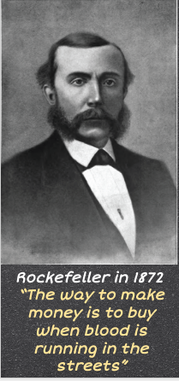
On 8 July 1879, John D. Rockefeller turned 40, and was one of America's 20 richest men, and easily the most obscure. Rockefeller's worth was often underestimated, with his stock in Standard Oil worth $18 million alone ($405m in 2015; when Vanderbilt died in 1877, he was worth $100m in 2015 dollars). By 1878, Rockefeller tried to be "semi-retired", often taking off afternoons, knowing that he had control over almost all of the refineries/pipelines in the oil industry.
It was at this time that the press, finally, took notice of Standard Oil and Rockefeller. In November 1878, the New York Sun featured a full-length profile of Rockefeller, and among the article's assertions was mention of a secret railroad deal from which Rockefeller benefited tremendously . . . put no proof was offered. By the early-1880s, Rockefeller had universal notoriety, much to his great chagrin and irritation.
In 1883, Rockefeller moved from Cleveland to New York City, pulled to the city due to the heavy kerosene trade. By 1884, Cleveland had been relegated to inferior status in terms of refining, and NYC, with all its seaboard refineries and its great port, was the new epicenter for Standard Oil. The export boom of petroleum products meant that Rockefeller had refineries in Brooklyn, Bayonne (NJ), Philadelphia, and Baltimore.
In 1879, Standard Oil couldn't own companies outside of Ohio, so three mid-level employees held stock in scores of subsidiary Standard Oil companies outside of Ohio. When these three received dividends, they were distributed to the 37 investors of Standard Oil as "individuals" in amounts proportionate to their holdings in the company. Rockefeller held three times the holdings of Henry Flagler, the co-founder of Standard Oil. So, even though Standard Oil owned the vast majority of refineries/pipelines in the industry, Rockefeller could honestly, under oath, say that Standard Oil didn't own property outside of Ohio. Rockefeller could claim that private individuals in Pennsylvania, New York, Maryland, and New Jersey owned the companies outside of Ohio; technically, the 3 mid-level employees, "trustees" owned the properties, but that makeshift arrangement was only able to last three years.
In 1881, Pennsylvania tried to tax Standard Oil properties, and Rockefeller feared that other states would follow suit, which would in essence mean that Rockefeller and Standard Oil would be held hostage by state governments. Standard Oil's holdings had reached a point where consolidation had to occur just to keep track of what was going on in the company and to continue to maximize profits. One of Rockefeller's advisers offered a brilliant strategy in which Standard Oil would create a company in each state it wished to do so (e.g. Standard Oil of New Jersey), and these separate companies would need separate boards of directors.
In 1881, Pennsylvania tried to tax Standard Oil properties, and Rockefeller feared that other states would follow suit, which would in essence mean that Rockefeller and Standard Oil would be held hostage by state governments. Standard Oil's holdings had reached a point where consolidation had to occur just to keep track of what was going on in the company and to continue to maximize profits. One of Rockefeller's advisers offered a brilliant strategy in which Standard Oil would create a company in each state it wished to do so (e.g. Standard Oil of New Jersey), and these separate companies would need separate boards of directors.
Based on that advice, an Executive Committee was created, and the stock of the various Standard Oil companies would be placed in the hands of trustees on that Executive Committee, who would then issue certificates of interest in the Standard Oil Trust estate, which led to being able to distribute dividends. This elaborate "stock swap" would create a union of stockholders which would not be the legally operators of the corporation. On 2 January 1882, the Standard Oil Trust agreement was drafted; the public didn't know about the new arrangement until the Standard Oil Trust emerged spawning an enterprise of $70 million, controlling 90% of the industry's refineries and pipelines.
It wasn't until six years later, in Congressional Anti-Trust hearings, that all that information was made public. Today, the Standard Oil Trust would be classified as a holding company, but at the time it seemed to be an imaginary entity, wielding infinite power but actually unable to do anything specific. The Standard Oil Trust received stock from Standard Oil of Ohio and 40 other companies; Rockefeller held 1/3 of the trust certificates worth $19 million ($470 million in 2015 dollars).
Negotiable securities were created from this arrangement, which meant that many Standard Oil employees would benefit greatly from owning stock, something that Rockefeller encouraged and assisted. By doing so, Rockefeller created a more motivated and closer-knit business culture for Standard Oil, and it also helped that employees received huge capital gains and dividends.
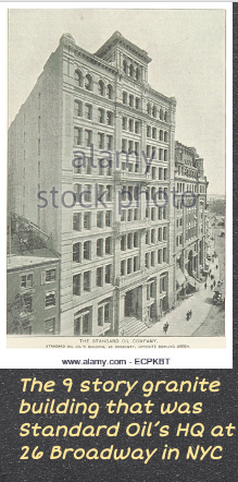
In late-1883, Rockefeller started to assemble real estate holdings in Manhattan on Broadway, basically on property where the home of Alexander Hamilton was located. After spending almost one million dollars, Standard Oil moved into their new opulent building on 26 Broadway, the nine story granite building became the world's most famous business address. The relatively-grim exterior gave way to a dignified-yet-understated interior, which mirrored Rockefeller's personality.
Rockefeller delegated much and presided lightly and genially over his empire, invisibly asserting his will. In meetings, the quieter Rockefeller was, the larger his presence filled the room, which added to his mystique as an industrial genius. Rockefeller valued internal harmony among his chief executives, and often couched his decisions as suggestions or questions. Rockefeller operated by gaining consensus, rarely making outwardly unilateral decisions, which meant few missteps since every contingency had been analyzed. And somehow, Rockefeller accomplished all this despite the incredibly restrictive interstate laws concerning corporations, in that a corporation could only legally exist in one state.
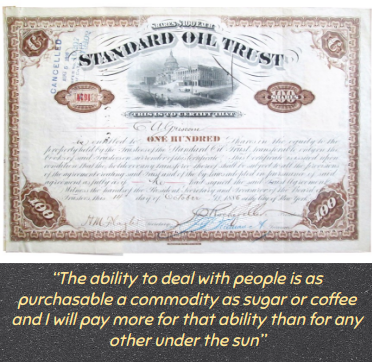
The general trend in big business after the Civil War was from freewheeling competition, to loosely-knit cartels, and then to airtight trusts. Oil prices wildly fluctuated with competition, but with the Standard Oil Trust, prices were stable, due to its enforcement and managerial powers. Rockefeller was at first an entrepreneur when he entered the oil refining business, but as the landscape changed, Rockefeller became a managing genius; Rockefeller basically anticipated the climate change in big business.
Since Rockefeller never owned more than 1/3 of Standard Oil, he needed the cooperation of other people. Rockefeller understood that he needed to submerge himself in the complex layers of the Standard Oil Trust. The Standard Oil Trust introduced economies-of-scale that were impossible before 1882. Also, the quality of kerosene was improved, by-products were introduced, and costs across-the-board were cut.
Since Rockefeller never owned more than 1/3 of Standard Oil, he needed the cooperation of other people. Rockefeller understood that he needed to submerge himself in the complex layers of the Standard Oil Trust. The Standard Oil Trust introduced economies-of-scale that were impossible before 1882. Also, the quality of kerosene was improved, by-products were introduced, and costs across-the-board were cut.
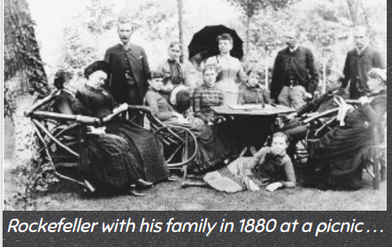
It was the Executive Committee that made all of that possible; they represented the 40+ companies that made up the Standard Oil Trust. Below the Executive Committee were specialized committees in such areas as pipelines, research-and-development, and efficiency (e.g. shutting down refineries), and incentives were created so the specialized committees actually competed against each other within the Standard Oil Trust. Rockefeller was always happy to purchase Standard Oil Trust Certificates from those willing to sell in that intra-competitive atmosphere.
Once Rockefeller made a decision on a specific goal, he pursued achieving it with all his skill, patience, and acumen. However, once Rockefeller made that decision, he was impervious and deaf to criticism, much like a rocket that could only keep going higher, never turning back as long as it still had fuel to burn.
Once Rockefeller made a decision on a specific goal, he pursued achieving it with all his skill, patience, and acumen. However, once Rockefeller made that decision, he was impervious and deaf to criticism, much like a rocket that could only keep going higher, never turning back as long as it still had fuel to burn.
 RSS Feed
