Mr. Jensen's U.S. History Website
  • U.S. History Blog
    • U.S. History Blog (May 2026 - May 2027)
    • U.S. History Blog (May 2025 - May 2026)
    • U.S. History Blog (May 2024 - May 2025)
    • U.S. History Blog (May 2023 - May 2024)
    • U.S. History Blog (May 2022 - May 2023)
    • U.S. History Blog (May 2021 - May 2022)
    • U.S. History Blog (May 2020 - May 2021)
    • U.S. History Blog (May 2019 - May 2020)
    • U.S. History Blog (May 2018 - May 2019)
    • U.S. History Blog (May 2017 - May 2018)
    • U.S. History Blog (May 2016 - May 2017)
    • U.S. History Blog (May 2015 - May 2016)
    • U.S. History Blog (May, 2014 - May, 2015)
  • About

Richard Nixon: April 1961 to February 1968

10/22/2016

0 Comments

 
            Source: Evan Thomas. Being Nixon: A Man Divided (2015)
Picture
      On 20 April 1961, President John F. Kennedy summoned former Vice-President and former Presidential candidate Richard Nixon to the White House, seeking his advice on the Bay of Pigs fiasco. Entering the Oval Office, Nixon was shocked to see a "beaten, very wan, tired, harassed" JFK . . . Nixon recalled that JFK said "s@#$" six times while pacing. JFK asked Nixon what he should do; Nixon, and interventionist and internationalist to the core, told JFK that he needed to remove Castro from power in Cuba. JFK was reluctant to directly do so, but a very flattered Nixon told JFK that he would support him no matter what the President decided.
     
​     Nixon's passion and devotion to politics was renewed and re-energized by his visit with JFK. Party inspired by something JFK said during the visit, Nixon wrote a book titled Six Crises, in which Nixon was remarkably candid about Alger Hiss, the "Checkers Speech", and his loss to JFK in 1960. Again and again, Nixon struggled with how to reconcile his introverted nature with the necessity of being an extrovert in order to be successful in politics.
     Writing the book was mentally and physically taxing, in that Nixon again became worn down and lost 10 pounds. Nixon was living alone in an apartment in Los Angeles, then after a bit he rented a house in order to enhance the writing process . . . while he was writing the book, Nixon was technically working for a law firm, which provided necessary income.
Picture
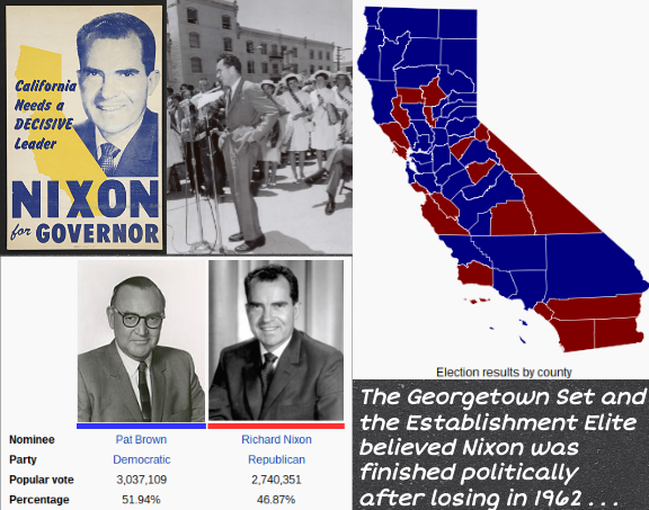
​     Even though Nixon was an introvert, he still became lonely and bored, in large part because he missed the political arena and the public stage. Soon after the Election of 1960, Nixon decided to run for Governor of California. Even before he announced his intention to run, Nixon was ahead of the incumbent Democratic Governor in the polls. On 25 September 1961, Nixon told his family that he was running; Pat thought it was a colossal mistake, but she promised to campaign by his side as usual. 
     
​     Nixon was oddly flat while campaigning against a conservative Republican challenger as well as Edmund G. "Pat" Brown, the Governor of California. By the fall of 1962, Nixon was trailing Brown in the polls, and needed a debate against the Governor to try and catch up. On 1 October 1962 in San Francisco, Nixon debated Brown. A question was asked specifically to Nixon that dealt with the behavior of his (idiot) brother, who was trying to cash in on Nixon's celebrity with the "Nixon Burger". Time and again, Nixon was in a no-win situation in terms of the questions he had to answer compared to Brown, who kept getting relatively easier questions. 
     A Los Angeles Times reporter went after Nixon hard every time he claimed that Brown was soft on Communism. Dick Tuck, the dirty trickster hired by JFK/RFK to harass Nixon during the General Campaign of 1960, was doing so again, this time on behalf of Brown (and indirectly for the Kennedys). After the debate, Nixon knew he was going to lose, in part due to the unfair treatment by the California press, but also due to the Cuban Missile Crisis . . . whatever momentum Nixon had by early-October was halted-or-reversed by Election Day.
Picture
     During the Cuban Missile Crisis, JFK sent a jet to California to fly Governor Brown to Washington, D.C. to "consult" on the crisis. Doing so was an outrageous political stunt to boost the Democratic Governor in the polls; to Nixon, it was yet another dirty trick he had to add in the already bulging dossier of grudges against the Kennedys. 
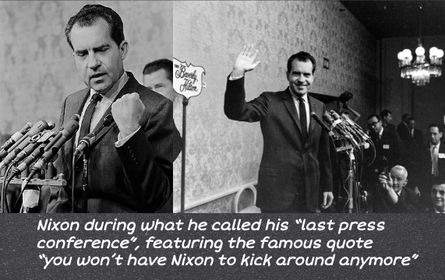
     The morning after he lost the election to Brown, Nixon decided to confront the reporters who had antagonized and mistreated him during the campaign. During what he called his last
press conference, Nixon told the media how much they'll miss not having "Nixon to kick around anymore". The sadness of his loss in California and the aftertaste of the press conference stayed with Nixon for years, according to his daughter, Tricia.
     The Establishment press wrote Nixon off for good. ABC aired a show titled "The Political Obituary of Richard Nixon" hosted by Howard K. Smith, featuring Alger Hiss as a special guest. Three months later, Nixon was again audited by the IRS, as he was in 1961 and 1962. Nixon blamed Attorney General Robert Kennedy for the abuse, which meant more items were filed in his Kennedy dirty tricks ledger. Not long after the Assassination of JFK, Nixon decided to move to New York City in order to make a clean break from politics, but still be part of the action.
     Nixon joined a reputable law firm (but not one of the city's elite) where he was made a temporary partner; among the partners was Leonard Garment, who would remain connected with Nixon all the way through Watergate and beyond. Nixon learned to appreciate the telephone even more as his favorite method of communication and persuasion; the phone allowed Nixon to concentrate on the words instead of appearances and social niceties/graces. 
Picture
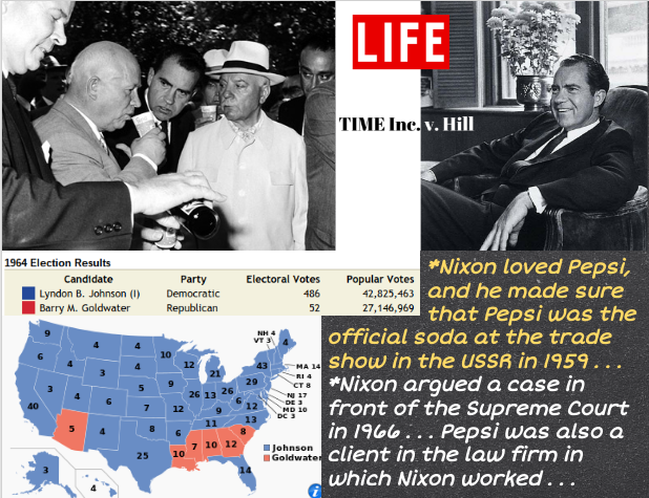
​     Nixon and Garment, while not identical in terms of personality, were both curious and restless and enjoyed each other's company. One of Nixon's contributions as a temporary partner was to line up Pepsi as a client for the firm. But Nixon's greatest moment as temporary partner occurred on 27 April 1966, when he argued a First Amendment case in front of the Supreme Court. 
     The Supreme Court case was Time, Inc. v. Hill: Time was accused of sensationalizing a home invasion suffered by the Hill family. Nixon delivered an excellent oral argument, but the   Supreme Court ruled against Nixon and the firm. Nixon viewed the result as another press conspiracy against him; Nixon told Garment that he never wanted to be reminded of the case.
Nixon believed that he should always look forward, but he constantly dwelled on the wounds from his past. 
     
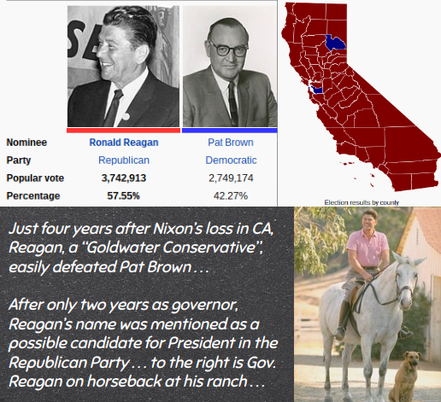
​     By 1965, Nixon decided to make another play for President in 1968, and to do so, he needed to get back in the political arena. Nixon campaigned hard for Republican candidates in the Congressional Elections of 1966, and by doing so not only became politically visible again, but also earned many political chits in the process. After Goldwater's disastrous campaign in 1964, Nixon wanted to bring the Republican Party back towards the center. As Nixon campaigned for others, it became clear that he was a hawk in Vietnam, but moderate on social policy. Nixon also accepted the reality of "Big Government", but he wanted to see it trimmed down at least somewhat.
Picture
     On Election Night, 6 November 1966, the Republicans gained 47 seats in the House, 3 in the Senate, and 8 Governors. Nixon had backed winners in many states, and in almost 80 Congressional districts where he campaigned. On the day before Thanksgiving in 1966, Nixon was told by his fundraiser advisers that it was time to make the move for President (one of Nixon's "Money-Men" was Maurice Stans, who would be significant during Watergate). Nixon was advised that the time was now to head off the Liberal Republican Nelson Rockefeller and the Conservative Republican, Governor Ronald Reagan of California.
     But in early-1967, Nixon declared a personal "moratorium" on politics: Nixon didn't travel, make speeches, raise money, woo Republicans, or earn political markers for later use. Nixon's timing was beyond-shrewd, in that 1965 - 1967 featured political anger nationwide in the extreme. The Harris Polling Organization created an "Alienation Index" in order to measure public anger . . . and the results were off-the-charts. Politicians other than Nixon tried to ride the waves of anger without getting rolled, and largely failed while Nixon remained upright offstage. 
Picture
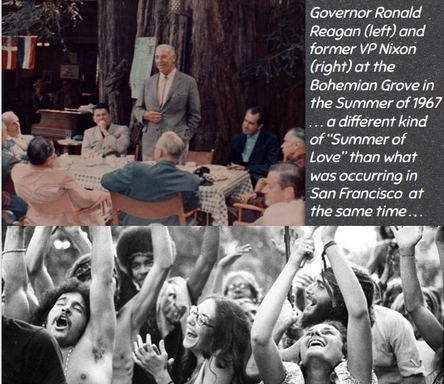
     In 1967, Nixon was once again invited to the Bohemian Grove, this time for a de facto audition to prove his Presidential bonafides to the powerful members. On a wall over the bar at one of the many camps at Bohemian Grove was a photograph of Ike surrounded by a group of admirers, while Nixon sat alone (as usual) across the table. But this time, Nixon wasn't a supplicant, but the center-of-attention. Nixon considered his speech in July 1967 to the members at the Bohemian Grove as his best, in large part due to the fact that there was no real media coverage. Nixon's words were a soothing tonic to those in attendance that felt incredibly threatened by the turmoil in America . . . the non-Elite Nixon had won the blessing of some powerful Establishment Elites.
     According to Leonard Garment, Nixon's yellow pad was his "best friend" . . . Nixon loved to analysis and strategy. On 22 December 1967, after the traditional Nixon Christmas Party, the yellow pad came out, and Nixon wrote down all the reasons why he should NOT run for President. The ambition was still there, but Nixon feared humiliation, and worse, no future in politics, and therefore no purpose in his life if he ran and lost again. Nixon went to Key Biscayne to spend "quiet time" with his best friend, BeBe Rebozo, and the Reverend Billy Graham was there as well, recovering from a lung infection. Simply put, Nixon viewed himself as a Man of Destiny, despite his faults, at least the ones that he actually acknowledged to himself. Nixon was never much into self-analysis, which Nixon believed was weak and phony . . . Nixon's greatest fear was to be thought of as weak.
Picture
     As Nixon pondered his run for President in 1968, he was drawn to the persona of one of the law firm's partners, John Mitchell. Nixon put Mitchell on a pedestal, believing that Mitchell represented everything he admired in a man (especially compared to the intellectual "Eggheads" and the Georgetown Set). Nixon knew he made a colossal mistake in 1960 when he tried to be his own campaign manager; Nixon asked Garment to see if Mitchell would be interested in running his campaign in 1968. Mitchell told Garment that he was interested, but he wasn't quite what he appeared to be, in that Mitchell had mislead many people concerning his background (e.g. claiming to have known JFK during WW II). Also, Mitchell was married to an unpredictable woman, Martha Mitchell, who was not only a social-and-political liability, but also caused Mitchell to drink more.
    
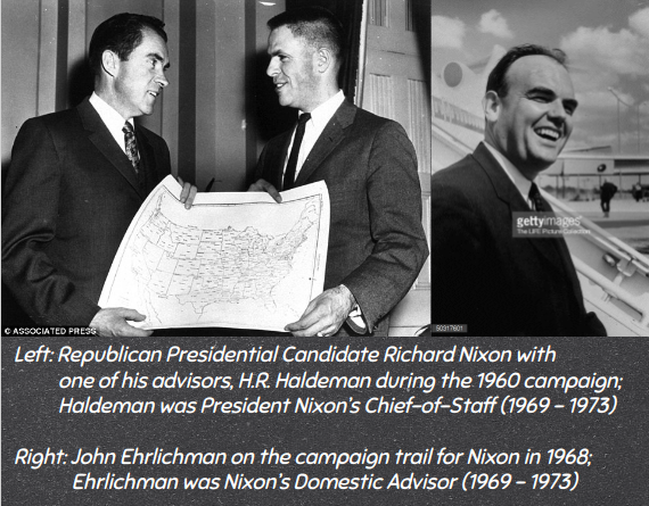
​     Nixon liked to be surrounded by vigorous-and-loyal young men, and his "Body Man" that kept Nixon apart from the rank-and-file, and that charmed those that needed to be charmed was Dwight Chapin. Chapin had the graces of an Ivy Leaguer (he was at USC) without the attitude, and was drawn to Nixon, and was willing to put up with Nixon's rare outbursts and many quirks. Chapin was the extension of the Nixon campaign's Chief-of-Staff, the handsome-and-chilly H.R. Haldeman, whose job was to basically be Nixon's "S.O.B.". As time went on, Haldeman would spend more waking hours with Nixon than anyone else, including his wife Pat.
     Haldeman was a Nixon volunteer in 1952, an "Advance Man" in 1956, and by the early-1960s he was in Nixon's "Circle of Trust". Haldeman's right-hand man was John Ehrlichman, who had worked for Nixon as a mole in Nelson Rockefeller's campaign in 1960. Both Haldeman and Ehrlichman were Christian Scientists, and they both brought discipline and a touch of arrogance to the Nixon campaign. With Haldeman and Ehrlichman, the "New Nixon" was a much colder politician . . . but also much "cooler" . . . 
0 Comments

Richard Nixon and the Election of 1960

10/8/2016

0 Comments

 
              Source: Evan Thomas. Being Nixon: A Man Divided (2015)
Picture
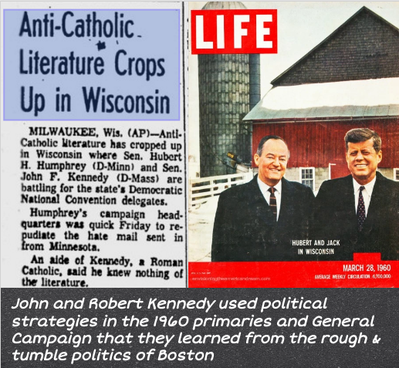
​     During the primary season, convention, and the General Campaign in 1960, Nixon was at his most noble and his most ignoble. On 16 July 1960, Nixon watched JFK gave his acceptance speech on television at the Democratic National Convention in Los Angeles, and he believed that JFK would be vulnerable on a televised debate. By then Nixon had found out about the "Kennedy Shenanigans" in the Wisconsin primary; John and Robert Kennedy sabotaged Hubert Humphrey's campaign with anti-Catholic literature postmarked from Humphrey's home state of Minnesota . . . Nixon put that information in his "never forget" file.
     Nixon made a major mistake in functioning as his own campaign manager, and ignored advice, foolishly promising to campaign in all 50 states. Very soon into the foolhardy venture, Nixon banged his knee on a car door (he was a tremendous klutz), and was hospitalized for two weeks with a serious staph infection that almost cost him his leg. Then, when Nixon tried to make up for lost time on the campaign trail, he developed a temperature of 103 degrees.
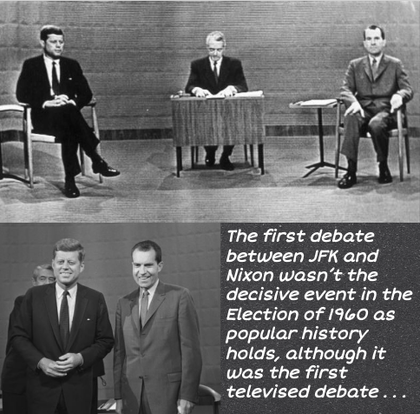
     Nixon arrived in Chicago just before midnight on 25 September 1960 for the first-ever televised Presidential debate with Kennedy. Nixon was still sick and exhausted, and had lost ten pounds. On the way to the studio the next day, Nixon again banged the same knee on a car door . . . Nixon was in agonizing pain wondering what could possibly go wrong next while JFK had spent the day sunning, napping, and listening to music.

Picture
     Before the first-ever televised Presidential debate, JFK looked great, and Nixon looked awful. JFK's political gamesmanship continued, when he tricked Nixon into thinking that he wasn't going to use makeup, which led Nixon to decide that he wasn't going to use makeup either (and then JFK went ahead and used makeup). Instead of makeup, Nixon had someone buy some Lazy Shave, a "shavestick" that would supposedly cover up Nixon's "5 O'Clock Shadow" . . . but it just created more of a disaster on Nixon's face when he was on television.
     Nixon and Kennedy were tied in the polls before their first debate, and 80 million Americans watched, the largest TV audience since Nixon's "Checkers" speech in 1952 and the Army-McCarthy Hearings in 1954. As later events would show, newsmen had been, and were doing the bidding of the Kennedys at Nixon's expense. While Nixon came across poorly on television during the first debate, Nixon more than held his own in the next three encounters with JFK. The debates were not decisive in the campaign
(despite what almost every news media outlet and political pundit has claimed), other than JFK being seen as a more mature leader as a result of the first debate . . . what really led to Nixon's defeat in 1960 occurred offstage.          
​                     
(Below: the entire first debate between JFK and Nixon)

Picture
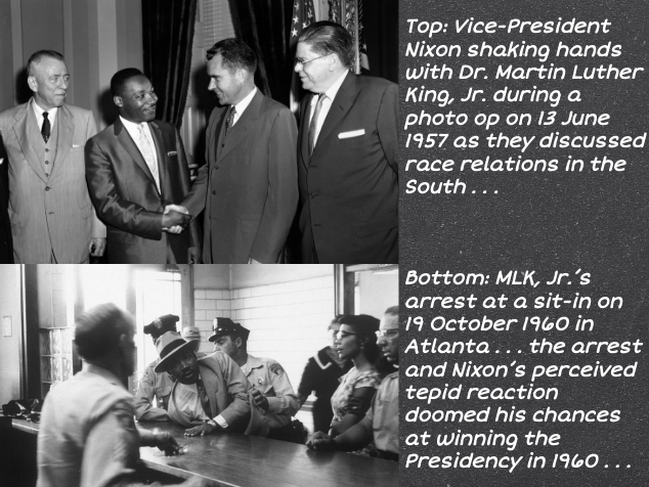
     Nixon was raised to never be a racist, and as Vice-President he was Eisenhower's point man on Civil Rights (not that popular history remembers). Nixon became friendly with Dr. Martin Luther King, Jr. on a trip to Africa in 1957, and Nixon was also friendly with Jackie Robinson. On 19 October 1960, MLK, Jr. was arrested at a peaceful protest in Atlanta. MLK, Jr. was sent to the state penitentiary in chains on an old charge of possessing an expired driver's license. 
     One of JFK's advisers, Sargent Shriver, convinced JFK to call Coretta Scott King, who was understandably concerned for her husband's safety and life, in order to offer his assistance (RFK was livid when he found out, but quickly figured out that he could use the situation for political advantage). JFK, and especially RFK, were active in gaining MLK Jr.'s release . . . and letting the media know that they did so (as did MLK, Jr. on his release). Nixon, however, feared white backlash in the South, and he tried to get the Eisenhower administration to announce that the Attorney General would investigate MLK, Jr.'s arrest. 
    
     If the release of MLK, Jr. from prison was a 45 rpm record, side one would be titled "JFK Called Mrs. King", while side two would be called "Richard Nixon Did Not". The shift among African-American voters to JFK from Nixon was swift and significant, especially in the industrial Midwest and Northeast, where JFK would win key states by narrow margins. Nixon learned that he had badly miscalculated only when it was far too late (he was apprised of the situation from his African-American driver). Nixon was surprised and upset that he had lost what he considered to be a hard-earned and rock-solid constituency with the African-American voting bloc.

Picture
     Characteristically, Nixon turned his disappointment into anger at the Kennedys for stealing the African-American vote, as well as other tactics. Nixon was upset that the media was so busy fawning over JFK in a love-struck fashion that no attention was paid to the Kennedy dirty tricks. Nixon had solid evidence that the Kennedy Campaign was paying what was called "Walking Around Money", hiring hecklers to harass Nixon campaign efforts, sending out negative and inaccurate literature under Nixon's name, changing street signs on the way to the location of Nixon rallies, and so on, and so on, and so on. 
    
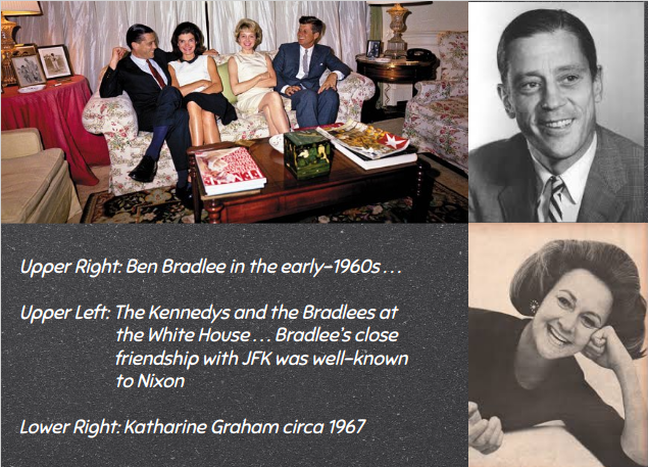
​     JFK lived very close and was friends with Ben Bradlee, at the time a Newsweek reporter (who became one of the great Nixon-haters at the Washington Post). JFK was also close to
Katharine Graham (soon to become the first female CEO in US History); Graham often threw parties for the Kennedys, and invited the Georgetown Set (of which she was part) as well as Establishment media figures as Walter Lippmann and James Reston. There wasn't a person at those parties that could stand the thought of a Nixon victory in the Election of 1960.
     Nixon couldn't possibly compete with JFK in the press, and reporters were often savage against him, their hatred and contempt open for all to see/read. Nixon's portrayal in the press had become so awful and distorted that he felt he had no choice but to suspend press conferences for the rest of his campaign for the Presidency.

Picture
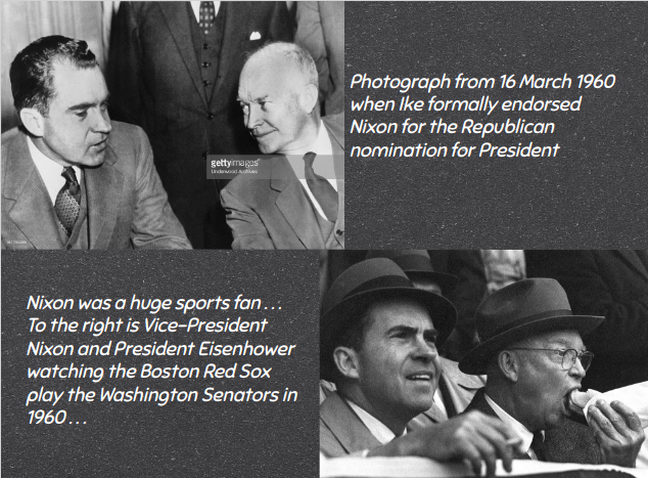
​     Once again President Eisenhower delayed in supporting his loyal Vice-President in his bid to succeed him in the White House. Ike had delayed endorsing Nixon during the primaries, and he didn't commit to actively campaigning for Nixon until well into the General Campaign. Interestingly, Nixon actually declined Ike's offer to personally campaign for him; Ike was still tremendously popular, and with Ike in Nixon's corner, that may have put him over the top against JFK. Ike didn't at all like being told no by someone he didn't consider to be a "winner". It turned out that the First Lady, Mamie, had begged Pat Nixon to tell her husband that Ike's health was poor, and campaigning may lead to disaster. 
    
​    Nixon, in politely declining Ike's offer to campaign on his behalf, acted and behaved nobly without explanation. What was at work as well was Nixon's near-pathological fear of personal confrontation, which not only cost him in the Election of 1960, but also when he was President. Others have argued that Nixon wanted to win the Presidency on his own without Ike's help so he could be his own "political man", which was probably true as well. 
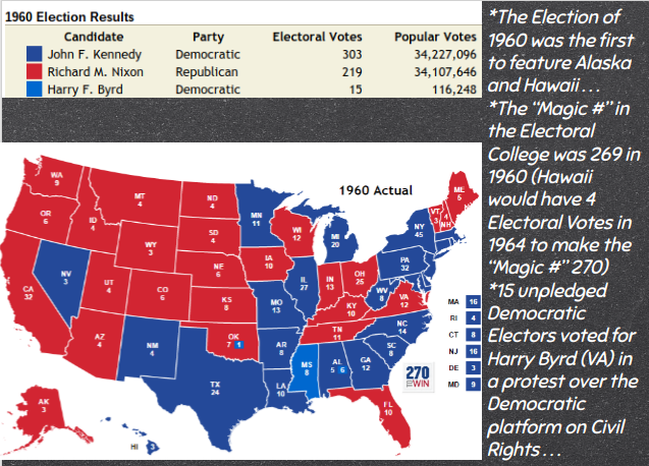
     Between the Republican National Convention and Election Day, Nixon traveled 65,000 miles and gave 180 formal speeches in his manic-and-foolhardy quest to fulfill his promise to campaign in all 50 states. In the end, three factors tipped the Election of 1960 to JFK's favor: first was Nixon losing far-too-many African-American votes due his far-too-passive pursuit in gaining MLK, Jr.'s release from prison. Secondly, JFK had 75% of the Catholic vote, which galled Nixon to no end, in that he believed the Kennedys made religion an issue to their advantage, while he never made being a Quaker a big deal at all. And third, there were nasty (and long since accepted as fact) rumors of shenanigans in Illinois (spearheaded by Mayor Richard Daley) and in Texas (led by JFK's running mate, Lyndon Johnson) . . . despite everything else, had Nixon won Illinois and Texas, he would have had 270 Electoral Votes, one more than what was needed (to be fair, there were Republican shenanigans in precincts in southern Illinois, so nobody really wore the halo of the politically righteous in 1960).

Picture
     Nixon vowed that he would never again enter an election at a disadvantage due to dirty tricks from an opponent. Example: the "Walking Around Money" from the Kennedy campaign featured large payments to African-American preachers and local politicians to make sure that people got out to vote for JFK.
    In Chicago, a switch of just 4500 votes would have given Nixon the state of Illinois and all 27 Electoral Votes. The charges against Mayor Daley were rampant (and again, have long since been accepted) of "Graveyard Votes"; in one mostly African-American precinct, there were more votes cast for JFK than there were people living in the district. Leading Republicans such as Senator Everett Dirksen (Ill) urged Nixon to challenge the results in Illinois and Texas. 
    
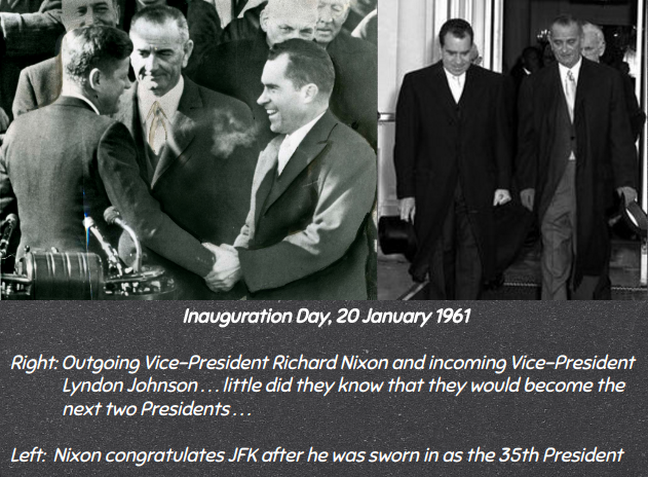
​     By mid-December 1960, Nixon had confirmed what he had originally thought: challenging the results would make him look like a sore loser while placing a cloud over JFK's Presidency (as well as forever disqualifying him for a future run as President). Even before then, Nixon met with JFK on 14 November 1960 at the Key Biscayne Hotel; JFK was extremely worried that Nixon would challenge results in states such as Illinois and Texas. Once again Nixon did the right and honorable thing, showing grace when in an awkward situation . . . Nixon told JFK that he needn't worry about any challenges . . . as far as he was concerned, the election was over. On 6 January 1961, in his last official function as Vice-President, Richard Nixon presided over the Electoral College vote, and announced the official results of JFK 303, Nixon 219, and Senator Harry F. Byrd (VA) 15 . . . ironically, Byrd was never a candidate for President, but received anti-Civil Rights "protest" votes from Democratic Electors.
            Below: Before JFK had to campaign against Nixon, he had to deal with
                     LBJ for the nomination of the Democratic Party for President

0 Comments

Vice-President Richard Nixon (1953 through early-1960)

10/7/2016

0 Comments

 
              Source: Evan Thomas. Being Nixon: A Man Divided (2015)
Picture
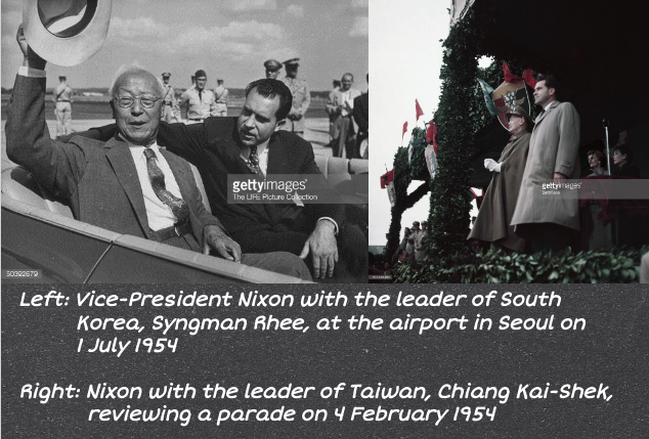
     President Dwight Eisenhower ran a "Hidden Hand" Presidency, in that he let Vice-President Richard Nixon (and others in his administration) take significant public roles, and when necessary, do the "dirty jobs" . . . Nixon wasn't a mere appendage for Ike. Nixon's first major mission as Vice-President was to make official visits to Chiang Kai-Shek, the leader of Taiwan, and Syngman Rhee, the leader of South Korea. Both leaders were rattling their sabres concerning their communist neighbors, and Nixon skillfully handled them.
     Nixon didn't like personal confrontation, but delivering a message from the President was very different. Nixon loved politics, the exercise of power, and finding ways to get things done. Nixon was absolutely thrilled to be acting on such an exalted and global stage, and the trip to Asia not only put him on the world stage with major actors, but also established him as an expert on foreign policy.
    
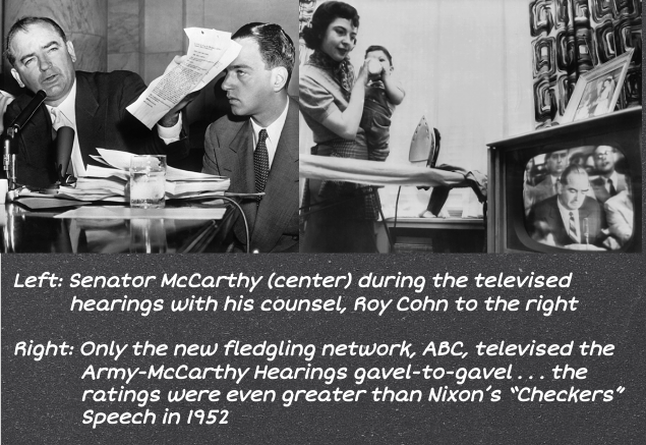
​     Nixon was Eisenhower's main "hit man" against Senator Joseph McCarthy. Nixon dealt with McCarthy face-to-face, but Ike also wanted Nixon to go on television and "ding" McCarthy without alienating anti-Communist conservatives . . . and to smile while doing so. Nixon often compared hunting Communists with rat hunting: one better shoot straight and play fair, because if one doesn't, the rats will escape, and innocent people may be hurt. Nixon was the straight shooter, while McCarthy was shooting indiscriminately, ruining reputations and lives of innocent Americans. 

Picture
     The press took notice of the difference, acknowledging that Nixon's bonafides versus Communism matched/exceeded those of McCarthy. Finally, in 1954, McCarthy brought himself down on national television, falling into Ike's trap during the Army-McCarthy Hearings (Ike and his beloved Army proved that McCarthy was nothing more than a cowardly bully on TV). 
    
​     
​     While Ike was vacationing during the Congressional Elections of 1954, Nixon campaigned hard for Republicans, traveling 26,000 miles in 6 weeks, visiting 95 cities in 30 states and speaking on behalf of 186 Republican candidates while Ike mostly took it easy and golfed, which galled Nixon (but he wisely kept quiet). What also galled Nixon was that he knew the Georgetown Set derided Nixon during their social gatherings, much like JFK's "Camelot Set" did with Vice-President Lyndon Johnson in the early-1960s. 
     As a result of the Congressional Elections of 1954, the Republicans lost control of both the House of Representatives and the Senate, and Nixon was despondent. Nixon had long had a nasty habit of wallowing in self-pity, and he believed that Ike may think his Vice-President didn't come through when it counted. But Nixon also had the habit of looking forward to future challenges, which would come in very handy soon enough.

Picture
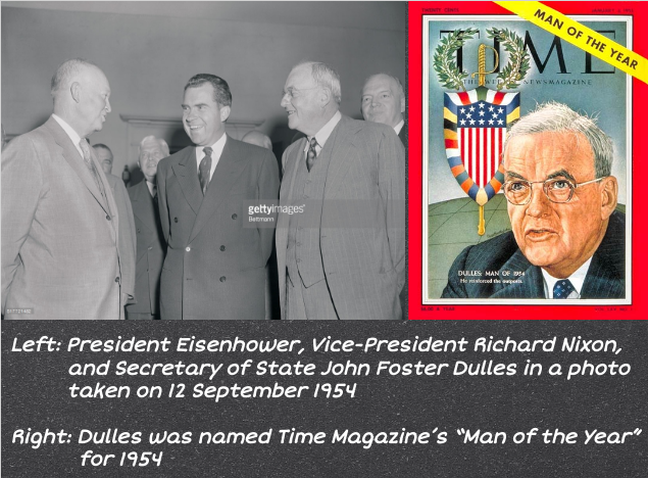
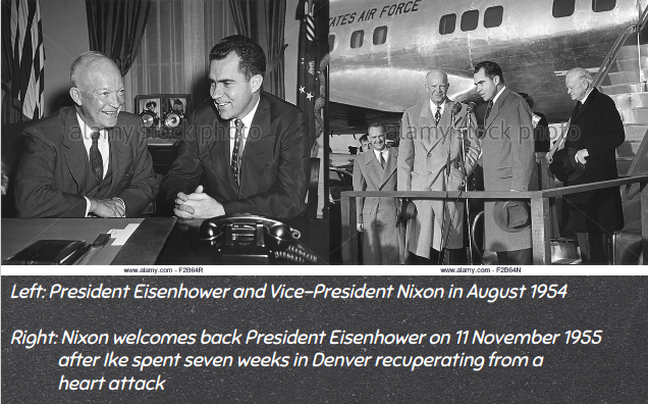
     On 24 September 1955, Nixon received a phone call informing him that President Eisenhower had a heart attack. While Ike was recovering in Denver, Nixon understood that he was "walking on eggshells" in Cabinet meetings . . . Nixon (like Bush after Reagan was shot) intuitively understood that he should run Cabinet meetings from his Vice-Presidential chair rather than the President's chair. Secretary of State John Foster Dulles was Ike's #1 man in his administration, and Nixon was very grateful that he and Dulles worked well together. 
     
​     
​    Nixon had spent time with Dulles on numerous social occasions, and both were socially awkward. During their discussions, Nixon learned more about foreign policy while Dulles learned more about politics. As Ike was recovering, Nixon and Dulles kept the U.S. Gov't on course with minimal disruption, and thankfully the Cold War was at an ebb. Relatively speaking, Nixon was able to advance his political standing while Ike was recovering, showing that he indeed was made of Presidential timbre.

Picture
     Soon after Ike's return, the President and his Vice-President had a chat. It was clear to Nixon that Ike wanted another Vice-President; Ike floated the idea that it would be a good move if Nixon accepted a Cabinet post, such as Secretary of Defense. This discussion was the first of many in which Ike suggested that Nixon take another position during his 2nd term. Ike kept saying that the decision was Nixon's, but Nixon dug in, and during one meeting courageously told Ike that the decision was actually the President's to make, and that he would do what the President wanted.
     
     These discussion were deeply demoralizing for Nixon. Ike believed that a post such as Secretary of Defense would help the younger Nixon gain political seasoning, but Nixon saw options such as SecDef as a significant public demotion. Ike told the media that the decision was Nixon's, and Nixon's health started to suffer (both real and imagined). Nixon prepared a media release which stated, in essence, that he would not be Ike's running mate in 1956. But Pat, despite being tired of being a politician's wife, urged him to fight for his rightful place on the ticket, knowing that private life would be a de facto "living death" for her husband.
​     Again Nixon went to the only Establishment Elite in Washington, D.C. that he trusted, "Princess Alice" Roosevelt Longworth (TR's daughter). "Princess Alice" told Nixon that in the New Hampshire primary, he was receiving many write-in votes for Vice-President (which had been orchestrated by pro-Nixon Republicans in New Hampshire). What President Nixon would call the Silent Majority in the early-1970s sent a message to Ike, and Ike got the message, and he kept Nixon as his running mate. Soon afterwards, in a private meeting, Ike wanted to know why Nixon took so long to decide whether-or-not he wanted to remain as Vice-President . . . yikes!!!

Picture
     Nixon disliked (hated would be a better word) personal confrontation of any kind, but he seemed to like PUBLIC confrontation. Nixon was fearless in taking on hostile crowds when campaigning or representing the President on official business. Once again, Nixon was enjoying being out on the hustings, and even though he was cynical about voters, he identified with them more than most other national-level politicians. A metaphor is useful in describing Nixon the Campaigner: Nixon's fear of heights made him an excellent cliff diver. 
    
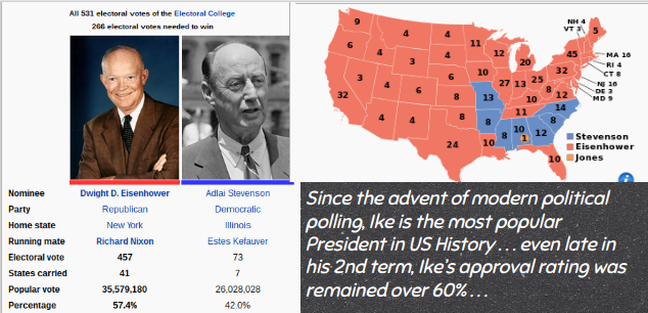
    Eisenhower and Nixon were re-elected in a landslide in 1956, and Ike continued to use Nixon as a "forward observer", sending his Vice-President abroad to scout out trouble spots and to report back. Nixon was very frustrated that he wasn't able to campaign for fellow Republicans during the Congressional Elections of 1958, in that Ike wanted Nixon to tour South America. Nixon faced dangerous crowds in Argentina and Venezuela, never backing down (he was in very serious danger in Venezuela with a hostile crowd that surrounded his car). 
     When Nixon returned to the U.S., he was seen as a heroic figure, a popular hero to most Americans. In July 1959, Nixon made his first trip to the USSR, with the memory of Sputnik still fresh in the minds of Americans. During his lengthy preparation for the trip, Nixon was introduced to Henry Kissinger, a prodigy of international security, and a "Harvard Man" . . . their future political marriage would be very significant in the late-1960s / early-1970s.

Picture
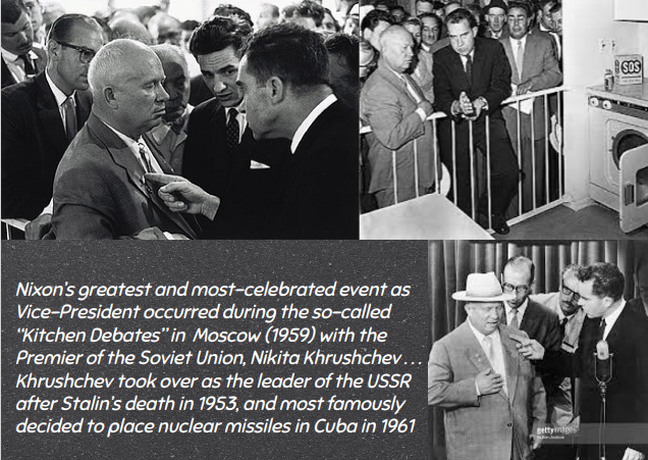
     On 22 July 1959, Vice-President Richard Nixon arrived in Moscow, and his first encounter with the Premier of the Soviet Union, Nikita Khrushchev, wasn't stellar. Nixon tried to be statesmanlike when they were taken to a trade fair, where they stopped at a TV studio built by RCA (Radio Corporation of America) to show the novelty of color TV to the Russians . . . Nixon felt that he allowed himself to be browbeaten by Khrushchev.
     
​     
​    The the "Mobile Debate" moved to a different set in the trade fair, an ultra-modern American kitchen. Nixon rallied and hit Khrushchev back in measure fashion, standing up to the Soviet leader with the world's media watching . . . Khrushchev figured out that he couldn't bully America's Vice-President. Nixon was granted the unprecedented opportunity of addressing the citizens of the USSR on state television. By standing up to Khrushchev in what became known as the "Kitchen Debate", Nixon showed his global mettle; Nixon kept his cool while Khrushchev blustered and ranted, and he didn't allow himself to be bullied.
     The trip to the USSR in 1959 was a tremendous confidence-builder for Nixon, and he showed that he was ready for the "Big Time" . . . Nixon had found his confident political identity. The "Kitchen Debate" was widely reported back in the U.S., and it was a turning point for Nixon, and he started to focus on getting ready for the Republican nomination for President in 1960 . . . 

0 Comments

Richard Nixon: U.S. Senator & Vice-President Elect (1949 - 1952)

10/2/2016

0 Comments

 
              Source: Evan Thomas. Being Nixon: A Man Divided (2015)
Picture
​     By 1949, Congressman Richard Nixon realized that in the House he was a "comer with no place to go". Although Nixon had thought about running for the Senate, he didn't decide until his most powerful ally, the editor of the LA Times, suggested that he run. The backing of the LA Times was of major benefit to Nixon, in that it meant no significant challengers in the primary as well as access to deep-pocket contributors.
    
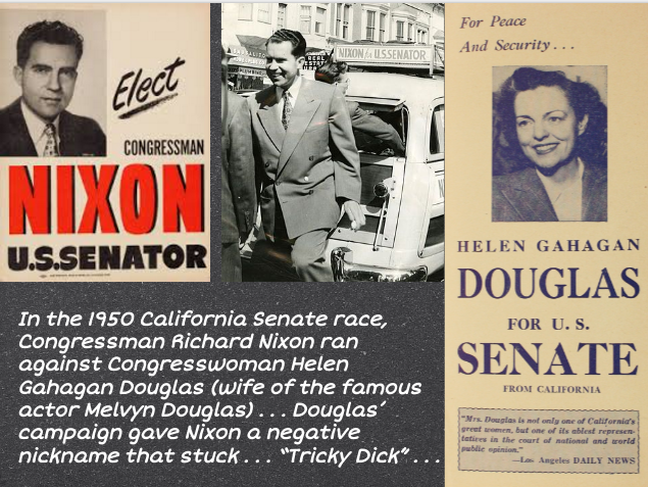
​     On 3 November 1949 Nixon formally announced that he would run for the U.S. Senate from California. Nixon packaged himself as the "Champion of the Forgotten Man", and his campaign slogan was a "Fighting, Rocking, Socking Campaign". Nixon's opponent was Congresswoman
Helen Gahagan Douglas, who was a former actress and was married to the actor Melvyn Douglas. Douglas was very liberal, and an added benefit for Nixon was that she wasn't a very good politician or campaigner. Douglas' Democratic opponents had already labeled her "The Pink Lady", as well as "Pinko" and "Red Queen", and Nixon's campaign used the same labels and tactics. 
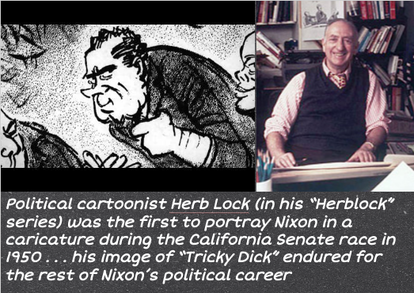
     Douglas slung back at Nixon indiscriminately; she actually attacked Nixon as being soft on Communism. Nixon's campaign put out the "Pink Sheet", attacking Douglas with a pink pamphlet that was sent throughout California. An increasingly desperate Douglas labeled Nixon as "Tricky Dick" . . . that negative nickname stuck with Nixon for the rest of his political career.

Picture
     Nixon mostly had a good time on the hustings (campaigning), driving 10,000 miles with his wife, Pat. While Nixon wasn't a great presser-of-the-flesh, he had an amazing memory for names. Nixon had thousands of note cards with names and details for each person. Nixon often astounded local politicians by calling them by their names while speaking to crowds. 
     On Election Day, 7 November 1950, Nixon was sure that voter turnout would be low and that he would lose (perhaps Nixon's greatest flaw was wallowing in self-pity, even when things were going well). But Nixon won in a landslide by over 20% of the vote, which was the largest margin of victory in the 30+ Senate races in the Congressional Elections of 1950. Nixon was only 37 years old, and was already a U.S. Senator from one of the most powerful states. However, among the Eastern Establishment, "Tricky Dick" became an object of derision. Herb Lock, a political satirist and cartoonist in the Washington Post, created a caricature of Nixon that featured dark jowls, a ski-jump nose, and beady eyes. Prominent Establishment magazines seemed to delight in poking fun at Nixon as a morality-free parvenu (a person of obscure origin that has gained fame and/or wealth). 
     These Establishment magazines were small in circulation, but were influential among intellectuals and academics, especially for "Ivy Leaguers". Georgetown society (the "Georgetown Set", among them was Katharine Graham, the first female C.E.O. in US History) became the most powerful and vocal against Nixon. In Nixon's mind, the Georgetown Set became "Enemy #1" . . . Richard and Pat Nixon weren't social outcasts, but getting to be included among the DC Elites (a.k.a. the "Swells") wasn't easy.

Picture
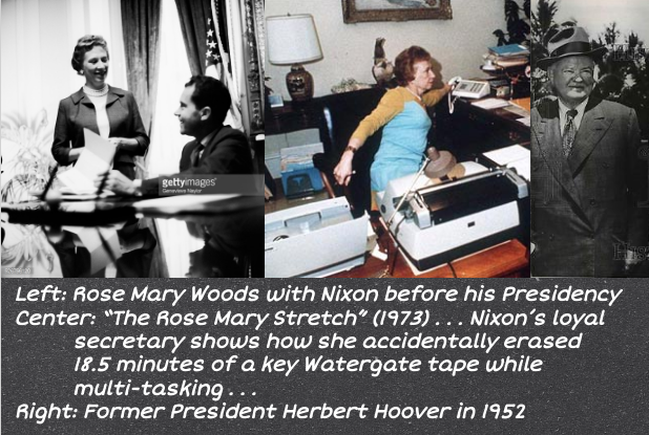
     Nixon's secretary on Capitol Hill was Rose Mary Woods ("Aunt Rose" to the Nixon family), who was smart, tough, tight-lipped, and fiercely loyal . . . she would be with Nixon until his resignation as President on 9 August 1974. Nixon was invited to Miami in December 1951 by Democratic Senator George Smathers, and in Miami Nixon was introduced to Charles "BeBe" Rebozo, who would become Nixon's closest friend. Rebozo made his fortune in real estate, and like Nixon was at heart a lonely man. Both men had to work hard at being part of a crowd; they found comfort and companionship in each other's company and silence. 
    
​      Nixon first saw Dwight Eisenhower during his homecoming parade after World War II. The second time Nixon saw Ike was when, as a member of the Herter Committee, Ike briefed the members on aspects of the Marshall Plan in Europe in 1948. The third time was when Nixon was invited to the beyond-exclusive Bohemian Grove, which was a two week closed retreat with some of the nation's most powerful men. Nixon was invited by former President Herbert Hoover, and Ike was there as well, basically being "checked out" by the Club as to his Presidential timbre. The fourth time Nixon saw Ike was in Europe during May 1951, where Ike personally told Nixon that he was impressed that he had got Alger Hiss "fairly". At that point, Nixon was an "Eisenhower Man", and by the spring of 1952, Nixon was hearing rumors that he might be Ike's Vice-Presidential running mate if Ike won the nomination at the
Republican National Convention.
​

Picture
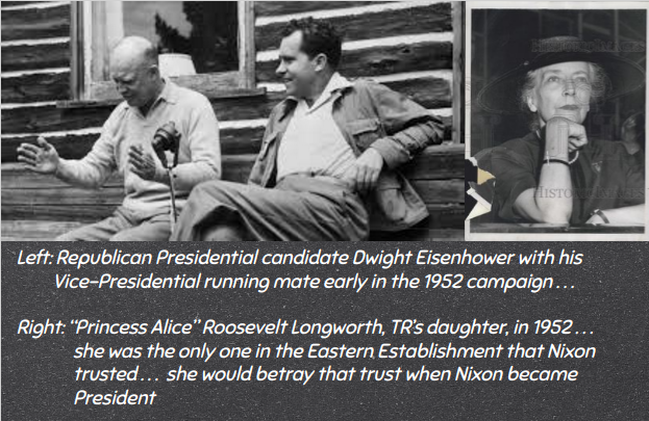
     Thomas Dewey, one of Ike's top backers (and Republican Presidential Candidate in 1944 and 1948), wanted Nixon as Ike's Vice-President, which was key in leading Ike down the path of selecting Nixon. Nixon, knowing he was in play for Ike's VP slot, wanted advice, and there was one member of the Eastern Establishment Elite the he liked, trusted, and admired: TR's daughter "Princess Alice" Roosevelt Longworth. Alice had attended the Hiss hearings, sitting in the front row, rooting for Nixon the entire time. "Princess Alice" liked troublemakers and people that stirred things up. FDR had banned her from the White House in 1940, and by 1952, she was an unabashed admirer of Senator Joseph McCarthy. Despite the obvious social gulf between them, Alice admired Nixon, and personally told him to be prepared to be Ike's Vice-Presidential running mate. 
    
​     Nixon was indeed selected to be Ike's V.P. and he was summoned to meet Ike at his hotel. Nixon's attempt at bonhomie fell flat when he entered the room and greeted Ike with a hearty "Hi Chief"; Ike, like George Washington, harbored a certain reserve, and didn't appreciate informality. Nixon and Ike tried to bond at least somewhat (e.g. fly fishing, golf), but to no avail, largely because Nixon was an incredible klutz, and Ike only had so much patience. 
     Nixon's role in Eisenhower's Presidential campaign was to be the one on the attack against the Democratic candidate, Adlai Stevenson, so Ike could be "above the fray". Nixon was performing a part, but he enjoyed campaigning in that manner. Soon, however, a headline would bring about the greatest political crisis that Nixon had experienced to that point . . . the headline from the New York Post read: "Secret Nixon Fund!" with the subheading "Secret Rich Man's Trust Fund Keeps Nixon in Style Far Beyond His Salary". 

Picture
      At first Nixon wasn't worried, since the New York Post had a salacious reputation, and it was common knowledge that Nixon had a permanent campaign fund of $18,000 ($160k today) from private donors so Nixon could meet travel expenses. The fund wasn't a secret, and Nixon didn't use the money for personal benefit. The New York Herald Tribune ran an editorial that called for Nixon to step down as Ike's VP running mate, and that headline grabbed Nixon's attention, since that paper was an ally during the Hiss hearings and a traditionally Republican publication. Nixon thought the editorial could very well reflect Ike's thinking, and soon afterwards, Ike called Nixon, telling Nixon that he, not Ike, would have to decide what to do.
   
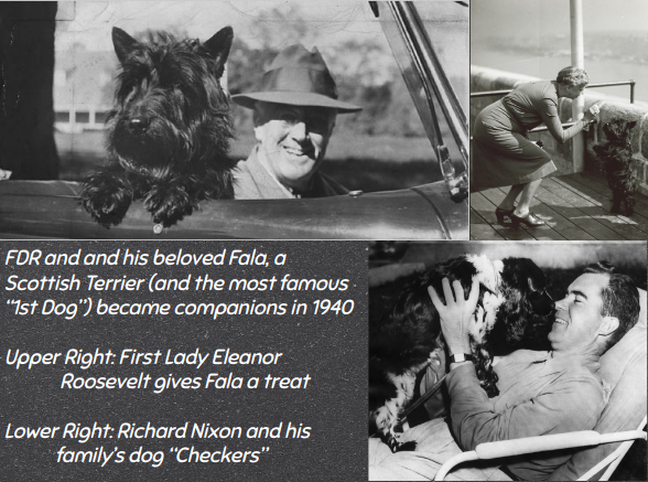
​     Ike suggested to Nixon that he use national television to make his case, which Nixon had also considered. Nixon wanted to know if he could have immediate and public support from Ike after his televised speech, and Ike held firm that he would wait a few days to see which way the wind was blowing. Nixon deliberated and thought, and then recalled that FDR in 1944 effectively ridiculed his Republican enemies using his beloved Scottie Fala. So, Nixon had his strategy, but he also knew that he and Pat would have to endure public scrutiny of their finances, which would show the nation (and the Establishment) how little they had in terms of assets relative to their debts. Nixon did not like the reality that he would lay bare his and Pat's relative pauperism to the Georgetown Set and the Establishment Elite. But most galling to Nixon was that Stevenson had the exact same campaign fund, but the press treated him with kid gloves.

Picture
​     In preparing for the televised address, Nixon was troubled-yet-thrilled, in that he was experiencing politics in the extreme, and he stood alone as the world watched. Republican officials paid $75,000 for 30 minutes of airtime on NBC at 8:30 pm Central time. Before Nixon went on television, Dewey called, informing Nixon that Ike and his supporters expected Nixon to announce during the broadcast that he was stepping down as Ike's Vice-President. Nixon was blunt,  telling Dewey that it was too late to make that kind of recommendation.
     
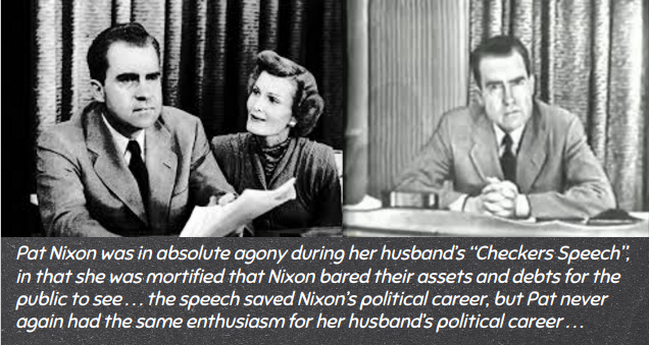
​     In what became known as the "Checkers Speech" (Nixon called it the Fund Speech), Nixon stated that the only gift that he or his family had ever accepted was a puppy that his daughters loved, and had named "Checkers". Nixon touted his success with exposing Alger Hiss, and stated that he wasn't a quitter. Nixon also discussed his finances, including debts, and closed with saying the decision whether he remained Ike's VP wasn't his, it was America's decision. 
​     After Nixon's speech, the verdict was unanimous within the Georgetown Set and the Establishment: Nixon was hammy, hokey, holier-than-thou, full of self-righteous pity and guilty of emotional fraud. Yet for most of America, Nixon's televised address was brilliant political theater; Nixon knew that the Establishment Elites would make fun of him, but the Average American would be moved. It's no wonder that hating Nixon became an obsession with the Liberal Elite, since he outfoxed them once again.

Picture
     Nixon's "Checkers Speech" was the origin of his later appeals to the what he would eventually call the Silent Majority, which would again leave the Establishment Elites (both Democrat and Republican) sputtering. Those with Ike that watched Nixon felt the same way as the Georgetown Set, but once Ike saw his wife Mamie crying during the broadcast, he knew he would (have to?) keep Nixon as his Vice-Presidential running mate. 
     Nixon's speech was the most-viewed telecast ever to that point on television, and it was a huge ratings smash on radio as well. Once Nixon returned to his hotel, he saw the torrent of support; Ike had sent a glowing telegram, but it was lost among the throng of the other telegrams, and Nixon was crestfallen that he didn't receive any positive feedback from Ike. Very soon after the speech, Ike summoned Nixon to meet him on board his train that was at
Wheeling, West Virginia. Ike told Nixon that "you're my boy", and they campaigned together for a brief time.
      
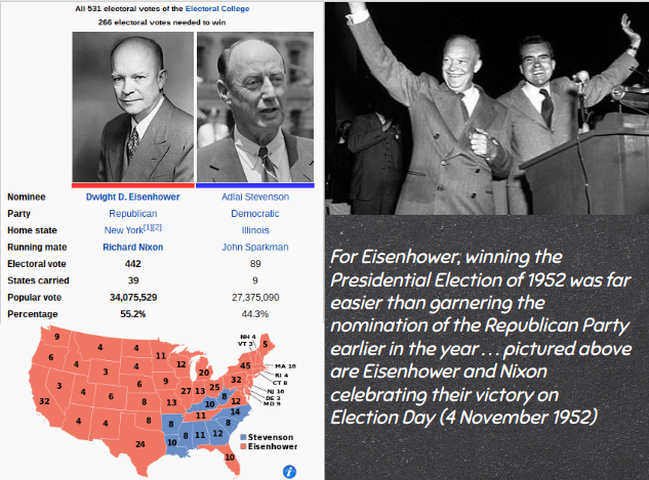
​     After the "Checkers Speech", Pat's political ambition waned, but she never stopped supporting her husband. Another result of the speech was that Nixon no longer cultivated reporters . . . it was official, to Nixon the media was pro-Establishment Elite and was now his main enemy. Eisenhower and Nixon won in a landslide in the Election of 1952, with the Electoral Vote 442 - 89, the popular vote 55.2% to 44.3% (34.1 million to 27.4 million) and 39 states to 9 states.

0 Comments

    Archives

    May 2017
    April 2017
    March 2017
    February 2017
    January 2017
    December 2016
    November 2016
    October 2016
    September 2016
    August 2016
    July 2016
    June 2016
    May 2016

    Categories

    All
    18th Century
    19th Century
    20th Century
    Biography
    History

    RSS Feed

Powered by Create your own unique website with customizable templates.