Mr. Jensen's U.S. History Website
  • U.S. History Blog
    • U.S. History Blog (May 2026 - May 2027)
    • U.S. History Blog (May 2025 - May 2026)
    • U.S. History Blog (May 2024 - May 2025)
    • U.S. History Blog (May 2023 - May 2024)
    • U.S. History Blog (May 2022 - May 2023)
    • U.S. History Blog (May 2021 - May 2022)
    • U.S. History Blog (May 2020 - May 2021)
    • U.S. History Blog (May 2019 - May 2020)
    • U.S. History Blog (May 2018 - May 2019)
    • U.S. History Blog (May 2017 - May 2018)
    • U.S. History Blog (May 2016 - May 2017)
    • U.S. History Blog (May 2015 - May 2016)
    • U.S. History Blog (May, 2014 - May, 2015)
  • About

Noah Webster & James Monroe: 1799 - 1806

6/24/2016

0 Comments

 
Sources: * Joshua Kendall. The Forgotten Founding Father - Noah Webster’s
                   Obsession and the Creation of an American
Culture (2011)
                * Harlow Giles Unger. The Last Founding Father - James Monroe

                   and a Nation’s Call to Greatness (2009)
Picture
​      On 14 December 1799, George Washington died. Noah Webster, who was one of Washington's favorites, sought to be Washington's biographer. But Bushrod Washington (a nephew, who almost exactly a year earlier was confirmed as an Associate Justice on the Supreme Court), who held Washington's papers, chose Representative John Marshall (VA) instead, who soon would become Chief Justice of the Supreme Court.
    Webster didn't feel the same level of commitment to the Federalists as he did to Washington. Webster was steadfast in his support of President John Adams, but he wasn't in awe. Webster supported Adams in the Election of 1800 against the Republican candidate Thomas Jefferson, which put Webster at loggerheads with the de facto leader of the Federalist Party,
Alexander Hamilton. Webster wrote editorials in support of Adams, who was being savagely attacked by Hamilton's poison pen. 
     After the Election of 1800, Hamilton refused to contribute to Webster's newspapers, and started his own, the New York Evening Post, which eventually became the New York Post, America's longest-running daily (now owned by Rupert Murdoch). By the fall of 1801, Webster and Hamilton engaged in New York's first newspaper war, which was an ideological (not personal) conflict, as well as a battle for circulation.
​     In a way, the newspaper war centered on which of the two was the #1 critic of President Jefferson and the Republicans. Webster saw Republican opposition to Adams as disloyal; ironically, Webster never figured out that Jefferson didn't want anything to do with him in terms of his dictionary in the years that followed. Jefferson viewed Webster as a mere pedagogue with limited political insights. Soon after Jefferson became President, Webster turned increasingly anti-Democratic and paranoid, and isolated himself at home in the "Arnold House".

Picture
       The success of Webster's speller meant that Webster could completely leave the newspaper business. On 15 October 1803, in his last editorial, Webster attacked a critic that disparaged his "Plague Book" on the Yellow Fever epidemic of the late-1790s (Webster argued that poor sanitation was the main cause). By 1803, Webster had already established himself as an obsessive definer. Webster advertised that he would create a dictionary unlike his predecessors that would actually create an American version of English . . . so much so it would make the work of those that came before him obsolete. Twenty-five years after Lexington & Concord, Webster's plan to replace the King's English, his "Linguistic Revolution", would be a lonely one. It seemed that no one had anything positive to say about Webster's proposed dictionary; he was accused of trying to add a bunch of "silly words" to English.
     In 1806, Webster published his Compendium (which meant concise) Dictionary, which was designed as an initial foray to his larger forthcoming dictionary. Americans did not fall all over themselves in embracing Webster's Compendium. Attacks on his first dictionary poured in; even U.S. Senator John Quincy Adams issued a polite-but-pointed rebuke of the dictionary. Webster's definitions had far more precision than his predecessors, but Webster's sweeping denunciations of his predecessors turned off potential supporters as well as buyers.

Picture
     James Monroe returned from France as a hero in Virginia, especially by the recently married James and Dolley Madison. Monroe was soon enlisted by Madison to help Jefferson win the Election of 1800. In December 1799, Monroe was elected Governor by the Virginia General Assembly; he was paid $3000/yr for basically doing nothing, since the office was rendered powerless by the powerful Virginia Planters. Monroe's tenure as Governor started on a very somber note, in that on 14 December 1799, Washington died. 
     Monroe did his best to reinvent the Governorship of Virginia, speaking candidly and often. Monroe basically shamed the Assembly into action in education, roads, and the militia. Monroe started the "State-of-the-State" address, showing the positives/negatives facing Virginia, and what he suggested should be done. As Governor, Monroe was instrumental in helping Jefferson and Madison organize Republicans in Virginia. On December 1801, Monroe was selected for his third one-year term as Governor, the last term allowed by Virginia's Constitution.

Picture
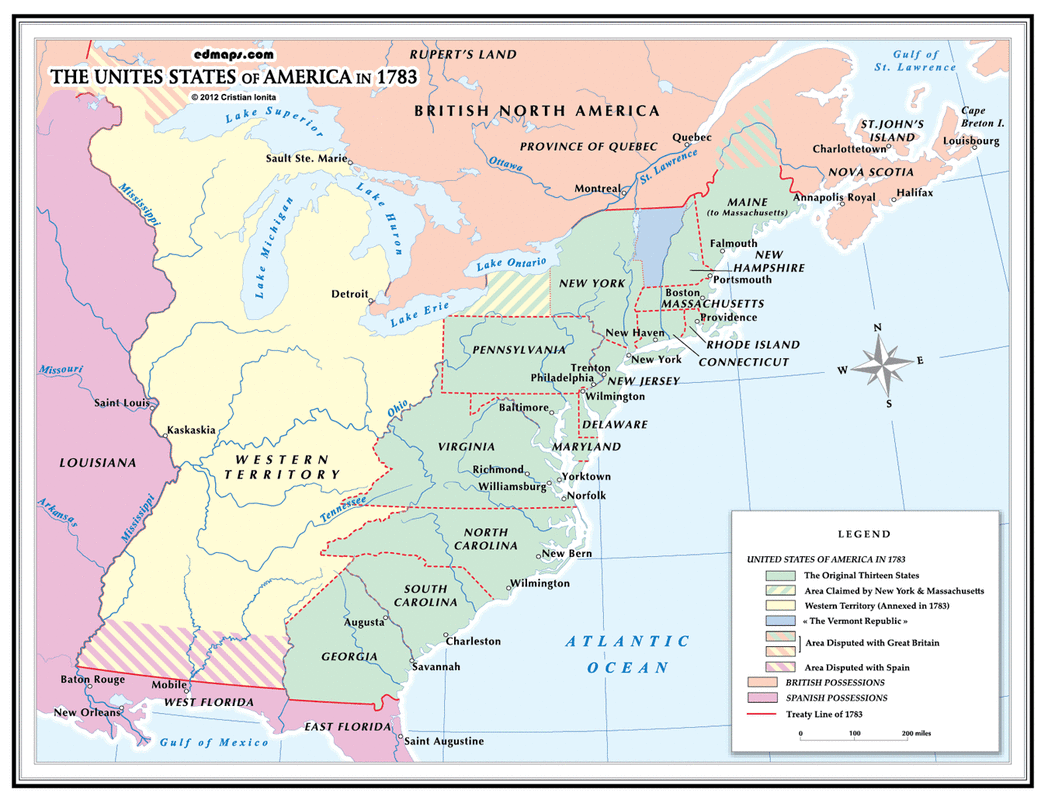
     Unknown to Jefferson early in his Presidency was that Spain had receded the Louisiana Territory to France in 1800, largely due to Spain's realization that it was unable to stem the tide of Americans crossing the Appalachians. Spain hoped that the French military could stop the American tidal wave towards the Mississippi River and the Gulf Coast, thereby securing their vital interests in North America. Napoleon planned on sending 20,000 troops to New Orleans, using the Louisiana Territory for necessary resources as well as settling accounts from the humiliating losses surrounding the French Revolution.
     Napoleon needed to send his soldiers to New Orleans before Jefferson knew what was happening. Napoleon gambled that Jefferson, a long-time Francophile, would not interfere with his plans in Louisiana if he could achieve a fait accompli in New Orleans. But Jefferson forgot his love affair with France when he found out about Spain's deal with France . . . Jefferson understood the importance of New Orleans, not only economically, but also strategically. In August 1802, the U.S. Minister to France, Robert Livingston, received orders from Jefferson to confirm Spain's recession of the Louisiana Territory to France . . . Napoleon ordered his government officials to delay any confirmation of the agreement.

Picture
     As Livingston waited and fumed at the delays, 20,000 troops were getting ready to leave Dunkirk for New Orleans . . . then fate intervened. Delay after delay occurred in terms of getting the ships ready to sail, and then an Arctic front-for-the-ages descended that was so cold, the French ships were frozen in ice at their docks. Then, a massive slave revolt occurred in Santo Domingo which not only threatened the major French sugar cane plantation, but also France's "jumping-off point" in the Caribbean to New Orleans. Napoleon was rumored to say "damn sugar, damn coffee, damn colonies". 
     Meanwhile in New Orleans, while the French were stuck at Dunkirk, Americans were getting ready to take New Orleans. Spain had refused U.S. entry (including cargo ships) into New Orleans, and in late-1802, Jefferson ordered his Secretary of War, Henry Dearborn, to get ready to invade the city. Before going to war, however, Jefferson decided to emulate Washington and John Adams and sent a commission to Paris . . . that commission was James Monroe. Monroe was given full discretionary powers, with Jefferson announcing that Monroe was also Minister Extraordinaire with France AND Spain, and had carte blanche with Britain . . . all in order to gain possession of New Orleans. 

Picture
      Monroe was instructed to inform France that the U.S. was going to take possession of New Orleans, either by purchase, or by force . . . so therefore, why not sell New Orleans to the U.S.? Congress authorized $2 million for Monroe, but Jefferson authorized Monroe to go as high as $9 million for not only New Orleans, but also West Florida.
     Spain yielded on the restrictions they placed on the U.S. in New Orleans, mostly due to pressure from Napoleon. That development didn't change Monroe's mission in Paris; Monroe told the French foreign minister if France set foot in New Orleans, America would not only to to war with France, but also enter a military alliance with Great Britain. 
     When the ice melted in the docks at Dunkirk, Britain believed the armada of French ships was getting ready to cross the Channel, and the Royal Navy boxed in the French ships, which was to America's great advantage. It was at this point that Napoleon started to seriously think about selling the Louisiana Territory to the U.S. The British Ambassador in Paris commented that "through no effort of their own, the Americans are now delivered".

Picture
     Livingston wasn't happy that Monroe was in Paris, feeling that his efforts would be co-opted by Monroe. Three weeks after arriving in France, Monroe (and Livingston) ignored his instructions, and signed an agreement with France's Finance Minister, buying all of the Louisiana Territory; the signing ceremony was no different than signing papers at a lawyer's office. The U.S. spent $15 million for land that doubled the size of the U.S. at .04/acre (the going rate in America was $2/acre). 
     It was also agreed that about 25% of future revenues from selling land in the Louisiana Territory would go towards paying claims of Americans against France from the "Quasi-War" in 1798. Monroe was a little unsettled with signing the agreement, in that he far exceeded the $9 million maximum, and that he was unable to get West Florida . . . Spain hadn't retro-ceded West Florida (or New Orleans for that matter) to France in 1800.

0 Comments

Noah Webster & James Monroe: France v. Britain (1793 - 1796)

6/24/2016

0 Comments

 
​Sources: * Joshua Kendall. The Forgotten Founding Father - Noah Webster’s
                               Obsession and the Creation of an American
Culture (2011)
                * Harlow Giles Unger. The Last Founding Father - James Monroe

                               and a Nation’s Call to Greatness (2009)
Picture
​     By 1793, Noah Webster's career was falling apart; he was frantic to have success in something. A national crisis, the "Genet Affair", would knock Webster out of his doldrums. To keep the U.S. at peace, Washington would once again turn to Webster, and Webster would soon be able to earn a good living by writing a torrent of words on behalf of his nation . . . nothing could have pleased Webster more.
     Webster (with the help of others) wrote an editorial in the Connecticut Courant in support of President Washington's declaration of neutrality in Europe during the French Revolution. Webster's editorial was designed to support Washington in the political maelstrom that was exacerbated by the French envoy to America, Edmond ("Citizen") Genet; Washington was deeply moved by Webster's efforts.
     When Webster traveled to Manhattan for potential publishing ventures (he was constantly searching for better deals for his speller), he found out that Genet was not only in NYC whipping up another political firestorm, but he was also staying at the same location that night as was Webster. Webster and Genet met each other, of course, and after inquiring about Webster's business in NYC, Genet asked Webster to have dinner.

Picture
      After dinner, Webster argued with Genet, with both eventually shouting at each other. Webster called Genet a "Mad Man", and other invectives that he couldn't later recall due to his emotional state. Although Webster would never again see Genet, the verbal sparring continued in the press; bashing Genet became a sort of part-time job for Webster. Webster soon discovered that Washington wanted to lessen Genet's influence by starting a Federalist newspaper in New York City. Washington offered Webster the job of editor, and Webster was eager to do so, but he lacked start-up capital. Federalist investors came to the rescue, including Alexander Hamilton, who contributed $150. Cumulatively, the loan from the various Federalists totaled $1800, and would be interest-free.
     Webster was in NYC by 13 November 1793, and on
​9 December the first issue of American Minerva, a four-page daily (except Sunday) Federalist newspaper, was published. Webster believed that his newspaper would be instrumental in spreading democracy in the U.S. (the endorsement from John Adams made Webster even more optimistic). Webster's first task was to take down Genet, whose fortunes were already tumbling. Webster kept up the pressure in his newspaper; by then most members in Congress were against the French Envoy Extraordinaire.
     Webster was supportive of the ideals of the French Revolution, but he was absolutely horrified by the violence. Webster was convinced that the absence of religion in France (and in general) promoted violence and lawlessness . . . Webster (as well as many other Americans) was concerned that the mayhem of the French Revolution might reach America.

Picture
       By that time, the Minerva was down to only 250 subscribers, only half the number necessary for Webster to keep the newspaper viable. Webster was (again) despondent, but he was not ready to give up. On 4 June 1794, Webster actually launched a semi-weekly offshoot for outside of New York called The Herald: A Gazette for the Country, featuring re-published items from the Minerva. One of the benefits of The Herald for Webster was that he absolutely loved to compile and organize information (a few years earlier, Webster had traveled to numerous cities, and had actually COUNTED how many homes were in each city . . . over 4500 in Philadelphia).
     By early-1796, Webster was finally earning handsome profits; he decided to rename the Minerva to The Commercial Advertiser, and circulation surpassed 1700 (his net profit exceeded $5000/yr). During the Jay Treaty crisis, Webster continuously came to Washington's defense with his publications by writing pro-treaty editorials under the name Curtius. So well-argued and written were the editorials that Thomas Jefferson thought that Curtius was Hamilton. Jefferson even told James Madison that Curtius was a very formidable opponent.
     Hamilton would soon enter the fray, writing dozens of editorials in support of the Jay Treaty. Even so, Webster believed that he had "out-Hamiltoned Hamilton" with his editorials.
Rufus King credited Curtius when he was talking to John Jay over who he believed was the most influential advocate for the Jay Treaty. After the Jay Treaty crisis, Webster's newspapers became required reading for America's Elite.

Picture
     On 8 April 1793, Edmond Genet arrived in the U.S., not long after Louis XVI was beheaded. President Washington saw neutrality as the only choice, in that if America entered the European conflict as an ally of France (honoring the Treaty of Alliance, 1778), trade with Great Britain would cease. In addition to that calamity, Britain would incite (and supply) Natives on the frontier, and Spain would have no reason to remain on the sidelines in North America, having an excuse to get involved due to European alliances.
     The British and the French refusal to honor U.S. neutrality on the open seas further polarized the national debate. According to John Quincy Adams, France represented the attitude for championing freedom, while Britain represented social order in the Civilized World: the Francophiles and Anglophiles in America were at each other's political throats. 
     Unwilling to risk his rising political career, James Monroe sought the middle-of-the-road. Monroe supported Jefferson's pro-France views, but he refused to sever ties with Washington. Meanwhile, Washington thought it would be politically advantageous to nominate a Francophile Republican to Paris, and after James Madison refused the nomination, Monroe was selected. At about the same time, Washington also nominated the Federalist Anglophile, John Jay, to go to the Court of St. James in London . . . John Quincy Adams, soon to be America's greatest diplomat of the era, supported both nominations.

Picture
       Monroe understood that he risked political oblivion if he failed in France, but he was going nowhere in the Senate. Secretary of State Edmund Randolph wanted Monroe to buttress U.S./French relations while also spying, providing political, military, and economic intelligence. On 18 June 1794, Monroe and his wife, Elizabeth, boarded the Cincinnatus in Baltimore. Accompanying the Monroes was his secretary of legation, Jefferson's nephew-by-marriage, Fulwar Skipwith (who would cause much trouble for President Madison in the Louisiana Territory).
     The Monroes stepped into a bloodbath of genocidal proportions when they arrived in France: 500,000+ in prison, 17,000 executed by the "government", and 25,000+ executed by mobs. The baggage of the Monroes had been "inspected", and many items were missing. Monroe immediately asserted himself, despite the danger, in a military bearing as the representative of an allied sovereign nation. On the way to Paris (which took 3 days by wagon; he didn't dare sleep much at all), Monroe learned of the execution of Robespierre. 
     Meanwhile, Gouverneur Morris, the man that Monroe was to replace, was still in Paris, and not very happy at being recalled. Morris took Monroe to Paris to the proper people and buildings, introduced Monroe, and at the same time announced his recall to the U.S. After presenting his credentials to what constituted the government in France, Monroe waited ten days, with no response.

Picture
     In a very bold maneuver, Monroe wrote the President of the National Convention, which was an unprecedented action. Monroe was in essence claiming that the U.S. belonged at the same international table as France and the other European powers. Monroe appeared the next day and made quite the impression with his height, standing, demeanor, and gravitas; the National Convention gave Monroe a huge ovation. 
     Two weeks later, Monroe approached the Committee of Public Safety in order to try and end French interference with U.S. ships on the Atlantic. By the end of 1794, the French government agreed to all of Monroe's requests on behalf of the U.S., and Monroe was even invited to official government receptions among the French Elite. 
     As John Jay's negotiations were occurring at the same time in London, Monroe became concerned that he may be blamed for any deterioration of US/French relations. In order to protect himself, Monroe sent duplicate letters to James Madison of what he sent SecState Randolph, which would prove to be very wise when scandal would force Randolph to resign. Elizabeth Monroe, very bravely, personally visited Lafayette's wife in prison, since her Monroe was unable to do so; as a result, after being imprisoned for 16 months, Mrs. Lafayette was freed.

Picture
      Bad news for Monroe: when word reached Parliament of Monroe's address to the French National Convention, Britain suspended negotiations with Jay, since they were concerned that America was forming a military alliance with France. SecState Randolph sent a letter to Monroe that scolded him for not keeping America in a neutral orientation with France. Monroe responded with a detailed "manifesto", showing that he in no way violated Randolph's instructions. In France, Monroe had become the near-equal of Benjamin Franklin in terms of American celebrity and status in the history of France.
     4 July 1795: Monroe became an even bigger celebrity in France by publicly celebrating Independence Day at the US Embassy, which Monroe had purchased with "imaginary money" (e.g. IOU's and land certificates), thinking the U.S. Government would eventually cover the cost . . . that would turn out to be a mistake that would drastically increase Monroe's personal debt. Monroe had become so fluent (and colloquial) in French that he no longer used interpreters, contrary from his instructions from Randolph. Meanwhile, back in America, Monroe was accused of being a sell-out by the pro-British Federalists.
     In November 1794, Monroe succeeded in gaining the release of Thomas Paine from a French prison. Paine quickly wore out his welcome with Monroe by attacking Washington with his now-poison pen . . . Monroe finally washed his hands of Paine by Christmas 1795. Early in 1795, Monroe received a letter from Randolph; in effect Randolph apologized for his previous remonstrating letter. Also, Randolph informed Monroe that Washington supported what he was doing in France. However, by the end of 1795, Monroe had created tension with important French officials over his repeated successful efforts of rescuing/protecting "Enemies of the State".

Picture
     
​    Monroe's troubles really began when the Jay Treaty was announced. In France, the treaty provoked government outrage, and then food shortage riots started. The mini-revolution toppled the French government, which was replaced with the Directory. The Directory, after reading the Jay Treaty, immediately nullified the Treaty of Alliance (1778) between the U.S. and France. The Directory also ordered French warships to seize all U.S. ships and cargoes bound for Britain, imprisoning the crews as well. 
     Monroe didn't know that after Randolph's forced resignation, there were no longer any sympathetic or supportive ears for Monroe in Washington's 2nd term Cabinet. The new SecState,
Timothy Pickering, wanted to purge the federal government of all Anti-Federalists and Republicans, which included Monroe as far as Pickering was concerned. Washington, convinced by his reshaped Cabinet that Monroe had failed in France, formally recalled Monroe back to the U.S in 1796.

0 Comments

Noah Webster & James Monroe: The Constitution (1785 - 1790)

6/22/2016

0 Comments

 
Sources: * Joshua Kendall. The Forgotten Founding Father - Noah Webster’s
                                Obsession and the Creation of an American
Culture (2011)
                * Harlow Giles Unger. The Last Founding Father - James
Monroe and
​                                a Nation’s Call to Greatness (2009)
Picture
     On 8 March 1785, Noah Webster announced the publication of his "Sketches of American Policy", which advocated a new, stronger national government. Webster would later contend that he played a pivotal role on designing the Constitution. In April 1785, Webster traveled to the southern states to promote his copyright law campaign.
     In 1786, Webster went to Virginia to continue his copyright law efforts. On his way to to the Virginia Assembly, Webster once again visited Mount Vernon. Washington gave Webster letters of introduction to the Virginia Governor and the speakers of the two houses . . . Washington made sure he mentioned in the letters that he supported a copyright law. 
     Of all the southern locations, Webster took a liking to Annapolis (MD), due to the "more elegant" houses. Also, Webster (like Washington) loved to dance, and Annapolis afforded many pleasant opportunities with socially prominent ladies. But even in Annapolis, Webster still had the tendency to see himself as a beleaguered outsider when he was a respected insider. Once in Dover (DE), Webster would never visit the south again; while in Delaware and then Pennsylvania, Webster made meaningful connections with people that either already were, or would become, very powerful and/or influential.

Picture
Picture
     Webster had Washington as a supporter . . . now Webster wanted
Benjamin Franklin in his fold as well. Webster knew how to flatter prominent people, of which Franklin (and Washington) was susceptible. Franklin grew fond of Webster, since Franklin was also obsessed with language and education; Franklin would eventually anoint Webster as his intellectual heir.
   Webster was thrilled with the possibility of collaboration with Franklin; Webster wanted to serve his nation and also to find "patrons" to support his work . . . dropping the names of Washington and Franklin would be beyond-useful. On 27 February 1786, Webster was introduced to Thomas Paine, a fellow man-of-words, and on 25 March 1786, Webster arrived in New York City. NYC was still suffering from the aftereffects of Britain's seven year occupation during the Revolutionary War.

Picture
     After the Constitutional Convention was over in September 1787, Webster wrote a pamphlet that summarized Franklin's views of the document, featuring such Franklin phrases as "perfection is not the lot of humanity" and "improvement on the best constitutions so far". Webster knew his tract wasn't the equal of the Federalist Essays; Webster admired the work of Alexander Hamilton and James Madison. Webster's pamphlet, however, exerted more influence outside of the state of New York that did the Federalist Essays.
     On 16 October 1787, Webster turned 29 years old, but his self-esteem was at a low-ebb due to serious financial matters (he hadn't yet made the money he eventually would with his speller). On 23 July 1788, Webster became the organizer and "Go-To-Guy" for the New York Ratification (of the Constitution) Parade. The parade was designed to bolster support in Upstate New York, since the state legislature remained deadlocked.
     Webster was also the chief chronicler of the event; Webster was recruited to be the parade's organizer since he was the driving force behind the New York Philological Society that included influential literary scholars. For Webster, the parade meant that he would be able to show his patriotism, and it was also a way to promote his speller. Webster wanted a virtual educational monopoly with his speller (meaning a national copyright law), and for that to occur, Webster needed the Constitution to be ratified, especially in New York and in New England.

Picture
     During June 1788, New Hampshire became the 9th state to ratify the Constitution, making it the "Supreme Law of the Land" . . . even so, it was essential that Virginia and New York also vote in favor of Ratification. An entirely new marketplace emerged, in that the new Congress would have the power to regulate literary property, although Congress didn't pass the national copyright law until 1790. Writers would hold the rights to their books for 14 years (until 1804).
     Webster sold about one million spellers by the time he filed for copyright protection in 1790. Webster's speller was the one "Yankee Book" that was treasured by Southerners. Webster's speller also gave rise to the Spelling Bee, America's first national pastime.

Picture
      During April 1787, Fredericksburg (VA) elected James Monroe to the Virginia Assembly; once again Monroe was in the political arena. In May 1787 the Virginia Assembly announced that Washington, Madison, Edmund Randolph (VA Governor), George Mason, and Patrick Henry (plus two others) had been named to be the Virginia delegation at Philadelphia for the upcoming Constitutional Convention. Henry refused to serve (by then he had become a rabid opponent of the proposed new government); Madison selected Dr. James McClurg over James Monroe, since Monroe was a practicing lawyer, and Madison didn't want Monroe to lose necessary income.
    
​     On 17 September 1787, 32 delegates signed the Constitution; by signing the document, the delegates in effect enacted a bloodless coup d'etat . . . and most of the nation was outraged. Monroe was sympathetic to Henry's many objections concerning the proposed Constitution, but he sided with Washington and Madison at first. Soon, Monroe came under the spell of the Anti-Federalists, especially since his uncle was a supporter of Patrick Henry. 
    The largest fear of the Anti-Federalists was the President's Commander-in-Chief powers specified in Article Two, believing it was a short-line to tyranny. Monroe was also concerned about a lack of a Bill of Rights; Monroe spoke at the Virginia Ratification Convention, but was drowned out by Henry, who spoke for an astounding 20% of all the words spoken on the record at the convention.

Picture
    The overall main point of the Anti-Federalists was that the new national government needed to be limited compared to what was written in the Constitution. Monroe listed five specific objections to the Constitution: 1) Power to tax without the consent of the governed; 2) The lack of a Bill of Rights; 3) No term limits for the President; 4) The President and Congress could easily collude; 5) The new government's treaty-making powers could undermine the interests of an entire region(s). 
     After Monroe laid out his objections for the record, his long-time friend John Marshall stood up, and shredded Monroe's objections. Madison backed up Marshall, focusing on the inability of the Articles of Confederation to protect citizens from invasion (the fear of an external invading force would not dissipate until 1815). Madison then stunned the convention by saying he would author the proposed Bill of Rights . . . the Virginia Ratification Convention voted 89 - 79 in favor of the Constitution in June 1788.

Picture
      After Virginia ratified the Constitution, Madison ran for a seat in the new House of Representatives (well into the 19th Century, it was more prestigious to serve in the House rather than the Senate), but the vindictive Patrick Henry redrew the state's district boundaries in order to try and block Madison's election. Henry also wanted Monroe to oppose Madison in the election; on 2 February 1789 the election results were made official - Madison 1308, Monroe 972 (thankfully, there was no rancor between the two men after the election). 
  Madison's support (and authorship) of the upcoming Bill of Rights meant that the moderate Anti-Federalists would not be part of Henry's radical voting bloc arrayed against him in Congress. Monroe's defeat against Madison once again placed him in the Land-of-Obscurity for awhile, and it was back to his law practice. On Christmas 1789, Jefferson was back at Monticello; Jefferson told Monroe that he was going to New York City to be the first Secretary of State. In the fall of 1790, Monroe was selected by the Virginia Assembly (it wouldn't be until the 17th Amendment that U.S. Senators would be elected by popular vote) to fill a vacant seat in the U.S. Senate due to a death in office. On 6 December 1790, James Monroe took the oath and became a U.S. Senator from the state of Virginia.

0 Comments

Noah Webster & James Monroe: 1782 - 1784

6/18/2016

0 Comments

 
Sources: * Joshua Kendall. The Forgotten Founding Father - Noah   Webster’s Obsession and
                                               the Creation of an American
Culture (2011)
                * Harlow Giles Unger. The Last Founding Father - James
Monroe and a Nation’s
                                               Call to Greatness (2009)
Picture
     At the time the Revolutionary War drew to a close, Noah Webster , seeing the national debate on which language should be "#1" in America (e.g. German, Hebrew), realized that a "Speller" would end the debate. That future speller would give him the fame and financial security that he wanted (by 1784, Webster had made enough money from his speller that he was able to dedicate his life to his "work with words"). Webster had reworked and improved previous spellers, and his version came out at the perfect time, and it sold well immediately.
     
​     Webster's method of instruction was the most user-friendly to date, simple-yet-rigorous, and it spoke directly to children. Webster did more than publish a speller: he also helped give birth to a new language, which would in turn help unite a fledgling nation. Webster's speller was a linguistic Declaration of Independence . . . it was an English unique to America. Webster divided words based on their pronunciation rather than the abstract principle of Latin from previous spellers. Webster saw the publication of his speller as a necessary follow-up, and even a continuation, of the American Revolution.

Picture
      Webster had to arrange for the financing, printing, and distribution of his speller, like all other authors in America in those days. Webster also was responsible for marketing, of which he had a knack, and his pre-publication publicity and book tours created a "national buzz", increasing demand. Over the next century, only the Bible would sell more copies than Webster's speller . . . but despite that success, Webster struggled with anxiety and alienation.
     To protect his speller (and to maximize his profits), Webster took it upon himself to become the 'Father of US Copyright Law". Webster found out from Thomas Jefferson and James Madison that the Articles of Confederation had no authority to pass a national copyright law. Webster used the Connecticut legislature to pass America's first copyright law, and New York, Massachusetts, Maryland, New Jersey, New Hampshire, and Rhode Island followed suit. Only then did Webster start to arrange for the publication of his speller, negotiating a deal with a publishing company that also issued a newspaper titled The Connecticut Courant.
     Webster convinced friends to invest, and after enough money had been raised, he wrote an IOU, which the company accepted in return for the ability to publish future editions. On 16 September 1783, just two weeks after the Treaty of Paris was signed, Webster placed an ad in the Courant, which gushed about his speller, offering discounts for those that bought in bulk. Webster also included testimonials from several key local officials.

Picture
     Webster's promotional campaign switched among lofty goals and harsh critiques of predecessors in a contemptuous tone. Those that attacked Webster for his critiques actually helped raise awareness of his speller, and sales increased. In 1783, the Articles of Confederation proposed an amendment that would provide Revolutionary War officers pensions with a value-added tax of 5%; by May 1784, the greatest opposition to the amendment was in Connecticut.
     The special convention in Connecticut knew that it could thwart the will of the other twelve states. Webster sided with Madison's view, insisting that Connecticut vote in support of the amendment in dozens of editorials. Webster labeled those that disagreed with him as enemies to his country, violent thugs, even traitors. Webster also wrote in his editorials about the need for a stronger national government . . . by the spring of 1784, Webster had started to directly appeal, and directly act with his speller, for American unity. On 19 May 1784, the Connecticut convention voted in favor of the "national impost",
​93 - 42; Webster was credited by influential people on both sides of the issue as being a difference-maker.

Picture
     During April 1782, James Monroe's uncle was elected to the Continental Congress. With momentum seemingly on his family's side, Monroe used his recommendations from the Revolutionary War (including Washington's) to help him get elected to the Virginia General Assembly (as did his long-time friend, John Marshall). On 6 May 1782, Monroe took his oath, but to his great disappointment, Jefferson wasn't present (once again, Jefferson was pouting at Monticello; this time it was due to many criticisms, some which were justified, and many that were not, about his actions and in-actions as Virginia's Governor during the Revolutionary War)
     Monroe and Marshall were warmly welcomed to the Assembly, and Monroe was appointed to the eight-member Executive Council, which actually governed Virginia (the Governor was designed to be a figurehead with little power, which made many of the criticisms leveled at Jefferson all the more ironic and hypocritical). Monroe compensated for his less-than-stellar conversational skills by being a very good listener, featuring thoughtful nods and pleasant smiles. Monroe also wrote many meaningful letters; he was winning over people across Virginia and beyond. 
     In June 1782, Monroe was admitted to the bar, as was Marshall, but there were few opportunities to practice law in post-Revolutionary War Richmond (as Webster discovered in Connecticut). As for the Executive Council, Monroe discovered that it was nothing more than a Gentleman's Club of sorts, with games and conversation. No decisions were made, mainly so the ruling Planter Class would continue to dominate the politics and economics of Virginia.

Picture
      The phrase "real estate" came into meaning in the early-1780s. Land was the only currency in 1782 America, since there was no mint, and therefore no specie (coins). Land provided commodities that were used to barter for what people needed; gaining possession of land in the West represented a "real" estate to more-and-more Americans. That "real" estate could be passed to future generations within the family.
     However, most Americans relied on "imaginary money" for most transactions, such as IOU's and entries in account books. Demand for western lands increased due to "crowding-out" in the East, also in part due to a significant increase in immigration from Europe. "Imaginary money" included land certificates, and with demand for land certificates increasing, so did their value. Every citizen of substance invested in these land certificates.
     
​     Scams were on the increase as well, with people/groups selling land certificates, but those certificates represented land that was already owned, or not even in existence. Monroe, the son of a carpenter, became proud of the land certificates that he held, and strongly supported expansion west. Monroe had much time to speculate on land certificates, in that after one year as a state legislator, the Assembly had accomplished nothing of significance.

Picture
 ​     So popular was Monroe with his legislative peers that he was elected to the Continental Congress, joining four others, including Jefferson (James Madison was heading back to Virginia after his three-year term expired). Monroe spent the Summer of 1783 at Monticello with Jefferson before their term started in December 1783. The Continental Congress convened in Annapolis (MD), and Jefferson lived in luxury while Monroe, broke and virtually penniless in comparison, considered his options (he still hadn't been paid for his year of service as a state legislator). 
     Jefferson insisted that Monroe be with him as much as possible, which meant not only lodging with him often, but also meeting many important and powerful people, and making many quality connections. On 23 December 1783 on the floor of the Continental Congress in Annapolis, Monroe witnessed Washington surrender his commission. A great general that led his nation to victory in a war went home, refusing to take power . . . it was unprecedented in history. With the Continental Congress every bit as inactive like the Virginia Assembly, Monroe had the time to become almost as fluent in French as Jefferson.

Picture
     Also during this time, Monroe learned the fine art of political discourse and debate, as well as proper behavior as a government official, from Jefferson. But Monroe was still in "follower-mode", voting the way the Virginia Assembly instructed. The major reason why the Continental Congress of the Articles of Confederation rarely voted was that a state delegation needed permission to vote from their state legislature, which rarely occurred. Also, when instructions were given, transportation was very slow, which delayed and cancelled many votes that may have occurred. 
     While Washington, Jefferson, Madison, and Monroe supported a stronger national government, that issue was hotly debated in the Continental Congress as well as across the nation. Congress became a "Debating Society" with no subsequent actions, which led to sparse attendance, and few quorums . . . the government under the Articles of Confederation was at stalemate, unable and unwilling to act.

0 Comments

Noah Webster & James Monroe During the Revolutionary War

6/18/2016

0 Comments

 
Sources: * Joshua Kendall. The Forgotten Founding Father - Noah Webster’s
                           Obsession and the Creation of an American Culture (2011)

                * Harlow Giles Unger. The Last Founding Father - 
James Monroe 
                           and a Nation’s Call to Greatness (2009)
Picture
     As you can see from the titles of the sources above, Noah Webster was the "Forgotten Founding Father", and James Monroe was the Last Founding Father . . . what follows in this US History Blog entry and others to come is a summary chronicle of Noah Webster's and James Monroe's actions and experiences from 1776 to 1806. 
​     While Monroe became a Revolutionary War hero, Webster was actually pressed into service, mostly due to the fact that Yale (and much of Connecticut) was in shambles due to the proximity of British redcoats, and that his adult family members were already serving. Webster, while never seeing any actual combat (he wasn't nearly as capable a soldier as Monroe), was near Saratoga at the end of that pivotal battle. 
     After finishing his commitment during the Revolutionary War, Webster looked for his first job as a Yale graduate in 1778, but the economic landscape was treacherous, in that hyperinflation created a very tight job market. Webster was lost and confused but he knew that he wanted to keep doing what the Revolutionary War interrupted: reading and writing, since he loved intellectual discovery. Webster held fast to his literary ambitions, but felt hopeless about achieving them, largely due to the fact that there weren't any American professional writers as of yet. When Webster graduated from Yale, he became separated from everything he held dear . . . Webster was afloat in the world at the age of 20 without any prospects, and without any aid.

Picture
​      Webster started as a teacher, but only earned 2 pounds per month, plus he had to deal with unruly and ungrateful students. Webster then tried becoming a lawyer; to qualify for the bar, he needed to study with a practicing attorney for two years. In the spring of 1779, Webster moved into the Hartford (CT) home of Oliver Ellsworth, who was not only one of the premier lawyers in Connecticut, but also a delegate to the Continental Congress. However, Webster couldn't handle the strain of teaching and training to become a lawyer; at the age of 21, Webster broke down . . . he would never again feel "quite right". 
   
​     For Webster, non-stop obsessive intellectual labor was the tonic; long before there was any treatment, Webster suffered from what was almost-certainly obsessive-compulsive disorder, which was a blessing and a curse all-at-once, as later years would confirm. Webster eventually joined the bar, but with the Revolutionary War dragging on, it was impossible for him, as a new untested lawyer, to get cases. On 17 January 1782, Webster was apoplectic that some editorials were promoting reunification with Great Britain. Webster wrote "Observations on the Revolution", plus three more editorials, supporting independence . . . soon the break with Great Britain would become permanent. 
     Webster started a "classical" school in Upstate New York for the children of prominent families. Webster was paid in silver dollars, a rare advantage in an economy that featured hyper-inflated currency and "imaginary money" (e.g. certificates of Western lands or IOU's). But Webster yearned to earn a better living as a lawyer, and he felt like a fish-out-of-water in Upstate New York . . . his "happy place" was home in Connecticut.

Picture
     On 15 June 1775, George Washington was named Commander of the Continental Army by the Continental Congress. During January 1776, 18 year-old James Monroe was made 1st Lieutenant (as was his childhood friend John Marshall) in a Virginia militia regiment. On 29 June 1776, Virginia declared its independence from Britain, and on 4 July 1776 the Continental Congress did so on behalf of all 13 states. In August 1776, Monroe's regiment was among other VA regiments in the vicinity of NYC, but they didn't get to link up with Washington's main force in time, since the General had already crossed the East River to Manhattan to avoid capture. 
    After the British/Hessian route on NYC, Monroe and the Virginia militias vowed to never run like the militias from Connecticut. Outnumbered 2:1, the Virginia militias, now part of Washington's main army, forced 1500 British redcoats to retreat, which was the first time that occurred in the Revolutionary War. But men from the Connecticut militias kept disappearing, which forced Washington to relocate his army to White Plains, NY. On 24 October 1776, a nighttime raid by the British was squashed by the VA militias, of which Monroe was part; no Virginian was killed/injured repelling the British attack. On 26 October 1776, the British approached Washington's position in far-greater numbers, and Washington (who had largely learned his lesson after New York City (don't let the British capture the army), divided his army into three parts, trying to give the British pause. 
     Washington and about 5000 men (including Monroe) crossed the Hudson River into New Jersey. Still being pursued by the British, Washington and his men crossed the Delaware River into Pennsylvania in early-December 1776. Desertions had reduced the number of soldiers under Washington's direct command to 3000. Only 200 of the 700 VA militia men were able to fight; Monroe was only 1 of 5 VA militia officers still active-and-able. Washington ordered his men to grab all of the boats on either side of the Delaware; the British and the Hessians were forced to remain on the New Jersey side of the river.

Picture
​      Lt. James Monroe had been among the first to cross the Delaware for the surprise attack on the Hessians at Trenton. Monroe was among the 50 that volunteered to surprise and capture Hessian artillery (3 pounders). A Hessian guard saw the 50 Americans advancing in the snow storm, and a general alert was sounded. Monroe was wounded in the attack, and almost died, shot in the chest and had a nicked artery; a physician saved the 19 year-old Monroe's life with expert and prompt emergency medical care. 
     
    Monroe and the other attackers were able to take and keep the Hessian artillery, and after the battle, Washington promoted Monroe to captain for "conspicuous gallantry". The daring advance attack of Monroe and the others were key in taking Trenton, since the Americans held the advantage in artillery. The success at Trenton led to a greater (and more costly) victory at
Princeton against the British; Trenton and Princeton led to not only higher morale, but also kept the number of soldiers with Washington at a decent level. 
     Monroe needed 10 weeks to recover from his wounds. Monroe soon discovered, as a captain, that he was expected to recruit his own men, which he was unable to do in Virginia due to the sheer scarcity of volunteers. Monroe's wealthy uncle, a judge, helped Monroe become an aide-de-camp with the rank of major to Lord Stirling. The still-teenage Monroe came to know many quality people from different regions, including Washington's top aide, Colonel Alexander Hamilton.

Picture
​       Monroe befriended the Marquis de Lafayette as Lord Stirling's aide, which expanded his literary, philosophical, and political horizons. Serving under Lord Stirling also broadened Monroe's military knowledge, including overall strategy with corresponding tactics. During the winter at Valley Forge, Lord Stirling returned home (which most of the high-ranking officers did during winter), but Major Monroe stayed camped with the men in a log hut with John Marshall.
      By then, Monroe had become a passionate Francophile and an Anglophobe; he celebrated the Treaty of Alliance (1778) with France. As a result of the treaty, Britain was convinced that a French invasion was real enough to abandon Philadelphia and consolidate forces in NYC. Washington decided the time was right to attack the British at Monmouth (NJ); after the cowardly retreat by General Charles Lee, Washington rallied his men, and Lord Stirling's forces rushed up in support, providing just enough soldiers to stop the British advance on their position. 
     Although Monmouth was at best a draw (the Redcoats slipped away at night), Washington claimed a victory, mostly for political reasons. Monmouth would be Monroe's last direct action of the Revolutionary War, since stalemate had largely set in for the rest of 1778 into 1779. 
Monroe, facing the prospect of no battlefield command, resigned his commission and position on Lord Stirling's staff on 20 December 1778. When Virginia created new regiments in reaction to British forces concentrating in the Chesapeake, Monroe thought he would finally become a battlefield commander (Monroe even had a rare letter of recommendation from General Washington). 
     Monroe was named Lieutenant Colonel, but the Virginia Assembly refused to supply the necessary funds to raise and equip the new militias, and in any case, recruits were still incredibly scarce. Monroe assailed the VA Assembly for their cowardliness, and went back to his uncle, who advised his nephew to abandon the military and focus on public service in government for his future. 

Picture
     Monroe's influential uncle also wrote a letter of recommendation to the Governor of Virginia, Thomas Jefferson, who had much spare time since the Assembly actually governed the state. In January 1780, Jefferson brought Monroe into his "Circle of Trust". Jefferson and Monroe had much in common, and Monroe seemed like a trusted little brother to Jefferson. Jefferson instructed Monroe (and others in his inner-circle) in the law, which Jefferson thought was a requirement for government service. 
     In the spring of 1780, the British took Charleston (SC), and Virginia freaked-out in response. Jefferson named Monroe a full colonel, and placed him in charge of the Virginia Southern Army. As Banastre Tarleton approached Richmond, even Governor Jefferson discovered that he was unable to raise men for the defense of Virginia. Monroe was sent to northern Virginia to continue his education, and to be "on deck", waiting for his call-to-action.
     On 23 May 1781, Tarleton seized Richmond, and Lafayette's army was in full flight back north. At Fredericksburg (VA), General "Mad Anthony" Wayne arrived with 1300+ troops, reinforcing Lafayette . . . General Cornwallis (Tarleton was under his command), far away from his supply base, decided to retreat from northern Virginia.
​

Picture
​    
​      Monroe met with Lafayette, and Lafayette gently told Monroe that he had enough officers, and went south towards Cornwallis. Monroe continued to try and find ways to get directly involved, all the way through Yorktown (1781), but failed. On 14 October 1781, Monroe's friends Hamilton and Lafayette executed a night-time bayonet charge on the remaining key British positions to end the siege at Yorktown. 
     On 17 October 1781, Cornwallis sent Washington a message proposing a cease-fire, and on 19 October, Cornwallis, Washington, and Rochambeau signed the articles of capitulation. Monroe was all-but-despondent at missing out on a chance at military glory, and finally became serious on following the advice from his uncle and Jefferson . . . serve his nation in peace as a public servant.

0 Comments

    Archives

    May 2017
    April 2017
    March 2017
    February 2017
    January 2017
    December 2016
    November 2016
    October 2016
    September 2016
    August 2016
    July 2016
    June 2016
    May 2016

    Categories

    All
    18th Century
    19th Century
    20th Century
    Biography
    History

    RSS Feed

Powered by Create your own unique website with customizable templates.