Source: David Halberstam. The Fifties (1997)
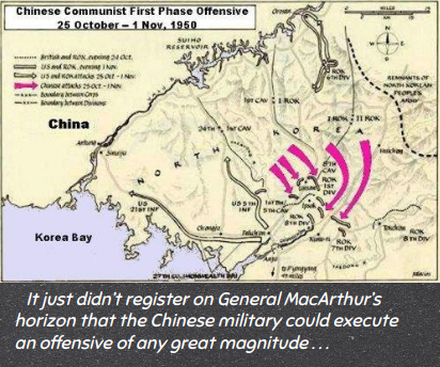
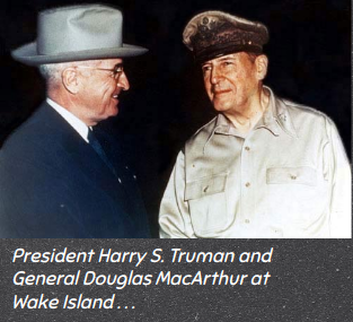
Even as General Douglas MacArthur was promising Truman (at their meeting at Wake Island), that he could easily defeat any Chinese army that showed itself south of the Yalu River, the Chinese Fourth Field Army was entering North Korea. The Chinese Fourth was one of the greatest infantry forces of the era, despite being short hardware and heavy on peasants. Mao Tse-Tung's Fourth prevailed over Chiang Kai-Shek's more powerful military, despite having to move almost entirely on foot without modern communications technology. The Fourth's attacks were coordinated by bugle calls, which had the added dimension of terrorizing the enemy.
The Chinese Fourth Field Army moved 286 miles in 18 days to their assembly point on the Yalu River, with each soldier only carrying 8 - 10 lbs. of supplies/weapons (a US soldier carried at least 60 lbs.). The Fourth was outfitted for the upcoming winter, and they were trained in particular for close-combat since the soldiers weren't marksmen, a method which usually led to very high casualties. The Fourth was divided into 6 armies of 30,000 each, and the Fourth started to cross the Yalu on 13 October 1950. The camouflage/movement of the Fourth was so good, and MacArthur's intelligence so bad, that none of their movements were detected by US forces. When MacArthur made his boast to Truman on Wake Island, there were already at least 130,000 Chinese soldiers in North Korea.
The Chinese Fourth Field Army moved 286 miles in 18 days to their assembly point on the Yalu River, with each soldier only carrying 8 - 10 lbs. of supplies/weapons (a US soldier carried at least 60 lbs.). The Fourth was outfitted for the upcoming winter, and they were trained in particular for close-combat since the soldiers weren't marksmen, a method which usually led to very high casualties. The Fourth was divided into 6 armies of 30,000 each, and the Fourth started to cross the Yalu on 13 October 1950. The camouflage/movement of the Fourth was so good, and MacArthur's intelligence so bad, that none of their movements were detected by US forces. When MacArthur made his boast to Truman on Wake Island, there were already at least 130,000 Chinese soldiers in North Korea.
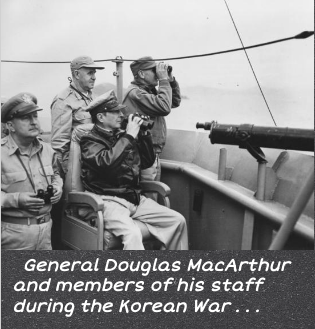
As the Chinese and US forces drew closer to each other on the southern side of the Yalu, MacArthur disobeyed orders which wanted him to stay south of the Yalu and only engage the North Korean army. In Tokyo, MacArthur ordered the US (and the token U.N.) forces to converge near the Yalu, and then told the US press that the war in Korea was for all practical purposes over. But nobody on the American side knew to where the North Korean army had escaped. On 24 October 1950, MacArthur clearly violated his orders by moving further north, and the powers-that-be in D.C. were absolutely stunned.
Despite taking Chinese prisoners, MacArthur had convinced himself into believing that he hadn't encountered any Chinese opposition. On 30 October 1950, MacArthur received clear intelligence that Chinese troops were in-country, but MacArthur dismissed the message as irrelevant. On 1 November 1950, a unit of the Chinese Fourth hit the US Army with full fury for the first time. The Chinese attack simply didn't stop, with wave-after-wave of Chinese soldiers attacking US positions . . . and then there were the Chinese bugle calls, ordering those repeated charges.
In the face of this Chinese offensive, MacArthur continued to give orders to push further north, despite his men not being properly outfitted for winter. MacArthur remained in Tokyo, refusing to accept evidence that the war in Korea had drastically changed, none of which surprised MacArthur's peers. To the growing despair/frustration of his field commanders, MacArthur wouldn't allow for adjustments . . . MacArthur didn't want the Chinese to enter North Korea, so in his mind they simply hadn't done so.
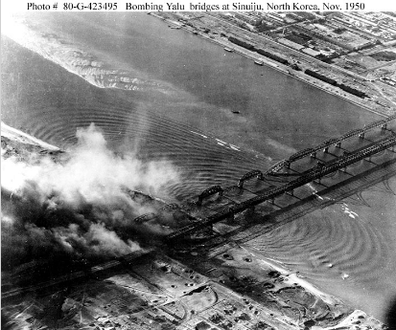
On 3 November 1950, Truman started to get worried over reports of US losses in Korea. Also by that date, MacArthur finally admitted that there just might be a Chinese presence in North Korea, and once again exceeded his orders, this time ordering the bombing of the North Korean end of the 12 bridges that crossed the Yalu River. MacArthur sent a cable saying that if he didn't bomb the bridges, all would be lost, and he would refuse to accept responsibility for that possible outcome. Instead of denying China had invaded North Korea, now MacArthur was promising a slaughter of his own men. What MacArthur had claimed would never occur under his command was happening, and MacArthur made no effort to apologize or explain.
MacArthur had become more arrogant and volatile than at any previous point in his military career, and the Joint Chiefs of Staff caved, allowing MacArthur to bomb the 12 bridges. Bombing the bridges on the Yalu provided the clearest possible provocation from the Chinese point-of-view, and was a useless action in any event since the Yalu would totally freeze-over in just a few weeks. In Washington, D.C., Truman, Under Secretary of State Dean Acheson, and Secretary of State George Marshall felt that events in Korea were slipping beyond their control. Acheson later wrote that they had stood by like frightened rabbits while MacArthur ran amuck. On 17 November 1950, MacArthur told his superiors in the federal government and military that he was ready to make his final approach to the Yalu River. MacArthur was ordered to only take the high ground overlooking the Yalu River Valley and to go no further.
MacArthur, due to his arrogance, foolishness, and vainglory was about to turn a small-scale war into a much larger conflict, as well as adding two years to the Korean War. MacArthur's actions also fed the monster in the US in terms of paranoia towards internal subversion, and would also poison US/Chinese relations for many years.
MacArthur thought only 30,000 Chinese troops were near the Yalu River, but the total was closer to 300,000. On 24 November 1950, MacArthur arrived at the front, wanting to see the results of his genius. MacArthur toured the lines, and then returned to Tokyo, somehow satisfied with what he saw. The US offensive to the Yalu started on 24 November 1950 in wind chills of minus 20-30 degrees. On 25 November 1950, the Chinese counterattacked, terrorizing US lines with a much larger version of the North Korean army (the Min Gun), and by 28 November 1950 it was clear that MacArthur had been outsmarted/out-executed by his Chinese counterparts, and that MacArthur's grand strategy was an epic disaster. Now the question was how many US soldiers and Marines could escape the Chinese attack.
The Chinese held all the high ground, cutting to pieces the retreating US forces below in the Yalu River Valley. It proved to be a killer gauntlet for over six miles, with approximately 3000 men KIA, WIA, or MIA, and it was quite simply a miracle that the losses weren't worse.
During December 1950, the US losses were just as costly and ghastly, with the US 8th Army falling apart like the
French in 1940, and the British in Singapore in 1942. It seemed that MacArthur had forced two choices on Truman: victory in a very costly war or a complete route at the hands of the Chinese.
Truman and his administration were fighting for their very legitimacy, and at the Pentagon, the spectre of another Dunkirk hung in the air. The Joint Chiefs of Staff were paralyzed under the never-ending barrage of bad news from Korea; the JCS no longer trusted MacArthur, but they were simply afraid to stand up to him. Finally,
Matthew Ridgway, the Army Vice Chief of Staff, demanded to know why MacArthur couldn't be removed . . . it was as if a light bulb was turned on over the heads of the JCS, and the collision course was set.
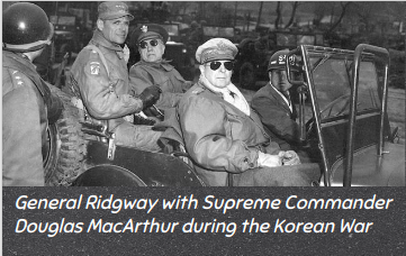
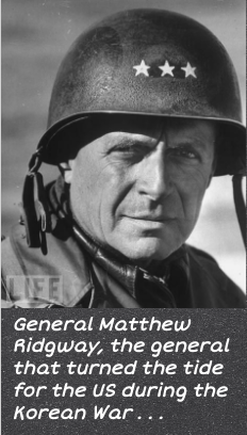
By early-December 1950, the Chinese took the North Korean capital of Pyongyang. What actually saved the US/UN forces was a fluke: General Walton Walker was killed in a jeep accident. Walker had proven to be a liability as a field commander, and General Matt Ridgway was placed in command of the US 8th Army. Ridgway was simply a ringer, arguably the preeminent American solder of the 20th Century. Ridgway saw the military as a calling, and was more committed to his Army and nation than the vast majority of high-ranking officers in the US military. Ridgway had commanded the 82nd Airborne in WW II, and became a great combat commander at the division level before he was promoted to a corps commander.
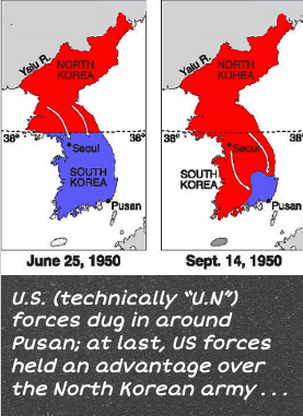
Ridgway was appalled at MacArthur's remoteness from the battlefields as he toured the front lines, the overall lack of commanders among the men, as well as the lack of daily intelligence reports due to minimal patrolling. The Army had completely lost confidence and its morale was at the bottom of an abyss. The US soldiers were poorly equipped, and depended far too much on vehicles in fighting an enemy that was on foot. Ridgway's #1 job was to restore morale and confidence; at the same time, Ridgway strengthened US forces around Pusan, making sure the 8th Army wouldn't be driven into the sea.
Ridgway was everywhere, and no unit, no matter how small, was immune from a visit. Ridgway worked on taking ground from the enemy a little at a time, which at least in part was designed to strengthen the American negotiating position when it came time for serious peace talks. As Ridgway was accomplishing the impossible, MacArthur was sending cables stating that unless the US widened the war, the US would be pushed out of the Korean peninsula.
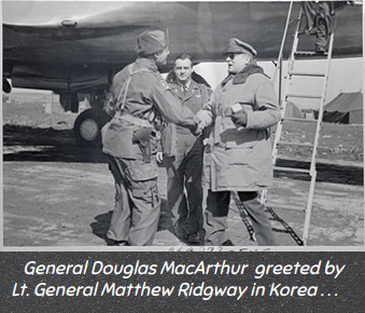
By mid-January 1951, Truman started receiving positive reports about Ridgway's efforts, and it became clear to Truman, SecState Marshall, and the #1 ranking general in the Army,
Omar Bradley, that Ridgway was the difference . . . but in Korea, Ridgway was the exception. Ridgway turned the tide of the Korean War like no other general in no other war, and unsurprisingly, the more Ridgway succeeded, the more difficult MacArthur became. MacArthur started to give press conferences stating that the only way true victory could be claimed was by unifying all of Korea, and that limited war was unacceptable. Top British military leaders were convinced that MacArthur wanted a war with China. General Bradley saw that as well, believing that MacArthur had been humiliated by the Red Chinese and wanted revenge to regain his lost honor.
It was true: MacArthur desperately wanted overwhelming military victories against the Chinese generals that had humiliated him on the global stage. It didn't seem to matter to MacArthur that his pursuit of reclaiming his "lost honor" could bring about WW III. Truman wanted to make an announcement that he would officially pursue a cease-fire in Korea on 24 March 1951, but MacArthur preempted Truman, making his own announcement which taunted the Chinese, labeling them a "defeated army". MacArthur's announcement wasn't only an insult the Chinese, but also a slap to the face of his Commander-in-Chief.
It was at that point that Truman made the decision to remove General Douglas MacArthur from his command. The final nail in MacArthur's coffin (he was a political klutz) was the letter he sent to Joe Martin, the (Far Right) Republican House Minority Leader, declaring that Chiang Kai-Shek, basically marooned in Taiwan, should get involved to increase the chances of total victory. MacArthur almost certainly had to know that Martin would widely release the contents of the letter.
Truman was advised that firing MacArthur would lead to the greatest political battle of his administration. As a result, Truman tried to play nice, sending a personal emissary to MacArthur, but of course, word leaked out, and MacArthur heard news of Truman's intentions on a radio broadcast. MacArthur told Ridgway, who was going to replace him, that Truman was mentally unstable. In the U.S., everyone had an opinion on "Truman v. MacArthur", and most everyone was emotional and very vocal (fights in bars were common, and fights among friends commuting on trains often occurred).
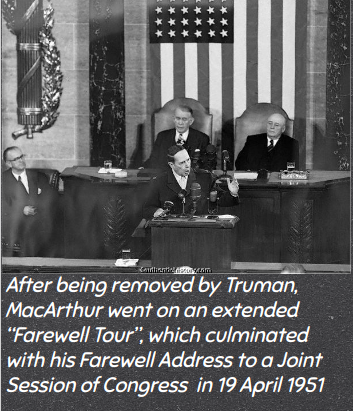
It was to that outpouring of emotion that MacArthur returned to America. Starting in Tokyo, then Hawaii, and then in the continental US, MacArthur's farewell tour didn't seem to have an end. MacArthur, the victimized narcissist, was in rare form even before his address to a Joint Session of Congress. The response to MacArthur's Farewell Address was split among party lines, with Republicans seeing a wronged great military leader, and Democrats seeing an out-of-control egotist/poser. Truman's comment regarding MacArthur's Farewell Address: "It was nothing but a bunch of damn b*%$@$*t".
 RSS Feed
