Mr. Jensen's U.S. History Website
  • U.S. History Blog
    • U.S. History Blog (May 2026 - May 2027)
    • U.S. History Blog (May 2025 - May 2026)
    • U.S. History Blog (May 2024 - May 2025)
    • U.S. History Blog (May 2023 - May 2024)
    • U.S. History Blog (May 2022 - May 2023)
    • U.S. History Blog (May 2021 - May 2022)
    • U.S. History Blog (May 2020 - May 2021)
    • U.S. History Blog (May 2019 - May 2020)
    • U.S. History Blog (May 2018 - May 2019)
    • U.S. History Blog (May 2017 - May 2018)
    • U.S. History Blog (May 2016 - May 2017)
    • U.S. History Blog (May 2015 - May 2016)
    • U.S. History Blog (May, 2014 - May, 2015)
  • About

Early Television: The Rise and Fall of Milton Berle

4/22/2017

0 Comments

 
                    Source: David Halberstam. The Fifties (1997)
Picture
     By 1949, radio was on the verge of being overtaken as a commercial vehicle by television. For over 20 years, radio had a monopoly on home entertainment, but now it was struggling as it tried to find its new role in the changing technological landscape. In startling fasion, one of the most popular and longest-running radio shows, the Fred Allen Show, died in June 1949, after an 18 year run.
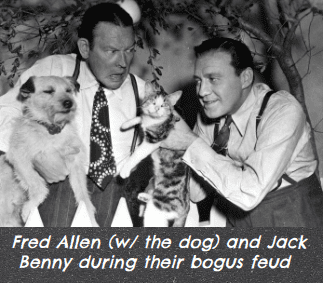
     For more than a decade, Allen owned his time slot as the foremost of radio comics. Allen was popular with the masses as well as the intelligentsia. Allen's most celebrated stunt was his fake feud with Jack Benny, also a top-rated radio comedian. Both would appear on each other's show to exchange insults. Allen's humor resonated with Americans during the Great Depression and World War II, but as prosperity exploded after the war, Allen's comedic attacks on the successful weren't as nearly well-received. By the late-1940s, Americans wanted to share in the success, not mock those that were already successful . . . the reality was that even without TV, Allen's schtick had worn thin.
Picture
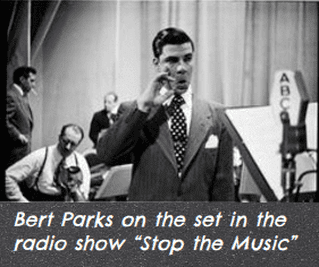
​     In 1948, Allen was still at the height of his popularity, but the radio show "Stop the Music!" with Bert Parks destroyed Allen's ratings. Allen tried TV, but he was one of the many radio personalities that didn't translate well to the new medium, and by December 1950, Fred Allen was off the air. 
     By 1950 there were 108 radio programs that had been on the air for 10+ years, with 12 of them being on the air for over 20 years. In 1953, when President Eisenhower ended the freeze imposed by Truman on awarding new TV stations, there were only 108 TV stations, with only 24 cities having two-or-more stations (it wasn't until 1951 that coaxial cable stretched across the U.S.). By 1953-54, people started to watch markedly more television, with massive toilet flushing in cities during commercial breaks, and people going to restaurants much earlier to be home for their favorite shows. Also, products advertised on TV soared in terms of public acceptance. The success of TV even threatened the movie industry, with theater closings being blamed on the new invader.
Picture
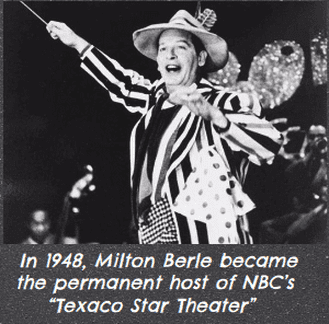
     The first example of the power of TV was the meteoric rise of Milton Berle, a slapstick   
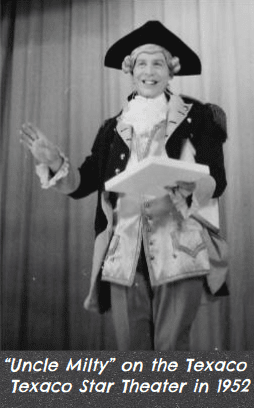
Vaudeville comic. Berle's humor was manic, sometimes even vulgar, and never droll. Berle arrived on TV in 1948 by chance: Texaco was looking for an emcee for their TV version of Texaco Star Theater, and Berle thought he would be a great fit for television. When Berle was hired, there were only 500,000 TV sets in the U.S.
     Almost from the start, Berle's show in Tuesday night became a weekly national event. The very success of Berle's show meant more TV sets were sold. A year into the show Berle was so famous he was on the covers of both Time and Newseek in the same week. The 42 year old Berle was America's first TV superstar. Where Allen was cerebral, Berle's comedy was very often over-the-top, which meant that he had to be seen.
Picture
     During the late-Autumn of 1948, Berle had a 94.7% rating (.947 of America's TV's were tuned to Berle). Early on, TV was an urban phenomenon: in 1949, almost half of America's 1.1 million TV's were in New York City (450k), with most of the remaining in Boston, Los Angeles, Detroit, Washington, D.C., Philadelphia, and Chicago. Berle appealed to the urban viewers, with 5 million watching him every Tuesday night (35% in NYC).
     Berle was paid $5000/week (nearly $50k in 2015 dollars) to do what he loved and did best. In 1951, NBC signed Berle to a 30 year contract for $200k/year, and it was at precisely that moment that Berle began to slip in the ratings. The further TV reached to non-urban areas, the lower Berle's rating became. As Berle's ratings decreased, his humor became more manic than ever, and he even changed the format of his show in the 1952-53 season. In essence, the show became more predictable and actually featured less of Berle. Texaco dropped its sponsorship when the show dropped to fifth in the ratings, and in the 1954-55 season, the show dropped to 13th, and soon Berle's show was only broadcast every 3rd week.

      In 1955, Berle was dropped from the show altogether, with his contract restructured to $120k/year, and he was allowed to appear on other networks. Berle was the first to experience the power and volatility of TV. The highs were greater than any other previous form of entertainment, generating an astonishing intimacy between performer and viewer. But the audience could quickly become less-enamored with the performer, and the star could crash as fast as he/she rose . . . it would be a lesson that entertainers, actors, and even politicians would learn the hard way in the passing decades.
Picture
0 Comments

The CIA Coup in Iran (1953)

4/9/2017

0 Comments

 
                     Source: David Halberstam. The Fifties (1997)
Picture
​     The Republicans, the minority party in national politics since the Election of FDR in 1932, constantly attacked the Democrats in the late-1940s/early-1950s for losing so much of the world to Communism. Once in charge in January 1953, President Eisenhower and the Republicans found that much of the globe was difficult/troubling, and those areas were very susceptible to Communism. The French were up to their necks with trouble trying to control Indochina (Vietnam) against indigenous communists, and the people of France were tiring of the whole affair, and the French government was asking the U.S. for more assistance.
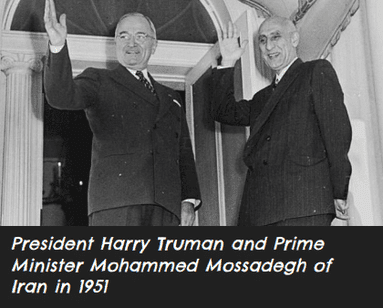
     World War II had hastened the collapse of Colonialism in the world, with Marxism finding very fertile ground. The Republicans didn't want to lose territory to the Communists, as they had accused Truman of "Losing China" in 1949 . . . but there were limits to American influence and power, as the Korean War was showing. Eisenhower thought he had found a solution to the dilemma with the Central Intelligence Agency (CIA), and its first chance to show what it could do occurred five months after Ike took office in June 1953 in Iran.  On 22 June 1953, the final meeting at the State Department concerning regime change in Iran occurred. The meeting in-and-of-itself was merely a formality, since the decision had already been made that the current leader of Iran, Prime Minister Mohammed Mossedegh, had to be removed.

Picture
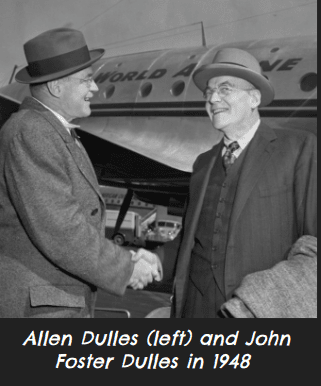
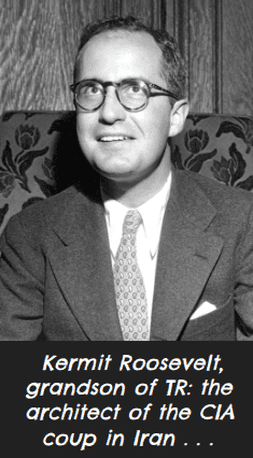
     In Secretary of State John Foster Dulles' office was his brother, Allen Dulles, Director of the CIA, as well was the CIA agent in charge of the operation in Iran, Kermit Roosevelt. The U.S. was moving into uncharted territory in terms of being actively involved in regime change in a sovereign nation. The Dulles brothers were able to bypass normal bureaucratic channels and procedures which would have interfered or slowed-down their planned covert operation. To both Dulles brothers, secrecy was essential in order to be effective in fighting the evils of global Communism.
     At the meeting as well was Walter Bedell
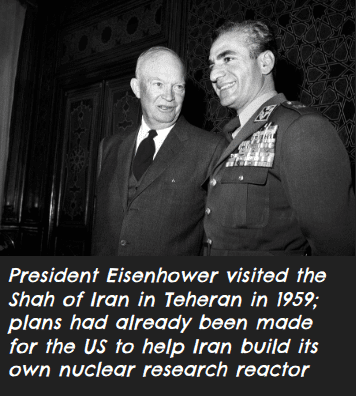
(Beetle) Smith, the Under Secretary of State. Smith, since WW II, had become one of Ike's most trusted-and-relied-upon men; no one admired Ike more than Smith. It was Smith's job to be Ike's "S.O.B.", and had become a true hard liner against the USSR after being the US Ambassador to Moscow from 1947-50. At the meeting, Smith was Ike's proxy. Kermit ("Kim") Roosevelt's plan was simple, in that if the Iranian people had to choose between Mossadegh and the Shah of Iran, Kim believed they would choose their traditional historic leader, the Shah.
     The stakes were high, given the oil in Iran as well as its strategic location bordering the USSR. The cost of the covert op would be $200k, at least half of which was for the "rental mob" to be used to protest against Mossadegh, who had been labeled an unstable maniac by the Eisenhower administration. Kim Roosevelt was TR's grandson, and he was very well-connected in D.C.; it had bee "Wild Bill" Donovan that brought Kim on board in the Office of Strategic Services (the forerunner of the CIA) during WW II. After the war, Kim's specialty had become the Middle East. Kim had become an expert on the relations between Iran and Great Britain; since the first successful oil strike in 1909, Great Britain had treated Iranian oil like it was their own.

Picture
​     After WW II, Britain had become an unwitting/unwilling accomplice, and even an architect, of the rising Iranian nationalism which began to surface in the late-1940s/early-1950s. By the time Britain offered Iran a 50-50 split (after their initial offer of 67-33) in oil revenues, it had become too late for deal-making. The Iranian politician that took the most advantage of the rising nationalism was Mossadegh, the Prime Minister, and he was easily able to muscle aside the young Shah (Mohammad Rezi Pahlavi) , whom the U.S. government thought weak. 
     During October 1951, Mossadegh ordered all British oil employees out the nation, and then had Iranian troops occupy a huge refinery. A Western boycott on Iranian oil followed, and Mossadegh broke off diplomatic relations with Britain. It was during these developments that the U.S. government under President Truman thought Mossadegh was moving towards Communism. During November 1952, Britain sought out Kermit Roosevelt, who still had access to his high-level contacts in Iran, about a coup against Mossadegh. Kim held off Britain, since he knew Truman would be at best lukewarm to the proposal. 
     Kim had predicted that the Republicans would like the plan, and he was proven right when "Beetle" Smith, once apprised of the plan, wanted to get going immediately. The key of the covert operation was the Iranian army; to whom would their loyalties lie, since only a few top generals supported Mossadegh. Both Britain and the U.S. wanted to remove Mossadegh: Britain wanted Iranian oil, while the U.S. wanted the oil but also to contain the USSR.

Picture
​     During February 1953, meetings between Britain and the U.S. started, and Ajax became the name of the covert operation in Iran. Kim saw that a new USSR ambassador had arrived in Teheran, the same one that had been in charge of the USSR coup in Czechoslovakia in 1948. So, it had become a race as to who would strike first in Iran, the British/U.S in support of the Shah, or the USSR in support of Mossadegh. 
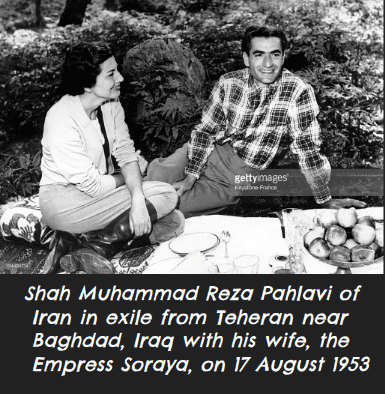
     Kim arrived in Teheran on 19 July 1953 to lead the covert op. Kim needed to move quickly and quietly in order to make all the necessary plans to mobilize-and-activate the pro-Shah mob. Kim even met the Shah in a car, with a blanket over Kim as the Shah got in the car. Kim told the Shah about the coded messages to be broadcast on the radio that were the signal to start the staged protests. By then, Kim had $1 million in Iranian currency, with only $100k earmarked for the mob. The Shah was instructed by Kim to be out of Iran when the coup occurred to not only reduce his visibility and perceived responsibility, but to also keep him safe if things went awry.
     On 16 August 1953, the coup started badly, with Mossadegh firing the first shot, claiming that the Shah had tried to fire him as Prime Minister. Mossadegh stated that his only recourse was to take all power in Iran, and for a day or so the pro-Mossadegh forces had control of the streets and the government.
​

Picture
     The pro-Shah mob took to the streets on 19 August 1953, and the tide quickly turned. When the pro-Shah forces made their move to take control, the Iranian army supported them and the exiled Shah, and Mossadegh went into hiding. The Shah of Iran was quickly returned and was back in power, and soon thereafter officially received Kermit Roosevelt. 
     Everyone involved on the U.S. side was delighted, since the coup was done quickly, cleanly, and cheaply. On 23 September 1953, President Eisenhower, in a private ceremony, awarded the National Security Medal to Kermit Roosevelt. In terms of Iranian oil, Britain formed the Anglo-Iranian Charter, which eventually became British Petroleum. Iranian oil was divided up, with the British receiving 40%, while Gulf, Standard, Texaco, and Mobil dividing another 40%. 
     Mossadegh was imprisoned for two-and-a-half years before being released. As the decades followed, the Shah was seen by his people as a mere pawn of the West, and his government collapsed in 1979, with barely a shot fired in his defense from his own people. Eisenhower and his loyalists were so encouraged by the successful coup in Iran that more covert operations were planned, and the role of the CIA was expanded . . . the seeds for the disaster at the Bay of Pigs were planted . . . 

0 Comments

1950s Consumerism, Television, and Madison Avenue

4/2/2017

0 Comments

 
                    Source: David Halberstam. The Fifties (1997)
Picture
      By the mid-1950s in terms of kitchen/household appliances, the price kept going down and the consumer kept buying more . . . it appeared that life in America would always get better. The great fear of manufacturers was that their sales/profits would decline, but just as with the automobile industry, the American consumer just had to have the latest appliance. Another fear was that Americans would save more relative to spending, but that also became an unfounded fear, in that Americans just kept buying.
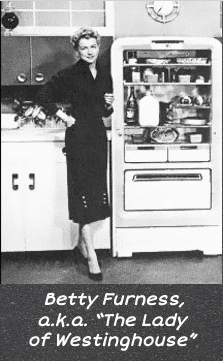
    Appliances quickly seemed to become outdated since the industry took the cue from General Motors by constantly updating models. In 1955, consumers spent $1.3B buying 4 million refrigerators, and the explanation was simple: frozen food. The figure that came to symbolize the dazzling new kitchen with appliances and advertising was Betty Furness, the Lady of Westinghouse. In 1949, Furness was 33 years old, and her career in over 30 movies (mostly B-movies) was winding down. Furness was attractive, but not in a way that made women jealous. Furness appeared as women wanted to be or envisioned themselves: bright, upbeat, confident, and modern without looking too glamorous. Furness exuded the kind of confidence that convinced women that their lives would be much easier with new appliances from Westinghouse.

Picture
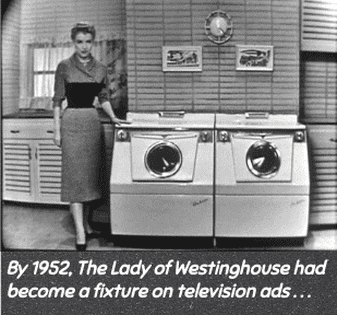
​     Furness became famous during the 1952 political conventions, since Westinghouse had purchased loads of TV commercial time; Furness was on the air about as much as Walter Cronkite, who made his reputation on TV during those conventions. Furness made 20 - 25 appearances each day during the week of each convention . . . thankfully by then the teleprompter had arrived. 
     Furness was not only famous, millions of women viewed her as a friend; to her surprise, to these women she was "Betty". The trademark phrase from the Lady of Westinghouse was "You can be sure if it's Westinghouse". Westinghouse signed Furness to a non-cancellable three year contract at $100k/year, and with that she became the Queen of American Appliances.
​     As she continued in her great job, she noticed that she began to shrink . . . the appliances were getting bigger-and-bigger each year. The only appliance that she advertised that didn't sell well was the dishwasher; women were afraid of losing their last "toehold" on the kitchen, according to industry research. Furness was with Westinghouse for eleven years; by the early-1960s, a the new Westinghouse CEO wanted a younger pitchwoman.

Picture
​     Furness was an example of the growing power of TV in terms of consumerism. In 1949, total TV billing from
Madison Avenue was $12.3m, in 1950, $40.8m, and in 1951, $128m. In the 1950s, advertising on TV compared with schools and churches with social influence. During the 1950s, the federal government started to close in on cigarette companies and their TV commercials. In July 1952, Reader's Digest (immune from advertising) published an article titled "Cancer by the Carton" that claimed a link between smoking and cancer. The cigarette industry, feeling at least somewhat cornered, introduced filter-tipped cigarettes.
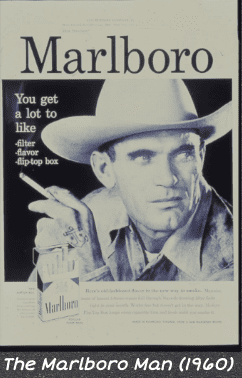
     It was at about this time that Philip Morris came out with Marlboro, originally a cigarette for women. But Philip Morris decided to push the product towards men; the problem was that at the time filtered cigarettes were considered to be effeminate. Philip Morris wanted an ad campaign (both print and TV) that showed that Marlboro was a masculine cigarette, for a real man. Over time, the brainstorming led from men with tattoos to a cowboy; the myth of the cowboy in the midst of fast-growing suburbs was a powerful lure to individualism. 
     The first Marlboro Man ad ran in January 1955, and the key to the campaign was the craggy-faced cowboy. Chesterfield cigarettes soon advertised with a cowboy as well, but as far as the American cigarette consumer was concerned, cowboys and the West belonged to Marlboro.

Picture
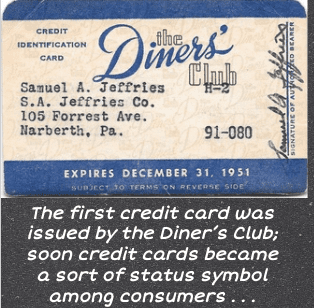
​     Capitalism in the 1950s was driven by ferocious consumerism, which had a different face than before WW II. Consumerism of the 1950s wasn't about need, it was about appearance, especially with neighbors. The target market were the millions surging into the middle class, and the preferred payment was credit, which was an important new development since the nation was prosperous, but not as prosperous as they may have believed. 
  Ordinary buyers were extended unprecedented credit limits. The Great Depression generation feared debt, but not the generation that came of age after WW II. But since millions of Americans in the 1950s had also endured the Great Depression and WW II, Madison Avenue had to find a way to balance the cautiousness of the past with the abundance and affluence of the 1950s. One thing that had to be sorted out on the advertising front was distinguishing between pleasure and guilt for those that were more affluent than their parents.

Picture
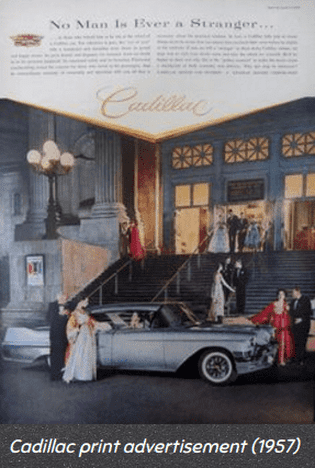
     The job of Madison Avenue was in essence to give moral permission to have fun without the guilt. Absolution had to be connected to gratification, and Cadillac had that aspect figured out. Cadillac was not only a top-of-the-line car, the best that money could buy, it was also a reward for a life's worth of hard work. The tone was set for more-and-more TV ads: the Head of the Household worked hard and selflessly, and he had earned the right to bestow these hard-earned fruits to his family, and to himself.
     That advertising strategy not only worked for Cadillac, but also for .15 cent hamburgers at McDonald's. America was slowly-but-surely learning to live with affluence, convincing itself that it had the right to new appliances, cars, and fast food, etc. For Madison Avenue, every year that went by in the 1950s, it became easier to sell compared to the "Puritan Past" before World War II.

  Addendum: The Plight of 1950s Suburban Housewives


0 Comments

    Archives

    May 2017
    April 2017
    March 2017
    February 2017
    January 2017
    December 2016
    November 2016
    October 2016
    September 2016
    August 2016
    July 2016
    June 2016
    May 2016

    Categories

    All
    18th Century
    19th Century
    20th Century
    Biography
    History

    RSS Feed

Powered by Create your own unique website with customizable templates.