Mr. Jensen's U.S. History Website
  • U.S. History Blog
    • U.S. History Blog (May 2026 - May 2027)
    • U.S. History Blog (May 2025 - May 2026)
    • U.S. History Blog (May 2024 - May 2025)
    • U.S. History Blog (May 2023 - May 2024)
    • U.S. History Blog (May 2022 - May 2023)
    • U.S. History Blog (May 2021 - May 2022)
    • U.S. History Blog (May 2020 - May 2021)
    • U.S. History Blog (May 2019 - May 2020)
    • U.S. History Blog (May 2018 - May 2019)
    • U.S. History Blog (May 2017 - May 2018)
    • U.S. History Blog (May 2016 - May 2017)
    • U.S. History Blog (May 2015 - May 2016)
    • U.S. History Blog (May, 2014 - May, 2015)
  • About

The Creation of the Standard Oil Trust (1882)

11/20/2016

1 Comment

 
             Ron Chernow. Titan: The Life of John D. Rockefeller, Sr. (1998)
Picture
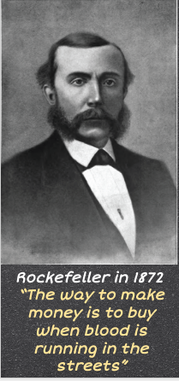
​     On 8 July 1879, John D. Rockefeller turned 40, and was one of America's 20 richest men, and easily the most obscure. Rockefeller's worth was often underestimated, with his stock in Standard Oil worth $18 million alone ($405m in 2015; when Vanderbilt died in 1877, he was worth $100m in 2015 dollars). By 1878, Rockefeller tried to be "semi-retired", often taking off afternoons, knowing that he had control over almost all of the refineries/pipelines in the oil industry. 
    It was at this time that the press, finally, took notice of Standard Oil and Rockefeller. In November 1878, the New York Sun featured a full-length profile of Rockefeller, and among the article's assertions was mention of a secret railroad deal from which Rockefeller benefited tremendously . . . put no proof was offered. By the early-1880s, Rockefeller had universal notoriety, much to his great chagrin and irritation. 
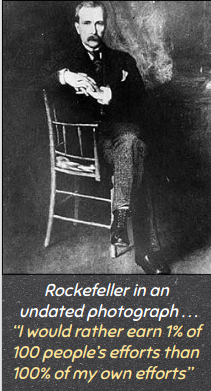
     In 1883, Rockefeller moved from Cleveland to New York City, pulled to the city due to the heavy kerosene trade. By 1884, Cleveland had been relegated to inferior status in terms of refining, and NYC, with all its seaboard refineries and its great port, was the new epicenter for Standard Oil. The export boom of petroleum products meant that Rockefeller had refineries in Brooklyn, Bayonne (NJ), Philadelphia, and Baltimore.
Picture
     In 1879, Standard Oil couldn't own companies outside of Ohio, so three mid-level employees held stock in scores of subsidiary Standard Oil companies outside of Ohio. When these three received dividends, they were distributed to the 37 investors of Standard Oil as "individuals" in amounts proportionate to their holdings in the company. Rockefeller held three times the holdings of Henry Flagler, the co-founder of Standard Oil. So, even though Standard Oil owned the vast majority of refineries/pipelines in the industry, Rockefeller could honestly, under oath, say that Standard Oil didn't own property outside of Ohio. Rockefeller could claim that private individuals in Pennsylvania, New York, Maryland, and New Jersey owned the companies outside of Ohio; technically, the 3 mid-level employees, "trustees" owned the properties, but that makeshift arrangement was only able to last three years.
     In 1881, Pennsylvania tried to tax Standard Oil properties, and Rockefeller feared that other states would follow suit, which would in essence mean that Rockefeller and Standard Oil would be held hostage by state governments. Standard Oil's holdings had reached a point where consolidation had to occur just to keep track of what was going on in the company and to continue to maximize profits. One of Rockefeller's advisers offered a brilliant strategy in which Standard Oil would create a company in each state it wished to do so (e.g. Standard Oil of New Jersey), and these separate companies would need separate boards of directors.
Picture
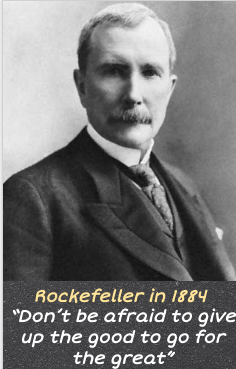
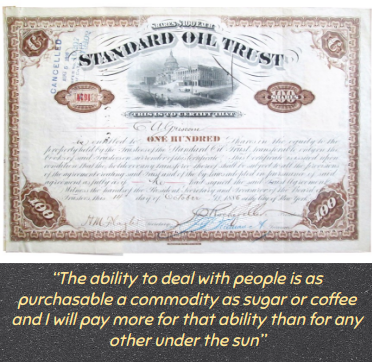
     Based on that advice, an Executive Committee was created, and the stock of the various Standard Oil companies would be placed in the hands of trustees on that Executive Committee, who would then issue certificates of interest in the Standard Oil Trust estate, which led to being able to distribute dividends. This elaborate "stock swap" would create a union of stockholders which would not be the legally operators of the corporation. On 2 January 1882, the Standard Oil Trust agreement was drafted; the public didn't know about the new arrangement until the Standard Oil Trust emerged spawning an enterprise of $70 million, controlling 90% of the industry's refineries and pipelines.
     It wasn't until six years later, in Congressional Anti-Trust hearings, that all that information was made public. Today, the Standard Oil Trust would be classified as a holding company, but at the time it seemed to be an imaginary entity, wielding infinite power but actually unable to do anything specific. The Standard Oil Trust received stock from Standard Oil of Ohio and 40 other companies; Rockefeller held 1/3 of the trust certificates worth $19 million ($470 million in 2015 dollars). 
     Negotiable securities were created from this arrangement, which meant that many Standard Oil employees would benefit greatly from owning stock, something that Rockefeller encouraged and assisted. By doing so, Rockefeller created a more motivated and closer-knit business culture for Standard Oil, and it also helped that employees received huge capital gains and dividends.
Picture
​    


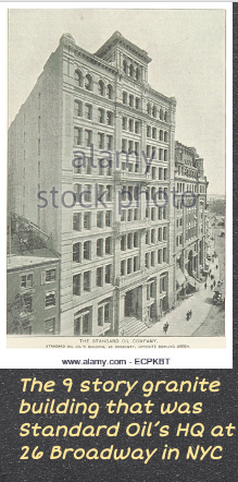
     In late-1883, Rockefeller started to assemble real estate holdings in Manhattan on Broadway, basically on property where the home of Alexander Hamilton was located. After spending almost one million dollars, Standard Oil moved into their new opulent building on 26 Broadway, the nine story granite building became the world's most famous business address. The relatively-grim exterior gave way to a dignified-yet-understated interior, which mirrored Rockefeller's personality. 
     Rockefeller delegated much and presided lightly and genially over his empire, invisibly asserting his will. In meetings, the quieter Rockefeller was, the larger his presence filled the room, which added to his mystique as an industrial genius. Rockefeller valued internal harmony among his chief executives, and often couched his decisions as suggestions or questions. Rockefeller operated by gaining consensus, rarely making outwardly unilateral decisions, which meant few missteps since every contingency had been analyzed. And somehow, Rockefeller accomplished all this despite the incredibly restrictive interstate laws concerning corporations, in that a corporation could only legally exist in one state.
Picture
     The general trend in big business after the Civil War was from freewheeling competition, to loosely-knit cartels, and then to airtight trusts. Oil prices wildly fluctuated with competition, but with the Standard Oil Trust, prices were stable, due to its enforcement and managerial powers. Rockefeller was at first an entrepreneur when he entered the oil refining business, but as the landscape changed, Rockefeller became a managing genius; Rockefeller basically anticipated the climate change in big business.
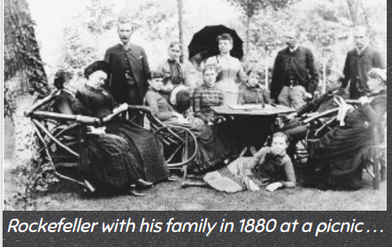
     Since Rockefeller never owned more than 1/3 of Standard Oil, he needed the cooperation of other people. Rockefeller understood that he needed to submerge himself in the complex layers of the Standard Oil Trust. The Standard Oil Trust introduced economies-of-scale that were impossible before 1882. Also, the quality of kerosene was improved, by-products were introduced, and costs across-the-board were cut.

Picture
    It was the Executive Committee that made all of that possible; they represented the 40+ companies that made up the Standard Oil Trust. Below the Executive Committee were specialized committees in such areas as pipelines, research-and-development, and efficiency (e.g. shutting down refineries), and incentives were created so the specialized committees actually competed against each other within the Standard Oil Trust. Rockefeller was always happy to purchase Standard Oil Trust Certificates from those willing to sell in that intra-competitive atmosphere.
​     Once Rockefeller made a decision on a specific goal, he pursued achieving it with all his skill, patience, and acumen. However, once Rockefeller made that decision, he was impervious and deaf to criticism, much like a rocket that could only keep going higher, never turning back as long as it still had fuel to burn.

1 Comment

President James Monroe, 1817 - 1825: Part Three

8/1/2016

0 Comments

 
                    Source: Harlow Giles Unger. The Last Founding Father -
                     James Monroe and a Nation’s Call to Greatness (2009)
Picture
     In 1822, President James Monroe decided it was time for the U.S. to join other nations in the "Recognition League"; Monroe officially recognized both Colombia and Mexico as independent nations. In 1823, what became known as the Monroe Doctrine (by the 1850s) was mostly written by Monroe, not his Secretary of State John Quincy Adams (although JQA was instrumental in suggesting and outlining the overall framework).
     On 2 December 1823, Monroe sent Congress his 7th Annual Message. Contained in the message was his dictum of "closing off" the Western Hemisphere to European colonizing-and-meddling. Monroe went further, saying that if a European nation(s) interfered in the Western Hemisphere, it would be seen as a threat to the United States. Monroe also stated that the U.S. wanted no part of Europe's affairs or wars (although trade with Europe would be uninterrupted). Monroe made sure to mention in his annual message that the U.S. Navy would be strengthened and far more active.

     Monroe's statements in his 7th Annual Message to Congress drew universal acclaim across America . . . it was one of the most popular announcements Monroe made during his entire time in office. London praised Monroe, while Czarist Russia dismissed it with contempt. The simple reality after the War of 1812 was that no European nation had the wherewithal to prevail in a lengthy trans-Oceanic war with the U.S. It was far-less costly to trade and make money than to try and subjugate America. By the end of 1823, Monroe was able to dispel America's fears of foreign attack.
     By the early-1820s, the U.S. became even more powerful economically, and even militarily, despite the small national army. The young nation had built many more roads and canals and steamboats, which networked America like never before. However, Monroe, for the only time in his Presidency, vetoed a bill, the National Road Bill, shocking the nation. Monroe argued that the Constitution did not grant power to the federal government for "internal improvements" connecting states. Monroe went on to say in his veto message that the military had the authority to build roads and canals between the states in the interest of national defense.
Picture
      In 1824, Congress passed the General Survey Bill, which authorized $30,000 for the construction of roads and canals vital to national defense. The Constitution clearly empowered the Legislative Branch to provide for the "common defense" and to "regulate commerce". Phrased in that manner, Monroe signed the General Survey Bill into law, and the expansion and networking in the U.S. continued at a manic pace.
     Monroe let it be known early in his 2nd term that he, like Washington, would not seek a third term. That announcement started the political free-for-all in the Cabinet (with the exception of SecState Quincy Adams) where pursuit of self-interest and advancement by far trumped the national interest. Among the members of the Cabinet, SecTreas William Crawford was by far the most aggressive; Crawford even confronted Monroe in the White House over appointments that he felt should have gone to those loyal to him. Crawford threatened Monroe with his cane, and Monroe grabbed fire tongs, preparing to defend himself. Thankfully, the Secretary of the Navy was present, and he escorted Crawford out of the room . . . a very bitter-and-ambitious Crawford never set foot in the White House again while Monroe was President.
Picture
      Meanwhile, Andrew Jackson, was proving to be an embarrassment for Monroe with his behavior and decision-making as the Territorial Governor of the recently-acquired Florida. As a result of the (mostly self-inflicted) controversies, Jackson resigned, and loudly proclaimed that Monroe was the reason for his troubles in Florida. The only good news associated with Monroe's decreasing influence during his 2nd term was that he was able to spend more time with his family. By 1824, Monroe concluded that SecState John Quincy Adams was the best qualified to succeed him as President, but for the time-being, Monroe kept that opinion to himself.
     The last positive event that occurred during Monroe's Presidency started in 1824, when
Lafayette accepted the President's invitation to tour the U.S.; Monroe hoped that Lafayette could rekindle national unity. Monroe's old friend from the Revolutionary War received the largest celebrations in U.S. History to that point, and for many decades later. Towns and cities did their best to outshine each other in honoring Lafayette. On 12 October 1824, Lafayette arrived in D.C., and finally the two Revolutionary War friends saw each other again in the White House. It was quite the scene, in that the last Revolutionary War Era President shook hands with the only surviving general from Washington's Army. An added bonus for Monroe was that for at least awhile, Lafayette's tour made the upcoming Election of 1824 a secondary event. 
Lafayette spent December of 1824 and January/February of 1825 in Washington, D.C.
Picture
      On 1 December 1824, John C. Calhoun was elected Vice-President with 182 Electoral Votes (Calhoun was trying to use the Vice-Presidency as a springboard to the Presidency), but the Electoral Vote for President was an absolute mess. Jackson received 99 Electoral Votes, but that was well-short of the 131 needed to be elected President. Next was JQA with 84, William Crawford at 41, and Henry Clay with 37. The election went to the House of Representatives, with each state's delegation representing one vote, and 13 states needed to be elected President
     Clay's ambition to eventually become President led to a deal being made: if JQA would make Clay his SecState, then Clay would swing enough states his way to elect him President. The results of the House vote were JQA 13, Jackson 7, and Crawford 4 (he was physically unable to be President in that he had suffered a serious stroke in 1823). Those loyal to Jackson immediately cried foul, declaring that JQA and Clay denied Jackson the Presidency in a "Corrupt Bargain". Clay believed that he had out-maneuvered Jackson, but the Average American (who by the early-1820s was able to vote) saw trickery and machinations, and Jackson would win by a large margin in 1828.
     Monroe's last message to Congress included asking for funds for Lafayette, who was basically broke. Congress allocated funds to save Lafayette, but was unwilling to do the same to help Monroe. By then, Monroe was $75,000 in debt, $53,000 of that was in essence "back-pay" that Congress owed Monroe from his years serving as a diplomat in Europe, including expenses.
Picture
      Monroe even provided an itemized account of his expenses in Europe, but Congress only authorized $29,000 towards the outgoing President. The money took care of Monroe's most pressing-and-immediate debts, but Monroe was insulted nonetheless. Monroe was never able to climb out of debt, and he died on 4 July 1831 at the age of 73; ironically, Monroe joined former Presidents John Adams and Thomas Jefferson in dying on Independence Day. President Andrew Jackson declared a National Day of Mourning on behalf of Monroe.
     By the early-1830s, Monroe's self-serving politically ambitious successors had started to seriously undermine national unity, which on a variety of fronts led to the Civil War thirty years later. And to this day, for better-or-for-worse, U.S. Presidents have invoked the Monroe Doctrine, for both Isolationist and Expansionist reasons.
0 Comments

James Monroe and the War of 1812, Part Two

7/4/2016

0 Comments

 
                        Source: Harlow Giles Unger. The Last Founding Father - 
                         James Monroe and a Nation’s Call to Greatness (2009)
Picture
     As the War of 1812 unfolded, nothing seemed to go right for President James Madison. The nation was bankrupt due to the politics and shortsightedness in Congress that refused to recharter the National Bank. And, due to the actions of Secretary of War John Armstrong, the nation was low on morale as well. To most Americans, Madison seemed impotent; everything Madison said-and-did alienated more-and-more Americans in the early stages of the War of 1812. Madison finally asked Congress to repeal the Embargo Act of 1807, which Congress proceeded to do, but the repeal didn't help much, if at all.      
       Captain Thomas Macdonough and his fleet saved "America's Bacon", so-to-speak, at Plattsburg
on Lake Champlain. Macdonough, using the geography of the lake to his advantage, surprised the advancing British, similar to Benedict Arnold at the Battle of Valcour Island in 1776. After two hours exchanging cannon fire, the British retreated north, and were no longer a threat to invade the U.S. from Canada. Also, despite repeated attacks at great cost, the British were unable to re-take Fort Niagara.
     The British response to the failures in New York State was to reorganize and mass their military force in Chesapeake Bay. Secretary of State James Monroe asked SecWar Armstrong to be sure and safeguard America's important documents in Washington, D.C., and even offered his services as a spy on horseback, monitoring British movements. Armstrong refused Monroe on both counts . . . Armstrong had convinced himself that the British were not heading towards the nation's capital, but to Baltimore.

Picture
      Eventually, President Madison realized that Armstrong's intransigence bordered on treason, at which point Madison took personal command of the military, and made Monroe his top commander. Monroe was at Bladensburg (MD) trying to organize the soldiers in the face of advancing British Redcoats. Monroe advised Madison to evacuate Washington, D.C. and to secure the nation's important documents and public records. 
     At the "Bladensburg Races", 7500 US soldiers/militia abandoned the field against 4000 British troops, with over 2000 American never firing a shot (some soldiers ran so fast in retreat that they entered D.C. before their President). Monroe was on his horse going against the torrent of retreating soldiers, trying to find the commander, General William Winder, to reorganize at least some of the men. The best Winder could do was to order his men (that were still in the area) to head to Baltimore . . . Monroe didn't abandon the capital until 8 pm.
    The buildings that received the worst "treatment" by the British were the White House and the House section of the Capitol Building. President Madison, badly shaken, named Monroe Secretary of War pro tem as well as the Supreme Military Commander. Monroe, armed with de facto dictatorial powers, ordered hastily-built defenses erected around Washington, D.C. in order to try and defend another British attack. Monroe deployed 7000 men in strategic areas, and made sure all available artillery was ready and properly located.

Picture
​     SecWar Armstrong returned, but no one wanted to follow him. Armstrong vilified Monroe in the press, claiming it was Monroe's fault that everyone had turned on him. Newspapers, as well as the general public, savaged President Madison, SecWar Armstrong, and General Winder, but treated Monroe as a national hero. Monroe called in the militias from other states, secured necessary supplies, and established a network of riders (a la the Committees of Correspondence from the Revolutionary War Era). Monroe rarely slept, and was seemingly everywhere, immersing himself in the defense of the nation's capital . . . his actions and presence raised the morale of not only the soldiers and politicians, but the area's citizens as well.
     Monroe issued orders to General Andrew Jackson to take is 1000+ men from Mobile (AL) to New Orleans, promising 10,000 more soldiers in support. Monroe replaced the impotent and ineffective General Winder at Baltimore, which proved to be a very wise decision when the British made their move on the city. Monroe also browbeat banks to loan the federal gov't $5 million with only Monroe's signature as collateral; New York City loaned Monroe $1 million.
     After the defeat of the British at Fort McHenry, the British fleet sailed to Jamaica, leaving the Chesapeake, at least in force. By then, Monroe WAS the Executive Branch; Madison deferred to Monroe on almost every decision. Monroe also instructed the Secretary of the Treasury, Alexander James Dallas, to start the process for chartering a 2nd National Bank by arranging for a capital outlay of $50 million. But Congress gutted the Bank Bill, so much so that President Madison vetoed the bill when it reached his desk.

Picture
     James Monroe wanted a standing army of 100,000 men, but Congress limited the army to 10,000. Monroe slipped in a spy at the Hartford Convention, and ordered the Governor of New York to mobilize his militia on a moment's notice in case the Federalists at Hartford actually decided on act on their threat of secession. Monroe's spy at the Hartford Convention told him that nothing of great magnitude had occurred, and Monroe told the Governor of New York to stand down.
    
​     Meanwhile, Jackson did not go to New Orleans right away as ordered. Instead, Jackson believed that Spain was ready to assert itself in Pensacola in what was left of Spanish West Florida (President Madison had taken the westernmost section of Spanish West Florida in 1810), so Jackson and his army headed in that direction. Spain freaked out, and asked Britain for help, and four British warships entered Mobile Bay, and started shelling Jackson's fort. Jackson's artillery scored a very lucky shot, sinking one of the British ships. At that point, Jackson felt that he had more-than-enough reason to take the Spanish strongholds at Pensacola, and was able to do so fairly easily, since there wasn't very much Spanish resistance.

Picture
     Jackson's army didn't arrive at New Orleans until 1 December 1814. On 8 January 1815, the British unleashed their offensive on Jackson's position outside the city, and incredibly, lost over 2000 men, while Jackson had 52 casualties (13 KIA, 39 WIA). A few days later, Monroe announced Jackson's victory to the assembled government in the U.S. Patent Office (the only major government building that remained untouched); huge cheers emanated from Hawks, Doves, Federalists and Republicans alike. 
     
​     Unbeknownst to the government, John Quincy Adams at Ghent (Belgium) had signed a treaty that accepted a return to the status quo before the war. Spanish West Florida remained in U.S. possession, but nothing was really settled in terms of the most vital American interests, especially concerning the borders. As a result of the War of 1812, 1877 Americans were killed, 4000+ were wounded, the US Gov't was millions of dollars in debt, which led to a depressed economy in the short-run and national bankruptcy. While none of the government's pre-war goals were achieved, Americans celebrated as if they had won the war. News of New Orleans, followed by Ghent, convinced America that they had defeated Great Britain in a "2nd War of Independence". Then, a third piece of news reached Americans - the Hartford Convention, which resulted in the destruction of the Federalist Party as a major player in American politics, since they were seen by most Americans as the Party of Disloyalty and Secession.

Picture
​     Overall, the delusion of victory against the British occurred due to several happy coincidences. First came news of the victories on Lake Champlain, followed by Lake Erie, Baltimore, and then New Orleans. Then came news of the Treaty of Ghent; in the public mind, all those events were seen as cause-and-effect. A few months later, the U.S. and Great Britain signed a series of commercial accords that led to the expansion of both nation's economies. The War of 1812 became "Old News" very quickly in America, due to the greatest prosperity since before the Revolutionary War.
     Monroe received the lion's share of the glory and credit since the area between the Appalachian Mountains and Mississippi River were no longer threatened by foreign invasion. Westward expansion to the region increased tremendously; never before in human history had so much land been transferred to "commoners". With the increase in property ownership came the right to vote, which led to seismic shifts in the American political, economic, and social landscapes in the 1820's. And finally, Congress authorized a 2nd National Bank, which, belatedly, started the process of solidifying the federal government's finances.
     Monroe was near collapse, having worked basically non-stop for the previous six months. President Madison's popularity had rebounded (he was far more popular leaving office than was Jefferson), but Monroe's popularity was reaching stratospheric levels. Monroe was, in effect, acting as the nation's President and Commander-in-Chief even after the war, exhausted though he was. Since he had far more free time on his hands, Monroe read John Marshall's lengthy biography on George Washington, and the volumes changed how Monroe would make decisions as a public figure and as President.

Picture
     While Monroe was incredibly popular, there was growing discomfort and resentment towards continuing the "Virginia Dynasty" (Washington, Jefferson, Madison) for President. Party nominations were in the hands of each party's Congressmen, who held a caucus for nominating candidates for President and Vice-President. It soon became clear that Monroe was the most qualified for President; even the rising political star from Georgia, William Crawford, saw Monroe in that light. Crawford also knew that if he challenged Monroe and lost, his political career may be not only be over, but he also would most likely not be considered for an important Cabinet post. So, Crawford withdrew his name from consideration for President for the Republicans, and the total results of the caucuses favored Monroe, by a margin of 65 to 44 for Crawford (Crawford constantly reminded Monroe of his "political sacrifice").
    
     Crawford had refused Madison's offer of Secretary of War in 1811 when the US and Great Britain were on the verge of war, and served as a minister in Europe until he accepted the once-again-offered post of Secretary of War in 1815 after the War of 1812. Crawford became Madison's Secretary of the Treasury in 1816, and Monroe would retain Crawford as his Secretary of the Treasury for his entire Presidency.
     During the months before the Election of 1816, both candidates, James Monroe for the Republicans, and Rufus King for the Federalists, didn't actually campaign for President, in that there was no point since party membership had drastically declined. King and the Federalists had nothing to criticize or attack, since the war was over, the economy was doing very well, and an increasing number of Americans were entering the propertied-class due to Westward Expansion. Monroe's popularity and credibility were such that the Federalists had no real chance to reclaim the White House (which had become the nickname of the President's Mansion after it was rebuilt after the British attack). The election of James Monroe as the nation's fifth President ushered in the "Era of Good Feelings" in 1817 . . . 

0 Comments

President James Monroe, 1817 -  1825: Part Two

7/3/2016

0 Comments

 
                    Source: Harlow Giles Unger. The Last Founding Father -
                     James Monroe and a Nation’s Call to Greatness (2009)
Picture
     By 1818, President James Monroe had liquidated the national debt of $67 million (due in most part to the War of 1812) without collecting any additional taxes. Also in 1818, the first segment of the Cumberland (National) Road was completed, spanning 130 miles from Cumberland (MD) to Wheeling (now WVA), which opened the West to large-scale farming. Roads, canals, and steamboats drastically lowered transportation costs yet increased the speed of delivery of goods. Also in 1818, the first fifteen miles of the Erie Canal opened; this canal would eventually make New York City the biggest-and-busiest city on the Atlantic Seaboard.
​     But in early-1819, the Panic of 1819 ushered in America's first economic crisis of the century. The Panic of 1819 was caused by the super-inflated prices of Western land speculation combined with shady bank practices, which led to hundreds of banks shutting down. As a result, the largest number of depositors to that point in US History lost their money. One bank in Rhode Island was initially capitalized at $45, yet the bank issued $800,000. Due to such unscrupulous practices, Congress passed a law requiring banks to literally back up their money with specie (coin) or precious metals such as gold.

Picture
     Due to the banking law, most banks simply just shut their doors, knowing that there were no laws on the books that could be used against them in an ex post facto situation. President Monroe was helpless to combat the banking crisis, and the only weapon in the arsenal of Congress was to increase tariffs. Thankfully, the Panic of 1819 wasn't nearly as serious as the Panic of 1837. The only Americans that were seriously hurt were the land speculators (such as Andrew Jackson; he never forgave the 2nd Bank of the United States for his diminished portfolio) and bankers that caused the Panic of 1819. Farmers across the nation, including the West, went about their business, living off the land and bartering for what they needed.
     The "Era of Good Feelings" took another hit when the territory of Missouri applied for statehood in 1819. Secretary of State John Quincy Adams stated that President Monroe believed the crisis could be "winked away with compromise" . . . JQA did not share Monroe's perspective on the matter. The House and Senate, divided due to sectionalism, delayed any decision on adding Missouri as a state to 1820. Monroe was not as unconcerned as JQA believed; the President saw the slavery debate as "menacing" to the tranquility of the nation.

Picture
     On 30 March 1820, Monroe started the last leg of his Goodwill Tour, which would take four months traveling over 5000 miles across six Southern states. Monroe started in North Carolina, then traveled through South Carolina to Savannah (GA). Monroe felt the toll of his sojourn soon enough, cancelling his stop at St. Louis and shortening scheduled destinations in Kentucky and Tennessee. After detouring to northern Alabama, Monroe arrived at Nashville (TN) on 6 June 1820. Monroe stayed with General Andrew Jackson at the Hermitage, and the two American titans smoothed out any differences they had over Florida in 1818. Monroe next traveled to Kentucky, and then even to southern Indiana before returning to D.C. on 9 August 1820.
    Missouri was added as a "Slave State" without a Northern "Free State" to maintain equilibrium in the U.S. Senate. The South saw that development as long-delayed justice, in that votes in the Senate that ended in a tie were broken by a Northern Vice-President in favor of the North, and in the House, the South was a 105-81 minority to the North. Monroe ordered his Cabinet to avoid engaging in the debate over Missouri with each other in order to try and keep a semblance of equilibrium among its members. Before the end of 1820, Maine petitioned to become a "Free State", and with the
Missouri Compromise (1820), balance returned to the Senate, and the "36 degree 30 minute North" line of latitude was drawn as far west as America's border reached.

Picture
   The Election of 1820 was the last Presidential election to be solely determined by the  Electoral College without being based on each state's popular vote. Monroe received 231 of 235 Electoral Votes; there were 3 abstentions, and the remaining Elector cast his vote for John Quincy Adams so George Washington would remain the only unanimously selected President.
     By Monroe's 2nd Inauguration on 4 March 1821, time had seemed to pass by the President, in that as the last Founding Father, Monroe was viewed in an increasingly antiquated fashion. In the view of more-and-more Americans, the work of the Founding Fathers was complete, and it seemed that America was looking to the future for their leaders. As 1821 unfolded, Monroe had to deal increasing disappointments, such as Secretary of the Treasury William H. Crawford claiming the federal government had a $7 million surplus, but the reality was a $5 million deficit. 
​    Congress responded by slashing military spending by 75% (from $800k to $200k). Crawford's "mistake" was intentional, in that he wanted to embarrass and discredit Monroe during his 2nd term. In Crawford's mind, a "Zero-Sum Game" existed between him and Monroe, in that a gain by Monroe was perceived as a corresponding loss by Crawford, and vice-versa. In a way, Monroe was a victim of his own political success, in that he had forced the demise of the Federalist Party. With no rival party on which to focus, prominent politicians such as Crawford started to attack others in their own party that were seen as obstacles to their path of towards the Presidency.

Picture
     During his 2nd term, Monroe discovered that he had no way to discipline the members of his Cabinet. With the exception of SecState Quincy Adams, the other members of the Cabinet started to jockey for position to be the next President. Monroe had accidentally created political anarchy, and his Cabinet officials and other prominent politicians used constituents from their region as their political base instead of using a political party, which undermined national unity and advanced Sectionalism.
     Among SecTreas Crawford's goals with his various shenanigans was to also discredit SecWar Calhoun as a potential rival. Monroe stubbornly refused to involve himself in the rivalries in his Cabinet. Monroe became an early "Lame Duck" (a British metaphor for "defaulter") during his 2nd term in many ways. Ironically, by 1821, Monroe was in the same situation as was Madison during his second term, except that Monroe didn't have a "Go-To Guy", as Madison had with James Monroe coming to his (and the nation's) rescue during the War of 1812.

0 Comments

President James Monroe, 1817 - 1825: Part One

7/2/2016

0 Comments

 
                    Source: Harlow Giles Unger. The Last Founding Father -
                     James Monroe and a Nation’s Call to Greatness (2009)
Picture
​      The Inauguration of President James Monroe on 4 March 1817 was the equal of George Washington's, even surpassing the Inaugural of the first President in some ways. Monroe had been the most powerful and visible figure in the second term of President James Madison, and accurately-or-not, Monroe was viewed as the military/diplomatic hero of the War of 1812. Also, Monroe has seen as the political figure most responsible for the burgeoning economy and Westward Expansion.
     In his Inaugural Address, Monroe outlined his priorities as President. First was to unify the nation, and second was to strengthen national defenses. Thirdly, Monroe wanted to further expand the economy featuring such aspects as roads, canals, manufacturing, and increased agricultural output. The phrase that resonated in the nation's newspapers from Monroe's 1st Inaugural Address was "National Honor is National Property". 
     Chief Justice John Marshall, Monroe's close friend since childhood, officiated the Oath of Office. Both men had reached the pinnacle of personal and political triumphs in the Executive and Judicial Branches of the federal government. Although Monroe disagreed with most of the Marshall Court decisions, Monroe took full advantage of them as President, doing things that the Jefferson Strict Constructionists would never have allowed, or even conceptualized. Marshall gave Monroe the tools to create the American Empire, as well as the greatest extended period of prosperity to that point in American History.

Picture
     Of America's first five Presidents, James Monroe was the most qualified and experienced entering office, since in effect he was the Executive Branch during the last two years of Madison's Presidency. Monroe wanted his Cabinet to reflect the regions of the U.S., and to allow him to make decisions as President by consensus. John Quincy Adams of Massachusetts was Secretary of State, and William Crawford of Georgia continued as Secretary of the Treasury. Monroe nominated     Henry Clay of Kentucky as Secretary of War, but Clay was insulted by the offer, since he had expected the honor of being Secretary of State. So, Clay refused Monroe's nomination, and continued as Speaker of the House. 
    Monroe finally found (actually he settled for) John C. Calhoun, a Representative from South Carolina twenty-four years his junior, as his Secretary of War; Calhoun shared Monroe's desire for defending America's extensive borders. Monroe retained both Richard Rush of Pennsylvania as Attorney General, and Benjamin Crowninshield of Massachusetts as the Secretary of the Navy. Monroe refused to have any Federalists in his Cabinet since he was still upset-and-distrustful with Federalists after the Hartford Convention (December 1814); to Monroe, even discussing the possibility of secession equaled treason.

Picture
     President Monroe decided to tour the nation to promote national unity, very much like Washington did early in his first term. It had been 25 years-or-so since Americans outside the nation's capital or President's hometown had seen the President of the United States. Monroe also wanted to meet Americans, learn about their region, and see for himself the state of America's defenses. Monroe was able to tour the North in the summer months due to Congress being in recess and with his SecState, John Quincy Adams, running the Executive Branch. 
     On 1 June 1817, Monroe set out for Baltimore, planning to use a combination of steamboats, carriages, and riding on horseback to be as anonymous as possible for his Goodwill Trip, but large crowds immediately shattered Monroe's plan of being incognito. The tour became a triumphant procession, with as many as 10,000+ waiting to see/hear the President. On 9 June 1817, Monroe reached New York City, and he traveled up the Hudson River on a Navy steam frigate to West Point. Then Monroe traveled to New England, including Boston, where he was in front of immense crowds since he was a Revolutionary War Hero.
     At a dinner party in Boston, Monroe was surprised to see former (Federalist) President and First Lady, John and Abigail Adams. Also at the dinner party former Federalist Secretary of State Timothy Pickering, who had been beyond-difficult for Monroe when he was America's chief European diplomat. The sight of Monroe, the Adams, and Pickering at the same table was witnessed-and-reported by the newspaper The Chronicle and the Patriot. The editorial asserted that the last time a congenial meeting occurred among those of different parties was before 1790 . . . that editorial, among others, was the genesis of the moniker "The Era of Good Feelings". 

Picture
     Monroe traveled as far as Detroit, and then through Ohio, Pennsylvania, Delaware, and then back to Washington, D.C. in September 1817. When back in the nation's capital, Monroe pressed Congress to abolish all income/internal taxes, since trade and the sale of public lands in the West would provide more-than-enough revenue for the federal government. By then, the President's House had been rebuilt from the destruction by the British invasion of the capital in 1814, and the new exterior walls were blackened sandstone slathered with white paint . . . the home of the President would soon have the nickname of the White House. 
     The First Lady, Elizabeth Monroe, was a physical mess, suffering especially from rheumatoid arthritis, and she also disliked crowds. Therefore, she wasn't able to be near the public hostess as was her predecessor, Dolley Madison. However, Elizabeth did refurbish the White House, and it was "kind-of" open to the public. Elizabeth's pain-and-discomfort was such that she wasn't able to visit the wives of the DC Elite like previous First Ladies, and as a result (of course) nasty gossip at the expense of Elizabeth was spread among the Elites in D.C. Monroe helped his wife by making sure that there weren't as many Presidential galas as in previous years, and those that occurred were held only when Congress was in session.
     The Monroes were accused by the gossip-mongers of turning the White House into a de facto European Court. The root of the nasty gossip among the wives of the DC Elite was simply their jealousy of the beautiful, graceful, very-well-educated, and worldly Elizabeth . . . these series of slanderous smears have sadly obscured her place among the list of our nation's outstanding First Ladies.

Picture
     Except for the petty social skirmishes/gossip concerning the White House and the Monroes, it sure seemed that the "Era of Good Feelings" would continue indefinitely. Monroe established decent connections with most of Congress, and there was a constant flow of Representatives and Senators to the White House. 
     Monroe's first crisis (of sorts) came when constant pirate attacks kept occurring on Amelia Island on the Spanish Florida / state of Georgia coastline and also off the port of Galveston, Texas. Additionally, and of far more political significance, renegade Seminole warriors continued to raid Georgia plantations, and then retreated to the safety of Spanish East Florida. Monroe ordered General Andrew Jackson to the vicinity of Spanish East Florida (by then, West Florida had been taken by the U.S.; also by then Monroe and Jackson had become friends). 
     The instructions that General Jackson received from SecWar Calhoun in terms of dealing with the Seminoles in Spanish Florida were vague, as were those from President Monroe. Jackson knew that Monroe's long-term goal was to eventually take Spanish East Florida, so Jackson's response to Monroe was that if he didn't hear from his superiors in 60 days, he would take appropriate action. Monroe believed that he couldn't reply to Jackson's response for Constitutional reasons, and Monroe didn't instruct SecWar Calhoun to send a message to Jackson that prohibited him from attacking outposts occupied by Spanish troops. 
     So therefore, no instructions from either President Monroe or SecWar Calhoun reached Jackson within the 60 day period, so Jackson interpreted Calhoun's vague original orders as permission to invade Spanish East Florida with 1000+ men, and he "let slip the Dogs of War".

Picture
     On 24 May 1818, Jackson captured Pensacola, which was in effect the capital of the panhandle of Spanish East Florida. Jackson wrote Monroe asking for more troops so he could move on St. Augustine. Monroe was so pleased with developments that he went on a Southern Goodwill Tour, taking along members of his Cabinet which included SecWar Calhoun. Calhoun thought Jackson's attack on Spanish East Florida was a direct challenge to his authority as Secretary of War. Monroe managed to calm down Calhoun, telling him how Jackson thought and acted, and that Jackson's actions had nothing to do with the SecWar. 
     Monroe started his Southern trip in the Chesapeake Region, focusing especially on Virginia. But Monroe had to cut his trip short in that Speaker of the House Henry Clay had whipped up a "Holy War" against General Jackson on Capitol Hill and Monroe headed back to D.C. to defend his general. When it came to Jackson, Clay was out-of-step with the vast majority of Americans that saw Jackson as a national hero. 
     President Monroe, as well as SecState Quincy Adams, thought that Jackson had actually increased America's international standing by attacking Spanish East Florida. Monroe instructed SecState Quincy Adams to give Spain an ultimatum: cede the rest of Florida to the U.S. or keep the raids from the Seminoles from occurring. Spain had its hands full with their possessions in South America, and the Spanish government (in Madrid and in Florida) was beyond-terrified of once again facing who they called the "Napoleon of the Woods" (General Jackson) . . . so Spain capitulated to Monroe.

Picture
     In order to save Spain some face with other nations in Europe, Monroe ordered Jackson to leave Spanish East Florida before all of Florida was ceded to the U.S. Government. In the
Adams-Onis Treaty (1819), the U.S. not only gained the rest of Florida, but the government also renounced all claims to Texas. The Adams-Onis Treaty also defined, at long last, the western border of the Louisiana Territory, reaching all the way to the Pacific Northwest (the treaty in actuality finalized the Louisiana Purchase). In sending Jackson into Spanish Florida, Monroe started a series of events that led to the Adams-Onis Treaty, which allowed the U.S. to seize control over most of what is now the 48 contiguous states.
     Monroe now had what constituted meaningful national defenses, with oceans, gulfs, lakes, and rivers providing specific boundaries/buffers. General Jackson went to Washington, D.C. to deal with Clay's attempt to censure him in Congress. By then, Congress had finally realized what Clay had not: Jackson was still America's Great Hero, and Clay's motion to censure Jackson was soundly defeated (President Jackson was censured in March 1834, from a resolution by Clay). Clay went to Jackson's hotel room to apologize to the General, but Jackson had already departed for New York City . . . Clay's desire to reduce Jackson's popularity, or even to politically destroy him, continued to fester-and-grow in the years that followed.
     Included in the Adams-Onis Treaty was an addendum from the Convention of 1818, that established the 49th Parallel as the border between the U.S. and Canada from what would become Minnesota to the Rockies. However, a border west of the Rocky Mountains in the Oregon Territory remained elusive for the U.S. and Great Britain, and an agreement was reached to allow open settlement for both nations for the next ten years.

0 Comments

James Monroe and the War of 1812, Part One

7/1/2016

0 Comments

 
                        Source: Harlow Giles Unger. The Last Founding Father - 
                         James Monroe and a Nation’s Call to Greatness (2009)
Picture
        James Monroe became Governor of Virginia for a fourth time; the Virginia Assembly selected Monroe after the previous governor was appointed to a federal position by President Madison. Monroe's fourth stint as governor didn't last long: on 20 March 1811, Madison sent Monroe a letter, asking him to be his Secretary of State. Monroe was still bitter from his experiences as a US diplomat in Europe under SecStates Edmund Randolph, Timothy Pickering, and James Madison . . . Monroe would not accept the post unless Madison addressed the unfair treatment he received while in England. Also, Monroe wouldn't accept the position if he was to be Madison's puppet. Madison, in another letter, admitted that there were unfavorable circumstances that led to Monroe's troubles in Great Britain . . . Monroe knew that would be the best response he would get from the President. As a result, James Monroe became President Madison's Secretary of State, and it is not and overstatement that Monroe saved Madison's Presidency, and perhaps the nation.

Picture
​      By the time Monroe arrived in Washington, D.C., the National Bank was no more; Congress had refused to recharter the institution, allowing it to expire in 1811. The National Bank allowed the federal government to deposit funds, which allowed the government to borrow against future revenues in times of emergency or deficits. The National Bank also issued U.S. Government Bonds in domestic and international markets, backed by the revenues generated from trade with Europe.
​     
​     But trade with Europe was down significantly, and a political coalition of Republicans, Federalists, and those focused on states rights had enough votes to block the renewal of the bank. Without a National Bank, the federal government was entirely dependent on Congress for money, and there was no longer a way to borrow in an emergency. Then the nation plunged into a currency nightmare, with far too many state banks issuing their own money, which led to high inflation. 
     Monroe was elated to be a significant figure in national and international politics, despite again being away from his family. By necessity, foreign affairs was the most vital concern in the early years of the federal government, and Monroe was in charge. Monroe played diplomatic hardball with France and Great Britain, so much so that Napoleon actually stopped taking American ships on the Atlantic, and even partially resumed trade.

Picture
     As tensions between the U.S. and Great Britain increased to a breaking point, the "War Hawks" appeared on the national stage, loudly clamoring for war. Though still a minority in Congress, some of the "War Hawks" won key committee chairmanships in the House (e.g. Foreign Affairs). The leader of the "War Hawks" was Speaker of the House, Henry Clay from Kentucky (he was the first Speaker to use his gavel and influence to advance his party's and his own political agenda). Clay's number one goal was to secure America's borders, which to the "War Hawks" meant invading Canada and Spanish Florida. Monroe was in support of the "War Hawks", knowing that negotiations were no longer possible with Britain. 
     By the end of June 1812, the combination of the Embargo Act and Napoleon's blockade on British goods in Europe brought US trade to the abyss, in that unemployment and inflation soared. June 1812 was also the month that Madison asked Congress for a declaration of war on Great Britain. America was unprepared for a war with a world power, in that the Navy only had 16 ships, and the Army only had 7000 soldiers, which were led by third-tier Revolutionary War era officers. And, to make the situation even more dire, the federal government no longer had a National Bank to finance the war.
     SecState Monroe was beyond-horrified and upset with the lack of strategy, tactics, and leadership that led to military disaster in Canada. British soldiers and allied Native warriors swarmed into Illinois and Indiana, with Ohio and Kentucky on alert. Monroe convinced Madison to keep their small-but-maneuverable ships at sea instead of recalling them to port. Monroe feared that if their Navy was in port, the British would be able to bottle-up the harbors, trapping what there was of the US Navy. But with the ships of the US Navy on the loose, they could at least harass the Royal Navy.

Picture
​      Madison asked Monroe to become the Acting Secretary of War, since he was the only member of the Cabinet with military experience (Monroe was a Revolutionary War hero, one of Washington's favorite officers). However, opposition to the nomination was such that Monroe withdrew his name from consideration to become the permanent Secretary of War in addition to Secretary of State. But Monroe was the Acting SecWar for ten weeks, and he made them count. Monroe focused on reorganizing the military as well as improving strategic planning.
     Madison nominated Brigadier General John Armstrong as the new SecWar, and he was easily confirmed by the Senate. It soon became clear that Armstrong's main goal was to destroy Monroe's political career. Armstrong had married a sister of
Robert Livingston, who still seethed with venom that Monroe had "stole his thunder" in France with the Louisiana Purchase. In trying to stay in favor with his father-in-law, Armstrong wound up almost destroying the nation.
     Monroe told Armstrong that protecting Washington, D.C. should be the main military priority, but Armstrong scoffed at the suggestion. Armstrong also brainwashed President Madison and the citizens of D.C. into a false sense of security, which resulted in Washington, D.C. being undefended against the British. 
     Monroe advised Madison to follow the advice of America's chief diplomat, John Quincy Adams, and send diplomats for peace talks with the British in St. Petersburg, Russia. But the British refused to show up at the peace talks because the British government believed they were about to win the war with America. Britain had reason to think so: the Royal Navy had contained the US Navy, Britain had won significant battles on land and at sea, and was poised to seize all the territory between the Appalachian Mountains and the Mississippi River.

Picture
​     Surprisingly, the U.S. rallied with successes in Canada combined with stunning victories on Lake Erie. But that momentum was lost when President Madison succumbed to Armstrong's boasts of his military prowess, and allowed him to take personal command of the army in Canada. Armstrong made matters worse when he placed Major General James Wilkinson in command, whose strategic and tactical leadership resulted in the British re-taking key forts, including Fort Niagara.
     In 1813, the Duke of Wellington told the British government that the war with America was unwinnable. Wellington argued that there was far-too-much territory to control, and trying to do so would sap British resources to the point where it would be likely that the current government would collapse. Finally, the British were in the mood for diplomacy, and on 4 November 1813, SecState Monroe received official communications that signaled Britain's desire for negotiations at a neutral site in Ghent, Belgium.

      Monroe sent Henry Clay and Pennsylvania Senator Albert Gallatin to Ghent; Monroe already had John Quincy Adams, his "diplomatic ringer", in Europe. Quincy Adams was given carte blanche by Madison and Monroe to cut the best deal with Great Britain that was possible. But in the spring of 1814, Britain defeated Napoleon, and the British arrogance returned, believing it could win the war in far-off America. 
     The British government believed itself to be invincible, and it's insatiable appetite for empire was rekindled. Ignoring Wellington's advice, Britain sent 14,000 troops to America, believing an onslaught by land-and-sea would lead to a decisive and victorious end to the war. The US seemed helpless and unable to respond to Britain's version of "Shock and Awe" . . .
Picture
0 Comments

Noah Webster & the American Dictionary of the English Language

6/24/2016

0 Comments

 
            Source: Joshua Kendall. The Forgotten Founding Father - Noah      
              Webster’s Obsession and the Creation of an American Culture
Picture
     In October 1807, Noah Webster turned 49, and found his true calling: his one-track mind was obsessed with creating an American English dictionary. Webster figured he needed a decade-or-so to complete his signature work. Webster wasn't motivated by money; his payoff was in the daily compiling, arranging, and defining, which both mitigated his perpetual angst and gave him a sense of purpose. 
    Webster started with defining the word "a" on 3 November 1807, when the Great Comet was still visible in the sky. For Webster, the dictionary was both a mental and physical exercise, where he was often pacing and writing while standing. Webster was among those whose life was changed by the Second Great Awakening; he became an involved Congregationalist (independent Protestantism), mostly due to a new pastor. Webster was going through a mid-life crisis, and being more religiously active helped Webster calm his inner turmoil as he worked on his revolutionary dictionary.

Picture
      Webster ran for Congress in 1808, 1810, 1812, and 1816, losing all four elections . . . the highest office this Forgotten Founding Father ever held was state legislator. Also, by 1809, Webster had basically alienated everyone he had every known due to his obsessive-compulsive behavior that was so often interpreted as arrogance. Webster's financial struggles resurfaced, and he sold the "Arnold House" (he had bought Benedict Arnold's house in New Haven , CT) for 1/3 less than he had purchased it in 1798 . . . Webster was "downsizing". 
     In 1812, Webster and his family headed to Amherst, Massachusetts, where he could keep working on his dictionary. Webster became very involved in Amherst, even helping establish Amherst College. Webster supported the Hartford Convention in late-1814, believing that the federal government had to be weakened. That was a significant change over the years for Webster, since he was very active for the Ratification of the Constitution in 1787-88. Webster wrote editorials for the first time in years, this time in favor of the convention in Hartford; his fellow state legislators were swayed, and voted 260-90 in passing a resolution supporting the upcoming convention. 
     On 15 December 1814, 26 delegates from 5 New England states met behind closed doors in Hartford . . . Webster wasn't a delegate since he wasn't classified as a "native" in Connecticut. The convention ultimately rejected secession (it was never seriously considered, only debated), and Webster, to his dying day, carried a torch for the Hartford Convention.

Picture
      It wasn't until 1817 that the born-again Congregationalist Noah Webster returned to "daily defining". Money was no longer a problem given the rate of sales for his speller, and most of his children had left home, which gave him more solitude and focus. In 1820, Webster helped found Amherst College as a bulwark against Harvard and Unitarianism, and Amherst was up-and-running in 1821 with 47 students.
     In the summer of 1822, Webster headed back to New Haven, where he had a small house built near Yale. It was during 1823 that Webster reached the letter "R" in his dictionary, and for him, the end of his long quest was in sight. While Webster's speller surpassed 5 million sold, his proposed complete dictionary remained an object of ridicule. By that point, Webster felt more connected to Europe that to America as a result of his "Word Work"; so much so that Webster traveled to Europe to continue to work on his dictionary (Webster also wanted access to rare books and scholars). 
    
​     In late-1824, Webster was in Cambridge (north of London), accessing rare books and documents, and visiting with linguistic scholars, and by January 1825, Webster finished his dictionary. Webster actually tried to publish his compete dictionary in Britain, but found no interest among publishers. So, Webster went back to his original plan, which meant publishing his dictionary in the U.S. If Britain would have embraced Webster's dictionary, then it would have been very probable that Britain and America would speak the same kind of English.

Picture
     Webster found a publisher in New England, and for two years, he proofread and edited his dictionary looking for errors, and in 1828 his complete dictionary was finally published. By 1829, America had finally realized that Webster wasn't a crackpot or a wild innovator after all: without realizing it, Americans were ready to embrace his complete dictionary. The comprehensiveness of Webster's American Dictionary was breathtaking: it featured 70,000 words, which was 12,000 more than previous dictionaries. Webster was the first lexicographer to feature his own examples as a central component of definitions (he modeled the use of the word). 
     Suddenly, Webster commanded respect from America's literati, who had long enjoyed mocking Webster's efforts. For Webster, permanent financial security and lionization were soon to follow, and Webster savored every drop of praise. On 29 October 1829, the 71 year-old Webster celebrated his 40th anniversary. Webster was happy family-wise, mostly because the entire family universe revolved around him (think of a 71 year-old Sheldon Cooper from the Big Bang Theory). 
     Despite his success, Webster was not at peace with himself, or the world. Webster was less peevish, but often seething. By 1829, Webster had reached a point where he actually looked down on the Average American; that Average American by 1829 had the right to vote, and had elected Andrew Jackson as President. Webster believed that the greatest evil in America was unchecked Democracy, which to him was the worst of all tyrannies . . . which led, in his opinion, to the greatest tyrant of all, President Jackson.

Picture
     Webster was forward-thinking with his dictionary, in that he was already planning to publish a revised edition; the "Inveterate Definer" just couldn't stop. Webster published a full-size dictionary (1000+ pages) and a smaller version for schools/offices (500+ pages); the smaller dictionary flew off the shelves at $6 each. Webster also published a new edition of his American Spelling Book before the copyright expired in 1832. 
     On 13 December 1830, Webster and his traveling companions arrived in Washington, D.C.
Webster was feted as a national treasure, and soon he received an invitation to dine at the White House on 28 December 1830. Webster was an "outsider" at the dinner which had over 30 Congressmen in attendance. Ironically, Webster was seated to the right of President Jackson, who was by far his least favorite person in America. But Webster kept his pique to himself concerning Jackson and the European cuisine that he absolutely detested (Webster even looked like Jackson, having been mistaken for Jackson many times in the past years). 
   
​      On 3 January 1831, Webster gave a speech on the floor of the House of Representatives on the origin, history, and present state of the English language; Webster also stressed the importance of a new copyright bill. Webster's remarks were well-received, and the copyright bill became law soon after. Many members of Congress went so far as to endorse Webster's American Dictionary as the "Standard" dictionary. By 1832, Webster focused his efforts on rectifying errors in his dictionary instead of compiling/defining . . . he even claimed to have found flaws in the wording in the King James Bible. On 28 May 1843, Noah Webster died at the age of 84 from complications of pleurisy.

0 Comments

Noah Webster & James Monroe: 1799 - 1806

6/24/2016

0 Comments

 
Sources: * Joshua Kendall. The Forgotten Founding Father - Noah Webster’s
                   Obsession and the Creation of an American
Culture (2011)
                * Harlow Giles Unger. The Last Founding Father - James Monroe

                   and a Nation’s Call to Greatness (2009)
Picture
​      On 14 December 1799, George Washington died. Noah Webster, who was one of Washington's favorites, sought to be Washington's biographer. But Bushrod Washington (a nephew, who almost exactly a year earlier was confirmed as an Associate Justice on the Supreme Court), who held Washington's papers, chose Representative John Marshall (VA) instead, who soon would become Chief Justice of the Supreme Court.
    Webster didn't feel the same level of commitment to the Federalists as he did to Washington. Webster was steadfast in his support of President John Adams, but he wasn't in awe. Webster supported Adams in the Election of 1800 against the Republican candidate Thomas Jefferson, which put Webster at loggerheads with the de facto leader of the Federalist Party,
Alexander Hamilton. Webster wrote editorials in support of Adams, who was being savagely attacked by Hamilton's poison pen. 
     After the Election of 1800, Hamilton refused to contribute to Webster's newspapers, and started his own, the New York Evening Post, which eventually became the New York Post, America's longest-running daily (now owned by Rupert Murdoch). By the fall of 1801, Webster and Hamilton engaged in New York's first newspaper war, which was an ideological (not personal) conflict, as well as a battle for circulation.
​     In a way, the newspaper war centered on which of the two was the #1 critic of President Jefferson and the Republicans. Webster saw Republican opposition to Adams as disloyal; ironically, Webster never figured out that Jefferson didn't want anything to do with him in terms of his dictionary in the years that followed. Jefferson viewed Webster as a mere pedagogue with limited political insights. Soon after Jefferson became President, Webster turned increasingly anti-Democratic and paranoid, and isolated himself at home in the "Arnold House".

Picture
       The success of Webster's speller meant that Webster could completely leave the newspaper business. On 15 October 1803, in his last editorial, Webster attacked a critic that disparaged his "Plague Book" on the Yellow Fever epidemic of the late-1790s (Webster argued that poor sanitation was the main cause). By 1803, Webster had already established himself as an obsessive definer. Webster advertised that he would create a dictionary unlike his predecessors that would actually create an American version of English . . . so much so it would make the work of those that came before him obsolete. Twenty-five years after Lexington & Concord, Webster's plan to replace the King's English, his "Linguistic Revolution", would be a lonely one. It seemed that no one had anything positive to say about Webster's proposed dictionary; he was accused of trying to add a bunch of "silly words" to English.
     In 1806, Webster published his Compendium (which meant concise) Dictionary, which was designed as an initial foray to his larger forthcoming dictionary. Americans did not fall all over themselves in embracing Webster's Compendium. Attacks on his first dictionary poured in; even U.S. Senator John Quincy Adams issued a polite-but-pointed rebuke of the dictionary. Webster's definitions had far more precision than his predecessors, but Webster's sweeping denunciations of his predecessors turned off potential supporters as well as buyers.

Picture
     James Monroe returned from France as a hero in Virginia, especially by the recently married James and Dolley Madison. Monroe was soon enlisted by Madison to help Jefferson win the Election of 1800. In December 1799, Monroe was elected Governor by the Virginia General Assembly; he was paid $3000/yr for basically doing nothing, since the office was rendered powerless by the powerful Virginia Planters. Monroe's tenure as Governor started on a very somber note, in that on 14 December 1799, Washington died. 
     Monroe did his best to reinvent the Governorship of Virginia, speaking candidly and often. Monroe basically shamed the Assembly into action in education, roads, and the militia. Monroe started the "State-of-the-State" address, showing the positives/negatives facing Virginia, and what he suggested should be done. As Governor, Monroe was instrumental in helping Jefferson and Madison organize Republicans in Virginia. On December 1801, Monroe was selected for his third one-year term as Governor, the last term allowed by Virginia's Constitution.

Picture
     Unknown to Jefferson early in his Presidency was that Spain had receded the Louisiana Territory to France in 1800, largely due to Spain's realization that it was unable to stem the tide of Americans crossing the Appalachians. Spain hoped that the French military could stop the American tidal wave towards the Mississippi River and the Gulf Coast, thereby securing their vital interests in North America. Napoleon planned on sending 20,000 troops to New Orleans, using the Louisiana Territory for necessary resources as well as settling accounts from the humiliating losses surrounding the French Revolution.
     Napoleon needed to send his soldiers to New Orleans before Jefferson knew what was happening. Napoleon gambled that Jefferson, a long-time Francophile, would not interfere with his plans in Louisiana if he could achieve a fait accompli in New Orleans. But Jefferson forgot his love affair with France when he found out about Spain's deal with France . . . Jefferson understood the importance of New Orleans, not only economically, but also strategically. In August 1802, the U.S. Minister to France, Robert Livingston, received orders from Jefferson to confirm Spain's recession of the Louisiana Territory to France . . . Napoleon ordered his government officials to delay any confirmation of the agreement.

Picture
     As Livingston waited and fumed at the delays, 20,000 troops were getting ready to leave Dunkirk for New Orleans . . . then fate intervened. Delay after delay occurred in terms of getting the ships ready to sail, and then an Arctic front-for-the-ages descended that was so cold, the French ships were frozen in ice at their docks. Then, a massive slave revolt occurred in Santo Domingo which not only threatened the major French sugar cane plantation, but also France's "jumping-off point" in the Caribbean to New Orleans. Napoleon was rumored to say "damn sugar, damn coffee, damn colonies". 
     Meanwhile in New Orleans, while the French were stuck at Dunkirk, Americans were getting ready to take New Orleans. Spain had refused U.S. entry (including cargo ships) into New Orleans, and in late-1802, Jefferson ordered his Secretary of War, Henry Dearborn, to get ready to invade the city. Before going to war, however, Jefferson decided to emulate Washington and John Adams and sent a commission to Paris . . . that commission was James Monroe. Monroe was given full discretionary powers, with Jefferson announcing that Monroe was also Minister Extraordinaire with France AND Spain, and had carte blanche with Britain . . . all in order to gain possession of New Orleans. 

Picture
      Monroe was instructed to inform France that the U.S. was going to take possession of New Orleans, either by purchase, or by force . . . so therefore, why not sell New Orleans to the U.S.? Congress authorized $2 million for Monroe, but Jefferson authorized Monroe to go as high as $9 million for not only New Orleans, but also West Florida.
     Spain yielded on the restrictions they placed on the U.S. in New Orleans, mostly due to pressure from Napoleon. That development didn't change Monroe's mission in Paris; Monroe told the French foreign minister if France set foot in New Orleans, America would not only to to war with France, but also enter a military alliance with Great Britain. 
     When the ice melted in the docks at Dunkirk, Britain believed the armada of French ships was getting ready to cross the Channel, and the Royal Navy boxed in the French ships, which was to America's great advantage. It was at this point that Napoleon started to seriously think about selling the Louisiana Territory to the U.S. The British Ambassador in Paris commented that "through no effort of their own, the Americans are now delivered".

Picture
     Livingston wasn't happy that Monroe was in Paris, feeling that his efforts would be co-opted by Monroe. Three weeks after arriving in France, Monroe (and Livingston) ignored his instructions, and signed an agreement with France's Finance Minister, buying all of the Louisiana Territory; the signing ceremony was no different than signing papers at a lawyer's office. The U.S. spent $15 million for land that doubled the size of the U.S. at .04/acre (the going rate in America was $2/acre). 
     It was also agreed that about 25% of future revenues from selling land in the Louisiana Territory would go towards paying claims of Americans against France from the "Quasi-War" in 1798. Monroe was a little unsettled with signing the agreement, in that he far exceeded the $9 million maximum, and that he was unable to get West Florida . . . Spain hadn't retro-ceded West Florida (or New Orleans for that matter) to France in 1800.

0 Comments

The Wright Brothers: Before Kitty Hawk

5/19/2016

0 Comments

 
           Source: David McCullough. The Wright Brothers (2015)
Picture
     The Wright Brothers were inseparable and indispensable to each other (Wilbur, pictured right, was the older by four years). They lived in the same house, worked together six days a week, ate meals together, and had a joint bank account. The Wright Brothers even "thought" together, both liked to cook, and both were beyond-energetic . . . they were happiest and at their best when working together on their own projects at the same bench in their workshop. 
     However, they could be highly demanding and critical of each other, occasionally disagreeing to a point where they would shout. Often, they would be just as far apart in their views/perspective an hour after their shouting match, but by then they had taken each other's position. Neither brother had a yearning for the limelight, and did their best to avoid attention. For all practical purposes, Wilbur and Orville were "unidentical twins"; Wilbur was the more serious by nature, and remembered almost everything he saw, heard, and read. Orville's powers-of-concentration were immense, so much so that he largely lived in a world of his own.

Picture
     Wilbur remained unperturbed and unruffled almost under any circumstances, and was an excellent speaker and writer; Orville was the more gentle of the brothers. Outside of home, Orville was painfully shy, and refused to take any public role an their behalf . . . that was Wilbur's job. But Orville was more cheerful, optimistic, and a natural entrepreneur, and his remarkable mechanical ingenuity was key in all their projects. Unlike Wilbur, Orville was extremely sensitive to criticism & mockery. 
     What the two brothers had in common above all else was unity of purpose and unyielding determination; they were both on a never-ending mission. In early-1899, Orville started a newspaper (he was still in high school) with his father's permission. A year later, both brothers published a money-making newspaper called "The Evening Item"; the business was Orville's, and he enjoyed it the most, working as hard as he could - Orville actually found Wilbur's performance in the newspaper business to be lacking. (Pictured: Wilbur and Orville on their front porch at home in Dayton, OH)

Picture
     It was during these newspaper years that the Wright Brothers took up bicycling, which had become a national craze. Gone were the days of the "High Wheelers" of the 1870s/1880s; "Safety Bicycles" with two wheels the same size became the norm. While bicycles were acclaimed as a boon to all mankind by some, others felt they were morally hazardous, in that kids could be unsupervised. Also, according to this minority moral viewpoint, bicycles would mean less reading & education, and group bicycle "tours" would end with "seductions". These concerns had little effect; it seemed that everyone was riding a bicycle, including the citizens of 
Dayton, Ohio.

     In the spring of 1893, the Wright Brothers opened their small bicycle business; of the two, Orville loved bicycles the most. Competition was stout among bicycle businesses, and while Orville thrived, Wilbur wasn't experiencing the same level of fulfillment or joy. In 1895, the Wright Brothers started making their own model bicycles, available for order. The "Van Cleve" (pictured)
sold for $60 (an attention-getting $1725 today); a second, less-expensive model called the "St. Clair" was introduced shortly thereafter. The Wright Brothers earned between $2000 and $3000 per year ($56k - $84k today).

Picture
      In 1896, during/after Orville's near-death bout with Typhoid Fever (105 degree temperature), Wilbur read about the German glider enthusiast Otto Lilienthal that was killed in an accident. Lilienthal took lessons from birds; in that he adapted the "Art of Flight" from their arched/vaulted wings . . . to fly, one had to be "with the wind". In 1896, Lilienthal had crashed while flying his #11 Glider, falling from an altitude of 50 feet, dying of a broken spine at age 48. After reading about Lilienthal's death, Wilbur passion towards flying was aroused; it was the first true passion he had experienced as an adult. Wilbur's reading on birds became intense . . . Wilbur was convinced that the structure of the fixed wing was key in order to achieve flight.
    On 30 May 1899, Wilbur wrote the Smithsonian Institute, requesting all the information they had on flight. Books and pamphlets were sent to Wilbur, among them items by Samuel Pierpont Langley​. Langley was an astronomer and a secretary of the Smithsonian, and was among the most respected scientists in America. In 1896, Langley flew a pilotless "Aerodrome" (pictured: a painting of the "Aerodrome" glider)
, launched by catapult on high ground by the Potomac River. The "Aerodrome" flew for about half-a-mile, and then crashed into the river. Among those trying to create a flying machine at the same time as Langley was Sir Hiram Maxim (famous for the modern machine gun); Maxim spent $100k of his own in his venture. Also, Alexander Graham Bell and Thomas Edison were researching air machines, as were inventors/innovators in France, where the word "avion" (airplane) was added to the French language.

Picture
      The Wright Brothers were not discouraged by the failures, humiliations, or deaths experienced by others. Wilbur & Orville were not college graduates, and didn't have any formal technical training, or any experience working with anyone else but themselves. The Wright Brothers didn't have any friends in "high places", financial backers, and had very little extra money of their own. Despite those obstacles, the Wright Brothers learned about LIFT, where the air moved faster over the top wing, thereby reducing the air pressure under the wing. Wilbur and Orville learned about PITCH (nose-up or nose-down) and ROLL (rotation of the wings, like a boat rocking) and YAW (applied to the direction, the turning of the plane, pointing the nose right/left) and EQUILIBRIUM (control: the ability to remain in the air, the most important factor). 
     Wilbur's study of birds in flight showed that birds adjusted their wings (e.g. tips), creating balance and equilibrium. For Wilbur, that meant shifting weight on the glider was out, and finding ways to manipulate air was in. Orville calculated that Lilienthal had only spent 5 total hours in the air; the Wright Brothers would test and fly many more hours to develop both their knowledge and skill. Orville, using cardboard wings, showed Wilbur how the top &/or bottom wings could be "warped" in order to manipulate the air, which would mean their glider could even bank-and-turn, just like birds. "Wing Warping" (a.k.a. "Wing Twisting") was an original advancement in aviation developed by the Wright Brothers.

Picture
​     In the summer of 1899, in the second floor of their bike shop, Wilbur and Orville started to build their first aircraft, a flying kite from split bamboo and paper with a wingspan of 5 feet. Their design of a biplane glider meant greater stability in the air; they tested the glider in an open field outside of Dayton (OH); when the wings were warped, the glider responded, but then started to descend by the nose, and crashed. Nonetheless, the Wright Brothers believed that they were ready for a man-carrying glider after their "Kite Test".
     On 13 May 1900, Wilbur wrote Octave Chanute, the famous French flight researcher, asking for advice on where to conduct flying experiments without rain or bad weather, yet with sufficient wind. Chanute suggested South Carolina or Georgia, where the sand dunes on the beaches would aid with landing. Based on that advice, plus mounds of meteorological data from the U.S. Weather Service, the Wright Brothers chose Kitty Hawk (NC) on the Outer Banks, for the steady winds and sandy & soft beaches . . . and the isolation for the Wright Brothers to work in privacy.
     In the final weeks of 1900, the Wright Brothers had built a full-size glider that could be taken apart and reassembled. The wingspan of their first glider at Kitty Hawk measured 18 feet, and cost $15, but still needed long spruce spars which were unattainable in Dayton, but the Wright Brothers hoped they would be able to find in the East Coast. The Wright Brothers also brought a box camera and a tripod, as well as all the necessary tools needed for the glider and camp. By this point, the Wright Brothers had made (and were making) enough money from their bicycle business so they could spend extended time in the Outer Banks . . .

0 Comments

    Archives

    May 2017
    April 2017
    March 2017
    February 2017
    January 2017
    December 2016
    November 2016
    October 2016
    September 2016
    August 2016
    July 2016
    June 2016
    May 2016

    Categories

    All
    18th Century
    19th Century
    20th Century
    Biography
    History

    RSS Feed

Powered by Create your own unique website with customizable templates.