Mr. Jensen's U.S. History Website
  • U.S. History Blog
    • U.S. History Blog (May 2026 - May 2027)
    • U.S. History Blog (May 2025 - May 2026)
    • U.S. History Blog (May 2024 - May 2025)
    • U.S. History Blog (May 2023 - May 2024)
    • U.S. History Blog (May 2022 - May 2023)
    • U.S. History Blog (May 2021 - May 2022)
    • U.S. History Blog (May 2020 - May 2021)
    • U.S. History Blog (May 2019 - May 2020)
    • U.S. History Blog (May 2018 - May 2019)
    • U.S. History Blog (May 2017 - May 2018)
    • U.S. History Blog (May 2016 - May 2017)
    • U.S. History Blog (May 2015 - May 2016)
    • U.S. History Blog (May, 2014 - May, 2015)
  • About

The 1950's: Elvis Presley, Part One

5/13/2017

0 Comments

 
                     Source: David Halberstam. The Fifties (1997)
Picture
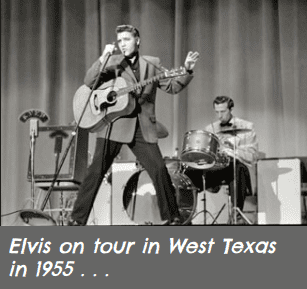
​      The Brown decision was the first important break between the pre-WW II traditionalists and the post-WW II modernists. The second was Elvis Presley: in cultural terms, Elvis was the start of a revolution. Leonard Bernstein in the late-1960s stated that Elvis was the greatest cultural force of the 20th Century in terms of music, language, clothes, etc. Elvis was an accidental revolutionary, a talented young man that arrived at the right place at the right time.
     Elvis actually had little interest in music in-and-of-itself other than as a vehicle to Hollywood to be the next
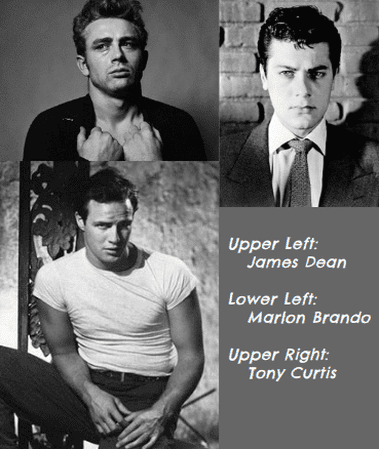
Marlon Brando or James Dean, a rebel on the big screen. Although Elvis would never become what he aspired to be, he learned the "No Smile Thing" from Brando, Dean, and Tony Curtis. Elvis was sure that not smiling was the key to their success, and he was sure he could achieve that same sultry look . . . Elvis spent hours practicing in front of a mirror.
Picture
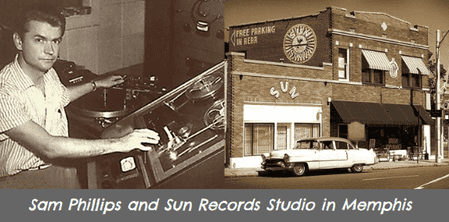
      Sam Phillips, the owner of Sun Records, a recording studio in Memphis, had been waiting for someone like Elvis, who was white but sounded like an African-American vocalist. It took Elvis a while to gather his courage to enter Phillips' studio, but he did so in the Summer of 1953. Ironically, he was sent to Phillips because another talent scout wanted to be rid of Elvis. Elvis was very eager to please, despite his nerves, when he entered Sun Records. Few Americans have been so rebellious in appearance but so polite with their manners, but that didn't bother Phillips in the least. 
     Philips liked Elvis' clothes. Elvis bought his clothes at Lansky's, a store on Beale Street whose customers were mostly flashy African-American men. Phillips also liked Elvis' sideburns. There is some dispute as to whether Phillips was actually in the studio when Elvis first walked in (Phillips' secretary took credit for the first recording). Phillips claimed he was there and recorded/pressed the first disc. Phillips knew Elvis had some kind of special talent, but he couldn't quite put his finger on it. 
     On 5 July 1954, Phillips brought in two musicians, and Elvis recorded "That's All Right Mama". It was a song from famed bluesman Arthur Crudup, but hadn't gone anywhere in terms of popularity. Elvis' blend of country with blues ("Rock-a-billy") would to right to the center of U.S. popular culture.
Picture
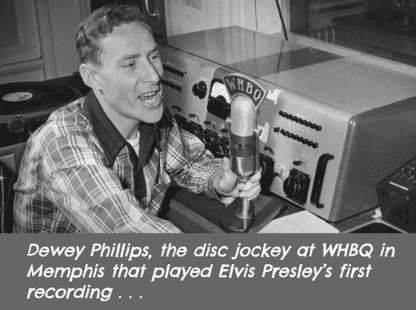
​     Phillips was sure the song was a winner, so he sent a copy to WHBQ to a disc jockey he knew, who had many listeners that were white kids. Dewey Phillips (no relation) was the conduit for the white kids of Memphis to hear African-American music with a powerful beat. The schools were still segregated, but the airwaves were not. Dewey wanted to know how popular his three hour radio show was, so he asked listeners to honk their horns if they were listening to his show at 9 pm, whether in the car or at home. At 9:05 pm the Memphis police chief called and told Dewey to stop his antics. So Dewey went back on the air and told his listeners that due to the police chief's call, he would not be able to say that he wanted his listeners to honk their horns at 11:30 pm.
     Not only was Dewey Phillips a passive-aggressive rebel, but according to Sam Phillips, Dewey had a "platinum ear", and was connected to his young listeners to an incredible degree. So it was no surprise that Sam sent Elvis' first recordings to Dewey. The songs were such a success that Dewey spent all his show alternating between Side A and Side B on the disc. In another bit of irony, Elvis could not read music, but he nonetheless could play guitar, and he could imitate any voice that he chose.
Picture
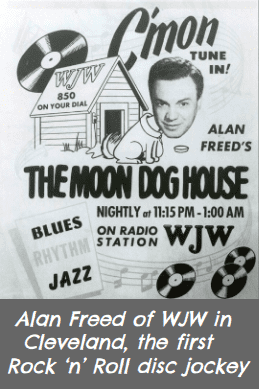
     Elvis grew up in a segregated world, but the radio dial was segregated. As the 1950s began, white kids had started to buy African-American Rhythm & Blues records, but no one saw it as a trend until 1951. Alan Freed was apprised of what was going on in terms of record sales among white kids by Lee Mintz, an owner of a local Cleveland record store. Mintz wanted Freed, a radio disc jockey, to change the format of his classical music show. And, if Freed did so, Mintz would advertise on the show, and work to find additional advertisers. 
     Mintz told Freed that the appeal of the music to white kids was centered around the beat. Freed had not yet found his special niche as a disc jockey on radio, but he not only found his niche, but secured his place in American music history. In the Summer of 1951, Freed started "The Moondog Show" on a 50,000 watt radio station in Cleveland, a station that was so powerful it reached most of the Midwest. Freed's success was immediate: it was as if an entire generation of middle class white kids had been waiting for someone to catch up with the times. On the radio, Freed became one of kids; he was on their side, opposite of their parents. When Freed endorsed concerts, thousands of tickets were sold, and more would be sold if he announced that he would be at the concert. In 1953, Freed had become incredibly popular in several states, while Elvis had graduated from high school, and had very limited options to pursue . . .
0 Comments

The 1950's: Elvis Presley, Part Two

5/13/2017

0 Comments

 
​                     Source: David Halberstam. The Fifties (1997)
Picture
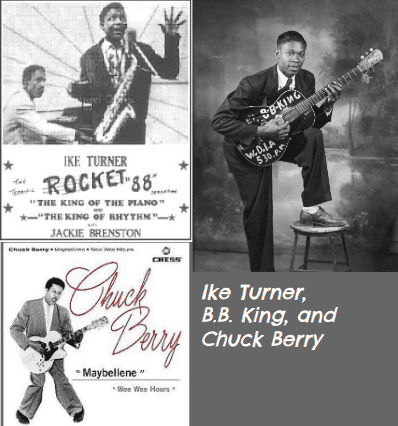
     After graduating from high school in 1953, Elvis drove a truck for Crown Electric, which was much more preferable to Elvis than working in a factory. Sam Phillips of Sun Records liked to record local talent, such as Riley B. King (who became the Beale Street Blues Boy; B.B. King). King told Ike Turner of Clarksdale, Mississippi of Phillips, and Turner became a de facto talent scout for Phillips in the region. In addition to Elvis, Phillips discovered Johnny Cash, Carl Perkins, Roy Orbison, and Jerry Lee Lewis, all American originals.
    While the music world was changing, the large recording companies had become more conservative, sharply disapproving of Rhythm & Blues. Until the 1950s, recorded music was only for sanctioned/approved artists, so those that liked Country or Rhythm & Blues had to listen to the radio. But the the improved recording technology democratized the music industry in large part because recording songs became very inexpensive. 
     In 1954, Bill Haley and the Comets did a version of "Shake Rattle and Roll" which sold over 1 million records by February 1955. Also in 1955, Chuck Berry became the first African-American to top the "white chart" at #5 with "Maybellene", and Little Richard soared up those same charts with "Tutti Fruitti". After Elvis was interviewed by Dewey Phillips on the air in Memphis, Elvis' musical career skyrocketed, first regionally, then nationally. Elvis became the star of a touring group that was managed by Colonel Tom Parker.

Picture
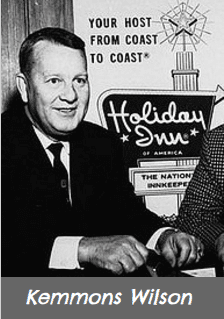
     Sam Phillips held out for as much as possible in selling Elvis' contract to a major recording studio, and Parker had connections with the Radio Corporation of America (RCA). Phillips called his best friend, Kemmons Wilson, who was in the midst of creating his Holiday Inn franchise (Phillips had got in on the ground floor with Wilson as an investor, and Phillips would become very rich down the road). Wilson told Phillips to sell the rights for Elvis, and RCA purchased the rights for Elvis for $35,000 . . . Elvis was now the property of RCA. 
     Presley's timing was perfect, with the crossover of Bill Haley, et al, in full swing. There was nothing parents could do about their kids listening/buying the new kind of music. Teens had more money to spend than any other previous generation of teens in US History, and the technology to play records was abundant and affordable. Elvis started to reach the stratosphere in 1955, when U.S. teens were starting to spend an incredible amount of money on the music of their choice. These teens didn't remember the Great Depression, and saving money didn't even remotely register on their horizon. A byproduct of the rising affluence was that the average middle class teen had $10+ a week ($90+ in 2015 dollars) to spend, a remarkable amount at that time.
     Teens no longer depended on the family appliances, and could listen to music away from home in their cars or with transistor radios (beginning in 1957). Disc jockeys became the most trusted adults for these teens. For the first time, teens had become their own separate, defined part of U.S. culture, and Elvis was the first major beneficiary, entering millions of American homes on the sly via the radio.

Picture
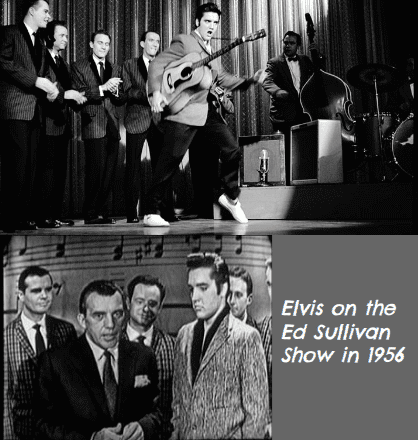
      By 1955, Ed Sullivan had become the unofficial "Minister of Culture" in America. The Ed Sullivan Show was the great variety show at 8 pm every Sunday, blending a safe array of variety acts . . . nothing would happen on the show that was remotely threatening. In 1956, Sullivan was at the height of his popularity and power, his show at the exact center of US mass culture, and he wanted no part of Elvis, in large part due to his gyrations while performing. Those gyrations started when Elvis needed something to do instead of standing still when he wasn't singing, and the crowds loved it.
     By 1956, Elvis had become a national celebrity and a national issue, with his success defying imagination; "Hound Dog" sold 2 million copies, while "Don't Be Cruel" sold 3 million. Elvis was selling $75,000 worth of records each day. Elvis had appeared on Milton Berle's show twice, really cutting loose the second time, causing an uproar over the vulgarity of his act. Sullivan announced that Elvis would never be on his show . . . the Guardian of Public Morality had spoken.
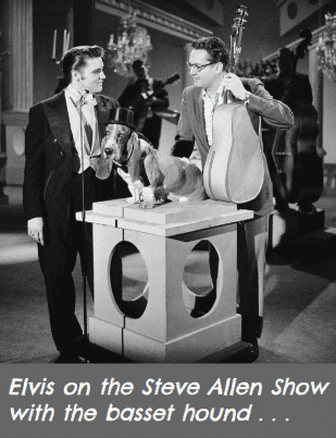
     Within three weeks of making that public statement, Sullivan had to change his mind after Elvis appeared on the Steve Allen Show on 1 July 1956. Allen had Elvis sing "Hound Dog" in a
tuxedo to a basset hound, and Elvis' fans hated it; the fans felt betrayed, and Elvis felt humiliated, wanting-and-needing another chance on television. Nevertheless, Allen had bested Sullivan in the ratings, and Sullivan immediately surrendered to the obvious.

Picture
​      Parker was contacted by Sullivan's representatives, and Elvis was signed to appear on the Ed Sullivan Show three times for a total of $50,000. Being the Guardian of Public Morality was good if it enhanced Sullivan's career, but it quickly went out the window if ratings slipped. The battle was over, and Sullivan had caved . . . the new music entered the U.S. mainstream. After the first of three shows, Sullivan was very pleased with the ratings (Charles Laughton hosted since Sullivan was recuperating from an auto accident). Sullivan also went out of his way to say that he hadn't lowered morals by having Elvis on his show. 
     After Elvis' third appearance, Sullivan sidled up to Elvis and called him a real, decent, fine boy, which was a televised surrender to the new order of things. Market economics had won, and unlike Jazz, the soon-to-be-called Rock 'n' Roll involved the masses in a visceral manner. New forces driven by technology had won, and teens didn't have to listen to their parents nearly as much anymore. Marlon Brando and Elvis were only the first of the new rebels in the world of entertainment. The common thread of those two, and their successors (e.g. James Dean), was that they projected the image of being misunderstood, especially by their parent's generation.


0 Comments

The 1950's: Lucille Ball and "I Love Lucy"

5/8/2017

0 Comments

 
                   Source: David Halberstam. The Fifties (1997)
Picture
    By the end of 1952, there were 19 million television sets in the United States, and a thousand new stores opened each month to sell TV's. More-and-more Americans felt closer to TV personalities than they did with their neighbors and distant families. Nothing showed the power of television to soften the edge between reality and fantasy than the coming of Lucille Ball, who by 1951 was 40 years old. Lucille Ball had a less-than-dazzling show business career to that point. In movies, she was seen as a comedienne rather than as an actress, and she drew "second banana" roles in B-movies (she was often called the "Queen of the B-Movies"). 
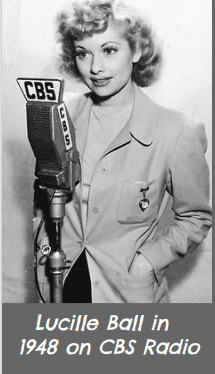
     In 1948, Lucille Ball was in a radio comedy called "My Favorite Husband", largely so she didn't have to travel very much. Also, she wanted to shore up her shaky marriage with the famous Cuban band leader, Desi Arnaz (he wasn't her husband on the radio).

Picture
     In 1950, CBS asked Lucille Ball to do a weekly situation comedy on TV, and no one involved was very excited about the venture. But Lucille Ball was destined for TV, primarily because she was a visual comedienne with a perfect sense of timing, a wonderfully expressive face, and her wackiness generated sympathy, not irritation. Lucy always managed to avoid total disaster, remaining lovable to not only the characters on the show, but especially to viewers.
    Lucy insisted that Desi be cast as her husband, and CBS executives were appalled, from Bill Paley
on down to the advertisers. Lucy remained adamant, and Paley gave in. Lucy understood what the execs did not, that viewers would more than get it that Desi was her husband in real life, even though the character names were Lucy and Ricky Ricardo.
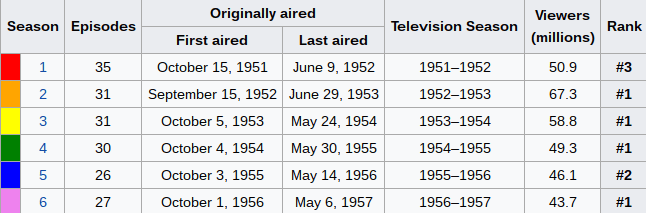
     Lucy cast herself as an ordinary housewife who longed to be a star. Ricky wanted nothing more than a noral life with a normal marriage. The Philip Morris Company became the sponsor, and the first episode aired on 15 October 1951. The executives at Philip Morris were not thrilled with the first episode, but were persuaded to give the show some time, and it wasn't long before "I Love Lucy" was in the Nielsen Top 10.

Picture
     "I Love Lucy" was the #1 show on television in four months, and soon, 2/3's of all TV's were tuned to the show. The show became so popular that even Marshal Field, the prominent Chicago retail store, shifted its Clearance Sale Night from Monday to Thursday since significantly fewer shoppers frequented the store on Mondays. 
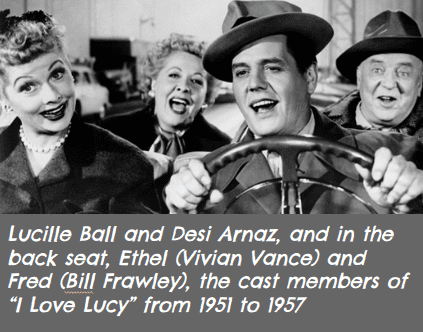
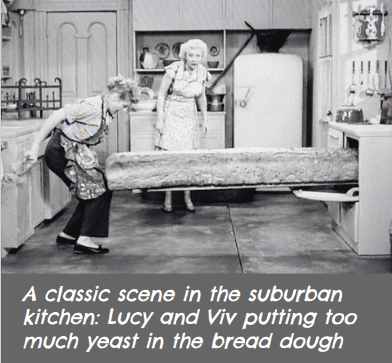
     Lucy insisted that her show be shot in front of a live studio audience, knowing that she played incredibly well performing live. Lucy appealed to all age groups, with children seeing Lucy as a childlike adult. To everyone's surprise, Desi was a great straight-man to Lucy, but Desi was the kind of straight-man that got laughs. Rounding out the primary cast was Vivian Vance as Ethel and Bill Frawley as Fred, Lucy and Ricky's screwball neighbors. 
     By 7 April 1952, 10.6 million households were watching "I Love Lucy", the first time that so many Americans watched the same TV show. By 1954, as many as 50 million watched certain episodes. The show became so popular that it lifted the entire TV industry to new heights; for example, during 1954 TV became the largest advertising medium in the world. 
 During the first few years of "I Love Lucy", the show was set in a city, but after ratings slipped a bit, all four characters moved to the suburbs in Westport, Connecticut.

Picture
Picture
     The great danger of TV was that of overexposure. TV brought the President into every viewer's home, endangering the illusion of heroic proportions created by distance. Jack Benny had a 15 year run on TV, beginning in 1950. Benny, even in his second year on television, understood that if the public felt that they had got too much of a TV personality, they'll get bored and tune out. Benny knew that on TV, a novelty can quickly become tedious and flat. Perhaps Lucille Ball understood that danger as well: "I Love Lucy" ended in 1957 as the
​#1 show on television.

0 Comments

Earl Warren and the Brown Decision (1954)

5/8/2017

0 Comments

 
                     Source: David Halberstam. The Fifties (1997)
Picture
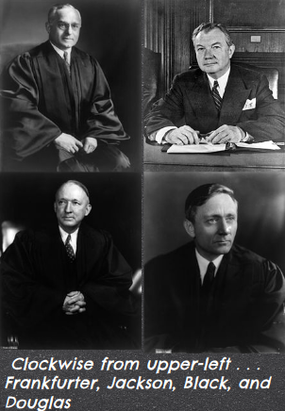
​     By the early-1950s, the Supreme Court was in chaos, mostly due to the long-simmering grudges/conflicts among the four FDR appointees: Felix Frankfurter, Robert Jackson, Hugo Black, and William O. Douglas. When Harlan Fisk Stone died as Chief Justice in 1946, Jackson accused Black of blocking his promotion to what he considered was his due. Black thought Jackson and Frankfurter (a relentless networker/schemer) had blocked his nomination for Chief Justice. 
     There were two political factions on the Court, the liberal Black/Douglas ring, and the conservative Jackson/Frankfurter ring. The four acted like spoiled children when decorum was the rule and expectation. The general atmosphere was poisonous: the Truman appointees, Harold Burton, Sherman Minton, and Tom Clark were not the intellectual titans of the other four, but they looked on aghast at the soap opera taking place in the Supreme Court.
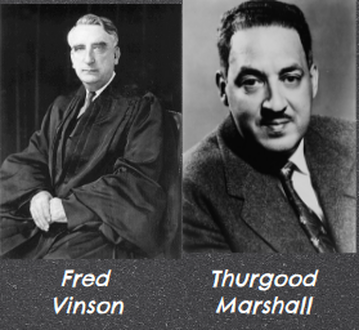
     Truman tried to make the Court more collegial, and nominated his old friend Fred Vinson as Chief Justice, whom Truman viewed as likable, gregarious, and a skilled conciliator. But Vinson's skill in bringing people together didn't present itself as Chief Justice, where the issues and people were far too complex for simple solutions and compromises.

Picture
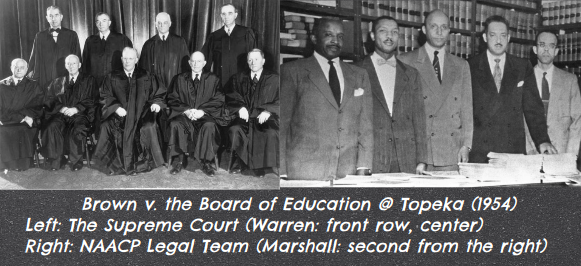
     Complicating things for Vinson was that the men he was dealing with did not have to run for re-election, and they were very different in temperament and background compared to the legislators to which he was accustomed. The four FDR appointees looked down on Vinson as their intellectual inferior, and the Vinson Court fragmented even further.  Meanwhile, the momentum for African-American Civil Rights was gaining speed, and Brown vs. the Board of Education at Topeka was heading towards the fragmented Court.
     Thurgood Marshall started working for the National Association for the Advancement of Colored People (NAACP) in 1936. By 1950, due at least in part to Marshall's efforts, the Supreme Court had outlawed discrimination in graduate schools, tilting away from Separate But Equal. During December 1952, Vinson was clearly very nervous about the Brown case. Frankfurter wanted segregation to end, but he predicted a 5 - 4 vote in favor, and that narrow margin would make implementation of the Court's order impossible; Frankfurter succeeded in delaying the Brown case until December 1953. 
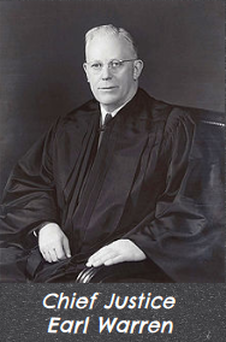
     In September 1953, Vinson suddenly died of a heart attack - who would President Eisenhower nominate as Chief Justice? Ike wanted a political moderate like himself. Ike offered the nomination to his Secretary of State, John Foster Dulles, knowing with almost 100% certainty that Dulles would turn it down. Speculation centered on Earl Warren, the liberal Republican Governor of California; it's historically debatable whether Ike owed Warren a favor from the Republican National Convention of 1952 (Warren supported Ike over Robert Taft). What bothered Civil Rights advocates was that as California Attorney General, Warren signed the order to relocate 80,000+ Japanese-Americans to internment camps not long after Pearl Harbor. 
During June 1943, California Governor Earl Warren reaffirmed his decision as attorney general in terms of Japanese-American internment. 

Picture
​     It was easy to underestimate Warren, who was a very good politician and very smart. Above all, Warren was an excellent listener, wanting people from many different perspectives to talk to him so he could expand his horizons. Warren seemed so relaxed and agreeable that it was very hard to see his ferocious sense of purpose. Warren was not a man that worried if others were smarter than him; in other words, Warren had no problem knowing that he wasn't the smartest man in the room.
     Warren as California's governor was both an optimist and an activist. Warren didn't bring an ideology to the Court, but his experience told him what government could do to help people. Warren wasn't intimidated by the four FDR appointees, even with their experience and intellectual capacities. They knew about the law, but Warren knew about the consequences of legal decisions. 
     Three things mattered most to Chief Justice Earl Warren: Equality, Education, and a Right to a Decent Life. Warren made an excellent first impression with his new colleagues, who were not easy to impress. Ike would soon discover that Warren was not the moderate he had sought for Chief Justice. Ike had long been removed form the reality of America, being in the military, and then as President. ike had been isolated from the changes in American society, where Warren had not.

Picture
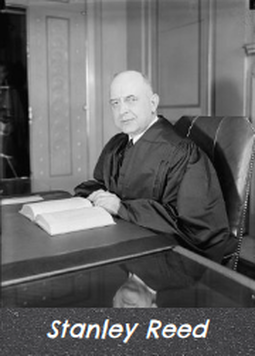
     Warren's greatest skill was cutting to the core of an issue, and Warren determined that the Court had to confront Plessy v. Ferguson (1896), and end Separate But Equal. For Warren, then, achieving that goal became a matter of strategy and tactics. Warren didn't want to inflame the South or unnecessarily divide the U.S.; Warren wanted a unanimous 9 - 0 decsion with a reasoned opinion(s). Warren framed the dialog among the other eight members of the Court to the point where if a justice was against reversing Plessy, that justice appeared to be a racist (Stanley Reed appeared to be the only segregationist on the Court).
     Warren also wanted to keep Frankfurter from writing a long concurring opinion that would water-down the impact of the unanimous decision. The first conference for Warren on the Brown case occurred on 13 December 1953, and Jackson still needed to be convinced, viewing Marshall's NAACP brief as mere sociology, not law, but he was gradually won over by Warren. Jackson wanted to write a second opinion, which on the one hand recognized social changes in America, but then Jackson went on about mixed-race people that could be viewed as actually be white. Jackson's heart attack on 30 March 1954 ended his effort at finishing his potentially controversial-and-dividing concurring opinion.

     Warren had eight justices in agreement, and he went after Reed to make it 9 - 0. Very politely, Warren kept up the pressure until Reed finally gave in; Reed asked that implementaion be gradual, not immediate. Warren's efforts/decision sacrificed brilliance for simplicity, and he deliberately sought to not offend. Frankfurter's glowing view of Warren wouldn't last long when a string of civil liberties cases descended on the Court. 
     The Brown decision ended legal segregation, and deprived segregationists their moral legitimacy. While most of the nation, especially Southern states, basically ignored the decision in terms of integrating schools, a change of consequence did indeed occur. After the Brown decision, the media felt obligated to cover stories about racial prejudice as never before . . . one era was ending, and another was beginning . . . 
Picture
0 Comments

The 1950's: Kemmons Wilson and Holiday Inn

5/8/2017

0 Comments

 
                   Source: David Halberstam. The Fifties (1997)
Picture
     The vacation that changed the landscape of the American road occurred in 1951 when Kemmons Wilson, a successful home builder in Memphis, took his family to Washington, D.C. In 1951, the interstate system didn't exist, and it was a crapshoot at the end of every day of travel as to the quality and cost of a motel. Wilson was charged extra for his kids, and sometimes he spent $20 a night ($184 in 2015 dollars), and there weren't any restaurants handy.
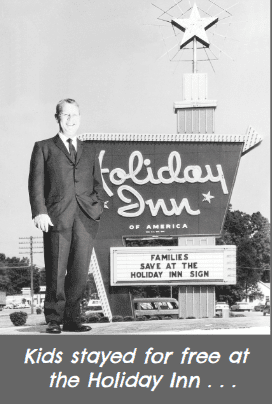
     One day during the trip, a very frustrated Wilson told his wife he was going into the motel business. Most everyone in America had a car and a family and Wilson saw the demand for roadside motels in his absolute frustration. Wilson envisioned 400 motels, and kids would stay free . . . it was the beginning of the modern American motel chain.

Picture
     Wilson was 38 years old, and he had always loved wheeling-and-dealing; even though he was a high school dropout, he had become a millionaire. Wilson also knew how big his motel room would be: 12 x 30 feet + a bathroom. The name for his motel chain, Holiday Inn, came from a Bing Crosby musical by the same name. Wilson decided that the perfect location for the first motel (120 rooms) would be between Memphis and Nashville, near where he owned a lumberyard. If he did everything right, Wilson figured the motel/restaurant would cost $325k.
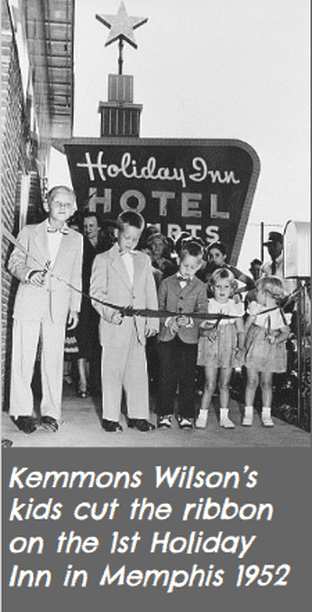
     Wilson took out a loan for that amount, and built his first motel/restaurant for $280k, using the remaining $45k as carryover for his next venture. The first Holiday Inn was built in just 90 days, and it opened in August 1952, a year after Wilson's immensely frustration vacation. The first Holiday Inn had a restaurant, gift shop, swimming pool, and in each room there was an air conditioner, as well as a rent-free television. Wilson charged $4 an night for single occupancy, and $6 for double, and children stayed free. Within two years Wilson built three more Holiday Inns, all on the main approaches to Memphis. Wilson wanted a large, highly visual sign for his motels, and the soon-to-be-famous sign soared to a height of 50 feet.

Picture
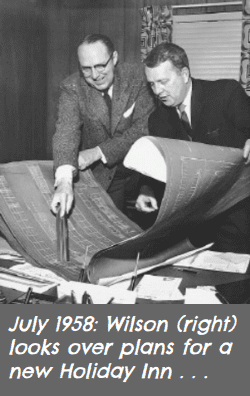
     But Wilson was 396 motels short of his goal, so he turned to the people he knew best, homebuilders. Each homebuilder that wanted to be part of Wilson's motel investment group would pay $500 for the right to own a Holiday Inn at their own location, plus a user's fee, plus .05 cents a night per room. At the first meeting, 70 homebuilders showed, and Wilson was sure that within a year every major U.S. city and major highway junction would have a Holiday Inn. Wilson's optimism was misplaced, in that only 3 builders accepted the proposal, but Wilson was actually lucky his colleagues didn't take him up on his bottom bargain-basement offer.
     Wilson realized that most of his fellow builders didn't see America changing as he did, so Wilson became the head of Holiday Inns, and he would franchise to others. Instead of homebuilders, Wilson contacted investors, such as doctors and lawyers (one of his investors was his friend Sam Phillips, who first recorded Elvis Presley). Wilson started building Holiday Inns for $3000 a room, and he franchised them out for $3500 a room, making a clean $500 per room during the construction phase. From the start, Holiday Inns were a success; the rooms always seemed to be filled. In 1954, eleven Holiday Inns opened, and that was also the year that the first franchised Holiday Inn was built.

Picture
     In 1956, the U.S. Interstate System was authorized at a cost of $76B, and America seemed to be coming to Wilson and his Holiday Inns. With the interstate, travelers could avoid going through cities altogether if they chose. In 1957, Wilson decided that he had to take his company public. Wilson and a handful of partners sold 120,000 sharea for $9.75/share on the Initial Public Offering. For awhile, Wilson had the roadside motel industry all to himself, in large part because Wilson could eye the perfect locations for a Holiday Inn in every area that didn't have a motel.
     Wilson wanted a highly visible venue that was on the right side of the highway leading into a city, with a lot of additional land just in case he wanted/needed to expand. Wilson had tremendous fun selecting locations and choosing franchises. When Wilson started to fly his own airplane, his ability to see traffic patterns greatly enhanced his selection of sites . . . Wilson's eye became a legend within the industry. 
     Eventually Wilson's Holiday Inn chain reached 1500 motels. At his peak, Wilson was building a new Holiday Inn every 2.5 days, and a new room every 15 minutes. By the early-1970s, Holiday Inns had triple the rooms of its nearest competitors, Ramada and Sheraton, and Wilson was receiving 10,000 requests each year for franchises.

0 Comments

    Archives

    May 2017
    April 2017
    March 2017
    February 2017
    January 2017
    December 2016
    November 2016
    October 2016
    September 2016
    August 2016
    July 2016
    June 2016
    May 2016

    Categories

    All
    18th Century
    19th Century
    20th Century
    Biography
    History

    RSS Feed

Powered by Create your own unique website with customizable templates.