Mr. Jensen's U.S. History Website
  • U.S. History Blog
    • U.S. History Blog (May 2026 - May 2027)
    • U.S. History Blog (May 2025 - May 2026)
    • U.S. History Blog (May 2024 - May 2025)
    • U.S. History Blog (May 2023 - May 2024)
    • U.S. History Blog (May 2022 - May 2023)
    • U.S. History Blog (May 2021 - May 2022)
    • U.S. History Blog (May 2020 - May 2021)
    • U.S. History Blog (May 2019 - May 2020)
    • U.S. History Blog (May 2018 - May 2019)
    • U.S. History Blog (May 2017 - May 2018)
    • U.S. History Blog (May 2016 - May 2017)
    • U.S. History Blog (May 2015 - May 2016)
    • U.S. History Blog (May, 2014 - May, 2015)
  • About

Sergeant Reckless Rotates to the U.S. And Is Celebrated

8/12/2016

0 Comments

 
       Source: Robin Hutton. Sgt. Reckless - America’s War Horse (2014)
Picture
​     After the cease-fire on 27 July 1953, Reckless spent her time running communications wire, and some of her Marine friends headed home. Gunnery Sergeant Joe Latham (Reckless' trainer and main guide) was worried what would happen to Reckless, since she wasn't listed on any official Marine rotation list. Latham didn't want Reckless to be left behind and alone; he was haunted by the idea that Reckless would become a broken-down cart horse.
     Adding to Latham's frustrations was that with new Marines arriving, the long-standing rule that nobody rides Reckless was ignored. During the day, Reckless had the run of the camp, but at night she was guarded by four Marines due to a rumor that she would be kidnapped for food. Reckless found a way to cut herself on barbed wire, and she needed stitches and bandages around her ear and head. Reckless was bady cut up, but she received top-notch veterinary care from her now-changing herd of fellow Marines. The stitches dissolved, and the bandages came off soon enough, but Reckless wound up with an ear that had a little notch on top
Picture
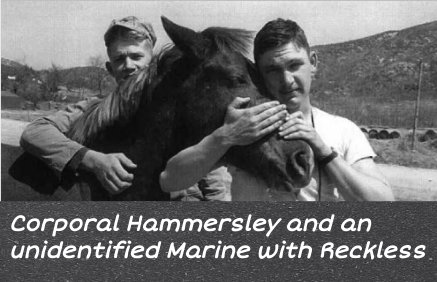
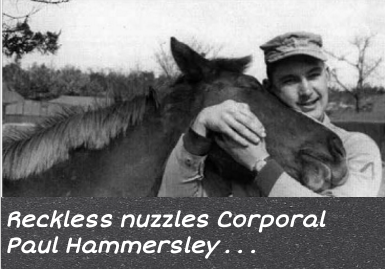
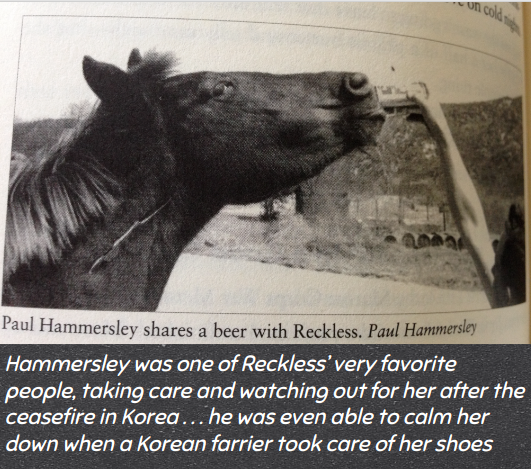
     Corporal Paul Hammersley was Reckless' new soulmate. Hammersley was able to keep Reckless calm when a Korean farrier re-did her shoes (Reckless hated people she didn't totally trust mess w/ her hooves). The Marines had to pay for Reckless' feed themselves, and Reckless loved to eat. And, with her great sense of smell, Reckless wasn't above ransacking a Marine's tent for food. 
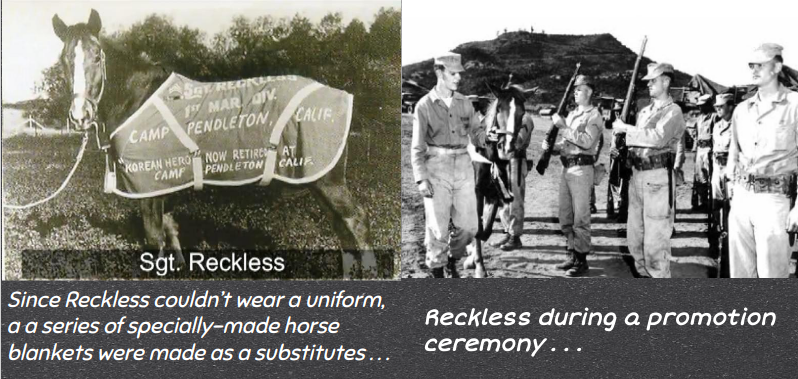
      During February 1954, the official announcement that Reckless was promoted to a Sergeant in the U.S. Marine Corps occurred. Her fellow Marines paid $51 for a specially designed blanket for Reckless to show her stripes and honors-earned in the Korean War during the ceremony. 
     On 10 April 1954, Reckless was officially promoted to sergeant by Major General Randolph Pate (who would soon become the 21st Commander of the U.S. Marine Corps). Pate pinned the stripes on Reckless' (slightly chewed) blanket; shortly afterwards a whole new blanket with stripes was placed on Reckless.
     Reckless' military honors were as follows: 2 Purple Hearts, the Marine Corps Good Conduct Medal, the Presidential Unit Citation With Star, the Navy Unit Citation, the National Defense Service Medal, and the United Nations Service Medal. 
Picture
Picture
     Within a week of her promotion, Reckless was a household name in America, thanks to an article in the 17 April 1954 Saturday Evening Post titled, "Reckless, the Pride of the Marines".
The four-page spread with photos caused a sensation, and letters poured in wanting to know when Reckless would come to the U.S. Lt. Pedersen was quoted that he thought Reckless deserved rotation to the U.S., but the "rotation question" took months to be answered.
     The Navy offered transport, but not without official paperwork for Reckless, a handler, and feed. Due to the Saturday Evening Post article, "Operation Bring Reckless Home" began. A formal request was made asking that Reckless be assigned permanent duty at Camp Pendleton (just north of San Diego). But, of course, bureaucrats were a problem; these isolated military and government workers didn't want Reckless to have a "free ride", courtesy of the American taxpayer. 
     Lieutenant Colonel Andrew Geer called a family friend that worked for Pacific Tranport Lines, and the company arranged to bring Reckless to the U.S. free-of-charge. In exchange for the free voyage, the company wanted the Marines to provide a stall, feed, and a handler. The Marines had three weeks to deliver Reckless to Yokohama, Japan, where the SS Pacific Transport was scheduled to depart on 22 October 1954.
Picture
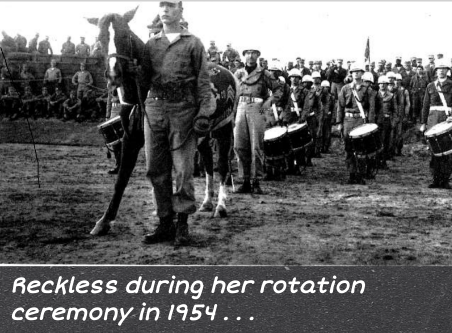
     On 17 October 1954, Reckless' rotation ceremony took place during halftime of a football game between the 7th Army Division and the 1st Marine Division. Reckless' life in her native Korea was soon to be over, and Lt. Pedersen was in San Francisco, awaiting the arrival of Reckless as were a host of her fellow Marines. 
     Pedersen was contacted by the SS Pacific Transport with an update about Reckless. The good news was that Reckless was eating again after being seasick (and almost being swept overboard in a storm). The bad news was that she ate her special "Sergeant Blanket". A press conference was set for 9 am on 9 November 1954 to cover the arrival of Reckless to the U.S., and Geer wanted Reckless to have a blanket with all her honors on display for the media to see.
     Geer found a very cooperative saddlery in San Francisco, and the company went above-and-beyond free-of-charge making a blanket, as did the companies that did the lettering and ribbons on the blanket. Kay Pedersen (wife of Lt. Pedersen) managed to sew the stripes and ribbons in place on the blanket just when the call came that the SS Pacific Transport was about to dock.
Picture
Picture
     That night Pedersen and other Marines went on board to see Reckless. It had been 18 months since Reckless had seen Pedersen, but that didn't matter. Reckless was elated to see Pedersen, burying her face in his hands, knowing that she was again safe. It was perhaps very likely that Reckless knew that she had arrived at her new home with her old friends.
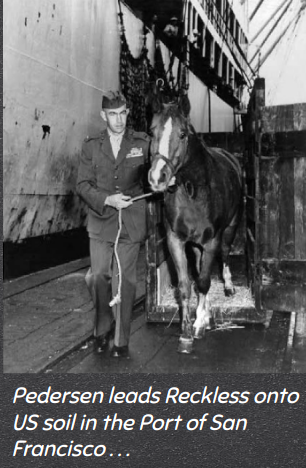
     On 10 November 1954, Reckless was prepped, glistening, and beautiful, ready to be presented to the media on board the ship. An added benefit was that Reckless absolutely loved attention; for more than an hour, Reckless posed with Marines for the media, happily munching carrots. Soon enough, Reckless let Pedersen know that she had become bored with the proceedings. Reckless was put in an unloading stall with Pedersen, and the two Marines were lowered by a winch to the dock. When Pedersen opened the stall door, Reckless was on U.S. soil and greeted with the kind of fanfare that a great war hero deserved.

Picture
     Newspaper headlines across the nation heralded Reckless. Reckless arrived in the U.S. on the same day that President Eisenhower dedicated the Iwo Jima Memorial. In the San Diego Union, a photo of Vice-President Nixon with two mothers of Marines that were killed-in-action at Iwo Jima was right beside a photo of Reckless arriving at San Francisco. 
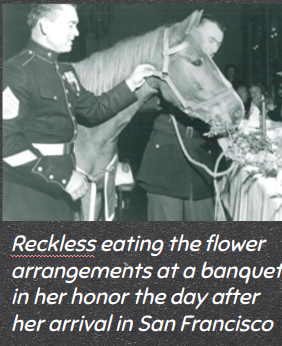
     Reckless was escorted to a gala in her honor at the Marine's Memorial Club and Hotel in San Francisco. Organized 1945, the Club was a living memorial, paying tribute to heroic Marines, both living or killed-in-action. Skeptics in the media didn't think Reckless could ride in an elevator, but in Reckless went, and she rode to the 10th floor in the freight elevator to the banquet dinner in the main dining room. 400+ Marines awaited Reckless in the banquet hall, and the keynote speaker was Lt. Col. Andrew Geer. 
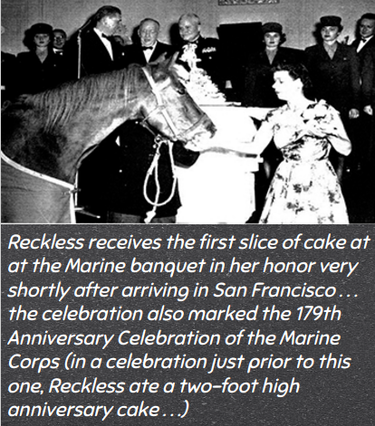
     Geer regaled the Marines with how Reckless went from a Korean racehorse to a Marine Hero. While Geer was speaking, Reckless decided to enjoy the two-foot high anniversary cake. After eating the cake, Reckless then enjoyed the carnation and rose centerpieces on some of the tables. After dinner, Reckless went to the 11th floor for the 179th Anniversary of the U.S. Marine Corps dance plus official cake-cutting ceremony.
Picture
Picture
     The Marine cake-cutting ceremony symbolizes the renewed commitment of the Marines to serve their nation. Traditionally, the first piece of cake goes to the Guest of Honor, and Reckless eagerly ate the first piece (the second piece goes to the oldest Marine present at the ceremony). 
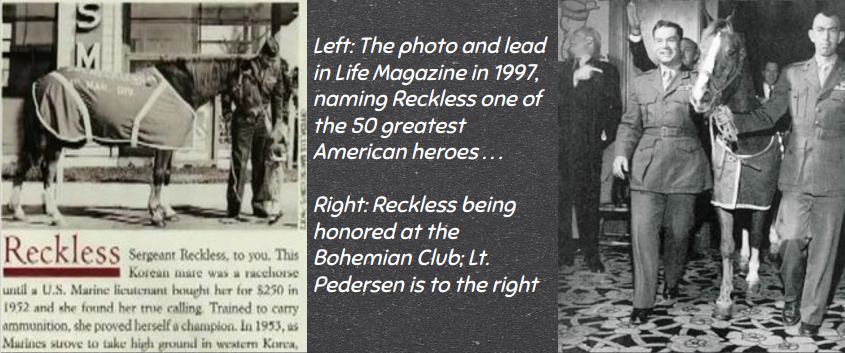
     On 11 November 1954, Reckless took her "Victory Tour" to the Cow Palace, giving one of her greatest strutting, whirling, and prancing performances. Then Reckless was taken to the very exclusive men-only Bohemian Club. Reckless was the first female to ever enter the Cartoon Room of the Bohemian Grove, the beyond-exclusive organization of incredibly powerful and influential men
. After the Bohemian Grove, it was time for Reckless to be loaded on her trailer, and travel to her new home at Camp Pendleton . . . 

               Epilogue: Reckless at Camp Pendleton . . .

            Below: a much longer (& better) documentary on Sgt. Reckless . . .
0 Comments

Sergeant Reckless Becomes a Marine

8/12/2016

0 Comments

 
      Source: Robin Hutton. Sgt. Reckless - America’s War Horse (2014)
Picture
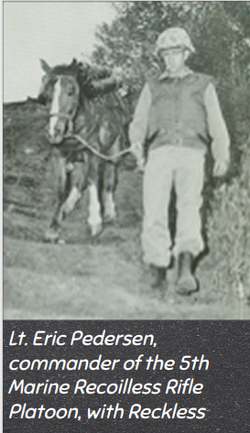
     The Commander of the 5th Marine Recoilless Rifle Platoon, Eric Pedersen, gave the order that nobody could ride the platoon's horse, which by acclaim was
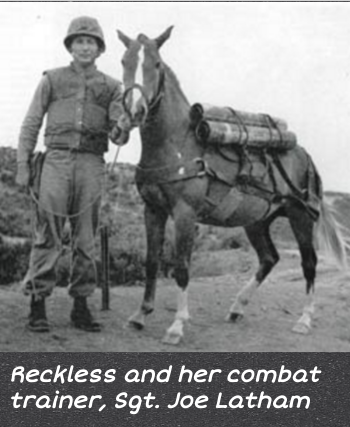
re-named Reckless. Private 1st Class Monroe Coleman (from Utah), who knew horses, would be the primary companion for Reckless. Pedersen ordered a bunker built for Reckless, as well as sufficient feed, and training for combat, which was referred to as "Hoof Camp".
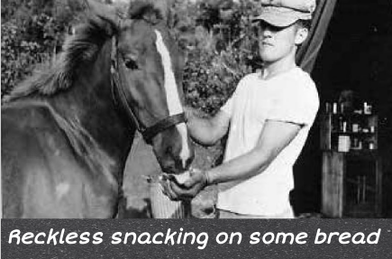
     Reckless loved the attention from the Marines; she had never known so many wonderful comforts and company. She was brought into a Marine's tent to sleep by a stove during the hellishly cold Korean winter nights. 
Reckless was even given full rein of the camp, just like a Marine, and her favorite stop was the galley tent (mess hall). The Marines quickly became Reckless' herd.

Picture
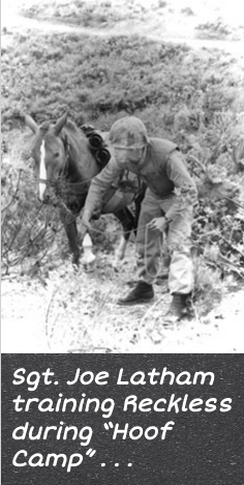
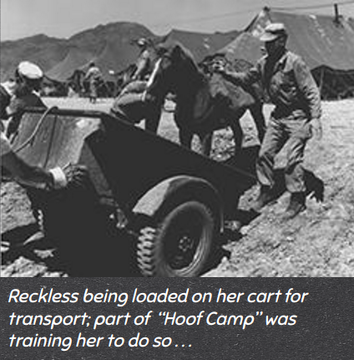
     "Hoof Camp" began for Reckless, and she was a very fast learner, needing only one or two sessions before demonstrating at least basic proficiency. Reckless was trained to among other things come when whistled, to get in/out of a trailer, and to surmount barbed wire. When Reckless was nervous, a shrill whistling sound came from her nostrils, almost as if she was "smelling" danger. When Reckless sized up a new challenge, she would lower her head as if deep in thought, and then, if comfortable, move ahead. As would be seen during combat, Reckless would go anywhere with someone that she trusted.
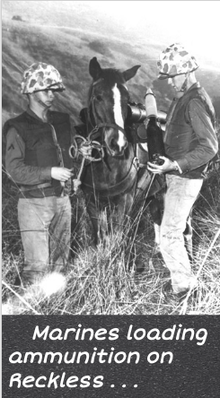
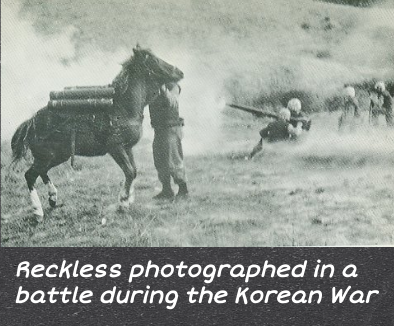
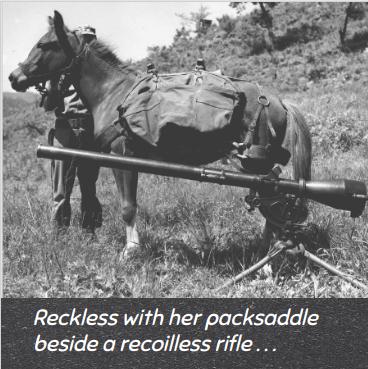
     Reckless was also trained to "hit the deck" when under enemy fire (she also learned to do so when she heard "Incoming"). She also had to be trained to be calm when the Recoilless Rifles were fired, as well as never going behind the guns. Reckless was trained to head to her bunker when enemy shells hit near camp, but there were times when she thought that the Marines' bunker was more convenient. After experimentation, the 5th Marine Recoilless Rifle Platoon found that Reckless could safely/easily carry six rounds of shells in canisters, and if absolutely necessary, 8 to 10 canisters.

Picture
      To other soldiers in the area, the 5th Marine Recoilless Rifle Platoon was referred to as the "Horse Marines". When the 5th Marine Recoilless Rifle Platoon was held in reserve, the duties of Reckless changed, in that she became transport for what was needed, even barbed wire; she could also string more communications wire in a day than 10 Marines. In January 1953, the 5th Marine Recoilless Rifle Platoon returned to combat, and they were placed in support of outposts named East Berlin, Berlin, Vegas, Reno, Carson, and Ava . . . Reckless would more than earn her stripes in early-1953. It was also about then that Lt. Pedersen sold "shares" to other Marines; while he still had the largest individual stake out of his $250 purchase price, he wanted many other Marines to be directly involved in the "Reckless venture". 
     When the fighting was fierce, Marines used their flak jackets to cover Reckless from head to tail, since she had become incredibly special to the other members of her herd. Reckless made friends wherever she went, which was incredibly handy in that Reckless would often be supporting more than just her platoon. Reckless would serve the Marines on Hill 120, which was a brute of a hill, but she was losing weight since she was eating C-rations because there wasn't enough available winter feed. So Marines were put on "Grass Duty" in order to make sure that Reckless ate normally, and she was also given antibiotics (which she hated), but in a week, Reckless was at 100%.

Picture
      During that week, the new Marine commander of the region ordered a truck to return with winter feed for Reckless. That new commander, Colonel Lew Walt, sensed that Reckless had become as important to the Marines as had Traveller, General Robert E. Lee's horse, to the Army of Northern Virginia. Reckless' health was crucial in that the Marines were about to engage in daytime firing raids on Chinese positions. Col. Walt wanted to stop the enemy's "creeping offensive" toward Marine positions. Daytime firing raids would allow for greater accuracy, as well as support from the air, tanks, artillery, recoilless rifles, and flamethrowers.
     Reckless' job was to make sure that those that were providing covering fire had their ammunition. On 24 January 1953 the firing raids started, and on 31 January 1953 came "Raid Tex". What was different about "Tex" was that Reckless would be delivering ammunition from daybreak to sunset. The distance from her pasture to the ammunition loading site was an easy 1/5 of a mile, but from the loading site to the location of the guns was very difficult, in that it was very treacherous for Reckless and her guide to navigate. 
     The most daunting challenge was the narrow, twisting trail that rose at a grade of 45 degrees. Reckless preferred to meet the intimidating incline with a running head start, and the ammunition canisters were thrown around on her back as she galloped. Reckless' guide just dropped the reins and let her go; each time Reckless would make the ridge on the strength of a final urgent lunge.

Picture
      At the top of Hill 120, Reckless was winded, exhausted, but standing triumphant. Reckless waited for her guide, and then made her way to the guns without assistance. The gun crew would see her, and call her over; Reckless made the journey to Hill 120 fifteen times that day delivering over a ton of explosives, and the firing raid was deemed a tremendous success.
     Over the next month, Reckless supported ten smaller but still very dangerous firing raids. On 25 February 1953, "Operation Charlie" was put into effect. This firing raid needed 5 rehearsals and careful planning, and it would be a far-more difficult assignment for Reckless in terms of the sheer volume of ammunition she would carry-and-deliver from dawn to dusk. Reckless made 24 trips during "Operation Charlie", covering 20 miles and delivering 3500 pounds of explosives. Reckless needed to make two runs to the top of the ridge on her last delivery . . . after that last run, Reckless' head was hung low as she returned to the safety of her bunker, utterly exhausted, not even nuzzling fellow Marines for attention.


     Once in her bunker, Reckless perked up when given her favorite food of warm bran mash, but she ate unusually slowly. Reckless received a thorough rubdown and was covered in a blanket for the night, all safe-and-snug . . . but Reckless' finest day was yet-to-come. By the spring of 1953, Reckless was enjoying the fresh green vegetation, and she burned-off extra energy by chasing her own shadow, prancing around whether-or-not she had an audience (Reckless tended to become bored if she wasn't working or being tended to in some manner). Sadly, Reckless had to say goodbye to many Marine friends since they were rotated back to the U.S., but the good news was that with the new arrivals, Reckless had a chance to make new friends.
Picture
      Reckless ventured out of her pasture one night, and actually headed to the front lines. Word spread along the Marines on the front that she had arrived, and she was enjoying the attention and the C-rations. But those Marines didn't radio Lt. Pedersen that Reckless was with them, wanting to play a little joke on the 5th Marine Recoilless Rifle Platoon. Then the enemy started an intense artillery barrage, and Reckless was rushed to the deepest part of the Marine trench, where she surprised them by kneeling, and she was covered with flak jackets. Suddenly, it was no longer funny that Reckless was on the front lines.
     Pedersen was finally notified at daybreak when the shelling stopped, and after that nighttime experience, Reckless would never be that adventurous again, since she would have plenty of work. During March 1953, Reckless and her squad participated in 18 firing raids over 13 days, but it would be the Battle for Outpost Vegas in late-March that would make Reckless a legend . . .


        Below: a retrospective of Sgt. Reckless' heroic actions in the Korean War
0 Comments

Sergeant Reckless Joins the Marines

8/12/2016

1 Comment

 
      Source: Robin Hutton. Sgt. Reckless - America’s War Horse (2014)
Picture
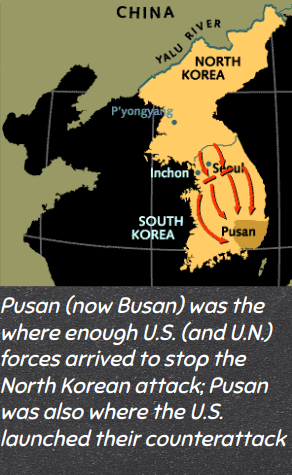
     Kim Huk Moon (a pseudonym; he wanted to remain anonymous after the Korean War) bred his treasured racehorse named Flame to a stallion in Pusan (now Busan in South Korea), and in June 1948, a young Flame (the future Reckless) was born. After Flame (the mother) died after a race, Kim couldn't bear to look at the younger Flame, and took the young horse to another trainer to have a foster mother. Kim still raced horses, but he avoided seeing the young Flame until an impromptu reunion in November 1949. 
     Before a race, Kim (age 22) saw young Flame spinning around in a free-spirited prance entertaining onlookers, just like his mother, and Kim was once-again smitten with a horse named Flame. At that point, three dogs started to attack young Flame, and they were momentarily distracted by Kim's yelling, and young Flame broke free, sprinting towards Kim. 
     Kim threw himself between Flame and the dogs, kicking one of them away. When the dogs finally backed off, Flame nuzzled Kim while he stroked the frightened horse, calming her down. Kim put Flame in the same stall that his mother had used, and the younger Flame became the center of Kim's life. Flame was two years old, and Kim started training her to be a successful (and profitable) racehorse.

Picture
​      Kim discovered that Flame had more natural intelligence than normal horses; her curiosity made her seem almost-human. Flame was so eager to learn that training was effortless, and Kim admitted to himself that young Flame had qualities and abilities that her mother did not possess. Flame was only 13 hands, basically the size of a pony, and she was often referred to as a Mongolian mare due to her size. However, other than Flame's height, her other physical features were consistent with Cheju ponies that had long legs with horse-like proportions. Cheju ponies were resistant to disease and ticks, and were extremely strong, capable of carrying loads up to 230 pounds.
     During June 1950, Kim worked hard to get Flame ready for her racing debut, but Flame's racing career was not to be. On the very day Flame was to make her racing debut, North Korea invaded South Korea, and Kim and his family headed towards Pusan. Flame pulled a cart with the family's belongings and some family members. Flame learned to swim when the family caravan reached a river. Flame crossed the river multiple times, taking family members across, exhausting herself doing so.
     At Pusan, Kim and Flame unloaded American ships, hauling military supplies to huge depots. In the spring of 1952, Flame was once again hitched to a cart, and the family headed back to Seoul. On their return, they saw a city in ruin, but Kim and Flame were fortunate in that they found work hauling rice from fields to US warehouses. 
     One of Kim's friends was badly hurt due to a landmine in a rice paddy, and Kim vowed to find enough money to help his friend get an artificial leg. After a day's work in October 1952, Kim took Flame to the racetrack to gallop and prance around. As Kim and Flame were about ready to leave the stables, four U.S. soldiers drove up in a jeep with an trailer . . . Flame's life was about to change.

Picture
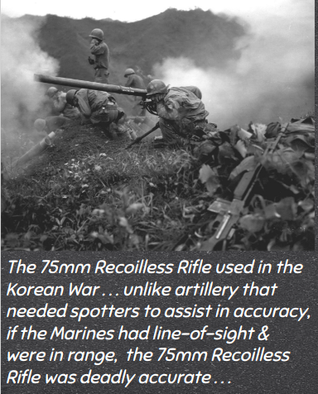
     The 75mm Recoilless Rifle sat on a tripod (no wheels) and was awkward and challenging to carry, usually needing 3-4 men. The recoilless rifle could fire a shell several thousand yards with precision, as long as there was line-of-sight. The 75mm recoilless rifle was 6'10" in length, and weighed 115 pounds; basically it was a metal tube with a breach on a tripod. No one could stand behind the weapon, in that similar to a bazooka, the 75mm had a tremendous backblast. 
     The 5th Marine Recoilless Rifle Platoon couldn't hide their position when firing, so after 4 or 5 shells were fired, the 75mm was moved to another spot, which further confounded the enemy. The 5th Marine Recoilless Rifle Platoon would "leapfrog" after firing; after the primary gun moved to another location, a secondary 75mm would begin firing, and the process would be repeated. "Leapfrogging" denied the enemy the ability to concentrate their fire on specific positions, but there was as much as 500 yards between guns.

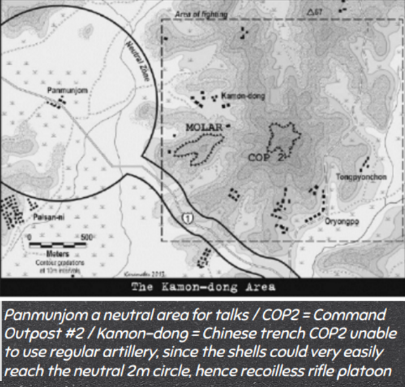
     The 5th Marine Recoilless Rifle Platoon wanted to engage Chinese troops on favorable high ground (code-name "Molar", see the map below) with the "Freedom Road" at their back, which meant that the Chinese couldn't fire back on their position (a negotiated "no-fire zone" existed 100 meters on either side of the road, which led to Panmunjom, the agreed-upon neutral zone). But Chinese snipers spotted the Marine scouts, and the 5th Marines would have to move their cumbersome 75mm without going through any of the restricted area, which meant very hilly terrain, some of which was impassable by jeep.
     The rifle and ammunition (75mm shells) would need to be hauled by Marines on foot, and there would be the need for "repeat runs" to resupply the firing positions. Also, since the shells were designed ready-to-fire, dropping one would mean an almost certain explosion, with dead or badly wounded Marines. The distance from the ammunition to the firing location was about half-a-mile, but it was a treacherous trip which featured barbed wire, a rice paddy dike, a seven foot ditch, and then a steep climb to the ridge, all in perilous view of the enemy.
Picture
Picture
     The first success of the 5th Marine Recoilless Rifle Platoon was taking out a Chinese supply hut that housed weapons and explosives. After the firing raid, the most exhausted Marines were the ammunition carriers, which gave the commander of the platoon, Lieutenant Eric Pedersen an idea . . . what if the platoon used a horse or a mule to transport and deliver what was needed. Permission from above was given, and a one-ton transport trailer was provided. That was all well-and-good, but Lt. Pedersen needed a special horse, exactly the right horse, to place in the trailer.
     Lt. Pedersen was eventually advised to try the racetrack in Seoul. Kim was rubbing down Flame when Lt. Pedersen, who loved horses, appeared with his trailer and men. Lt. Pedersen had a good eye for horses, and Flame was the 5th horse that Pedersen inspected. Lt. Pedersen saw that Flame had an "intelligent eye", and a "fine head", which reminded him of his childhood horse. Lt. Pedersen approached Flame, and Flame wasn't in the least bit frightened; in fact, Flame moved towards Lt. Pedersen.
     When Pedersen (after just a bit of haggling) offered $250 in US dollars for Flame, Kim knew that he had enough money for an artificial leg for his best friend, Choi, who was there as well, assisting Kim. Kim had a private goodbye with his beloved horse, and when the Marines left, Kim wept alone in the now Flame-less stall.

1 Comment

Sergeant Reckless Becomes a War Hero

8/12/2016

1 Comment

 
     Source: Robin Hutton. Sgt. Reckless - America’s War Horse (2014)
​     The Battle of the Nevada Complex was among the fiercest clashes ever fought by the United States Marine Corps. At stake was a strategic position called the "Iron Triangle", which was anchored by Marine outposts code-named Vegas, Reno, and Carson. The Chinese army attacked these outposts in great numbers to try and strengthen the Communist position at the ongoing peace talks, as well as increase the threat on Seoul.
     The Nevada Complex was surrounded by higher ground held by Chinese troops, and to make matters worse, each outpost depended on the others for flank defense. Between Carson and Vegas was a small area code-named "Reno Block"; the Marines in that area were ordered to keep the enemy outside the "Iron Triangle" . . . if one of the Marine outposts fell, the other two would almost certainly fall as well. 
     26 March 1953 was a normal day for the Marines, but at 7 pm simultaneous surprise attacks hit all three outposts, with 180 Chinese artillery/mortar shells per minute. After ten minutes of choreographed artillery and machine gun fire, 3500 Chinese troops attacked a much smaller force of Marines that were divided among three outposts.
Picture
​     At each outpost there were only 40 - 50 Marines at any given time, so each outpost had to focus on defending itself rather than supporting another outpost(s). A barrage of 14,000 artillery shells assaulted the Marines on the ridge at Vegas, and Reckless had already taken refuge in her bunker, glad to see Gunnery Sergeant Joseph Latham (her primary trainer/guide) and rubbed up against him, sweating due to extreme nervousness.
     The Marines at Vegas were about to be overrun, and they put in a call for VT artillery. VT artillery meant that "variable time" fuses were used, designed to burst overhead on the advancing enemy, which was just short of suicide for the Marines at Vegas (thankfully, the Marines at Vegas had created caves in the back of the hillside). Communications, both wire and radio, were no longer functioning with Vegas, and the officers at the command post by midnight concluded that the outpost had been taken by the enemy. 
     On 27 March 1953, plans for a coordinated attack were made to retake Vegas and Reno; Carson was still held by the Marines. Reckless was loaded with 192 pounds of explosives, and was pointed in the direction of the recoilless rifles to which her delivery was to be made, and she advanced on her own (not the first time she had done so) towards the guns. Again, the toughest climb was at the end, surmounting the crest of the ridge. Reckless started off in a trot, then she reached a full gallop in order to tackle the severe incline. Reckless made it over the incline to the ridge, then she had to navigate 250 feet of twisting trail to the gun site; nothing was going to stop her from her duty.
Picture
     Reckless was tasked with making deliveries of ammunition to multiple gun sites, with the furthest trip 700 yards (which she did in 20 minutes, round-trip), and the nearest 550 yards (12 minutes round-trip). At 11 am, the order was given to focus most of the guns on Vegas. Unlike regular artillery/mortars, the recoilless rifle didn't need spotters, and could accurately fire at enemy targets with Marines nearby on the offensive, which was the good news. The bad news for the Marines firing the recoilless rifle was that the enemy could easily locate their position and return fire. The normal tactic of "leapfrogging" after firing 4 - 5 shells was not possible due to the high number of advancing Chinese troops . . . the recoilless rifles needed to be fired as fast as possible, and Reckless supplied the 75mm shells to do so.
     The Chinese artillery was also trying to kill Reckless, who was in full view of the enemy making her deliveries of ammunition. Reckless was in constant motion, determined to keep her beloved herd supplied; the sight of a little 13 hand horse doing so did wonders for the morale of the Marines under fire. On Reckless' 21st delivery, 3 enemy mortar shells with white-hot burning phosphorous hit nearby, engulfing the Marines, including Reckless. Gunnery Sgt. Latham threw his flak jacket over Reckless' eyes, and comforted her to keep her from bolting. When the situation returned to "normal", Latham had Reckless continue with her mission.
Picture
​     Undaunted, Reckless continued her deliveries of ammunition in the midst of deafening noise, blinding smoke, and murderous artillery and machine gun fire. Through it all was the sight of a small struggling horse putting everything she had into her route, especially the arduous incline to the ridge, loaded with 75mm shells. Most of the time Reckless worked solo during the battle, knowing what her duty required. 
     Reckless also carried wounded Marines, and on one trip, Reckless shielded four Marines heading to the fighting; in return, the Marines threw their flak jackets over Reckless. Reckless suffered a shrapnel cut over her left eye, but she kept going. Later that day, she was wounded again when hot shrapnel struck her left flank behind the rib cage and in front of her hind leg. Her wounds were dressed, and Reckless went back to the battle, with neither of the wounds slowing her down. However, instead of galloping up the last incline to the ridge, she crept up and took rests.
     An almost incomprehensible sense of duty was ingrained in Reckless. Every time Reckless was sent out, it wasn't expected that she would return to the load site, and when she did, the Marines couldn't believe their eyes. Reckless kept the recoilless rifles firing due to her willingness to keep doing her duty, and the fact that she survived was beyond-astonishing. Reckless endured the extreme loneliness of her mission, and showed incredible loyalty to her fellow Marines in the face of extreme danger. 
Picture
     Reckless and the Marine gun crews were so effective at continuous fire that more than one gun barrel melted. Coming off the hill from battle, Reckless stumbled a bit, showing her utter exhaustion, while her fellow Marines showering her with praise. The battle raged on, but Reckless and the 5th Marine Recoilless Rifle Platoon were done for the day. Reckless' head dragged so low it almost touched the ground, but she perked up as she neared her pasture. Reckless gave a heavy sigh when her packsaddle was removed, and after eating and drinking a lot (she had lost quite a bit of weight as a result of her heroic actions), Reckless started to nod off to sleep before her rubdown was over.
     Strangely, nobody controlled the summit at Vegas, with both slopes held by opposing forces. Additional recoilless rifles arrived (to replace the ones with melted barrels) and the 5th Marine Recoilless Rifle Platoon was told to be ready for action the next day. On the morning
of 28 March 1953, Reckless accepted the packsaddle without a fuss after she ate, and she appeared to still show the effects of the disorienting concussion waves from the previous day's artillery. Although very tired and sore, Reckless was back in "mission-mode" before the end of her first trip.
Picture
     By that point Reckless was used to the sounds of battle, so when she sweated, it was from exertion, not fear. The Chinese artillery barrage on the Marines' position was among the largest and most intense in all of military history. So much so that the Marine command post decided to bombard the Chinese positions from the air, after failing to remove them with ground tactics and artillery fire. By 2:55 pm, Outpost Vegas was once again securely in the hand of the Marines, but the battle was not yet over.
     Reckless and her platoon (a.k.a. herd) fired directly into the trenches of the Chinese soldiers as the Marines advanced . . . now the Marines had to hold what they captured. The battle ended when all available Marines on Vegas took all available grenades (including those from dead/wounded Marines) and lobbed them in the smoke when they smelled garlic (a strong garlic smell indicated a large number of Chinese soldiers nearby). Finally the Chinese reached their breaking point; having gone through 4000 soldiers, they were unwilling to endure more casualties. The number of artillery shells fired began to subside, and the smoke disappeared.
     On 30 March 1953 at 2:30 am, the most savage battle that the Marines faced in the Korean War was over. The battle at Outpost Vegas broke the back of the Chinese in terms of their ability-and-will to fight at that level of intensity and ferocity. The Marines gave a lot of credit to Reckless for their victory, seeing her as a hero.
Picture
     The Marine brass awarded Reckless two Purple Hearts. Reckless kept her Marines supplied with so much ammunition that gun barrels melted, carried wounded Marines to safety, shielded Marines from enemy fire, and was twice wounded in the act of duty. In a single day Reckless made an unbelievable 51 round trips to various gun sites, working solo 95% of the time. Reckless carried five tons of ammunition on treacherous terrain under heavy fire, covering at least 35 miles. No horse, before-or-since, has come close to such selfless acts of bravery and loyalty.
     Reckless was elated to be in a new pasture that teemed with fresh grass and colorful flowers. For the Marines, the Battle for the Nevada Complex was the turning point; skirmishes
continued, but the 5th Marine Recoilless Rifle Platoon would not experience any more intense battles during the Korean War. The Marines didn't yet know, but peace was only four months away, with a cease-fire taking effect on 27 July 1953.
     (Below: another short video chronicling the heroism of Sergeant Reckless)
1 Comment

The 1st Term of Vice-President Herbert Walker Bush (1981-1985)

8/3/2016

0 Comments

 
              Source: Jon Meacham. Destiny and Power: The American Odyssey
                                      of George Herbert Walker Bush (2015)
Picture
     While many political pundits predicted a competitive Presidential Election in 1980, the results were very one-sided, with former California governor Ronald Reagan defeating President Jimmy Carter in a landslide. Very soon after Election Day, Vice-President Elect George Herbert Walker Bush pledged to Reagan that he would be loyal and low-maintenance. 
Bush understood his role, and made sure that Reagan understood that he was ready to serve the President.
    Even before November 1980 was over, the responsibilities of Bush as VP were basically set. First, Bush would have a scheduled weekly luncheon with Reagan, with no staff present, and no set agenda. Second, Bush was automatically invited to all Presidential meetings, and third, Bush was to receive copies of all memoranda going to the President. Lastly, VP Bush's office would be in the West Wing of the White House. And to make matters even better for Bush, his long-time friend and political confident, James Baker III, was Reagan's Chief-of-Staff . . . with Baker, Bush had a "Friend in Court".
     Reagan came to trust Bush after the Republican National Convention in Detroit due to his hard work and loyalty, but also because it was clear that Bush in no way wanted to outshine the President. As a result, Reagan pushed hard to be sure that Bush was included in the "Inner Sanctum" as much as possible. During his first term, Reagan was an effective delegator, especially when he had his "Triumvirate", and Bush was discreet and conscientious.

Picture
     As Vice-President, Bush was neither irrelevant as many predicted, nor as powerful as many feared. Bush worked hard to show that he was worthy of the Reagan Legacy. The role that Bush crafted for himself was that of a senior confidential advisor and absolute loyalist to the President. Bush was kind of a "Human Marine I", which was a tremendous perk for Reagan that made his job easier as President. 
    
     Bush received advice from Carter's former Vice-President Walter Mondale, and Bush had personally witnessed what happened to Ford's Vice-President, Nelson Rockefeller. Rockefeller was determined to be a major player in domestic policy in the Ford administration, and Ford's staff wouldn't allow Rockefeller to have any meaningful role, believing that Rockefeller was often trying to "one-up" the President. Bush thought that if he had a good relationship with Reagan, nothing else really mattered . . . Bush knew that his focus was solely on serving the President. 
​     First Lady Nancy Reagan wasn't a fan of George or Barbara Bush, declining to include the Bushes socially, and she rarely invited them to the private residence in the White House. Fortunately, Nancy was the outlier in the Reagan administration in terms of any negative feelings towards Vice-President Bush.

Picture
     On 30 March 1981, Bush was to fly from Andrews Air Force Base at 8:55 am to Fort Worth on Air Force 2. As Bush was landing in Texas, Reagan was eating lunch as he was preparing to give a speech to the Building and Construction Trades Union of the AFL-CIO at the Washington Hilton ballroom. Bush then flew to Austin with the House Majority Leader Jim Wright, and as Air Force 2 was taxiing the runway at 1:45 pm Central time, an air traffic controller radioed Air Force 2 inquiring if they were continuing to Austin or diverting to Washington, D.C.
    
​    Soon, Secretary of State Alexander Haig called Bush on Air Force 2, telling the Vice-President to return to D.C., but the line was full of static, and Bush had a hard time making sense of what he was told. It wasn't until Bush received a written message from Haig that Bush knew that Reagan had been shot. Air Force 2 landed briefly in Austin to refuel, and Bush would return to Andrews as fast as the jet could safely take him, and then to the White House. 
     Even during this crisis, Bush understood his role as Vice-President. Bush refused to answer reporter's questions until more information was gained. When Air Force 2 taxied into the hangar at Andrews, the plan was to fly Bush to the South Lawn at the White House by helicopter, which was far faster (and prestigious and "showier") than traveling down Massachusetts Avenue by car. 

Picture
     Vice-President Bush nixed the plan, since it would break his rule that the U.S. can only have one President at a time, and he viewed landing by helicopter on the South Lawn as disloyal showboating. Bush watched Haig's disastrous press conference while on Air Force 2, and at 6:08 pm Eastern time, Ed Meese called Bush to report that Reagan was out of surgery and his prognosis looked good. Meese also told Bush that they would meet at the Vice-Presidential mansion after he arrived in D.C. 
   
​     Once Bush arrived at the White House and entered the Situation Room, he asked to be updated. Bush at once concluded that SecState Haig and SecDef Caspar Weinberger had basically made a mess of things, but now Bush and the "Triumvirate" (Baker, Meese, and Michael Deaver) were present, and the situation dramatically improved. Vice-President Bush addressed the nation at 8:20 pm Eastern time with a brief statement. Bush closed his address by saying that the officers of the federal government fulfilled their obligations during the crisis with skill and care. Bush knew that statement wasn't true concerning Haig or Weinberger, but Bush thought it best to especially cast Haig in a positive light, if nothing else for Reagan's sake.
Bush decided against seeing Reagan in the hospital, instead paying a respectful visit to Nancy in the Residence.

Picture
     From 31 March to 11 April 1981, Vice-President Bush was the "long-term pinch hitter" for the President. Bush presided over the Cabinet, but from his normal chair as Vice-President. When Reagan returned to the White House on 11 April, Bush had emerged from the crisis as a sensible-and-steadying force in the administration; Reagan appreciated his Vice-President even more as a result. A telling moment when Bush visited Reagan at the hospital before he was discharged: Reagan had spilled water on the bathroom floor in his hospital room, and he got down on his hands-and-knees to clean it up so the nurse wouldn't get in trouble. Bush remembered that moment in part because that's exactly what he would have done had Reagan not "beat him to the punch".
     In early-1983, Bush was tasked by Reagan to head to Europe and visit seven key nations in order to try and diffuse Reagan's image as a "Nuclear Cowboy". Also, Bush was to impress on the leaders of those nations, especially the USSR, that Reagan was serious about arms reductions. Bush was "up-but-edgy" with his high-profile trip to Europe, but Bush proved to be the perfect one to send, in that he was positive, experienced, and politically astute. By putting a reasonable face on U.S. policy, Bush was able to lower rhetorical tensions. British Prime Minister Margaret Thatcher sent Reagan warm and encouraging words about Bush, which was only part of the proof of Bush's effectiveness in visiting seven nations in eleven days.

Picture
     In Washington, D.C., Vice-President Bush was welcomed back as a returning hero, especially by the President; Bush improved the political landscape in Europe for the U.S. The liberal-leaning Washington Post ran an editorial titled "George Did It"; Bush had no way to know that his return from Europe would prove to be the apex of his Vice-Presidency.
     In April 1983, Reagan officially announced that he would run for a second term with Bush as Vice-President. However, 64% of conservative leaders wanted Bush replaced; they still weren't sold on Bush's conservative bona fides. While campaigning for Reagan in 1984, Bush seemed to lose his political focus and center, and was inarticulate-enough in the spotlight for critics to pounce.
     
​     Bush soon found himself in an unenviable "no-win" situation when he had to take on
Geraldine Ferraro in a Vice-Presidential debate. It became worse for Bush when Barbara told reporters that Ferraro could be described with a word that "rhymed with rich". Barbary was in agony, not only causing difficulty for her husband, but also believing that those words would be etched on her tombstone (her family teased her as the "Poet Laureate" of the Bush clan). 
     Bush continued to misstep during the 1984 campaign, and even took heat for attending the 40th Anniversary of his World War II Navy pilot mission. Even with Reagan winning 49 states in the Election of 1984, Vice-President Bush was worn-down. Bush went to Camp David to physically and emotionally recover, and started to think about the Election of 1988, which was "only" 47.5 months away . . .

Picture
  Addendum: George Herbert Walker Bush . . . 
                             * 2nd Term as Vice-President
                             * The Republican Primaries of 1988
                             * The Republican National Convention of 1988
                             * The General Campaign and the Election of 1988

0 Comments

President James Monroe, 1817 - 1825: Part Three

8/1/2016

0 Comments

 
                    Source: Harlow Giles Unger. The Last Founding Father -
                     James Monroe and a Nation’s Call to Greatness (2009)
Picture
     In 1822, President James Monroe decided it was time for the U.S. to join other nations in the "Recognition League"; Monroe officially recognized both Colombia and Mexico as independent nations. In 1823, what became known as the Monroe Doctrine (by the 1850s) was mostly written by Monroe, not his Secretary of State John Quincy Adams (although JQA was instrumental in suggesting and outlining the overall framework).
     On 2 December 1823, Monroe sent Congress his 7th Annual Message. Contained in the message was his dictum of "closing off" the Western Hemisphere to European colonizing-and-meddling. Monroe went further, saying that if a European nation(s) interfered in the Western Hemisphere, it would be seen as a threat to the United States. Monroe also stated that the U.S. wanted no part of Europe's affairs or wars (although trade with Europe would be uninterrupted). Monroe made sure to mention in his annual message that the U.S. Navy would be strengthened and far more active.

     Monroe's statements in his 7th Annual Message to Congress drew universal acclaim across America . . . it was one of the most popular announcements Monroe made during his entire time in office. London praised Monroe, while Czarist Russia dismissed it with contempt. The simple reality after the War of 1812 was that no European nation had the wherewithal to prevail in a lengthy trans-Oceanic war with the U.S. It was far-less costly to trade and make money than to try and subjugate America. By the end of 1823, Monroe was able to dispel America's fears of foreign attack.
     By the early-1820s, the U.S. became even more powerful economically, and even militarily, despite the small national army. The young nation had built many more roads and canals and steamboats, which networked America like never before. However, Monroe, for the only time in his Presidency, vetoed a bill, the National Road Bill, shocking the nation. Monroe argued that the Constitution did not grant power to the federal government for "internal improvements" connecting states. Monroe went on to say in his veto message that the military had the authority to build roads and canals between the states in the interest of national defense.
Picture
      In 1824, Congress passed the General Survey Bill, which authorized $30,000 for the construction of roads and canals vital to national defense. The Constitution clearly empowered the Legislative Branch to provide for the "common defense" and to "regulate commerce". Phrased in that manner, Monroe signed the General Survey Bill into law, and the expansion and networking in the U.S. continued at a manic pace.
     Monroe let it be known early in his 2nd term that he, like Washington, would not seek a third term. That announcement started the political free-for-all in the Cabinet (with the exception of SecState Quincy Adams) where pursuit of self-interest and advancement by far trumped the national interest. Among the members of the Cabinet, SecTreas William Crawford was by far the most aggressive; Crawford even confronted Monroe in the White House over appointments that he felt should have gone to those loyal to him. Crawford threatened Monroe with his cane, and Monroe grabbed fire tongs, preparing to defend himself. Thankfully, the Secretary of the Navy was present, and he escorted Crawford out of the room . . . a very bitter-and-ambitious Crawford never set foot in the White House again while Monroe was President.
Picture
      Meanwhile, Andrew Jackson, was proving to be an embarrassment for Monroe with his behavior and decision-making as the Territorial Governor of the recently-acquired Florida. As a result of the (mostly self-inflicted) controversies, Jackson resigned, and loudly proclaimed that Monroe was the reason for his troubles in Florida. The only good news associated with Monroe's decreasing influence during his 2nd term was that he was able to spend more time with his family. By 1824, Monroe concluded that SecState John Quincy Adams was the best qualified to succeed him as President, but for the time-being, Monroe kept that opinion to himself.
     The last positive event that occurred during Monroe's Presidency started in 1824, when
Lafayette accepted the President's invitation to tour the U.S.; Monroe hoped that Lafayette could rekindle national unity. Monroe's old friend from the Revolutionary War received the largest celebrations in U.S. History to that point, and for many decades later. Towns and cities did their best to outshine each other in honoring Lafayette. On 12 October 1824, Lafayette arrived in D.C., and finally the two Revolutionary War friends saw each other again in the White House. It was quite the scene, in that the last Revolutionary War Era President shook hands with the only surviving general from Washington's Army. An added bonus for Monroe was that for at least awhile, Lafayette's tour made the upcoming Election of 1824 a secondary event. 
Lafayette spent December of 1824 and January/February of 1825 in Washington, D.C.
Picture
      On 1 December 1824, John C. Calhoun was elected Vice-President with 182 Electoral Votes (Calhoun was trying to use the Vice-Presidency as a springboard to the Presidency), but the Electoral Vote for President was an absolute mess. Jackson received 99 Electoral Votes, but that was well-short of the 131 needed to be elected President. Next was JQA with 84, William Crawford at 41, and Henry Clay with 37. The election went to the House of Representatives, with each state's delegation representing one vote, and 13 states needed to be elected President
     Clay's ambition to eventually become President led to a deal being made: if JQA would make Clay his SecState, then Clay would swing enough states his way to elect him President. The results of the House vote were JQA 13, Jackson 7, and Crawford 4 (he was physically unable to be President in that he had suffered a serious stroke in 1823). Those loyal to Jackson immediately cried foul, declaring that JQA and Clay denied Jackson the Presidency in a "Corrupt Bargain". Clay believed that he had out-maneuvered Jackson, but the Average American (who by the early-1820s was able to vote) saw trickery and machinations, and Jackson would win by a large margin in 1828.
     Monroe's last message to Congress included asking for funds for Lafayette, who was basically broke. Congress allocated funds to save Lafayette, but was unwilling to do the same to help Monroe. By then, Monroe was $75,000 in debt, $53,000 of that was in essence "back-pay" that Congress owed Monroe from his years serving as a diplomat in Europe, including expenses.
Picture
      Monroe even provided an itemized account of his expenses in Europe, but Congress only authorized $29,000 towards the outgoing President. The money took care of Monroe's most pressing-and-immediate debts, but Monroe was insulted nonetheless. Monroe was never able to climb out of debt, and he died on 4 July 1831 at the age of 73; ironically, Monroe joined former Presidents John Adams and Thomas Jefferson in dying on Independence Day. President Andrew Jackson declared a National Day of Mourning on behalf of Monroe.
     By the early-1830s, Monroe's self-serving politically ambitious successors had started to seriously undermine national unity, which on a variety of fronts led to the Civil War thirty years later. And to this day, for better-or-for-worse, U.S. Presidents have invoked the Monroe Doctrine, for both Isolationist and Expansionist reasons.
0 Comments

    Archives

    May 2017
    April 2017
    March 2017
    February 2017
    January 2017
    December 2016
    November 2016
    October 2016
    September 2016
    August 2016
    July 2016
    June 2016
    May 2016

    Categories

    All
    18th Century
    19th Century
    20th Century
    Biography
    History

    RSS Feed

Powered by Create your own unique website with customizable templates.