Source: David Halberstam. The Fifties (1997)
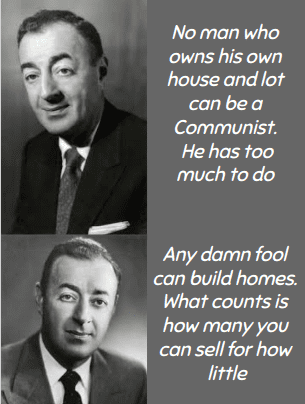
Home ownership was another sign of the abundance in America after WW II. With the explosion of the number of cars and roads, distances were opened up to the point where farmland around cities became desireable for suburban housing. $5000 became the base price of a new home, which equaled two years of family income (the typical automobile assembly line worker earned $3k/yr). Owning a home symbolized independence and security, and the home became the embodiment of the American Dream, as well as fulfillment and contentment.
The home brought families together in the 1950s, a decade when the car and television pulled families apart. While Henry Ford was the first "Great Figure" in American business in the 20th Century, William Levitt was the second. Levitt brought Ford's mass production techniques to housing, which up to then was among the most neglected of American industries. The typical pre-WW II builder constructed five houses a year; Levitt revolutionized the process, creating many affordable homes where Americans entered the middle class by the millions.
The home brought families together in the 1950s, a decade when the car and television pulled families apart. While Henry Ford was the first "Great Figure" in American business in the 20th Century, William Levitt was the second. Levitt brought Ford's mass production techniques to housing, which up to then was among the most neglected of American industries. The typical pre-WW II builder constructed five houses a year; Levitt revolutionized the process, creating many affordable homes where Americans entered the middle class by the millions.
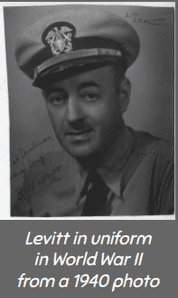
Levitt, perhaps more than any single person, made the American Dream a reality. Levittown was more of a social creation than architectural; according to Levitt, owning a home was Capitalism in the most personal sense. In 1941, Levitt and his brother Alfred won a government contract to build 2350 war worker's homes in Norfolk VA. At first it was a disastrous experience, with nothing going to plan, including uncooperative workers and subcontractors, which equaled less production and profits.
Levitt broke down construction to its basic elements, and identified 27 separate steps. So, 27 seperate teams were trained, each specializing in just one step. Doing so not only allowed Levitt to find a way around the shortage of skilled carpenters, since the process needed far less skilled workers, but it also sped up the entire process. Also, Levitt calculated salaries instead of wages, in essence paying for pieceword at an advanced level. A worker could add to his base salary by producing more instead of just working longer hours.
Levitt broke down construction to its basic elements, and identified 27 separate steps. So, 27 seperate teams were trained, each specializing in just one step. Doing so not only allowed Levitt to find a way around the shortage of skilled carpenters, since the process needed far less skilled workers, but it also sped up the entire process. Also, Levitt calculated salaries instead of wages, in essence paying for pieceword at an advanced level. A worker could add to his base salary by producing more instead of just working longer hours.
As World War II continued, Levitt and his crew became experts in mass building, and as such Levitt was transferred to the SeaBees (Navy Construction Batallion) in the Pacific. Levitt was commissioned to build instant airfields on an island taken from Japan for the Navy. Levitt was the only one that was capable of doing what the Navy needed; lives were in the balance if Levitt couldn't build those airfields on schedule. Not only did Levitt and his fellow SeaBees discuss how they would accomplish their work on the island, but also what they would do after the war. WW II allowed Levitt to experiment on the quickest, most efficient, and most profitiable ways to build low-cost mass housing, something that never would have occurred had Levitt been a civilian.
After WW II, Levitt begged/borrowed money, knowing he just had to build homes and the massive profits would follow. Levitt understood that demand for those homes was immense; even before WW II, Levitt had purchased 1000 acres of agricultural land near
Hempstead, Long Island (NY). During WW II, Levitt told his brother (Alfred) to keep up the option on that land; while his brother the architect didn't see the potential in the land, Levitt did. "Housing Starts" fell from 1 million/year before the Great Depression to fewer than 100k/year before WW II. What Levitt also noticed was that at the same time, the marriage/birth rate increased dramatically . . . so after WW II, the US housing situation was extremely tight. In Chicago, 250 trolley cars were sold to be used for homes. Estimates for those that wanted new homes after the war exceeded five million.
A federal housing bill was rushed through Congress that protected builders by using federal mortgage guarantees, which in essence subsidized builders so they would make money by constructing homes. The stored-up energy in America to spend money after WW II was unleashed: in 1944, 144,000 single homes were built, in 1946, 937k, in 1948, 1.18m, and by 1950, 1.7m. So Levitt had every reason to believe that he was on the top of the Wave of the Future in terms of building suburban housing.
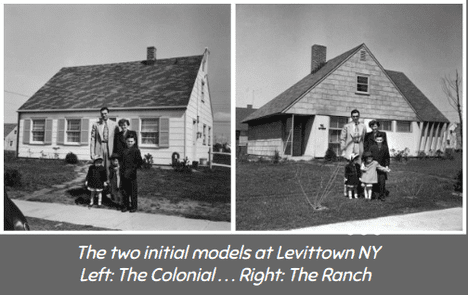
In 1946, Levitt started building homes at Hempstead, adding more land to what he already owned, just 20 miles north from Manhattan. Levitt started to create the largest housing development in history to that point, and it was an astonishing success from the very beginning. The first houses had 4.5 rooms for a young family, with lots 60 x 100 feet and the house only taking up 12% of the lot. The living room was 12 x 16, and there were 2 bedrooms and a bath. A family could expand by adding on to the outside or finishing the attic.
Soon Levitt redesigned the house so the kitchen was located at the back of the house, so moms could watch their kids in the backyard. The basic Levittown Cape Cod model sold for $7990, with a later ranch model for $9500. And for an extra incentive to buy a home from him in the early period of Levittown, Levitt even threw in a TV and a washing machine for free, focusing on the needs of fellow returning veterans.
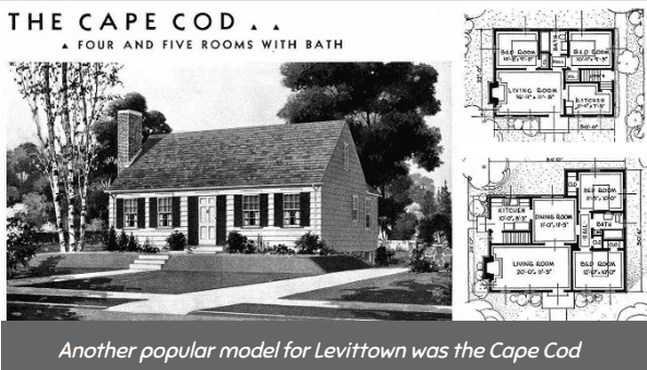
Levitt was initially thunderstruck by the sheer number of veterans intending to purchase a house waiting in line to see the model home. When Levitt opened his office for business on March 1949, 1400 contracts were drawn the first day. Selling homes was easy, building them was not, but Levitt was ready. Right away, Levitt showed that he learned a lesson from buidling homes during WW II in Norfolk: his homes would not have a basement, but a slab foundation. Right away, the most difficult-and-complicated part of buidling a house was eliminated.A Long Island official actually denied Levitt a permit to build because he was a basement-lover, but a scathing editorial in a Hempstead newspaper made the official back down.
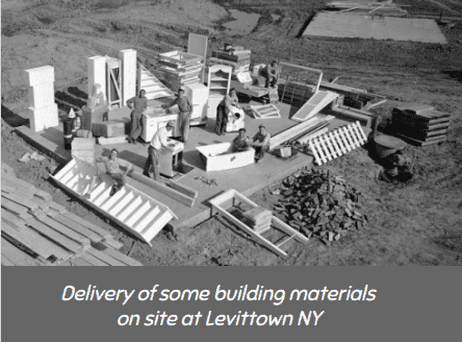
Levitt's genius was that he incorporated a moving assembly line like Ford, but since the home couldn't move, he moved the specialized crews to the buidling site: the construction site became the factory. Leviit learned that prefabricated houses were too limited in nature, so Levitt created his own kind of preassembly. Many critical parts of the house were preassembled at other locations, and brought in, so ordinary workers with power tools (they were new on the scene) could assemble the home. It didn't take Levitt long to figure out that the first thing he had to actually construct was a road to the housing development so the delivery and construction trucks wouldn't get bogged down in the mud.
By July 1948, Levitt's specialized crews were building 36 homes a day, 18 in the morning, and 18 in the afternoon. Nothing could be left ot chance, since even a delayed shipment of nails would ruin the tight timetable. Levitt made his own nails, lumber, and cement, doing his absolute best to create at least a partial vertical monopoly.
The first Levittown in Long Island had 17,000 homes with 82,000 people; a swimming pool was built for every 1000 homes. The suburb of Levittown was not unlike a Massachusetts whaling port in the 1840s, but instead of being gone for months from home with the wife running the household, the men were back from their 20 mile commute to NC by dinnertime.
Levitt hated labor unions, since in his view unions protected the slowest and most ineffecient workers. Levitt only hired non-union workers, and paid them top-dollar and provided many incentives. A Levitt worker earned twice that of a typical constrution worker, but he earned that money on Levitt's terms. Levitt bought appliances form Levitt subsidiaries, since the very idea of middlemen enraged him. And Levitt simplified the process of financing so people could purchase his homes much easier: no money down, and the price was the price, no debate, which was especially appealing to veterans. And, as an added bonus, Levitt's homes were high-quality and durable. Many that criticized Levitt were those in already traditional middle class homes while others attacked Levitt focusing on the perceived massive conformity of his housing development, saying he had sucked out any sembelance of individuality . . . but those "cookie-cutter" homes turned out to be islands of individuality in a sea of conformity.
Levitt hated labor unions, since in his view unions protected the slowest and most ineffecient workers. Levitt only hired non-union workers, and paid them top-dollar and provided many incentives. A Levitt worker earned twice that of a typical constrution worker, but he earned that money on Levitt's terms. Levitt bought appliances form Levitt subsidiaries, since the very idea of middlemen enraged him. And Levitt simplified the process of financing so people could purchase his homes much easier: no money down, and the price was the price, no debate, which was especially appealing to veterans. And, as an added bonus, Levitt's homes were high-quality and durable. Many that criticized Levitt were those in already traditional middle class homes while others attacked Levitt focusing on the perceived massive conformity of his housing development, saying he had sucked out any sembelance of individuality . . . but those "cookie-cutter" homes turned out to be islands of individuality in a sea of conformity.
However, for the next 20 years, African-Americans could not buy a home in a Levittown. Levitt's father moved the family from their neighborhood when Levitt was a boy because an African-American family moved in nearby, afraid the value of neighborhood homes would plummet. Levitt understood that if one African-American family moved in, it would drastically reduce demand. Levitt stated that he could solve the housing problem, but not the housing AND racial problem.
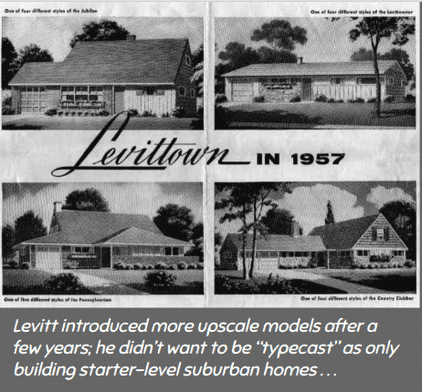
Soon enough, Levitt understood that he needed to offer/build upgraded homes. In essence, Levitt took a page from General Motors with their models for different incomes (Chevy, Pontiac, Build, Oldsmobile, and Cadillac). But Levitt kept the down payment low, even with the increased price of the home. While Levitt still built base-level suburban homes, he wanted to profit from the more affluent buyer as well.
What Levitt (and other builders) started was a massive migration from the cities to the suburbs, a.k.a. "The Great White Flight". From 1950 to 1980, 18 of the top 25 US cities lost population, while the suburbs gained 60 million people . . . 83% of the nation's growth would occur in the suburbs during that time. By 1970, more Americans lived in suburbs compared to cities . . . Levitt started a social/economic revolution. The move to the suburbs also interrupted progress made by women in the workplace before/during World War II. For awhile at least, suburban housewifes were isolated in the Private Sphere, having to cater to her family's every need.

 RSS Feed
