Mr. Jensen's U.S. History Website
  • U.S. History Blog
    • U.S. History Blog (May 2026 - May 2027)
    • U.S. History Blog (May 2025 - May 2026)
    • U.S. History Blog (May 2024 - May 2025)
    • U.S. History Blog (May 2023 - May 2024)
    • U.S. History Blog (May 2022 - May 2023)
    • U.S. History Blog (May 2021 - May 2022)
    • U.S. History Blog (May 2020 - May 2021)
    • U.S. History Blog (May 2019 - May 2020)
    • U.S. History Blog (May 2018 - May 2019)
    • U.S. History Blog (May 2017 - May 2018)
    • U.S. History Blog (May 2016 - May 2017)
    • U.S. History Blog (May 2015 - May 2016)
    • U.S. History Blog (May, 2014 - May, 2015)
  • About

Woodrow Wilson & the Declaration of War Against Germany

5/12/2018

0 Comments

 
                                  Source: A. Scott Berg. Wilson  (2013)
Picture
    After the Election of 1916, the Great War in Europe raged on, with the year 1916 already the deadliest in human history to that point. Nearly a million casualties were incurred during the Battle of Verdun, and it was twice as worse at the Somme in France and at Brusilov on the Eastern Front, and Germany increased their U-Boat attacks. Despite the unprecedented carnage, no nation was yet ready to throw in the towel. 
  During December 1916, President Woodrow Wilson received word from the non-militaristic elements in the German government  that they would be open to peace talks since the British blockade was starting to have a serious effect on the food supply for German civilians; it was the first chink in the German armor. As far as Colonel House (Wilson's representative in Europe) was concerned, Britain was the only obstacle to peace in Europe. Germany and Britain wanted commercial advantages from the US but neither nation offered anything in return in terms of peaceful overtures. By then Wilson believed that only he alone could (and should) speak for not only the US, but for the world as well. Wilson hoped to propose a series of terms that would deliver an enduring peace; as far as Wilson was concerned, he was the foreign policy of the US. On 3 January 1917, Wilson and House started to create their plan to remake the world, starting with the principle of self-determination.

Picture
     On 22 January 1917 Wilson again spoke to a Joint Session of Congress, this time providing little notice of when he would deliver the speech and what he would speak about. Wilson previewed the League of Nations, arguing that the only enduring peace would be a peace among equal nations. While Wilson asked for the US to embrace his version of a New World Order, his opponents labeled him as the "President of the World". The most positive reaction to the speech came from Germany, while Britain and France wondered why Wilson felt that he had a place at the table at all since the US wasn't directly involved in the Great War. 
     On 31 January 1917, Germany announced a new naval engagement policy of unrestricted submarine warfare, which stated that any ship in a war zone could be attacked, even ships from neutral nations. On 3 February 1917, Wilson announced that diplomatic ties with Germany had been severed, and that the German Ambassador to the US had been expelled; the US was now only one step away from declaring war on Germany. On 29 February 1917 came news of the Zimmermann Telegram. The British had intercepted the coded telegram on US wires weeks before but didn't relay what it held to Wilson until 25 February 1917. Wilson soon thereafter again addressed Congress, again pushing for "armed neutrality". 
     On 5 March 1917, Wilson delivered his Second Inaugural Address (4 March was on Sunday, and Wilson was sworn in to his second term in private) and he focused on international events. Wilson had done his best to morally and mentally prepare the US for going to war, but the nation was far from ready militarily.

Picture
  During yet another illness, Wilson started to use his wife Edith as "a blind" in order to pass information between Wilson and Secretary of State Robert Lansing and Secretary of the Navy Josephus Daniels. Then the Russian Revolution began and Czar Nicholas II abdicated his throne (he did so on his son's behalf as well), and a Provisional Government was formed with the rising tide of Bolshevism forming to topple that government. 
    During the next Cabinet meeting, Wilson asked if he should speak to Congress before his next scheduled address which was on 16 April 1917. The Cabinet urged action without delay, arguing that the US was already in a state of war with Germany. Even the pacifist in the Cabinet, SecNav Daniels (also a close friend of former SecState William Jennings Bryan), supported war with Germany. On 30 March 1917 Wilson started to prepare his address to Congress, which he had rescheduled for 2 April 1917. House was a huge supporter of the speech when Wilson read it to him in private, since it featured much of what House had suggested to Wilson since the Great War began . . . but as much as House would like to claim at least partial credit for the address, it was a Wilson speech all the way.

Picture
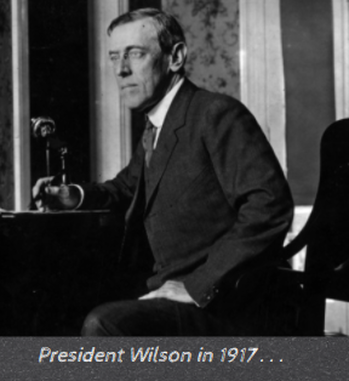
     President Woodrow Wilson addressed a Joint Session of Congress on 2 April 1917. In due course Wilson worked his way to his argument that war against Germany had become a necessity for the US while also point out that sacrifices would have to be made to militarize and mobilize. Wilson stated that Germany had become a global menace and that US was going to war to achieve ultimate peace and self-determination for nations, and then Wilson came to a quote for the ages: "The world must be made safe for Democracy". Wilson closed his address by saying that the US was going to war as the champion for the rights of Mankind. Ironically, as Wilson left the podium, Senator
Henry Cabot Lodge  worked his way to Wilson to personally congratulate the President. 
     On 4 April 1917, after a quick debate, the Senate voted in favor of a declaration of war by a vote of 82 to 6. The House of Representatives followed suit on 6 April 1917 voting 373 to 50 for a declaration of war. Among the 50 that voted no was the first female representative in US History, Jeannette Rankin (MT), who had been pressured by both hawks and doves and wanted to abstain; former Speaker Joe Cannon told Rankin to vote her conscience. On 7 April 1917, Wilson signed the joint resolution declaring war on Germany, even though the US military at the time was ranked between Belgium and Portugal. 

0 Comments

The Post-Presidency of Woodrow Wilson (1920 - 1924)

5/12/2018

0 Comments

 
                                  Source: A. Scott Berg. Wilson (2013)
Picture
     After Election Day 1920, the only major remaining duty for President Woodrow Wilson was his last State of the Union Address, which he knew he couldn't deliver in person. On 6 December 1920, Congressional leaders came to the White House to formally tell Wilson that Congress was back in session. One of those Congressional leaders was Senator
Henry Cabot Lodge, whom Wilson refused to shake hands, since Lodge was the lead Senator that was doing his best to scuttle ratification of the Treaty of Versailles and US membership in the League of Nations.
   Improving news from abroad actually led to Wilson's mood becoming more bitter, even mean-spirited. The disabled President (his left arm was paralyzed and his left leg was lame due to a severe stroke in September 1919) demanded on his afternoon drives that the Secret Service apprehend the drivers of the cars that passed his vehicle. Wilson even wrote Attorney General A. Mitchell Palmer that he wanted each of those divers fined $1000. During January 1921, Palmer presented Wilson with a document to sign that would pardon Eugene V. Debs, and Wilson wrote "denied" on the document.
     Woodrow and Edith Wilson decided to remain in Washington, D.C. largely for Wilson to be able to use the vast resources of the Library of Congress to research and write. Wilson needed to generate income (it wouldn't be until 1958 that Congress allocated a pension for former Presidents) but he absolutely refused to write his memoirs; bitterness and depression was basically oozing out of Wilson's pores. On 1 March 1921, Wilson presided over his last Cabinet meeting, and on 3 March 1921, Warren and Florence Harding invited the Wilsons to the traditional informal pre-Inauguration Day tea. Dr. Cary Grayson, who had been Wilson's doctor his entire Presidency, had to break the news to Wilson that he couldn't be a full active participant on Inauguration Day due to too many stairs. However, Wilson was able to be in the car with Harding in the first Inaugural Procession in automobiles before he had to leave the continuing ceremonies. Like Herbert Hoover in 1933, Wilson stared straight ahead in the car, refusing to acknowledge the crowds; Wilson felt that they were cheering for Harding, not for him.

Picture
  When the car carrying Wilson and Harding reached the Capitol Building, Harding leaped out of the car and raced up the stairs, leaving Wilson behind to be taken in a side door in a wheelchair. Wilson and Edith were furious at Harding, who was most likely very nervous (and also thoughtless). Once in the President's Room in the Capitol for the last time, among the dignitaries that paid their respects to Wilson was former
General John J. Pershing. The last person to talk to Wilson before Vice-President Calvin Coolidge was sworn in was Senator Lodge, who asked the President if he had any last communications to make with Congress; Wilson's response was a polite-yet-curt "no". 
     Due to the steps involved in reaching the Presidential Platform, Wilson was not able to be present for the swearing-in for Coolidge and Harding, so the Wilsons quietly disappeared In the car back to their home on S Street, Edith vented her full fury at Harding, while Wilson gently laughed. One of Harding's first actions was a very generous gesture: Grayson was assigned to continue to take care of former President Woodrow Wilson. It didn't take too many months to pass for Harding's brand of arrogance and his anti-intellectual tone to start foreign leaders to worry about the leadership in the US; now Wilson didn't look too bad to European leaders. 
     No President has left the White House being/feeling more depleted than Wilson, who lacked the spirit to do things that consumed his (apparently) fully-functioning mind. What Wilson looked forward to the most each day was his daily drive around DC, and starting in April 1921, every Saturday evening was "Play Night" at Keith's Theater, where the manager reserved seats in the last row for the Wilsons and their entourage. Soon enough, Wilson became part of that theater's landscape with its patrons, and often Wilson received ovations in his honor in the theater and when he approached his Pierce Arrow to go back home. By then Wilson had become a bit more mobile, but his physical health hadn't improved much overall in that his left arm and left leg were not improving, and he was experiencing gastrointestinal difficulties.

Picture
     On 25 August 1921, the US signed the Treaty of Berlin which officially ended the war between the US and Germany. It was a watered-down version of the Treaty of Versailles packed with "Lodge Reservations". Later that week the US signed treaties with Austria and Hungary, formally ending the state of war with those nations. The Revenue Act of 1921 drastically reduced the taxes for the rich, something new Secretary of the Treasury Andrew Mellon argued was
necessary for economic growth. During December 1921, Harding commuted the prison sentence of Debs, something Wilson had absolutely refused to do since he viewed Debs as a traitor. 
     Where Wilson (when he was healthy) had been a nose-to-the-grindstone President when he wasn't "off-the-clock" with Edith reading or watching movies, Warren Harding drank, played poker, cheated on his wife, and was taken advantage of by his cronies since he was basically incapable of saying "no". A tone of licentiousness was transmitted to the nation by the Harding Administration, which encouraged far too many citizens to engage in the same boorish behavior. One result was that the admiration of Wilson in the press and public increased a tremendous amount. Crowds would gather to watch Wilson leave his house on
​S Street for his daily drive, and people passed by Wilson's residence in de facto tours to see where the former President lived. 
Wilson's name started appearing in the US and elsewhere in the world on plaques, bridges, and streets. ​

Picture
  On 4 October 1921, Harding notified Wilson of an "unusual assemblage" at Arlington National Cemetery in which the burial of an
Unknown Soldier from World War I would occur. An Act of Congress with just minutes left in Wilson's Presidency authorized an exhumation of an unnamed US soldier buried in France for entombment in a new marble sarcophagus at Arlington. Wilson wasn't physically able to be at the burial itself, but he wanted to be part of the procession, requesting an open carriage instead of a car. The Wilsons arrived on time in their carriage for the procession, but in the last of a series of slights from the Harding Administration, Wilson and Edith found that their place in the procession had already been filled, and that they didn't have a guard. So, the Wilson carriage had to unceremoniously wedge itself into the procession at its first opportunity, and they were far behind the government officials in the parade. The crowd, upon realizing Wilson was in the procession, responded with appropriate praise which lasted all the way to the White House. Once there, Wilson left the procession as he had been instructed and went home. 
     The next day about 20,000 people were in front of Wilson's house, cheering at the two instances when Wilson came outside to engage the crowd, especially when he talked to two veterans. Soon after the entombment of the Unknown Soldier, many Americans started calling Wilson the "Known Soldier". The famous journalist/muckraker Ida Tarbell came to realize that Americans were starting to see foreign affairs Wilson's way, and she wrote an article that was published in Collier's asking the rhetorical question why so many Americans from different backgrounds revered Wilson. Tarbell believed that Wilson's mission had been to elevate mankind.

Picture
     Even though Wilson was not a military man, soldiers and their families held Wilson in high regard, believing that he had sacrificed much for his nation as they had. Ironically during this "Wilson Revival" there was no role for Joseph Tumulty, who had been Wilson's loyal secretary and also part of the conspiracy with Edith and Grayson to keep Wilson's stroke secret. A marginalized Tumulty frantically tried to get back into the Wilson fold, going so far to fabricate a statement that he claimed was given to him by Wilson at the annual Democratic function honoring Thomas Jefferson. When Wilson read about his "statement" in the newspapers he was thunderstruck; Tumulty had to sheepishly admit to Wilson that he was the culprit, and he gave a rather lame admission and retraction to the New York Times. Tumulty just kept digging a deeper hole for himself with Wilson, and he was excluded form Wilson's life just as Wilson had cut of all ties with
Colonel Edward House in Paris in 1919 (but Wilson never doubted Tumulty's loyalty and service for the eight years he was President). 
     
The Congressional Elections of 1922 were a referendum on Harding's Presidency, and his fellow Republicans suffered in that their lead in the Senate was halved and the Democrats were in striking distance of re-taking control in the House winning 76 seats. It seemed that the voters weren't in total agreement with the Republican effort to erase all-things-Wilson, such as enacting protective tariffs and coddling Big Business. Wilson was very irritated that Lodge won re-election to his sixth term by a very thin margin of only a few thousand votes. 
     After reaching the age of 66, Wilson received two unexpected tributes. On 27 December 1922, Franklin Roosevelt told Wilson that the Woodrow Wilson Foundation had raised over one million dollars, the vast majority coming from regular citizens. Then came a resolution from the Senate stating their pleasure at Wilson's continued improving health (most Republicans were "busy' during the actual vote), and a very complimentary appended message was included by Vice-President Calvin Coolidge. On 2 August 1923, President Warren Harding died of a heart attack. Despite being on cordial terms with Harding, Wilson believed that Harding was an inept politician. Nonetheless, Wilson sent a prompt note of sympathy to Harding's widow, Florence. 

     President Coolidge invited Wilson to participate in Harding's funeral which was to occur on
8 August 1923. Wilson wrote Coolidge that he was very grateful but unable to attend the funeral, procession, and the other ceremonies at the Capitol. But Wilson did view Harding's casket from his car and was part of the procession down Pennsylvania Avenue, where upon reaching the Capitol, Wilson and Edith returned home. 
     As the scandal-ridden postmortem of Harding's Presidency came to light (e.g. Teapot Dome
and his numerous affairs), Wilson became even more popular. Florence Harding hadn't allowed an autopsy, so conspiracy theories abounded as to how Harding REALLY died. Wilson truly appreciated and admired the calming influence that President Coolidge had on the nation.
Picture
     However, Wilson's energy and health soon diminished to the point where few were allowed to see him at home and Wilson didn't make as many outings. Yet Wilson did agree to give a radio address (8 paragraphs) from his home on the significance of Armistice Day. Radio technicians worked for hours in Wilson's home to get ready for the radio address which would be delivered later that day on 10 November 1923, on the Eve of Armistice Day. At 8:30 pm that night, Wilson gave his radio address to the nation; the address went without a hitch but Wilson was hard on himself for not being as eloquent as he had wanted. On Armistice Day 1923, a large crowd formed in front of Wilson's house as had become the recent tradition. 
     On 28 December 1923, Woodrow Wilson celebrated his 67th birthday. On 31 January 1924, Grayson examined Wilson, and despite the reduced energy, Grayson was not alarmed. However, Edith wanted a second opinion, and a specialist told her that Wilson was very sick, and Grayson agreed to stay overnight. On the morning of 1 February 1924, Edith was convinced that her husband was dying and that she needed to notify the three daughters. 
Grayson informed Edith that Wilson had taken a turn for the worse overnight in that his systems were shutting down. ​
Picture
    Soon the public realized what was going on at the Wilson house and many Americans gathered outside the home in a sort of death vigil. Wilson's kidneys were failing and doctors administered oxygen and gave him morphine to reduce the pain. On 3 February 1924 at 11:15 pm, Woodrow Wilson died. Coolidge directed that US Flags be lowered to half-staff for 30 days in honor of the former President. Coolidge also offered Arlington National Cemetery for Wilson's internment, but Edith wanted to maintain as much dignity and modesty as possible, knowing that was the wish of her husband. 
  The Bethlehem Chapel in the National Cathedral offered their services and location for Wilson's funeral and burial, which pleased Edith since she didn't want a state funeral. Edith wrote Lodge telling him that he wasn't welcome to the funeral or burial; Lodge responded very courteously saying he would not attend, and he released a notice to the press that he was unable to attend due to a respiratory condition. Edith's behavior was at its worst in that she used the time before the funeral/burial to exact some petty revenge on those she felt had wronged her husband. Edith arranged for a small private funeral at home and then a second formal funeral at the Bethlehem Chapel where only about 300 could attend. Edith would spend her remaining years in the same house where she had lived with her husband after he left the Presidency. 
     The Bethlehem Chapel was not the final resting place for Wilson; in 1956 Wilson was moved on the grounds of the National Cathedral, interred in a limestone sarcophagus which was more visible in honoring Wilson and more accessible. Edith, age 85, was there for the ceremony. On 20 January 1961, Edith was in the third row in the Presidential Platform for the Inauguration of John F. Kennedy and during the Inaugural Parade Edith rode in the same car as Eleanor Roosevelt. Edith Wilson died at the age of 89 from heart/lung problems on 28 December 1961, which was Wilson's birthday . . . she was interred with Wilson in the South Nave of the National Cathedral in Washington, D. C.

0 Comments

Woodrow Wilson and the Election of 1916

5/6/2018

0 Comments

 
                                 Source: A. Scott Berg. Wilson (2013)
Picture
   Nationalism had become a global epidemic, and in the Summer of 1916 that contagion hit the US in an election year. Flag-waving became a manic fad in America with parades the norm all across the nation for "Americanism" and preparedness (example: over 130,000 marched in a parade in Chicago). President Woodrow Wilson conspicuously showed his patriotism for all to see in speeches and appearances. On 14 June 1916 (Flag Day) Wilson led 66,000+ down Pennsylvania Avenue from the Capitol to the White House. Wilson made appearances at Arlington National Cemetery and West Point.
     On 7 June 1916, the Republican National Convention started in Chicago, but their house was in disarray in that the Grand Old Party still hadn't resolved its clash between the conservative, moderate, and liberal branches of the party. The Old Guard of the party refused to accept Theodore Roosevelt as the nominee believing that he valued himself over the Republican Party. Their focus instead shifted to Supreme Court Associate Justice Charles Evans Hughes, who was also the former governor of New York. An eager Hughes garnered the nomination on the 3rd ballot with TR far back in the tally of delegates. Hughes was pro-business and eager to enter the war in Europe. Hughes was the only Supreme Court justice to leave the bench to run for President. Doing so allowed Wilson to nominate a Progressive judge to the Supreme Court who was quickly confirmed by the Senate. 

Picture
     A week later the Democrats held their national convention in St. Louis which basically served as a coronation of Wilson, who controlled the convention from the White House. The mantra "He Kept Us Out Of War" was a product of a carefully staged convention. After the convention Wilson took to the hustings (campaigning) in many of the toss-up states, with almost all of them in the Midwest and the West, with California and its 13 Electoral Votes a top prize. 
   Wilson traveled as far west as Nebraska, while the Democratic Party sent the appropriate surrogates to campaign for Wilson in specific areas, such as large voting blocs of immigrant voters in New York City and William Jennings Bryan in the Midwest and the Great Plains. Wilson had become an even greater orator by 1916, and he refused to "talk down" to the voters. But Hughes proved to be a match for Wilson in almost every category, including oratory and academic background. 
     However, the Republican campaign for Hughes wasn't nearly as cohesive and focused as was Wilson's, and Hughes lacked a positive message or a vision. During the campaign, Wilson announced that the US had become a creditor nation, which took much of the wind out of the sails for Hughes in terms of of his pro-business rhetoric. Theodore Roosevelt's attacks on Wilson intensified during the campaign, but TR failed to bring voters in the Bull Moose Party to the Republican fold, with a sizable number ready to vote Democratic. 

Picture
     Unlike Wilson, Hughes barnstormed the nation, including California, and Hughes delved into the gutter bringing up Mary Peck from Wilson's past.  Eugene V. Debs didn't run for President; Debs instead ran for a set in Congress from his home district in Indiana, focusing his campaign rhetoric on attacking Wilson. Edith (who became Wilson's second wife on 18 December 1915) expected Wilson to lose the election, and Wilson had written a secret memo in which if he lost the election he would step down as President before his term ended . . . a plan of which Edith wasn't aware. 
  Similar to the Chicago Tribune's headline in 1948, the New York Times said it would flash a light on top of its building when a winner was determined on Election Day, white for Wilson and red for Hughes; late on Election Day the NY Times building flashed red. The New York World also predicted a Hughes victory at 10 pm on Election Day, and Theodore Roosevelt issued a public statement thanking Americans for electing Hughes as President. As the day after Election Day dawned, results coming in from the West had been unexpectedly pro-Wilson and as the morning hours passed the result was still in doubt with the Electoral Tally too close to call.

Picture
     The election came down to California and its 13 Electoral Votes. Each of the state's ballots was carefully guarded and painstakingly counted for accuracy. California held back on announcing a winner because Sierra County's results weren't yet in due to an early blizzard, so the nation had to wait. On 10 November 1915, California, which had been traditionally a Republican state, officially announced Wilson the winner by 3806 votes. California's result was due in large part because Wilson campaigned for peace while Hughes campaigned for war; the rising tide of Nationalism in America hadn't yet reached critical mass. Wilson also benefited from women voters in California as well as other western states.
     The final tally in the Electoral College was Wilson with 277 and Hughes at 254. Wilson had 9.13 million votes to Hughes 8.55 million. Wilson was the first Democratic candidate elected to a second term since Andrew Jackson in 1832, and Wilson was the first Democratic candidate since James Knox Polk in 1844 to win the Presidency without carrying his home state (which in Wilson's case was New Jersey). However, the Democrats lost two seats in the Senate, but still held an advantage of 54 to 42 over the Republicans. In the House, the Democrats fared much worse, in that the Republicans held an advantage of 215 - 214, but three Progressive Party representatives announced they would caucus with the Democrats, giving them a razor-thin majority. The Republican candidate for President, Charles Evans Hughes, didn't concede the election by telegram until 22 November 1916. 

0 Comments

    Archives

    May 2018
    April 2018
    March 2018
    February 2018
    January 2018
    December 2017
    November 2017
    October 2017
    September 2017
    August 2017
    July 2017
    June 2017
    May 2017

    Categories

    All
    18th Century
    19th Century
    20th Century
    Biography
    History

Powered by Create your own unique website with customizable templates.
