Mr. Jensen's U.S. History Website
  • U.S. History Blog
    • U.S. History Blog (May 2026 - May 2027)
    • U.S. History Blog (May 2025 - May 2026)
    • U.S. History Blog (May 2024 - May 2025)
    • U.S. History Blog (May 2023 - May 2024)
    • U.S. History Blog (May 2022 - May 2023)
    • U.S. History Blog (May 2021 - May 2022)
    • U.S. History Blog (May 2020 - May 2021)
    • U.S. History Blog (May 2019 - May 2020)
    • U.S. History Blog (May 2018 - May 2019)
    • U.S. History Blog (May 2017 - May 2018)
    • U.S. History Blog (May 2016 - May 2017)
    • U.S. History Blog (May 2015 - May 2016)
    • U.S. History Blog (May, 2014 - May, 2015)
  • About

Woodrow Wilson & the Declaration of War Against Germany

5/12/2018

0 Comments

 
                                  Source: A. Scott Berg. Wilson  (2013)
Picture
    After the Election of 1916, the Great War in Europe raged on, with the year 1916 already the deadliest in human history to that point. Nearly a million casualties were incurred during the Battle of Verdun, and it was twice as worse at the Somme in France and at Brusilov on the Eastern Front, and Germany increased their U-Boat attacks. Despite the unprecedented carnage, no nation was yet ready to throw in the towel. 
  During December 1916, President Woodrow Wilson received word from the non-militaristic elements in the German government  that they would be open to peace talks since the British blockade was starting to have a serious effect on the food supply for German civilians; it was the first chink in the German armor. As far as Colonel House (Wilson's representative in Europe) was concerned, Britain was the only obstacle to peace in Europe. Germany and Britain wanted commercial advantages from the US but neither nation offered anything in return in terms of peaceful overtures. By then Wilson believed that only he alone could (and should) speak for not only the US, but for the world as well. Wilson hoped to propose a series of terms that would deliver an enduring peace; as far as Wilson was concerned, he was the foreign policy of the US. On 3 January 1917, Wilson and House started to create their plan to remake the world, starting with the principle of self-determination.

Picture
     On 22 January 1917 Wilson again spoke to a Joint Session of Congress, this time providing little notice of when he would deliver the speech and what he would speak about. Wilson previewed the League of Nations, arguing that the only enduring peace would be a peace among equal nations. While Wilson asked for the US to embrace his version of a New World Order, his opponents labeled him as the "President of the World". The most positive reaction to the speech came from Germany, while Britain and France wondered why Wilson felt that he had a place at the table at all since the US wasn't directly involved in the Great War. 
     On 31 January 1917, Germany announced a new naval engagement policy of unrestricted submarine warfare, which stated that any ship in a war zone could be attacked, even ships from neutral nations. On 3 February 1917, Wilson announced that diplomatic ties with Germany had been severed, and that the German Ambassador to the US had been expelled; the US was now only one step away from declaring war on Germany. On 29 February 1917 came news of the Zimmermann Telegram. The British had intercepted the coded telegram on US wires weeks before but didn't relay what it held to Wilson until 25 February 1917. Wilson soon thereafter again addressed Congress, again pushing for "armed neutrality". 
     On 5 March 1917, Wilson delivered his Second Inaugural Address (4 March was on Sunday, and Wilson was sworn in to his second term in private) and he focused on international events. Wilson had done his best to morally and mentally prepare the US for going to war, but the nation was far from ready militarily.

Picture
  During yet another illness, Wilson started to use his wife Edith as "a blind" in order to pass information between Wilson and Secretary of State Robert Lansing and Secretary of the Navy Josephus Daniels. Then the Russian Revolution began and Czar Nicholas II abdicated his throne (he did so on his son's behalf as well), and a Provisional Government was formed with the rising tide of Bolshevism forming to topple that government. 
    During the next Cabinet meeting, Wilson asked if he should speak to Congress before his next scheduled address which was on 16 April 1917. The Cabinet urged action without delay, arguing that the US was already in a state of war with Germany. Even the pacifist in the Cabinet, SecNav Daniels (also a close friend of former SecState William Jennings Bryan), supported war with Germany. On 30 March 1917 Wilson started to prepare his address to Congress, which he had rescheduled for 2 April 1917. House was a huge supporter of the speech when Wilson read it to him in private, since it featured much of what House had suggested to Wilson since the Great War began . . . but as much as House would like to claim at least partial credit for the address, it was a Wilson speech all the way.

Picture
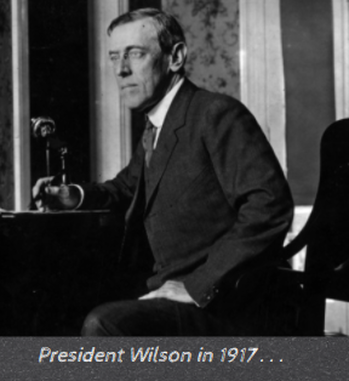
     President Woodrow Wilson addressed a Joint Session of Congress on 2 April 1917. In due course Wilson worked his way to his argument that war against Germany had become a necessity for the US while also point out that sacrifices would have to be made to militarize and mobilize. Wilson stated that Germany had become a global menace and that US was going to war to achieve ultimate peace and self-determination for nations, and then Wilson came to a quote for the ages: "The world must be made safe for Democracy". Wilson closed his address by saying that the US was going to war as the champion for the rights of Mankind. Ironically, as Wilson left the podium, Senator
Henry Cabot Lodge  worked his way to Wilson to personally congratulate the President. 
     On 4 April 1917, after a quick debate, the Senate voted in favor of a declaration of war by a vote of 82 to 6. The House of Representatives followed suit on 6 April 1917 voting 373 to 50 for a declaration of war. Among the 50 that voted no was the first female representative in US History, Jeannette Rankin (MT), who had been pressured by both hawks and doves and wanted to abstain; former Speaker Joe Cannon told Rankin to vote her conscience. On 7 April 1917, Wilson signed the joint resolution declaring war on Germany, even though the US military at the time was ranked between Belgium and Portugal. 

0 Comments

The Post-Presidency of Woodrow Wilson (1920 - 1924)

5/12/2018

0 Comments

 
                                  Source: A. Scott Berg. Wilson (2013)
Picture
     After Election Day 1920, the only major remaining duty for President Woodrow Wilson was his last State of the Union Address, which he knew he couldn't deliver in person. On 6 December 1920, Congressional leaders came to the White House to formally tell Wilson that Congress was back in session. One of those Congressional leaders was Senator
Henry Cabot Lodge, whom Wilson refused to shake hands, since Lodge was the lead Senator that was doing his best to scuttle ratification of the Treaty of Versailles and US membership in the League of Nations.
   Improving news from abroad actually led to Wilson's mood becoming more bitter, even mean-spirited. The disabled President (his left arm was paralyzed and his left leg was lame due to a severe stroke in September 1919) demanded on his afternoon drives that the Secret Service apprehend the drivers of the cars that passed his vehicle. Wilson even wrote Attorney General A. Mitchell Palmer that he wanted each of those divers fined $1000. During January 1921, Palmer presented Wilson with a document to sign that would pardon Eugene V. Debs, and Wilson wrote "denied" on the document.
     Woodrow and Edith Wilson decided to remain in Washington, D.C. largely for Wilson to be able to use the vast resources of the Library of Congress to research and write. Wilson needed to generate income (it wouldn't be until 1958 that Congress allocated a pension for former Presidents) but he absolutely refused to write his memoirs; bitterness and depression was basically oozing out of Wilson's pores. On 1 March 1921, Wilson presided over his last Cabinet meeting, and on 3 March 1921, Warren and Florence Harding invited the Wilsons to the traditional informal pre-Inauguration Day tea. Dr. Cary Grayson, who had been Wilson's doctor his entire Presidency, had to break the news to Wilson that he couldn't be a full active participant on Inauguration Day due to too many stairs. However, Wilson was able to be in the car with Harding in the first Inaugural Procession in automobiles before he had to leave the continuing ceremonies. Like Herbert Hoover in 1933, Wilson stared straight ahead in the car, refusing to acknowledge the crowds; Wilson felt that they were cheering for Harding, not for him.

Picture
  When the car carrying Wilson and Harding reached the Capitol Building, Harding leaped out of the car and raced up the stairs, leaving Wilson behind to be taken in a side door in a wheelchair. Wilson and Edith were furious at Harding, who was most likely very nervous (and also thoughtless). Once in the President's Room in the Capitol for the last time, among the dignitaries that paid their respects to Wilson was former
General John J. Pershing. The last person to talk to Wilson before Vice-President Calvin Coolidge was sworn in was Senator Lodge, who asked the President if he had any last communications to make with Congress; Wilson's response was a polite-yet-curt "no". 
     Due to the steps involved in reaching the Presidential Platform, Wilson was not able to be present for the swearing-in for Coolidge and Harding, so the Wilsons quietly disappeared In the car back to their home on S Street, Edith vented her full fury at Harding, while Wilson gently laughed. One of Harding's first actions was a very generous gesture: Grayson was assigned to continue to take care of former President Woodrow Wilson. It didn't take too many months to pass for Harding's brand of arrogance and his anti-intellectual tone to start foreign leaders to worry about the leadership in the US; now Wilson didn't look too bad to European leaders. 
     No President has left the White House being/feeling more depleted than Wilson, who lacked the spirit to do things that consumed his (apparently) fully-functioning mind. What Wilson looked forward to the most each day was his daily drive around DC, and starting in April 1921, every Saturday evening was "Play Night" at Keith's Theater, where the manager reserved seats in the last row for the Wilsons and their entourage. Soon enough, Wilson became part of that theater's landscape with its patrons, and often Wilson received ovations in his honor in the theater and when he approached his Pierce Arrow to go back home. By then Wilson had become a bit more mobile, but his physical health hadn't improved much overall in that his left arm and left leg were not improving, and he was experiencing gastrointestinal difficulties.

Picture
     On 25 August 1921, the US signed the Treaty of Berlin which officially ended the war between the US and Germany. It was a watered-down version of the Treaty of Versailles packed with "Lodge Reservations". Later that week the US signed treaties with Austria and Hungary, formally ending the state of war with those nations. The Revenue Act of 1921 drastically reduced the taxes for the rich, something new Secretary of the Treasury Andrew Mellon argued was
necessary for economic growth. During December 1921, Harding commuted the prison sentence of Debs, something Wilson had absolutely refused to do since he viewed Debs as a traitor. 
     Where Wilson (when he was healthy) had been a nose-to-the-grindstone President when he wasn't "off-the-clock" with Edith reading or watching movies, Warren Harding drank, played poker, cheated on his wife, and was taken advantage of by his cronies since he was basically incapable of saying "no". A tone of licentiousness was transmitted to the nation by the Harding Administration, which encouraged far too many citizens to engage in the same boorish behavior. One result was that the admiration of Wilson in the press and public increased a tremendous amount. Crowds would gather to watch Wilson leave his house on
​S Street for his daily drive, and people passed by Wilson's residence in de facto tours to see where the former President lived. 
Wilson's name started appearing in the US and elsewhere in the world on plaques, bridges, and streets. ​

Picture
  On 4 October 1921, Harding notified Wilson of an "unusual assemblage" at Arlington National Cemetery in which the burial of an
Unknown Soldier from World War I would occur. An Act of Congress with just minutes left in Wilson's Presidency authorized an exhumation of an unnamed US soldier buried in France for entombment in a new marble sarcophagus at Arlington. Wilson wasn't physically able to be at the burial itself, but he wanted to be part of the procession, requesting an open carriage instead of a car. The Wilsons arrived on time in their carriage for the procession, but in the last of a series of slights from the Harding Administration, Wilson and Edith found that their place in the procession had already been filled, and that they didn't have a guard. So, the Wilson carriage had to unceremoniously wedge itself into the procession at its first opportunity, and they were far behind the government officials in the parade. The crowd, upon realizing Wilson was in the procession, responded with appropriate praise which lasted all the way to the White House. Once there, Wilson left the procession as he had been instructed and went home. 
     The next day about 20,000 people were in front of Wilson's house, cheering at the two instances when Wilson came outside to engage the crowd, especially when he talked to two veterans. Soon after the entombment of the Unknown Soldier, many Americans started calling Wilson the "Known Soldier". The famous journalist/muckraker Ida Tarbell came to realize that Americans were starting to see foreign affairs Wilson's way, and she wrote an article that was published in Collier's asking the rhetorical question why so many Americans from different backgrounds revered Wilson. Tarbell believed that Wilson's mission had been to elevate mankind.

Picture
     Even though Wilson was not a military man, soldiers and their families held Wilson in high regard, believing that he had sacrificed much for his nation as they had. Ironically during this "Wilson Revival" there was no role for Joseph Tumulty, who had been Wilson's loyal secretary and also part of the conspiracy with Edith and Grayson to keep Wilson's stroke secret. A marginalized Tumulty frantically tried to get back into the Wilson fold, going so far to fabricate a statement that he claimed was given to him by Wilson at the annual Democratic function honoring Thomas Jefferson. When Wilson read about his "statement" in the newspapers he was thunderstruck; Tumulty had to sheepishly admit to Wilson that he was the culprit, and he gave a rather lame admission and retraction to the New York Times. Tumulty just kept digging a deeper hole for himself with Wilson, and he was excluded form Wilson's life just as Wilson had cut of all ties with
Colonel Edward House in Paris in 1919 (but Wilson never doubted Tumulty's loyalty and service for the eight years he was President). 
     
The Congressional Elections of 1922 were a referendum on Harding's Presidency, and his fellow Republicans suffered in that their lead in the Senate was halved and the Democrats were in striking distance of re-taking control in the House winning 76 seats. It seemed that the voters weren't in total agreement with the Republican effort to erase all-things-Wilson, such as enacting protective tariffs and coddling Big Business. Wilson was very irritated that Lodge won re-election to his sixth term by a very thin margin of only a few thousand votes. 
     After reaching the age of 66, Wilson received two unexpected tributes. On 27 December 1922, Franklin Roosevelt told Wilson that the Woodrow Wilson Foundation had raised over one million dollars, the vast majority coming from regular citizens. Then came a resolution from the Senate stating their pleasure at Wilson's continued improving health (most Republicans were "busy' during the actual vote), and a very complimentary appended message was included by Vice-President Calvin Coolidge. On 2 August 1923, President Warren Harding died of a heart attack. Despite being on cordial terms with Harding, Wilson believed that Harding was an inept politician. Nonetheless, Wilson sent a prompt note of sympathy to Harding's widow, Florence. 

     President Coolidge invited Wilson to participate in Harding's funeral which was to occur on
8 August 1923. Wilson wrote Coolidge that he was very grateful but unable to attend the funeral, procession, and the other ceremonies at the Capitol. But Wilson did view Harding's casket from his car and was part of the procession down Pennsylvania Avenue, where upon reaching the Capitol, Wilson and Edith returned home. 
     As the scandal-ridden postmortem of Harding's Presidency came to light (e.g. Teapot Dome
and his numerous affairs), Wilson became even more popular. Florence Harding hadn't allowed an autopsy, so conspiracy theories abounded as to how Harding REALLY died. Wilson truly appreciated and admired the calming influence that President Coolidge had on the nation.
Picture
     However, Wilson's energy and health soon diminished to the point where few were allowed to see him at home and Wilson didn't make as many outings. Yet Wilson did agree to give a radio address (8 paragraphs) from his home on the significance of Armistice Day. Radio technicians worked for hours in Wilson's home to get ready for the radio address which would be delivered later that day on 10 November 1923, on the Eve of Armistice Day. At 8:30 pm that night, Wilson gave his radio address to the nation; the address went without a hitch but Wilson was hard on himself for not being as eloquent as he had wanted. On Armistice Day 1923, a large crowd formed in front of Wilson's house as had become the recent tradition. 
     On 28 December 1923, Woodrow Wilson celebrated his 67th birthday. On 31 January 1924, Grayson examined Wilson, and despite the reduced energy, Grayson was not alarmed. However, Edith wanted a second opinion, and a specialist told her that Wilson was very sick, and Grayson agreed to stay overnight. On the morning of 1 February 1924, Edith was convinced that her husband was dying and that she needed to notify the three daughters. 
Grayson informed Edith that Wilson had taken a turn for the worse overnight in that his systems were shutting down. ​
Picture
    Soon the public realized what was going on at the Wilson house and many Americans gathered outside the home in a sort of death vigil. Wilson's kidneys were failing and doctors administered oxygen and gave him morphine to reduce the pain. On 3 February 1924 at 11:15 pm, Woodrow Wilson died. Coolidge directed that US Flags be lowered to half-staff for 30 days in honor of the former President. Coolidge also offered Arlington National Cemetery for Wilson's internment, but Edith wanted to maintain as much dignity and modesty as possible, knowing that was the wish of her husband. 
  The Bethlehem Chapel in the National Cathedral offered their services and location for Wilson's funeral and burial, which pleased Edith since she didn't want a state funeral. Edith wrote Lodge telling him that he wasn't welcome to the funeral or burial; Lodge responded very courteously saying he would not attend, and he released a notice to the press that he was unable to attend due to a respiratory condition. Edith's behavior was at its worst in that she used the time before the funeral/burial to exact some petty revenge on those she felt had wronged her husband. Edith arranged for a small private funeral at home and then a second formal funeral at the Bethlehem Chapel where only about 300 could attend. Edith would spend her remaining years in the same house where she had lived with her husband after he left the Presidency. 
     The Bethlehem Chapel was not the final resting place for Wilson; in 1956 Wilson was moved on the grounds of the National Cathedral, interred in a limestone sarcophagus which was more visible in honoring Wilson and more accessible. Edith, age 85, was there for the ceremony. On 20 January 1961, Edith was in the third row in the Presidential Platform for the Inauguration of John F. Kennedy and during the Inaugural Parade Edith rode in the same car as Eleanor Roosevelt. Edith Wilson died at the age of 89 from heart/lung problems on 28 December 1961, which was Wilson's birthday . . . she was interred with Wilson in the South Nave of the National Cathedral in Washington, D. C.

0 Comments

Woodrow Wilson and the Election of 1916

5/6/2018

0 Comments

 
                                 Source: A. Scott Berg. Wilson (2013)
Picture
   Nationalism had become a global epidemic, and in the Summer of 1916 that contagion hit the US in an election year. Flag-waving became a manic fad in America with parades the norm all across the nation for "Americanism" and preparedness (example: over 130,000 marched in a parade in Chicago). President Woodrow Wilson conspicuously showed his patriotism for all to see in speeches and appearances. On 14 June 1916 (Flag Day) Wilson led 66,000+ down Pennsylvania Avenue from the Capitol to the White House. Wilson made appearances at Arlington National Cemetery and West Point.
     On 7 June 1916, the Republican National Convention started in Chicago, but their house was in disarray in that the Grand Old Party still hadn't resolved its clash between the conservative, moderate, and liberal branches of the party. The Old Guard of the party refused to accept Theodore Roosevelt as the nominee believing that he valued himself over the Republican Party. Their focus instead shifted to Supreme Court Associate Justice Charles Evans Hughes, who was also the former governor of New York. An eager Hughes garnered the nomination on the 3rd ballot with TR far back in the tally of delegates. Hughes was pro-business and eager to enter the war in Europe. Hughes was the only Supreme Court justice to leave the bench to run for President. Doing so allowed Wilson to nominate a Progressive judge to the Supreme Court who was quickly confirmed by the Senate. 

Picture
     A week later the Democrats held their national convention in St. Louis which basically served as a coronation of Wilson, who controlled the convention from the White House. The mantra "He Kept Us Out Of War" was a product of a carefully staged convention. After the convention Wilson took to the hustings (campaigning) in many of the toss-up states, with almost all of them in the Midwest and the West, with California and its 13 Electoral Votes a top prize. 
   Wilson traveled as far west as Nebraska, while the Democratic Party sent the appropriate surrogates to campaign for Wilson in specific areas, such as large voting blocs of immigrant voters in New York City and William Jennings Bryan in the Midwest and the Great Plains. Wilson had become an even greater orator by 1916, and he refused to "talk down" to the voters. But Hughes proved to be a match for Wilson in almost every category, including oratory and academic background. 
     However, the Republican campaign for Hughes wasn't nearly as cohesive and focused as was Wilson's, and Hughes lacked a positive message or a vision. During the campaign, Wilson announced that the US had become a creditor nation, which took much of the wind out of the sails for Hughes in terms of of his pro-business rhetoric. Theodore Roosevelt's attacks on Wilson intensified during the campaign, but TR failed to bring voters in the Bull Moose Party to the Republican fold, with a sizable number ready to vote Democratic. 

Picture
     Unlike Wilson, Hughes barnstormed the nation, including California, and Hughes delved into the gutter bringing up Mary Peck from Wilson's past.  Eugene V. Debs didn't run for President; Debs instead ran for a set in Congress from his home district in Indiana, focusing his campaign rhetoric on attacking Wilson. Edith (who became Wilson's second wife on 18 December 1915) expected Wilson to lose the election, and Wilson had written a secret memo in which if he lost the election he would step down as President before his term ended . . . a plan of which Edith wasn't aware. 
  Similar to the Chicago Tribune's headline in 1948, the New York Times said it would flash a light on top of its building when a winner was determined on Election Day, white for Wilson and red for Hughes; late on Election Day the NY Times building flashed red. The New York World also predicted a Hughes victory at 10 pm on Election Day, and Theodore Roosevelt issued a public statement thanking Americans for electing Hughes as President. As the day after Election Day dawned, results coming in from the West had been unexpectedly pro-Wilson and as the morning hours passed the result was still in doubt with the Electoral Tally too close to call.

Picture
     The election came down to California and its 13 Electoral Votes. Each of the state's ballots was carefully guarded and painstakingly counted for accuracy. California held back on announcing a winner because Sierra County's results weren't yet in due to an early blizzard, so the nation had to wait. On 10 November 1915, California, which had been traditionally a Republican state, officially announced Wilson the winner by 3806 votes. California's result was due in large part because Wilson campaigned for peace while Hughes campaigned for war; the rising tide of Nationalism in America hadn't yet reached critical mass. Wilson also benefited from women voters in California as well as other western states.
     The final tally in the Electoral College was Wilson with 277 and Hughes at 254. Wilson had 9.13 million votes to Hughes 8.55 million. Wilson was the first Democratic candidate elected to a second term since Andrew Jackson in 1832, and Wilson was the first Democratic candidate since James Knox Polk in 1844 to win the Presidency without carrying his home state (which in Wilson's case was New Jersey). However, the Democrats lost two seats in the Senate, but still held an advantage of 54 to 42 over the Republicans. In the House, the Democrats fared much worse, in that the Republicans held an advantage of 215 - 214, but three Progressive Party representatives announced they would caucus with the Democrats, giving them a razor-thin majority. The Republican candidate for President, Charles Evans Hughes, didn't concede the election by telegram until 22 November 1916. 

0 Comments

Woodrow Wilson: August 1914 to June 1915

4/21/2018

1 Comment

 
                               Source: A. Scott Berg. Wilson (2013)
Picture
    As early as August 1914, President Woodrow Wilson was concerned that Germany's actions on the Atlantic would jeopardize US neutrality. Wilson began to structure his own permanent plan for peace after the war, which was in effect a New World Order; Wilson believed that the world had become a neighborhood of nations. Wilson came up with four overall principles: no more land would be acquired by conquest, small nations have equal rights, governments should be the only ones that make weapons, and the creation of an association of nations where all guarantee the territorial integrity of all other nations. 
     On 8 December 1914, Wilson delivered his Annual Message to Congress where he focused on national defense, or to be more accurate, the lack thereof. Wilson did not want to commit the US to the development of a large standing army, and in subsequent speeches Wilson repeated the mantra of neutrality. Former President Theodore Roosevelt attacked Wilson in the press, basically calling Wilson a coward. Wilson sent his main adviser, Colonel Edward House, to Europe to get accurate information on what was really occurring in the war. Already, Wilson saw the Great War as a way to expand his ideal of liberating people from autocracy.

Picture
     On 30 January 1915, House and his wife sailed to Europe on board the RMS Lusitania. House was a US Minister without portfolio, which meant he in essence had carte blanche to make decisions on behalf of Wilson. House met with King George V, and then went to Berlin where he met with the German foreign minister Arthur Zimmermann. All those House talked to in Europe were not remotely interested in ending the war, with each nation actually convincing itself that they were winning.
     In early-1915, Great Britain enacted a naval blockade on the German coastline in the North Sea, and Germany responded by expanding their naval engagement zone, meaning that all enemy ships, naval or commercial, were subject to being sunk in the war zone around Britain. On 10 February 1915, Secretary of State William Jennings Bryan wanted assurances from Germany that American ships would be left alone in the war zone. But even before his communique was sent, in January 1915 Germany had sunk the SS William P. Frye that was carrying wheat. Adding to the tension was that by 1 May 1915 the Germans had sunk two more US merchant ships.

Picture
     Meanwhile, Dr. Cary Grayson, Wilson personal physician, had fallen in love with Alice Gertrude Gordon, a DC heiress. Before his death her father asked a long-time friend to look out for his daughter, and she agreed to be Alice's unofficial guardian; that friend was Edith Bolling Galt, the future second wife of President Woodrow Wilson. After a five month trip in Europe, Alice and Edith had bonded, and Edith had found that she also liked Grayson. 
     One day Wilson saw Edith in Grayson's presence, and he asked his doctor about that beautiful woman that he had seen. Grayson took it upon himself to introduce Edith to Wilson, and that task wasn't easy in that Edith wasn't smitten with DC society or its politics. Grayson arranged it so Edith became friends with Helen Bones, Wilson's part-time hostess (Wilson had
lost his first wife, Ellen, not long before, so there wasn't a First Lady). Edith was the first woman in DC to drive her own automobile, and she and Helen took short drives in her electric car (Also of interest: it appears that Edith was a direct descendant of Pocahontas). Edith liked hearing stories about Wilson from Helen, finding out that the President was very different from how he was portrayed in the press. 
     Helen arranged things one day so that Edith visited the White House when Wilson had come back from golfing with Grayson (who was in cahoots with Helen), and sure enough the four had tea. Edith did not stay for dinner, not wanting to overstay her welcome. On 23 March 1915 Edith was invited to the White House for dinner, where Wilson entertained Helen and Edith. Two weeks later Wilson and Edith and Helen took a drive in the White House limousine which led Wilson to invite Edith to go with him to a Washington Senators game where he was to throw out the first pitch. For appearances (and politics) sake Helen accompanied Wilson and Edith when they were out in public.

Picture
   On 3 May 1915, Helen and Grayson arranged it so Wilson and Edith were alone for the first time. Wilson told Edith that he loved her and wanted to marry her, all after knowing her for only two months. Edith said that if Wilson required an answer right then-and-there, her answer was no; Edith wanted time to weigh the benefits/costs of marrying the President. So started Wilson's most passionate chase, where he wrote many romantic letters to Edith; to Wilson, the world stood still despite all the tumultuous events occurring nationally and globally until she accepted his proposal.
     On 7 May 1915 Wilson had just finished lunch when he was told of the sinking of the Lusitania; initial reports had no loss of life, but soon changed. Wilson canceled his golf game and instead went for a drive in order to process what he had been told. The sinking of the Lusitania became a rallying cry for the Jingoes (especially Theodore Roosevelt) to declare war in Germany, which was also the prevailing view of at least a few members of the Cabinet. Wilson was upset that Britain had indeed used passengers, including Americans, as human shields to protect luxury liners that were carrying weapons (The Lusitania sank in less that 20 minutes due to the German torpedo igniting coal  dust, which was the source of the second explosion that doomed the ship . . . but that knowledge came decades later in the early-1990s due to the efforts of Bob Ballard). 

Picture
      As for Germany, Wilson knew that a disaster such as the Lusitania could cause in inevitable drift towards war. But Wilson wasn't thinking all that straight at the time due to his obsession with Edith, which perhaps explained why in a speech after the Lusitania disaster Wilson claimed that there were times when a nation is so right that it didn't have to convince other nations that it was right. The next day's headlines in many newspapers read "Too Proud to Fight", which gave plenty of ammunition to Wilson's increasing number of political enemies such as Senator Henry Cabot Lodge. Lodge resented Wilson's rhetorical gifts (he was forever irritated that Wilson was the Intellectual Politician instead of him) and was all too happy to take advantage of the opportunity in order to politically attack Wilson.
    Wilson admitted that he wasn't sure what he said in that speech in Philadelphia, since Edith was foremost on his mind. The next day Wilson did some damage control saying that he was not afraid of war, but that the Lusitania disaster didn't necessitate a declaration of war. The next day former President William Howard Taft publicly supported Wilson, but SecState Bryan disagreed with Wilson's tough diplomatic response to Germany, wanting to play peacemaker.

Picture
     In Europe, House was trying to get Britain to lift their devastating blockade while at the same time he was trying to get Germany to reduce the number of U-Boat attacks and its use of poison gas. During Cabinet meetings, SecState Bryan's pacifism was starting to get on Wilson's nerves. Bryan sent Wilson a letter letting him know that if the situation remained the same in terms of Wilson's rhetoric with Germany, he would resign. Wilson told Edith of the letter, and she totally supported Wilson in replacing Bryan. Edith knew she had much to learn about politics if she was to become the First Lady, and first in order was to avoid reacting in knee-jerk fashion. 
     Wilson finally received a reply from Germany, and while the communique wasn't conciliatory, there was a promise to not target neutral ships. SecState Bryan again disagreed with the tone of Wilson's drafted response to Berlin, and resigned as SecState a few days later after meeting with Wilson. Wilson was overjoyed with Bryan's resignation as was Edith; Wilson truly enjoyed and appreciated that Edith saw things the same way he did, which meant they were able to vent their frustrations to each other in private. Wilson decided to nominate Robert Lansing as Acting Secretary of State to replace Bryan; little did Wilson know that he would have far more difficulty with Lansing as Secretary of State after the Armistice was signed in November 1918.

1 Comment

Woodrow Wilson: From NJ Governor to President-Elect

4/15/2018

0 Comments

 
                            Source: A. Scott Berg. Wilson (2013)
Picture
     By 1910, New Jersey had become the most densely-populated state, and it had also become the "Mother of Trusts"; the President of Princeton University, Woodrow Wilson, commented that New Jersey was one of the "backward states". When presented with the offer to run for Governor of New Jersey as a Democrat by the state's party bosses, Wilson didn't resist. Wilson had to show the various powerful interests in New Jersey that he would be a team player, and Wilson's answers to questions posed to him by the state's power brokers in the Boss System were deemed adequate, not outstanding. But not even support from the New Jersey Democratic Machine made Wilson's nomination a lock, in that there were other candidates that were far-more politically connected and experienced; even Wilson's supporters wondered how a political novice from academia could hold his own in the rough-and-tumble of  New Jersey politics.
     Wilson won the Democratic nomination for governor on the first ballot, and his acceptance speech at the state convention electrified the delegates. Wilson claimed that he would be single-minded in his pursuit of serving the citizens of New Jersey. The campaign for governor was interesting in that Wilson still had a university to run, and he had to work his campaign around his obligations at Princeton. On 20 October 1910, Wilson submitted his resignation to the Board of Trustees at Princeton; Wilson was allowed to used the President's mansion for the rest of the semester, and he was honored with Princeton's greatest award, the Doctor of Laws degree. Wilson said that he would get out of the mansion after the campaign, and that he would forego the remainder of his salary as President of Princeton.

Picture
     Soon enough, Wilson's political handlers discovered that he had a great grasp on a great number of political topics/issues. Wilson campaigned hard across the state for six weeks, and he already had shown that he was not a puppet to the state's party bosses, remaining his idealistic self. But Wilson did one thing the state party machine wanted, and that was to attack the Republicans; Wilson also mixed state issues with national and global concerns. Wilson's political independence was the talk of the state, even attracting Republican voters, and Wilson won in a landslide, 54 to 43 percent. 
     Governor-Elect Wilson soon found himself at odds with the state's party machine bosses over who the legislature should send to the US Senate (before the 17th Amendment, state legislatures selected their own US Senators). On 17 January 1911, Wilson was inaugurated as the Governor of New Jersey, and soon was able to garner enough support to get a non-machine candidate appointed to the US Senate. As he did when he became President of Princeton, Governor Wilson proposed a sweeping agenda of reform, with many items geared towards limiting the power of monopolies and election reform. 
    Without announcing his intention to run for President, the tide of Progressivism took Wilson's name to the forefront in the national Democratic Party. In 1911, the elder statesman of the Democratic Party was William Jennings Bryan, who was ironically four years younger than Wilson. While Bryan was not going to win the party's nomination in 1912, he would be key in determining who would. After a dinner with Wilson, Bryan became a Wilson fan, and Wilson was a fan of Bryan's. Wilson's successes in New Jersey had made him a national political figure by the Spring of 1911, and by then Wilson had become a true Progressive reformer. 

Picture
     Among Wilson's wealthy supporters was Henry Morgenthau, Sr. (his son, Henry Morgenthau, Jr., served in FDR's Cabinet), and in October 1911, Wilson was introduced to Edward Mandell House of Texas, who would provide much more than campaign funds. House, due mostly to an inheritance, was able to pursue the only thing that aroused passion in him: politics. House, relatively fragile physically, was politically formidable in Texas, and his influence in national Democratic Party politics was growing. While House had impressed Wilson' most ardent and influential supporters, he wasn't yet ready to commit his support to Wilson. On 24 November 1911, House and Wilson met for the first time, and a meaningful political connection (and friendship) was made; Wilson had met his alter ego.
     House became a conduit for Wilson, talking to influential people such as Bryan, whom House had known for over a decade. Within a year, Wilson told others that House was his second personality. In New Jersey, Princeton selected a President that Wilson believed was a step back for the university, the Republicans won back both houses in the state legislature, and Wilson vetoed over 40 bills, which enraged the state's Republican Party. Even so, Wilson was able to get Progressive legislation passed, enhancing his standing as a reformer governor.
     For the first time before a Democratic National Convention, several states used primary elections to pledge delegates to candidates. Wilson had to forego some state primaries (such as Missouri and Alabama) since their Favorite Son candidates were a lock to win, and in the primaries he ran, Wilson basically got clobbered, and there was no momentum gained. But some states went Wilson's way: Ohio, Pennsylvania, Wisconsin, Kansas, Oklahoma, Texas, and New Jersey, even with the state's party bosses working against him. Not since 1860 had the Democratic Party been so divided in terms of selecting a candidate to run for President. 

Picture
     The upcoming Democratic National Convention in Baltimore would operate on the "2/3's Rule", which meant that 729 delegates (a super-majority of 2/3's) was the magic number. Wilson thought that the "2/3's Rule" was undemocratic, but the same rule increased the odds of a brokered convention, which could only aid Wilson's bid for the nomination. Heading into the convention, Wilson had the second-most delegates, but was almost 200 behind. Bryan maneuvered things ahead of the convention to force the major candidates to declare their political intentions, and Wilson was revealed to be the only Progressive among the candidates (much to Bryan's delight). Among the items in the Democratic Platform was the popular election of US Senators (the future 17th Amendment) and a federal income tax (the future 16th Amendment).
     After the first ballot, Wilson was behind 440 to 324, and Wilson agreed to keep his name in the ring instead of withdrawing his name as a candidate, which kept his candidates pledged to him. As more ballots were taken, Wilson was advised by his representatives at the convention (the tradition was that candidates were not at the convention) that he had gained momentum and the delegate leader had peaked. Among the delegates on the floor of the convention that laid claim to shifting momentum in favor of Wilson was a state senator from New York, Franklin Roosevelt (he made over 300 campaign buttons for Wilson and created much hooplah). 
     On the 30th ballot, Wilson inched ahead, and finally, on the 46th ballot, Wilson surpassed the 2/3's mark with 990 delegates. House offered his services to Wilson to help be sure that a likely victory in the upcoming Presidential Election in 1912 wouldn't be lost. On 7 August 1912, Wilson, in front of thousands in New Jersey, officially accepted the Democratic nomination with an acceptance speech (which was the tradition in those days). 
     Not since the Election of 1860 had four candidates run for President: Wilson (Democrat), former President Theodore Roosevelt (the Progressive Party, a.k.a. the "Bull Moose Party"), 
President William Howard Taft (Republican), and Eugene V. Debs (Socialist). In 1912, all media was local, so in order to effectively campaign, a candidate had to set "small fires" across the nation, which meant many speeches in big cities and on the train on what was called Whistle-Stop Tours. President Taft didn't actively campaign (believing he would lose), and Debs wasn't able to nationally campaign, so the election in effect came down to Wilson and Roosevelt. Wilson was the novelty that Americans came to see, since TR was a known political personality. 
Wilson was able to stir the moral and political convictions of millions of American voters, far more so than TR. ​

Picture
    Wilson told his campaign treasurer (Morgenthau) that he would not accept campaign donations if there were strings attached, and he wanted to publicize the money coming in and going out. 90,000+ citizens contributed over $1.1m . . . but there was something missing from Wilson's campaign, and he filled it with Louis Brandeis, who was Wilson's expert on Trusts. Where TR wanted to regulate, Wilson and Brandeis wanted much stronger limits on monopolies which they believed was achievable by increasing competition instead of government regulation. Wilson and Brandeis called their Progressive agenda the New Freedom. 
     TR's campaign focused on histrionics and hyperbole, while Wilson quietly converted citizens to followers. Wilson had a rare skill set, an intellectual politician that had charm and charisma, which connected him to the voter. After TR was shot in Milwaukee and needed to stop his campaign for two weeks, Wilson refused to campaign until TR returned to the hustings. As the general campaign wound down, TR spoke to a huge crowd at Madison Square Garden to thunderous applause, and Wilson spoke the next day at the Garden to an even greater reception. On Election Day, Wilson carried all but 8 states: TR won 6, while President Taft carried Utah and Vermont. 
Wilson's 435 Electoral Votes were the highest number ever to that point in a Presidential Election even though his popular vote total was only 41.9% (a majority was basically impossible with four candidates). In only 658 days after becoming a politician, Wilson had been elected President of the United States.
     Wilson's victory had coattails, in that Democrats in the House of Representatives added to their majority with 61 additional seats, and even though states still "selected" their US Senators, the Democrats had an advantage of 7 in the Senate. Wilson was the first Democratic President in 20 years (since Grover Cleveland, elected in 1884 and 1892), and the first Southerner elected President since Zachary Taylor in 1848. An additional item that had Wilson very much looking forward to his time in the White House: Colonel House would continue as his main political adviser. 

0 Comments

Intrepid: Creating an Alliance - Churchill & FDR Against Hitler

2/2/2018

0 Comments

 
     Source: William Stevenson. A Man Called Intrepid - The Incredible True Story
                   of the Master Spy That Helped Win World War II (1976, 2000)
Picture
     In 1924 William Stephenson
(WS) received an offer from a company in Berlin called Cipher Machines to create what would become known as Enigma. WS thought Enigma could be miniaturized, which was exactly what experts in Germany were thinking. WS played around with the first stages of Enigma, and then moved on to other ventures and forgot all about it.
   Much happened in WS's world during the next ten years, including becoming a millionaire by the age of 30. In the midst of his success, WS kept supplying information, at least indirectly, to Winston Churchill (who at the time was basically politically dead, but not out) of the dangers Hitler presented to Britain. When Hitler was appointed Chancellor of the Reichstag in 1933, Churchill had Hitler pegged exactly right in terms of what he would do during the next 12 years.
     WS saw that Hitler was using weapons of mass persuasion and thought control (e.g. burning books), and Hitler's use of propaganda spread in Germany like poison gas. WS privately wrote Churchill that he believed Hitler would try to conquer the world. When WS was in Germany looking after business interests, Alfred Rosenberg (Hitler's propaganda minister before Joseph Goebbels) saw WS as a potential asset to the Nazis in that WS controlled one of the largest movie/recording studios outside of Hollywood. The Nazis saw WS as a possible conduit to spread their propaganda, and WS's worldwide connections could be useful to the German corporations.

Picture
     In 1933, WS discovered that Enigma was being effectively used in limited situations through AT&T (American Telephone & Telegraph); Hitler promised huge profits to AT&T if the corporation invested in German cartels. WS's radar was roused in terms of Enigma and its intelligence uses on the Nazi Germany side of things, and WS discovered that London was far more interested in what he had to report than Washington, D.C. However, the US Radio Intelligence Division had independently reached the same conclusion as WS concerning Enigma . . . and then Enigma vanished from the horizon.
   Only informal individuals/groups (such as WS) saw the potential for Enigma in Nazi Germany and that there was another (worse) war coming. However, these "Nervous Nellies" were labeled as unpatriotic, and there was also the desire to avoid having to deal with more adversity during the Great Depression . . . so WS and those that viewed Nazi Germany as a dire threat had to become invisible reluctant detectives.
    WS was building planes at a time when Britain basically refused to build military aircraft; one of WS's planes was the direct forerunner of the British Spitfire. Admiral Reginald ("Blinker") Hall put together another informal intelligence group that he called Focus, which was made up of men/women that saw war as inevitable, which ran counter to the "official line" from Whitehall (the British Gov't). Churchill and Hall didn't have parliamentary authority, but they did have King George V's (the king died in 1936) permission and funding for what was in essence a secret intelligence operation. Hall's point man was Major Desmond Morton, who shuttled between the secret informal intelligence groups that Hall had created, which included
Ian Fleming. WS's business office just off Piccadilly Circus was the informal base of intelligence which was used to inform Washington, D.C. of what had been learned.

Picture
     While official rules prohibited any official communication between Britain and the US in terms of sharing intelligence, informal sharing of intelligence was another matter. Already these groups were trying to intercept/decipher coded radio transmissions from Germany and Japan. With the help of WS's intelligence location in Canada, this kind of informal eavesdropping became more-and-more efficient. 
     WS was becoming the chief of an intelligence apparatus, and after 1935 there started to be very little mention of WS in newspapers, and clippings about WS started to disappear in newspaper files. But WS was still in the public eye, which was intentional in that he knew the first resource German intelligence would use would be newspapers (and their files). WS was also building up his international contacts in preparation for the Secret War of intelligence he knew was coming.
     At about the time his newspaper clippings were starting to vanish from various locations, WS won the prestigious King's Cup air race in a plane designed by his own company. The Luftwaffe still viewed WS as a potential asset, and as they talked to and questioned WS, he learned much about the Nazis. Luftwaffe officers spoke so freely to WS in large part because they were so proud of their efficiency. WS was told that the Wehracht and Luftwaffe would crush Russia using coordination unheard of before radio transmissions . . . the Blitzkrieg.
     WS knew the key to the Blitzkrieg was the speed of communications, and WS reported to Churchill that he believed communications was the weak link in the Nazi German military machine. WS told Churchill if they could read their radio traffic, the Britain could anticipate Hitler's actions . . . without knowing it, WS's search for the Enigma machine had already started.

Picture
     Flying from Berlin to London on a passenger airline, WS was aware that there were Luftwaffe officers on board casing out Britain from the air, familiarizing themselves with their future target. Meanwhile, Whitehall was doing everything they could to pacify Hitler; those like WS that saw the danger of Nazi Germany were in the shadow in the informal intelligence groups under Churchill's umbrella. The Luftwaffe spies on the passenger planes had official support of the Nazi leadership in Berlin, while the WS's in Britain had to operate under the government's radar. At that point in time, Churchill was a political leper in Britain.
     WS thought that the US could be their supporter, in that Churchill had loads of courage but no power, and FDR wasn't under any such restraints. President Franklin Roosevelt, the furthest thing from a warmonger, saw the danger of Nazi Germany in the same light as WS and Churchill. FDR relied on and trusted William Donovan for foreign intelligence, which in effect made Donovan FDR's William Stephenson. Donovan, as a corporate lawyer, knew an incredible amount about international corporate operations/law, especially in terms of Nazi involvement. So it was very logical that WS and Donovan would once again connect as they had during the Great War.
     While it was officially frowned-upon to intercept and try to decode Japanese radio traffic, FDR did nothing to discourage such actions. The existence of a cipher machine being used by both Japan and Germany was known by the US and Britain, and at least somewhat understood. Both WS and Donovan knew that the "soft underbelly" of any dictatorship was it security system. WS knew that a dictator functioned in a cocoon in which he feels invulnerable, which then would lead to making mistakes. Secret communications would be the Achilles Heel of Nazi Germany, and WS was beyond-delighted that Donovan shared his point of view.

Picture
     The US groped for any intelligence on Enigma on the Japanese side of the coin, while the informal intelligence groups in Britain did the same concerning Nazi Germany. WS discovered that Enigma was being used to enhance the Nazi Party's communications security, and one of the Nazis in control of Enigma at that point was Reinhard Heydrich, who used Enigma for internal domestic security, trying to find Enemies of the State. In addition, Heydrich was the one that, through false documents leaked into the USSR, caused Stalin to purge the Red Army's officer corps starting in 1936; the result was that the USSR was not in a position to go to war with Nazi Germany when it wanted/needed to.
     Heydrich and WS were opponents in an increasing battle of intelligence wits, and Admiral Wilhelm Canaris, the leader of the Abwher, kept grooming Heydrich for greater intelligence successes. WS knew of Heydrich's actions, such as getting factories to switch over to making kitchen appliances when international inspectors came to Germany to see if the Nazis were honoring the Treaty of Versailles. WS had such knowledge because he was so plugged-in to the international corporate scene. Whitehall was unmoved when WS presented them with evidence that Nazi Germany was manufacturing Stuka fighter planes. In 1938, under Heydrich's orders, brand new and far more complicated Enigma machines were being manufactured, which would keep the Nazi top secret radio transmissions even more secure; Enigma would also be the central nervous system of the Blitzkrieg.
     Heydrich would become the greatest intelligence leader in Nazi Germany, and Enigma would allow Hitler to use Shock and Awe against anyone he decided to invade. The Blitzkrieg depended on quick communications and total secrecy, so to WS it was an obvious priority to find out how to crack Enigma . . . unless Enigma was cracked, there was no effective way in the early years of World War II to stop the Blitzkrieg.

Picture
  As a result of the Munich Appeasement in 1938, the 1st Lord of the Admiralty, Duff Cooper (a very loyal and talented man), resigned in protest of the agreed-upon document, which then led to Churchill being named to the post. Cooper, with Hall's help, was the one that started Britain down the serious road to recruiting/organizing an intelligence apparatus. After Munich, WS believed that Hitler would be able to perfect the Blitzkrieg, and WS made it as clear as possible to as many in the British government as possible that after the agreement in Munich, war was a certainty, and that the US would eventually be dragged into another catastrophic European war.
     Churchill was still relatively powerless, even with the responsibilities of being the 1st Lord of the Admiralty, and the strong right arm he needed to increase his power was FDR. By April 1939, FDR wanted Germany and Italy to promise to not invade 31 specifically listed nations. Hitler ranted/raved in absolute derision as a result, which cemented FDR's view of Hitler to the same tune as WS's and Churchill's During the Great Depression, most Americans focused on the economic successes of Nazi Germany, not Hitler's tyranny, which posed a huge obstacle for FDR. Hitler's desire for Lebensraum wasn't nearly as innocuous as most Americans believed ...

0 Comments

Sir William Stephenson: The Origin of Intrepid

1/11/2018

0 Comments

 
      Source: William Stevenson. A Man Called Intrepid - The Incredible True Story
                    of the Master Spy That Helped Win World War II (1976, 2000)
Picture
     William Stephenson grew up in the plains of Western Canada near Winnipeg in a family that was largely self-reliant. Stephenson loved to tinker and innovate (his middle name was Samuel, after Samuel Morse), and he eventually became an expert with the radio. Right after graduating high school, Stephenson volunteered to serve in the Great War, and he was sent straight to the trenches with the Royal Canadian Engineers. Before Stephenson turned 19, he had been promoted to captain, in part due to his bravery, and also due to the incredible number of British officers that were killed in action. After a suffering a second attack of poison gas, Stephenson was classified as "disabled for life" and was scheduled to return to Britain. 
  During his time in Europe, Stephenson came across William Donovan, who was near the front on behalf of the American War Relief Commission, whose mission was to try and find a way to reduce the horrific number of KIA's. At age 33, Donovan was a successful lawyer in New York City, and also a top-notch investigator. In 1916, Stephenson made a great impression on Donovan, since Stephenson asked/answered questions that helped Donovan's mission. Among the topics that Stephenson discussed with Donovan was that he believed that in the end, Germany would lose the war since the nation was fighting for
​"bad reasons". 

Picture
     Stephenson was not allowed to go back to the front, so he transferred to the Royal Flying Corps; he covered up his medical status which wasn't too difficult in that he wasn't asked any probing questions. After just five hours of instruction, Stephenson was deemed combat ready as a pilot, even though he looked like he was an invalid. But looks were deceiving: Stephenson would soon become the 73rd Squadron's equivalent of Eddie Rickenbacker, the American "Ace of Aces". 
     Stephenson figured out that the Red Baron's brother, Lothar, was the far-more dangerous German fighter pilot, hitting British targets that actually mattered instead of going for the easy glory-kills for statistics and self-promotion (as his brother often did). Stephenson's report on Lothar caught the attention of the man in charge of British intelligence during World War I, Admiral Sir Reginald "Blinker" Hall (an eye constantly twitched, earning him the nickname). Technically, Hall was the Director of Naval Intelligence, but his power and influence dominated all of British intelligence, even after being removed from his naval post in 1915 due to political reasons. Hall was the one that had intercepted and decrypted the Zimmerman Telegram in 1917, which at that point had been the most significant intelligence coup for Britain.

Picture
    Stephenson was the only level-headed and accurate air analyst as far as Hall was concerned, and soon Hall discovered that Stephenson was an expert on wireless communications, which was a necessity in intelligence. Stephenson suggested that Hall create a database in order to cross-reference the tendencies of German pilots, which Stephenson wanted at least in part to take Lothar out of the skies. On 21 March 1918, Lothar patrolled a region that was heavy with British planes, and Stephenson was leading his squadron in an escort role for those British pilots. Stephenson forced Lothar to crash, and while the German pilot lived, he was never again able to pilot a plane.
   Later, Stephenson was wounded in the leg by mistaken friendly fire from a French pilot as Stephenson tried to help out French planes under attack from German pilots. Stephenson would get wounded in the same leg a second time, and on the ground he was taken prisoner by the Germans and kept under close guard so there was no escape; keeping veteran enemy pilots out of the air was a top priority for the German High Command. Stephenson slowly healed, but he exaggerated the extent of his injuries to convince his German captors that he was unable to escape. After only a week as a prisoner, Stephenson had already figured out the best method and route for his escape.

Picture
     Stephenson was mobile enough to escape by October 1918, and had stolen enough kitchen utensils to create makeshift wire cutters. Stephenson stole the commandant's family portrait as a direct insult and was on his way to freedom an hour before dawn. Stephenson reached Allied lines three days later, and then submitted a detailed report on the Germany prison camp where he had been held. That report worked its way up to Hall, who was in the process of adding young men to his intelligence network. 
   Hall wanted Stephenson to be a part of British intelligence, but Stephenson was too well known, since he was a British "Ace of Aces" with 26 confirmed kills, as well as distinguishing himself in the trenches before he did so in the skies. Interestingly, Stephenson had become a very good boxer during WW I at the same time Gene Tunney served for the US in the Marines in Europe. Stephenson and Tunney became lifelong friends and business partners, and Tunney's success in the ring when he became the undefeated world champion would help Stephenson's efforts in British intelligence during World War II.
     In 1918, Hall was in the process of becoming part of the military and political background in Britain in order to be able to effectively run his intelligence groups, which he would do for the next quarter-century. Hall had already established the British Secret Intelligence Service in the US during the Great War, and his operating budget was kept secret. Hall very badly wanted to find a role in his intelligence apparatus for William Stephenson . . . 

0 Comments

Harry Truman: Becoming Part of the Pendergast Machine

12/16/2017

0 Comments

 
                     Source: David McCullough. Truman (1992)
Picture
      On 28 June 1919, Harry Truman and Bess Wallace were married, and Truman was a partner with Eddie Jacobson (a fellow veteran from the 129th Field Artillery in WW I, as was Jim Pendergast) in a haberdashery named Truman and Jacobson. Jacobson did the buying, and Truman kept the books, and they took turns with customers (unlike Truman, Jacobson had 12 years experience in retail sales). Truman and Jacobson didn't sell suits/coats, but instead sold shirts, socks, ties, belts, and underwear, in essence, most everything else a man needed to be well-dressed.
     Truman and Jacobson opened their store in late-November 1919, and their goal was to make it a first-class operation. The business partners were making money, and they were in step with the times in terms of fashion, since most Americans wanted "Normalcy" in 1920. However, by 1921, the silk shirt that had sold very well was no longer in demand, and by the Summer of 1921, people entered Truman and Jacobson, but they didn't buy much, and the parners borrowed to keep the latest styles on the shelves . . . both men knew that their prosperity was most likely at an end. 
     Meanwhile, Truman volunteered to help plan-and-run the American Legion convention in Kansas City which was scheduled for the Fall of 1921. On 1 November 1921, the "Who's Who" of World War I appeared, including Marshal Ferdinand Foch, John J. Pershing, Eddie Rickenbacker, as well as Vice-President Calvin Coolidge. Truman had the honor of presenting flags to the Allied commanders, Pershing and Foch. 
     Truman and Jacobson failed in 1922, and both men decided to pay off their creditors ($35k) instead of declaring bankruptcy (however Jacobson would declare himself bankrupt three years later). As a result, Truman was strapped for money for the next 20 years. The store had been a colossal failure, but few thought it was Truman's fault, in that he (like many others) was a victim of circumstances beyond his control. Truman blamed the Republicans in Washington, D.C., especially the tight-money policies of SecTreas Andrew Mellon. Truman conveniently overlooked (or ignored) that before leaving office, President Wilson cut government spending and raised taxes.

Picture
      Jim Pendergast's father was the legendary "Alderman Jim", the first Pendergast in Kansas City politics, and the founder of the Pendergast Dynasty (Machine). The peak of "Alderman Jim's" power occurred right after the Turn-of-the-Century, and he died in 1911. But the Pendergast organization endured/thrived, and the mantle of leadership was passed to Tom Pendergast, a brother that was 16 years younger. Tom Pendergast learned the business of politics from the ground-up, and not long after becoming a city alderman, he quit in 1915, and would never again run for office.  
     Tom Pendergast would become a "Boss" in the truest sense; he was very intelligent, jaunty at heart, but looked menacing . . . he was both formidable and engaging. Pendergast saw politics as a way to bring in money and to increase influence, in a way that "Alderman Jim" never envisioned. Pendergast expanded the saloon and wholesale liquor business, and soon was able to control the flow of liquor to other saloons, which meant more influence/power. Also, Pendergast started the Ready-Mixed Concrete Company, which was the first in the area to manufacture ready-mixed concrete at the factory, which was delivered by truck to construction sites. 
     Other Pendergast companies soon appeared in construction, paving, painting, pipelines, and even cigars, and tremendous amounts of money and influence followed. Pendergast focused on satisfying the needs of as many people as possible to increase his power base. Pendergast largely kept to himself, which added to his mystique; eventually, Truman would be part of the Pendergast organization, and would, much like Pendergast, learn much about politics.

Picture
     Pendergast preferred to remain in the background as much as possible, and didn't flaunt his power or his wealth. Pendergast's organization went all the way down to the block level, which meant (indirect) personal contact with most everyone in his reach; for example, newcomers would find it very easy to get hooked up with utilities. Pendergast paid special attention to those in need, for example he would come to the rescue after a major blizzard, provide free dinners at Christmas, and he offered assistance during the Influenza Pandemic of 1918. All that Pendergast expected in return was gratitude, which was to be shown on election day, and most believed that voting for Pendergast's candidates was the least they could do to show their thanks (many did more, becoming "Repeaters", voting repeatedly with different names).
     But in the 1920s, Pendergast's growing power had limits, largely because he had rivals in Kansas City. Pendergast could play rough against his rivals, using tactics made famous by
Boss Tweed in New York City in the late-1800s, and "stealing" elections became a fine art. Pendergast's brother, Mike, was the "enforcer", as well as being responsible for increasing the "Country Vote", which included Independence, Missouri. Mike had a daughter and six sons, with the oldest being Jim Pendergast, whom Truman came to know and admire during the Great War. With Pendergast having daughters but no son, Jim was the heir apparent to the Pendergast organization. 
     During the late-Fall/early-Winter of 1921, Jim Pendergast brought his father, Mike, to Truman and Jacobson in order for his father to meet Truman. By then, Truman knew his haberdashery was going to fail (as did Jim), and Jim and Mike wanted to know if Truman was interested in running for the office of Eastern Judge of Jackson County. The elected office was a job in the courthouse in Independence, which was the equivalent of being a county commissioner, a prime political post that the Pendergast Machine would love to have, and to keep.

Picture
     The Eastern Judge was responsible for the rural areas outside of Kansas City MO, and the three county judges controlled the county's purse strings and awarded contracts (e.g. roads). 
The idea of approaching Truman was Jim's alone, but Mike was ready to embrace Truman due to Jim's description of Truman's character . . . if Captain Truman was okay for Jim, he was okay for Mike. Truman accepted their offer at once without any hesitation. To Jim and Mike, Truman was their dream candidate, and as subsequent years proved, Truman offered far more to the Pendergast Machine than the machine offered Truman. For Truman, the timing of the offer was perfect, in that he did indeed need to be rescued. If elected, Truman would serve a term of two years; if Truman hadn't been recruited by Jim and Mike Pendergast, he probably would have never entered politics.
     On 8 March 1922, Truman (age 38) announced his candidacy for the position of Eastern Judge. Truman was the American Legion candidate, within the umbrella of the Democratic Party in the county. Four other Democrats were in the race for the nomination as well, and all were formidable opponents. Truman's platform centered around sound roads and management of county business, but Truman had to learn how to give speeches well enough to communicate his political goals. 
     The main event for the Democratic candidates occurred at a political picnic in July 1922, where over 4000 showed up, twice the normal crowd. Truman was flown in as an attention-getting move, and after throwing up behind the scenes (it was his first flight), Truman recovered to give his speech, which was scheduled last. By then, Truman was a far-better public speaker, able to effectively state the problem and then his proposed solution(s). One of the main points of Truman's speech was that he wanted the county to stop operating in perpetual debt; after his impassioned speech, it seemed to be a foregone conclusion that Truman would win the Democratic primary.

Picture
     Truman was concerned over the growing influence of the Ku Klux Klan in Jackson County. Truman paid $10 to join, but he refused to be pro-KKK once in office, so the KKK refunded Truman's $10 . . . Truman was not a member. It had been a colossal mistake to even try and join the KKK in the first place, most likely due to political naivete. The move was very uncharacteristic of Truman; it has never been explained why Truman thought he needed, for even a moment, support from the KKK when he had the Pendergast Machine behind him. Truman had to know what the KKK really stood for, since he had earlier been part of a Masonic effort to limit the influence of the Klan in St. Louis . . . one of the lingering results was that the KKK was no longer indifferent towards Truman.
     Truman won the primary, but privately he was disappointed in the efforts put forth by the Pendergast Machine on his behalf, in that he expected far more money/support. The main reason for Truman's disappointment was that he won in a nail-biter, winning by only 279 votes out of 11,000+ cast. And that margin was due to armed backup by those in support of Truman that blocked violent shenanigans from Pendergast's rivals in Kansas City and the surrounding areas. Those that came to Truman's rescue with guns at the polls were largely men that were under his command in Battery D in the 129th Field Artillery during World War I.

Picture
     Truman won the Democratic primary in narrow fashion, but the general election against the Republican candidate was a mere formality. Truman was sworn in to office on 1 January 1923, and he enjoyed being called judge, and also greatly enjoyed the prestige of the position. Truman and the other Pendergast judge (the Western Judge) acted quickly and the county debt was cut in half to $500k, and the county's credit rating improved along with the roads. Improvement to the county's infrastructure occurred, and was noticed by citizens. However, being the Eastern Judge did not satisfy Truman's ambitions, and somewhat to his surprise, he wanted other ways to make himself known, and to further his networking beyond Jackson County. 
     For the Democrats on the national stage, it was a rough time in 1924; it took a record 103 ballots to nominate their candidate during the convention, selecting John W. Davis who was destined to lose. An effort to nominate Al Smith (the party's candidate in 1928) failed, along with a resolution on the platform to denounce the KKK. When William Jennings Bryan tried to speak, he was rudely shouted down by unruly delegates on the floor. The only positive moment during the convention was the nomination speech for Al Smith, delivered by FDR. Tom Pendergast was at the convention, and he was spellbound by FDR.
     Truman ran for Eastern Judge again in 1924, and this time he won the Democratic primary by a little over 1000 votes. The Kansas City Star put aside its distaste for Pendergast and focused on the good works and sound management by Truman. Shockingly, the Republican candidate prevailed in the general election, due in large part to substantial support from the Ku Klux Klan.

Picture
     Truman knew that if he ran again in 1926, he would win in a landslide, but in the meantime, Truman became a "Man of Affairs" in Kansas City, selling memberships to the Kansas City Auto Club, earning $5000 in the process. Truman stayed active with veterans groups and the Masons, and he expanded his networking as much as he could. Truman kept in close touch with Jim and Mike Pendergast, and he met Tom Pendergast for the first time in the mid-1920s, and decided to do what Pendergast wished him to do, which was to run for presiding judge. There wasn't much doubt about the outcome compared to his first two elections, and as presiding judge, Truman at last had real authority.
       Truman served two full terms as presiding judge from January 1927 to December 1934, and he was acclaimed by nearly all for doing a great job in office. In essence, Truman was the CEO of Jackson County, and in many ways, as the topmost elected official, he was the county's de facto President. Truman even raised funds so the Republican Party could hold their national convention in Kansas City, since they were about to pull out due to costs; Truman stated that it would be good for the economy of Kansas City to host the Republican convention in the land of the Democrats. Truman had even more power to improve roads, doing so with concrete, which was readily available from Ready-Mixed Concrete, one of Pendergast's many companies.

0 Comments

Harry Truman and the Great War

12/2/2017

0 Comments

 
                     Source: David McCullough. Truman (1992)
Picture
     When America entered World War I, Truman was 33 years old (two years past the maximum age according to the Selective Service Act), and had he wanted to sit out the Great War, nobody in Jackson County, Missouri would have said a thing. While Truman had been an officer in the Missouri National Guard, he had been out of uniform for six years, and his eyes were always an issue. Truman was the sole supporter of his mother and sister, and as a farmer, Truman was actually supposed to stay and produce crops to fulfill his patriotic duty. Truman could have stayed home in Independence, MO for any of several reasons, but he enlisted as soon as he could after Congress declared war on Germany in April 1917. 
     Truman re-joined the Missouri National Guard, organized an artillery battery, and was soon elected 1st Lieutenant. When his unit was absorbed into the United States Army, Truman had to take his first regular Army physical. Truman passed the eye examination by memorizing the chart; he was basically blind in this left eye, with uncorrected vision of 20/400.

Picture
     During September 1917 Truman was on his way to Lawton, Oklahoma, which was near Fort Sill. While in training, he proved to himself and the other soldiers that he was officer material. One of Truman's fellow officers was James Pendergast, a nephew of the most powerful "Boss" in the U.S., Tom Pendergast in Kansas City MO. Truman was the main reason why James was cleared of charges involving 3 of his men dying in an accidental explosion. On 29 March 1918, the U.S.S. George Washington (a confiscated German luxury liner) left for Europe with over 7000 soldiers on board, including Truman.
     On 13 April 1918, the George Washington arrived at Brest, France. While the Great War was raging at the front, Truman basically enjoyed himself, surrounded by luxuries that were new to him. Truman was assigned to an artillery school near General John Pershing's HQ in Lorraine (a region in France that borders Belgium, Luxembourg, and Germany), where Truman experienced even more luxury. Soon enough, military reality set in with Truman going through rigorous college-level classwork, going from class-to-class for over 12 hours a day. Truman's classroom/field training centered on the French 75mm field gun; although the gun recoiled, the aim kept true. The French 75mm could fire 30/40 shots a minute at a range of 5 miles; the fire from a battery of four was absolutely murderous. No other field piece in World War I could match the French 75mm; to the Germans, it was the "Devil Gun". 

Picture
Picture
     Truman's training ordeal was over after five weeks, and he was glad that he had "slipped through", as he put it. Truman was sent to rejoin his old regiment, and when he arrived, he was told that he had been promoted to captain. Truman was assigned to teach the men how to fire the 75mm in classroom and field sessions. Truman received another promotion, and he was in charge of 4 guns and nearly 200 men, but Battery D of the 129th Field Artillery in the
American Expeditionary Force was filled with men that, to put it mildly, resisted authority.
   Truman was terrified when he first presented himself in front of his men, but he didn't tolerate any discipline problems, and Truman made it clear right away that he was in charge, saying that they had to get used to him, not the other way around. While Truman made it clear that he wouldn't put up with any shenanigans, he improved the food and took the time to get to know his men, which helped his command immensely. 

Picture
     Truman's first order when positioned to engage the Germans was to fire poison gas at German batteries about four miles away. The order to fire was given on 29 August 1918 at 8 pm, and Truman's Battery D fired 500 rounds. The order to move so they were not in the line of return fire was delayed because the 1st Sergeant in charge of the horses didn't show up on time. Truman's horse slipped soon after the Germans started to return fire, and he was trapped under his horse for a time. After Truman was pulled free, the same 1st Sergeant screamed that everybody should run for it, and many of Truman's men ran, but it remains unclear how many fled in panic. 
     Truman didn't budge, and he screamed at his mean using profanity, something they hadn't heard from him. A livid and terrified Captain Truman succeeded in getting his men and the situation under control. Battery D had lost four horses and the 75mm guns were in mud up to their axles and were impossible to move with manpower alone. Truman decided that the guns could be saved later, and he took his men to a far safer location, where they slept.

Picture
     Truman was worried that he had been a disgrace as an officer, but his immediate superior told him that green troops behaved that way their first time in action, and to not worry. Truman made sure that the 1st Sergeant that was late with the horses and started the panic was no longer part of his battery. On 3 September 1918, Battery D was on the move again, and after marching two days they were on a train moving north to become part of the great American offensive near the
Ardennes. On 16 September 1918, Truman was ordered to take his men to the Ardennes to be part of the 24 mile long line of US soldiers whose goal was to deny the Germans access to the railhead at Sedan; it would be known as the Meuse-Argonne Offensive, which was by far the largest American military attack in US History up to that point (The overall strategy for Meuse-Argonne was organized by an officer on Pershing's staff, George C. Marshall, who would become an indispensable member of President Truman's Cabinet).
     Once in position, Truman spent the next two-plus days getting ready for "H-Hour", which occurred at 5:30 am on 26 September 1918, with each battery firing 1000 rounds an hour (or about 6 rounds per gun per minute), and each gun would need to be idle 10 minutes every hour in order for the barrel to cool. After the initial salvos, the idea was to advance and keep firing while being sure to not hit any of their own men in the process, as if moving the guns forward on that terrain under fire wasn't already hellishly difficult enough. 

Picture
     Truman advanced ahead of his battery, getting-and-sending data for his men to use when firing their guns on German positions; in short, Truman truly shared the danger with his men and led by example. The battery pulled back for a rest, and Truman's men viewed their commander with even greater respect; Truman couldn't help but to feel proud. There was one more major artillery battle for Battery D  that began on 1 November 1918 near Verdun. On 11 November 1918, Battery D was firing on German lines when Truman received information that a ceasefire would take effect at 11 am; Truman ordered the last round fired at 10:45 am. 
     Afterwards, Truman went back to "Super Happy Fun Time" in Nice, and then in Paris, in effect on leave. When Truman returned to his command, the wait to head home became endless, but it was during that time that General Pershing arrived and shook Truman's hand, telling him that he did a good job, and to get his men safely out. 
     Truman was already thinking about running for political office in Missouri by using his outstanding war record, but mostly he just wanted to get back home and to marry the love of his life, Bess Wallace. But Truman, like most of the other American soldiers, were stuck in France while President Woodrow Wilson was in negotiations at Versailles. Finally, on 9 April 1919, Truman sailed for New York City with over 1000 men of the 129th Field Artillery on the former German passenger ship, Zeppelin. 

0 Comments

George H.W. Bush: Becoming Reagan's Vice-President (1980)

7/20/2017

0 Comments

 
                         Source: Jon Meacham. Destiny and Power:
           The American Odyssey of George Herbert Walker Bush (2015)
Picture
     For the five weeks between the Iowa caucuses and the New Hampshire primary, the political struggle between Bush and Reagan became intense and personal. Bush claimed that Reagan was too old and too extreme, while Reagan claimed that Bush was too effete and elite. Reagan was forced to emerge from his comfortable California cocoon and actually campaign in New Hampshire, in large part to show that being in his late-60s had no bearing on his energy/vigor. Reagan's most effective attack on Bush was that he wasn't a "true" Man of the Right.
     The turning point before the New Hampshire primary occurred in Nashua. The debate was scheduled to only involve Bush and Reagan, but Reagan wanted all the challengers on the stage, just like in the first debate (Reagan felt he was justified in that he provided funding for the debate). Bush refused Reagan's proposal, and was on stage, alone and waiting. Reagan appeared on the stage with the other candidates in tow . . . Reagan shined, and Bush froze. The tumult from the crowd was such that the other candidates (including Senator Bob Dole of Kansas) left the stage. Bush discovered that Right Wing Conservatives would do anything to win, even if it meant breaking the clearly agreed-upon rules for the second debate.

Picture
     What Bush should have done was meet with Reagan and the other candidates off the stage, and explain that the newspaper made the rules of the debate, not him. Bush's biggest mistake was that he didn't take the Reagan, et al perspective into account, a rare misstep by Bush; he didn't follow his well-honed political instincts. Reagan won the New Hampshire primary garnering 50% to Bush's 23%. The Massachusetts primary became Bush's line-in-the-sand, in that the state had far more moderate and liberal Republicans compared to conservatives. If Bush lost Massachusetts, former President Gerald Ford was ready to sweep into the fray. Bush won the Massachusetts primary, but Ford still loomed in the background.
     In March, Reagan won the primaries in South Carolina, Florida, Georgia, and Illinois, while Bush won Connecticut. By the end of March, there were only three candidates left: Reagan, Bush, and John Anderson. Reagan then swept Kansas, Wisconsin, and Louisiana, and with those successes, Ford stayed out of the race. It was increasingly clear to Bush (and Baker) that he would not catch Reagan, but he stayed relevant by prevailing in the occasional primary and winning some delegates.

Picture
     The magic number of delegates needed to win the Republican Nomination in 1980 was 998, and on the eve of the Pennsylvania primary, Reagan had 577 delegates, while Bush only had 109, a total to which he added after winning the Pennsylvania primary with 53% to Reagan's 46%. Bush had already used the phrase "Voodoo Economics" as a critique on Reagan's economic proposals, but in Pennsylvania, the media started to repeat the phrase. After Reagan won the Oregon primary, he had surpassed the threshold of 998 delegates to win the nomination at the Republican National Convention in Detroit in July.
     Baker gave Bush the news that their campaign was running low on money, and to campaign in the California primary, in Reagan's home state, would be foolhardy. Baker told Bush that every day he stayed in the race under the present circumstances meant that Reagan would have less-and-less confidence in him for the Vice-Presidential slot. Bush loved to compete, but it was starting to cloud his vision and common sense. Baker kept up the pressure, mentioning that since 1932 five of the last eight Presidents had been Vice-Presidents or the nominee from their party for Vice-President (FDR, Truman, LBJ, Nixon, Ford). Faced with the cold hard facts, Bush finally, gracefully, dropped out of the race. 
      For the 49 days between Bush's withdrawal and the Republican Convention in Detroit, Reagan was advised to select a moderate for Vice-President, and many powerful and influential Republicans favored Bush. Also, thoughtful conservatives realized that Bush would be a boon to the ticket. Bush had become enthusiastic about being the nominee for Vice-President, and waited for Reagan's call . . . Bush knew that his political career was almost certain to be over if he wasn't selected as Vice-President. Yet again, Bush's fate was in the hands of someone more powerful than himself . . . little did Bush know that Reagan didn't want him as his running mate.

Picture
     Reagan was very upset with Bush's use of "Voodoo Economics" to describe economic proposals, and he hadn't forgotten (or forgiven) Bush for criticizing his age, physical fitness, and his stamina. Also, Reagan hadn't forgotten Bush's "Nashua Freeze"; Reagan simply didn't believe that Bush could handle pressure (It didn't register to the civilian Reagan that Bush was a decorated Navy pilot in World War II, and was more than capable of handling anything that came his way). Once something was in Reagan's imagination, it was locked and loaded, and too often he didn't listen to practical advice, at least right away.
     However, Reagan needed to show the convention, and the Republican Party, that he was a problem-solver, not a rigid doctrinaire; a moderate for VP would illustrate that reality. Conservatives like Jesse Helms and Jack Kemp were vying for VP, which only increased the odds for a moderate such as Bush. Moderate delegates were upset with the Conservative-driven (and very ideological) platform, and no one knew what Reagan would decide, including Reagan.
      When Reagan arrived in Detroit on 14 July 1980, he was still in anyone-but-Bush mode for VP. Former President Gerald Ford spoke to the convention, which led to Reagan thinking (again) about Ford as VP. But the distance between the possibility and reality was great. Reagan offered the VP slot to Ford, and Ford turned it down, but Reagan asked Ford to take a day to think it over. Ford was noncommittal, and he didn't promote Bush; Ford was still torn as to whether-or-not to be on the ticket in order to exact political revenge against Carter from 1976. Ford responded, asking quite a bit from Reagan in terms of Vice-Presidential powers, and Reagan seemed flexible in response. Carter was ecstatic, believing that Ford as the VP candidate would show that Reagan needed to be supervised.

Picture
     Bush was slated to speak to the Convention on 16 July at 8 pm; if he wasn't selected as Reagan's VP, he believed the speech would be the last thing he did as a major politician. Before Bush spoke, Ford was on CBS being interviewed by Walter Cronkite. Bush watched, as did Reagan. Ford wanted very substantive promises from Reagan on substantive matters, saying nothing less would be acceptable. Then Cronkite mentioned a "Co-Presidency", and while Ford didn't say that's what he wanted, the mention of that phrase ended Reagan's courtship of Ford. To Reagan, sharing sovereignty as President was unacceptable, but Bush believed Ford had cemented his bid as VP.
     Bush gave his speech, gushing about Reagan to the cheering delegates. Before the speech, Baker and others involved running Bush's campaign were approached by Reagan's team, who wanted to know if Bush supported the platform. The Bush people said he supported the platform, but Bush believed that history would pass him by, in that a Reagan/Ford administration would only feature Reagan, Ford, and even some Nixon loyalists . . . but not him. Later that evening, Reagan was far-more upset with Ford from the interview than he was about anything Bush had said or done during the primaries. Reagan agreed to reconsider Bush if he was 100% in support of the (conservative) Republican platform.

Picture
     By 11:35 pm on the penultimate night of the convention, Reagan still hadn't selected his running mate. Finally Reagan reached the point he always (eventually) reached, the point of pragmatism. At 11:37 pm, Baker answered the phone in the Bush quarters, and Reagan spoke directly to Bush, offering the VP slot. Bush replied, "I'd be honored, Governor". Out of the clear blue sky, Bush's political future as back on track; he was a saved political man. 
     Bush and Reagan had coffee the next morning. Bush knew if he could have a sit-down with Reagan, Reagan would like him "just fine", which happened. Later, Reagan asked Dole (one of the disaffected from Nashua, and still holding many grudges against Bush), to give the nominating speech to place Bush's name in front of the convention for Vice-President. The more Reagan talked to Bush, the more he heard Bush say "we" instead of "I"; Bush made it crystal clear, in his affable way, that he would be a loyal Vice-President. Bush was again active, on the move, and looking forward . . . other than his family, those were his favorite things in life.

0 Comments
<<Previous

    Archives

    May 2018
    April 2018
    March 2018
    February 2018
    January 2018
    December 2017
    November 2017
    October 2017
    September 2017
    August 2017
    July 2017
    June 2017
    May 2017

    Categories

    All
    18th Century
    19th Century
    20th Century
    Biography
    History

Powered by Create your own unique website with customizable templates.
