Mr. Jensen's U.S. History Website
  • U.S. History Blog
    • U.S. History Blog (May 2026 - May 2027)
    • U.S. History Blog (May 2025 - May 2026)
    • U.S. History Blog (May 2024 - May 2025)
    • U.S. History Blog (May 2023 - May 2024)
    • U.S. History Blog (May 2022 - May 2023)
    • U.S. History Blog (May 2021 - May 2022)
    • U.S. History Blog (May 2020 - May 2021)
    • U.S. History Blog (May 2019 - May 2020)
    • U.S. History Blog (May 2018 - May 2019)
    • U.S. History Blog (May 2017 - May 2018)
    • U.S. History Blog (May 2016 - May 2017)
    • U.S. History Blog (May 2015 - May 2016)
    • U.S. History Blog (May, 2014 - May, 2015)
  • About

Theodore Roosevelt & the River of Doubt, Part Three

5/28/2017

0 Comments

 
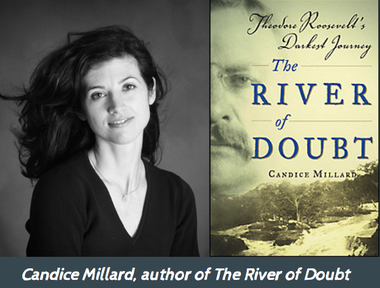
                               Source: Candice Millard. The River of Doubt:
                        Theodore Roosevelt’s  Darkest Journey (2009)
Picture
​     On 1 March 1914, the expedition was on their third day on the River of Doubt. Camping that night, Cherrie (the expedition's naturalist) had shot a woolly monkey. In their haste to prepare the meat, the men weren't very careful where they stepped, and a coral snake awaited. Of all the creatures in the Amazon Rainforest, the most reliably lethal are snakes. To be sure, they are hard to find, but as a result they strike from seemingly nowhere.
     The most infamous of the poisonous snakes in the Amazon are the ringed coral snake and the pit viper (a relative of the North American rattlesnake). A coral snake isn't as aggressive, nor does it have the large fangs as a pit viper, but its venom is just as lethal, causing excruciating/irreversible paralysis leading to a total collapse of the respiratory system. The victim of a coral snake bite slowly, knowingly, suffocates to death. In 1914, those bitten by the coral snake were simply given up for dead.
     A camarada finally noticed the agitated coral snake, and swung an ax to kill it, but TR was in the way of the ax. TR nimbly jumped up-and-out of the way, but landed on the body of the coral snake. The coral snake dug its fangs into TR's tough leather boot . . . a quarter-inch of leather spared TR from a horrible death.
Picture
​     So far, even though the River of Doubt kept twisting and doubling-back, it had been as calm as a lowland stream. By the middle of 2 March 1914, the paddlers sensed that the current had started to quicken. Milky (murky) rivers such as the Amazon and the Madeira originate west from the Andes Mountains. But "black" rivers, such as the River of Doubt, come from the highlands in the north. The soils that these black rivers contain are nutrient-poor and don't contain decomposing organic material, which stains the river black like tea.
     During the rainy season, the River of Doubt is nearly as black as the Rio Negro AND as murky as the Amazon. The River of Doubt mixes with blackwater and murky tributaries, which literally clouds the picture. An additional problem was that the River of Doubt flowed over various types of soil and rock formations which led to a perfect breeding ground for waterfalls/rapids. TR and the others heard the roar of waterfalls/rapids in the distance, a sound that would be the most alarming thing they would hear in the coming weeks.
Picture
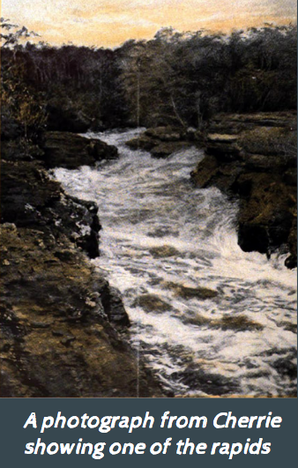
​     After dealing with a small series of rapids, the expedition turned in a bend on the river and saw a huge amount of white water, the guaranteed prelude to a series of major rapids. The expedition drove their dugouts to the banks of the river in order to figure out what to do next. TR, Rondon, Cherrie, Kermit, and a few others hacked their way through the vegetation along the river in order to see what was up ahead. The saw a series of rapids that went for nearly a mile, including two six foot waterfalls; the velocity of the rushing water was impressive-yet-depressing. Then, after the river split and went around an island, the river churned through a passage that was only about two yards wide. At that point, the river turned into a large water cannon; no dugout could ever fit through that opening.
     A long portage would have to be made, and it lasted two-and-a-half days. Block and tackle allowed the camaradas to get the dugouts out of the river. A corduroy road had to be built from the trees for the dugouts to be moved overland. Hundreds of thick six foot long poles were created, placed at two yard intervals in order to act as rollers for the dugouts . . . the physical labor was beyond-arduous. Also, there simply wasn't any game, and the expedition had rolled snake-eyes fishing. But, there were plenty of insects to torment the men, and they became more bold and aggressive the deeper the men plunged into the rainforest. Virtually every animal hid from the men as they moved through, and the only wildlife the men would usually see were the dangerous/lethal ones. 
Picture
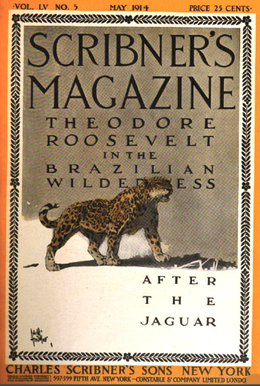
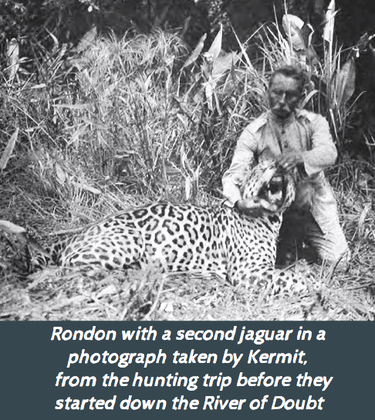
     TR and Kermit had expected to be able to hunt big game (as they did in Africa), but in the Amazon ecosystem, there simply wasn't any game for them to hunt on-or-near the river. This was in part due to the fact that South America was the last continent (not named Antarctica) to be populated by people. Thousands of years before, large animals were easy prey, and most were driven to extinction. Of the remaining mammals, the jaguar was the undisputed king. Earlier in the expedition, Cherrie heard horses scream, which was a very rare occurrence . . . a jaguar was nearby, stalking them.  Thankfully, the jaguar was too wary and elusive to pose much of a threat to the expedition. Peccaries (wild pigs) were also dangerous, but scarce.
     As Rondon well knew, the real threat was from insects, both physically and psychologically. Ants make up 10% of the biomass in the Amazon Rainforest, and the coordinated actions of colony/hive insects could be deadly. A single tree in the Amazon can be home to 40+ different species of ants. Virtually every growing thing teemed with insects; termites were especially active during the Rainy Season. "Fly Dope", the first insect repellant, helped quite a bit, but TR had only brought a small amount. All of the men on the expedition were clumsy, easy prey for countless animals/insects in the Amazon region.
Picture
​     The long portage ended on 5 March 1914, and by early afternoon the expedition was back in their dugouts; TR had no idea of how much longer they would be on the River of Doubt (e.g. 100 kilometers? 800 kilometers?). On 6 March 1914, at 3 pm, the men again felt the current quicken and heard the ominous roar of rapids. Ahead were two waterfalls followed by very treacherous rapids, and another portage loomed. That portage took 3 full days to go 750 yards, and hauling the dugouts overland caused some damage to the boats, and the expedition was losing rations related to time. 
     During the portage, Kermit killed a large bird that resembled a turkey, and his companion had a large monkey, which was great news. Then Kermit delivered the bad news: there was another series of nasty waterfalls/rapids ahead of the already-scouted rapids. On 10 March 1914, the expedition relaunched their dugouts, and just a mile later, they reached the waterfalls/rapids described by Kermit. The idea of another nightmarish portage was rejected, so all agreed to go over the rapids in the dugouts. Camaradas were assigned to haul supplies on land so the dugouts were empty. The dugouts were paddled through by brave, intrepid men, and were undamaged; however, the smaller of the two balsas didn't make it through. After twelve days on the River of Doubt, the expedition had only traveled 75 miles downriver.
Picture
     Kermit thrived on the challenge of getting the dugouts through the rapids. Left on his own devices, he would often brood, but given a task, he shined. Overnight, after clearing the rapids, the river rose and had swept away two dugouts, and both were badly damaged after being smashed against sharp boulders. With only five dugouts, there was no way to carry both men and supplies . . . the men couldn't turn back, and they couldn't go forward.
     Creating new dugouts would take time, time the expedition didn't have. It was quickly determined that the men would run out of food long before they finished their expedition. Also, the men knew they were being watched by unseen Indians. Rondon, after some discussion, decided that one dugout would be built to replace the two that were lost, so it had to be large. After measuring 26 feet from a suitable tree, the backbreaking work of hewing-out a log started, with only four days budgeted to finish the dugout. The camaradas worked around the clock under Rondon's direction. Only one camarada was worthless, lazy, and untrustworthy: Julio de Lima. If Rondon could have sent him back, he would have long ago done so.
Picture
​     While the dugout was being built, TR and Kermit did their best to find food in the rainforest. Kermit had some success, but TR came back empty-handed. The animals kept hiding in the dense rainforest, and the myopic TR didn't have a chance at spotting anything. TR's myopia had been a curse since childhood, and his glasses constantly fogged-over in the rainforest. And, when it rained, TR simply couldn't see much at all, yet he continued despite the significant handicap.
     On 14 March 1914, the dugout was finished. It took all 22 men to drag the 26 foot dugout to the river. Once back in their dugouts, the further the men traveled down the river, the faster the current became, with shifting whirlpools trailing them like sharks. As a sign of their desperation, it had been decided that they would go through all the rapids they encountered; the threat of starving to death in the rainforest outweighed the dangers of the rapids. Also, to speed up the pace of the expedition, Rondon resorted to faster-but-less-accurate mapping techniques. 
     In just four hours, the men ran six rapids. TR's large dugout came close to being swamped after being sucked into a vortex (whirlpool) . . . it was a very close call, for both men and cargo. In half a day, they had traveled ten miles; little did they know that the next day would end in tragedy.
                           The next day's tragedy and the Cinta Larga . . .
0 Comments

Theodore Roosevelt & the River of Doubt, Part Two

5/23/2017

0 Comments

 
                                 Source: Candice Millard. The River of Doubt:
                         Theodore Roosevelt’s  Darkest Journey (2009)
Picture
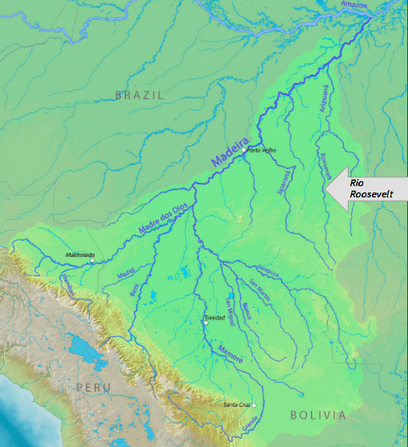
     The River of Doubt, at the start of its torturous journey north, was so tightly coiled that it actually doubled-back on occasion, and in every direction from the river was impenetrable rainforest. Rondon believed that the river eventually drained into the Madeira River, the principal tributary to the Amazon. Rondon, based on that educated guess, sent men under the command of Lt. Pyrineus up the Madeira to a point close to where he calculated the expedition would emerge . . . those orders would save the expedition. 
    The Madeira River is so large that its basin is twice the size of France. The Madeira winds for 2000 miles through Brazil, and has over a dozen tributaries. Rondon's men would wait for them on the Aripuana, a large tributary of the Madeira, and they positioned themselves where the Aripuana forked. Based on Rondon's educated guess, the River of Doubt would be approximately 1000 miles long, similar to the Ohio River or the Rhine (The Madeira is also equal in volume to the world's second-largest river, the Congo).
    The tributaries of the Amazon are studded with waterfalls and rapids, which makes those rivers impossible to completely navigate. The Madeira has at least 30 waterfalls/rapids, with 16 in just 225 miles. The Brazilians on the expedition knew that the River of Doubt would be choked with waterfalls/rapids as well. ​ Rondon had already determined to name the River of Doubt after TR; the question was when would he tell TR that he had renamed it Rio Roosevelt in honor of the former President.

Picture
​     Both Rondon and TR believed that by going downriver, they would be able to harness the power of the River of Doubt to their advantage. But soon enough they would face the reality that when they reached rapids, the expedition would almost certainly have to portage around them. Eventually the overall reality would descend on the expedition: the men would either reach Lt. Pyrineus on the Aripuana River, or die in the attempt. 
     TR had come face-to-face with life-or-death situations before, including a near-fatal car/trolley accident in 1902, the safari in Africa in 1909, and an assassin's bullet in 1912. However, TR was about to become an explorer in the truest, most unforgiving, sense of the word . . . and TR would find himself woefully unprepared for what was ahead. Incredibly, TR had arrived at the River of Doubt without any boats at all - 22 men, hundreds of pounds of supplies . . . and zero boats. 
     Rondon arranged for 7 dugout canoes from the Nambiquara tribe that were "recently built". They were nothing more than hollowed-out tree trunks, and would be impossible to maneuver around/through rapids. The canoes had minimal flotation and steering, and the fully-loaded dugouts left the men with only inches of boat above the water . . . any rough water at all would swamp the dugouts. And the dugouts were very heavy, weighing around 2500 pounds each, which would prove to be an excruciating burden when it came time to portage around waterfalls/rapids. And when in the river, there were caimans (South American alligators), as well as anacondas . . . and piranhas.

Picture
​     And then there were the mosquitoes, as well as the piums, which were flies that behaved like mosquitoes, in that they also swarmed. In the rainforest, it seemed that every living thing was ready to attack, whether offensively or defensively. Poisonous frogs, jaguars, packs of wild pigs . . . and hostile Indians. Time was also an enemy, in that delays during the expedition could turn out to be deadly. TR and Kermit wanted to move ahead quickly: Kermit wanted to be with Belle, and TR wanted another trophy of accomplishment. 
     But for Rondon, the expedition wasn't an isolated event in which to brag afterwards, but an integral part of his 25+ years of service/sacrifice for his nation. Rondon hoped that by guiding TR through the River of Doubt that he would receive additional funding for this telegraph missions as well as providing an accurate map of the river for the people of his nation. Therefore, Rondon was not going to be in a rush to move down the River of Doubt as TR or Kermit wanted.
     Finally, when the supplies were divided up for the descent on the River of Doubt, Anthony Fiala's incompetence was there to be seen by all. So much of the food was useless - Fiala simply assumed that hunting game would automatically supplement what he had supplied. Fiala (and the other Americans, including TR) had no clue about hunting in the Amazon Rainforest, in that game would be incredibly scarce for outsiders to hunt and kill. With advance warning, such as hearing the outsiders making noise in the rainforest, animals would simply hide where they couldn't be seen. On 27 February 1914, TR climbed into his narrow dugout, and was swept into the River of Doubt's swift current. TR heard Miller, the naturalist that was not allowed to continue (since the other naturalist, Cherrie, was going), shout a hearty "Good Luck" as TR headed down the river.

Picture
     The current carried the 7 dugouts in single file. In addition to the dugouts were 2 balsas (jury-rigged pontoon boats using two dugouts) that had most of the baggage, and were manned by some camaradas (comrades; but really the "worker bees" of the expedition); but the balsas were harder to steer than even the dugouts. TR was in the last (and largest) of the dugouts, with Rondon second in line, and Kermit was running point with two camaradas in the smallest of the dugouts. 
     The camaradas pulled the dugouts through the water with long wooden paddles, all the while looking for ripples, the only advanced warning that a tree lay just below the surface. The rains had caused the River of Doubt to swell to such a level that most of the dangers to the dugouts were now below the surface. The camaradas outnumbered the rest of the expedition by 3:1, and TR and the others didn't yet know which camaradas they could trust . . . and which they should never turn their backs. One of the camaradas in TR's dugout, Julio de Lima, nearly killed another camarada with a knife during the long overland trek in the Brazilian Highlands over a perceived insult. Even though Rondon didn't know about de Lima's volatile nature, he made de Lima TR's bowman. 
     Rondon was interested in geographical and scientific precision, not adventure, and he was determined to carefully and completely survey the river. And since the rainforest didn't provide any usable reference points, Rondon would have to use celestial navigation to survey the River of Doubt.

Picture
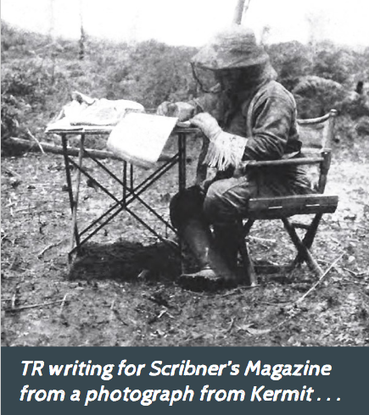
     Rondon used a sextant to calculate latitude/longitude, and he had to make frequent stops on the river in order to take careful measurements of distance and route. Kermit had the unenviable job of placing the sighting rod, usually at a bend in the river. Planting the sighting rod meant Kermit had to use a machete to cut away dense vegetation near the shore, as well as dealing with angry insects. Once the sighting rod was placed, Rondon could use his compass and record the river's direction; the river turned so often that on the first day of the expedition, Kermit planted the sighting rod 114 times. TR wasn't pleased, in that not only was the expedition traveling much slower than he envisioned, but also because Kermit was repeatedly placed in dangerous situations. In the first five hours, the expedition traveled only six miles, but TR kept his cool, and didn't ask Rondon to adjust his routine.
     TR's dugout actually moved ahead of Rondon and Kermit, and the expedition reunited and made camp after clearing out an area of vegetation. On 28 February 1914, TR emerged from his balloon silk tent, and before him down the cleared path was the dark/swollen River of Doubt. The 7 dugouts rocked uneasily in their moorings, still looking unworthy to be on the river. TR had never seen the enormity of nature that was around him that morning. The Amazon Rainforest was not a garden of easy abundance - it was in fact the exact opposite. The Amazon Rainforest was (and is) the greatest natural battlefield on Earth, occupying all of its inhabitants every minute of every day; every inch of space was alive, and everything was connected.

Picture
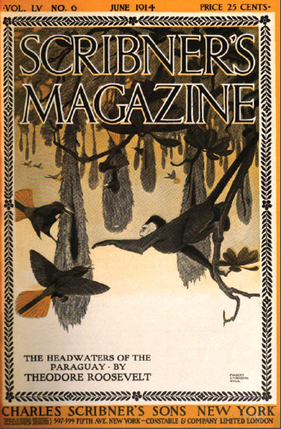
     TR and the expedition had become part of a huge ecosystem that had throbbed with life for millions of years, and the expedition was the invader. Ironically, once up-and-out from the dense vegetation by the banks of the river, the heavy canopy of trees meant the floor of the rainforest was surprisingly clear. The most common site on the ground was a labyrinth of tree trunks/vines with few other barriers. 
     TR was more a figurehead as a co-commander, deferring to Rondon on all matters of importance. TR was basically the expedition's raconteur (a.k.a. the "Life of the Party"), especially in camp. Rondon couldn't believe that TR could talk so much for so long, speaking endlessly on all subjects. While everyone had risen early, it wasn't until noon on 28 February 1914 that Day Two started on the River of Doubt. TR's dugout had to work to catch up to Rondon and Kermit since TR had granted Cherrie (the naturalist) permission to collect birds.
     Despite the beauty, constant rain and insects made the men miserable. The Amazon Basin gets over 100 inches of rain a year (3 times that of New York City), with 60% of the rain due to transpiration. Most of the rain that fell in the Amazon Basin occurred during the months of March and April. And then there were the unexplained sounds during the day, and the constant hum of life at night. But the most terrifying thing that occurred at night when the men were in camp was the occasional total absence of sound.

0 Comments

Theodore Roosevelt & the River of Doubt, Part One

5/21/2017

2 Comments

 
                                 Source: Candice Millard. The River of Doubt:
                         Theodore Roosevelt’s  Darkest Journey (2009)
Picture
     The Amazon River accounts for 15% of the world's fresh water carried to the oceans; the river's mouth is so vast that the island that rests in the middle of the Mouth of the Amazon (Marajo) is the size of Switzerland. The Amazon is navigable for about 75% of its length, the equivalent of traveling from Bangor, Maine to San Francisco. The thousands of tributaries that entered the Amazon River in the early-1900s were twisting and wild. 
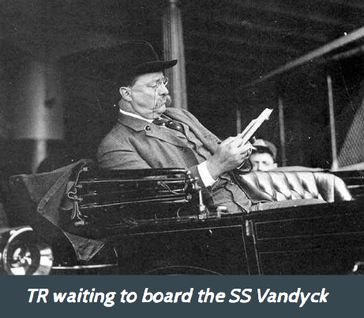
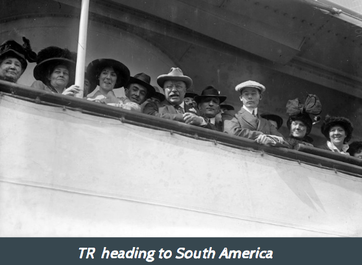
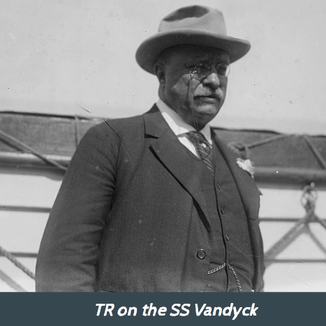
   The route drawn up by Father John Augustine Zahm (the man that was primarily responsible for TR's desire for adventure in South America) entailed traveling on five of the best-known rivers on the continent: the Parana, Paraguay, Tapajos, Negro, and Orinoco Rivers. All five rivers were on any decent map of Brazil. However, within just days after arriving in Brazil, TR abandoned Zahm's tame itinerary, and started to plan a much more interesting and dangerous trek. On 18 October 1913, TR's steamship, the Vandyck, reached
Bahia, and one of TR's sons, Kermit (who had been working in Brazil for quite a while), was waiting in the harbor on a launch provided by the city's governor. 
     Theodore Roosevelt didn't stay in Bahia long, since he wanted to be in Rio de Janeiro by 21 October 1913 to follow up on discussions about government assistance for his new expedition. Once again, after a crushing disappointment/heartbreak (this time it was losing the Election of 1912), TR decided to do something adventurous. In 1909 after leaving the White House, TR went on safari in Africa with Kermit and a host of others, but he was only a hunter . . . this time, TR decided it was time to become the explorer that he knew had always existed in him.

Picture
​     Colonel Candido Rondon, the most famous Brazilian explorer, received a cable from government officials that told him to link up with TR, and go with his expedition into the Amazon Rainforest. Rondon, who had spent half his 48 years exploring the Amazon, was currently heading the Strategic Telegraph Commission that was heroically erecting poles/wires to connect the Brazilian interior to the populated coastline. Rondon accepted the assignment, but fervently hoped that he would be part of an expedition that would be serious about scientific discovery; he had no desire to be a tour guide on a safari.
     Unknown to Rondon was that TR had exactly the kind of expedition in mind that Rondon desired. After discussions with Brazilian officials, TR decided to explore an uncharted river of which the only group that had seen its headwaters had been led by Rondon. Rondon had named it the River of Doubt, and he knew little about the river's course or character. Rondon had stumbled on the river five years earlier on one of his telegraph expeditions. Rondon and his men followed the River of Doubt just long enough to know that a separate expedition would be necessary to traverse-and-chart the river.

Picture
​     Rondon had proposed an expedition on the River of Doubt to officials from the Brazilian government as one of the possible alternatives to what Zahm had in mind. TR chose Rondon's proposal largely because it offered the greatest unforeseen challenges. The officials from the American Museum of Natural History, who were bankrolling TR's trip, were thunderstruck when apprised of TR's new plan. Alarm bells went off at the museum after TR's letter arrived, notifying his benefactors of his change of plans. One of the officials sent a scathing letter to TR telling him that the museum in no way wanted to be part of his far-too-risky venture, and that they wouldn't take any responsibility disaster occurred.
     TR gave the men that were with him a choice to stay or leave, but all, even Zahm, remained with TR for the expedition to the River of Doubt. It was now official: TR was something he had always wanted to be, an explorer. To the museum's officials, TR's exploration down the River of Doubt was not just insane, but suicidal; TR ignored letters sent from the museum's officials telling him to revert to the original itinerary. 
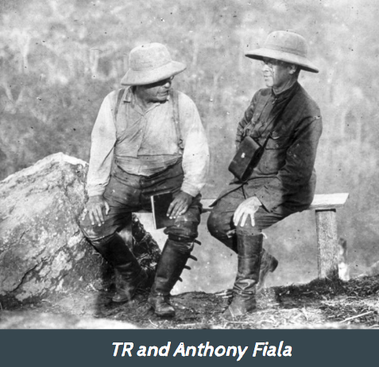
     It soon became clear to most in the traveling group that they weren't properly equipped for their expedition on the River of Doubt. The man responsible for equipping the expedition, Anthony Fiala, had brought too many unusable/improper supplies, as well as an appalling amount of personal baggage. Fiala had been recruited by Zahm, since he had prior experience in the Arctic, but Fiala had made major mistakes on that expedition, and was persona non grata in the exploration community (he was working as a clerk in a sporting goods store when he first met Zahm). Fiala saw Zahm's offer as his chance to restore his reputation. One of the reasons why Fiala had brought so many of the wrong kind of supplies was that he wanted to make sure that TR traveled in luxury.

Picture
     By then, Kermit, although he lived-and-worked in Brazil for quite some time, had become engaged to the love of his life, Belle, via a series of letters. Edith, TR's wife/Kermit's mother, had convinced Kermit that he should go with his father on the River of Doubt. Kermit had no problem being convinced to go, in that he was also worried about TR's health and safety. 
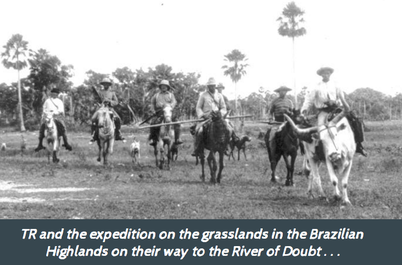
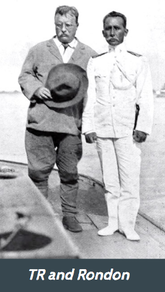
     On 12 December 1913, Rondon (who was only 5' 3") awaited TR's arrival on the Paraguayan President's yacht; TR had just wrapped up the last of his speaking commitments in South America. Now both men could focus their attentions/energies on the River of Doubt, but the river was so remote that it would take two months to reach, first by boat, then overland. Much of the distance would be making their way across 400 miles in the Brazilian Highlands, which included plains, scrub forests, barren desert, and dense rainforest.
      Once on the river, every mile traveled meant the expedition would be further away from any civilization, and closer to the unknown. The harsh terrain featured fierce Indian tribes that were deadly threats to any intruder; even for the most hardened explorers, what TR and Rondon were about to do was considered folly. Only a handful of men had ever seen the headwaters of the River of Doubt and lived, but they had been led by Rondon.

Picture
​     Survival against long odds had become a trademark for Rondon, but so was loneliness and isolation. Rondon wanted to serve his nation's most forgotten and endangered people, the Indians. Rondon wanted to assimilate as many as possible into mainstream Brazilian society (protect, then incorporate). By the time Rondon was placed in charge of erecting telegraph lines in the rainforest, assignment to his unit soon became punishment for laziness and/or violence. Many with Rondon were from Rio's jails, and once in the rainforest, they wished that they had remained in prison. By far, the most harrowing telegraph mission was in 1909, when Rondon discovered the River of Doubt. But in every expedition, Rondon had made serious efforts to make peaceful-and-positive contact with as many Indian tribes as possible.
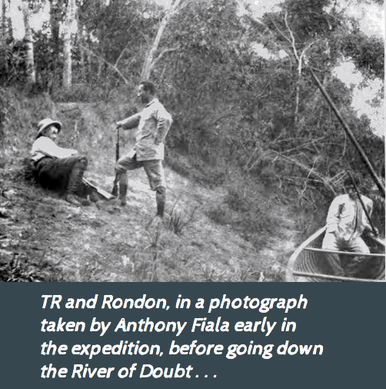
     TR and Rondon were officially the co-commanders of the expedition. TR didn't speak Portuguese, and Rondon didn't speak English, but they both spoke French, and when Kermit was present, he was their interpreter. But TR and Rondon actually had very little difficulty in communicating, and by 15 December 1913, they had both developed a deep-and-lasting respect for each other. To TR, Rondon represented the Explorer he had always admired and aspired to become. After surviving the ordeal on the River of Doubt, TR counted Rondon as one of the four greatest explorers of all time, linking him with Amundsen, Byrd, and Peary. Rondon admired TR, valuing the former President's ability for rational thought in the face of hardship.

Picture
​     
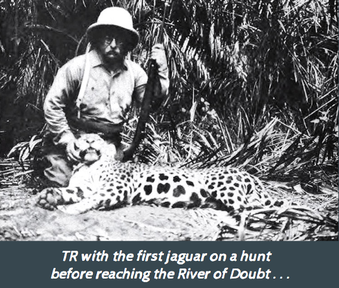
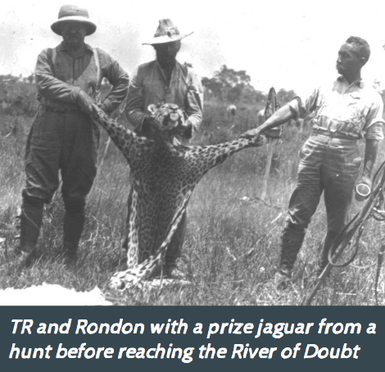
​     Rondon was a Positivist (scientific/logical idealism), and preferred to avoid conflict at all costs. The personalities of the war-loving and action-oriented TR and the idealistic/pacifist Rondon would be put to the test on the River of Doubt. TR still had the endurance of a man half his age, which TR proved on 1 January 1914 by taking part in a jaguar hunt. Brazilians came back from the hunt dead-tired, but Fiala saw TR and Kermit coming back, dragging a Brazilian official behind them. TR's clothes were in tatters, but Fiala said that TR had that "war-like look" about him, which Kermit did not. Fiala called out to TR if he was okay, and TR responded by saying "I'm Bully!". The next day, TR and Kermit were milling around about the camp as if nothing stressful had ever occurred the previous day . . . from that point on, the Brazilians in the expedition regarded TR and Kermit with great awe.

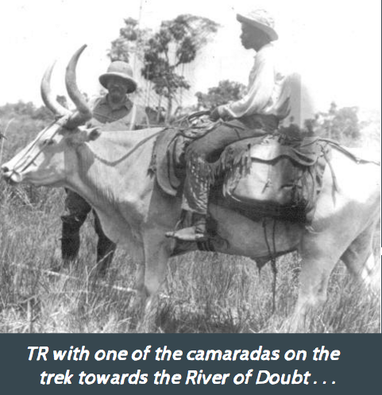
          TR and the expedition's arduous trek towards the River of Doubt . . .
2 Comments

    Archives

    May 2018
    April 2018
    March 2018
    February 2018
    January 2018
    December 2017
    November 2017
    October 2017
    September 2017
    August 2017
    July 2017
    June 2017
    May 2017

    Categories

    All
    18th Century
    19th Century
    20th Century
    Biography
    History

Powered by Create your own unique website with customizable templates.