Source: Margaret MacMillan. Paris 1919:
Six Months That Changed the World (2007)
Six Months That Changed the World (2007)
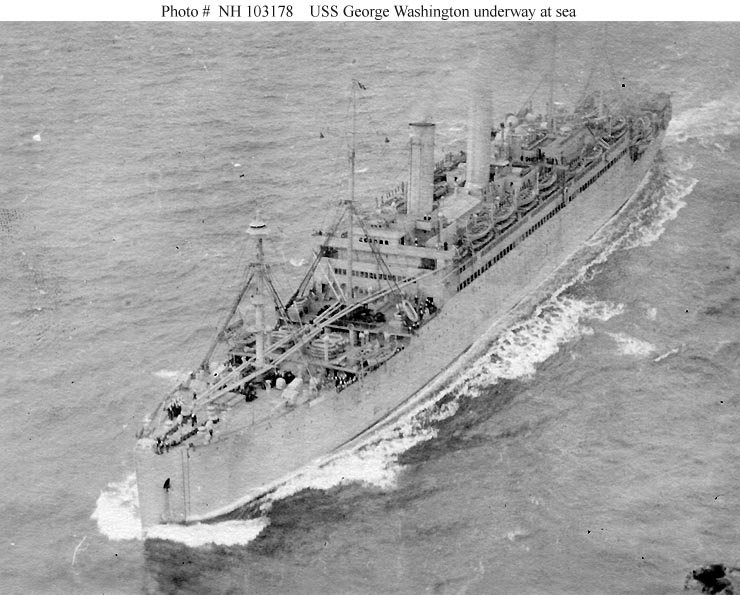
On 4 December, 1918, the SS George Washington set sail for Europe. Among those on board were President Woodrow Wilson, his (second) wife Edith, and Secretary of State Robert Lansing. Also on board were selected "experts" from universities and government, as well as prominent diplomats. On board the former German passenger ship were mountains of research/reference material for the President and his massive entourage to use in Paris.
No United States President had ever gone to Europe while in office (Theodore Roosevelt attended the funeral of King Edward VII in 1910 as an official representative of the U.S., but by then he was an ex-President); Wilson's opponents accused him of flat-out violating the Constitution by making the trip, while his supporters saw going to Paris as a very unwise decision. To Wilson, making the peace was as important as winning the war, and he felt that he owed it to all concerned that he head to Paris. A British diplomat compared Wilson's trip to Paris to that of a debutante entranced by the prospect of attending her first ball.
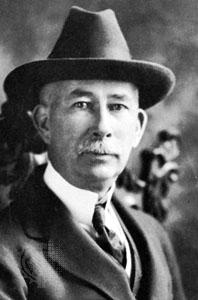
Wilson told his most trusted advisor, Colonel Edward House
(pictured; who was already in Paris) that he would focus on his "Big Picture" Ideals; he didn't want to remain too long in Paris, and get bogged down in any details . . . or to talk to German representatives. The "Preliminary Conference" actually became the main attraction, and Wilson wound up staying in Paris for six months. Other than a quick return to the U.S. from mid-February to mid-March, Wilson was in Paris from January through June in 1919.
(Below: The SS George Washington heads towards Europe in December, 1918)
President Wilson had a long list of enemies, many of which were former friends; his enemies viewed him as an ingrate and a liar. Wilson never forgave those that disagreed with him - he was a "Great Hater", in the mold of Robert Kennedy before JFK was assassinated.
According to Edward House, Wilson was only receptive to other perspectives when he was in the process of making a decision. Once Wilson had made a decision, it was inviolate, no longer open to discussion by anyone; some admired that trait, while others viewed it as egotism of the most dangerous magnitude. A French diplomat stated that Wilson would have been a great tyrant, in that he had no concept at all that he could ever be wrong.
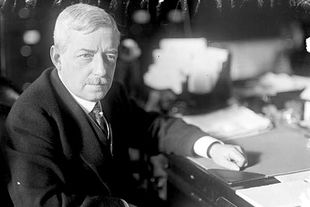
Wilson was so sure he knew what he was going to do in Paris (and that he would succeed) that he only had four others with him in his "Circle of Trust" (five, if one counts Edith). One was his most trusted advisor, Edward House. Another was SecState Lansing (pictured); the only reason Wilson brought Lansing along was that it would have been very awkward to explain why the SecState wasn't with the President (also, Lansing had committed the Cardinal Sin of publicly disagreeing with Wilson). The other two were General Tinker Bliss (the military representative; Wilson only talked with him five times in Paris) and Henry White, a retired diplomat whose function was to help Edith Wilson on matters of French etiquette.
Wilson had deliberately slighted the Republicans, despite the fact that many (especially the moderates) at least shared some of Wilson's Post-World War I goals. By December of 1919, Wilson's hatred and distrust of the Republicans had reached a crescendo; this omission, plus Wilson's absolute refusal to compromise after he returned from Paris, led to the narrow defeat in the Senate of not only the Treaty of Versailles, but also American participation in the League of Nations.
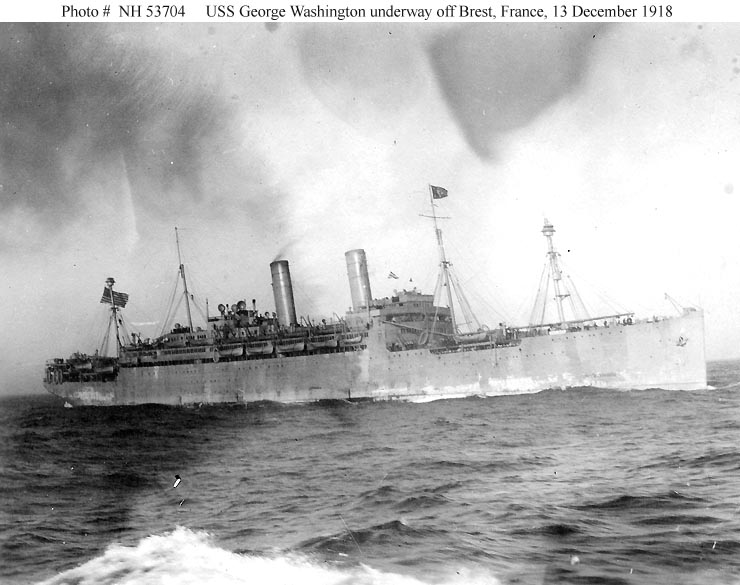
(Below: The SS George Washington of the coast of France in December 1918)
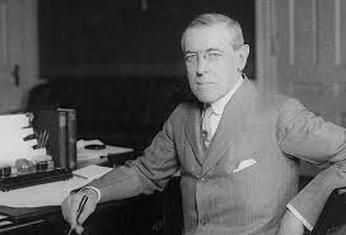
President Wilson stated that he loved Democracy, but he absolutely hated most of his fellow politicians, regardless of party. Wilson wanted to serve humanity, but he had so few personal relationships. Wilson was an Idealist, and he was also someone that wanted as much power as possible in order to accomplish his great works and vision. Therefore, he was intolerant of perspectives of others that differed with his, and blind to legitimate concerns. Those that opposed Wilson weren't just wrong, they were wicked . . . like the Germans.
By December of 1919, Wilson had convinced himself that he spoke for the global masses, despite clear evidence to the contrary (that would be evident in Paris, but it wouldn't become in any way manifest to Wilson). Adding to the future problems he would face in Paris, Wilson often ignored established facts if they didn't fit with his Idealism.
During The Great War, America had become a huge provider of food for the Allies; more significantly, the US had supplanted Britain to become the world's financial power, due to the massive loans to the Allies. European allies owed $7 billion to the US Government, and $4 billion to US banks - Wilson believed that the financial debts alone would force Great Britain and France to see the Post-WW I world his way, and to follow his lead in Paris.
Wilson's well-publicized-in-advance proclamation of "Self-Determination" was controversial and opaque; it was kind of like trying to explain the Electoral College to the uninformed (or worse yet, the Bowl Championship Series before 2014). Many requests reached Wilson even before he arrived in Paris wanting him to define what he meant by "Self-Determination", but he never answered the queries, and never defined his flagship term while in Paris. It was left to others to interpret what he meant (historians aren't even sure that Wilson was able to define his own term): did Wilson mean a type of Democracy, or true "Self-Determination" in its literal sense, or even acceptable versions of autocracy . . . no one knew.
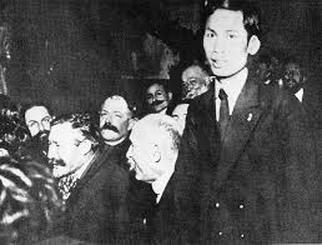
Complicating the landscape of "Self-Determination" was that Wilson had no sympathy for Irish Nationalists trying to free themselves from Britain, or for those asking for decolonization in Africa or Southeast Asia
(the person who would eventually call himself
Ho Chi Minh was in Paris, pictured at the right). SecState Lansing thought that Wilson had raised hopes in the world that would never be realized, and that the President was bound be be discredited. Lansing further wrote that a clear definition of what constituted a nation ("Self-Determination") would have gone a long way in Paris.
Wilson eventually stated that "Well-Defined" national aspirations would be satisfactory; but he never clarified that term either. It was beyond-difficult to categorize "Well-Defined" Nationalism in any case - a Poland for the Poles? A Slovakia for the Slovaks? A Ukraine for the Ukrainians? An Ireland for the Irish? In every case, there were other ethnicities and nationalities that were prominent minorities . . . when imposed borders are created, war is a likely result. Wilson's job in Paris would prove to be an "Impossible Dream". The possibilities of dividing people across yet-to-be-determined boundaries was unending, in particular in Central Europe. In short (according to MacMillan), an arrogant, inflexible, idealistic President Woodrow Wilson went to Europe, and basically made a very difficult situation worse. Basically, Wilson brought a Bible to a poker game.
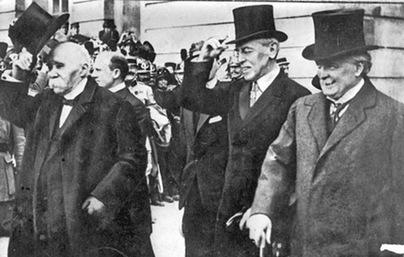
American Idealism by 1919 featured two sides. One was an eagerness to set the world straight, assuming that American values were global and universal. The other was ready to turn its back with contempt if its message to the world was ignored. This has lead to a certain "obtuseness" from not only Wilson, but in the decades that followed - a tendency to preach to others, rather than listen. It has also led to a point-of-view that American principles are pure, while all others are suspect, even wicked or evil. British Prime Minister David Lloyd George summed up this American Idealism by sarcastically stating that Wilson came to Europe ready to rescue the heathen Europeans from themselves. (Pictured above, from Left-to-Right: French Premier Georges Clemenceau, President Woodrow Wilson, and British Prime Minister David Lloyd George)
American Idealism by 1919 featured two sides. One was an eagerness to set the world straight, assuming that American values were global and universal. The other was ready to turn its back with contempt if its message to the world was ignored. This has lead to a certain "obtuseness" from not only Wilson, but in the decades that followed - a tendency to preach to others, rather than listen. It has also led to a point-of-view that American principles are pure, while all others are suspect, even wicked or evil. British Prime Minister David Lloyd George summed up this American Idealism by sarcastically stating that Wilson came to Europe ready to rescue the heathen Europeans from themselves. (Pictured above, from Left-to-Right: French Premier Georges Clemenceau, President Woodrow Wilson, and British Prime Minister David Lloyd George)
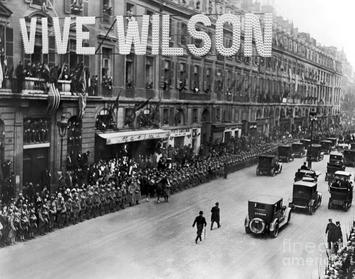
It was easy to mock President Wilson, and many did, but SO MANY believed in him and his 14 Points as the year 1919 began. Wilson represented a brighter future; after The Great War, much of the world was ready to listen, and believe, in the American President. So many disparate populations took Wilson's 14 Points to heart; to these populations, his principles became a sort of sacred tract.
Wilson commented to George Creel, who was also on board the SS George Washington (his "Propaganda Chief"), that he may have done too good a job in spreading the 14 Points across the globe, especially in Europe. Wilson thought that Creel may have unconsciously spun a web from which there was no escape. On 13 December, 1918, the SS George Washington reached the French port of Brest; World War I had been over for a
little over a month - Wilson's reception in France was beyond-"Beatle-esque". Wilson, at a private dinner, expressed his pleasure at his reception: the French, in his words, were "most friendly."
Soon, Wilson would have to deal with British Prime Minister David Lloyd George, and French Premier Georges Clemenceau, and their very different visions of Post-WW I Europe. And, added to that, Wilson would be expected to wave his "magic wand" and satisfy a myriad of impossible-to-satisfy requests and demands from people in Europe, Asia, and Africa.
Here is the New York Times book review of Paris 1919 by Margaret MacMillan
Below: A preview of a documentary based on MacMillan's Paris 1919
For the Stout-of-Heart, here are Parts 1 and 2 of Paris 1919, the full documentary
