Mr. Jensen's U.S. History Website
  • U.S. History Blog
    • U.S. History Blog (May 2026 - May 2027)
    • U.S. History Blog (May 2025 - May 2026)
    • U.S. History Blog (May 2024 - May 2025)
    • U.S. History Blog (May 2023 - May 2024)
    • U.S. History Blog (May 2022 - May 2023)
    • U.S. History Blog (May 2021 - May 2022)
    • U.S. History Blog (May 2020 - May 2021)
    • U.S. History Blog (May 2019 - May 2020)
    • U.S. History Blog (May 2018 - May 2019)
    • U.S. History Blog (May 2017 - May 2018)
    • U.S. History Blog (May 2016 - May 2017)
    • U.S. History Blog (May 2015 - May 2016)
    • U.S. History Blog (May, 2014 - May, 2015)
  • About

The Dust Bowl: 1935 & Beyond

5/27/2024

1 Comment

 
            Source: Timothy Egan. The Worst Hard Time - The Untold Story of 
                          Those Who Survived the Great American Dust Bowl (2006)
Picture
     Many members of Congress wondered why those in the Dust Bowl should get special attention, while other members simply thought those in the Dust Bowl were ignorant inbred hicks that were too stupid and undeserving of any government assistance. The famous journalist H.L. Mencken referred to people in the Dust Bowl as “inferior men”, and that the best thing to be done would be to sterilize them. While Black Sunday tipped the scales to Bennett’s advantage, he wanted to give Congress a dose of reality. On 19 April 1935, five days after Black Sunday, Bennett entered Room 333 in the Senate Office Building and started his presentation, this time knowing that a dust storm was once again heading towards DC. Soon enough, a senator that had been gazing out the window tuning out the presentation, interrupted Bennett saying it was getting dark outside. Very soon thereafter there was enough dust in the air that sunlight disappeared, and the air took on a coppery color. For the second straight year, a dust storm from the Great Plains fell on Washington, D.C; Bennett told the assembled senators “there goes Oklahoma”. 
     Within a day, Bennett had his permanent agency plus funding, and then Congress passed the Soil Conservation Act, making the US the first nation to pass a law centered on conserving the soil. 150 Civilian Conservation Corps camps were reassigned to Bennett’s Soil Conservation Service, and 20,000 CCC personnel were sent to the Great Plains. At about the same time, FDR had created the
Resettlement Administration, and had also signed Executive Order 7028 which gave the federal government the ability to buy back homestead land from the previous 73 years. To many, it seemed like the government was trying to depopulate the Great Plains, especially the Dust Bowl. By late-1935, 20% of Cimarron County had left since the start of the drought four years prior, numbering about one thousand. Over the next two years in the Great Plains, around 220,000 would had to California, most of them from OK, AR, and TX, all called “Okies”; but only 16,000 were from the Dust Bowl (by that time, the government had classified a tiny sliver of southwest Nebraska as part of the Dust Bowl). 

Picture
     During 1935, after the movie industry in Hollywood refused, Congress funded a documentary which would be the first-and-only wide theatrically-released commercial movie during peacetime from the government, which was titled “The Plow That Broke the Plains”. The documentary was filmed in MY, WY, CO, KS, OK, and TX. The film portrayed the Great Plains as a mythic place in a lost world, where the land and the elements raged against the inhabitants. The documentary flat-out blamed the farmers that had plowed up the grasslands for causing the Dust Bowl. The documentary was edited, and then awaited a release date scheduled in 1936. 
     Over 850 million tons of topsoil had blown off from the lands in the Dust Bowl in 1935 alone, which equaled eight tons of soil for each US citizen. Dust Bowl farmers lost 480 tons of soil per acre, and where all that soil had gone was anyone’s guess. The five million acres in the Dust Bowl were in a coma, unable to be cultivated, and another 100 million acres would most likely never again be cultivated no matter how much it rained in the future. Just as the grass had been stripped from the land, now people and whole towns seemed to be stripped from their land. FDR was torn whether to abandon hope or dig in and try to save those in the Dust Bowl. To Congress, it was cheaper to pay people to leave their land in the Great Plains instead of subsidizing them to remain, but FDR believed in the big restoration dream in the region. 

Picture
   By March 1936, the situation hadn’t improved in the Dust Bowl. During that Spring, “The Plow That Broke the Plains” was in theaters, and the documentary wasn’t the only one blaming the farmers for the Dust Bowl, with cowboys, scientists, and Bennett arguing the same point in their own ways. Bennett’s agency was busy using trial-and-error in order to find the best grass to reseed the Great Plains, mapping out areas that could actually be reseeded. The main problem was how to hold down the remaining soil long enough for those grass seeds to sprout. 
    During the months of July and August 1936, there were two days in each month where the temperature reached a record 118 degrees in No Man’s Land; that August was the hottest month of the 20th Century for Oklahoma. Whatever rain fell came in torrents and washed away, creating flash floods, and then it was as if no rain at all had fallen. During August 1936 near Dalhart, Bennett had created the biggest soil conservation project in history, dubbed “Operation Dust Bowl”. His plan was to slow the formation of the drifts of soil by contour plowing, followed by planting grass seed from Africa. Bennett’s goal was to create a living ecosystem from scratch, but not by planting crops (yet). Bennett experienced a great amount of difficulty getting enough people in the area to join in with his soil conservation efforts. Basically, most in the area bitterly complained about how awful everyone else was other than themselves. Bennett, with FDR’s blessing, informed them that he was also working on an investigation into the causes of the Dust Bowl.

Picture
     By the end of the Summer of 1936, Bennett was convinced that the Southern Plains could be saved. Bennett often heard from people in the Dust Bowl that there just had to be a way to drill down far enough to access the newly-discovered Ogallala Aquifer. With no way yet to access the vast underground reservoir, Bennett believed that the solution to save the Southern Plains was a great plow-up in reverse: contour plowing + crop rotation + soil conservation districts, and for all other areas of the Great Plains that were not going to be used for agriculture, bring back grasslands. 
     FDR wanted to know, before committing to any more government spending, if the region could be saved, and if so, how. FDR also wanted to know the role the federal government played in the Great Plow-Up that caused the Dust Bowl. On 27 August 1936, the Great Plains Drought Area Committee report was delivered to FDR, signed first by Bennett. The conclusions of the report were stark, stating that the Dust Bowl was not caused by changes in nature.  With rainfall less than 20 inches a year west of the 98th Meridian, it simply had not been smart to plow up grasslands to plant crops, no matter how many agricultural gimmicks were used. The report also stated that mistaken public policies stimulated by wartime (WW I) demands for food led to over-plowing, over-planting, overgrazing, and that the government shared in the blame. For FDR, a President that wanted the government to be the solution to problems, this report was a bitter pill to swallow: people were the cause of the Dust Bowl, and the federal government was complicit. 

Picture
     The report chronicled a chronology of collapse. In 1879, 10 million acres were plowed; by 1929 the total reached 100 million acres, and the removal of the buffalo grass was cited to be particularly devastating. Grasslands had been in existence for eons, and the Cattle Boom and the Wheat Boom had shattered the ecosystem. What happened was the agricultural equivalent of the Gold Rush, where the new farmers arrived en masse lacking the knowledge or incentive to stop the destruction of the grasslands, and the Homestead policies from the government were a huge reason for the nightmare. FDR loved action plans, but the report stated that there were no easy solutions, that the land would not cure itself, and that the nation could not allow the farmer to fail. 
     FDR wanted to know what was next in terms of the future of the Great Plains, but he did not wait to further accelerate his plan of planting trees to stop the wind, check erosion, and to continue to employ thousands in the Civilian Conservation Corps (an 11 man team in the CCC could plant 6000 trees a day). In effect FDR ignored the report, trying to re-engineer the Great Plains. Bennett was allowed to continue his agency, but FDR went ahead with planting trees, which was an idea that had captivated him for many years. By early-1937, Bennett’s “Operation Dust Bowl” was in full swing with 47k acres, with the goal of expanding ten times that area. For many in the Dalhart area, it felt good to try and heal the land. People across the TX Panhandle had finally agreed to strict soil conservation practices, and to set up sanctions against landowners that allowed their soil to blow.  

Picture
     The land started to soften and green started to show in the areas where Bennett had set up shop for his project. Bennett made sure that he was photographed in a field of waist-high alfalfa, which aided him in his insistence that the people in the TX Panhandle needed to keep up with their soil conservation efforts. The early part of the Summer of 1937 had a couple of decent rainstorms, and there was also some rainfall that didn’t lead to flash floods. 
     During July the rains stopped, the temperatures reached 110 degrees, and then swarms of grasshoppers descended on the region, and everything that had grown was consumed. Estimates had 23,000 grasshoppers per acre, 14 million per square mile. Large numbers of grasshoppers had come from the Rocky Mountains and laid eggs in the Great Plains; with the drought, there hadn’t been any rain that produced the fungus that would have killed most of those eggs. Also, snakes and birds ate grasshoppers, but there simply weren’t enough of either in the Dust Bowl. 
     States called up their National Guard to exterminate grasshoppers by any means, such as burning fields, trying to crush them with contraptions pulled by tractors, and using poison, spraying up to 175 tons per acre. Arsenic and a few other preferred poisons killed pretty much every living thing in its wake. And then the dust storms kicked up again: the year of 1937 featured 134 dust storms, the highest number yet. 

Picture
     A large tree was cut down in Nebraska in 1936, probably the oldest tree in the state. When the tree’s rings were analyzed, it was discovered that the tree had experienced 20 droughts in 748 years (a drought of some level every 30-or-so years); the drought of the 1930s was the tree’s 21st. 
     On 11 July 1938, FDR visited the Southern Plains, choosing Amarillo since it was the biggest city in the Dust Bowl (over 100,000 greeted the President at the railroad station, and ironically rain started to fall just after his arrival). Bennett had suggested Amarillo, since FDR would also be able to see the results of his soil reclamation project, which by then had over one million acres under his guidance. FDR had come to believe that the Dust Bowl could have been prevented, that it was a catastrophe caused by people, both citizens and the government. FDR wisely kept those thoughts to himself as he addressed the crowd in Amarillo in his trademark optimistic manner. FDR would never again return to the Great Plains, since the War in Europe was close at hand. 
    By that time, there was an increasing number of people in the region that were all-in drilling for water in the Ogallala Aquifer, and saying the hell with Bennett; those farmers were added to a long list of those in history that hadn’t learned a thing from their nightmare. Vast areas of the Great Plains never fully recovered from the clutches of the megadrought of the 1930s; to this day, some of the land is still sterile and drifting. In the heart of what was the Dust Bowl are three national grasslands run by the US Forest Service, and the trees from FDR’s planting spree have mostly disappeared, in part because when the rains returned, farmers ripped the trees from their roots to plant crops. Since the 1930s, the farm population on the Great Plains has shrunk by 80%. Corporate agribusiness takes water from the Ogallala Aquifer eight times faster than it can replenish itself. In parts of the TX Panhandle, the Aquifer is getting close to being tapped out. What saved the region that was in the Dust Bowl when droughts returned was Bennett’s vision and soil conservation techniques: Bennett died at the age of 79 in 1960, and is buried in Arlington National Cemetery. 

1 Comment

The Dust Bowl: 1934 - 1935

5/24/2024

0 Comments

 
            Source: Timothy Egan. The Worst Hard Time - The Untold Story of 
                          Those Who Survived the Great American Dust Bowl (2006)
Picture
     On 9 May 1934, whirlwinds started in the Dakotas and eastern Montana. The next day it gathered strength and headed east, and by the time it reached Illinois and Ohio, it looked like a solid block of airborne dirt. Pilots had to fly 15k feet in order to get above the black mass, and they described what they saw in apocalyptic terms. The dust storm carried three tons of dirt for every American alive, dumping 6000 tons over Chicago. By 11 May 1934, the dirt fell like snow on Boston, and by the time it hit NYC, the storm measured 1800 miles wide from the Great Plains to the Atlantic Ocean, weighing 350 million tons. 
     New York Harbor turned gray, and only 50% of the sun’s rays were able to break through. NYC’s air quality was already very bad, at 227 particles per square millimeter, but the dust storm raised it to 619 millimeters. For five hours, the dirt of the Great Plains was dumped on America’s largest city. The dust storm descended on Washington, D.C. as dust fell on the National Mall and seeped into the White House. People in the eastern cities demanded to know why the people in the Great Plains could keep the soil where it was supposed to be. At least on the Atlantic Seaboard, the dust storm came-and-went, but that was obviously not the case in places like the TX and OK Panhandles. 
     During January 1934, there were four dust storms in the Southern Plains, seven in February, seven in March, fourteen in April, four in May, two each in June and July, one in August, six in September, two in October, three in November, and four in December, for a total of 56 dust storms; and 1934 would not be the worst year. The worst-affected locations in the Southern Plains, which eventually would be referred to as the Dust Bowl, were southern CO, southwestern KS, the TX/OK Panhandles, northeastern NM, and extreme southwestern NE. Men avoided shaking hands with each other, since the static electricity could knock a man down. Car drivers dragged chains behind their vehicles in order to ground the electricity in the air. By 1934, almost every farmer in the soon-to-be-called Dust Bowl had gone three years without any income from his land. 

Picture
     By May 1934, Nebraska fell into the same dire straits as her neighbor states to the south, and during that same year, only 10 inches of rain fell on the OK Panhandle. During 1934, the New Deal offered assistance for those that didn’t plant (an average of $498 a farmer, about $11.5k in 2023 dollars), but it was still a hard sell to convince a farmer that he would get money for not working his land. The original intent of the New Deal agricultural subsidies was to help farmers that were near starvation, pounded by dust storms, and close to foreclosure to remain on their land, and it soon became an untouchable pillar of the federal budget. 
     A government check for $498 was enough to keep farmers on their land for another year, but that money only kept them treading water in terms of their debts, taxes, and basic costs; without government subsidies, all of Cimarron County would have left their farms. 4000 of the 5500 families in the six counties of the OK Panhandle received government assistance which added up to about $1 million. In No Man’s Land, without a cow or a hog of their own, there were three ways for farmers to get food: a soupline in Boise City, a foodline of sorts from the sheriff (roadkill), or they could steal food; crimes were no longer petty in nature in No Man’s Land (Bonnie and Clyde were heroes to the people in No Man’s Land).

Picture
     Starting on 1 March 1935, there was a dust storm for thirty consecutive days.  Almost everyone in the Dust Bowl had trouble breathing, and there was absolutely no way to keep the dust out of their lungs. More-and-more parents kept their kids home from school, refusing to take the risk that their children might be isolated in the schoolhouse for any length of time during a dust storm; school was viewed as a luxury, not a necessity. The dust of the Great Plains has a high silica content, and after prolonged exposure, it has the same effect as coal dust on miners. The difference is that for coal miners, it takes many years for the dust to build up in their lungs, but in the Dust Bowl, it only took two or three years. Sinusitis, laryngitis, and bronchitis were all too common, and by the mid-1930s
dust pneumonia was added to the list, which became increasingly deadly, even within days of being diagnosed. 

    FDR didn’t yet have a comprehensive plan to help relocate people that wanted to leave the Dust Bowl, but there were piecemeal efforts to help those that wanted out to move. Black dust came from Kansas, while red dust came from eastern Oklahoma, and the yellow-orange dust was from Texas; sometimes all three types of dirt were in the massive dust storms. When sunlight actually penetrated the dust in the air, the hue was green. If the wind blew from the southwest, people knew a dust storm was coming, and when the winds blew strongly from the north, people knew a huge dust storm was heading their way; the black blizzards from the north were the most brutal and hated. 

Picture
     By 1935, the sun had gone down on many businesses in Dalhart due to their inability to pay back taxes, as well as the reality that there were so few customers. The busiest enterprise in Dalhart was the courtroom, where foreclosures and other legal matters were conducted. But the courts in the Dust Bowl had to deal with a new kind of mental illness - people driven mad by the dust. County courts in TX had the authority to involuntarily confine a person in a state institution. Finally, by 1935, more-and-more farmers in the Southern Plains became amenable to Bennett’s idea of contour plowing to conserve the soil. In Dalhart, it had reached the point where a critical mass of people decided it was time to listen to the government, which meant listening to Bennett. 
     Bennett wanted farmers in the TX Panhandle to promise, in writing, to change their ways and to cooperate together in terms of soil conservation. Bennett understood that getting real consensus to do so would be very difficult, given the stark life-threatening conditions in the Dust Bowl. Bennett wanted to use a large tract of land in the TX Panhandle to demonstrate how to keep the soil down. A majority of citizens in that county where Dalhart was located had to approve, which they did; in effect, these proud and independent people asked the government for assistance and guidance. 
   Dalhart had already become the focus of attention, in that Fox MovieTone News had filmed in the town, and millions had seen the misery on the big screen, such as a black blizzard with dark snow.  During March 1935, a dust storm broke the routine of previous dust storms, in that it covered both the TX/OK Panhandles, SW Kansas, and SE Colorado. Dalhart got hammered with dust that was heavier and more coarse than previous dust storms, which felt like gravel, even shattering some windows. Kansas had it worse in March and April 1935, with 4.7 tons of dust per acre falling on the western part of the state. 

Picture
     14 April 1935, Palm Sunday (a.k.a. “Black Sunday”): The day started out as perfect as had been experienced in the region in many a moon. There was sunlight with no wind or dust in the air. It was perfect shortsleeve weather with the temperature in the 80s, and the “Tomorrow People” were again thinking of a better future. Eight hundred miles to the north near Bismarck (ND), a high pressure system tussled with a cold front from the Yukon, and that clash of warm and cold air turned violent, resulting in screaming winds across North Dakota. The largest dust storm so far was heading to the Southern Plains. In just two hours, the temperature dropped to 30 degrees in ND, and by mid-morning, the storm had reached Nebraska. Already people were calling weather bureaus demanding to know why it was so dark during the day. 
    The dust storm that had reached NYC in 1934 occurred due to the configuration of the jet stream, but this dust storm moved south with the cold front, and the weather folks were confused, in that there was nothing in terms of their indicators that showed a storm of that size was coming. By the time the dust storm reached Kansas, it was 200 miles wide, with high winds that behaved like a tornado that was turned on its side. In Denver, the temperature dropped 25 degrees in one hour, and then the city fell into a dust haze, being hit by the western edge of the massive dust storm. A few minutes before the dust storm hit Dodge City (KS), it was 85 degrees and perfect; then the temperature suddenly dropped and winds were at 65 mph, and on barbed wire fences, every point was glowing with static electricity. People all across No Man’s Land were caught outside by the huge dust storm, and flashes of electricity appeared around cars.
     Inside a room that was black with dust in Pampa (TX), 110 miles southeast of Dalhart, Woody Guthrie, a 22 year old down-on-his-luck folk singer thought up the first line of a song about the world coming to an end. Guthrie had been wandering the TX Panhandle for the last two years, doing odd jobs and hopping trains, learning to strum a few chords on a guitar along the way. Guthrie’s first line of the song was “So Long, It’s Been Good to Know Ya”. At 7:20 pm, the storm reached Amarillo (TX) with enough static electricity to power NYC. The fury of the Black Sunday dust storm has never been duplicated. Accounts and photographs of Black Sunday reached throughout the US, documenting a story that most people in cities had simply not believed. For the first time, a dust storm had been documented in great detail, and the term “Dust Bowl” was used for the first time to describe the affected region. 

Picture
     The drought in the Southern Plains was in its fourth year, and it was easily the worst in a generation. What was different about this drought was that there were no longer grasslands - the land was bare. Additionally,  Congress had been sitting on Bennett’s plan to save the Great Plains from the farmers that tore up the grasslands. Bennett wanted something more permanent from Congress than funding for a demonstration project in the TX Panhandle. Bennett made his case to Congress like a lawyer making his final argument in front of a jury. Bennett wanted Congress to see the human misery in addition to the photos and filmed footage of the greatest environmental catastrophe in US History.
​     Bennett changed his strategy from the “Scolder” and the “I Told You So” man to the charmer, the historian, the scientist, and the showboat. Bennett argued that the land in the Dust Bowl could be reclaimed, and the farmers retrained, if Congress authorized public works funding. He tried to convince Congress to create a permanent agency to fund healing the land in the Dust Bowl, with local control, but also with a constant nudge from DC. Bennett argued that Congress needed to think beyond immediate relief and triage, and that his plan centered around changing human behavior, not the weather. Bennett went out of his way to note that those in the Dust Bowl were begging for guidance. Despite Bennett’s best efforts, many in Congress thought that other citizens in the nation were more in need of government assistance; the ranks of the landless farmer in the Dust Bowl had become an unmoored army. 

0 Comments

The Dust Bowl: 1931 - 1933

5/23/2024

0 Comments

 
            Source: Timothy Egan. The Worst Hard Time - The Untold Story of 
                          Those Who Survived the Great American Dust Bowl (2006)
Picture
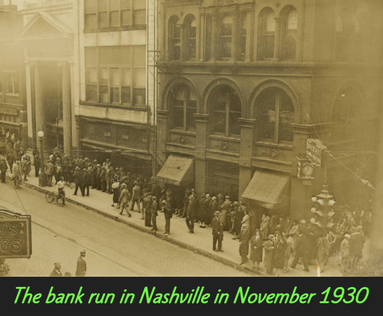
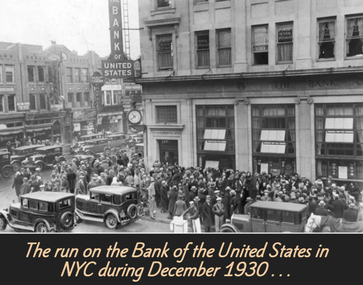
     On 27 June 1931, in Dalhart (TX), the First National Bank did not open for business, notifying customers that it had become insolvent with a sign on the front door; on that day, the temperature reached 112 degrees. People wondered “what now”; Dalhart, like the rest of the Southern Plains, was taking on a more desperate edge, almost two years into the Great Depression; it seemed like the entire boom of the 1920s had been a dream. During November 1930, 256 banks failed in the US, and fear, spreading like a contagion, led to more bank runs and bank collapses. Oil had fallen from $1.45/barrel to .10/barrel, and in Dalhart, the only thriving business was the whorehouse. 
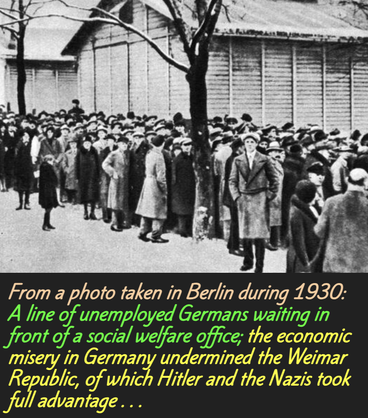
     Two million Americans lived as nomads, with many riding the rails and avoiding the railroad bulls. During September 1929, 1.5 million were unemployed, and by February 1930, the number reached 4.5 million. President Herbert Hoover stated that the main problem was a loss of confidence in the financial sector, and on 3 March 1930, he claimed that the worst of the depression would be over in 60 days. By the end of 1930, 8 million were unemployed, the banking systems had collapsed, and confidence in the financial sector had evaporated. During 1930, 1350 banks failed, taking $853m in deposits, and in 1931, 2294 banks failed. During December 1931 came the biggest bank failure to that point, when the Bank of the United States in New York City collapsed, and $2 million in deposits vanished; by that month, unemployment had skyrocketed to 25%. 
     The populist Father Charles Coughlin
had a radio audience in excess of one million, and he was increasingly becoming more-and-more anti-Semitic. In Lincoln (NE), 4000 people gathered in front of the state capitol steps, blaming the collapse of the economy on a “Jewish Conspiracy” with the banks. For factory workers still fortunate to be employed, their wages decreased from $25/week to $16/week in the early-1930s. In the Southern Plains, especially in what became known as the Dust Bowl, the “Next Year People” looked to the harvest of 1931 to save them. Wheat was pouring out of the combines in a nation that desperately needed food, but that production was met with the lowest price per bushel ever, which was 50% below what it cost farmers to grow and harvest the wheat. Adding to the misery was the excessive summer heat in 1931, which was the worst-yet of the 20th Century, and it stopped raining; the rains would not return for nearly eight years. 

Picture
     The Winter of 1931 - 1932 featured fly-by snow storms that didn’t amount to much of anything in terms of meaningful precipitation. Less rain fell in eastern Montana than normally fell in southern Arizona. Farmers in the Great Plains needed snow to insulate the nubs of wheat during their dormancy, and then the first rains in the Spring to kickstart the wheat. The soil turned to fine particles and took flight in the wind, while vast amounts of wheat in storehouses were attacked by rodents, and the price of wheat in some areas fell to .19/bushel, the lowest price ever. 
   Farmers and politicians in Washington, D.C. were baffled as to why President Hoover, the same man that spearheaded the price of wheat to reach $2/bushel via price-fixing, refused to help the agricultural sector, preferring that market forces solve the price problem. By 1932, one-third of the farmers on the Great Plains faced foreclosures for back taxes and/or debt, and by then all of the agricultural sector was in the same predicament as the wheat farmers. 
     By the Spring of 1932, it was too dry to plant, and with no ground cover, the soil started to fly away. Winds of 30 mph moved the soil in the air, and then winds of 40 - 50 mph resulted in dust storms. The land in the Southern Plains dried up during that spring, and in the succeeding months there was no rain. Unemployment in OK reached 29%, and in that state, of the 16 million acres in cultivation, 13 million were eroded, and that was BEFORE the epic drought. Far too many farmers, “Suitcase Farmers” or otherwise, had simply abandoned their land. That barren abandoned plowed-up land was a threat to the farmers that had stayed and tried to manage things. The grasslands were gone forever, and there was nothing to hold the soil in place. On 21 January 1932, a dust cloud 10,000 feet high appeared outside of Amarillo (TX), which defied explanation, since it was black and coarse, and dust was everywhere and on-and-in everyone; when people blew their noses, they saw black snot.

Picture
     As the drought in the Southern Plains entered its second year, a profusion of pests and bugs appeared. Insects bred and hatched that normally would have been killed in colder/wetter years, and they emerged in huge numbers. Grasshoppers consumed wheatfields and gardens, wiping out vegetables that could have been canned for an entire winter. Buckets of centipedes crawled all over drapes and floors, and constantly had to be swept out the door. In some cases, tarantulas with two inch long legs and a body the size of an apple were discovered in homes. The big dust cloud in January 1932 had carried many of these insects to Dalhart, and in No Man’s Land, black widows crawled out of woodsheds and corn stacks, and even entered homes. 
     Rabbits had the run of the land, and while they were an easy source of food, they also ate far too much of any existing or future crop. Rabbit drives were organized, where people were encouraged to bring clubs; in Dalhart, two thousand people took hours to kill several thousand rabbits. Rabbit drives became a weekly event in some locations, where up to six thousand rabbits were killed in a single afternoon in a square mile section. 
     The heat of the Summer of 1932 broke all records, such as Baca County reaching 115 degrees. It was a time where bankers were seen as thieves, and the US Government was a cold Big Brother that refused to help a family member in need. During the Fall of 1932, many farmers didn’t plant winter wheat, since there wasn’t any incentive to do so. Focusing on their gardens was the goal, which also meant one could keep their self-respect; life was on hold until the rains returned. Whatever grass existed under the soil, dust, and sand, there was not nearly enough for cattle to forage, and in all of 1932, only 12 inches of rain fell in No Man’s Land, half of what was minimally needed. By 1932, what families had saved from 1931 in terms of wheat and other crops was gone.

Picture
     The dust storm that hit Amarillo in January 1932 was viewed as an aberration, a freak of nature, and there was still no technical term for the storm from weather forecasters. During March 1932, there were many smaller versions of the Amarillo storm across the Southern Plains. As the winds continued to blow in April 1932, on most days a farmer at best could only see the length of his section of land. During 1932, there were 14 dust storms where visibility was at-or-less than a quarter mile. The land itself became a malevolent force, with children coughing through the night and hacking up dust. 
     Hugh Hammond Bennett had a Ph.D. from North Carolina, where he had focused on soil and land management. The US Government hired Bennett to be part of a team that conducted the first-ever soil survey. Bennett knew more about the soil in the US than anyone else, and by 1932 he had traveled abroad in order to learn how societies/cultures had used the land for centuries without doing any damage or harm to the soil. Bennett, the “Doctor of Dirt”, concluded that the misery, especially in the Southern Plains, was a man-made catastrophe. Specifically, Bennett pointed out that farmers had plowed-up huge tracts of grasslands in straight lines in barely a generation. He continued to state that Americans were the greatest destroyers of land in history, due to “stupendous ignorance”. By 1932, Bennett knew that far too many people had abandoned their land, avoiding any responsibility.
     Bennett had become extremely frustrated with the US Government for encouraging the Great Plow-Up in the Southern Plains, specifically going after his old employer, the Department of Agriculture, for misleading the nation. Bennett told anyone that would listen that farmers in the Southern Plains were working against nature. Even during the late-1920s, Bennett publicly warned what would happen in the Southern Plains, long before anyone else that wasn’t a cowboy sounded the alarm. The government’s insistence that soil was an inexhaustible resource was arrogance on the grandest scale as far as Bennett was concerned.

Picture
     During 1932, most Americans didn’t pay any federal income tax, but President Hoover wanted to tax the untaxed in order to help pay down the federal budget deficit. Hoover scoffed at photographs of people that sold apples to survive, saying that they were shirking and should get a real job. Congress, however, decided that it was better to tax the wealthy in order to try and reduce the federal budget deficit. It was clear during 1932 that the Republicans were on the descendancy and the Democrats were on the ascendancy; unemployment remained at 25%, and it seemed that the Great Depression had been going on forever.
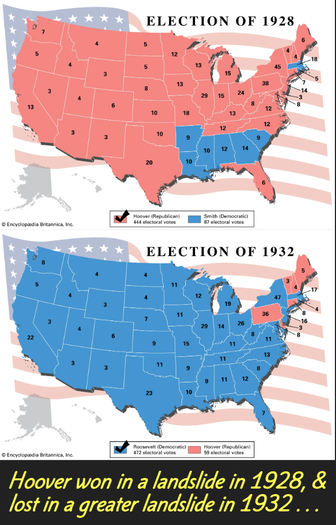
Franklin Roosevelt defeated Hoover in a landslide in the Election of 1932, winning 73% of OK’s vote, and 88% in TX. 

     FDR didn’t waste any time after his Inauguration, declaring a “Bank Holiday” and using his first “Fireside Chat” to restore confidence in banks. Next up for FDR was the farmer, where the President stated that the government would influence the price and flow of food so farmers could make a living off the land. The government bought surplus corn and other crops, and then distributed it to the needy. Soon enough, cattle ranchers and wheat farmers would be asked to reduce supply in return for government subsidies (cash). The
Agricultural Adjustment Act (AAA) became the framework where the government in essence became the market. 
     Bennett, the son of a NC cotton farmer, continued to rage against the killing of the land in the Southern Plains, particularly in OK, and especially in the Cherokee Strip (immediately east of the OK Panhandle). Since Bennett’s background was in agriculture, his speeches and diatribes didn’t seem like they came from an out-of-touch urban elite or a science nag. Bennet still lived an agricultural life, which led most other scientists to dismiss Bennett, with some calling him a crank. Other scientists blamed the weather instead of the farmer; Bennett’s ecology-driven crusade simply didn’t have as of yet a wide audience. 

Picture
     One of the first things FDR did as President was to summon Bennett to the White House. After Bennett brought FDR up to date, the President asked if there was anything that could be done to reverse things in the Southern Plains. FDR liked Bennett, and he appointed the “Doctor of Dirt” as the director of a new agency within the Department of the Interior, whose mission was to stabilize the soil. FDR wanted Bennett to see the crisis in the Southern Plains in a different way, in other words to solve the problem instead of playing the “blame-game”. Bennett was a scientist who knew his subject, as well as a showman, and he attacked his new job with great relish and enthusiasm, per FDR’s instructions. 
     During February 1933 in Boise City, the temperature dropped 70 degrees in less than 24 hours, with the dust blowing at minus-14 below zero. Already, there had been 33 severe dust storms in 1933 in the TX and OK Panhandles. Predicting dust storms were worthless, since all weather forecasts in those days were based on barometric pressure, which was an ancient method, despite all efforts to be accurate and precise. Ironically, given all the technological marvels of the 1920s, predicting the weather remained as arcane as ever. When the weather turned nasty without notice, people died, sometimes in large numbers, such as during the
Tri-State Tornadoes of 1925 that killed 957 people. The only thing weather forecasters did that was accurate was to take measurements of the weather, but the technology didn’t yet exist to make much use of the data in terms of predictions. 

Picture
     March and April 1933 were awful in terms of the wind and dust storms, in that all the wheat planted from the previous Fall was killed, and an area half the size of Britain had no pasture or feed for cattle. At the end of April came a dust storm that lasted 20 hours with sustained winds of 40+ mph. Charles Lindbergh tried to fly across the TX Panhandle on 6 May 1933, but couldn’t complete his flight because so much dust had been sucked into his plane’s engine. Lindbergh wanted no part of the curious people that wanted to talk to him, and he stayed in-or-near his plane for two days until he was able to fly out. 
     Then rain mixed with the dust, resulting in a mud hailstorm, hit the area doing great damage. And then came a tornado which touched down in Liberal (KS) near the OK border, killing 4 people and making over 800 homeless; adding insult to catastrophe were more mud pellets from the sky. There had never been a drier recorded summer in the Southern Plains before 1933: in the TX Panhandle, which produced six million bushels of grain in 1931, produced just a few truckloads in 1933. Chickens, cattle, and milk cows died from ingesting the dust in their desperate search for food. While some people left No Man’s Land and the other severely affected areas, most stayed, hunkering down in order to try and see their way through the never-ending nightmare . . . 

0 Comments

The Dust Bowl: The Great Plow-Up (1926 - 1930)

5/22/2024

0 Comments

 
            Source: Timothy Egan. The Worst Hard Time - The Untold Story of 
                          Those Who Survived the Great American Dust Bowl (2006)
Picture
     During the first 30 years of the 20th Century, areas like the TX and OK Panhandles were the last frontier in the continental US, and those that had missed out or hadn’t taken the risk with earlier homesteading opportunities viewed the Southern Plains as their last chance to make it big on their own. From 1924 - 1929 in the Texas Panhandle, the acreage that was plowed-under for wheat went from 876k to 2.5m, an increase of 300%. The years of 1926 through 1929 were the “wet years”, creating rampant optimism, with everyone in the region thinking that the weather had permanently changed. 
     In the Northern Plains, an increasing number of settlers were cursing the railroads and the federal government for their misleading statements and lies about the quality of the land. Meanwhile, in the Southern Plains, people welcomed the railroads as if nothing awful had happened up north. In 1929, President Herbert Hoover claimed that the nation was near the final triumph over poverty, a statement which resonated in the Southern Plains. Each year an additional million acres of grassland were plowed-up in the Southern Plains, 5.2 million acres from 1925 - 1930, which was an area equivalent to two Yellowstone National Parks. That 5.2 million acres was in addition to the 20 million acres that had already been plowed-up in the region. 

Picture
     By the Summer of 1929, the US had a food surplus, and every town along a railroad in the Southern Plains had huge piles of unsold grain by their grain bins. After Russia resumed exporting wheat, Europe experienced a huge glut as well, and there were towers of grain that nobody wanted in both the TX and OK Panhandles; it was a warning sign of the hard times to come. The balance was tipping from ascendancy to a sharp descendancy, with the price of wheat going down to below $1.50/bushel, then below $1, then below .75, which was only one-third of the market price per bushel from just a few years prior. 
     Farmers in the Southern Plains had two choices. First, cut back on production and hope that the supply of wheat would go down and prices would go back up. The second choice was to plow up more land and produce more wheat to make money on volume. All across the Southern Plains, farmers chose to plow up more grassland to plant more wheat. The vast majority of them had been issued loans, which allowed them to buy one-way plows, tractors, combines, and more land. The only way to equal the profits made from 1925 with the current low price for wheat was to plant twice the acreage; 50k acres a day were plowed up starting in 1929 until the Dust Bowl arrived. 
     German immigrants to the Panhandles brought with them seeds for hard winter wheat (turkey red seeds), which was resistant to cold and drought. That winter wheat took so well to the Southern Plains west of the 98th Meridian that it changed the overall negative view of the Great American Desert.  Adding to the future time bomb was that there was no worse time to plow up grassland than during the Fall, when it would be exposed for months during the “Blow Seasons” of Winter and Spring. The farmers fully realized that leaving that much land exposed was a gamble, but they did so independently en masse nonetheless. 

Picture
     There were so many Germans in Russia in the late-1800s that the railroads and land developers in the Great Plains targeted them for immigration to the US, since they were perceived as being a “step up” from those that quit their lands in the Great Plains in terms of work ethic, responsibility to the land, and their debts. Germans in the Volga region were told of great lands in the midsection of the US, and to them it sounded like the Promised Land. Germans in Russia left in droves for the Great Plains, and in places such as Lincoln (NE), German was spoken more often than English. From 1873 - 1920, over 300k Germans from Russia arrived in the Great Plains, plowing up the land and planting winter wheat in areas that had been vacated or not settled. 
     During the early-1890s, the “Cherokee Strip” in OK was made available for white settlers. Again, the Cherokee had been betrayed by the US Government; the Cherokee burned the land before they left, with nothing remaining but black bristles. The same thing happened to the Comanche further west, and both Native nations were promised by the government that their displaced people would receive 160 acres elsewhere in order to learn how to farm. 
     Norwegians also came to the Southern Plains in large numbers, creating Oslo (TX), but that settlement was doomed by the lack of rain and no railroads, with the drought in 1913 breaking the colony for good. However, the Germans from Russia stayed on their land, since their experience in the Volga Highlands had taught them how to live in a treeless place during a (normal) drought. However, soon enough these transplanted Germans would be in a horrible situation far worse than anything they had faced in Russia. 

Picture
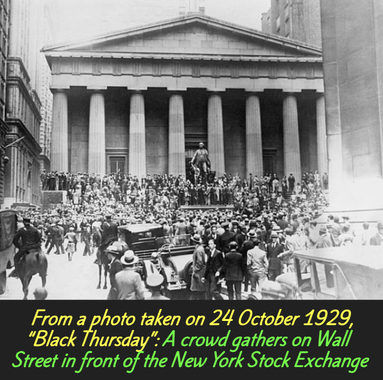
     Starting on 24 October 1929, the Stock Market Crash occurred. According to the stock brokers, it was merely a correction after a decade of rapid growth, but in the next three weeks the Stock Market lost an additional 40% of its value, more than $35B (the US Government’s fiscal budget for that year was $3B). An even worse consequence was that banks were hollowed out due to the unpaid loans (“Buying on Margin”). At most, four million people owned stocks in a nation of 120 million; at no time in the 1920s did more than 1.5 million Americans purchase shares in the Stock Market. In 1929, 25% of the jobs in the nation were in agriculture - to farmers, the Stock Market Crash only hurt the city slickers, the dandies, the swells. Very soon after the Stock Market Crash, the local newspaper in Boise City claimed that “our ship is coming in”.
     However, the price of wheat was following the sharply decreasing price of stocks. There was already so much surplus wheat that in KS and NE people burned grain for heat, with one courthouse burning corn for heat all winter. At the start of 1930, wheat sold for one-eighth of the price (.40/bushel) as it did in 1920, which was barely enough to cover costs, and definitely not enough to stay current with outstanding debts. All across the Southern Plains, there was only one answer: plow up more land and plant more wheat. 
     Foreshadowing: By the end of 1932, 25% of US banks were closed, and nine million people had lost their savings. The loss in the Stock Market surpassed $50B, and over two million people lost their jobs, triple from the previous summer. Rioting over food started to occur, and those riots reached Oklahoma City despite mounds of excess grain in the state. There was actually too much of everything (food, clothing, cars), but there were too few people able to purchase much . . . the going rate for corn was actually listed at .03/bushel. 

Picture
     In the Southern Plains, it rained enough for another great wheat harvest in 1929, and the price increased to .80/bushel, but soon enough plummeted to .24/bushel, and farmers begged their banks to give them one more chance. During the Fall of 1930, the “Nesters” took to their plows and tore up more grassland than ever before in order to plant even more wheat. More and more land had been stripped with nothing planted, exposed to the wind, mostly due to the “Suitcase Farmers” who had cut their losses and vanished, abandoning the land. 
     Baca County in Colorado was the last big section of the Southern Plains to be plowed-up; the Era of the Cowboy was gone in CO, as it had disappeared in TX. A line of the Santa Fe railroad was in Boca County by 1927, leading to a 200% growth in population in a few years. By 1930, Baca County was the largest wheat producing county in CO. The county (and the region) averaged 16 inches of rain a year, but the cowboys told the farmers that the recent “wet years” wouldn’t last, and that a drought was coming soon. 
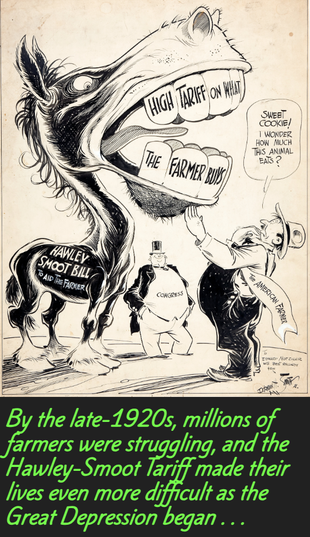
     At the onset of the Great Depression, the price per barrel of oil dropped from $1.30 to .20, and the world economy was in a giant mess, with Germany among the nations hit the hardest. Big Business interests convinced Congress to enact a brutal tax on imports (the Hawley-Smoot Tariff in 1930), which sent the economies in Europe into more of a tailspin. The US financial sector had become the world’s largest casino, without any government oversight or regulation, and the consequences were starting to play out. 

Picture
     The rules put in place to stop the negative consequences, e.g. tariffs and constricting the money supply, only made matters worse, which led to a sharp decrease in consumption (consumer spending). The Great Depression was a global nightmare, and in the Southern Plains, current wheat harvests were stacked next to the previous year’s harvests. Farmers felt that they had done everything right, and their reward was wheat selling for .30/bushel, which was below what it cost to plant, cultivate, and harvest. President Hoover rejected the idea that the US Government buy the surplus wheat to feed those that were hungry/starving in the nation, believing that it was the responsibility of the states to do so, as well as wanting to be fiscally responsible. 
     On 14 September 1930, a windstorm kicked up dust in southwest KS and headed towards OK. By the time the windstorm hit the TX Panhandle, it had become a dust storm unlike anyone had ever before seen in the Southern Plains. No one really knew what they were seeing or experiencing, since it wasn’t a sandstorm or a hailstorm, despite the ominous and threatening skies. The dust storm rolled like a mobile hill of black crud, and it carried enough static electricity to short out a car, and it felt like sandpaper when it hit a person’s face. The first “Duster” was a curiosity, nothing more, and people in that part of the Southern Plains went on with their lives . . . 

0 Comments

The Dust Bowl: The Great Plow-Up (Mid-1800s to the 1920s)

5/21/2024

0 Comments

 
            Source: Timothy Egan. The Worst Hard Time - The Untold Story of 
                          Those Who Survived the Great American Dust Bowl (2006)
Picture
     When the Spanish introduced horses in the Great Plains, they had the same effect as the railroads did later for white settlements. Soon, Plains Native tribes/villages grew as did their radius for hunting, traveling, and trading. In what would become the southern section of the Dust Bowl, the horse led to the Comanches becoming the dominant Native nation in the 1700s. By the early-to-mid-1800s, the Comanches had come to hate Texans more than anyone else; starting around 1840, the Texas Rangers were organized and tasked by the Lone Star Republic to go after Natives, especially the Comanche. A mounted Comanche was the most effective warrior on the Great Plains, difficult targets to be sure, but almost otherworldly when on the attack. Years of hunting buffalo (which was their “wellspring”) on horseback gave the Comanche the initial advantage over the Rangers.
     The Medicine Lodge Treaty of 1867 promised the Comanche (and other Native nations, such as the Kiowa) rights to much of what was called the Great American Desert. Very few whites were interested in settling in that vast area, in that rainfall wasn’t as high relative to the Northern or Eastern Great Plains. The so-called “Staked Plains” were in essence reserved for Natives that hunted buffalo, such as the Comanche. Hoever, within just a few years after the treaty, whites entered the region and started to kill millions of buffalo, stockpiling hides and horns for the lucrative trade back East. From 1872 - 1873, seven million pounds of buffalo tongues were shipped out of Dodge City (KS) alone; a government agent estimated that over the same time over 25 million buffalo had been killed.

Picture
     Texans flat-out ignored the Medicine Lodge Treaty, claiming that the land belonged to them, and was in no way part of the public domain outlined in the treaty. With the buffalo population diminishing, the Comanche attacked cattle and trading posts, which was a major cause of the Red River War of 1874-75. That war broke the Comanche, in that so many of their horses were killed by the US Cavalry under the command of General Phil Sheridan, which meant that the Comanche were no longer the Lords of the Plains. During 1875, Sheridan recommended to the Texas state legislature that it would be a wise strategy to exterminate the remaining buffalo in order to gain peace with the Natives. Soon enough, that region of the Great Plains was empty of Natives and buffalo. 
     As of 1926, virtually all of the Texas Panhandle was grassland. The grasslands of the Great Plains covered 21% of the US and Canada, and other than the rainforests, it was the largest ecosystem in the world. Six of the seven “weather moods” in that part of the Great Plains were deadly, featuring blizzards, grass fires, hail storms, drought, flash floods, and tornadoes. Cattle proved to be far more fragile than buffalo in terms of enduring and surviving the temperature extremes of the region. For example, the Winter of 1885 - 1886 wiped out nearly all the cattle in the Southern Great Plains, and the same happened the next winter in the Northern Great Plains. The annual rainfall in the Southern Great Plains was less than 20 inches, but it was enough to grow crops without irrigation. That miracle of “Dry Farming” would be the siren song that lured farmers to the region to plow-up the grasslands and grow crops. 

Picture
     Hardy Campbell (from Lincoln NE) was the most famous apostle of Dry Farming. The US Government placed their stamp of approval on Campbell by creating an agriculture office in the Texas Panhandle. No new farmer to that region was without Campbell’s Soil Culture Manual, which was a how-to book that practically guaranteed prosperity. Campbell asserted that plowing-up the untouched grasslands would lead to more rainfall; in other words, “rain follows the plow”. The Santa Fe Railroad had a “progress map” that showed the “Rain Line” of 20 inches or more moving west with the expansion of the railroads, at a rate of about 18 miles a year. With scientific certitude, the railroad claimed that the steam from their locomotives added to the rainfall. 
     However, those that had lived in the region for many years, such as ranchers, cowboys, and especially Natives, knew that the Texas/Oklahoma Panhandles were no place to plow-up the grasslands. The average rainfall was only 16 inches a year, which was barely enough to sustain a crop in the short-run, and not at all for the long-run. The region was only good for one thing - growing grass, which even during the driest years held the soil in place (especially the short Buffalo Grass). “Nesters” (new farmers) and the ranchers/cowboys came to hate each other, with both sides thinking the other was trying to run them off the land. Cowboys were “Hedonists on Horseback”, while the Nesters were "Bonnet-Wearing Pilgrims Without a Clue". By 1926 in the Texas Panhandle, only 450k acres remained unplowed. Between 1910 and 1930, nearly 30 towns were created in the Texas Panhandle, due mostly to agriculture and oil drilling. Most Texans honored Prohibition, but not those in the Panhandle, since corn whiskey was a great way to make as much as $500/week (approximately $9000 in 2023 dollars).

Picture
    Lies and exaggerations brought people to Boise City (rhymes with “choice”) in OK’s Panhandle, and by 1908, the same year OK became a state, 3000 town lots had been sold at $45 each. The developers even bragged that the town’s streets were paved, Main Street was bustling, and a fourth railroad line would reach Boise City. All of those claims were pure fiction, as discovered by the understandably-shocked buyers when they arrived. Boise City had no railroads or tracks, no plans for railroads, no fine houses or businesses, and the artesian well was a fly-infested joke. The company hadn’t even owned the land that it sold to these gullible buyers (the two developers were sent to Leavenworth prison). Nonetheless, Boise City (closer to Denver than Oklahoma City by 40 miles) eventually took shape.  Despite murder threats from rival towns, Boise City became the county seat of Cimarron County. By 1920, Boise City had 250 residents, and the county approached a population of 3500. 
     The flattest, driest, most wind-raked and least-arable part of the US was transformed by government subsidies, private showmanship, and the strong desire of those that were there to transform the Great American Desert into a liveable “Eden”. In a way, settling and developing that area was taking a dare and suspending common sense. The overall goal was to make the OK Panhandle a wheat-producing colossus. Also in play was that the area including/surrounding the OK Panhandle was referred to as “No Man’s Land”, which was one of the last places in the nation where a person could successfully hide; rare was the person that came to look for them in that area. The OK Panhandle was a result of the Missouri Compromise (1820), in that no slavery could exist above the “36/30 Line” (36 degrees, 30 minutes north latitude), which left a rectangle 35 miles wide and 210 miles long that was not attached to any state or territory in the West, until it was added to the Oklahoma Territory in 1890. The great land rushes that occurred in OK in the late-1880s never reached the OK Panhandle (but certainly came at the expense of Natives). 

Picture
     The peak year for homesteading claims in the US occurred in 1914, surpassing 53k in the Great Plains. While Cimarron County grew 70% between 1910 - 1930. Areas of the Northern Plains, such as Montana, lost quite a few homesteaders, in that the land had played itself out. Free train rides to the Southern Plains courtesy of the federal government encouraged and contributed to the population boom. There wouldn’t have been much settlement in the Southern Great Plains (or anywhere in the Great Plains), including the railroads, without windmills that drew water. Once an aquifer was reached, which was not easy to do in most cases, and even hazardous in some instances, a single tower windmill could furnish enough water for most farming needs for a full section of land. Despite parts breaking down, Nesters believed that they had tapped into a life-giving vein of water that would keep going in perpetuity. 
     The biggest fear was fire, and the ingredients for Mother Nature to produce fires were all too common, such as lightning starting grass fires. Fire was part of the ecosystem on the Great Plains, a way for nature to cleanse itself and produce new grass. The fires were very difficult for a person to outrun, and cattle had no chance whatsoever. And if it wasn’t fire, then it was flooding, where the Cimarron River would often overflow. But starting especially in 1914, people plowed-up land in the Southern Plains knowing that wheat would sell for top dollar to feed Europe in the Great War. Wheat farmers on the Great Plains in just ten years went from subsistence to small-business class wealth, with profit margins as high as ten times greater than the involved costs. During 1910, wheat was at .80/bushel, which was enough to make a small profit. Five years later, during the Great War, the price more than doubled, and wheat production increased by 50%. 

Picture
     When the Turks blocked the Dardanelles, they had no idea they were a boon to US wheat farmers. With wheat no longer available from Russia, the US stepped in to fill the void. A mantra spread that planting wheat would help the Allies win the war against Germany and Austria-Hungary. On a half-section of land (a full section is 640 acres) 15 bushels/acre led to 4800 bushels, which cost .35 a bushel to grow. The selling price per bushel was $2, and a profit of $8000/yr (approximately $194k in 2023 dollars) was possible by 1917, the year the US declared war on Germany. As a comparison, a Ford factory worker earned about one-eighth of that total in a year. The irrationally exuberant Nesters started to imagine 30 bushels/acre or more, and Campbell claimed that 50 bushels/acre was realistic, even without adequate rainfall. These Great Plains farmers, especially in the Southern Plains, had no idea that they were laying a foundation for a time bomb that would shatter the natural world. Dryland wheat looked like an easy gamble for those arriving in No Man’s Land (OK Panhandle). The self-described “Wheat Queen” of KS told anyone that would listen that on her 2000 acres of “bony” soil, she profited $75k in 1926 ($1.3m in 2023 dollars). That total was more than President Coolidge earned, and more than every professional baseball player not named Babe Ruth. 
     The tractor changed everything for farmers on the Great Plains. During the 1830s, it took 58 hours to plant and harvest a single acre, but with the tractor in 1930, it took only 3 hours. A tractor did the work of ten horses, and the new combines cut and threshed grain at the same time, using just a fraction of the labor. The one-way plow was the implement that just flat-out tore up the grasslands in a brutally efficient manner; to dry farmers, it was a miracle. By 1925, train tracks finally reached Boise City, so now it was never easier to get wheat to market. Meanwhile, in eastern Montana, towns founded by railroads 30 years prior were folding, and no amount of government incentives could drum up interest for another surge of settlers.

Picture
     In the Southern Plains, railroads started to connect previously unsettled areas, which with every harvest increased the population in-and-around Boise City. With the onset of mechanized agriculture, mortgages followed. For many years, bankers refused to loan money to farmers west of the 98th Meridian, since it simply didn’t rain very much and was seen as far too risky. However, a handful of wet years and the introduction of the tractor and the combine changed the loaning/borrowing landscape. Farmers gladly committed their property as collateral in order to get more money to buy and plow-up more land in order to plant more wheat. 
     By 1929, Boise City was a thriving town with a theater, hotel, bookstore, bank, newspaper, creamery, a few cafes, and a telephone exchange. Many farmers bought appliances from Sears, and some bought real houses to replace their ramshackle initial homes, and a kind of giddiness took hold in No Man’s Land. Cimarron County, on the far end of No Man’s Land, had a population of 5408 by the end of 1929, with Boise City’s population at 1200. Through easy loans, a small parcel of land could become a much larger land holding, and with tractors and combines, finding extra labor was no longer as necessary or daunting. Newcomers were pouring into No Man’s Land, including “Suitcase Farmers”, who had zero intention of actually living there. All they wanted was for others to plant, cultivate, and harvest winter wheat, and they would come back to claim their huge profits the next summer; it was a game called “Trying to Hit a Crop”. After Congress passed the Federal Farm Loan Act of 1916, banks offered loans to farmers for 40 years at 6% interest. A $5000 loan meant payments of only $35/month, and any man with a tractor and at least a half-section of land could easily manage the monthly payment. The Federal Bureau of Soils claimed that soil was the one indestructible and immutable asset that the nation possessed, that soil can never be used up or exhausted. 

0 Comments

14) President Hoover: 1932 - 1933

5/17/2024

0 Comments

 
                                  Source: Kenneth Whyte. Hoover -
                             An Extraordinary Life in Extraordinary Times (2017)
Picture
     Before the Republican National Convention in Chicago, Hoover insisted on a compromise on the GOP platform concerning Prohibition, in that he in no way wanted a repeal. The plank on the platform stated that the issue of Prohibition be left to the states to decide (e.g. passing an amendment to cancel Prohibition), which made no one happy, since the Democrats were the party of repeal. Hoover received 98% of the vote of the convention delegates, which surpassed Coolidge’s 96% in 1924 (but less than TR’s 100% in 1904). The entire convention had been a humdrum affair, with some delegates sensing that an opportunity had been lost, since there had been no attacks on the Democrats. 
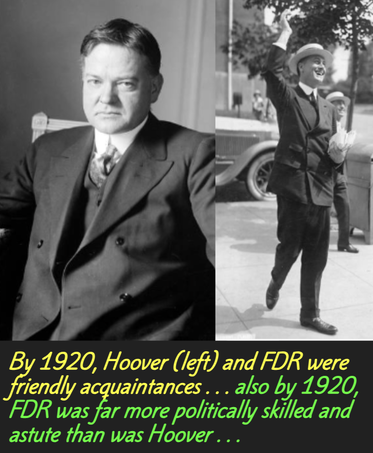
     If Hoover could have handpicked the candidate of the Democrats, he would have selected FDR, since he didn’t think Franklin Roosevelt had the necessary levels of imagination and leadership. To Hoover, FDR didn’t pass muster as a Presidential candidate, and then there was the matter of major health concerns as well for the NY governor. During the
Democratic National Convention, FDR won the nomination on the 4th ballot, and Hoover believed his chances at re-election had vastly improved. Hoover’s low estimation of FDR mirrored conventional wisdom, in that FDR was viewed as a rich spoiled dandy, unsuited for the highest office in the land. Up to 1932, FDR’s public speeches had been awkward and vague, not inspiring much confidence. 
     However, FDR had a firm grip on the two central issues in 1932: the failures of the Republicans in Congress and the weak spots of President Hoover. FDR kept throwing various charges against Hoover, letting voters decide what would stick. FDR attacked Hoover from both conservative and liberal flanks, ridiculing the President’s judgment and leadership. FDR laid the blame of the Stock Market Crash and the deep economic depression on Hoover, ignoring the reality of the situation. FDR went even further, portraying Hoover as the main villain in the nation. 
     FDR shared Harding’s trait of projecting confidence and radiating comfort and cheer, and he was able to assume whatever role voters desired. But FDR was far more ruthless than Harding, unafraid to tear down others to advance his ambition. Hoover was slow to respond to FDR’s attacks, in large part because he believed that it was not dignified to actively campaign, especially for re-election. Hoover refused to hit the hustings, while FDR, despite his inability to independently mobile, was active and out-and-about.
Picture
     During July 1932, Congress passed the Emergency Relief and Construction Act, directing an additional $1.5B to the RFC, as well as $300m to the states. Hoover signed the bill into law on 21 July 1932, but he had to swallow a bitter pill, in that banks that applied for RFC money would be publicly named. The act gave direct aid to the states, and the RFC ballooned to $4B, leading many to believe that the Democrats hadn’t done nearly as much as Hoover during the last few very hard years. 
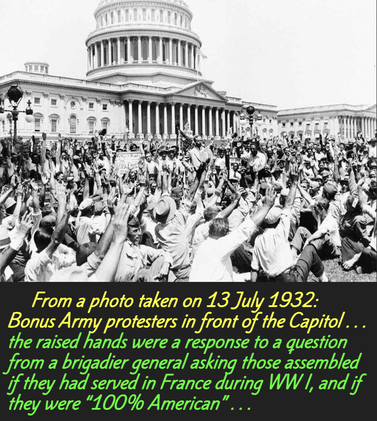
     And there was the Bonus Army, which numbered over 10k in the DC area, which proved to be the most significant way the Great War haunted Hoover’s Presidency. Hoover canceled at least one public appearance with the Bonus Army in DC, but he secretly distributed food, clothing, blankets, etc. to the 10k+. The 6th Marine Barracks took charge of the medical side of things concerning the Bonus Army, seeing hundreds of veterans a day. On 7 July 1932, the Senate soundly defeated a bill that would have distributed $2.5B to the veterans. A majority in the Senate agreed with Hoover, in that paying the veterans now (until waiting until 1945) meant less federal money spent elsewhere, and that it would have been too large a federal expenditure on such a small percentage of the population. At that point, most of the Bonus Army left DC, and Hoover authorized $100k in travel subsidies to assist in their return home. 
    However, a militant minority refused to leave, and the weeks that followed turned very tense. Rumors circulated that the remnants of the Bonus Army would storm the White House, and that they were arming themselves with weapons (e.g. machine guns). On 28 July 1932, a riot occurred when DC police tried to force the Bonus Army to leave. The DC police asked Hoover for assistance from the Army, and Hoover agreed, ordering the militant minority to be escorted back to their camp across the Anacostia River. 
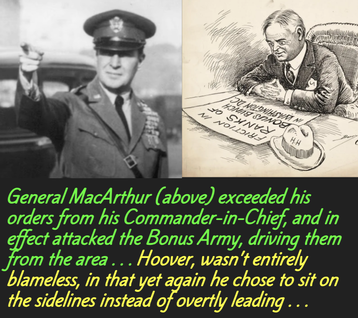
     Who turned the tense situation into a nightmare was Army Chief of Staff Douglas MacArthur, who didn’t see fellow veterans in a desperate situation, but rather enemies of the state. MacArthur believed that a major revolt was in the offing, and he ordered an Army detachment of six tanks, a column of infantry, and mounted cavalry to engage the Bonus Army at the base of the Capitol Building. The detachment, under MacArthur’s orders, used tear gas and bayonets to force the Bonus Army across the Anacostia. Ignoring Hoover’s orders that once across the river the veterans were to be left alone, MacArthur torched their encampment. Then MacArthur held a press conference to congratulate Hoover on his firm hand concerning the Bonus Army. When FDR heard of the Bonus Army Incident, he believed that Hoover had doomed whatever chance he had at re-election.
Picture
    Newspapers such as the New York Times were very much in support of Hoover, as were the DC newspapers, and an Associated Press poll showed that a large majority of citizens supported the President. Dissent against what happened to the Bonus Army was slow to develop, and FDR remained silent on the event during the initial stages of the campaign. Even when it was determined that the Bonus Army was not a communist revolt, FDR remained mum, and supported the Senate vote in denying money to the veterans. In short, there is no historical evidence that indicates that the Bonus Army Incident negatively affected Hoover before the Presidential election.
     But FDR had many other avenues in which to attack Hoover in terms of the economic misery that gripped the nation, since no one really understood what happened to the economy, experts included. Conservatives assailed Hoover on using the government to intrude on the private sector, and socialist-leaning Democrats attacked Hoover for not admitting that capitalism was played-out. The verdict by the Fall of 1932 was that Hoover and the federal government had failed the nation. The problem for Hoover was how could he prove that he had done his best to at least partially blunt the misery of the worst economic depression in US History. It reached the point where few believed that the economic nightmare would have occurred if anyone other than Hoover had been President. 
     FDR recognized the dilemma that Hoover was in, and he gave no quarter on his campaign. An increasing number of voters found FDR’s attacks on Hoover compelling, and Hoover’s optimism and resilience were viewed as ineptness and incompetence. By September 1932, it was clear that Hoover’s chances at re-election were virtually nonexistent, and whatever campaigning he did was without any support from the Republican Party. Yet Hoover still believed he could win, in part because yet another “False Dawn” was peeking over the horizon, in that major economic indicators seemed to be moving in a positive direction. Hoover claimed that he had stopped the sinking of the economy, but that recovery would take time. In the back of Hoover’s mind was that there would probably be a new freefall in the economy which could occur at any time, given what happened with the previous “False Dawns”. Hoover hoped that the economic indicators would be enough to convince the GOP to back him through re-election. 
     Hoover campaigned on economic recovery, but he also kept stating that FDR did not have a monopoly on caring about the nation’s welfare. Hoover hit the campaign trail like never before, spending much time writing speeches trying to prove that FDR’s assertions about him were wrong. By mid-October 1932, Hoover found out that the Republican Party had run out of campaign funds, even though the GOP had routinely outspent the Democrats in previous Presidential campaigns.
Picture
    Hoover went to CA the week before the election, and even he had to admit that FDR had all the momentum as Election Day approached. Hoover was so exhausted that he gave a less-than-stellar radio address just days before the election, even losing his place in the speech, since he was so tired he couldn’t focus on the document in front of him. Hoover was the first Presidential candidate to commission scientific polling for data, where he found that his desire to keep Prohibition in place drove voters to the Democrats, since they thought that opening the taps and distilleries would invigorate the economy. Hoover discovered the hard way that a huge number of voters believed there was a connection to the continued existence of Prohibition and the nightmare economic depression. It didn’t help Hoover any that the Republican Party, unlike the Democrats, were split on the benefits of repealing Prohibition. 
     The Great Depression damaged Hoover’s chances at re-election, but less than has been popularly thought. 58% had Hoover “somewhat responsible” for the Great Depression, while 68% believed that the government had made the depression less severe, with the RFC receiving much of the credit. A large majority polled blamed financiers and businesses for causing the Great Depression, with Wall Street blamed far more than Hoover. A surprising result of Hoover’s polling was that the vast majority believed that the Great Depression was easing its grip on the nation, and that the economy would soon start its recovery, which exactly matched what he’d been arguing since the Summer of 1932. 
     Ironically, the temporary economic upturn held through Election Day. Hoover’s polling data indicated that he had hurt himself with his stance on the Smoot-Hawley Tariff, and that Isolationism was preferred over Internationalism. It was a
Pyrrhic Victory for Hoover when his polling data indicated that the government could offset economic depressions by becoming more involved in the financial and business sectors. And in one more irony, it was FDR that made government involvement an issue during the campaign. However, scientific polling data couldn’t measure such aspects as the personality differences between Hoover and FDR, nor FDR’s superior political acumen and skills. The results of the Election of 1932: Electoral College - FDR 472, Hoover 59 / Popular Vote - FDR .574, Hoover .396 / States Won - FDR 42, Hoover 6 (Northeast states). 
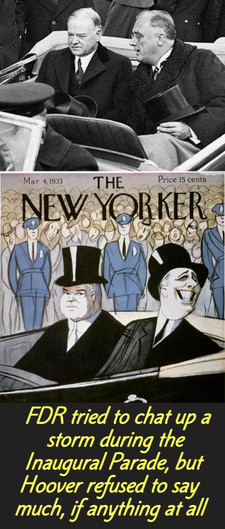
     Hoover still had four months to go until Inauguration Day, and there was plenty for him to do for the nation while still in office. President Hoover tried to get President-Elect FDR involved before 4 March 1933, but FDR wanted no part in assisting any Republican efforts to improve the economy before he was sworn in as the 32nd President (nor did he want any blame before that day). Hoover and FDR met on 22 November 1932 in the Red Room of the White House; the two former friendly acquaintances were now political antagonists. That antagonism was almost entirely on Hoover’s end, since he was always incredibly touchy and thin-skinned on any attacks against him. Hoover was unwilling to forgive FDR, while FDR was unable to comprehend why Hoover just couldn’t let matters go; the two men would remain antagonists for the rest of their lives.
Picture
     After the meeting, FDR told the press that Hoover could do whatever he liked for the remainder of this term. However, Hoover was very limited on his way out of office, given the mood and make-up of Congress. And FDR had instructed the Democrats in Congress to keep Hoover from “tinkering” with the reparations debts, since the moratorium had expired. Britain made their next debt payment to the US on time, France defaulted, and Germany announced that it was going to cancel all future reparations payments to the US. 
    Then the US economy took a further downturn. Investors exchanged dollars for gold based on vague statements from FDR, who questioned the validity of the Gold Standard. As the supply of gold went down in the Federal Reserve, the stability of the banks went down, as did the confidence of citizens in their banks. Congress had decided to “punish” the banks before Inauguration Day, contrary to all sound advice. And the insistence of Congress to publicize the loans issued banks from the RFC reduced confidence in specific banks, which was contrary to Hoover’s advice. Hoover had good reason to blame FDR and the Democrats in Congress for ruining his hard-earned partial economic recovery, an argument which has gained credence among economists over the succeeding decades. For every item Hoover wanted addressed before his Presidency ended, he was thwarted by Congressional Democrats, acting at the behest of FDR, who pretended to sit on the sidelines. To Democrats, it was simply politically stupid to cooperate in any way with Hoover when FDR would be inaugurated on 4 March 1933, and the Democrats would have a majority in both the House and the Senate. 

Picture
     On 5 February 1933, Congress closed shop 23 days before their session was scheduled to end, which was nothing more than obstructionism against Hoover. It was common knowledge that FDR had demanded Congress to give him a free hand with his economic recovery programs once he was sworn into office, and it was also common knowledge that Congress was going to give FDR that freedom. 
    A full-blown banking crisis forced another meeting to occur between Hoover and FDR before Inauguration Day, mostly due to the actions of Henry Ford’s arrogant idiot son,
Edsel Ford. The mammoth Guardian Group, headed by Edsel Ford, was in desperate need of capital since the firm under his leadership had squandered an incredible amount of money on irresponsible speculation. Edsel Ford refused to cooperate with the strict terms of the RFC, believing the Guardian Group was too big to be allowed to fail. The RFC refused to loan Edsel Ford any money, the Guardian Group collapsed, and its failure triggered bank runs on a national scale. 
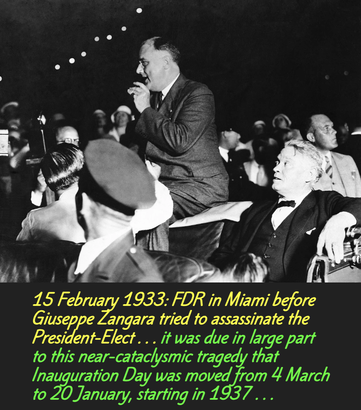
     As a result, all the positive economic signals of the second half of 1932 went up in smoke. By the end of February 1933, 25% of the Fed's gold reserves had vanished. Wholesale prices declined, unemployment increased, and many states followed the lead of MI in declaring “bank holidays”. As FDR saw things, the economic collapse would give him even more freedom as President to enact his economic recovery programs. FDR showed nothing but poise and confidence as President-Elect all the way to his Inauguration. After FDR took the Oath of Office to become the 32nd President of the United States, FDR and Hoover never again saw each other.
0 Comments

13) President Hoover: 1931 - 1932

5/16/2024

0 Comments

 
                                  Source: Kenneth Whyte. Hoover -
                             An Extraordinary Life in Extraordinary Times (2017)
Picture
   Even with bipartisan support in Congress, Hoover’s attempt to save the banking sector was a longshot, since the overall economy was in the deepest depression in US History. Apprehension was crushing optimism, so why, people asked, place any trust in the latest “cure”. Even to Hoover, it seemed that the harder he rubbed the lamp, the smaller the genie became. Yet, after the press release from Hoover, the NYSE recorded its strongest day since the Stock Market Crash, and bankers were lavish in their praise of the President, despite their private doubts. It was the second time in just six months that Hoover had produced bipartisan support of a major bill, and the press went out of its way to be optimistic instead of touting doomsday. The National Credit Corporation was the name of the $500m “bailout” fund, and the idea was to wait until the financial panic was over before punishing the reckless banks. 
     On 20 October 1931 during a Cabinet meeting, it was determined that the $500m plan was working, in that bank runs had slowed, as had the amount of gold leaving the US. Hoover used the break in the economic downturn to introduce additional federal government action to aid in recovery. Then, contrary to advice from his Cabinet and the Fed, Hoover decided to unleash his inner-Cooldige by pursuing a balanced budget by raising taxes and cutting government spending. Up to that point, Hoover was willing to have the government in debt-mode, but he decided that the time for allowing that situation to continue was over. Hoover miscalculated, in that Britain was off the Gold Standard, which meant gold was no longer flowing to the US but flowing out, interest rates were high, and asset values were decreasing fast. The government needed to increase spending, but Hoover (and plenty of Republicans in Congress) believed otherwise.

Picture
    The nation was in the midst of a credit squeeze, so to Hoover, to have the federal government in debt would mean that the government would be in competition for credit with the private sector. Hoover believed that additional government borrowing would place unnecessary stress on the financial sector, and lead to more bank failures. Also, an unbalanced federal budget might make the US appear to be economically weak, and even more gold would exit the nation. Under the rules of the Gold Standard, Hoover had to show Britain (and the world) that the US had their federal budget under control. 
     Hoover previewed a plan to increase tax revenues by 30% ($900m) in the next fiscal year. To Hoover, balancing the federal budget would restore confidence in the US, as well as the flow of credit to the nation. However, higher taxes and less federal spending proved to be harsh medicine during the greatest depression in US History. Hoover understood that initially economic recovery might be delayed, but the President was thinking long term, not short term. Hoover’s plan faced little opposition in Congress, the press, or among the general public. 
     Then, during September 1931 in Manchuria, a Japanese line of railroad track was blown up, killing some Japanese. The Japanese government blamed Chinese nationalists for the attack, and the Japanese army moved in and took all the strategic locations in Manchuria. The League of Nations (of which the US was not a member) turned to the US for enforcement in Manchuria, since it was powerless to do anything with Japan; the US acted, condemning the Japanese actions in Manchuria.

Picture
     There was no question that Japan was in violation of the League of Nations charter, the Kellogg-Briand Pact, as well as several other international agreements. Japan sent conciliatory notes to SecWar Stimson, but then occupied all of Manchuria. Hoover knew that a Japanese puppet government would be set up in Manchuria under the guise of independence, and he also knew there was nothing the US could do; therefore, Hoover placed his focus and attention on moral persuasion and international negotiations. When the US refused to recognize any of Japan’s territorial acquisitions in Manchuria, Japan marched into Shanghai just a few months later. Events in China would dominate Hoover’s time in dealing with international affairs for the resto of his Presidency. 
     The Fall of 1931 proved to be Hoover’s 4th “False Dawn”, in that the $500m bank bailout didn’t work because almost none of the government bailout money was used by banks for loans. More banks failed, markets plummeted, and unemployment increased even further. The federal budget deficit was $2B, with $4B budgeted, which was not counting Hoover’s austerity plan. Hoover’s efforts at volunteerism to curb the depression wasn’t making a dent, nor were his unprecedented actions in federal government intervention, and he knew the patience of Americans was running out. Hoover delivered his 3rd State of the Union Address in early-December 1931. Hoover stated that he wanted to increase the role of the federal government in order to deal with the “credit paralysis”, and he outlined his plan of balancing the federal budget, raising taxes, and cutting spending, with a portion of the deficit financed through borrowing money.
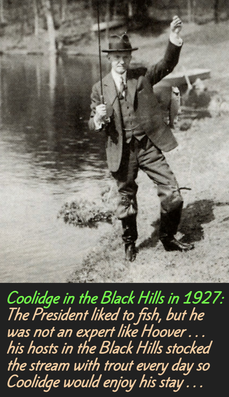
Picture
     In his State of the Union Address, Hoover appealed for a full array of bank reforms, including deposit insurance. The centerpiece of his address was the Reconstruction Finance Corporation (RFC), which would initially be funded by $500m from the Treasury, and an additional $1.5m from debentures (a security backed by general credit, not assets). Hoover also reiterated his stance that unemployment relief was a local/state problem, and individual Americans needed to in essence step up to the plate. Hoover didn’t say anything about Prohibition or foreign affairs in his address to a Joint Session of Congress. 
     Minutes after his State of the Union Address, identical bills for the RFC were sent to the proper committees in the House and Senate, and Hoover informed both chambers that he wanted the RFC passed before winter recess. It was an enormous unprecedented step to use federal funds to bailout banks during peacetime, with even Nebraska Senator George Norris taken aback. But Hoover had never been shy about federal interference in the economy, going back to his days running the Food Administration during WW I or as SecCommerce. What opposition there was to the RFC was based on a sense that Hoover’s plan didn’t get to the root causes(s) of the depression. 
     After winter recess, a Senate subcommittee on manufactures started hearings on spending hundreds of millions on unemployment relief. A parade of witnesses testified to the depths of despair concerning being out of work, and that the whole crisis was far beyond their means with which to cope. The witnesses were in favor of federal direct relief as a temporary measure. During those hearings, the rest of Congress debated Hoover’s RFC, but there appeared to be no choice but to vote for the plan, in large part because nobody had an alternate plan to present. 

Picture
     Hoover had learned some lessons from the tariff debates in Congress, and was much more involved with the RFC, meeting with small groups of Representatives and Senators. Hoover signed the RFC into law, and it became an official entity on 22 January 1932. Days later came the Glass-Steagall Act, which expanded the definition of what was considered acceptable collateral by the Fed, which allowed an extension of credit to member banks. Congress also allowed supplementing the gold reserves with government bonds as a strategy to deal with inflation. Hoover was pleased that a bill for federal direct relief for unemployment didn’t pass, as well as the defeat in the Senate for the “dole” bill (which was in essence a form of welfare). Hoover’s belief in local/state sovereignty over those areas had held sway. 
     The last item under consideration in Congress was Hoover’s plan to balance the federal budget, which led to intense debate. The federal budget deficit was 43.3% of the $4.7B federal spending, and to Hoover’s horror, new initiatives for relief were debated, which would swell the deficit even further (included in the considered relief initiatives were $2B in veterans bonuses). Despite his deep misgivings, Hoover signed the Revenue Act of 1932 into law, which would stand as tax legislation for many years. By then it was universally conceded that the depression was the worst in the nation’s history, even worse than the depression that occurred during the mid-to-late 1890s. Even though Hoover’s popularity was at its lowest, Hoover remained a very active President, the Republican political brand was still powerful, and the Democrats hadn’t identified a capable nominee for President. The Philadelphia Ledger predicted that the Election of 1932 would be as close as the Election of 1916, where Wilson won re-election by a single state.

0 Comments

12) President Hoover: 1930 - 1931

5/15/2024

0 Comments

 
                                  Source: Kenneth Whyte. Hoover -
                             An Extraordinary Life in Extraordinary Times (2017)
Picture
     The final weeks of 1930 mocked the idea of an economic recovery occurring, featuring bank failures that started in earnest during November in Nashville (TN). Caldwell and Company was the largest banking chain in the South, with over $200m in assets, but it was overextended and vulnerable due to drought and collapsing agricultural incomes. After that bank closed their doors, other banks in the chain followed in TN, AR, NC, and KY. Confidence in banks disappeared in the South, with depositors taking money out of stable banks in bank runs. Quick and decisive action by the Federal Reserve Branch in Atlanta stemmed the rising panic. Then the badly managed Bank of the US in NYC, the 4th largest bank in the city, crumbled under the weight of poor real estate investments, and the bank was declared insolvent. The failure of the Bank of the US in NYC was the largest bank failure in the nation’s history to that point; the Federal Reserve Branch in NYC did what Atlanta had done, and again a broader banking panic was checked, for the time-being. 
     To Hoover, the twin banking disasters signaled that the banking sector was the weak link in the US economy. There were over 25,000 banks in the nation, under very little federal or state regulation, and far too many were under-capitalized, in large part stressed from the Stock Market Crash in 1929. Even during normal times, 500+ banks failed each year in the US. What Hoover wanted to know after the Stock Market Crash in October 1929 was how significant chain banks were in the nation’s economy, in that were they strong or weak links in the overall economy. Hoover’s request of Congress in that regard went unanswered, in part due to Hoover’s preference to remain on the sidelines, but also because Hoover kept publicly stating that the financial sector was strong. As bothersome as the banking failures in the South and NYC had been, both had been contained by the Fed. Ironically, the twin failures and the corresponding contaminants elevated the belief that the economy was on the rebound. Hoover subscribed to that line of thinking, but he still asked Congress for funding for public works, since he thought recovery may be months away. However, Hoover was reluctant to increase federal spending, with the expected economic recovery on the horizon.

Picture
    It was at that time that Hoover started to use the veto like a sword. For example, Hoover vetoed the Norris-led Muscle Shoals project on political grounds (most likely payback to the insurgent Republicans), even though it had much in common with the Boulder Canyon project he had authorized earlier. Hoover stated that too much federal spending and involvement would lead to a reduction in the level of American enterprise in the private sector, or as an economist would say, “crowding out”. 
     
There was a bill working its way through the House that wanted veterans (the vast majority that served during the Great War) to be able to borrow up to 50% of their pensions that did not come due until 1945. Hoover received an estimate that if that occurred the federal government would go $1B in debt. Hoover and others saw the House effort as a misguided attempt at effective lobbying, and to the President there were far better ways to encourage consumption and reduce unemployment. Also in play was that the vast majority of the nearly 400k World War I veterans were employed, and that the government had already spent $5B in various expenditures on their behalf. In the end, Hoover vetoed the veterans bill, remaining consistent in his belief that the federal government’s role in the private sector should be minimal, and that it should not negatively affect the private sector; Congress didn’t take long to override Hoover’s veto. Hoover’s vetoes came with a political cost, in that Hoover was accused of being indifferent towards those that were suffering, pointing out that he had come to the rescue in Europe three times, but wasn’t doing so in the US. 
     On 12 February 1931 (Lincoln’s Birthday), Hoover addressed the nation on the radio, reiterating his stance that the government should only provide supplemental assistance instead of superseding/crowding out the private sector, as well as state governments. On top of the worsening economy was the growing debate on Prohibition, which was threatening to split the Republican Party. Maryland refused to enforce the Volstead Act (the enforcement aspect of Prohibition), and Hoover was in political trouble with Prohibition, since he had been straddling the fence even when he was pursuing the Republican nomination in 1928. Hoover’s efforts at increasing the enforcement of Prohibition further embarrassed and discredited him. 
     Hoover needed to distance himself as a firm “Dry”, but again he kept thinking politically towards 1932 and a second term. Even though the “Drys” were reducing in numbers and political influence, they remained a powerful contingent in the Republican Party, which spooked the President. Hoover’s lack of clarity and leadership added to the confusion and frustration of what should be done with Prohibition.

Picture
​     During early-1931, for the second time since the Stock Market Crash, there seemed to be evidence of economic recovery, which of course meant that there was no need for the federal government to get involved (The government estimate of unemployment was between 4.5 and 5.5 million). Hoover remained silent, having concluded that the economic depression had a mind of its own, and it defied prediction. 
     Few could match Hoover’s understanding of world economies and markets. Hoover knew that Germany and Austria were overburdened in terms of reparations from the Great War, and that Britain and France were struggling mightily as well. According to Hoover, inflationary monetary policies, particularly in Germany, were to blame for the global depression arriving in the US. Also, the Fed raised interest rates that pulled needed capital out of Europe to America. Hoover didn’t act until a crisis occurred on 5 May 1931, when the US Ambassador to Germany laid out the nightmare scenario that was playing out in Germany. The Ambassador argued that immediate assistance to Germany was required in order to stem the misery, as well as the growing influence of fanatic groups such as the Nazis. 
     Six days later the largest bank in Austria collapsed, and the financial panic spread from Vienna to Berlin. Money and gold fled both nations despite the high banking rates imposed, and most of that gold landed in the US where it simply wasn’t needed. The vast surplus of gold in the US led to a panic in banking and financial sectors, with the Dow reaching a new low of 122, which was one-third of its total before the Stock Market Crash. On 5 June 1931, Hoover met with SecTreas Mellon and StecState Stimson, telling them that he believed the Weimar Republic in Germany was about to collapse, and that the movement of gold to the US was paralyzing global financial institutions. 
     Hoover wanted to forgo collecting reparations from Germany for a year, but doing so would mean dealing with Congress. Hoover was bound-and-determined to proceed, regardless of the obstacles. Both Hoover and Stimson were afraid that Germany would soon disallow the withdrawals of gold and capital by other nations. Hoover finally decided to push for bipartisan support in Congress for a one year moratorium on German reparations to the US, and then to announce it to the world.

Picture
    On 15 June 1931 in Indianapolis, Hoover repeated that he thought the root cause of the economic depression in the US was the Great War and its aftermath, and that the spread of the global depression wasn’t entirely due to less global trade and lower commodity prices. Hoover stated that the major factor in play for the depression was the climate of fear since the Stock Market Crash. Hoover challenged Americans to stop looking at the “empty hole” in the donut, adding that the government had a role in helping get the nation out of the depression, but that it wouldn’t legislate its way there. Hoover was not on the attack against his enemies, rather he was positive, optimistic, and buoyant. 
    Hoover next traveled to Marian (OH) and laid a wreath on Harding’s lonely tomb.
After doing so, Hoover spoke, saying that Harding was a betrayed President, betrayed by those close to him. Hoover’s last major stop on his Midwestern tour was to Springfield (IL) where Lincoln was buried. Hoover kept receiving positive news about the economy during and after his return to DC. Hoover’s focus remained on getting his reparations moratorium through Congress, making for perhaps the first time personal appeals for legislative votes, and there appeared to be substantial bipartisan support. On 20 June 1931, Hoover announced to the press that it was almost certain that the moratorium would pass Congress, and as a result he had to spend quite a bit of time on the phone with members of Congress explaining and defending his premature statement. 
     The overall reaction of citizens to the moratorium was positive, which wasn’t surprising given the ingrained tradition of Isolationism in the US. Wall Street was also supportive, in that the Dow gained 11% in two days of heavy trading; that would prove to be Hoover’s third “False Dawn” concerning the economy. For the moratorium to be effective, those that were convinced that Germany was on the road to ruin needed to be convinced otherwise, that the advances of the Communists and Nazis in Central Europe would be checked. Also, the other nations that spend 20% or more of their GNP on reparations needed to spend the money they saved in positive and smart ways, which wasn’t at all guaranteed. 

Picture
     In Chicago, British economist John Maynard Keynes told Hoover that the moratorium policy was sound as long as it was accepted and followed by the various nations and affected parties, in particular France. Hoover needed instant approval and cooperation from the involved governments for his moratorium plan to work, and just as with Versailles, France did its best to subvert a US President in the name of punishing Germany and national pride. In effect Hoover had hoisted his moratorium plan on Britain, France, and Italy without their knowledge or consent, where at least during Versailles there had been negotiations involved. And much like the Senate with Wilson in 1919, France and Italy had mountains of reservations to Hoover’s moratorium plan. France simply wouldn’t cooperate, and that rekindled all the opinions that Germany was heading towards ruin and revolution. 
     Bank failures continued in Central Europe during the Summer of 1931. Trouble spread to Britain where a run on the pound started. Hoover’s negativity was accompanied by rising defensiveness and paranoia, with the President obsessing about those that weren’t cooperating, and he saw large conspiracies aplenty afoot that were intended to derail his Presidency. Soon fissures appeared in his Cabinet as well, with SecTreas Mellon taking an extended vacation, isolating himself from reality and his job. Even Stimson’s relationship with Hoover became strained, with the President thinking his SecState did as he pleased, like he thought House had done with Wilson. Stimson was empathetic, understanding the burden that Hoover carried as President. 
     By the Summer of 1931 unemployment was significantly worse, and it was impossible to pinpoint the causes. One government estimate had 6 million Americans out of work. All major economic indicators were going against recovery and towards a deeper depression. The vast majority of governors and mayors agreed with Hoover that economic relief was a function of the state and/or city governments, and most were offended at the mere suggestion that the federal government needed to become involved in their affairs. 

     After Hoover announced the formation of the Presidential Organization for Unemployment Relief (POUR), which was a voluntary effort, NY governor FDR announced TERA, which was the state’s Temporary Emergency Relief Administration, which provided $20m in direct relief to the unemployed. FDR portrayed his effort as a bold and compassionate alternative to Hoover’s thin gruel, which was consistent with the Democratic National Committee’s goal of diminishing Hoover’s chances at re-election in 1932 by portraying him as unsympathetic and uncaring. 

Picture
     In actuality, Hoover was 100% in support of direct relief by the states. The trouble Hoover had with FDR was that the NY governor was very vague with his suggestions of what Hoover should do at the national level. And as it turned out, FDR’s TERA and the supporting state programs didn’t do much to alleviate the depression in NY. Hoover dearly wanted a second term, in that most of his plans for the nation needed at least eight years to get them started, and he yearned for the chance to be President under normal economic conditions. More people in Congress as well as the nation pointed their fingers at Hoover for the misery, even though there wasn’t any coherent reason for doing so. In some areas of the US, Hoover was even hated. Hoover’s neglect of being Chief of Party meant that when the chips were down, the Republican Party wouldn’t go to the mat for the President. 
     International events made the situation in the US even worse, with austerity measures causing havoc in Britain. Banks were frozen, unemployment reached 20%, and Britain didn’t see any way out of the morass. Churchill stated that the US and the French hoarding of gold would be a calamity for Britain and the rest of Europe. Hoover admitted that a little over half of the world’s gold reserves were in the possession of the US, but not by intention or design, and he rejected Churchill’s charge of hoarding. Speculation was that the US was the next to take a huge economic fall, since it held so much of British and German debt. Then came the rapid outflow of gold from the US, and the actions of the Fed to stop it failed to do so. The momentum towards deflation increased, in that prices and production in the US fell even further. American consumers and businesses became more reluctant than ever to spend and invest. 
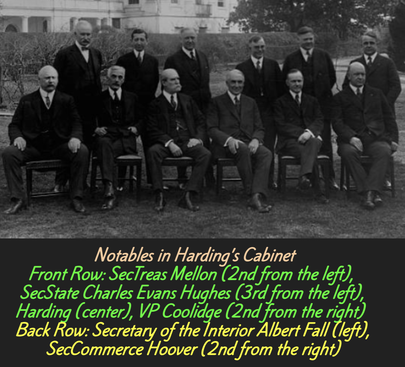
   On 22 September 1931, US Steel announced a 10% wage cut, which broke the voluntary agreement made with Hoover two years before. Then the British abandoned the Gold Standard, which was a massive breakdown in the machinery of international finance, which put even more pressure on the US to stabilize the global economy. This time the panic would not be contained, and the US financial sector was hit with both barrels. So much gold and capital left the US that it sent shockwaves through the entire financial system, which led to a liquidity crisis of unprecedented proportions.

Picture
     Hoover never considered suspending the Gold Standard, and he wasn’t pressured to do so, since it was Republican orthodoxy. There was simply no other way to measure the value of other nation’s currency in order to conduct international trade. Through the months of September and October 1931, banks failed at a rate of 125 a week in the US. The Fed could not come to the rescue, since most of the failed banks were out of their authority to regulate (meaning state and local banks); that meant that the federal government would have to fill the void . . . but how? Hoover wanted a repeat where J.P. Morgan came to the rescue at the onset of the Panic of 1907, where he stemmed the tide of bank failures (at great profit for a very few), but the banks would have none of that this time. Another option was for the government to create a fund for failing banks, to which Hoover was not totally averse. But Hoover didn’t want that fund to become permanent, and he didn’t want to call a special session of Congress, or to even extend a regular session. 
     Hoover was inwardly furious at SecTreas Mellon for not being proactive, even believing that Mellon placed his personal banking interests ahead of those of the nation. Hoover counted 1215 banks failures since 1 January 1931, and billions of dollars were either frozen or had left the nation. Hoover wanted stronger banks to bail out the weaker ones, pledging 2% of their assets to create a $500m fund that would led money on less rigid terms than the Federal Reserve. The major banks believed that the depression of 1907 was ancient history, and that the creation of the Fed meant that they were no longer responsible for bailing out other banks. These major banks saw Hoover’s plan as throwing good money after bad, and they suggested to the President that the government fund the $500 million. Hoover had assumed that the bankers would be hostile to government intervention, and he was shocked that they welcomed government action in the financial sector. 
     Hoover met with key members of Congress on the same issue, but like the major banks, there wasn’t any support for a privately-raised $500m managed by the government. However, those same key members of Congress spoke publicly in support of Hoover, which led the President to release a statement to the press verifying their support. In that same statement, Hoover denounced the “foolish alarm” that caused bank runs (massive withdrawals), and that the fear was “wholly unjustifiable”; then Hoover outlined his $500m program for the banks . . . 

0 Comments

11) President Hoover: 1929 - 1930

5/13/2024

0 Comments

 
                                  Source: Kenneth Whyte. Hoover -
                             An Extraordinary Life in Extraordinary Times (2017)
Picture
     After the Stock Market Crash, Hoover wanted to stem the panic and fear in the public, which could reduce consumer spending, reduce production, and increase unemployment. Hoover understood that the “Big Picture” goal was to buoy public confidence in the financial system. By mid-November 1929, it appeared that the worst was over when the Dow rebounded to 198.7, which was half its peak from September. 
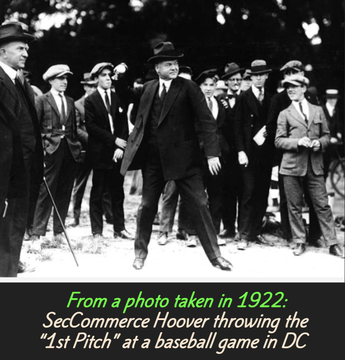
     Hoover then encouraged private investment in major projects rather than speculation, and he basically browbeat the railroad industry into promising to invest $1B instead of cutting costs and laying off workers. Soon enough, Hoover met with the “Who’s Who” of the corporate world, asking them to do the same. Hoover asked that they maintain wages in order to sustain consumption (consumer spending), and labor leaders promised to cooperate as well. 
     The 71st Congress in early-1930 enacted Hoover’s requested reductions in corporate and income taxes, and he announced increases in federal construction programs, and encouraged the private sector to increase investment. As far as the government and the general public were concerned, Hoover had kept a financial panic from becoming an economic depression. Hoover’s actions were largely symbolic, but it was his leadership at the helm that impressed Americans. Hoover had been calm and inspirational, and economists agreed that the President’s response was the most sophisticated by any President concerning an economic crisis. That being said, the US was divided as to what would come next: recovery or recession. 


Picture
     The Stock Market Crash was bad luck for Hoover, compared to the incredibly smooth run that Coolidge had from early-August 1923 to
​4 March 1929. It soon became clear that the economy was at least in the doldrums, with consumption decreasing as well as key commodity prices. The legislative calendar was not in Hoover’s favor, in that the tariff debate was to resume very soon. On 25 March 1930, there were enough Democrats and insurgent Republicans that joined the Protectionist Republicans in the Senate to pass Smoot’s tariff bill. The conference bill (the compromise bill from the House + Senate) returned Hoover’s requested tariff flexibility and authority, and the tariff rates were closer to what the House passed. 

     The Smoot-Hawley Bill was less popular than ever by that point; most Republicans disliked the bill, but couldn’t coherently articulate why. Protectionists thought the tariff rates were too low, while Hoover and those in his camp saw the tariff rates as far too high, and hostile to agriculture as well. The general public thought Congress was beyond-stupid and excessively greedy. Editorials in newspapers across 43 states denounced the Smoot-Hawley tariff bill, and a coalition of 1028 economists heaped scorn on the bill as well. 
     Hoover had no desire to veto the bill, in that he was thinking politically, not economically. As far as Hoover was concerned, vetoing the bill would be a bad move politically, in that his veto would be overridden in both chambers, and it would become law anyway. Hoover believed a veto would work against the Republicans in the upcoming Congressional Elections in 1930, as well as unnecessarily creating more enemies in Congress. Perhaps more importantly to Hoover, a veto would do nothing but hurt his chances at being the GOP nominee for 1932. Hoover didn’t want to even begin to admit that his first year as President had been a legislative comedy of errors and misadventure - so Hoover was not going to veto the Smoot-Hawley tariff bill, even though he believed it was almost certainly bad news for the nation.

Picture
     On 17 June 1930, Hoover signed into law the Smoot-Hawley tariff. In reality, the Smoot-Hawley tariff’s impact wasn’t much, leading to a 5% decline in imports, which was negligible when foreign trade was less than 4% of the US GNP. The protectionist tariff did feature very unfair trade policies, especially towards the British Commonwealth, but by 1930 the global economic depression was the main culprit in terms of the sharp reduction in global trade. The real impact of Smoot-Hawley was political, and Hoover paid the price, in that he had talked about taking politics out of tariffs, but he had allowed the entire enterprise by sitting quietly on the sidelines. Hoover had been exposed as a novice and a weak legislative President, which in part had occurred before the Stock Market Crash. At least Hoover had a five month break from Congress, since the extended session was over. 
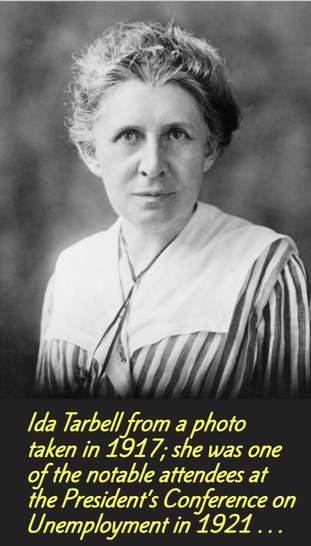
     During the first quarter of 1930, automobile, steel, and petroleum production declined, as well as sales in department stores. However, the collected data wasn’t clear on what was occurring in the economy, since there wasn’t much historical data to guide Hoover and the government in how to respond. But there wasn’t really anyone that believed that 1930 would be any worse that the sharp economic downturn during 1921. By March 1930, states reported that unemployment was either holding steady, or only slightly down. Unemployment levels that reached the level of distress were limited to 12 states, and the governors in all but one told Hoover that things were improving. The Federal Reserve Discount Rate was at 3%, and industrial production was increasing, and there had been no major bank or industrial collapses. It appeared that perhaps the corner had been turned after the Stock Market Crash, but the overall price levels were still in decline. Hoover stated that the worst was behind the nation, and the President was not alone in his optimism.
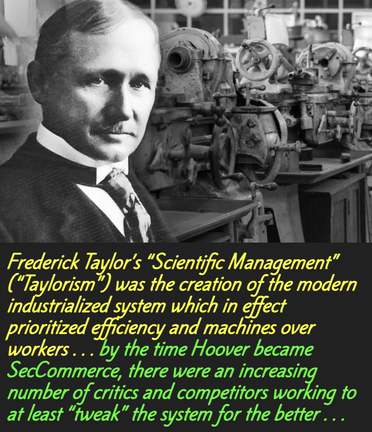
Picture
     The optimism that the economy would recover wasn’t dampened by the stagnant state of the economy during the Summer of 1930. Optimists pointed to the summer bookings for travel to Europe, which were at record highs, and that Salvation Army breadlines in the Bowery had closed. Hoover didn’t attempt any countercyclical measures that summer, since he believed the economy was recovering. Hoover instead focused on the severe drought in the South, which was centered in AR. The drought, unlike the economy, was a tangible problem for Hoover to solve. During September 1930, the rains came and the political emergency was over, but not necessarily for the affected farmers in the region. 
     Hoover worried about the Republican chances in the House for the Congressional Elections of 1930, not caring much about the Senate since no matter the election results that chamber would remain an obstacle. Losing Republican seats in the House, however, would reflect very poorly on Hoover. For the first time, the Democratic National Committee (DNC) wasn’t dormant after a Presidential election they had lost, and they went after Hoover from the beginning of his term, which was something that Harding and Coolidge never faced. Instead, the Republican National Committee (RNC) had gone dormant, so there was no opposing voice to compete with the DNC. 

Picture
     Hoover did not want to campaign for Republicans running for the House, since he would be even more politically exposed, and he didn’t want the blame if a Republican candidate lost. However, Hoover wanted the Republicans to hold their majority in the House nonetheless, so once again he went to the sidelines. By that point, Hoover’s influence in the House had at best become nominal, and most Republicans in Congress were indifferent to the President. Hoover and the Republicans in Congress were staring past each other, playing different games with different agendas. Hoover’s desire to be “above” politics angered Republicans, since he bypassed Congress whenever possible, with his committees of experts on various fronts. Hoover needed to lead his party, but that aspect of the Presidency didn’t register with him in 1930. 
     Republicans lost a whopping 52 seats in the House, which meant they only had a one-seat majority. The Republicans lost an incredible 8 seats in the Senate, which tied them with the Democrats, which meant that the Republican Vice-President, Charles Curtis, would break ties. The main result of the elections in the Senate was that there was a higher percentage of insurgent Republicans opposed to Hoover. The Congressional losses were a setback, and Hoover took the results hard, but the party’s losses were not viewed to have been Hoover’s fault. Hoover blamed Prohibition as a major factor for the Republican losses, believing it was time to repeal the 18th Amendment.

0 Comments

10) President Hoover & the Stock Market Crash of 1929

5/8/2024

0 Comments

 
                                 Source: Kenneth Whyte. Hoover -
                             An Extraordinary Life in Extraordinary Times (2017)
Picture
     Hoover worked at a pace that was so unprecedented that Congress largely followed his lead, including limiting tariffs. The same Republican Senators that were so bothersome for Coolidge (led by George Norris), were in at least temporary retreat with Hoover in office. Hoover kept Congress in an extra session in April 1929 in order to, among other things, get meaningful tariff reform and agricultural relief before it became too hot to remain in DC during the summer. The Agricultural Marketing Act was the most comprehensive and sweeping agricultural law ever to that point, authorizing $500m in a replenished fund to be administered by cooperatives (by the farmers themselves). Hoover signed the bill into law on 15 June 1929. In so doing, Hoover was able to fulfill a campaign promise, and he believed the agricultural sector had become far more organized to his vision of what it should have been long ago. However, during the process of passing that bill into law, the Norris-led Senators made their presence known, which showed that Hoover’s working majority in the Senate was anything but rock solid. 
     In terms of tariff reform, what Hoover really wanted was flexibility in adjusting specific tariffs, instead of waiting for Congress to act. However, Hoover was vague with his wishes, and on 7 May 1929, Representative Willis C. Hawley (R; OR) introduced a lengthy tariff bill to the House which went further than Hoover wanted, raising tariff rates favoring industry over agriculture. Hoover expressed his displeasure with Hawley’s bill, but it was to no avail since special interests were at work pressuring Congressmen to advance the tariff bill. When the proposed increases were made public, the demand for additional tariff increases on more goods followed; in every case the justification was to protect jobs in the US in competitive global industries. Foreign governments such as Canada, America’s largest trading partner, were aghast at these suggested tariff rates. Also under attack in the House was Hoover’s request that he be able to adjust the tariff rates as President. 

Picture
    Hoover met with Hawley and other Congressmen to warn them of the consequences of excessive protectionism, and that the majority of newspaper editorials were against the tariff bill. After the meeting, Hoover didn’t have any confidence that anything he said got through to Hawley and the others. A final House vote on the Hawley bill was scheduled for 29 May 1929, and over 90% of the members of the House were in their seats ready to vote on that day. It was the first time in three Congressional sessions in which that high a percentage of the House was present for a vote on a bill. The Hawley tariff bill easily passed by a vote of 264 - 147, with the vote falling almost entirely along party lines. Even to those that had supported and voted for the tariff bill, there was a feeling that they had failed in protecting the broader interests of US citizens. House Republicans actually dreaded what would happen once the Senate Republicans got their hands on the tariff bill. 
     Hoover’s “Summer White House” along the Rapidan River in VA wasn’t far from DC. Hoover fished and enjoyed solitude, but the location also meant that he could be in DC whenever he wanted, and since the President was near-and-in DC, those in the Executive Branch had to be on the clock. Hoover accomplished some things with Congress out of session, including reducing overcrowding and improving conditions in prisons, focusing on Leavenworth. However, the fate of the tariff bill heading towards the Senate took most of Hoover’s attention that summer. Hoover took some solace that the chairman of the Senate Finance Committee, Reed Smoot
(R; UT), voiced concerns similar to Hoover’s over the House tariff bill. However, Smoot was an evangelist of Protectionism, and he badly wanted to have his name attached to a significant tariff act. The Senate Finance Committee worked during the summer, hearing from over 1000 witnesses, with most of them clamoring for tariff rate increases. It soon became apparent that Hoover was closer to the Democrats than the Republican insurgents in terms of tariffs.  

Picture
     During August 1929, Smoot and his committee emerged with their version of the tariff bill that raised agricultural tariff rates while lowering selected manufacturing tariff rates, which was a bill that Hoover could accept. But the time for any meaningful compromise on tariff reform had vanished, and grumblings were heard from both the House and the Senate about what the other chamber had done with the tariff bill. Hoover chose to remain on the sidelines, but he didn’t appear to be rattled by the impasse between the House and the Senate. However, there were enough Senate Republicans, unafraid of Hoover’s electoral mandate or veto power, to strike from Smoot’s bill the flexible tariff provision, which was a serious and direct message to the President. After making a public statement on the Smoot bill, Senator William Borah (R; ID), a man that had worked hard to get Hoover elected President, now basically taunted Hoover for interfering with Congress; still, Hoover chose to remain on the sidelines. 
     On 2 October 1929, actually still in the extra session from April, the Senate voted 47 - 42 on an amendment to get rid of the Presidential flexible tariff rate adjustments. The remaining seven weeks of that Congressional session led to nothing more than a vocal stalemate between the House and Senate over the two tariff bills. On 22 November 1929 (about a month after the Stock Market Crash), the extra session ended after fruitless weeks trying to bring Smoot’s tariff bill to the Senate floor for a vote. The performance of the Republicans in both chambers, and Hoover choosing to be on the sidelines, came under intense scrutiny. Hoover’s veneer of invulnerability was pierced, and Democrats started to directly attack the President. The tariff bills were the most hotly debated topic in DC, and Hoover badly erred in choosing to remove himself from the intense debates. 

Picture
     Hoover was mostly an amateur in how to effectively deal with Congress, having never held elected office before entering the White House. Hoover didn’t know the inner workings of Congress or DC, or how to be a Legislative President, shepherding or blocking bills. Hoover was also tone-deaf to the rising discord among the ranks of the Republicans as his Presidency unfolded. Hoover’s years as SecCommerce had not prepared him for the maelstrom that awaited him as President in dealing and working with the House and the Senate. And Hoover’s desire to not deal with patronage meant that, at least in part, he didn’t have any leverage over members in Congress, which was an area in which Harding excelled. Hoover, in his initial approach to the Presidency, practically invited legislative failure, which led to a vacuum of leadership on the tariff bill, of which protectionists were only more than happy to exploit. So the situation was this: could Hoover learn and adjust fast enough to regain his lost momentum in Congress and DC. 
     By mid-summer 1929, it was also apparent that Hoover wasn’t able to rein in the Stock Market. Bankers in NYC scoffed at accusations that the Stock Market was unsound. The head of the New York Stock Exchange (NYSE) answered to the governor of New York, Franklin Roosevelt, not to Hoover, and he turned a blind eye towards the excessive speculation. However, the Federal Reserve did put pressure on the major NYC banks to quit making loans on margin. But when those banks stopped doing so, banks outside the authority of the Fed filled the void; then the NYC bankers rejoined the fray in issuing loans on margin, deathly afraid that they would miss out on gargantuan profits. In response, the Fed raised the Discount rate from 5% to 6%, trying to temper the excessive speculation. 
     By then Hoover had reached the point where he felt the only corrective to the irrational exuberance was financial disaster, so Hoover did not support the Fed’s interest rate hike, seeing it as bad for business. There were almost immediate signs that the Fed had pushed too far with the interest rate hike, in that real output fell 2% from August to October 1929, and foreign central banks raised their interest rates in order to protect their gold supplies. Those tight money policies by the central banks pushed Central Europe further into economic depression.

Picture
     On 3 September 1929, the Dow Jones Industrial Average reached 381.2, which was a 500% increase from 1921. What followed was a series of corrections, but nobody knew if worse was to come. Hoover was in MI for the dedication of the Edison Institute as well as the 50th anniversary of the incandescent light bulb when the Stock Market Crash occurred. On 23 October 1929, the Dow gave up 6.33% of its trading value, and the ensuing panic on the floor that followed the next day was called “Black Thursday”. On 24 October 1929, the trading volume surpassed 6 million shares, and over $4 billion was lost, more than the annual federal budget. The great sell-off occurred at a rate of 2.6 million an hour; irrational exuberance had now been replaced by irrational panic. Records were broken for the number of shares traded, price drops, money lost, telegrams delivered, and telephone calls made. During the succeeding days, the declines continued, with sellers far outnumbering buyers. The losses in the Stock Market totaled over $30 billion, which was more than twice the national debt. 
    Hoover viewed the Stock Market Crash as an opening to implement the countercyclical policies that he had long advocated, and it was just the kind of emergency in which Americans believed that Hoover would once again come to the rescue. Hoover, using data from the Panic of 1907, tried to limit the financial damage to the Stock Market. Hoover told the nation that the economy was sound, and that the Federal Reserve had been created in 1913 largely to avoid repeating the mistakes that led to the Panic of 1907. The Fed, not unlike after 9/11, acted quickly to try and restore confidence. Among the actions of the Fed was to reduce the Discount Rate to 4.5%, as well as to expedite lending and making it easier to purchase securities. Those measures helped commercial banks stay open, and Hoover correctly credited the Fed . . . but no one, not even Hoover, saw that the Stock Market Crash had weakened most banks to the point where an unprecedented national banking collapse would occur in 1930 . . .

0 Comments
<<Previous

    Archives

    May 2024
    April 2024
    March 2024
    February 2024
    January 2024
    December 2023
    November 2023
    October 2023
    September 2023
    August 2023
    July 2023
    June 2023
    May 2023

    Categories

    All
    18th Century
    19th Century
    20th Century
    History

Powered by Create your own unique website with customizable templates.