Mr. Jensen's U.S. History Website
  • U.S. History Blog
    • U.S. History Blog (May 2026 - May 2027)
    • U.S. History Blog (May 2025 - May 2026)
    • U.S. History Blog (May 2024 - May 2025)
    • U.S. History Blog (May 2023 - May 2024)
    • U.S. History Blog (May 2022 - May 2023)
    • U.S. History Blog (May 2021 - May 2022)
    • U.S. History Blog (May 2020 - May 2021)
    • U.S. History Blog (May 2019 - May 2020)
    • U.S. History Blog (May 2018 - May 2019)
    • U.S. History Blog (May 2017 - May 2018)
    • U.S. History Blog (May 2016 - May 2017)
    • U.S. History Blog (May 2015 - May 2016)
    • U.S. History Blog (May, 2014 - May, 2015)
  • About

VP Nixon's Pursuit of the GOP Nomination in 1960, Part One

2/22/2020

0 Comments

 
                    Source: John A. Farrell. Richard Nixon - The Life (2017)
Picture
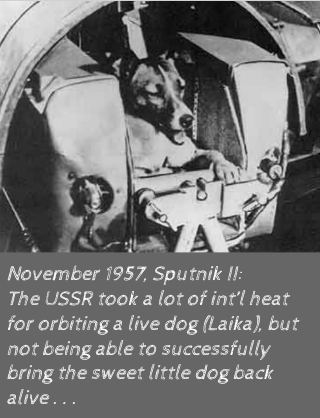
     The true impact of Sputnik, which was launched on 4 October 1957, was political. The perception of a “Missile Gap” with the USSR would not go away anytime soon (even though the USSR in fact hardly had any operational ICBMs into the 1960s). America’s prestige suffered, as did Ike’s as a military genius. The intellectual elites and their supporters viewed the “Happy Days” of the 1950s as pure complacency, During November 1957, Ike suffered a stroke (and the USSR orbited Sputnik II), and he was in far worse shape that the public was told. But again Ike recovered, and again VP Nixon won accolades for his loyalty. 
     The Democrats decided it was time to play the “change card”, and JFK would take full advantage. In many ways, JFK was the opposite of Nixon, but they had some things in common, such as family troubles and a desire for glory. But JFK (and his campaign manager RFK) had far fewer scruples than Nixon in terms of politics and campaigning, and they targeted Nixon’s #1 campaign guy, Murray Chotiner, for destruction. RFK was counsel to a Senate committee which went after Chotiner for trading access to Nixon for personal gain. Chotiner was forced to leave the Nixon fold, and the Vice-President would be without his valuable help and expertise in 1960.
Picture
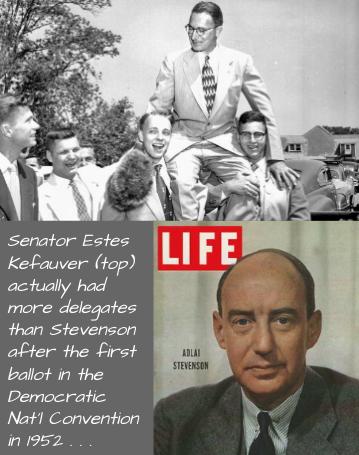
     There were many serious impediments to JFK being a serious contender for the Democratic nomination, such as his relative youth, uninspiring legislative record, religion (Catholic), having a possible traitor for a father, and being friends with Senator Joseph McCarthy. When JFK made a spirited and competitive bid for the VP slot at the Democratic National Convention in 1956 (losing out to Senator Estes Kefauver), JFK and RFK realized that those impediments were surmountable. 
     To JFK, Sputnik was sent from Heaven, since it made Ike vulnerable on national security. Nixon advised Ike and his Circle of Trust that things would get worse on the national security front before it improved. To Nixon’s frustration, Ike’s overall approach as his second term ended was to be a caretaker, holding serve before he left the White House. 
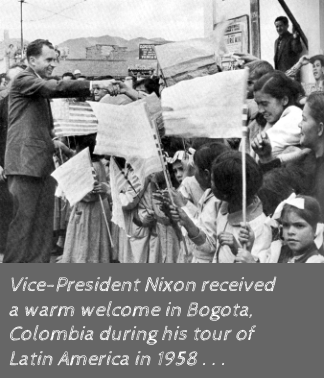
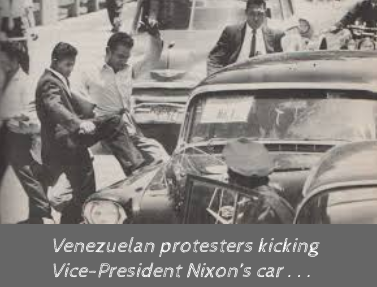
   Nixon’s march to the Republican nomination in 1960 featured hard-won ascents, slip-ups, and resiliency. One of the events that enhanced Vice-President Nixon’s political street cred was getting ambushed in his motorcade in Caracas (Venezuela) by a mob in the Spring of 1958. Trouble during VP Nixon’s South America Goodwill Tour started in Peru, where Nixon was told by the US Ambassador to Peru that if he made a public appearance, a violent mob almost certainly would be waiting. Nixon’s dilemma: should he cancel his appearance, where he and the US would look weak, or should risk his safety and make his appearance. Nixon actually walked into the crowd, and rocks were thrown, with at least one hitting Nixon on the shoulder. Nixon demanded a dignified walk back to the cars, and as the convertible drove away, a Secret Service agent held down Nixon’s ankles to keep him in the car.
Picture
     The reporters that had tagged along with Nixon wrote glowingly about the audacity/bravery of the VP, and Ike sent Nixon a congratulatory cable. When Nixon was back safely in his hotel, he was informed that two figures from the State Department stated that Nixon’s foray into the mob was a bad idea. Nixon demanded that he be connected to the two by phone, and while losing his temper he called them cowards. Nixon demanded that everyone should laud him for his bravery that day. 
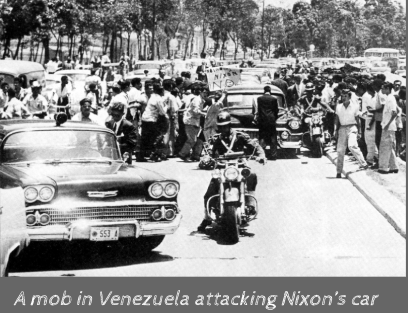
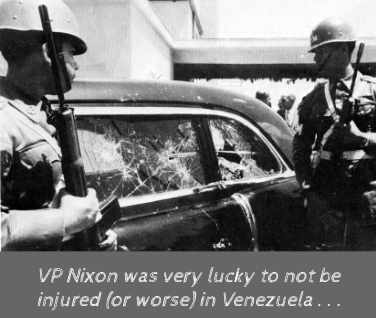
     On 13 May 1958, Nixon arrived in Venezuela, where a crowd welcomed the VP by spitting at/on him, a far worse reception than what he experienced arriving in Peru. While Nixon’s motorcade was heading to the grave of Simon Bolivar so Nixon could lay a wreath, the convoy was attacked by demonstrators that rushed up to the cars. Secret Service agents pushed away the demonstrators who had hate in their eyes, and in that mob were hardened battle-tested Communist insurgents. The mob started to rock Nixon’s car, and Nixon ordered the Secret Service detail in his car to not do anything unless he was forcibly removed from the car. Finally, the Venezuelan police ended the sham traffic jam which had forced the motorcade to stop, and the US contingent sped away. Later, when Nixon processed what had happened, he concluded that he had gone through a near-death experience.
Picture
    Media accounts in the US portrayed Nixon as cool under fire while in Peru and Venezuela, while also defending the nation’s honor. Nixon was warmed/thrilled to see a large and enthusiastic crowd welcome him back to the National Airport in DC, and among those in the crowd was President Eisenhower. Nixon’s experience in South America was the cover story of Life magazine, and Nixon’s popularity surged since he was seen as a genuine American hero. One of the reasons why the public’s imagination was captivated by Nixon’s actions in South America was that the public wanted/needed leadership and decisiveness, which Ike wasn’t providing. 
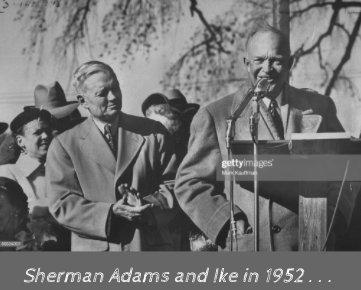
     During the Fall of 1958, Nixon experienced a valley instead of a pinnacle, with the Republicans getting their hats handed to them in the Congressional Elections of 1958. The Republicans were about as dispirited as they had been after FDR and the Democrats drubbed them in 1932. The furor over Sputnik had been followed by a recession, rising unemployment, trouble in the agricultural sector, and corruption in the federal government, which included Chief of Staff Sherman Adams (he had accepted gifts in ways that looked dishonest). Ike couldn’t bring himself to fire Adams, so he enlisted VP Nixon (among others) to do his dirty work. Nixon absolutely hated face-to-face confrontation, but he did his best to convince Adams to fall on his sword for Ike. Nixon called dealing with Adams the single-most difficult task ever given to him by Ike.
Picture
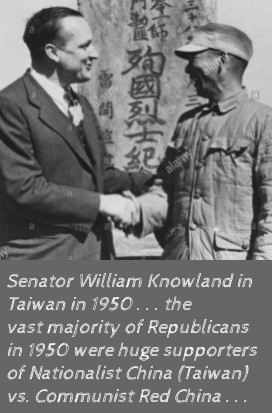
    The Republicans lost 48 seats in the House and 13 seats in the Senate. Nixon saw it coming, but he campaigned hard nonetheless, trying to minimize the damage of the train wreck instead of safely sitting on the sidelines. But self-destructing scheming, especially in CA, dearly cost the GOP. It was called the “Big Switch”, where Senator Knowland’s ambition and stupidity collided. Knowland believed that being elected governor of CA would be a much better platform from which to pursue the White House than the Senate, and his wife wanted to leave DC and return to CA. 
    California already had a Republican governor, Goodwin Knight, who also had designs on the White House and an ambitious wife. Since Ike’s heart attack, Knowland and Knight had done their best to keep Nixon from ascending to the pinnacle of the GOP, and the “Big Switch” was in effect their strategy to deny Nixon the nomination in 1960 while advancing their own ambitions. In the Fall of 1957, Knowland announced that he was running for CA governor no matter what Knight planned on doing. To avoid a destructive Republican primary, Palmer and Nixon convinced Knight to pursue Knowland’s soon-to-be vacant Senate seat. Knight resisted until the CA Republican Party threatened to cut off campaign funds. The whole affair played out in public, with even the wives going at each other in the media.
Picture
      In the midst of all that scurrilous hoo-haw, Knowland came out in support of a “right to work” initiative that labor unions absolutely hated. Edmund “Pat” Brown (D), the California Attorney General, hammered Knowland by over one million votes, and Knight lost his Senate race by a similar margin. The CA Republican Party, who held so much power in the state for so many years, was gutted. While Nixon enjoyed seeing to CA GOP rivals do themselves in, it was now far more difficult to get California in his column if he ran for President in 1960.
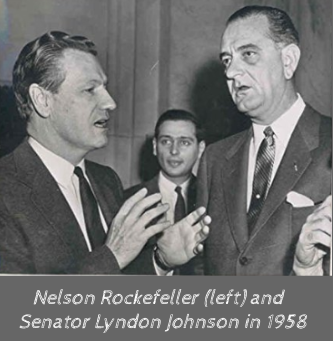
     In New York, liberal Republican Nelson Rockefeller was elected governor, and he would prove to be the main obstacle for Nixon’s pursuit of the GOP nomination in 1960. As 1958 closed, Nixon had serious doubts that he could win the nomination, whereas JFK/RFK were very optimistic of their prospects, since they had been campaigning in effect since 1956. Then, all of a sudden, Nixon found himself at another pinnacle with the “Kitchen Debate” with USSR Premier, Nikita Khrushchev, in 1959.
0 Comments

Vice-President Richard Nixon & Civil Rights

2/8/2020

0 Comments

 
                      Source: John A. Farrell. Richard Nixon - The Life (2017)
Picture
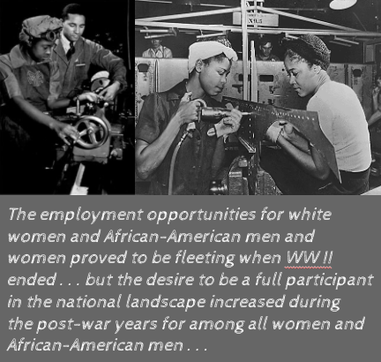
     During World War II, due to the absolute necessity for workers, factories provided opportunities for women, but also for African-Americans in the north in such cities as Detroit and Chicago. World War II also invigorated the movement for Civil Rights, since many African-American families in the north were able to own property and to vote. One million African-Americans served their nation in WW II, and when they returned home, they were in no mood to put up with white supremacy. This revitalized movement for Civil Rights took three tracks after WW II: the courts, going through Congress, and public protest. 
     The first concrete gains that occurred during the Civil Rights Movement occurred during the Ike/Nixon years, and among those in Ike’s administration, it was Nixon who was the champion for Civil Rights. Ike moved slow in terms of Civil Rights, but when it came to enforcing the laws that were in the books, he acted, such as making sure the Army remained desegregated per
Truman’s Executive Order (even in Army bases in the South). That being said, Ike didn’t like the Supreme Court’s decision in Brown v. the Board of Education, in that he preferred a more gradual approach to major social change. Ike wanted consensus when and wherever possible, and he labeled Civil Rights leaders as extremists (as he did with white supremacists), which outraged African-American leaders.

Picture
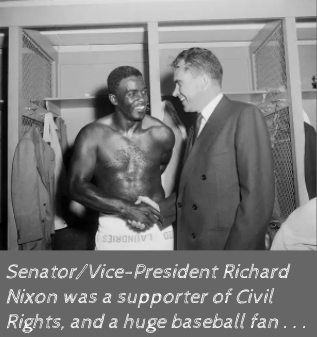
    Nixon had been an underdog in his life before WW II, which meant he could at least sympathize with those that faced discrimination. At the Republican National Convention in 1952, Nixon formed a connection with Jackie Robinson​, which would be the first of quite a few connections he made among prominent African-Americans figures as Senator and Vice-President. Nixon’s efforts may seem fairly tame by today’s standards, but Nixon was among the few politicians that was making the effort in the 1950s.  MLK, Jr. told a reporter that he believed that Nixon had no racial prejudice whatsoever. That being said, Nixon, like Ike, wanted a more gradual inclusion, and the always-present reality of politics was a barrier. 
     Ike’s Civil Rights strategy was to position himself as a captive of events beyond his control, and then to not reverse course on Civil Rights advances (e.g. Ike nominated two pro-Civil Rights Supreme Court Justices in John Marshall Harlan and William J. Brennan, Jr.). In December 1955, the pressure on the dam burst with the arrest of Rosa Parks, and the Civil Rights Movement started in earnest. A Civil Rights bill was introduced to the House in 1956, and it was in part designed to politically threaten Representatives/Senators from the South who stood in opposition to any gains in Civil Rights, in that millions of African-Americans would vote. Ike was in favor of the bill, saying that if re-elected, he would push for its passage; at the time Ike made that statement, the Civil Rights bill was stalled in both houses.

Picture
    Nixon’s first contribution to the passage of the Civil Rights Act of 1957 occurred in January 1957, when the new Congress started its session. The ultimate line of defense for the South in the Senate, since Southern Senators held the key committee chairmanships due to their seniority, was to threaten to block pending bills under review in their committee if any Civil Rights bill was pushed. The Cloture Rule, where 2/3’s of the Senators had to vote to end a filibuster was in many ways, by the late-1950s, the South’s revenge for losing the Civil War. Southern Senators used parliamentary procedure as a weapon and a shield, and there were ways for these Southern Senators to keep their advantage over the long haul since only 1/3 of the Senate was up for re-election every two years. 
     Vice-President Nixon (also the President of the Senate) knew that he risked the wrath of the South  if he ruled against the ongoing filibuster that held the Civil Rights bill hostage. Nixon also knew that African-Americans in the South wouldn’t be able to vote en masse to express their gratitude. And there was the reality that Ike’s popularity with African-American Democrats didn’t guarantee transference to Nixon. While waking up at night, Nixon had a “eureka” moment, and he scribbled some things down on his yellow legal pad . . . and he soon did the right thing.

Picture
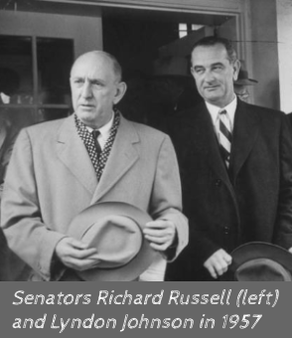
      When Congress reconvened, the pro-Civil Rights forces introduced a motion to adopt new rules. Nixon offered an advisory opinion that the Senate was convening a fresh body and could change the existing rules by a simple majority vote (Time magazine declared Nixon’s statement a “thunderstriking” moment). Southern Senate leaders were forced to scurry for a response, and eventually Lyndon Johnson (Senate Majority Leader) and Richard Russell (GA) were able to tally 55 votes to table Nixon’s suggestion. However, that total was 15 votes less than the last time the Southern bloc had voted on the filibuster. In effect, Nixon had put the Senators from the South on notice, in that they were shown that their tactics using the filibuster were not bulletproof. 
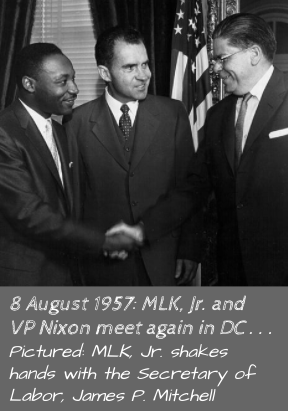
     Nixon was now the most invested member of Ike’s administration with the Civil Rights bill, and MLK, Jr. was further impressed with the Vice-President. MLK, Jr. didn’t have a favorable opinion of Nixon until he became VP, since MLK’s lens for viewing Nixon before VP centered on the controversial CA Senate Race in 1950 and serving on HUAC. MLK did qualify his praise for Nixon, hoping that Nixon’s actions were genuine, not for political convenience/gain.

Picture
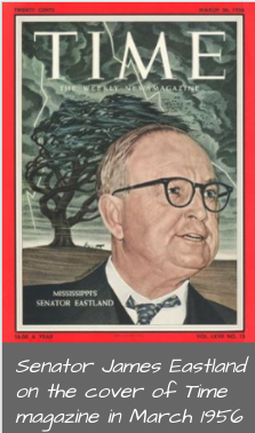
    The Civil Rights bill passed the House in June 1957, with a final tally of 285 (167 Republicans + 118 Dems) to 126. Again, Nixon was called upon to make a controversial ruling in the Senate, and he allowed the bill to move directly to the Senate floor instead of the guaranteed grave that awaited in the Senate Judiciary Committee that was chaired by James Eastland (D; MS).  This time, the Senate upheld Nixon’s ruling (45-39), and for the first time since 1875, a Civil Rights bill was being considered on the floor of the Senate. 
     Once again, it was Nixon that saved the day for the Civil Rights Movement in the Senate. But Nixon had company, and it was none other than Senator William Knowland (R; CA), an avowed political enemy. Both Nixon and Knowland understood that the GOP needed to attract African-American voters for their goal of winning the Republican nomination for President in 1960. The leading Democratic contenders, most notably LBJ and JFK, were wooing the Solid South, and were in support of gutting the Civil Rights bill via amendments. (both LBJ and JFK had voted to send the Civil Rights bill to Eastland’s committee). During the floor debate in the Senate, section three of the Civil Rights bill was removed, which spelled out voting rights for African-Americans. Section three had no chance of inclusion after Ike proved noncommittal when asked by reporters for his opinion which favored gradualism. By trying to not anger all sides involved, Ike failed to lead on Civil Rights.

Picture
     Nixon thought it best to get what could be passed instead of holding out for a better bill (among those that felt the same way at that point was the Senate Majority Leader, LBJ). Nixon and MLK, Jr. were among those that saw the Civil Rights Act of 1957 as a step in the right direction, in that at long last the federal government took at least some responsibility for enforcing Civil Rights (especially the 14th Amendment). It was the first time in over 80 years that Congress voted against the wishes of the South in terms of Civil Rights. The coalition of moderate Republicans and liberal Democrats grew in strength and numbers, and they were the voting bloc that as able to pass the Civil Rights Act of 1964 and the Voting Rights Act of 1965. 
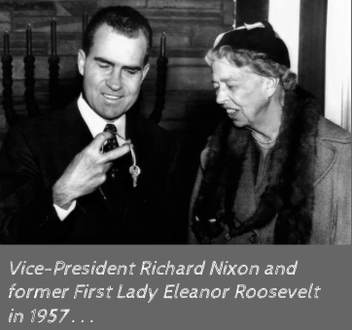
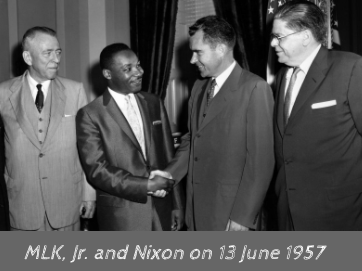
     Senator Richard Russell (GA) in essence only gained time until the federal government decided to become seriously involved with Civil Rights in the mid-1960s. The Civil Rights Act of 1957 didn’t in-and-of-itself accomplish much in the short term, but the foundation of the Solid South had started to crack. In his dealings with the Civil Rights bill, Nixon had been advised/guided by MLK, Jr., and in June 1957, Nixon and MLK, Jr. had a follow-up/get ready for the next phase meeting at Nixon’s office in the Capitol. Nixon came away more impressed with MLK, Jr., and in effect endorsed him as a major Civil Rights leader, which also further alienated MLK, Jr. from the envious/jealous Old Guard within the Civil Rights Movement.

Picture
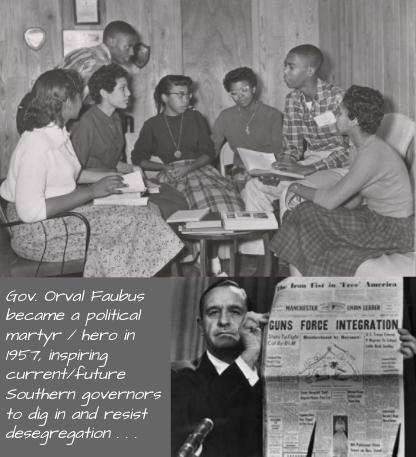
     Ironically, Ike needed deleted third section of the Civil Rights bill, since he would have possessed a variety of remedies in order to deal with Orval Faubus in Arkansas in 1957. Ike’s shortsightedness and flat-out ignorance of Civil Rights cost him, and Ike only had the blunt instrument of the 101st Airborne to punish Faubus. Ike never regretted sending 11,000 troops to Little Rock in 1957, but he hated it that stubborn/obdurate Southerners had forced him in the position to do so. 
     Whatever moral high ground Russell had was gone after Little Rock when he sent a telegram to Ike. In that telegram, Russell accused Ike and the Republicans of using the same tactics as Hitler in order to get the Civil Rights bill passed (imagine, sending that telegram to the former Supreme Allied Commander in Europe that personally saw the horrors of the Nazi death camps). Ike appeared on television to explain his decision to send the 101st Airborne to Little Rock. Americans saw Ike (finally) acting like Lincoln’s Republican heir, and the vast majority of Americans in the north sided with the President. 
     Nixon publicly supported Ike, saying the President did his duty and saved the nation from going through a dire Constitutional crisis. Nixon’s pursuit of Civil Rights earned him many plaudits, as well as many additional enemies. Even some of Nixon’s supporters felt he went too far in advocating Civil Rights for African-Americans. There were some that felt Nixon should have let Ike shoulder all the responsibility for Little Rock in order for Nixon to gain Southern delegates for the Republican National Convention in 1960.

0 Comments

Vice-President Richard Nixon (1955 - 1957)

1/22/2020

0 Comments

 
               Source: John A. Farrell. Richard Nixon - The Life (2017)
Picture
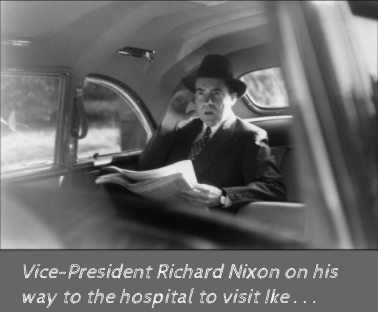
  On 24 September 1955, President Eisenhower, while in Denver, had a heart attack. Ike’s 74 year old doctor misdiagnosed the President’s condition, labeling it indigestion. Ike (64 yrs old) wasn’t taken to a hospital until twelve hours after his heart attack. Vice-President Richard Nixon knew that he was now under an even greater spotlight in the media and government, and he knew that he needed to show in every possible way that he wasn’t “taking over” from Ike. 
   Nixon and Deputy Attorney General Bill Rogers met with among others Sherman Adams (Ike’s #1 advisor) and the chairman of the Republican National Committee to discuss the politics of Presidential incapacitation. During the days that followed while Ike’s condition improved (despite some setbacks), Nixon showed wisdom and self-control. As the weeks passed, Ike’s Circle of Trust did their best to keep Ike’s power in their hands while keeping a close eye on Nixon. Meanwhile, the government and the media feasted on rumors, most of them not positive concerning Nixon.
     Nixon knew that a repeat of President Woodrow Wilson’s incapacity needed to be avoided, but he also knew that he needed to find a way to show that the government was still in strong/capable hands without Ike at the helm. In effect, Sherman Adams, who joined Ike in Denver, became the de facto President during Ike’s recovery, while Nixon performed wonderfully as the loyal Vice-President.

Picture
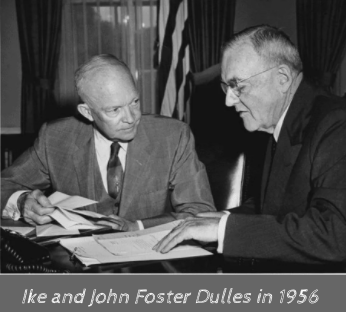
    Ike sent Nixon instructions so he could lead Cabinet and National Security Council meetings, but Ike made it clear to Nixon that SecState John Foster Dulles was in charge of foreign policy.  Nixon performed his duties in Ike’s absence with sensitivity and loyalty. For example, Nixon declined to take Ike’s chair in meetings, and he went to see those he wanted/needed to meet instead of summoning them. Nixon’s actions bolstered confidence in the nation and abroad, and many that were skeptical of Nixon were (at least temporarily) converted. 
     Jack Anderson, the beyond-famous investigative journalist, told Drew Pearson that Nixon was acting like a model Vice-President. Dulles was very grateful since Nixon kept silent concerning communists within the government while Ike recovered. Whatever plans Nixon had to leave politics vanished during this time, and Chotiner even started a “stealth campaign” to gauge interest for a Nixon nomination in 1956 in Ike didn’t run again. 
     No good deed goes unpunished, as Nixon discovered. Ike emerged from his recovery not only ready to run again in 1956, but to also ready get rid of Nixon as his Vice-President. Ike decided to run again in part because he simply didn’t want to give the Democrats a chance to win the White House. Also, as a coronary patient, Ike needed something in which to look forward and to give purpose, which meant another term as President.

Picture
    The major factor why Ike seriously considered dropping Nixon as VP was due to his near-death experience. Ike simply didn’t think that Nixon was Presidential material, especially with what he considered to be repeated political immaturity and opportunism on Nixon’s part. Despite all of the positives Nixon brought to the Vice-Presidency, Ike didn’t think Nixon did that much on his behalf as President. In fact, Nixon had developed  a high level of political maturity and had done everything right and had been totally loyal, but Ike started to freeze out Nixon even more. 
     On 26 December 1955, Ike invited Nixon to the White House and suggested that Nixon serve in the Cabinet during his second term. There seemed to be some sense in that suggestion, since William Howard Taft and Herbert Hoover had become President via that route, while the last sitting VP to be elected President was Martin Van Buren in 1836. Nixon had never been in charge of anything bigger than directing a staff that worked for him (e.g. making sure that Rose Mary Woods kept up with the mail), and therefore, Ike argued, that Nixon could raise his stature by serving in the Cabinet; Ike even dangled the possibility that Nixon could become Secretary of State.

Picture
   Nixon was fully aware of the politics involved, in that if he was reassigned to the Cabinet, it would look like Ike had no confidence in Nixon being President. To Nixon, it was 1952 all over again, with Ike wanting Nixon gone, but also wanting Nixon to cut his own political throat in order to minimize any blow back towards Ike. In late-February 1956, Ike announced that he would run for a second term, but he didn’t commit to Nixon as VP, saying that Nixon had to chart his own political course; the statement wasn’t exactly an endorsement. Senator John Kennedy (D; MA) was appalled at Ike’s public treatment of his Vice-President 
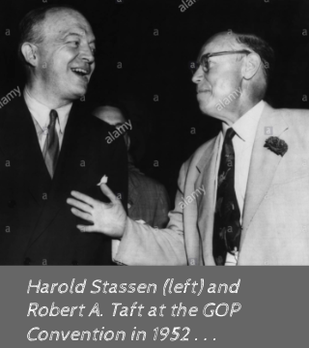
     Nixon’s health was also becoming an issue, in that he needed more pills to regulate his real and perceived ailments. The biggest problem facing Nixon was that he didn’t have a goal on which to focus. Nixon refused to play Ike’s game, and Ike didn’t want to remove Nixon as VP. During late-April 1956, Nixon decided that enough was enough, and he formally informed Ike that he wanted to remain as Vice-President. But Nixon’s status wasn’t yet settled, since in June 1956 Ike had surgery to remove an obstructed section of intestine, and in July 1956, Harold Stassen (among other Republicans), started a “Dump Nixon” movement.

Picture
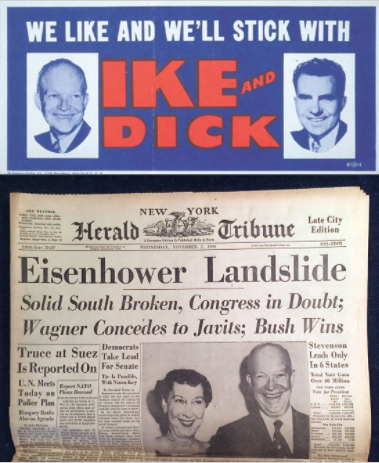
   Ike allowed the insanity surrounding Nixon’s status as VP to continue, and it wasn’t until Ike secured his second nomination at the GOP convention 1956 where the delegates again nominated Nixon as VP. Winning in 1956 looked good for Ike/Nixon since the economy was surging and millions of Americans had entered the middle class after World War II. The Democrats nominated Adlai Stevenson again, who offered no rationale for a change from Ike . . . the result was Nixon again was the target. 
  In his “Nixonland Speech”, Stevenson went on the attack, so much so that key advisors told him that he had gone too far. Stevenson desperately tried to convince voters that Ike’s health was precipitous enough that Nixon could be President during Ike’s second term. Due to the economy and a multitude of global crises that occurred in 1956 (e.g. the Suez Crisis), voters were comfortable taking a chance on Ike’s health than the prospect of a Stevenson Presidency. Nixon campaigned in 36 states, traveling mostly on board a DC-6. Nixon even decided to try and woo reporters by holding over 50 press conferences during the campaign.

Picture
    In private, Nixon would occasionally go bonkers in a rage over something that wasn’t a big deal in the presence of his staffers. Some key staffers told Nixon, after he had calmed down, that his behavior was the opposite of being Presidential. However, what the media saw during the general campaign in 1956 was the first incarnation of the “New Nixon”, with many reporters writing about Nixon’s maturity. Stevenson complained that Nixon had only temporarily put away his switchblade while masquerading as an Eagle Scout.
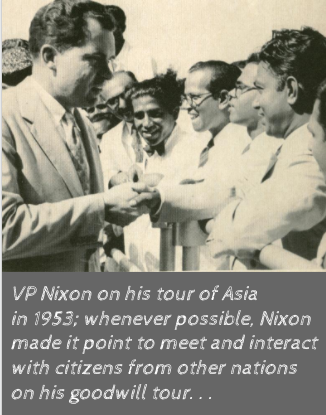
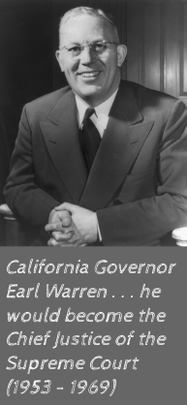
 On 20 January 1957 (Inauguration Day was on a Sunday, so the public Inauguration was on the next day), Nixon was officially sworn-in as Vice-President in a near-empty room in the White House by the Republican Leader of the Senate, William Knowland, and Ike was sworn in for his second term by Chief Justice Earl Warren; Nixon was surrounded by his two biggest enemies from his home state of CA. Soon Ike had his VP traveling abroad. During March 1957, Nixon was in Africa, and while in Ghana, he met Dr. Martin Luther King, Jr., who urged the VP to speak out against segregation. Nixon had dragged his feet in dealing with Senator Joseph McCarthy, but that would not be the case for Civil Rights, where Nixon would be one of the relatively few major politicians that tried to lead the way on that front.

0 Comments

Richard Nixon: The "Checkers Speech" (1952), Part One

1/1/2020

0 Comments

 
                    Source: John A. Farrell. Richard Nixon - The Life (2017)
Picture
     Liberal journalists looked hard for dirt on Nixon in CA, and soon rumors surfaced that Nixon was an anti-Semite (Nixon didn’t care about race or religion as long as people supported him) and that he had a secret slush fund that was maintained by a wealthy businessman. When Nixon was Senator-Elect in late-1950, the political fund called the “Nixon Sustaining Fund”  totaling $18k was created and was administered by a Pasadena banker. The maximum yearly contribution from an individual was $500, and only those that had supported Nixon since 1946 could contribute. 
     The goal was to have the fund reach a range between $20k and $25k so the fund could sustain political expenses and travel. Once Nixon was nominated for VP, the fund started to allot $500/month for household use, which was paid directly to the Nixons, which if nothing else made it easier for Pat to travel with her husband (that $500/mo was also earmarked for house cleaning and for a nanny).

Picture
     The gossip around the area in CA where the Nixons lived was that the $500/mo from the fund was so Pat could hire a maid. Peter Edson (a syndicated columnist) resolved to ask Nixon about the fund when he next had access to Nixon. Edson’s chance came on 14 September 1952 after Nixon’s appearance on Meet the Press, where Nixon urged Edson to contact those in charge of the fund to get all the accurate information he wanted. On 17 September 1952, Edson sent Nixon a draft of his column which was to be published the next day. Edson wrote a message to Nixon that he believed a list of all the donors of the fund should have been included in the information he was given to make sure that everyone knew the fund was above board. 
   The title of Edson’s column was straightforward: “Nixon Aided Financially by Rich Californians”, but his more factual version took a back seat to the New York Post. The Post had a reporter in CA named Leo Katcher that had been “tipped” by loyalists of Earl Warren. The New York Post’s headline was “Secret Rich Men’s Trust Fund Keeps Nixon in Style Far Beyond His Salary”. The story itself wasn’t lurid, but the headline did the damage and a political firestorm ensued. The Post simply didn’t do any fact-checking: the Nixon’s lived the life of typical middle class Americans, living in comfort, but not in luxury.

Picture
     What infuriated Nixon to no end was the he knew that Adlai Stevenson had a similar fund ($84k), and that he used it for entertaining others, campaign contributions, and staff bonuses. Stevenson’s VP candidate had his wife on the campaign payroll, and even Eisenhower received money from supporters/admirers for private use . . . but the media only hammered Nixon. As far as the media was concerned, the scandal was a test for Ike as much as it was for Nixon in terms of Ike’s judgment and decision-making. The weeks to come could very well knock down Ike to the point where Stevenson could be elected President. 
     Ike heard of the headline when his campaign train was crossing Nebraska, and by the evening, there was “great concern” among Ike’s campaign staff. A statement was drafted for the press that urged Nixon to release all relevant documents concerning the fund. Ike was caught in a political vice, in that he had railed against corruption in the Truman administration, and now corruption was possibly part of his campaign for President. Ike’s campaign had even taken on a tone of righteousness, and now his political crusade was in jeopardy. 
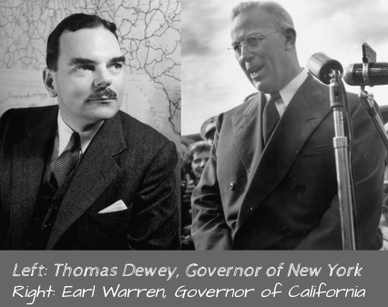
     Ecstatic liberal reporters commented out loud that Ike would have to let Nixon go as VP . The veterans in Ike’s campaign staff wanted to ride out the storm, since it would be disastrous to admit that Ike’s first major Presidential-level decision was a blunder. The less experienced campaign staff members, who were actually closer to Ike, were furious with Nixon and very worried about Ike’s image, and they wanted Nixon to vanish. For the chronically insecure Nixon, the next few days were hell; Eisenhower, Stassen, Dewey, and other powerful Republican patrons abandoned Nixon, and his enemies closed in for the kill. In CA, Warren and Knowland were very active in trying to pressure Ike to dump Nixon.

Picture
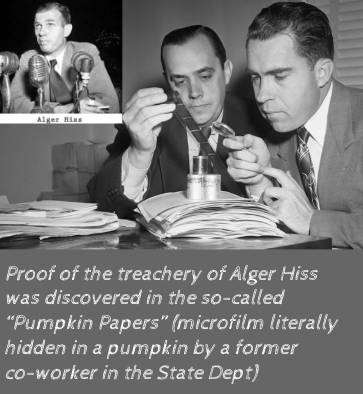
     Nixon’s instinct from the first moment was to fight back. Nixon started with stating during campaign speeches that the “Communists and Crooks” were out to get him. It felt good to lash out, and the crowds responded enthusiastically. Then word reached Nixon that the Washington Post and the NY Herald Tribune would call on Nixon to step down as Ike’s VP. Nixon was far more wounded by the Herald Tribune than the Post, since the Herald Tribune had helped Nixon when he went after Alger Hiss. Nixon had even reached the point where he considered the Herald Tribune’s editorial staff to be his friends; Nixon reacted as if the roof had caved in on his political career. 
     The most loyal and truest friends Nixon had at that time were Murray Chotiner and his wife Pat; both told Nixon to rally in the face of the attacks. From his wife especially, Nixon found his resolve to fight back instead of perhaps holding a press conference (that no doubt would have sounded a lot like his meltdown in 1962). By the weekend, the liberal media was sure that Nixon was guilty of income tax evasion. A plan of attack had formed in Nixon’ mind, in that he wanted to present his side straight to the people. Nixon soon learned that Knowland had been summoned by Ike’s staff, which told Nixon that he was about to be cut loose as VP.

Picture
     In Portland (OR) a hostile crowd jostled the Nixon and threw coins at them to the point where he and Pat had to duck. Ike was calm, and he wrote to some powerful people in the media, advising them to not overreact and to give Nixon a chance, and if he needed to make a decision, he would do so. Ike told reporters (off the record) that he would give Nixon a chance to defend himself and to show that he was beyond reproach. Privately, Ike felt that Nixon had to step down to avoid losing the election. 
     Ike found time to talk with Nixon on the telephone soon after the headlines appeared. Ike directly suggested that Nixon go on television and defend himself, which Nixon had already planned to do. What Ike wanted Nixon to do was to perform a “full financial scrubbing” on television; the televised speech had to mend the wound. Ike then told Nixon that he would wait a few days after the televised speech before he let Nixon know where he stood on the ticket. Nixon suspended his campaign on the train and went back to Los Angeles for an unprecedented televised address to the nation by a Vice-Presidential candidate. Once the televised speech was announced, most in the media were sure that Nixon would step down. 
     Nixon’s process for writing his own speeches stayed the same throughout his political career. Nixon used his beloved yellow legal pad to write a series of drafts until he not only was happy with what he would say, but also so familiar with the speech that he really didn’t need to use notes during the speech.

Picture
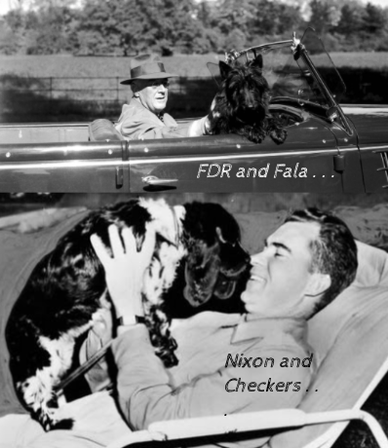
    Nixon decided on a three-part response, with the first being a flat-out refutation of all the allegations concerning the so-called slush fund. Second would be the full financial disclosure on which Ike insisted, and the last part was for going on the attack, blasting the Democrats while lauding Ike. But Nixon wasn’t yet done, in that he remembered the reaction in 1944 when FDR used his beloved dog Fala to ridicule the nonsensical Republican charges made against him. Nixon decided to do the same with their family’s new cocker spaniel puppy, Checkers. 
    Nixon also remembered a phrase he had used after the slush fund charges had come out when in response to a heckler that held a sign that wanted to know where Pat’s mink coat was, Nixon stated that his wife wore a respectable “Republican cloth coat”. Nixon showed his audacity by how he would close his TV speech, in that he would ask the viewers to respond . . . but to whom? If the responses were sent directly to Nixon, the Democrats would accuse him of shenanigans, so Nixon decided that the responses should be sent to the Republican National Committee (RNC). 
     An hour before the telecast, Dewey called Nixon on behalf of Ike’s entourage. Dewey told Nixon that after the broadcast he was expected to step down as Ike’s VP. Under questioning from Nixon, Dewey admitted that he hadn’t actually been told to make that demand to Nixon by Ike. After he asked Nixon what he planned to do, an incredulous, devastated, and furious Nixon told Dewey to find out by watching the broadcast.

Picture
     Due to Dewey’s phone call, Nixon had trouble memorizing his remarks, so he would have to rely on his notes. When Nixon entered the studio, he simply didn’t think his fight would end in a victory. For $75k, the Republican Party had strung together 60+ NBC affiliates and hundreds of radio stations to broadcast Nixon’s speech from 9:30 - 10 pm on the East Coast, 8:30 - 9 pm Central/Mountain, and 6:30 - 7 pm on the West Coast. As an added bonus, Nixon’s speech was on a Tuesday evening, the same night as Milton Berle's show. 
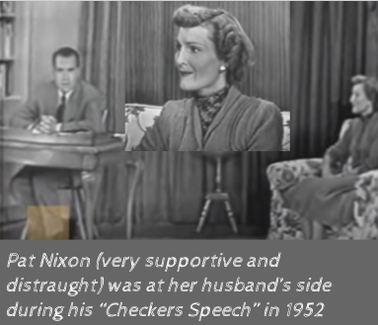
  Ted Rogers was a television producer/director who had met Nixon in 1950, and he was part of Nixon’s campaign staff. Rogers arranged for the “Library Set” to be used in the studio, with a chair for Pat off to the side of the desk. Nixon did not want to rehearse, so everything was planned on the fly by Rogers and his team. After basically flubbing his opening remarks, Nixon got on a roll, and he knew he was in the process of nailing his speech, especially when he stopped looking at his notes. Nixon was again on stage and acting, as he had in high school and college. Soon, Nixon told the television audience that he was going to do something unprecedented in politics by showing his financial standing to all (Pat had begged him not to do so beforehand) . . .

0 Comments

Richard Nixon: The "Checkers Speech" (1952), Part Two

1/1/2020

0 Comments

 
                   Source: John A. Farrell. Richard Nixon - The Life (2017)
Picture
     Nixon detailed his past, making it beyond clear that he worked his way up instead of being born well-off. By the time he reached his service in the US Navy during WW II, his allotted 30 minutes were half gone. Nixon, after the “cloth coat” phrase, used the Checkers puppy line for all it was worth. Nixon used that corny manipulative line to tell the viewers that he was one of them, and “THEY” are messing with US. The Checkers phrase was the end of the second segment of Nixon’s speech. 
   Then Nixon stated that it was fine that Stevenson, who inherited a fortune from his father, could run for President. Nixon added that a man from modest means should also be able to run for high office, and that’s where Nixon mentioned Lincoln and used a quote from the 16th President. In the last ten or so minutes, Nixon went on the attack against his tormentors, accusing Truman, Stevenson, and the Democrats of coddling Communists in the federal government and allowing massive corruption to flourish. Nixon also went after the media, arguing that after the Hiss Case, the media had gone after him very hard and unfairly.

Picture
  Nixon challenged the two Democratic candidates to fully disclose their finances, and if they didn’t, then there must be something to hide. Nixon didn’t mention Ike, but by the end of the campaign, Ike felt obligated to disclose his finances; an intensely private man, Ike never forgave Nixon. Nixon then got up from behind the desk and moved, like a political gladiator in the ring, and spoke about the Korean War, and how Ike was the one to end the war via tough negotiations. With a minute to go, Nixon stated that he refused to step down as VP since he wasn’t a quitter, but he would abide by what the RNC told him based on the viewer responses. 
     Nixon not only refused to resign as VP, but he had in effect taken the power away from Ike and given it to the public and the Republican Party. Nixon fit in a phrase that Ike was a great man, and the picture faded as Nixon was still speaking. Nixon soon learned that he did indeed nail his performance based on the reactions and feedback of those involved in televising his speech. Nixon left the studio through an adoring crowd in order to return to the Ambassador Hotel, where he received congratulatory phone calls and telegrams from people across the nation. 

Picture
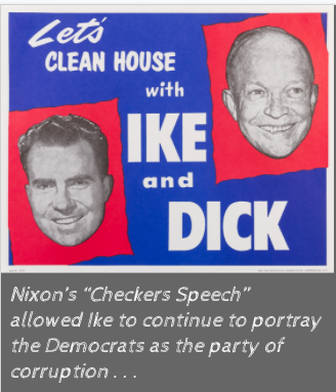
     In 30 minutes on television, Nixon had changed his image from that of a liability to an indispensable asset to Ike in the eyes of millions of Americans, while the elites and intellectuals dismissed Nixon’s speech as sentimental dreck. Nixon had looked young, honest, and earnest to millions, and his summary of his accomplishments resonated with Americans that had worked their way to a better life.  To that point in time, Nixon’s speech had the largest audience to watch a TV program. 
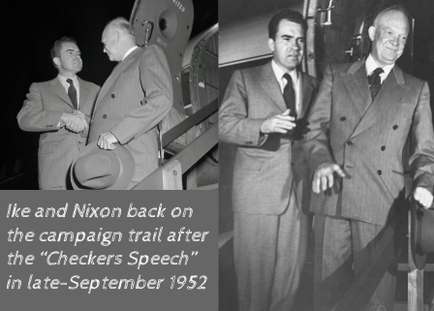
    To Ike, Nixon reminded him of Patton, courageous but insubordinate. That being said, Ike sent a telegram congratulating Nixon, who wouldn’t read it right away since it got lost amid the rush of telegrams. Nixon wasn’t happy that he didn’t immediately hear from Ike, and Ike wasn’t happy that Nixon had used the RNC as his clearinghouse for viewer feedback. In an effort to take back at least some control, Ike told the media that keeping or getting rid of Nixon was not his decision alone. Ike let Nixon (and the media) know that the campaign would resume after they had met and Nixon had given his report . . . and then Ike would make the decision whether or not Nixon remained as VP. For Nixon, the agony of not knowing his political fate continued. After using television in a way that would change politics forever, Nixon started to wallow in self-pity (e.g. “what more can he possibly want from me?”).

Picture
     Nixon dared to think about ignoring Ike’s summons, and Nixon decided to at least make Ike sweat and guess a little by traveling to Missoula (MT). Nixon was told by Chotiner, who had communicated with Ike’s Circle of Trust, that Nixon was still VP, but Ike still wanted to meet face-to-face. Nixon finally realized that the general would soon become President, and it would not be wise to alienate himself even before he took the oath of office as VP. So Nixon flew to Wheeling (WVA) and met with Ike. Ike called Nixon his “boy”, and in the presence of some of the media, they talked and then went to face a crowd of supporters outside. 
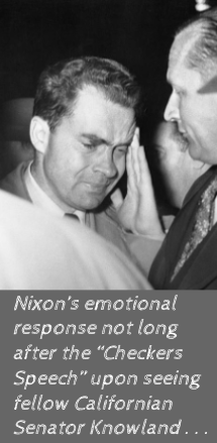
     Later that night, Ike was told that the RNC had voted 107 - 0 to keep Nixon on as VP. At a political rally, Senator Knowland was on the podium, and Nixon, so happy to see a familiar face, even if it was a Republican that was for all practical purposes an enemy, cried on Knowland’s shoulder (a photographer captured that moment). Ike told his brother than Nixon came through with flying colors with what was already being called the “Checkers Speech”. Nixon did more than save his political career, he changed politics by using television to communicate directly to millions of Americans, bypassing the power brokers and apparatus of his political party.


Picture
    A previous seachange in the political landscape occurred in the 1890s with the Populists, who were soon enough absorbed by the Democrats. Before the Populists, all the Republicans had to do was to drop Lincoln’s name, or run candidates such as Ulysses S. Grant or Theodore Roosevelt while only paying lip service for those that were at a disadvantage (e.g. immigrant factory laborers).  The Populists/Democrats changed who spoke for the Little Guy, and through the Great Depression, World War II, and the beginning of the Cold War, the Democrats remained the party that spoke for the Common Man. 
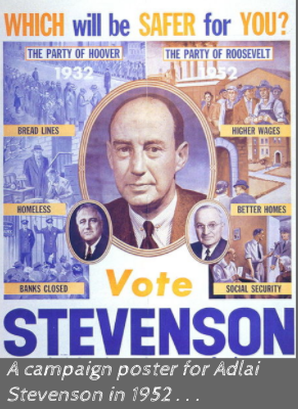
     However, amid the post-WW II economic expansion, the New Deal Coalition broke apart, and it was Nixon in 1952 that became the champion for the Little Guy, and the Democrats looked like Elitists in comparion by nominating Adlai Stevenson. While the liberal elites sneered and ridiculed Nixon, his “Checkers Speech” hastened the unraveling of the New Deal Coalition. Nixon came the closest to humanizing the Republican Party than any other national level candidate had done in decades.

Picture
   However, in 1952 it wasn’t the Left Wing Liberal Populists that organized, but instead it was the Right Wing Conservative Populists that did so. That meant that the real political battle was between the Elites and the Intellectuals versus the Common Person, and Nixon was too gifted a politician to miss the opportunity. Nixon shared the background of the Little Guy in terms of values, discontentment, and rancor; in so many ways, politically, the 1950s weren’t the Eisenhower Years, but rather the Nixon Years. So much of the 1950s featured the positive and negative perspectives of the  US lower middle class, as well as its spirit, self-pity, and its envy of those in a higher social/economic class; it was a kind of general collective resentful whine, and Nixon perfectly encapsulated what millions of Americans felt and believed. 
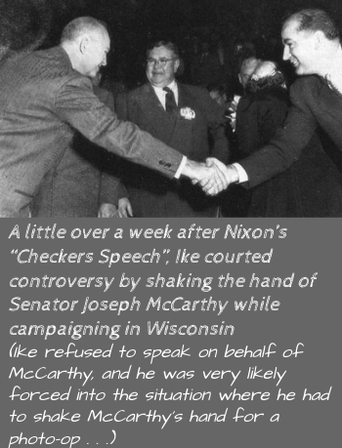
     Nixon knew that the Republicans could win in 1952 if the GOP portrayed the Democrats as the Party of the Elites, which would then by default lead the Republicans to become the Party of the Little Guy. Ike had the common touch, but in a far gentler and benevolent fashion than Nixon. Ike also knew how to lead competing factions and work towards unity (at least in the military), and Ike also knew how to persuade, and when to turn on his charm. That being said, Ike agreed to turn Nixon loose against the Democrats in the General Campaign to be, in essence, a less aggressive/more respectable version of Senator Joseph McCarthy.

Picture
     In mid-October 1952, Ike et al arranged for Nixon to have another 30 minutes on television, where he went after Stevenson for testifying on behalf of Alger Hiss in the late-1940s; Nixon questioned Stevenson’s judgment, not his loyalty. In late-October 1952, Nixon was in Texarkana, and “Tricky Dick” came out when he accused the Truman administration of being traitors to the high principles of their party. Truman, Speaker of the House Sam Rayburn, and other high-profile Democrats never forgave Nixon for labeling them and their party traitors. Nixon may-or-may-not have understood that when he tarred with the widest brush, he would pay a price in the future. 
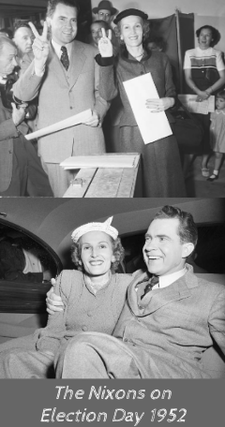
     The results of the Election of 1952 were as follows: Popular Vote - Ike 55%, Stevenson 44% / States Won - Ike 39, Stevenson 9 (Stevenson failed to win his home state of Illinois) / Electoral Votes - Ike 442, Stevenson 89. As an added bonus, the Republicans won narrow majorities in both houses. Nixon knew that Ike won the election because he was a national hero, not because of Nixon’s actions on the President-Elect’s behalf. During 1952, Nixon’s hate of the media reached its highest level so far, and his hatred for the communications systems network through which he needed to communicate would have profound consequences in the years to come.
           
Addendum: Nixon & the Media After the "Checkers Speech" . . . 

0 Comments

Nixon: From Senator to Vice-President (1950 - 1952), Part Two

12/24/2019

0 Comments

 
                     Source: John A. Farrell. Richard Nixon - The Life (2017)
Picture
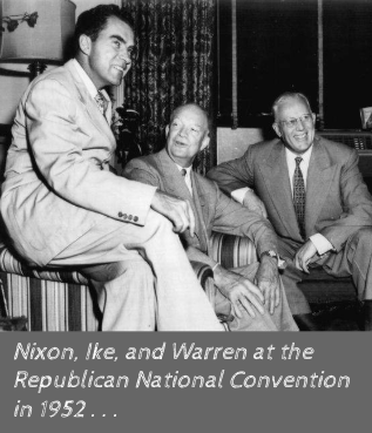
     Those in Ike’s Circle of Trust, such as Thomas Dewey, liked what they saw/heard from Nixon, and Nixon was told by Ike et al  that if he was able to be a strong presence for Ike with the CA delegation, then his chances for being VP would increase. California’s 70 Republican delegates for the convention would be decided in the primary in June 1952 (the only larger GOP delegation was NY). The best deal that Nixon could manage, due to Warren’s power/influence in CA, was to unite with the various GOP factions to defeat the renegade conservative in the primary, and then the CA delegation would be divided into thirds for Warren, Knowland, and Nixon. 
     Warren agreed to the plan since as the Favorite Son of CA, by tradition, he held all 70 delegates unless he released them. Nixon seemed content that he did the best he could for Ike with the CA delegation. However, Nixon did all he could to rain on Warren’s parade, issuing a mailer that stated that Warren had no chance of winning the nomination while also pointing out that the only candidates that had a chance were Ike and Taft. At the last minute, a few delegates were replaced, and they were pro-Nixon; even Kyle Palmer became irritated with Nixon and his tactics.

Picture
     Nominating conventions are run by the party’s faithful to reward the loyal, which proved to be at least somewhat of an impediment in that Ike had only recently entered the Republican fold. Ike had undeniable popularity, but Taft had a large lead/advantage in the Inside Game in terms of the delegate count.  Dewey and Henry Cabot Lodge, Jr. secured the delegates from the northeastern states for Ike, and Warren had CA, so that left the Southern delegates; that meant going in that the nomination at the convention could very well be contested. 
     Ike played the “Boss Card”, stating that Americans were sick of political bosses, and that Taft’s Inside Game was the epitome of the Boss system, meaning that Taft was trying to thwart the will of the people.  Nixon was on the Platform Committee, and he chimed in saying that if Taft was nominated, he would be a sure loser to the Democratic candidate. Nixon was not alone believing that the Republicans needed a hero like Ike to get as many voters as possible to vote the GOP ticket. 
     Nixon then left Chicago and joined the CA delegation so he could enter Chicago with them for the start of the convention. As the train continued east, Nixon’s men kept telling delegates that if they believed that Warren could keep Ike from a 1st ballot victory, they were living in a fantasy land. The Nixon folks kept at it, saying that it would be wise to support Ike so CA wouldn’t be left out in the cold, politically speaking. Warren was furious at Nixon’s attempt to recruit delegates for Ike under his nose, and it became known as the “Great Train Robbery”, which added support for Ike at Warren’s expense.

Picture
     The first showdown of the GOP convention was over the credentials of the contested delegates, which were mostly from the South. In this situation, Nixon and Warren had a common interest, in that they both wanted to block contested delegates loyal to Taft. But Warren misread the tea leaves, in that Taft wasn’t the one he needed to worry about . . . it was Ike and Nixon. 
   The Taft GOP Old Guard steamroller became stalled, and then it was too late when Warren figured out what really happened, that Nixon had sold out Warren to advance Ike’s nomination. Warren and Senator William Knowland (R; CA) were beyond-bitter; a seething Warren sent a mutual friend to Ike to express his extreme displeasure at having an Eisenhower spy in their midst. But Ike didn’t need the CA delegation in order to win the nomination, and he basically ignored Warren while also telling him, via intermediaries, that Nixon looked good for VP.

Picture
     The next showdown was whether to seat Ike’s Southern delegates, but by then Ike was driving the GOP steamroller. Ike’s popularity and charisma, combined with Nixon’s well-received remarks concerning Ike, meant that the CA delegation voted 62 - 8 to seat Ike’s Southern delegates, and the other state delegations followed CA’s lead in a scene that played out over television. Ike would not forget what Nixon had accomplished with the CA delegation.
     Warren eventually saw (and rued) his folly, in that by focusing on Taft he had not only hurt himself, but also advanced the cause for Ike and Nixon; from that day on, Warren’s hate for Nixon was epic. Ike let Warren have his moment with the CA delegation, letting all 70 vote for their Favorite Son. Ike could do so since he knew that Warren Burger, a Stassen man, had succeeded in switching the Minnesota delegation to put Ike over the top for the nomination. 
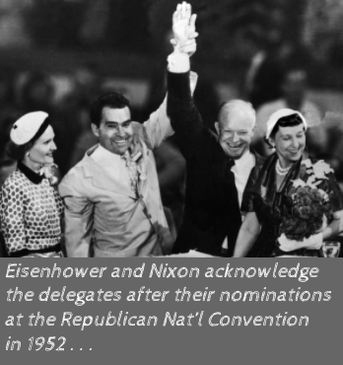
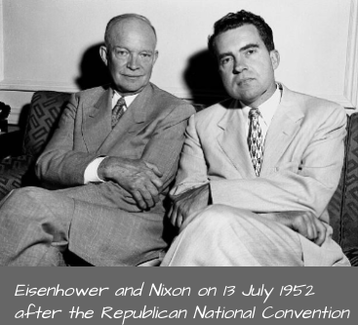
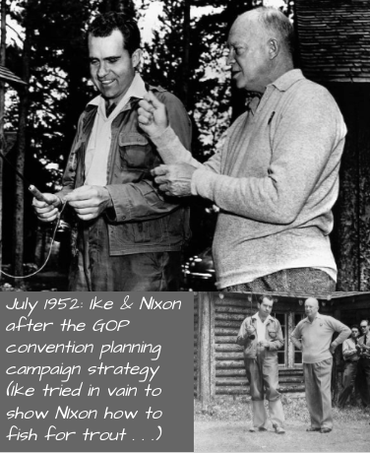
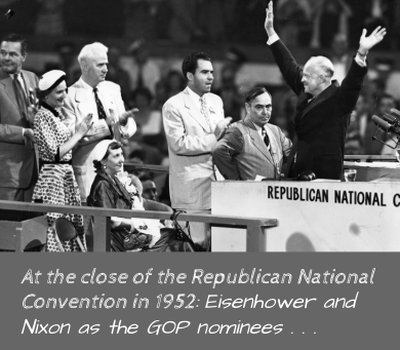
   Given how often a Vice-President became President, it was odd that Ike didn’t give much thought to his running mate. Since Martin Van Buren in 1836, the Vice-Presidency had become a political Boot Hill unless there was a death in office (George H.W. Bush in 1988 was the first sitting Vice-President since MVB to win a Presidential Election). What Ike et al wanted was for the General to take the high road, and the VP candidate (Nixon?) would be the campaign’s attacking pit bull. Chotiner advised Nixon to take the VP if offered, arguing that the worst thing that would happen was that Nixon would have four more years of his term as Senator if Ike lost the election. Shortly after Ike was nominated as President, Nixon was nominated as VP by acclamation.

Picture
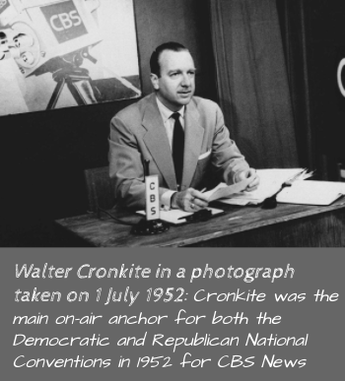
     Television had become an American mainstay by 1951, but viewership was still concentrated in the big cities in the East. Milton Berle, Roy Rogers, and the first politician to use TV to promote an agenda (and himself), Estes Kefauver, chaired Senate hearings on organized crime and juvenile delinquency. Both political conventions were huge ratings hits on TV as well, with millions watching the real-time political drama play out (conventions were nearly as scripted then as they are today). Also due to TV, Americans watching CBS were introduced to Walter Cronkite during those conventions. 
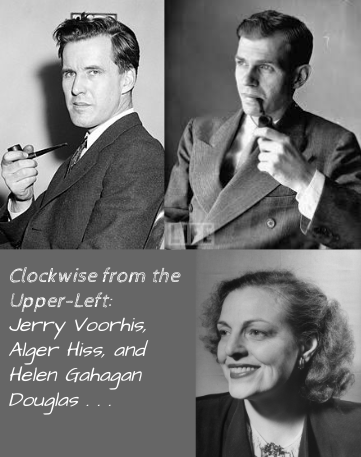
   By the General Campaign of 1952, Nixon had nailed four political scalps to his wall: Voorhis, Hiss, Gahagan Douglas, and Warren . . . and Nixon had his sights on a fifth, Adlai Stevenson, the nominee of the Democrats. Nixon was eager to go after Stevenson in part because he had been a character witness for Alger Hiss during the HUAC hearings in the late-1940s. With the blessing of Ike’s inner circle, Nixon et al compiled information in a file called “Stevenson’s Communist Affiliations”. Nixon refused to use any personal information that was gained (e.g. the possibility that Stevenson was a homosexual). In the years that followed, Nixon developed an intense hatred for Stevenson, who to Nixon was the epitome of the liberal intellectual elites that had a condescending attitude to any politician that they considered below their level/status. Also, Nixon hated it that Stevenson was a political messiah to the Georgetown Set in DC as well as the Ivy Leaguers. Nixon saw Stevenson as all veneer and no substance; in essence, without even knowing it, Nixon was perhaps triple-dog-daring his political foes to strike.    

0 Comments

Nixon: From Senator to Vice-President (1950 - 1952), Part One

12/14/2019

0 Comments

 
                    Source: John A. Farrell. Richard Nixon - The Life (2017)
Picture
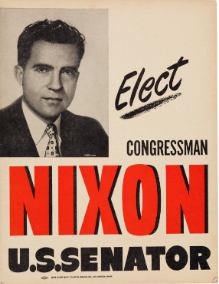
  Defeating Jerry Voorhis in the Congressional race in  1946, exposing Alger Hiss in the late-1940s, and then defeating Helen Gahagan Douglas for the Senate in 1950 came with a cost in that Nixon had destroyed three high-profile (and very admired to the Left) New Deal liberals; Nixon became the enemy of that liberal bloc. The DC press disliked Nixon even before they met him due to his campaign tactics against Voorhis in 1946. Nixon’s unmasking of Alger Hiss rocked the foundation of the liberal set in DC, and after his campaign against Gahagan Douglas in 1950, the DC liberal jackals had Nixon in their crosshairs.
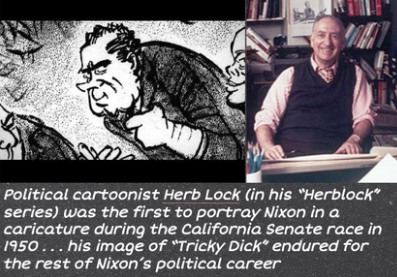
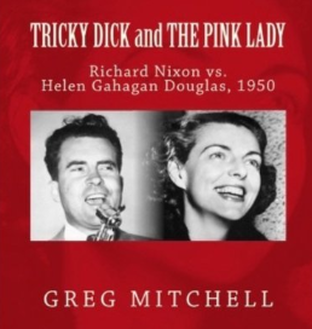
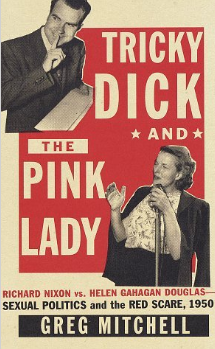
     In California, Nixon’s name had been smeared as well due to his campaign attacks/strategies. Those in Nixon’s corner felt that perhaps it was his years of debate training that made him so aggressive and relentless in pursuit of an issue/goal. Nixon even admitted to some that his tactics/strategies in 1950 against Gahagan Douglas were a “shoddy” way to win. Gahagan Douglas blamed the Korean War as the main reason for her defeat against Nixon, believing that Nixon would have won anyway without resorting to character assassination (e.g. “The Pink Lady”). Left-Wing editorialists accused Nixon of petty malice, and Herblock’s portrayals of Nixon in his very influential and widely syndicated political cartoons illustrated Nixon’s dirty tactics. By early-1951, “Tricky Dick” had become a political caricature.

Picture
     On 4 December 1950, Nixon was sworn in as a United States Senator since Downey resigned before his term ended to become a lobbyist. Even though Downey was a Democrat, he was also a Californian, and he wanted Nixon to have a tie-breaker in his advantage in terms of seniority compared to the other freshmen Senators yet to be sworn in. 
     In his much larger and expensive Senate office, Nixon brought 33 year old Rose Mary Woods on board as his secretary, whom he met while serving on the Herter Committee as a Congressman. Woods and others around Nixon started to develop a fierce loyalty to the Senator that was comparable to vows taken by nuns; Woods would top that list of loyal surrogates all the way to the end of Nixon’s Presidency. Woods became a gatekeeper, a detail person, and a keeper of secrets for Nixon.
  When the Senate wasn’t in session, Nixon traveled the nation and gave speeches in 21 states, which not only provided additional income, but doing so also meant that Nixon established connections with state and local level Republicans. Nixon’s rapid ascent to national level politics in just a few years had taken a toll on Nixon. With the Alger Hiss investigation, Nixon became melancholy and worked himself to the point of exhaustion. Then physical problems such as a painful neck and back occurred, as well as facial tics, sleeplessness and chronic stomach troubles. The times of Nixon being lighthearted in the company of others started to sharply and noticeably decrease.

Picture
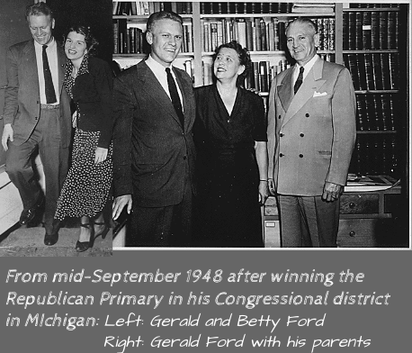
     Gerald and Betty Ford arrived in DC in 1948, and the Fords befriended the Nixons. Ford discovered that Nixon could be in a very good mood and then instantly become dour. Even when both were still in the House, Ford saw that Nixon’s moodiness drained much from him. At the root of what made Nixon tick was that he threw himself into work in a furious fashion in order to deal with deep insecurities that were a product of his past. In part, Nixon refused to lose because in no way did he want to disappoint his mother. 
     In 1951, Senator George Smathers (D; FL) introduced Nixon to Bebe Rebozo, a Cuban-American real estate businessman, and Nixon went out on Rebozo’s boat for a short jaunt. Smathers and Rebozo were renown in the Senate for providing a relaxing time in Florida for Senators. Interestingly, among Smather’s closest friends were JFK and LBJ. Rebozo’s initial feedback to Smathers concerning Nixon was that he really didn’t want Nixon back in Florida, since the freshman Senator didn’t drink, chase women, or play golf . . . in time, though Rebozo in essence became Nixon’s best friend. 
     Nixon’s first speech on the Senate floor was to deride President Truman for firing General Douglas MacArthur while also pressing Truman to expand the war in Korea by bombing Chinese supply lines. By doing so, he was following the official Republican line supporting MacArthur while also taking aim at Red China. Nixon was already exchanging letters with Kyle Palmer of the Los Angeles Times analyzing the upcoming Election of 1952.

Picture
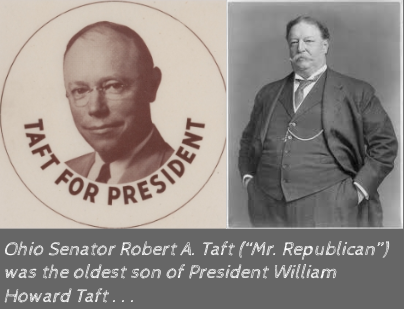
  Nixon understood that the Republicans placed a high priority on backing party members from the Sunbelt, especially from CA and TX. Beginning in 1948 the Republicans would nominate a candidate from the Sunbelt for President or Vice-President for 14 of the next 16 conventions. It seemed likely that whoever won the Republican nomination in 1952, Ike or Senator Robert A. Taft, he would look West for his Vice-President. Nixon liked the chances of former general Dwight Eisenhower to win the nomination, and Ike’s stand on the issues mostly matched Nixon’s. In 1951, Nixon became an overt supporter of Ike, thinking that by doing so he might make the short list for VP. 
     In May 1951 while in Paris, Ike (the #1 NATO general) reached out to Nixon, who was in Geneva for a World Health Organization (WHO) conference. Nixon presented himself to Ike as a loyal subordinate, and they talked for 45 minutes. Nixon liked that Ike paid just as much attention when he listened as when he talked. Nixon was strong on the three major issues the Republicans would focus on in 1952: Korea, corruption in the Democratic Party and the battle against Communism. Nixon shared Ike’s internationalism, while Taft was basically an isolationist. Ike didn’t categorize Nixon in the same way as he had Senator Joseph McCarthy and his thugs, or with the Old Guard Conservatives of the GOP.

Picture
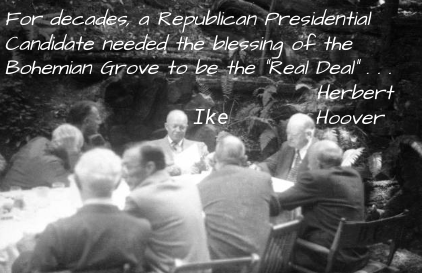
     Three weeks later, Nixon was part of a confidential strategy meeting in which Harold Stassen would announce his candidacy, and then drop out when Ike formally announced in order to try and deny Taft the nomination in Chicago. During a gathering at the Bohemian Grove, most of the power brokers agreed that Ike/Nixon would be a solid ticket for the Republicans in 1952. The skunk in Nixon’s garden party was Earl Warren, who wanted to be President, but like Herbert Hoover, he didn’t want to get his hands dirty in pursuit of the office. Warren wanted the status that Ike enjoyed, being the statesman far above the fray. Warren always wanted the help of others to pursue his political goals, but when he saw someone coming up the ranks, he did his best to keep him down.
     Ike remained in Europe, waiting to be drafted for the Republican nomination by an adoring public. Warren played coy, hoping that, as a Favorite Son from CA, the convention would turn to him if there was a deadlock among the delegates. Heading into the Republican National Convention of 1952, Nixon and Warren were on a collision course. Warren hoped that he could keep CA’s delegation in his corner, and therefore deny Taft or Ike the nomination on the 1st ballot. Nixon wanted Ike, with his conspicuous help, to secure the nomination on the 1st ballot, and then perhaps be offered the other spot on the ticket.

0 Comments

"Tricky Dick" vs. the "Pink Lady" (1950), Part One

12/1/2019

0 Comments

 
                    Source: John A. Farrell. Richard Nixon - The Life (2017)
Picture
     The Central Valley Project in the San Joaquin Valley (1935) was designed to bring water to small farms in order to encourage rural development; the project featured a 160 acre limit on water usage per unit (farm). The senior Senator from California, Sheridan Downey (Democrat), was against the New Deal plan from its inception.  However, Representative Helen Gahagan Douglas, a Republican from a district in Los Angeles and a staunch supporter of FDR, kept the original vision of the Central Valley Project in her heart. That meant that Gahagan Douglas wanted the project to focus/benefit the small family farmer instead of corporate agriculture. 
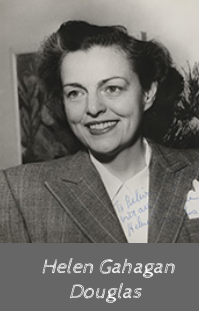
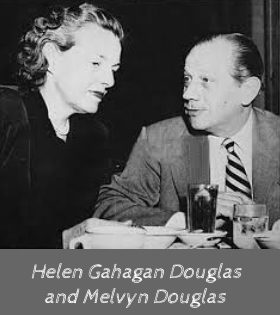
   Gahagan Douglas concluded that Downey needed to be taught a lesson for becoming conservative as a Democrat during the Great Depression, so she challenged Downey in the Democratic primary. By that time, Gahagan Douglas had married the famous movie actor Melvyn Douglas, and they had become the classic liberal couple in Hollywood. Gahagan Douglas had won a seat in Congress in 1944, and she was a favorite of both FDR and Eleanor Roosevelt. Helen Gahagan Douglas, like Jerry Voorhis, was more of a show horse than a workhorse, but she was an earnest diva, putting in enough hours to become familiar with a range of issues. 

Picture
    Gahagan Douglas was an enthusiastic supporter of SecAg Henry Wallace (the most liberal New Deal Democrat in the FDR’s administration), the United Nations, and for international control of atomic energy; she was against the Truman Doctrine (Containment) and HUAC (the House Un-American Activities Committee).  Gahagan Douglas was in a political conundrum, in that the well-to-do saw her as a traitor to her class (as they did with FDR), and conservatives simply believed she was a dupe for Stalin. Added to the mix was the antipathy she faced simply because she was a woman in a “man’s job”. 
     Gahagan Douglas had become used to the spotlight and criticism, but she failed to see the coming seachange in the political landscape after World War II, and that’s where Nixon would have her beat. California Democratic leaders wanted her to drop her challenge to Downey in 1950, and if she did so, she would be rewarded with the state party’s support to pursue the other CA Senate seat in 1952, held by William Knowland. The supporters of Gahagan Douglas assumed that her aura would carry the day, no matter the challenger or the situation. and perhaps Gahagan Douglas viewed herself in the same way since she refused to withdraw from the Senate Democratic primary in 1950. 
     The CA Democratic leadership asked Gahagan Douglas to reverse her stand on the Tidelands Oil issue, and she refused to do so, even though that would have meant more than enough money for her campaign. As a result, money poured in against her from conservative industrial/commercial oil interests, which meant she was totally dependent on New Deal liberals from the start of her campaign. During October 1949, Gahagan Douglas officially declared herself a candidate for the US Senate from California.

Picture
     In the meantime, Representative Richard Nixon’s rising star on Capitol Hill had dimmed since Truman won re-election and the Democrats took control of both houses as a result of the Election of 1948 (there was no way that Nixon could know that the Republicans would only control the House for two of the next forty years). To Nixon, the only plausible chance for advancement in politics was running for the Senate in 1950; already, Nixon was thinking of the White House. Pat Nixon viewed a Senate seat more positively in that with a six year term there would be far more permanency in their lives. 
    Nixon had to get the blessings of CA Governor Earl Warren and Senator Knowland, and the Lt. Governor of CA needed to stay out of the race altogether. Nixon also knew that he needed the political editor of the Los Angeles Times, Kyle Palmer, in his corner. Palmer hadn’t fully supported Nixon in 1946 until the campaign was at its end, but he had kept track of Nixon since, and he wasn’t going to wait too long in 1950. Palmer also knew that Warren and Knowland owed the LA Times for its support of their winning campaigns, so that meant that Palmer was able to get both CA politicians on board the Nixon train. It was the start of a sort of political bromance between Nixon and the LA Times that would continue while Nixon was in the Senate. 
     Palmer’s vision was that there would be a President from California that was at least partially beholden to the Los Angeles Times . . . and Kyle Palmer. Palmer’s #1 guy for that dream was Earl Warren, but Palmer decided to hedge his bet with Nixon, who he viewed as an excellent backup. Palmer helped clear the way for Nixon on the CA Republican Party, telling those that needed to know that the LA Times was only going to support Nixon; the clear implication was that if the CA Republicans wanted the support of the LA Times, find another election in which to run. 

Picture
    When Nixon heard that Gahagan Douglas was challenging Downey, that made Nixon’s decision to run for the Senate permanent.  The Senate campaign of 1950 was when Nixon and Murray Chotiner (his main campaign strategist/detail man) seamlessly meshed together; both were ruthless, righteous, very hard-working, and liked to be on the attack. Nixon and Chotiner believed that Downey needed to be culled from the political herd, and that Gahagan Douglas was a Socialist stooge for Joseph Stalin. 
   Chotiner was paid $937.50/month to be Nixon’s point man, and his first order of business was to make Nixon’s name known to all of California instead of only in the 12th Congressional District. Chotiner set up two separate campaign committees for Nixon, one in Southern CA and the other in Northern CA, since each were politically different regions. Early in the campaign, Chotiner warned Nixon that the Republican party couldn’t be the “Party of No”, and that Nixon would have to be able to answer questions and communicate solutions (e.g. Truman’s plan for health care vs. Republican outcries that it was Socialism). Chotiner kept reminding Nixon that, as a Republican, he needed to do more than just point out the evils of a Democratic plan or strategy.

Picture
     Chotiner knew that in order to win Nixon had to get thousands of CA Democrats to vote for him, since CA was 60% Democratic to a (rising) 40% Republican. Nine months before the election, the Los Angeles Times fully and enthusiastically endorsed Nixon for the Senate. 
     Then, a federal judge in essence set aside the perjury conviction of Alger Hiss, and Nixon demanded an investigation of the judge. Given this great opportunity for a retrial, Hiss, who always thought he was smarter than everyone else, changed his lawyer . . . the very lawyer that had succeeded in reversing his perjury conviction.
​     On 21 January 1950, Alger Hiss, with his new lawyer, was again found guilty of perjury. Nixon could breathe easier, since his crowning achievement that had made him a national political figure, the discovery that Alger Hiss had given information to the USSR while working in the State Department, was still valid    (the statute of limitations had expired for espionage, so the best Nixon and HUAC could do was to go after Hiss for perjury). Nixon wanted/needed his Cold War Communist-hunting credentials to be immaculate for his campaign against Helen Gahagan Douglas for the US Senate in California in 1950, so on the House floor, Nixon retraced what he had always called the “Hiss Case”.

0 Comments

"Tricky Dick" vs. the "Pink Lady" (1950), Part Two

12/1/2019

0 Comments

 
                       Source: John A. Farrell. Richard Nixon - The Life (2017)
Picture
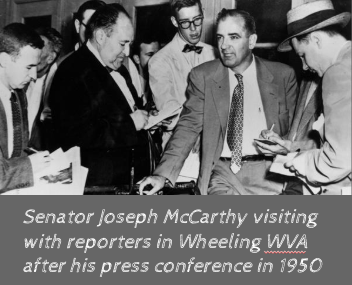
   The junior Senator from Wisconsin, Joseph McCarthy (Republican), used some of Nixon’s phrases from his review of the “Hiss Case” just a few days later on 9 February 1950, when he launched a Communist witch hunt that would bear his name in a press conference in Wheeling (WVA). The Associated Press picked up McCarthy’s claim that there were Communists in the State Department, and just like that McCarthy became a national political figure without having to actually find a Communist spy, which Nixon had painstakingly done with Hiss. 
    From Truman-on-down, the Democrats attacked McCarthy, but the Republicans rallied around a bully, since by 1950 the GOP had concluded that there were more votes to be had via the Red Scare. The year 1950 proved to be pivotal, in that Hiss had been convicted for a second time in January, and later that month Truman announced that the US would develop the hydrogen bomb (a.k.a. the “Super”).  A few days later the government released details about Klaus Fuchs and other USSR spies that had stolen US atomic secrets, and soon Julius and Ethel Rosenberg were arrested for espionage. Fear of Communists in the US (the “Enemy Within”) had officially reached epidemic levels in 1950, and McCarthy’s witch hunt would fan the flames.

Picture
     In the midst of all of this, Truman ignored FDR’s sage advice to avoid taking sides in an anti-colonial war of independence; Truman approved the first million dollar aid package to French Indochina. Nixon viewed McCarthy as a reckless ally in the hunt for Communists in the US, and he urged McCarthy to make an extra effort to be accurate with his accusations. 
     As the Spring of 1950 progressed, Nixon and Chotiner were convinced that they needed to ramp up their strategy from 1946 against Voorhis for the Senate race. Nixon was advised by a prominent CA Republican that he should portray Gahagan Douglas as an actual member of the Communist Party instead of a dupe for Stalin. Downey pulled out of the Democratic primary for health reasons (he was 65), and a Democrat in the primary that had no chance of winning called Gahagan Douglas the “Pink Lady”. Even though he had withdrawn, Downey chimed in, loudly stating for the media that Gahagan Douglas had opposed the Truman Doctrine and had also opposed additional funding for HUAC, which according to Downey, assisted Soviet tyranny.

Picture
     Due to CA rules and the squabbles among the Democrats, Nixon saw an opportunity and ran in both the Democratic and Repubican primaries for the Senate. It was actually a kooky unelectable Democratic candidate that was trying to deny Gahagan Douglas victory that gave Nixon the nickname that would stick with him forever: “Tricky Dick” (it was in a full page newspaper ad). When the dust settled, it was Gahagan Douglas vs. Richard Nixon in general campaign for a seat in the US Senate in 1950. Chotiner believed that women voters would not flock to Gahagan Douglas in droves, since women were (and are) hard on other women and that she was an upper-class liberal. Almost twenty years before the Feminist Movement gained traction, millions of women still believed that women should remain in the private sphere, and those, like Gahagan Douglas that dared to dabble in the public sphere, were usually punished in one way or another. That being said, Nixon and Chotiner both believed that the “Pink Lady” strategy was the surest route to victory.
     On 24 June 1950, Nixon was on his way to CA after finishing a session of Congress when news broke of North Korea’s surprise attack on South Korea; the US would again be at war, and Communism was no longer a theoretical danger. Gahagan Douglas wasn’t an idiot; she was fully aware of the damage done to her in the Democratic primary in terms of distorting her record as well as the “Pink Lady” label, and she believed that a preemptive strike on Nixon would be her best strategy. Gahagan Douglas focused on Nixon’s vote against a $60m aid package to South Korea in January 1950, arguing that Nixon had helped cause the Korean War. Nixon fumed, in that he voted against the bill because it didn’t include aid for Chiang Kai-Shek and Taiwan. Nixon played the accepted game of not voting for the original bill in order to extract something better for later.

Picture
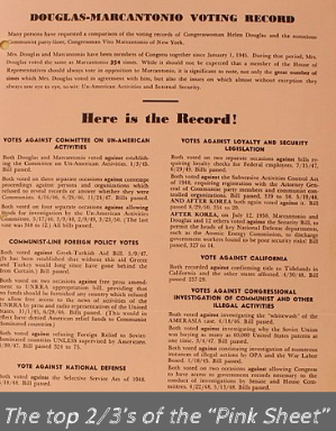
     Gahagan Douglas didn’t have the media on her side (in particular the LA Times) to make the charges stick in the memory of the voters. Also, by striking first, she was fair game for Nixon’s full attack; Gahagan Douglas gave Nixon the gift of being the aggrieved party seeking redress from an unfair charge. To start, Nixon portrayed Gahagan Douglas as a stooge for Stalin, but soon the “pink sheet” was issued at Nixon campaign rallies that distorted the record of Gahagan Douglas. 
   Contained in the pink sheet was a comparison of the voting records of Gahagan Douglas and a fellow representative from NYC who followed the Communist Party’s line. NIxon outlined the times that Gahagan Douglas voted the same as the NYC representatives; his goal was to get all of CA talking about the treachery of Helen Gahagan Douglas.

Picture
   During August 1950, the old Mundt-Nixon bill was introduced under the new title of the Subversive Activities Control Act, and Gahagan Douglas was one of only 20 in the House that voted against the bill. At that point, Kyle Palmer started to warm up to the idea of going after Gahagan Douglas, and in his op/eds, he constantly used the word “emotional” when referring to her, as well as other keywords such as “dramatic” and “superficial”.  During October 1950, Nixon made it clear that he was accusing Gahagan Douglas of actions that were inspired and/or approved by the Communist Party. 
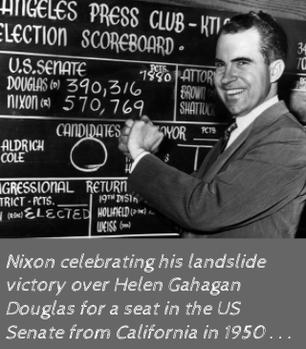
     Gahagan Douglas was limited by a lack of funding and mostly negative attention by the media. Gahagan Douglas reported campaign spending of $156k, while Nixon reported $750k (which was probably too low). Neither the White House or the Democratic National Committee made much of an effort on behalf of Gahagan Douglas, but her campaign was inept/inefficient compared to Nixon’s juggernaut. During the weeks before the election, news from Korea was awful, in that US troops were not holding their own against the North Korean and Chinese armies, which benefited Nixon's campaign. In the days before the election, Nixon attacked Gahagan Douglas for her opposition to ban Communist China from the United Nations. Nixon crushed Gahagan Douglas in the election, garnering 59% of the vote; at the tender age of 37, Richard Nixon was a United States Senator.

0 Comments

James Knox Polk and the Mexican War, Part Two

11/17/2019

0 Comments

 
       Source: Robert W. Merry. A Country of Vast Designs - James K. Polk,
                     the Mexican War, and the Conquest of the American Continent (2009)
Picture
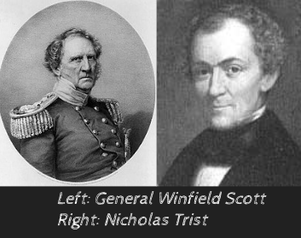
     Unbeknownst to Polk and DC, General Winfield Scott and Nicholas Trist not only healed their rift, but they became close, developing an emotional bond so strong that it would last the rest of their lives. What helped form that bond was that they discovered that they both hated President Polk.  Trist wasn’t authorized to personally deliver the sealed packet to the Mexican government (Scott was the one authorized), but Trist wanted the Mexican government to receive the packet much sooner, so Trist asked a member of the British legation to deliver the packet on his behalf. Very soon after receiving the packet, Santa Ana called a “special session” to consider the US offer. 
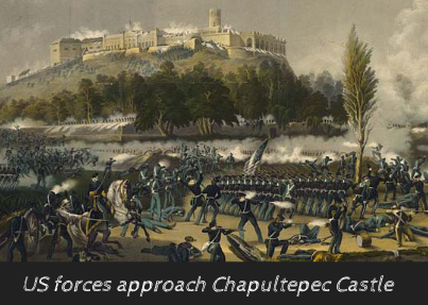
     Scott and Trist actually offered Santa Anna a $1m bribe to end the war and to begin negotiations. Scott told his staff that bribes of that nature were how to deal with nations/governments such as Mexico. The bribe fell through when the Mexican legislature refused the give Santa Anna the necessary powers to negotiate with the US. As a result, Scott was forced to press the reality of war to the Mexican government, which meant he had to make his move on Mexico City.

Picture
     In the Summer of 1847, Whig conventions burst forth with their support for Zachary Taylor to be the party’s candidate for President. All that mattered was that he was a war hero and therefore able to win votes for the Whigs in 1848. Few knew Taylor’s touchy/petulant side, as well as his lack of intellectual curiosity, ability, and imagination. Taylor released statements that sounded like he expected to go straight from the battlefield as a commander to the Presidency in a sort of political immaculate ascension, which proved to be a political blunder that slowed his momentum.
     The Whigs increasingly became more united on one front, in that no land should be taken from Mexico as a result of the war. The tactic was brilliant in a way, sidestepping the Wilmot Proviso while at the same time putting pressure on the Democrats. It was about at that time that Buchanan informed Polk that the US no longer had any more money to fund the war. An absolutely mystified/upset Polk ordered an investigation as to where the money went. It was soon discovered that $2m went to New Orleans brokers, who kept $1.1m of the money as a “handling fee”; although the money was distributed to far too many people/groups, it turned out that most of the money was still disbursed to the military.

Picture
     In August 1847, Scott inflicted a series of defeats on Santa Anna, culminating with what would be his greatest military humiliation in Mexico City. On 20 August 1847, a broken and desperate Santa Anna convinced the Mexican government to negotiate a truce with Scott in order to shore up his defenses, and to also plan shenanigans. When approached by a Mexican official, Scott and Trist agreed to the proposed truce. Scott went further, ending Santa Anna an offer of armistice. Even though the war at that point was unwinnable, Santa Anna broke the truce by building fortifications for his troops, while also blocking the US from obtaining supplies from Mexico City. 
     On 7 September 1847, Scott ended the truce while Trist was working the diplomatic angle. Mexico remained firm on the Nueces River being the border between Texas and Mexico, and refused to sign anything that labeled them as a nation that had lost a war. Trist discovered that US military victories had only strengthened the resolve/resistance of the Mexican government. In principle, Trist agreed to a Nueces/Rio Grande mutual boundary area, and sent the proposal to DC. In short, Trist was tried to negotiate and end to what he considered to be a war started by Polk. On 4 October 1847, Polk instructed Buchanan to recall Trist.


Picture
     By mid-September 1847, Scott had taken Mexico City and raised the US Flag in the National Palace. The only way to enter Mexico City was by the causeways (highways), and while Santa Anna had the roads defended, US artillery was able to scatter the resistance. Most of the casualties in the Mexican War occurred during Scott’s assault on Mexico City. For example, taking Molina del Ray, a foundry rumored to have Mexican artillery and shells, led to 116 KIA and 665 WIA, and in the end, there was no Mexican artillery . . . the high-cost battle was tactically worthless. 
     Scott was then inclined to hit Chapultepec Castle and the two major western causeways. Scott’s officer cadre wanted to advance from the three southern causeways, but Scott refused. Although the fighting was intense, it only took two hours to take Chapultepec and to secure the surrounding area. In the process, Santa Anna lost four times more than Scott, and by the end of the day, Scott had the southwest and northwest causeways that entered Mexico City. As Mexican resistance faded away, Santa Anna and his remaining force skulked out of Mexico City that night. 
     In the end, Scott was brilliant in his assault on Mexico City. With only 11,000 troops and cut off from supplies, he defeated 30k Mexican soldiers that were well-entrenched; it was a remarkable military achievement, and Scott became the second great hero of the war. Scott’s vainglorious behavior increased due to his victory, and among the generals on his staff, Major General Gideon Pillow did his best to undermine Scott’s reputation by constantly writing Polk (e.g. telling the President that the US took Mexico City in spite of Scott).

Picture
    Pillow developed delusions of grandeur since he had powerful backers in DC, and he greatly exaggerated his role in the Mexico City campaign. Pillow kept cooling himself out of business with his fellow officers, even going so far as to keep a Mexican artillery piece as a souvenir, and he was caught. Pillow demanded a court-martial, which was a mistake in that the truth came out that he was a general that moved too slowly and wasn’t a team player . . . such was the drama of the US Army Officer Corps at the close of the war.
     Polk started to think of increasing the US military strength in Mexico City and wait for Mexico to “cry uncle”. On 13 November 1847, Henry Clay came back to the forefront with a speech in Lexington (KY) where he tried to unify the anti-war and anti-slavery blocs. Clay took a formal stand in favor of the Wilmot Proviso, which had been at least informally adopted on the Whig platform. While the speech helped the Whigs, it didn’t help Clay with the Whigs, who were still in love with Taylor. Polk focused on ending the war and keeping his pledge to only serve a single term; by then, Polk wanted out, in large part because the new House would be under the control of the Whigs.

Picture
  Trist was dealing with far more moderate politicians in the Mexican government that were willing to negotiate when Trist received his recall notice from DC, as well as instructions to immediately stop negotiations. Trist ignored both instructions since he was finally making serious progress. Interestingly, Trist held no official diplomatic authority at that point, but the Mexican government either didn’t know or care about Trist’s new standing. 
     Trist believed that if he could make “The Deal” while openly defying Polk and DC, then he would be the one awash in glory. Trist knew that Polk as getting desperate in terms of ending the war, and US military forces in Mexico could very well increase as a result. On 4 December 1847 after talking to a newspaperman, Trist decided to “make the treaty”. On 7 December 1847, the 30th Congress convened, and Polk’s political standing and influence eroded further with the new Whig majority. Also, without knowing it, Polk would also lose unity in his Cabinet and cede authority for ending the war . . . the only thing Polk would control was how hard he worked (the “Martyrdom of Duty”).

Picture
    Polk’s position was that a cession was required as a de facto indemnity from Mexico (read “war reparations”). In Polk’s eyes, that cession would legalize and justify the Mexican War. Polk made it very simple: no cession = no indemnity = the war wasn’t legal. As far as Polk knew, Mexico wasn’t negotiating, and he would have to intensify the military pressure on that government. Polk, the ultimate chessmaster, knew that if the US didn’t take California and New Mexico (which Mexico was unable to govern anyway), then Britain could fill that void, which would create a whole other major crisis. Opposition to Polk’s way of thinking was swift and furious, and the new debate centered around how much of Mexico the US should take. Some in the Cabinet thought the US should take all of Mexico (Polk definitely leaned towards that way of thinking). 
     In November 1847, General Zachary Taylor asked for and received a six month leave of absence. When Taylor entered New Orleans in December 1847, it was in a political, not a military, posture. On 2 February 1848, Polk received word that the troublesome (to Polk) John C. Fremont had been dismissed from the military due largely to his actions in California. The President was soon asked to show clemency towards “The Pathfinder”, and Polk, unhappy that the whole affair had been dumped on his lap, decided to restore Fremont to active duty. Fremont refused to accept Polk’s offer of remitting the court-martial’s sentence, believing that he never should have been charged in the first place. The immediate political result of the Fremont business was that Benton became a 100% Polk opponent (Benton even refused to make eye contact with the President), but Polk found himself on friendly terms with Henry Clay.

0 Comments
<<Previous
Forward>>

    Archives

    May 2020
    April 2020
    March 2020
    February 2020
    January 2020
    December 2019
    November 2019
    October 2019
    September 2019
    August 2019
    July 2019
    June 2019
    May 2019

    Categories

    All
    18th Century
    19th Century
    20th Century
    History

Powered by Create your own unique website with customizable templates.