Source: H.W. Brands. Heirs of the Founders (2017)
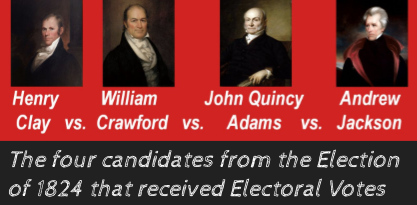
The candidates for the Election of 1824 were the first that didn’t have a direct role in the Revolutionary War, and by then it had become a political requirement for a candidate to portray himself as a man-of-the-people, both of which favored Jackson. The general let it be known that if he was drafted to run for President, he would do so. Meanwhile, those in Monroe’s 2nd Term Cabinet, Crawford (SecTreas), JQA (SecState), and Calhoun (SecWar), signaled their interest to run to their respective states, since it was a state that officially nominated a candidate (there were not nationally organized political parties yet).
What had changed by 1824 was that the voting requirements in most states had been liberalized, in that in essence one was eligible to vote if he was a white man. So for the first time in US History, Presidential candidates in 1824 had to campaign for votes. Crawford packaged himself as the candidate of the South, while JQA used the same strategy in the North. Calhoun was unable to inspire many voters into his fold, in that he was too intellectual for most voter. JQA was an intellectual as well, but he was able to attract voters in his region, while Crawford stole Calhoun’s thunder in the South. Henry Clay was also running for President in 1824, and he openly spoke on his own behalf as a candidate, which was something the other candidates did not do.
What had changed by 1824 was that the voting requirements in most states had been liberalized, in that in essence one was eligible to vote if he was a white man. So for the first time in US History, Presidential candidates in 1824 had to campaign for votes. Crawford packaged himself as the candidate of the South, while JQA used the same strategy in the North. Calhoun was unable to inspire many voters into his fold, in that he was too intellectual for most voter. JQA was an intellectual as well, but he was able to attract voters in his region, while Crawford stole Calhoun’s thunder in the South. Henry Clay was also running for President in 1824, and he openly spoke on his own behalf as a candidate, which was something the other candidates did not do.
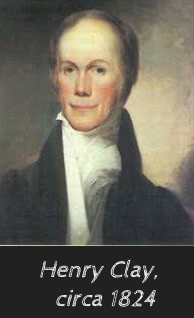
Clay had returned as Speaker in 1823, and by January 1824, Clay had resumed his efforts at nation-building with his American System. Clay had the advantage of giving what was, in effect, campaign speeches from the House floor while also reinforcing and building connections with members of Congress, the DC Elite, and powerful state level figures.
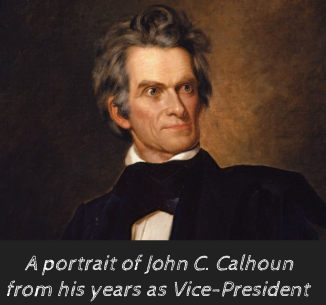
Clay did his best to keep the Republican (there was only one political party in 1824, the Party of Jefferson, who was still alive in 1824) caucus from selecting a candidate via a majority, and at the same time, Clay did his best to tear down Crawford. The Republican caucus did not nominate Crawford, and surveying the field of candidates, Clay predicted that no one would win a majority in the Electoral College. Republican state conventions were held, and in the Pennsylvania state Republican convention, Jackson garnerd 124 delegates to Calhoun’s 1. As a result, Calhoun started to focus on pursuing the Vice-Presidency in support of Jackson, which was what Clay had predicted Calhoun would do after losing badly in Pennsylvania.
Clay did his best to keep the Republican (there was only one political party in 1824, the Party of Jefferson, who was still alive in 1824) caucus from selecting a candidate via a majority, and at the same time, Clay did his best to tear down Crawford. The Republican caucus did not nominate Crawford, and surveying the field of candidates, Clay predicted that no one would win a majority in the Electoral College. Republican state conventions were held, and in the Pennsylvania state Republican convention, Jackson garnerd 124 delegates to Calhoun’s 1. As a result, Calhoun started to focus on pursuing the Vice-Presidency in support of Jackson, which was what Clay had predicted Calhoun would do after losing badly in Pennsylvania.
SecState JQA simply did not engage in the intriguing of SecWar Calhoun and SecTreas Crawford in pursuing the Presidency. JQA believed that the campaigns orchestrated by both men would cancel each other out to his benefit, which was apparently his sole strategy in that he didn’t have an organized campaign where he could attack other candidates and defend himself. JQA was especially bothered that Crawford and Calhoun used their Cabinet positions to enhance their bid for the Presidency instead of actually doing their job. JQA was quietly pleased when Calhoun’s campaign fizzled out.
During the Summer/Fall of 1824, Jackson gained momentum with the multitude of new eligible voters, and Crawford, the early frontrunner, suffered a stroke. New England was solidly behind JQA, but Clay had difficulty gaining support in the West due to Jackson’s popularity, and also in the South since Calhoun was running for Vice-President in support of Jackson. Of the 24 states, 18 allowed the popular vote to determine the state’s electors, while 6 states kept their electors under the control of their legislature.
During the Summer/Fall of 1824, Jackson gained momentum with the multitude of new eligible voters, and Crawford, the early frontrunner, suffered a stroke. New England was solidly behind JQA, but Clay had difficulty gaining support in the West due to Jackson’s popularity, and also in the South since Calhoun was running for Vice-President in support of Jackson. Of the 24 states, 18 allowed the popular vote to determine the state’s electors, while 6 states kept their electors under the control of their legislature.
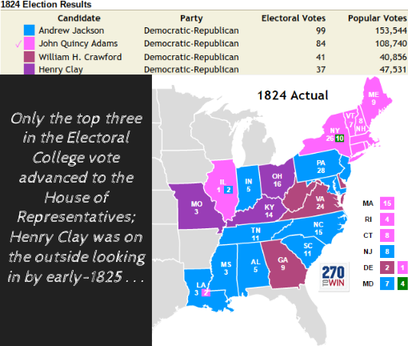
None of the four candidates (Jackson, JQA, Crawford, and Clay) received a majority in the Electoral College in the Election of 1824. But Clay’s fourth-place showing (37 Electoral Votes) proved significant, in that Clay would not be one of the top three candidates forwarded to the House of Representatives; if Clay had finished 3rd, almost certainly, given his clout/influence in the House, he would have been the next President.
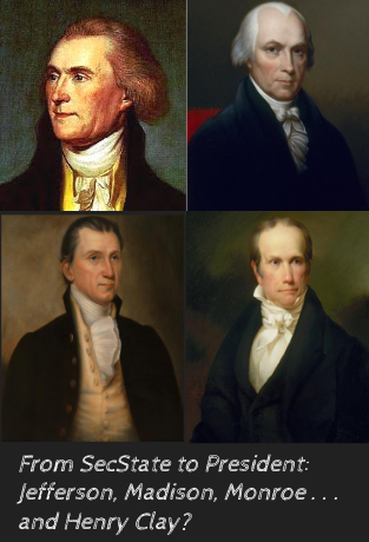
Clay focused his energies in the House to get JQA the necessary support, meaning 13 states, and in exchange, he would be JQA’s SecState, which had been the stepping-stone to the Presidency for Jefferson, Madison, and Monroe. Clay’s conscience was clear, and in addition he simply saw Jackson as a threat to the nation’s future; Clay had positioned himself, he believed, to become President in the next four to eight years.
The conscience of John Quincy Adams was not as clear as Clay’s, in that he viewed Clay’s strategy as nothing more than self-serving political shenanigans, and his opinion of Clay since Ghent hadn’t changed at all. However, it soon became clear to JQA that the only path he had to become President was through Clay. Then Calhoun indicated that he would throw his support behind the candidate that endorsed him as their Vice-President; so JQA faced a decision . . . would he deal with Clay or Calhoun or both?
By the time the Electoral Vote had officially been counted in the Senate, JQA decided he would go with Clay. The majority of the members of the House wanted an early resolution on the first ballot. JQA’s diary for the crucial day when Clay outlined his plan was left blank at the crucial juncture, and Clay didn’t keep a diary. However, Clay’s letters of that time frame show that his hopes of becoming President in 1824-25 had dimmed, and then evaporated he finished fourth in the Electoral College.
What hurt and irritated Clay was that he narrowly lost Louisiana (he suspected shenanigans had been afoot); had he won the state, he would have finished ahead of the still-incapacitated Crawford. In the House, Clay found himself under siege by backers of JQA, Crawford, and even Jackson had powerful friends in the chamber . . . such was Clay’s influence and power in the House of Representatives. In the end, Clay viewed JQA as the “safe” choice, and in addition he would be well-placed as SecState to win the Presidency in 1828 or 1832.
What hurt and irritated Clay was that he narrowly lost Louisiana (he suspected shenanigans had been afoot); had he won the state, he would have finished ahead of the still-incapacitated Crawford. In the House, Clay found himself under siege by backers of JQA, Crawford, and even Jackson had powerful friends in the chamber . . . such was Clay’s influence and power in the House of Representatives. In the end, Clay viewed JQA as the “safe” choice, and in addition he would be well-placed as SecState to win the Presidency in 1828 or 1832.
To Clay, Jackson’s military background bothered him the more he thought about it, and he referred to Jackson in many letters as a “Military Chieftain”. Sure enough, his label for Jackson found its way into the Washington National Intelligencer, after which it was only a matter of time until Jackson found out. Jackson arranged for one of his letters that criticized Clay to be leaked, where he pointed out that Clay had never been in the military to defend his nation, and therefore knew nothing about being a true patriot.
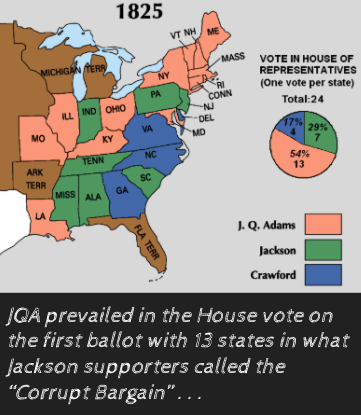
The pressure on Clay increased, so much so that one had to go back to the Burr-Hamilton Duel to find a situation where a public figure had so much pressure placed on him by another public figure. It became clear to Clay that Jackson and his supporters were thinking in the long term (e.g. 1828), as were all those not in support of JQA. John Quincy Adams was elected on the first ballot with 13 states, Jackson had 7 states, and Crawford had 4 states. Jackson’s supporters, as well as Jackson himself, were beyond-livid at the loss, and the blame and their full fury was focused on Clay.
The next day, JQA met with Clay and offered him SecState during a 30 minute conversation, and Clay thanked JQA and said he would think about the offer. Very soon thereafter, Clay accepted, knowing that the blowback would be a hurricane. News of the nomination sent the Jacksonians into a frenzy, and they labeled it the “Corrupt Bargain”, and repeated it so often that it became a mantra.
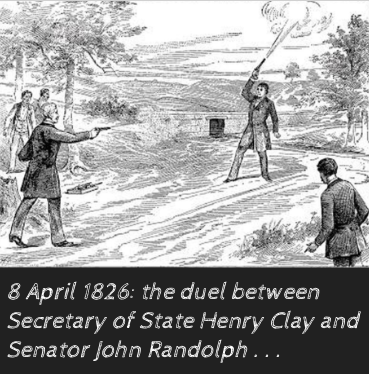
As SecState, Clay actually was in a duel with Senator John Randolph (VA) on 8 April 1826; Clay was told that Randolph impugned his honor in a speech in Congress. Each man fired three shots, with Randolph’s first shot fired into the ground due to the pistol’s hair-trigger, and Clay’s first shot missed (it’s not known if he intentionally missed). The second shots of both men also missed; it’s worth noting that Randolph was far more nervous and out-of-his-element compared to Clay during the duel.
Clay’s third shot went through Randolph’s coat but did not injure him, and Randolph fired into the air, and the duel was over. The only debt to be paid afterwards was that Clay had to purchase a new coat for Randolph, but the Affair of Honor had been settled. The duel had been witnessed by Senator Thomas Hart Benton (MO), who had been an intermediary for both men before and during the duel.
Clay’s third shot went through Randolph’s coat but did not injure him, and Randolph fired into the air, and the duel was over. The only debt to be paid afterwards was that Clay had to purchase a new coat for Randolph, but the Affair of Honor had been settled. The duel had been witnessed by Senator Thomas Hart Benton (MO), who had been an intermediary for both men before and during the duel.
