Source: H.W. Brands. Heirs of the Founders (2017)
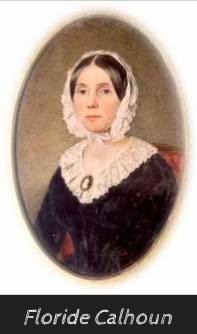
Floride Calhoun, rarely became involved in her husband’s political life, but the main exception to that was when she took an immediate dislike to Margaret Eaton during her husband’s swearing-in ceremony as Vice-President. Peggy Eaton was considered to be the most beautiful woman in DC, and she acted the part, drawing the attention of the DC men and the ire/hatred of the DC women.
Peggy and William Eaton hadn’t married until 1829, and before then they were an item until Peggy’s husband died. They married very soon afterwards, too soon as far as the Nashville/Tennessee and DC Elites were concerned. Since there was no First Lady, Floride was the DC tone-setter in terms of the social landscape; Floride refused to return a visit to Peggy Eaton, and the rest of the DC women followed her lead . . . “The Shunning" had started, and soon Jackson would enter the DC fracas on the side of SecWar Eaton and his wife.
Peggy and William Eaton hadn’t married until 1829, and before then they were an item until Peggy’s husband died. They married very soon afterwards, too soon as far as the Nashville/Tennessee and DC Elites were concerned. Since there was no First Lady, Floride was the DC tone-setter in terms of the social landscape; Floride refused to return a visit to Peggy Eaton, and the rest of the DC women followed her lead . . . “The Shunning" had started, and soon Jackson would enter the DC fracas on the side of SecWar Eaton and his wife.
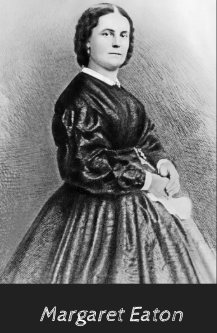
Floride saw herself as the defender of the family, and Peggy Eaton had carried on in a way up to her marriage that hadn’t been family-friendly enough for Floride and the DC women. In Floride’s point-of-view, she had taken a stand against indecency by shunning Peggy Eaton. Calhoun knew that Jackson was loyal to a fault, and that the William Eaton was in Jackson’s Circle of Trust, so he remained silent . . . but Floride’s boycott of the Eatons had spread throughout DC society, and soon DC was divided between “Team Floride” and “Team Peggy”. Cabinet meetings were unable to be held since the two camps refused to even be in the same room as the other . . . in the midst of the DC political machine shutting down, Jackson’s support of Peggy Eaton was unwavering.
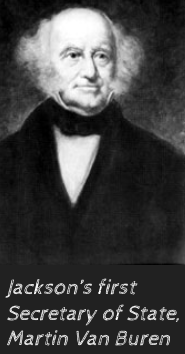
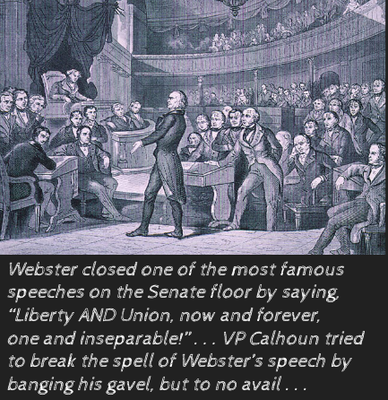
SecState Martin Van Buren joined Jackson on “Team Peggy”. MVB saw the great divide as an opportunity to ingratiate himself even further with Jackson. As far as Jackson was concerned, Calhoun was working against him on the Eaton Affair, indirectly using others to attack/distract him. The Eaton Affair was still in full bloom as Congress convened in 1830. The main issue before Congress was the Tariff of 1828, and the impact of Calhoun’s manifesto had been felt by then. The battle lines were drawn, and soon Senator Daniel Webster (MA) would be forced into the fray.
SecState Martin Van Buren joined Jackson on “Team Peggy”. MVB saw the great divide as an opportunity to ingratiate himself even further with Jackson. As far as Jackson was concerned, Calhoun was working against him on the Eaton Affair, indirectly using others to attack/distract him. The Eaton Affair was still in full bloom as Congress convened in 1830. The main issue before Congress was the Tariff of 1828, and the impact of Calhoun’s manifesto had been felt by then. The battle lines were drawn, and soon Senator Daniel Webster (MA) would be forced into the fray.
Calhoun assumed that Jackson would only serve (or last) a single term, believing like many others that the former general would want to return to Tennessee to tend to his wife’s grave and to deal w/ his myriad of health problems. In contrast, Calhoun was in top shape in his late-40s, and his eyes glowed, even changing color depending on his mood and/or the lighting. Calhoun was a strikingly impressive figure, and Calhoun simply saw himself as the next President, and he assumed that millions of Americans saw him in that light as well.
But Clay also saw himself as a future President, and his ambition was no secret. Even though Clay was in temporary political exile after the Election of 1828 (as was JQA until he was
elected to the House from his home district in MA), Clay knew he would return . . . he also knew he would stand in opposition to either Jackson or his successor. MVB also saw himself as a future President, and unlike Calhoun or Clay, he had good reason for that belief, since he was a rising star in DC in the Jackson administration.
One result of the Eaton Affair was that MVB emerged as Jackson’s logical successor, and MVB figured that he’d run and win in 1832, since of course Jackson would head back to TN. But as early as 1830, Jackson caught the “2nd Term Bug”, which forced MVB, Clay, and Calhoun to adjust their time frames. Calhoun and MVB had to decide whether to wait until 1836 or to challenge Jackson in 1832, and MVB decided to wait four years. Calhoun decided on 1832, which was more than somewhat logical in that the Vice-President was no longer in Jackson’s favor, since Jackson had blamed the Eaton Affair on Calhoun, and had seriously questioned his loyalty to the Union.
The rift between President and Vice-President became public in the Spring of 1830 during a celebration of Jefferson’s birthday on 13 April by the (no longer calling themselves Republicans) Democrats. After dinner came the toasts, with each toaster airing his beliefs, preferences, and grievances. Places were arranged for 100, but there was serious doubt as to whether all 100 invited Democrats would attend given the rancor over the Tariff of 1828. The
Webster-Hayne Debate earlier that year had clearly drawn the line between pro-Union and States’ Rights supporters.
But the immediate question was the attitudes that the President and Vice-President held towards each other. Both were to speak that night, and the air was electric with anticipation. As the 24 scheduled toasts unfolded, slowly the focus trended towards states’ rights. The unscheduled toasts were to follow, and President Jackson had the prerogative to deliver the first toast if he so chose.
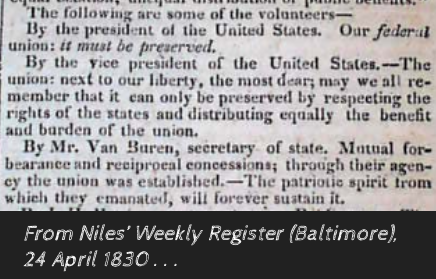
Jackson did not speak loudly, but his words had force, and they felt like rifle shots fired across the room: “Our Federal Union - it must be preserved”. That was all Jackson said, easily the shortest toast of the evening to that point. Everyone assumed that Jackson was just warming up, but the President sat down, and all heads swiveled to Calhoun. The Vice-President was in a position where he had to respond; up to that point, Calhoun had done all his talking via the written word, and semi-anonymously at that. Jackson had called out Calhoun in a political equivalent of challenging someone to a duel.
Calhoun simply could not match Jackson’s brevity/clarity, in large part due to the impossibility of communicating the essence of states’ rights in few words. Calhoun had prepared himself that night to respond on multiple fronts, since he didn’t know what Jackson would say, and he adjusted on the spot. Calhoun raised his glass and started to say “The Union . . .”; for a split second, it appeared to some that Calhoun had caved, but he continued. “ . . . next to our liberty the most dear”. Calhoun went on by stating that the rights of the states needed to be respected. Heads swiveled back to Jackson to see if he would counter with a toast of his own, but he did not, as was customary with toasts such as these. Also, Jackson knew better than to debate Calhoun, and Jackson simply let his statement stand as it was.
Calhoun simply could not match Jackson’s brevity/clarity, in large part due to the impossibility of communicating the essence of states’ rights in few words. Calhoun had prepared himself that night to respond on multiple fronts, since he didn’t know what Jackson would say, and he adjusted on the spot. Calhoun raised his glass and started to say “The Union . . .”; for a split second, it appeared to some that Calhoun had caved, but he continued. “ . . . next to our liberty the most dear”. Calhoun went on by stating that the rights of the states needed to be respected. Heads swiveled back to Jackson to see if he would counter with a toast of his own, but he did not, as was customary with toasts such as these. Also, Jackson knew better than to debate Calhoun, and Jackson simply let his statement stand as it was.
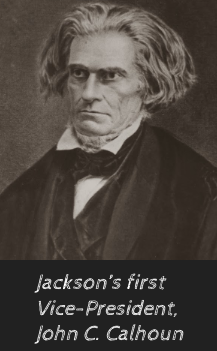
Jackson knew that Calhoun had been behind the Eaton Affair with Floride, and was behind the growing Nullification Crisis. But after the Jefferson Birthday Dinner, Jackson discovered that Calhoun, as SecWar during the Seminole campaign, had worked and spoke out against Jackson. Jackson knew that SecState JQA had defended him and his actions concerning Spanish Florida, and the general assumed that Calhoun had done so as well.
Two weeks after the diner, Jackson received a copy of a letter written by Crawford that such was not the case, in that Calhoun had wanted Jackson to be publicly punished and humiliated. In the letter, Crawford indicated that Calhoun had set him up to face the wrath of Jackson. Jackson sent a copy of the letter to Calhoun, demanding a response, this time calling out Calhoun in private. Jackson offered Calhoun a chance to explain himself and his actions; in the back of Jackson’s mind, he had wondered about Calhoun in the succeeding years, but now he had proof that he could not dismiss.
Jackson’s challenge to Calhoun was to disprove the charge if you can, but Calhoun could not do so, so he really didn’t bother to try. Calhoun refused to answer for his actions taken as SecWar; Calhoun understood that Jackson was using Calhoun to help launch his campaign for re-election in 1832 by slamming the door shut on Calhoun’s candidacy. Calhoun knew by then that the real audience was the American public, and so Calhoun, after stating that he wouldn’t defend his actions in public, of course did exactly that. In a series of long and tedious letters, Calhoun did his best tl defend his actions against Jackson as SecWar. Jackson publicly responded by, in effect, labeling Calhoun as a Brutus.
Clay monitored Calhoun’s dilemma with quiet satisfaction, since among those associated with Congress, Calhoun had worried Clay the most in terms of running against him for President. Between them, Calhoun was the first to be in the Cabinet, and then the first to win a national election (VP). Clay thought Calhoun was finished because he had been too clever for his own good, and too principled and unmoving with state’s rights. Clay had expected to run in 1832 against Calhoun or MVB, but then Jackson decided to run again, and by 1836 Clay would be almost 60 years old. The Democrats were splintering into factions, and Clay believed that worked to his advantage if he acted quickly.
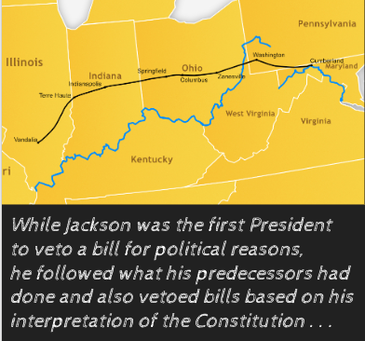
President Jackson had blocked and undermined Clay’s American System since he had entered office, with Jackson opposing protective tariffs and federally-funded internal improvements (e.g. roads). Clay saw Jackson’s hostile opposition to his American System as insulting and narrow-minded. Jackson had vetoed the Maysville Road Bill which would have greatly benefited Kentucky, and Jackson refused to support a bill that would in essence tax MA, whose roads were finished, to help a state like KY. To Jackson, even roads between states were for individual states to fund and build; Clay believed that Jackson would keep the US mired in the 18th Century.
President Jackson had blocked and undermined Clay’s American System since he had entered office, with Jackson opposing protective tariffs and federally-funded internal improvements (e.g. roads). Clay saw Jackson’s hostile opposition to his American System as insulting and narrow-minded. Jackson had vetoed the Maysville Road Bill which would have greatly benefited Kentucky, and Jackson refused to support a bill that would in essence tax MA, whose roads were finished, to help a state like KY. To Jackson, even roads between states were for individual states to fund and build; Clay believed that Jackson would keep the US mired in the 18th Century.
