Mr. Jensen's U.S. History Website
  • U.S. History Blog
    • U.S. History Blog (May 2026 - May 2027)
    • U.S. History Blog (May 2025 - May 2026)
    • U.S. History Blog (May 2024 - May 2025)
    • U.S. History Blog (May 2023 - May 2024)
    • U.S. History Blog (May 2022 - May 2023)
    • U.S. History Blog (May 2021 - May 2022)
    • U.S. History Blog (May 2020 - May 2021)
    • U.S. History Blog (May 2019 - May 2020)
    • U.S. History Blog (May 2018 - May 2019)
    • U.S. History Blog (May 2017 - May 2018)
    • U.S. History Blog (May 2016 - May 2017)
    • U.S. History Blog (May 2015 - May 2016)
    • U.S. History Blog (May, 2014 - May, 2015)
  • About

Henry Clay: The 2nd National Bank & The Election of 1832

7/25/2019

0 Comments

 
                        Source: H.W. Brands. Heirs of the Founders (2017)
Picture
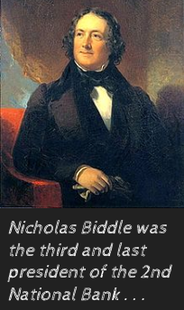
     It proved to be the 2nd National Bank of the United States, the third pillar of Clay’s American System, that would be the battleground between Clay and Jackson as the Election of 1832 approached. Clay’s support of the BUS (Bank of the US) was public, steadfast, and longstanding, while Jackson’s opposition was well-known, but recent. The President of the BUS, Nicholas Biddle, had spent years trying to educate Americans on the workings and benefits of banks, and now he tried to do the same with Jackson.
    Biddle had done his best to stay out of the political area and to keep his focus on the financial systems of the nation. If Biddle saw Jackson has uneducated in banks, Clay saw Biddle as naive in terms of politics, and Clay set out teach Biddle the ways of DC. The charter of the BUS was set to expire in 1836, and Jackson was intent on allowing the charter to run out. But the investors and customers of the BUS wanted reassurance that the institution would last beyond 1836, which led to support for an early renewal of the charter.

Picture
      In 1830, Clay counseled patience in regards to the charter’s early renewal, in large part because at that point Jackson hadn’t decided on running for a 2nd term. Clay told Biddle that pushing for an early renewal during the Campaign of 1832 might play into MVB’s hands, so the best strategy was to wait until after the election. But the general rise of the propaganda campaign in support of the BUS continued, and Congress appeared to be in support of the renewal. And then Jackson decided to run again in 1832, and Biddle now saw that patience was not a virtue in order to save the BUS, and Clay had reached that very same conclusion as well. To Clay and Biddle, the only hope was to press for the renewal of the BUS before the Election of 1832.
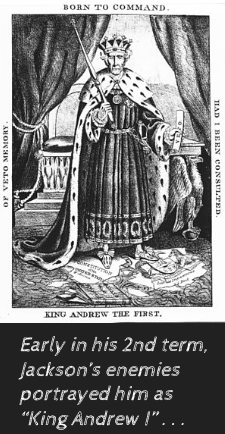
    Clay thought he could manage the renewal through Congress, and even though Jackson would veto the bill, the BUS would become an even greater campaign issue, and perhaps Jackson’s veto might cost him re-election. It was Clay’s only hope since Jackson looked to be virtually unbeatable, so getting Jackson to veto the BUS bill might not only politically damage Jackson, but his veto might create an anti-Jackson coalition that would support Clay. Clay didn’t show all his cards to Biddle, especially his knowledge of how Jackson would react to being openly challenged during the campaign.


Picture
     Senator Daniel Webster's interest in the BUS was different from Clay, but just as intense. Biddle paid Webster for legal work, which in effect meant that Biddle kept Webster on retainer as an advisor concerning the politics of the BUS. Webster kept speaking in the Senate on behalf of the BUS, and Biddle kept him on a retainer. Webster made it clear to Biddle that the retainer needed to remain ongoing. Webster told Biddle that there was strong support for the BUS renewal, and that it would be wise to start the process right away. So, on the separate advice from Clay and Webster, Biddle took the fateful step of starting the renewal of the charter of the 2nd National Bank of the United States in early-1832.
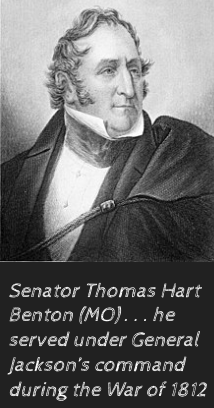
    Webster congratulated Biddle on his decision to do so and did his best to get the bill through the Senate. The enemies of the BUS were galvanized, and Senator Thomas Hart Benton (MO) called the BUS unconstitutional, immoral, and a conspiracy. Benton’s tirade played well in the West and among the vast majority of Jacksonians. However, Clay was able to get the votes in both houses to renew the charter of the BUS. The margin was comfortable in the House, but in the Senate is was a close call, which led to charges of bribery and shenanigans by the opponents of the BUS.

Picture
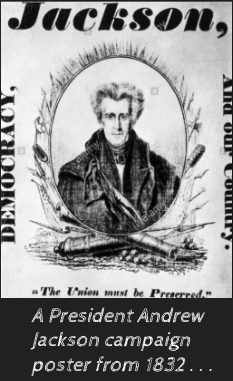
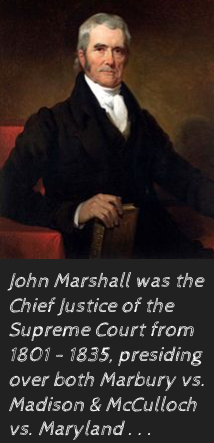
     All the while Jackson knew he was being “set up”. As far as Jackson was concerned, he hadn’t picked the fight; Clay was the aggressor seeking political gain. Jackson was not going to back down in the slightest way, and he vetoed the renewal bill, and he sent Congress a stern message why he had done so. Jackson argued that the BUS was unconstitutional. To Jackson, Marbury v. Madison (1803) and
McCulloch v. Maryland (1819) only meant that the lower courts had to follow the Supreme Court decisions, not Congress. Jackson stated that each branch of the government could have its own interpretation of the Constitution.

    Jackson simply didn’t believe that the “necessary and proper” clause authorized a national bank. In Jackson’s time, the precedent and practice of judicial review in the hands of the Supreme Court hadn’t yet been set in stone. Jackson’s statements against the BUS were bold, but not original. Jackson went on to say that the BUS was a monopoly that enriched its shareholders at the expense of regular Americans, which aggravated the nation’s inequalities.

Picture
     Webster knew the veto was coming, but he still appeared to be shocked, telling many that Jackson’s veto defied logic, law, and reason; in effect, Webster argued that Jackson had said, “I am the state”. Biddle was not surprised by the veto at all, but he wasn’t discouraged. Biddle felt that Jackson had cooled himself out of business with his veto message to Congress. Biddle also thought the veto would benefit Clay, who Biddle believed was the instrument of survival for the BUS. Clay however, understood that Jackson’s veto had solidified anti-Jackson sentiment in the predictable places, but among the growing number of “Average American” populist voters, the veto could do nothing but help Jackson.
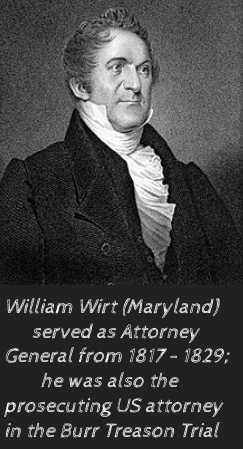
   1832 marked the first year of political party nominating conventions, and the Anti-Masons were first, nominating Maryland’s William Wirt (what Clay had done in terms of revolutionizing the role of Speaker, Wirt had done with the Cabinet post of Attorney General). The idea of a convention caught on, with the National Republicans nominating Clay . . . the Democrats (nee Republicans), had officially started to fracture apart. A convention of Jacksonians (now calling themselves Democrats for the first time), officially, nominated Jackson as President and MVB as VP.  The
Election of 1832 was not close, with Jackson tallying 219 Electoral Votes to Clay’s 49, and Jackson won 16 states to Clay’s 6 (Wirt carried one state, and a Nullification candidate carried South Carolina).

Picture
     To Jackson, Clay was despicable and corrupt, and that was that; not even his compromise concerning the Tariff of 1828 made a dent on Jackson’s negative opinion. The battle over the BUS continued into Jackson’s 2nd term. Clay and Biddle hoped to salvage something from the crisis that they knew they had created, thinking that if somehow the BUS outlasted Jackson, it would survive. But Jackson was determined to strike first and deliver the crushing blow to the BUS.
    Jackson calculated that the BUS would collapse if he
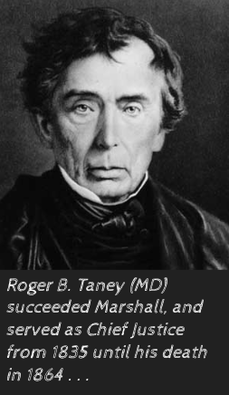
removed government deposits. Jackson had to remove SecTreas William Duane, who refused to remove the deposits, and moved Roger Taney (Attorney General) in as Acting SecTreas to do so. Biddle was neither alarmed nor surprised, knowing that the crisis would come to exactly that point. Biddle believed that he held the advantage using strategic bribes to keep the people in the BUS system that would not cooperate with Jackson’s goal of removing the deposits. At the same time, Biddle ordered the BUS to call in loans and to stop issuing loans. Biddle’s idea was that he would starve the economy of the money it needed to flourish; in essence, Biddle tried to show that the US could not possibly survive without the BUS.

Picture
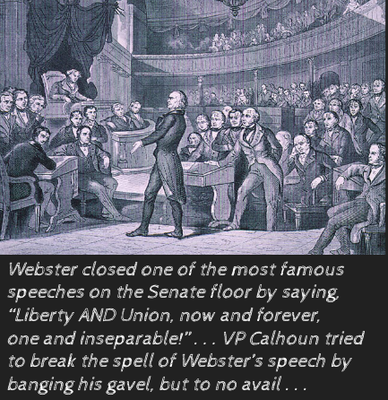
   Clay was not surprised at Jackson’s decision to remove government deposits from the BUS, but he was appalled. Clay formally asked the Senate to censure the President. In a speech on the Senate floor, Clay asserted that Jackson’s actions were a move to grab more power. Most of the Senators enthusiastically agreed with Clay, and Vice-President MVB (like VP Calhoun had tried to do after Webster’s spellbinding floor speech) tried to use his gavel to lessen the impact of Clay’s speech.
    Calhoun joined Clay in opposition to Jackson’s attempt to remove government deposits. Benton believed that Jackson was in the right, since he also distrusted banks. From the moment the deposits were removed, Benton observed that the BUS and Biddle were doing their best to create a crisis that would be to their advantage, especially Biddle’s squeeze on the money supply and credit. Jackson concluded that the shenanigans of the BUS were due to Clay and Biddle, and he viewed it as a personal challenge in that it was either his Presidency or the BUS. Jackson held Biddle responsible for the tactics, but he held Clay responsible for the overall strategy.

0 Comments

Clay, Calhoun, and Webster: The Tariff of 1828

7/22/2019

0 Comments

 
                             Source: H.W. Brands. Heirs of the Founders (2017)
Picture
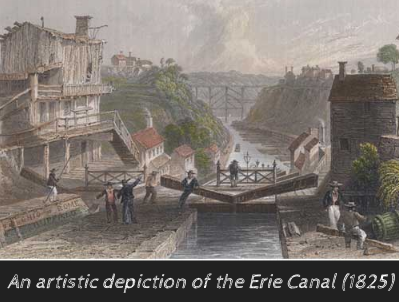
      The opening of the Erie Canal in 1825 in New York was the greatest thing to happen to that state to that point in US History. The Erie Canal transformed the economic geography of the eastern-half of the US, and in effect, Rochester NY became a city-of-the-world. The Erie Canal was 360 miles long (to the Hudson River), 40 feet wide, and 4 feet deep with dozens upon dozens of dams and locks. Transportation costs for such commodities as wheat, corn, pigs, and lumber decreased by 90%, and New York City supplanted New Orleans as America’s #1 port (NYC also eclipsed Philadelphia as America’s financial hub).
    To commemorate the opening of the Erie Canal, cannon fire salutes were carried out, with the next cannon firing after it heard the report from the cannon further up the canal. It took only 82 minutes for the last cannon in NYC to fire to end the sequence, which was to that point the most rapid long distance communication in history. NYC was the most delirious, suddenly finding itself the gateway to the American West. The opening of the Erie Canal started a series of events that would propel the US into the modern era, with the steam engine being used in steamboats and locomotives. The Industrial Revolution truly started in the US when steam power came to the nation’s factories.
    Costs of manufactured goods such as textiles were sharply reduced, which in turn generated more demand, which led to greater investment in new equipment; a continuing cycle of economic growth occurred in the North. In the South, however, the saving of labor held very little appeal, since slavery was a fixed, not a variable, cost. The Southern economy expanded, but only as a result of the increased cotton trade with foreign nations (and the North), not actual transformation. The South experienced additive growth, while the North went through multiplicative growth; by the mid-1820s, it became clear to any objective person that the South would fall behind the North in terms of population and wealth.

Picture
     Senator Daniel Webster (MA) spoke out against protectionism and in favor of free trade, knowing that the differing needs in the various regions of the globe led to reciprocal wants, which meant that free trade was a win-win for the US. Webster dismissed the popular notion advanced by Henry Clay (Speaker of the House) and the other protectionists that trade was a zero-sum game; Webster correctly stated that overall, free trade was a plus-sum game. Webster also pointed out that free trade wasn’t limited to trade between just two nations (bilateral trade).
    Protectionists stated that their main interest was to foster US industries, and to that Webster argued that navigation and commerce were already-existing industries that would be harmed by protectionism. Webster scoffed at the argument from protectionists that every dollar paid by and American for a foreign-produced good went to that specific foreign producer; Webster argued (not using these exact words) that a multiplier-effect was in play. Webster also dismissed the protectionist argument that US security would be improved by high tariffs in that self-sufficiency equaled greater security, and that the US would no longer be susceptible to a foreign power’s interference with US trade.
    Webster stated that it was free trade that had raised the stature of America in the eyes of the world, and protectionism would diminish that stature. Webster made sure his speech in favor of free trade was widely circulated in print, but before too long Webster wished he could take back every copy. Webster realized that while he was right about free trade economically, he had entered a world where protectionism and free trade had become politicized (much like the current debate on global warming), and that he had become politically very vulnerable with his constituents.


Picture
    As the Election of 1828 approached, both the Jacksonians and those supporting John Quincy Adams/Henry Clay fashioned tariff schedules and policies to their political views in order to garner votes, ignoring (or not knowing) the economic ramifications. What emerged from that political scrum was the Tariff of 1828, which raised the tariff on competing imports of US manufactured goods by 50%. Little thought was given to the American consumer who had to pay the increased cost of the imported good.
    The tariff drew strong support in the North due to the importance of industry in the region, and Northern support in Congress meant that the tariff would be enacted. Southerners felt that they had simply been used-and-abused, since there was no offsetting benefit for their region. There was also the prospect that Great Britain could retaliate by purchasing less cotton. The Tariff of 1828 served its main political purpose in undermining
John Quincy Adams' administration, while Andrew Jackson became a hero to both sides of the tariff debate in virtually every state. John Quincy Adams’ only hope in winning re-election in 1828 hinged with a possible coalition with New England and the South, but the Tariff of 1828 doomed that prospect.

    Webster was caught in the maelstrom of the tariff debate and almost politically drowned. Webster found himself moving towards partial protectionism due to the demands of his constituents in his district, even though doing so went against his economic beliefs/knowledge. In the end, the Tariff of 1828 strongly benefited and protected such New England industries as wool, which in theory would keep the South and the West addicted to New England’s wool industry for many decades to come.

Picture
     Webster agonized on how he would vote in the Senate on the tariff bill, in that his free trade conscience wrestled with his political ambitions. Webster dreaded the possibility that his vote could be the deciding vote, and he felt that the eyes of the nation were upon him. After the Tariff of 1828 became law, Webster rationalized his vote in favor of the tariff, saying he was glad New England benefited, but in the future changes would have to be made.
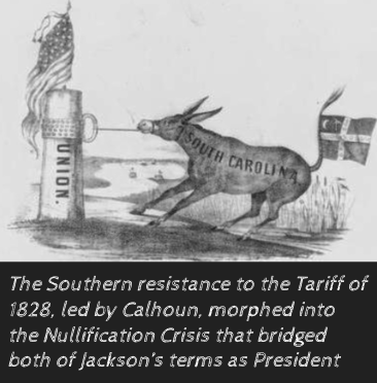
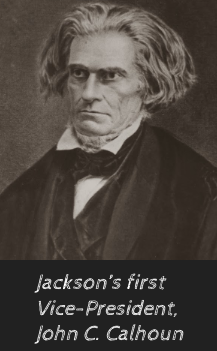
    To Vice-President John C. Calhoun (SC), it was the sectionalism of the vote in both houses of Congress that rankled him. The VP had nothing against protectionism in the abstract, but as far as Calhoun was concerned, the Tariff of 1828 was a sword that the North had swung against the South. Calhoun had witnessed the glee that emanated from Northern members of Congress as they worked the tariff through the legislative process. Soon, Calhoun and the South referred to the Tariff of 1828 as the “Tariff of Abominations”.
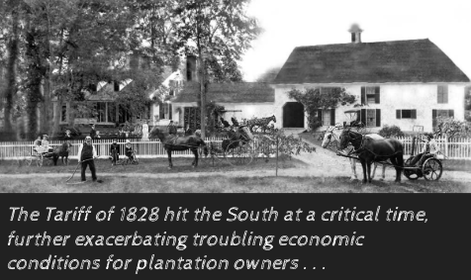
    Calhoun noted that the tariff hit the South at a very vulnerable time, in that the textile industry in the North had rebounded from the Panic of 1819, and cotton prices had soared which led to Southern planters borrowing more money to plant/cultivate/harvest more cotton on additional lands. Planters in other cotton producing nations had done the same, and the price of a bale of cotton in the world market plummeted from the resulting glut, falling 2/3’s between 1828 and 1828.  Sugar and rice planters were not affected, but cotton planters were hit hard, over their heads in debt. The Tariff of 1828 made hard times even worse in the South, and Southerners were desperate to find someone to blame for their misfortune. Proud Southerners such as Calhoun simply wouldn’t stand for that treatment, and as far as the South was concerned, the North had declared economic warfare on their region.


Picture
     During the Summer of 1828, South Carolina voiced their resistance to Northern tyranny, seeing the North as the “New Great Britain in Town”, and their resistance akin to that of the Patriots during the Revolutionary War Era. South Carolina sought a single voice to air their grievances, and VP Calhoun was their man. Calhoun soon wrote a manifesto of over 35,000 words, but unlike Webster, he didn’t publish right away, since Calhoun knew his words could have unintended consequences concerning the Election of 1828; in no way did Calhoun want President John Quincy Adams to win re-election.
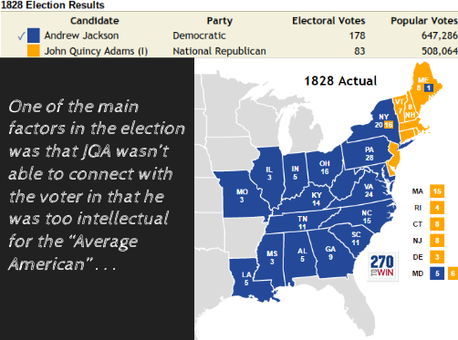
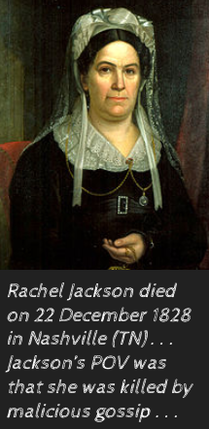
   Calhoun knew he couldn’t overcome the tidal wave of support behind Jackson, so once again Calhoun ran for Vice-President and again easily prevailed in the Electoral College. The Campaign of 1828 was easily the nastiest to that point in US History, with Clay behind much of the anti-Jackson attacks. In a Kentucky newspaper, Rachel Jackson was referred to as a “dirty black wench” . . . Jackson seethed. In the end, Jackson won by a large margin in the Electoral College, 178 to 83 over JQA, and Jackson saw the result as confirmation of the rising tide of democracy. Soon thereafter, Jacksonians started to call themselves Democrats, and not only did the Average American elect Jackson as President, but the Democrats also had a majority in both houses in Congress.

Picture
     After the election (while Rachel was dying with Jackson at her side), Calhoun released his manifesto against the Tariff of 1828. Calhoun’s name was not on the document; instead, prominent South Carolinians signed lengthy diatribe. Calhoun didn’t want his name on the document since he believed his arguments needed to stand on their own merits, and that as VP it would have been unseemly to be seen arguing against federal law.
    Additionally, Thomas Jefferson had withheld his identity as the author of the Kentucky Resolution in 1799, and Calhoun figured that was good for Jefferson was good for him. Calhoun argued that the Tariff of 1828 was unconstitutional, in that it went beyond the powers granted to the federal government in the Constitution. The power to tax was for revenue, Calhoun argued, not for protecting/promoting the commerce of one region of a nation over another. Calhoun also argued that the Tariff of 1828 would actually lead to less revenue for the federal government.

Picture
   Calhoun stated that there was nothing to keep the North from raising the price of goods they sold to the South, while the South had no comparable advantage. Also, Southern cotton growers may lose their global market share, perhaps permanently. According to Calhoun, the only power to counter the Tariff of 1828 was the power of the states, and that the arguments of Jefferson and Madison in the Kentucky & Virginia Resolutions were still valid.
    Calhoun went on to say that a state such as South Carolina could declare a federal law null and void in their state. Calhoun admitted that the Constitution didn’t give a state the right to review/interpret federal law, but neither did the Constitution give the Supreme Court that right. Yet the Court asserted for themselves the right to interpret the Constitution in terms of Acts of Congress, and the states should have that same right, Calhoun stated. Calhoun also argued that the states had a much greater argument in their favor compared to the Supreme Court due to the 10th Amendment.

0 Comments

Clay & Calhoun: The Eaton Affair and DC Politics

7/18/2019

0 Comments

 
                         Source: H.W. Brands. Heirs of the Founders (2017)
Picture
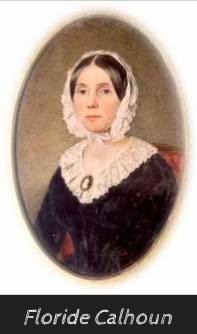
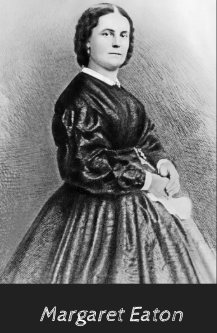
     Floride Calhoun, rarely became involved in her husband’s political life, but the main exception to that was when she took an immediate dislike to Margaret Eaton during her husband’s swearing-in ceremony as Vice-President. Peggy Eaton was considered to be the most beautiful woman in DC, and she acted the part, drawing the attention of the DC men and the ire/hatred of the DC women.
    Peggy and William Eaton hadn’t married until 1829, and before then they were an item until Peggy’s husband died. They married very soon afterwards, too soon as far as the Nashville/Tennessee and DC Elites were concerned. Since there was no First Lady, Floride was the DC tone-setter in terms of the social landscape; Floride refused to return a visit to Peggy Eaton, and the rest of the DC women followed her lead . . . “The Shunning" had started, and soon Jackson would enter the DC fracas on the side of SecWar Eaton and his wife.

Picture
     Floride saw herself as the defender of the family, and Peggy Eaton had carried on in a way up to her marriage that hadn’t been family-friendly enough for Floride and the DC women. In Floride’s point-of-view, she had taken a stand against indecency by shunning Peggy Eaton. Calhoun knew that Jackson was loyal to a fault, and that the William Eaton was in Jackson’s Circle of Trust, so he remained silent . . . but Floride’s boycott of the Eatons had spread throughout DC society, and soon DC was divided between “Team Floride” and “Team Peggy”.  Cabinet meetings were unable to be held since the two camps refused to even be in the same room as the other . . . in the midst of the DC political machine shutting down, Jackson’s support of Peggy Eaton was unwavering.
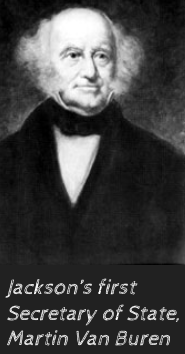
    SecState Martin Van Buren joined Jackson on “Team Peggy”. MVB saw the great divide as an opportunity to ingratiate himself even further with Jackson. As far as Jackson was concerned, Calhoun was working against him on the Eaton Affair, indirectly using others to attack/distract him. The Eaton Affair was still in full bloom as Congress convened in 1830. The main issue before Congress was the Tariff of 1828, and the impact of Calhoun’s manifesto had been felt by then. The battle lines were drawn, and soon Senator Daniel Webster (MA) would be forced into the fray.

Picture
      Calhoun assumed that Jackson would only serve (or last) a single term, believing like many others that the former general would want to return to Tennessee to tend to his wife’s grave and to deal w/ his myriad of health problems. In contrast, Calhoun was in top shape in his late-40s, and his eyes glowed, even changing color depending on his mood and/or the lighting. Calhoun was a strikingly impressive figure, and Calhoun simply saw himself as the next President, and he assumed that millions of Americans saw him in that light as well.
    But Clay also saw himself as a future President, and his ambition was no secret. Even though Clay was in temporary political exile after the Election of 1828 (as was JQA until he was
elected to the House from his home district in MA), Clay knew he would return . . . he also knew he would stand in opposition to either Jackson or his successor. MVB also saw himself as a future President, and unlike Calhoun or Clay, he had good reason for that belief, since he was a rising star in DC in the Jackson administration.

Picture
     One result of the Eaton Affair was that MVB emerged as Jackson’s logical successor, and MVB figured that he’d run and win in 1832, since of course Jackson would head back to TN. But as early as 1830, Jackson caught the “2nd Term Bug”, which forced MVB, Clay, and Calhoun to adjust their time frames. Calhoun and MVB had to decide whether to wait until 1836 or to challenge Jackson in 1832, and MVB decided to wait four years. Calhoun decided on 1832, which was more than somewhat logical in that the Vice-President was no longer in Jackson’s favor, since Jackson had blamed the Eaton Affair on Calhoun, and had seriously questioned his loyalty to the Union.
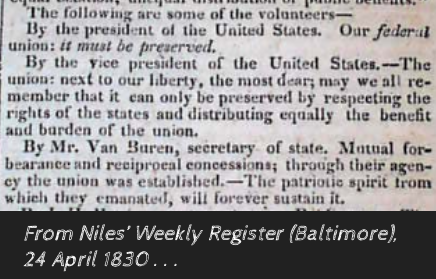
   The rift between President and Vice-President became public in the Spring of 1830 during a celebration of Jefferson’s birthday on 13 April by the (no longer calling themselves Republicans) Democrats. After dinner came the toasts, with each toaster airing his beliefs, preferences, and grievances. Places were arranged for 100, but there was serious doubt as to whether all 100 invited Democrats would attend given the rancor over the Tariff of 1828. The
Webster-Hayne Debate earlier that year had clearly drawn the line between pro-Union and States’ Rights supporters.

    But the immediate question was the attitudes that the President and Vice-President held towards each other. Both were to speak that night, and the air was electric with anticipation. As the 24 scheduled toasts unfolded, slowly the focus trended towards states’ rights. The unscheduled toasts were to follow, and President Jackson had the prerogative to deliver the first toast if he so chose.   

Picture
     Jackson did not speak loudly, but his words had force, and they felt like rifle shots fired across the room: “Our Federal Union - it must be preserved”. That was all Jackson said, easily the shortest toast of the evening to that point. Everyone assumed that Jackson was just warming up, but the President sat down, and all heads swiveled to Calhoun. The Vice-President was in a position where he had to respond; up to that point, Calhoun had done all his talking via the written word, and semi-anonymously at that. Jackson had called out Calhoun in a political equivalent of challenging someone to a duel.
    Calhoun simply could not match Jackson’s brevity/clarity, in large part due to the impossibility of communicating the essence of states’ rights in few words. Calhoun had prepared himself that night to respond on multiple fronts, since he didn’t know what Jackson would say, and he adjusted on the spot. Calhoun raised his glass and started to say “The Union . . .”; for a split second, it appeared to some that Calhoun had caved, but he continued. “ . . . next to our liberty the most dear”. Calhoun went on by stating that the rights of the states needed to be respected. Heads swiveled back to Jackson to see if he would counter with a toast of his own, but he did not, as was customary with toasts such as these. Also, Jackson knew better than to debate Calhoun, and Jackson simply let his statement stand as it was.

Picture
    Jackson knew that Calhoun had been behind the Eaton Affair with Floride, and was behind the growing Nullification Crisis. But after the Jefferson Birthday Dinner, Jackson discovered that Calhoun, as SecWar during the Seminole campaign, had worked and spoke out against Jackson. Jackson knew that SecState JQA had defended him and his actions concerning Spanish Florida, and the general assumed that Calhoun had done so as well.
    Two weeks after the diner, Jackson received a copy of a letter written by Crawford that such was not the case, in that Calhoun had wanted Jackson to be publicly punished and humiliated. In the letter, Crawford indicated that Calhoun had set him up to face the wrath of Jackson. Jackson sent a copy of the letter to Calhoun, demanding a response, this time calling out Calhoun in private. Jackson offered Calhoun a chance to explain himself and his actions; in the back of Jackson’s mind, he had wondered about Calhoun in the succeeding years, but now he had proof that he could not dismiss.
    Jackson’s challenge to Calhoun was to disprove the charge if you can, but Calhoun could not do so, so he really didn’t bother to try. Calhoun refused to answer for his actions taken as SecWar; Calhoun understood that Jackson was using Calhoun to help launch his campaign for re-election in 1832 by slamming the door shut on Calhoun’s candidacy. Calhoun knew by then that the real audience was the American public, and so Calhoun, after stating that he wouldn’t defend his actions in public, of course did exactly that. In a series of long and tedious letters, Calhoun did his best tl defend his actions against Jackson as SecWar. Jackson publicly responded by, in effect, labeling Calhoun as a Brutus.

Picture
     Clay monitored Calhoun’s dilemma with quiet satisfaction, since among those associated with Congress, Calhoun had worried Clay the most in terms of running against him for President. Between them, Calhoun was the first to be in the Cabinet, and then the first to win a national election (VP). Clay thought Calhoun was finished because he had been too clever for his own good, and too principled and unmoving with state’s rights. Clay had expected to run in 1832 against Calhoun or MVB, but then Jackson decided to run again, and by 1836 Clay would be almost 60 years old. The Democrats were splintering into factions, and Clay believed that worked to his advantage if he acted quickly.
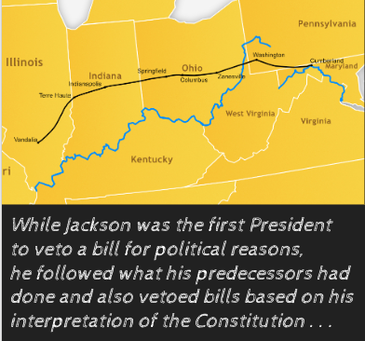
    President Jackson had blocked and undermined Clay’s American System since he had entered office, with Jackson opposing protective tariffs and federally-funded internal improvements (e.g. roads). Clay saw Jackson’s hostile opposition to his American System as insulting and narrow-minded. Jackson had vetoed the Maysville Road Bill which would have greatly benefited Kentucky, and Jackson refused to support a bill that would in essence tax MA, whose roads were finished, to help a state like KY. To Jackson, even roads between states were for individual states to fund and build; Clay believed that Jackson would keep the US mired in the 18th Century.


0 Comments

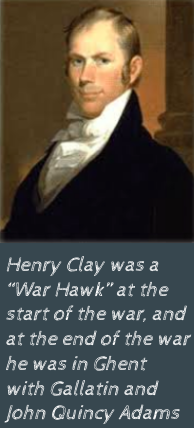
Henry Clay: The Election of 1824

7/9/2019

0 Comments

 
                           Source: H.W. Brands. Heirs of the Founders (2017)
Picture
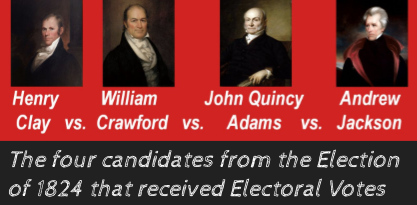
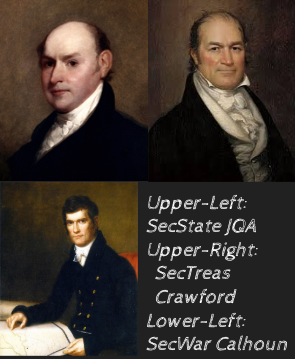
     The candidates for the Election of 1824 were the first that didn’t have a direct role in the Revolutionary War, and by then it had become a political requirement for a candidate to portray himself as a man-of-the-people, both of which favored Jackson. The general let it be known that if he was drafted to run for President, he would do so. Meanwhile, those in Monroe’s 2nd Term Cabinet, Crawford (SecTreas), JQA (SecState), and Calhoun (SecWar), signaled their interest to run to their respective states, since it was a state that officially nominated a candidate (there were not nationally organized political parties yet).
    What had changed by 1824 was that the voting requirements in most states had been liberalized, in that in essence one was eligible to vote if he was a white man. So for the first time in US History, Presidential candidates in 1824 had to campaign for votes. Crawford packaged himself as the candidate of the South, while JQA used the same strategy in the North. Calhoun was unable to inspire many voters into his fold, in that he was too intellectual for most voter. JQA was an intellectual as well, but he was able to attract voters in his region, while Crawford stole Calhoun’s thunder in the South. Henry Clay was also running for President in 1824, and he openly spoke on his own behalf as a candidate, which was something the other candidates did not do.

Picture
     Clay had returned as Speaker in 1823, and by January 1824, Clay had resumed his efforts at nation-building with his American System. Clay had the advantage of giving what was, in effect, campaign speeches from the House floor while also reinforcing and building connections with members of Congress, the DC Elite, and powerful state level figures.
    Clay did his best to keep the Republican (there was only one political party in 1824, the Party of Jefferson, who was still alive in 1824) caucus from selecting a candidate via a majority, and at the same time, Clay did his best to tear down Crawford. The Republican caucus did not nominate Crawford, and surveying the field of candidates, Clay predicted that no one would win a majority in the Electoral College. Republican state conventions were held, and in the Pennsylvania state Republican convention, Jackson garnerd 124 delegates to Calhoun’s 1. As a result, Calhoun started to focus on pursuing the Vice-Presidency in support of Jackson, which was what Clay had predicted Calhoun would do after losing badly in Pennsylvania.

Picture
     SecState JQA simply did not engage in the intriguing of SecWar Calhoun and SecTreas Crawford in pursuing the Presidency. JQA believed that the campaigns orchestrated by both men would cancel each other out to his benefit, which was apparently his sole strategy in that he didn’t have an organized campaign where he could attack other candidates and defend himself. JQA was especially bothered that Crawford and Calhoun used their Cabinet positions to enhance their bid for the Presidency instead of actually doing their job.  JQA was quietly pleased when Calhoun’s campaign fizzled out.
    During the Summer/Fall of 1824, Jackson gained momentum with the multitude of new eligible voters, and Crawford, the early frontrunner, suffered a stroke. New England was solidly behind JQA, but Clay had difficulty gaining support in the West due to Jackson’s popularity, and also in the South since Calhoun was running for Vice-President in support of Jackson. Of the 24 states, 18 allowed the popular vote to determine the state’s electors, while 6 states kept their electors under the control of their legislature.

Picture
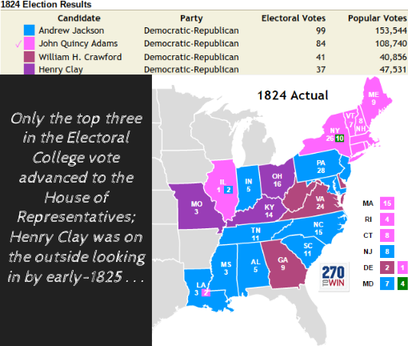
     None of the four candidates (Jackson, JQA, Crawford, and Clay) received a majority in the Electoral College in the Election of 1824. But Clay’s fourth-place showing (37 Electoral Votes) proved significant, in that Clay would not be one of the top three candidates forwarded to the House of Representatives; if Clay had finished 3rd, almost certainly, given his clout/influence in the House, he would have been the next President.
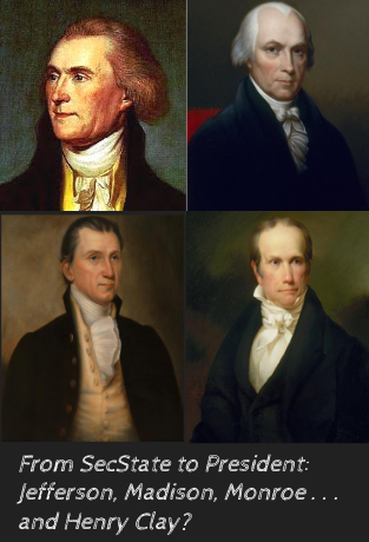
    Clay focused his energies in the House to get JQA the necessary support, meaning 13 states, and in exchange, he would be JQA’s SecState, which had been the stepping-stone to the Presidency for Jefferson, Madison, and Monroe. Clay’s conscience was clear, and in addition he simply saw Jackson as a threat to the nation’s future; Clay had positioned himself, he believed, to become President in the next four to eight years.
    The conscience of John Quincy Adams  was not as clear as Clay’s, in that he viewed Clay’s strategy as nothing more than self-serving political shenanigans, and his opinion of Clay since Ghent hadn’t changed at all. However, it soon became clear to JQA that the only path he had to become President was through Clay. Then Calhoun indicated that he would throw his support behind the candidate that endorsed him as their Vice-President; so JQA faced a decision . . . would he deal with Clay or Calhoun or both?

Picture
     By the time the Electoral Vote had officially been counted in the Senate, JQA decided he would go with Clay. The majority of the members of the House wanted an early resolution on the first ballot. JQA’s diary for the crucial day when Clay outlined his plan was left blank at the crucial juncture, and Clay didn’t keep a diary. However, Clay’s letters of that time frame show that his hopes of becoming President in 1824-25 had dimmed, and then evaporated he finished fourth in the Electoral College.
    What hurt and irritated Clay was that he narrowly lost Louisiana (he suspected shenanigans had been afoot); had he won the state, he would have finished ahead of the still-incapacitated Crawford. In the House, Clay found himself under siege by backers of JQA, Crawford, and even Jackson had powerful friends in the chamber . . . such was Clay’s influence and power in the House of Representatives. In the end, Clay viewed JQA as the “safe” choice, and in addition he would be well-placed as SecState to win the Presidency in 1828 or 1832.

Picture
    To Clay, Jackson’s military background bothered him the more he thought about it, and he referred to Jackson in many letters as a “Military Chieftain”.  Sure enough, his label for Jackson found its way into the Washington National Intelligencer, after which it was only a matter of time until Jackson found out. Jackson arranged for one of his letters that criticized Clay to be leaked, where he pointed out that Clay had never been in the military to defend his nation, and therefore knew nothing about being a true patriot.
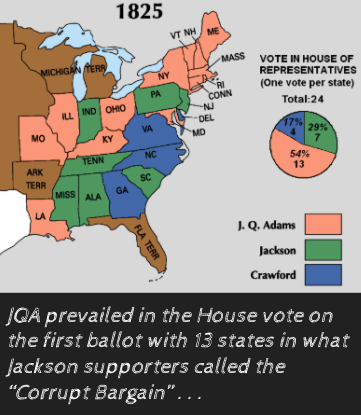
    The pressure on Clay increased, so much so that one had to go back to the Burr-Hamilton Duel to find a situation where a public figure had so much pressure placed on him by another public figure. It became clear to Clay that Jackson and his supporters were thinking in the long term (e.g. 1828), as were all those not in support of JQA. John Quincy Adams was elected on the first ballot with 13 states, Jackson had 7 states, and Crawford had 4 states. Jackson’s supporters, as well as Jackson himself, were beyond-livid at the loss, and the blame and their full fury was focused on Clay.
    The next day, JQA met with Clay and offered him SecState during a 30 minute conversation, and Clay thanked JQA and said he would think about the offer. Very soon thereafter, Clay accepted, knowing that the blowback would be a hurricane. News of the nomination sent the Jacksonians into a frenzy, and they labeled it the “Corrupt Bargain”, and repeated it so often that it became a mantra.

Picture
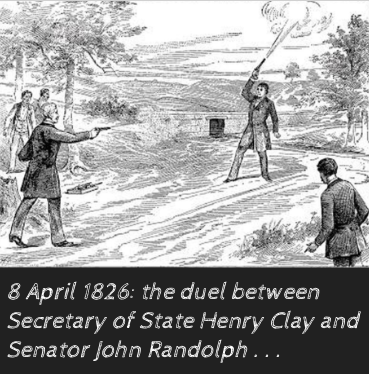
     As SecState, Clay actually was in a duel with Senator John Randolph (VA) on 8 April 1826; Clay was told that Randolph impugned his honor in a speech in Congress. Each man fired three shots, with Randolph’s first shot fired into the ground due to the pistol’s hair-trigger, and Clay’s first shot missed (it’s not known if he intentionally missed). The second shots of both men also missed; it’s worth noting that Randolph was far more nervous and out-of-his-element compared to Clay during the duel.
    Clay’s third shot went through Randolph’s coat but did not injure him, and Randolph fired into the air, and the duel was over. The only debt to be paid afterwards was that Clay had to purchase a new coat for Randolph, but the Affair of Honor had been settled. The duel had been witnessed by Senator Thomas Hart Benton (MO), who had been an intermediary for both men before and during the duel.

0 Comments

Henry Clay & John C. Calhoun: Missouri and Florida

7/1/2019

0 Comments

 
                       Source: H.W. Brands. Heirs of the Founders (2018)
Picture
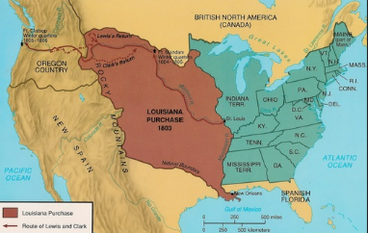
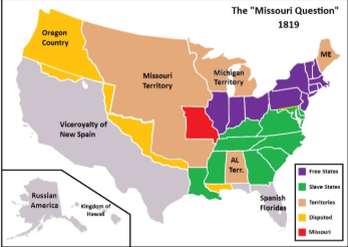
     Missouri was the first territory from the Louisiana Purchase to become a state after Louisiana, which had been added as a slave state in noncontroversial fashion, but not so with Missouri. Both Northerners and Southerners viewed the potential state as a valuable and strategic addition to their own region, at the expense of the other. Slavery was legal in the Missouri Territory, and slaveholders dominated the territory’s politics.
    Congressman James Tallmadge (NY) introduced a bill that would grant Missouri status as a slave state, However, his bill would ban new slaves from entering the state and freedom for existing slaves when they reached the age of 25. To Tallmadge, Missouri could enter as a slave state, but slavery would soon disappear. The Tallmadge Amendment passed the House of Representatives since Northerners outnumbered Southerners, but it stalled in the Senate.
    Southern Senators argued that the amendment was unconstitutional, in that the Constitution in no way gave power to Congress to restrict slavery in the states. As a result, Missouri was not added as a state in 1819, but the territory continued to grow, as did the pressure to find a compromise. The “Missouri Question” was all Washington, D.C. could think about as 1820 dawned.

Picture
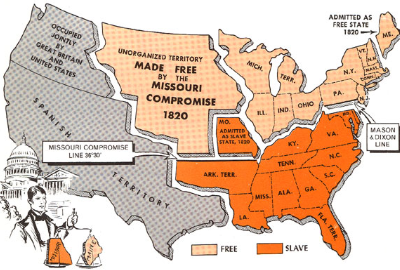
     The compromise that Henry Clay had in mind revolved around Maine, which in a case of excellent timing wanted to be rid of Massachusetts. To Clay, adding Missouri and Maine as states together would make the North and South happy and unhappy all at once, which was usually the sign of an excellent compromise.  Clay’s real problem was dealing with the Tallmadge Amendment, where Clay argued it was not only imprudent, but also unconstitutional. Clay argued that when slavery had to compete against free white labor, slavery would lose, which would advance the reality of emancipation.
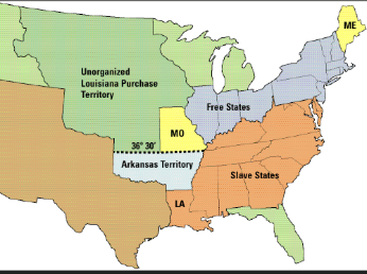
    Clay also in essence scolded the North, arguing that their resistance only emboldened the South. It’s possible that not even Clay truly believed his arguments, and he didn’t change many, if any, minds, but he believed he had put a gloss of respectability on his upcoming compromise. Clay had the Senate go first, and they voted to add Missouri and Maine as states in mid-February 1820, The Senate also voted to allow Missouri to write a state constitution without any restrictions on slavery. An amendment by Senator Jesse Thomas (OH) introduced the 36 Degrees, 30 Minutes North (36/30) concept, which was approximately at the mouth of the Ohio River. Under his 36/30 proposal, states south of the line would be slave states, and north of the line free states, which would in theory keep balance in the Senate between North and South.  Under the proposed amendment, Missouri was the only exception to 36/30.


Picture
      Northern Senators believed that they were giving away very little by voting for 36/30, and even better, they could claim political victory to the opponents of slavery. The Thomas Amendment of 36/30 benefited Clay the most, politically, and Clay believed he could shepherd the various versions of the bill from both houses through the Conference Committee. And Clay did just that: the South gained an unrestricted slave state with Missouri as well as the lower portion of the Louisiana Territory. The North gained a free state in Maine and the upper Louisiana Territory; to Clay, 36/30 was a solution that would last for decades.
    But there were growing voices that opposed any possibility of the expansion of slavery in the West, and Southern zealots were all-in on making sure there were no restrictions on the spread of slavery towards the West. What Clay had bought the US was time, where he hoped the issue of slavery could be decided (peacefully), before the nation expanded all the way to the Pacific Ocean.


Picture
     A panic in 1819 took hold of the nation’s financial system, which caused an economic depression that affected the West the most. A distressed population demanded relief from both state and federal levels of government. Clay held bad debts during the depression which left him exposed when his debtors defaulted. Clay liquidated property, but it wasn’t enough, and he concluded that he couldn’t afford to remain in politics, which meant he wouldn’t run for re-election in his Congressional district in 1820.
    Clay tried to think of ways to get back his fortune, or at the very least stay out of debtors’ prison, and he formed a new law practice in Lexington (KY). Clay even resigned as Speaker before his term in the House ended, but the House floundered as a result, since the chamber was used to his leadership. As a result, the still pending Missouri Compromise seemed to be on the verge of unraveling. So Clay came to the rescue, getting himself appointed to chair a special committee to deal with the “Missouri Problem”. Then came the issue of whether Missouri’s three Electoral Votes in the Election of 1820 actually counted, since technically Missouri was not yet a state.

Picture
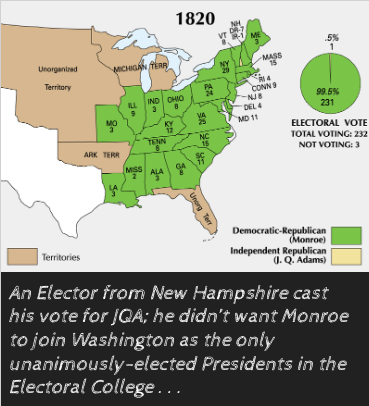
    Clay’s electoral compromise proposal was that two Electoral Vote totals be tallied, one with Missouri, and the other not counting Missouri. Clay knew that Monroe would win re-election by a large margin (the Election of 1820 was the last “closed” Elector election, and Monroe received all but one of the Electoral Votes, with JQA receiving the single vote), so then both totals would be forwarded to and from the Senate in order to certify the election. Both houses approved Clay’s compromise, but while the compromise didn’t fan the flames, it didn’t dissipate hard feelings either.
    Eventually the House and the Senate agreed to admit Missouri as a state on the condition that Missouri’s legislature never adopt legislation abridging the rights of any citizens from any other state, and the votes were close, with the hardliners from both the North and South seeing the situation as intolerable. Missouri gave in, but in the same breath the state legislature denied that Congress had the authority to restrict them in that manner. Clay didn’t care about the close margins, only that the Missouri Compromise, as it became to be called, passed . . . the crisis had passed, but not the underlying causes, or danger.


Picture
    John C. Calhoun became President James Monroe’s Secretary of War because Clay simply refused to accept the post. Monroe sought regional balance in his Cabinet: John Quincy Adams of Massachusetts (SecState), William Crawford of Georgia (SecTreas), and to honor the West, Clay from Kentucky as SecWar. But Clay actually declined the position even before it was officially offered by Monroe. Clay almost certainly would have accepted SecState, and most likely SecTreas, but to Clay, SecWar looked to be the political equivalent of a backwater posting in the military.
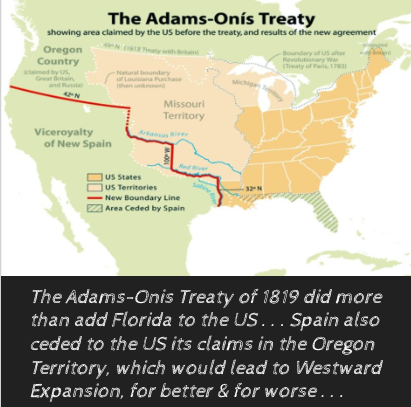
    Monroe considered Andrew Jackson, but the general wanted to remain in the field. Monroe settled on South Carolina’s Calhoun, who was seen as not much more than a proxy for Clay by 1820. Where Clay saw SecWar as an insult, Calhoun saw the Cabinet position as a great opportunity. But Calhoun had no idea what he was getting into, especially with General Jackson. Jackson continued to see Spain in Florida as a threat, and as harborers for the Seminoles . . . so Jackson thought, why not just take Florida from Spain? Monroe reached the same conclusion, albeit more slowly than Jackson. But the crux of the matter was that the President and the nation’s most famous general knew that Florida would need to be taken from Spain by force.

Picture
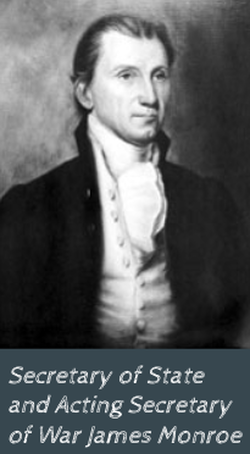
      President Monroe authorized JQA to pursue the diplomatic possibility of gaining Florida from Spain via negotiations or purchase. At the same time, Monroe indirectly encouraged Jackson to flex his military muscles to show that Spain had no way to control or secure Florida. Jackson’s plan to Monroe was to run roughshod over Spanish Florida, ostensibly in order to deal with the Seminoles. But Jackson also made it clear that his aggressive actions would not implicate the government, and that appealed very much to Monroe.
    Intrigue and controversy ensued once SecWar Calhoun was informed of the plan. Jackson claimed that Calhoun had agreed with Monroe and sent him a letter authorizing him to proceed. However, Jackson said that he had destroyed the letter, claiming that Monroe wanted him to do so in case Jackson was captured or killed. Monroe publicly disavowed Jackson’s actions in Florida, since Jackson had found a way to offend the British in the process.
    Jackson expected that disavowal, but when he caught news that his reputation had been attacked by SecTreas Crawford, who called Jackson uncontrollable and insubordinate, he was infuriated. Jackson had no way of knowing that Calhoun, not Crawford, was the ringleader of the anti-Jackson chorus in DC. Calhoun borrowed trouble in assailing Jackson, but payment would come years later, in that Jackson had no idea of Calhoun’s shenanigans. Calhoun sent Jackson letters which made it seem that the SecWar was in the general’s corner: Calhoun would be able to keep his political gamesmanship secret from Jackson for over a decade.

0 Comments

Andrew Jackson & The Battle of New Orleans, Part Five

6/18/2019

0 Comments

 
Source: Brian Kilmeade & Don Yaeger. Andrew Jackson And The Miracle of New
              Orleans - The Battle That Shaped America's Destiny (2017)
Picture
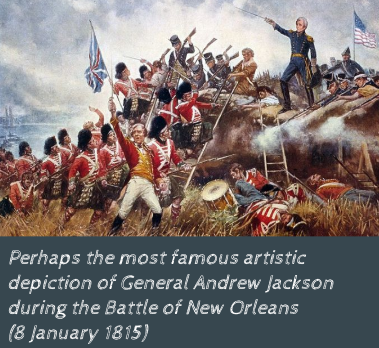
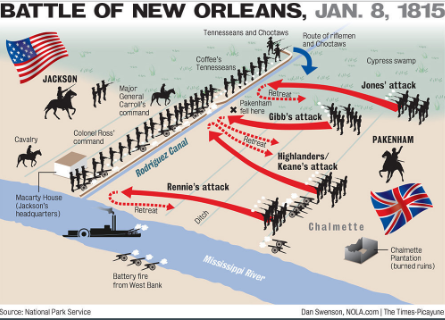
​     Jackson could see the entire battlefield from the ramparts, and 2/3’s of the open plain was filled with British redcoats. The 32 pounder, loaded with musket balls, fired, and the forward elements of the British center suffered terribly, but the British troops from behind kept pushing forward. Rennie’s men advanced very close to the targeted redoubt, but after Rennie was killed with a shot to his head, his men retreated.  When the British were 200 yards away from the US center, the deadly musket fire started, especially from the Tennessee Volunteers and Kentucky Riflemen. Jackson’s men took turns firing, then falling back to reload; some fired as quickly as they could after reloading, while others took their time.
    All the while, Jackson was there, directing, encouraging, and inspiring his men. The Volunteers and Riflemen, most armed with .38 caliber long rifles (42 inch barrels), couldn’t miss hitting what they aimed at. Keane’s column had started to fall back under the intense musket/artillery fire, and after Keane was wounded, they fell back even faster. The British troops that reached the canal found that their footing was not nearly good enough to advance up the grade, and all the while Jackson’s men fired down on them. To the British, Jackson’s men seemed to be almost invisible; even to soldiers that survived battle during the Napoleonic Wars, this battle had become overwhelming.

    On the British right, Gibbs was carried off the field, and Pakenham and his aides raced to fill the void and to take command. The troops were rallying when Pakenham was shot in the knee, and then Pakenham’s horse was killed by another shot. In the process, Pakenham had been wounded again, this time being shot in an arm. As the twice-wounded Pakenham was getting help mounting another horse, a cannon ball ripped into his groin, mangling his spine. Pakenham was taken from the field, and his last command as he lay dying was to bring up the reserves. British casualties were horrific, while Jackson’s men suffered hardly a pinprick by comparison.

Picture
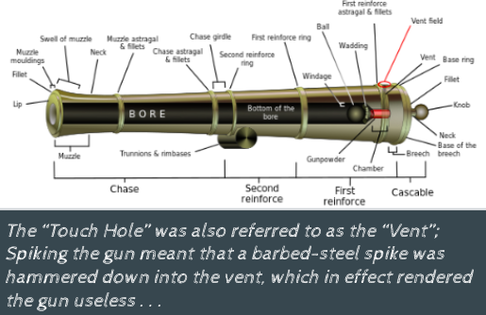
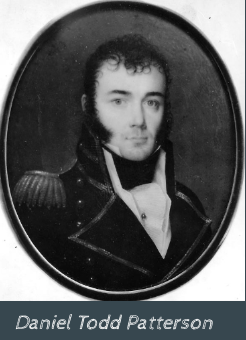
    The attack across the bank, which was Pakenham’s best hope for victory, occurred far too late. The British had been delayed further due to the strong current of the river, which carried them far downstream from their planned landing point, which led to a four mile march. As the British advanced, they could see Patterson’s guns firing across the river into the main British force. The ramparts on the opposite shore proved to be no problem for the British to overrun, but before that occurred, Patterson ordered his men to spike the guns (an iron rod was hammered into the vent, a.k.a. the touch hole, at the back of the gun), which was a very time-intensive and laborious process to undo. The British controlled the position, but they were unable to use the US artillery, which meant that Jackson’s main force would not be under deadly flanking fire.
    By midday, Jackson received the flag of truce at the HQ house. Before he had left for the HQ house however, Jackson had walked the entire line of defense, thanking and congratulating his officers and his men. Jackson agreed to a ceasefire so the British could deal with their dead/wounded. During the last part of the battle, a British officer had waved a handkerchief on his bayonet as a flag of truce, an that British officer gave up his sword, which had been the first real sign that Jackson’s men had accomplished the impossible.

Picture
     The Americans from their line watched not only the horrors of the massive numbers of KIA British soldiers on the ground, but also the hundreds that simply got up from the ground that had barely suffered a scratch. The casualty count for the British was never truly confirmed, but estimates were stunningly high; a total of 3000 KIA/WIA was not an unrealistic estimate (Jackson eventually settled on 2600 KIA/WIA . . . Jackson only had 12 KIA).
    Jackson had secured the mouth of the Mississippi River for the US. Jackson’s multi-ethnic / multi-class army did what Napoleon had failed to do, which was to destroy the finest fighting force in the world. Jackson had proven to possess superior military instincts, planning, and ferocious leadership compared to his British counterparts.  From the HQ house, Jackson kept the artillery going, letting the British know he was watching them as well as determined to see them leave the vicinity as soon as possible.
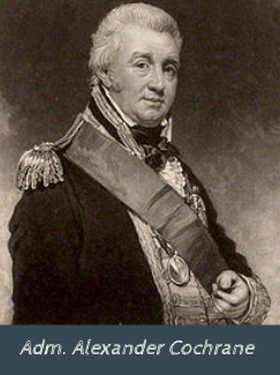
    Sixty miles downriver, Cochrane was firing on Fort St. Philip with five warships. Cochrane fired more than 1000 rounds over 9 days but didn’t inflict any real damage on the fort. Jackson held his position at the canal, and on 19 January 1815, the British force decamped with an overnight withdrawal.


Picture
     20 January 1815: Jackson returned to New Orleans for the first time in a month, and on 23 January 1815, the city had a formal celebration with Jackson being the recipient of most of the attention and adulation. Jackson suspended the curfew that night, and the citizens of New Orleans celebrated until dawn.
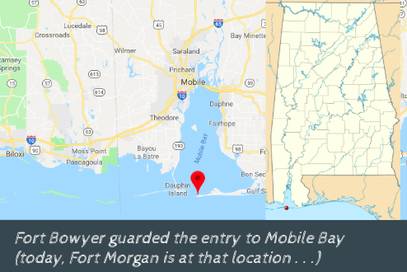
    While the British had retreated from land, they remained a strong presence in the surrounding waters. Jackson was concerned that the British might go after another strategic location such as Fort Bowyer, and Jackson was right. Cochrane didn’t think the war was over since no word from London to that effect had yet reached him. Cochrane now had a much larger fleet under his command, now in excess of 60 ships, and that fleet set sail for Fort Bowyer on 27 January 1815. If nothing else, Cochrane wanted to regain lost prestige, not only for his navy, but especially for himself. On 8 February 1815, Cochrane landed 5000 men several miles from the fort. Before he ordered the onslaught, Cochrane sent an officer under a flag of truce to demand the fort’s surrender.
    The commander of Fort Bowyer had no real choice but to surrender since he only had 360 men, and on 12 February 1815, Fort Bowyer surrendered. Jackson wrote Monroe of his absolute mortification of the surrender since now the British had an open route to Mobile. But on the next day, a British frigate arrived, and Cochrane received orders to stand down since the Treaty of Ghent was in effect. Cochrane was also ordered to set sail for Britain, but Jackson refused to believe Cochrane would do so until he received absolute confirmation.

Picture
     On 14 February 1815, President Madison received a copy of the Treaty of Ghent, and he submitted the treaty to the Senate without delay. The Senate ratified the treaty 35 - 0, even though many were miffed that there was no mention of British actions that started the war such as impressment. Meanwhile, over a thousand miles away, Jackson was still waiting for news. Jackson refused to lend any credence to the rumors he heard that the war was over, or even to the clippings of British newspapers that some had shown to the general. Jackson kept martial law in effect in New Orleans, and most citizens of the city had come to view Jackson as a jailer instead of a deliverer. Rachel’s presence eased Jackson’s tensions at least somewhat, and finally, on 8 March 1815 after receiving “persuasive evidence”, Jackson cut New Orleans loose from the restraints, and he released his men so they could return home.
    Jackson didn’t start for home until early-April, but when he returned to Tennessee, it was as a national hero. Thanks to Jackson, the US would never again be invaded by a foreign power. The victory at New Orleans overshadowed the previous humiliations of the war, such as the burning of DC. The nation’s memory of the war would remain forever centered on Jackson, since he was the figure given the most credit for restoring the honor of the nation. Fort McHenry, successes on the Great Lakes, and especially New Orleans gave the US a sense of nationhood for the first time, and recognition and respect from Europe was an added bonus.

Picture
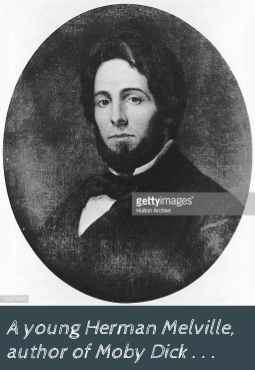
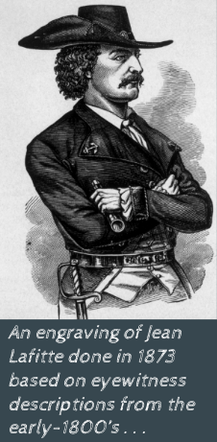
     On 15 February 1815, Congress authorized a medal to be struck with Jackson’s profile. Patterson would eventually be in command of the USS Constitution, and by 1839, the year he died, he was the commander of the Washington Navy Yard. Jones would cross paths with a navy deserter named Herman Melville, and Melville featured Jones as Commodore J___ in Moby Dick. Lafitte was pardoned, but he remained a pirate, setting up shop in Galveston in Spanish Texas. Lafitte died in 1823 during a ship-to-ship battle, but over the succeeding years, he became the stuff of myth and legend.
    The Duke of Wellington placed the blame for the British defeat squarely on Admiral Cochrane, pointing out that the trek across Lake Borgne meant that the British troops were not connected to their supply base. Jackson’s failure to secure the river bank opposite of his position has raised questions about his battle preparations and strategies . . . no matter, since Jackson was the man of the hour that deserved all the honors and plaudits. Jackson’s decision-making and instincts before/during the battle proved to be stellar.

Picture
   Jackson was invited to the 25th anniversary celebration of the battle held in New Orleans. Jackson believed that 8 January 1815 mattered in US History just as much as 4 July 1776. By 1839, Jackson’s health was poor; he spent the last five months of his Presidency bedridden, almost dying for a serious attack related to the musket ball that was still in his chest from the duel in 1806. Despite his fame and importance, Jackson was cash-poor, and he refused to borrow money to go to New Orleans. But the battle was such a huge part of his life that he insisted that he continue to be addressed as general.
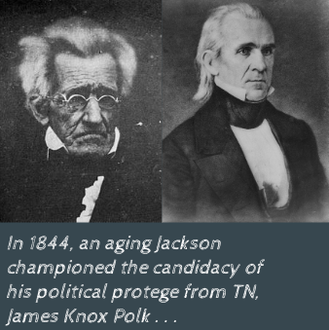
    December 1839: Jackson decided to go to New Orleans, and he borrowed against his cotton crop to do so. Jackson left Nashville on 24 December 1839, and it took for days to travel 125 miles to the mouth of the Cumberland River, where Jackson boarded the Gallatin and headed down the Ohio River. Jackson arrived in New Orleans in the morning of 8 January 1840, and Jackson was seen by a crowd of about 30,000 cheering Americans. After the celebrations, Jackson boarded the Vicksburg and headed upriver, back to the Hermitage. Jackson died on 8 June 1845 must months after his protege, fellow Tennessean James Knox Polk, took office as the nation’s 11th President.

             Addendum: Henry Clay and The Treaty of Ghent . . . 

0 Comments

Andrew Jackson & The Battle of New Orleans, Part Four

6/17/2019

0 Comments

 
Source: Brian Kilmeade & Don Yaeger. Andrew Jackson And The Miracle of New
              Orleans - The Battle That Shaped America's Destiny (2017)
Picture
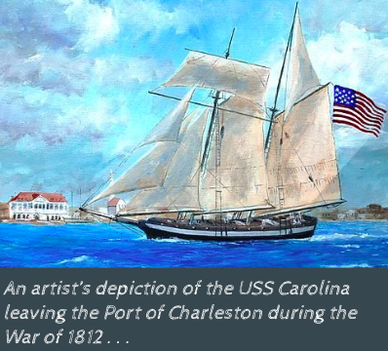
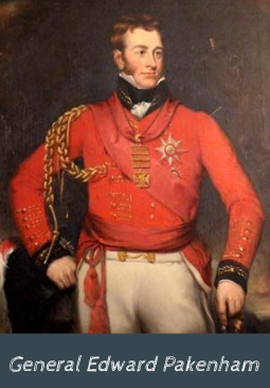
     The USS Carolina and now the USS Louisiana, continued to shell the British camp, and US snipers were in the area targeting any British soldier that was in their range. At night, British sentries were hit by US cavalry, and worse were the raids by Choctaws on the sentries. At 2 pm on Christmas Day 1814, General Edward Pakenham and the remaining troops arrived at the camp. Pakenham was the rare British general that truly shared the danger with his men, and he had proven his worth/stature in that he was one of the key generals that led to the defeat of Napoleon. He had been WIA many times, but this as Sir Edward Pakenham’s first real independent command.
    Pakenham immediately saw that his attack would occur in a tight area with the Mississippi River on one side and a cypress swamp on the other. Pakenham was not very happy, to say the least, to find out that those in command before he arrived had placed him in such a limiting position. At an officer’s meeting, Pakenham mentioned that he would like to withdraw to a more favorable location, but Admiral Cochrane sharply disagreed, insulted at the mere suggestion that there had been any failure while he had been command. Cochrane in essence triple-dog-dared Pakenham to take the US position with his army, or Cochrane’s marines would do so. Pakenham was surprised at Cochrane’s outburst, and he needed the admiral’s assistance and ships. Pakenham realized that he was stuck, and that he needed to make the best of an awful strategic location . . . but his first plan was to destroy the USS Carolina.

Picture
     27 December 1814: Jackson saw from his vantage point in the top floor of his “Headquarters House” that British cannon were targeting the Carolina. As far as Jackson knew, the British battery hadn’t been there the day before. Pakenham was in direct command of the battery; the artillery had been brought to the levee during Christmas night, and the guns were spaced by several hundred yards, making them very difficult for the Carolina to hit. Pakenham made sure that other necessary preparations were made for defending/stabilizing the guns on the soft soil.
    Jackson ordered the Louisiana to sail out of range of the British artillery. The Carolina returned fire with the only long-range gun it had, its 12 pounder. Jackson watched as the British artillery kept hitting the Carolina, and a cannon fireball penetrated deep in the bowels of the ship, and the Carolina was soon fully ablaze. Then Jackson saw the British train their guns on the Louisiana, who had been unable to sail out of range due to the current and no wind. The only escape for the Louisiana was upriver, and the Louisiana had to be moved manually, both by oarsmen on boats and from those on shore pulling ropes. Soon enough, the Louisiana was moved half-a-mile out of range of the British guns.   


Picture
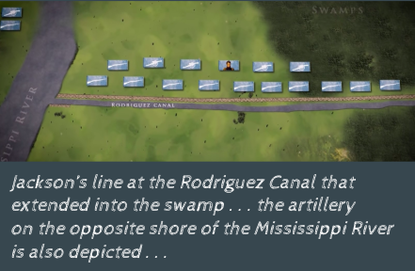
   Pakenham still lacked specific knowledge of Jackson’s strength/location, so next for Pakenham was to get rid of the snipers and cavalry that kept him from finding out what he needed to know. On 28 December 1814, Pakenham organized a force that would reconnoiter, and if possible, attack Jackson’s position. Pakenham simply didn’t believe that Jackson would be the kind of worthy adversary he had faced in Europe. Soon enough, Pakenham received reports that the US line was dug in from river-to-swamp with 5 foot high breastworks.
    Lafitte, meanwhile, had told Jackson that his line was still vulnerable unless he extended it into the swamp. Jackson, to his credit, immediately acted on Lafitte’s advice. Pakenham, now seeing Jackson’s line with his own eyes, was surprised to see five big guns visible among the breastworks. Jackson had taken advice from ditch digging slaves that bales of cotton should be used to fill the muddy hollows. Cotton bales were buried and connected by iron rings with wooden platforms on top where the big guns were placed. Pakenham and his force came within a half mile of Jackson’s line on the canal. But the Volunteers and Riflemen were hitting what they aimed at, and the Louisiana was firing from the river. Pakenham quickly understood that he didn’t have nearly enough artillery in play, and he sent orders to bring up more guns.
    While all this occurred, Jackson received a messenger from the governor of New Orleans, informing Jackson that serious talk had developed in the city about surrendering to the British. Jackson informed the messenger that if he couldn’t save the city, he would burn New Orleans to the ground, cut off the British from receiving any supplies from downriver, and force them to eventually leave. Jackson made it crystal clear that New Orleans would never raise the white flag as long as he was alive and in command.
    Pakenham had seen enough and he ordered a withdrawal. British soldiers were ashamed and upset with the humiliating retreat after their proud advance into battle, but Pakenham at least had the information about Jackson’s defenses that he needed. Pakenham knew that the deadly US artillery would have to be silenced for the next advance to succeed. Jackson installed a 32 pounder in the center of his line, knowing the British would return in greater force.

Picture
     For the next three days the armies kept their distance, but during that time, Jackson had reinforced and extended his line into the swamp. Jackson also ordered secondary lines of defense behind his main line just in case they were needed. On the opposite bank of the Mississippi River from his position, Jackson had Patterson bring cannon ashore from the Louisiana for flanking fire on the British advance.
    Pakenham ordered artillery to be located just 600 yards from Jackson’s line, and his men did so stealthily at night. Fog kept Jackson’s men from seeing what the British had done overnight, but intelligence indicated that Pakenham had heavily reinforced his army. When the fog cleared, the British guns focused much of their fire on the HQ house where Jackson was located. Over 100 cannon balls hit the HQ house, but no one was injured.
    Jackson went to the line at the canal, and he noticed more British soldiers were in play with new/additional artillery. There was little Jackson could do but hope his own artillery could keep the British advance at bay. While the British had more cannon, the US guns were higher off the ground and more effective, but the British artillery proved damaging. Jackson rode up and down the line, exhorting/calming his men, and the line held, mostly due to the more accurate US artillery. Pakenham watched as his options faded, and once again the British retired from the field with nothing to show for their hardships or efforts.


Picture
     Dysentery had taken hold of the British camp, and rations were running low, since the army had taken almost everything consumable from nearby plantations. Sniper and artillery fire by the US continued as well, but Pakenham was undeterred given the conditions and setbacks so far. Pakenham’s plan was to break through Jackson’s line in using greater force, but in order to do so, he would need to take the US guns on the opposite shore of the Mississippi River, and then rain flanking artillery fire down on Jackson’s line. Yet again, the sense of impending victory took hold among the British ranks, especially with the addition of two more full regiments.
    On 4 January 1815, 3000 militia had arrived, mostly Kentucky Riflemen, but they were badly outfitted and short weapons. Jackson had to threaten the governor of New Orleans to get off his behind and get all that was available from the city to his lines, and finally the additional Riflemen were set to go by 6 January 1815. Jackson located his 5000 men in terms of factions, with about 1000 of his men across the Mississippi.
    On the evening of 7 January 1815, Jackson received intelligence from Patterson that the British were making a move on Jackson’s artillery across the river, and Patterson asked Jackson for reinforcements. Jackson had already sent Patterson 400 Riflemen . . . Jackson remained convinced that the British attack would be on his main line of defense, not across the river.

Picture
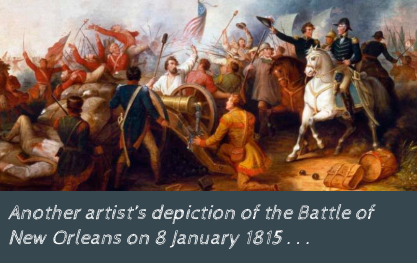
     8 January 1815, the Battle of New Orleans: An American flag flew proudly at the center of Jackson’s line. Even before dawn, Pakenham received bad news, in that the attempt to take the US artillery on the opposite shore had been delayed, which meant there wouldn’t be any artillery flanking fire on Jackson’s line, at least not when Pakenham wanted it. The attempt had been delayed since Cochrane’s design for a temporary lock between the river and the bayou led to ships getting grounded.
    The British contingent trying to cross the river was 8 hours behind schedule, and Pakenham had to decide whether to attack or delay. Pakenham decided to attack, hoping that the could break through Jackson’s line, even though the casualties would be great. Pakenham ordered a rocket to be fired to signal the advance, which Jackson easily saw; Jackson and his men had been at their position since 4 am. The British remained invisible due to heavy fog, so Jackson didn’t immediately see that Pakenham had divided his force into three brigades.
    Under General Samuel Gibbs, the main attack would come from the British right, but his men forgot to bring scaling ladders, and they went back 500 yards to get them, which delayed their advance; military historians still debate whether that delay cost the British victory. The soldiers under Gibbs’ command that led the charge were decimated by Jackson’s force.
    On the opposite flank along the river as a brigade commanded by Colonel Robert Rennie, and his orders were to take Jackson’s newly placed forward redoubt (protected cannon) at all costs. Pakenham needed that artillery silenced to prevent the slaughter of his troops in the open field. General John Keane led the other brigade, which was in the center, and Pakenham had a reserve brigade in the rear composed of the most recent arrivals. The US artillery fire started even before the fog had burned off, but Jackson’s men were able to see the redcoats nonetheless.


0 Comments

Andrew Jackson & The Battle of New Orleans, Part Three

6/16/2019

0 Comments

 
Source: Brian Kilmeade & Don Yaeger. Andrew Jackson And The Miracle Of New 
              Orleans - The Battle That Shaped America's Destiny (2017)
Picture
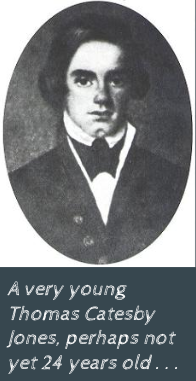
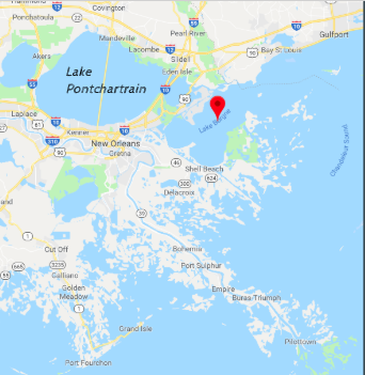
     Lt. Jones was on board one of the five gunboats, waiting for the British advance across the lake. During the previous few days, the 24 yr old commander had been playing cat-and-mouse with the British, and reporting to Patterson everything he observed. The British started to move across Lake Borgne on 13 December 1814 at 10 am, and their attack on New Orleans had officially started. Jones ordered the schooner to blow up the US supplies located on a nearby shore so the British wouldn’t get any “freebies”, but there was little else he could do other than be an irritant to the British advance.
    Jones kept waiting for the British barges to move south and land their troops, but instead the British kept advancing on his position, and by 2 pm Jones became 100% sure the were targeting his gunboats. Jones retreated further into Lake Borgne, heading to the Rigolets as Patterson had ordered, and if his stand there failed, he would retreat into Lake Pontchartrain. However, the waters had become even more shallow and three gunboats became stuck, and it wasn’t until 3:30 pm that the boats were freed.
    Jones noticed that three barges veered to the north to attack the schooner, which navigated as close to shore as possible, and the men were able to fend off the British from both ship and land. But by 7:30 pm, the crew of the schooner set their ship ablaze, knowing they could not withstand any further attacks. Jones soon thereafter lost the wind, while the British barges were powered by oarsmen; Jones knew he would have to turn and engage the British the next morning.

Picture
    The British started off by capturing the converted fishing vessel which was used for communications, and the British continued to advance on the five gunboats who were anchored in place. Jones had no choice, since the winds were still calm and the current worked against them. More than 40 British barges closed on the five gunboats, and Jones ordered the boarding nets to be released into the water (which would make it far more difficult for the British to board a gunboat).
    The British waited just out of range of the cannon on the gunboats in essence to rest up for the final assault. The gunboats were not in an even row of five due to the current, and Jones’ boat was actually the first which would be in the line of fire. While the US smooth bore cannon on each gunboat had longer range, able to fire more than a mile away, the barges were small targets. Despite the best efforts of the crew of Jones’ gunboat, Jones was shot in the shoulder and the British boarded and took the vessel, and in less that two hours the rest of the gunboats fell into the hands of the British.
    Despite the defeat, Jones had served Jackson well, in that he bought Jackson valuable time. Under interrogation, Jones and his men exaggerated the size of Jackson’s force, which created some hesitation and concern in Cochrane’s decision-making. Cochrane may have gained the necessary foothold to bring British troops to the immediate vicinity of New Orleans, but he had no idea of the strength of Jackson’s army.


Picture
     Jackson would not learn of the defeat on Lake Borgne until a day after the citizens of New Orleans heard the bad news. Before hearing the bad news, and despite another round of dysentery, Jackson went to the mouth of Lake Borgne, opposite where  Jones had faced the British, and then to view the expanse of Lake Pontchartrain, and then to Chef Menteur Road, which to Jackson seemed the most likely avenue for the British advance on land. Then, on 15 December 1814, Jackson received the news of Jones’ defeat on Lake Borgne.
    Jackson had written Monroe that the lakes around New Orleans had been secured, and now Jackson wished he could get that letter back. Jackson knew that he, with only about 1000 men, had to pull a rabbit out of his hat to protect the city. Jackson sent out emergency missives ordering the men he had positioned in such locations as Baton Rouge to come back immediately. Jackson was also waiting for around 2500 Kentucky Riflemen under the command of General John Thomas to arrive, and he also worrying if the supplies and ammunition from Pittsburgh would arrive on time. Jackson ordered that two battalions of free blacks be incorporated into his command, but he also ordered that they be treated equally.
   Jackson had his hands full, in that he needed to calm a panicked city while also uniting various factions. In order to try and accomplish both of those tasks, Jackson announced that a procession (parade) would occur in the city’s central square, knowing that those in New Orleans loved a parade. Citizens cheered for all the various elements of Jackson’s army as they proceeded through the central square, honoring those whose loyalties/qualities had been recently questioned.

Picture
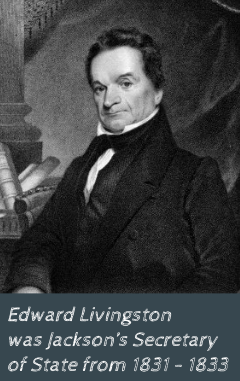
  Through Livingston, a resplendent Jackson complimented the citizens and encouraged them to further heroism, and then he addressed each faction of his army. Jackson left his audience reassured/inspired, but he also declared martial law the day before, meaning that there was no longer any free entry/exit from the city, and that there was a city-wide 9 pm curfew with lights-out. Through his martial law proclamation, Jackson ordered that every able-bodied man was to fight (even though that may not have been exactly legal). That order also meant that Patterson could conscript who he needed, since he was desperate for additional numbers as well. While Jackson succeeded in reducing panic, he didn’t know that the British were well on their way to New Orleans a full day before the parade.
    Barges propelled by oarsmen dealt with the shallow waters and brought forth many soldiers, but it was still a hard crossing given that the barges were overloaded, and the 30 mile / 10 hour voyage each way was miserable (storms made the crossing even more unbearable). Pea Island, which was little more than a sandbar, would be the staging location for the advance. The oarsmen had to make three complete round trips, and then another hard row of 30 miles awaited to reach real landfall. Pea Island had no cover or shelter, and the British misery continued. It took five days to get the British forces on Pea Island, but morale remained high due to the anticipated spoils of war.

Picture
    Jackson remained clueless about which route the British would take from Lake Borgne, and from which location the British would actually launch their ground assault. After Jackson received word that the British were on Pea Island, he knew from his own reconnoitering that the best route was along the Plain of Gentilly, and he sent men to that location.  However, it was also possible that the British would travel south of that plain at Jumonville, and it was also possible to advance via the English Turn.
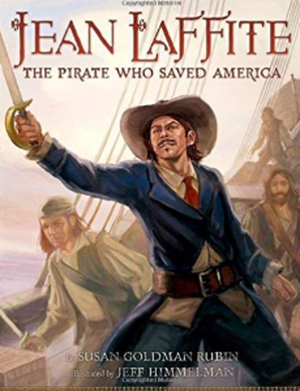
    While the most direct routes were manned, Jackson still had two problems, in that he did not have enough ammunition, and he didn’t have enough knowledge of the bayous in order to repel every possibility of attack. In order to strengthen his defenses, Jackson needed to add one more group to his motley collection of troops. For months, Jackson had resisted making any agreements with pirates, and the motives of Lafitte were hard to decipher in any case. On 14 December 1814, the Louisiana state legislature in effect granted amnesty to Lafitte and his pirates for all previous transgressions, and Jackson was under increased pressure from the numerous and influential Creoles to enlist Lafitte.
    For the last three years, Livingston had been Lafitte’s legal advisor, and Jackson asked Livingston for his advice, and Livingston recommended that Jackson at least meet w/ Lafitte. Jackson was also interested in that Lafitte had boasted that he could supply an army of 30k, so in effect Jackson had little choice but to meet with the pirate leader. After obtaining secure passage to enter the city (since there was still a warrant out for his arrest), Lafitte explained to Jackson that he offered more than just his allegiance; he had over 1000 men willing to fight, and he had powder, shot, and flints, all of which Jackson desperately needed.
    Just as Jackson had recognized a military kindred spirit win Red Eagle, Jackson saw Lafitte in the same way. And Lafitte knew the backwater bayous intimately, and Jackson had Volunteers and Riflemen that hit what they aimed at, and Lafitte had the necessary ammunition. So, Jackson arranged that after Lafitte was through organizing his men and distributing the ammunition, etc, that he would join Jackson as a de facto officer.

Picture
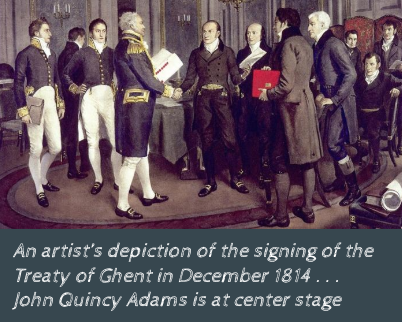
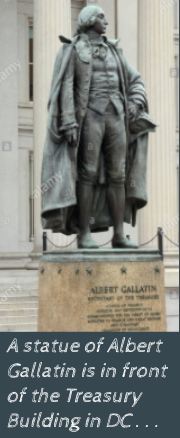
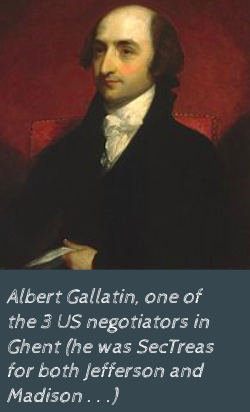
     By December 1814 in Ghent, the US contingent started to believe that an agreement might be within reach, with fishing rights in the North Atlantic and navigation on the Mississippi River the only apparent remaining issues. John Quincy Adams valued the fishing rights far more than Clay, and Clay valued navigation on the Mississippi far more than JQA. Then the British introduced a new wrinkle to the negotiations, focusing yet again on language that kept lands in possession held by either side at the end of the war. JQA started to think that something was up (catching up to Gallatin), and he started to wonder what the British really wanted to achieve with that language; JQA wondered what would happen if the British captured New Orleans.
    The new draft of the document indicated that all territories, places, and possessions captured during the war would be returned, but was that phrase accurate, and to be trusted? Would the treaty mean that the US would get New Orleans back if the British took possession of the city? To John Quincy Adams, the key word was “possessions”, in that the British had never officially recognized the Louisiana Territory as an American possession. Unknown to JAQ, Clay, and Gallatin, General Pakenham’s orders were to keep going after New Orleans until he had confirmation by the British government of a finalized treaty. Pakenham was told to gain “possession of the country”. If JQA didn’t fully understand what was going on, Jackson had no chance, but Jackson’s instincts told him that holding on to New Orleans was beyond-vital.

Picture
     Cochrane sent out spies (including Spaniards), and after hearing the information that was brought back, he concluded that the best approach to New Orleans was via Bayou Bienvenue, in that it was unguarded and without obstructions. Also, ten-to-twelve Spaniards would act as pilots along the complex waterway. On 22 December 1814, Cochrane gave the order to advance with an expeditionary force of 1600 men, and they entered the Bayou Bienvenue that night. US pickets were captured, so Jackson knew nothing about the advance.
    The next day, the swamp gave way to firmer ground for the British, and New Orleans was only seven miles away on dry ground. The British expeditionary force decided to rest overnight instead of taking the fight right to the Americans, which was the first major British mistake of the campaign. The British had taken possession of a plantation as their new staging ground, and took prisoners, including the ower, Major Villere. Villere escaped by exiting a window, knocking down a few British soldiers, and running away to a nearby dense cypress woods, somehow avoiding getting shot. Villere knew he was being pursued, but he knew the area, and the British did not. Villere hid himself by climbing up a huge cypress tree, and the British failed to find him, returning to the plantation knowing that news of the presence and approach would now reach New Orleans.

                  Addendum: The First Battle of New Orleans . . .


0 Comments

Andrew Jackson & The Battle of New Orleans, Part Two

6/1/2019

0 Comments

 
Source: Brian Kilmeade & Don Yaeger. Andrew Jackson And The Miracle Of New   
​              Orleans - The Battle That Shaped America's Destiny (2017)
Picture
    On 27 August 1814, Jackson received confirmation that the British were landing in force in the Gulf of Mexico just 50 miles east of his position. Jackson had intelligence that indicated that this relatively small British contingent would be supplemented by a much larger force, and that the plan was to take Pensacola, and then Mobile Bay, and then the ultimate prize, New Orleans. Jackson had to scramble in order to amass 2000 troops, and most of them were inexperienced. Jackson wrote to Nashville, asking for the entire Tennessee militia, including cavalry, but in the meantime, Jackson had to get ready to defend Fort Boyer.
    Fort Bowyer stood 30 miles south of Mobile at the opening of Mobile Bay. British ships would have to pass through the narrow opening under fire from Fort Bowyer’s guns, but the fort had long been neglected and wasn’t readily fit. Jackson’s men worked around the clock to get Fort Bowyer ready knowing that the British could arrive at any time. Jackson wrote the governor of New Orleans to warn him of the British plan to advance on the city; Jackson was ready to fight the British from his position at Fort Bowyer, but the odds of defeating the British were not in his favor.

Picture
     Jackson was 100% sure of the intentions of the British in the Gulf, but that wasn’t the case in Washington, D.C. with President James Madison and Secretary of War John Armstrong. Instead of getting DC’s defenses ready, SecWar Armstrong was certain that Baltimore was the main target of the British, and Madison followed his advice. Armstrong went so far to tell Madison that DC had little strategic value to the British. On 20 August 1814, Secretary of State James Monroe decided to find out what was really going on and he took to his horse. Soon, Monroe saw that the British invasion had already started, but even Monroe, a former officer in the Revolutionary War, couldn’t ascertain the true target of the British.
    On 24 August 1814, the British attacked Bladensburg (MD), 8 miles from DC, and by doing so showed their hand: DC was their ultimate target. Around 7000 US troops faced 4000 British troops, but once the British engaged the US soldiers, they turned and ran as fast as the could (the “Bladensburg Races”). Once in DC, snipers fired on British troops, and the British commander ordered the house from which they fired burned, which then started a cascade of conflagrations, which soon meant that the President’s House (it wasn’t called the White House until after the War of 1812 after it was refurbished and repainted with many coats of whitewash) was targeted for destruction. The British also set fire to other government buildings and to specific newspaper buildings/presses. Even after a hurricane forced the British out of DC, the US government was homeless; the only good news was that Armstrong was sacked, and SecState Monroe became the Acting SecWar. But not even Monroe could provide, at least right away, the kind of government assistance that Jackson needed . . . and the negotiations in Ghent were going nowhere.

Picture
    2 September 1814, Bataria Bay south of New Orleans: the British attempted to meet with Jean Lafitte, and emissaries were taken to the pirate who welcomed them, and led them to his very comfortable house. Lafitte was invited to join the British for their upcoming offensive, but Lafitte had difficulty at that moment deciding whether he was being asked or being coerced. The British emissaries told Lafitte that he would receive $30,000 in cash plus land grants, as well as pardons for his men that were currently incarcerated. Lafitte was also told that New Orleans was the ultimate target for the British: the message was clear - join the British or be destroyed.
    Lafitte told the British he needed time to consider their offer, and the British emissaries had no choice but to wait overnight since their boat was “guarded” by Lafitte’s men . . . Lafitte assured the British emissaries that they would have safe passage back to their ship the following morning. After the British left, Lafitte drafted his formal response, saying that he would meet them again in two weeks to give his answer. Lafitte chose to be a double agent, in that he wrote a close friend in New Orleans of the British intentions on the city. Lafitte also wrote to the governor of New Orleans to not only alert him, but to also offer his services in defense of the city. Whether or not Jackson wanted him, Jean Lafitte had thrown in his lot with the New Orleans and the general.

Picture
    Over a week would pass until Jackson was told about the British “offer” to Lafitte, but Jackson was far more concerned about holding Mobile (AL), 150 miles to the east of New Orleans. But before Jackson could inspect the defenses at Fort Bowyer, the British made their move on the fort on 13 September 1814. In no way did Jackson want his small advancing force to be captured, so he headed back to Mobile and hoped that the fort could withstand the British onslaught . . . but Jackson had to get Mobile ready if the British advanced.
    Unknown to Jackson, the British had a land force that was ready to attack Fort Bowyer from behind as well as from the water. But Jackson’s men at Fort Bowyer were made of much sterner stuff than the soldiers at Bladensburg, and the British land force’s advance was frustrated. The US guns from the fort were able to match the British guns from their ships, and the engagement was a stalemate, but it was only a matter of time until the guns at Fort Bowyer ran out of ammunition. And then one of the fort’s cannon shots hit the anchor chain of one of the British ships, and the current took it wo within 600 yards from the fort, where it ran into a submerged sandbar. The British had to abandon the ship since it was under direct fire from the fort, and three hours later, the British ship exploded.


Picture
     Jackson, even though he was 30 miles away, saw the fireball of the explosion of the British ship on the horizon, but many anxious hours would pass until Jackson received confirmation that Fort Bowyer remained in American hands. The three remaining British ships sailed away from the fort even though they had at least a 10:1 advantage in manpower: 158 US defenders had denied the British access to Mobile Bay and Mobile. Jackson wrote SecWar/SecState Monroe to inform him of the victory, but if Monroe had time to savor the news, it didn’t last long since it was about at the same time that the British attacked Fort McHenry. In a much larger-scale version of the attack on Fort Bowyer, the British were denied their goal of advancing to Baltimore.
    Jackson, without the large numbers necessary to defend all the strategic locations in the Gulf, had to try and out-guess the British, and for the moment, Jackson stayed in Mobile to gather intelligence. Jackson set about to reinforce Fort Bowyer while while waiting for reinforcements. The guns from the destroyed British ship were taken and installed in Fort Bowyer, and once Jackson was satisfied with the fort’s defenses, he was ready to try and find a way to remove the British from Pensacola (in Spanish Florida, 50 miles east of Mobile). The Spanish had granted the British free use of Pensacola’s harbor, which meant that the British cold mount an overland attack on New Orleans.
    Soon enough, Jackson’s force exceeded 4000 men, but he didn’t have any direction or permission from DC to take Pensacola . . . Jackson even received instructions from DC to stay away from Pensacola, since Madison and Monroe were afraid that Spain might enter the war. However, via backchannels, Monroe told Jackson that he was “authorized” to attack Pensacola, and that he would receive “support”. Monroe understood the strategic significance of Pensacola, and Jackson knew that if his attack failed, he would bear the political blame, not Madison. Jackson knew that if he took Fort Barrancas he would be able to control Pensacola Bay, and the British fleet would be forced to leave . . . but the problem was that the British held the fort. On 6 November 1814, Jackson halted just two miles from Pensacola. Jackson decided to communicate with the Spanish governor of Florida first, and the general demanded that the Spaniards expel the British and give the fort to him, and the Spanish governor refused.

Picture
     At Ghent, as far as the US diplomats were concerned, negotiations were moving forward, but not nearly as quickly as desired. The British had insisted that the proposed treaty contain two Latin words, “uti possidetis”, which meant that when the war was over, whatever land each had had, that side kept. Gallatin correctly concluded that the British were in the process of trying to take New Orleans, which would mean that US expansion west would be controlled by the British . . . and at that point there was nothing that JQA, Clay, or Gallatin could do about those two Latin words.
    During the night of 7 November 1814, Jackson moved all but 500 of his men into the woods outside of Pensacola. The Spanish defenses still believed that Jackson’s army was still in camp since their guns were trained on the (empty) tents. The British were focused on the western approach to Pensacola, so Jackson took both the Spanish and British by surprise. Jackson quickly overran the Spaniards and the British blew up the ordnance at the fort, which meant that Fort Barrancas was unusable. However, Pensacola was defenseless, even though Jackson didn’t gain the fort. More importantly, the British would not be able to use Pensacola as their base of attack on New Orleans on land.
    Jackson was by far the most effective general in the US Army, as Madison and Monroe well knew; somehow, the President and Acting SecWar found $100k for Jackson’s army and promised the general additional soldiers. In just three days, Jackson was back in Mobile, where he received letters from Monroe telling him what he already knew, that the British had designs on New Orleans . . . on 22 November 1814, Jackson started his men towards the city.

Picture
    26 November 1814, Jamaica: the largest fleet assembled in the history of the Western Hemisphere, featuring 50 large vessels, was ready to sail; the British were making their move on New Orleans. Among the 50 ships were 6 Ships of the Line, each with 74 guns, 8 three-masted frigates w/ 38 or more guns, and there were schooners, sloops, and barges, all of them with guns. There were also cargo ships whose job it was to carry away the spoils from taking New Orleans. However, this immense fleet left Jamaica before all of General Edward Pakenham's forces were present.
    Jackson didn’t know for certain if the British fleet was indeed heading to New Orleans, and he had no way to know the size of the fleet, but Jackson assumed a large British force was heading his way. Jackson took an overland route from Mobile to New Orleans, gathering as much intelligence as he could along the way. Jackson planned on a trek lasting 12 days traveling 300 miles, needing to blaze his own trail in some parts, but it only took him 10 days to reach New Orleans.
    When Jackson reached the outskirts of New Orleans, a carriage took him and his aids to the city, where many wanted to meet the “Savior of New Orleans”. Since Jackson didn’t speak French, his old Congressional colleague who lived in New Orleans, Edward Livingston, served as interpreter. Additionally, Livingston would serve Jackson as his secretary and confidant, and Livingston’s inside knowledge of how things worked in New Orleans became invaluable to the general.


          Addendum: The Beginning of the Battle of Lake Borgne . . .

0 Comments

Andrew Jackson & The Battle of New Orleans, Part One

5/24/2019

0 Comments

 
Source: Brian Kilmeade and Don Yaeger. Andrew Jackson And The Miracle
              of New Orleans - The Battle That Shaped America's Destiny (2018)
Picture
      On 1 June 1812, Congress declared war on Great Britain, 19 - 13 in the Senate, and
79 - 49 in the House. For the last twenty-nine years since the Revolutionary War, Britain had not respected US sovereignty, and President James Madison and a majority in both houses had reached the end of their limits. But the reality was that the US was an incredible long shot to prevail in a conflict against Britain in that there was no real national army, and France would not be of any assistance this time. So many Americans were in opposition to the war that the fragile national unity that had formed since the Revolution might fracture.

    As far as Andrew Jackson was concerned, the British attack on the USS Chesapeake in 1807 demanded a military response. Those in the West such as Jackson fumed at the inability of the national government to address the troubles on the frontier with the Natives and Spain. Jackson saw the War of 1812 as a way to not only serve his nation, but also to address his long-standing desire for revenge against the British (during the Revolution in North Carolina, Jackson and other members of his family were taken prisoner and beaten).
    At the age of 21, Jackson took a job as a public prosecutor in the western region of North Carolina, which took him west of the Appalachians into what would become Tennessee. Jackson made an immediate impression in Nashville, and the reputations of both Jackson and Nashville would grow over the years (when Jackson married Rachel Donelson, he married into one of the founding families of Nashville). When Tennessee became a state in 1796, Jackson was selected to attend the constitutional convention, and then served as TN’s first representative in the House before being selected to the Senate. But too little was accomplished in Washington, D.C. for Jackson’s liking, and he soon discovered that the legislative life was not for him.
    Jackson accepted an appointment to the TN supreme court in February 1802, and shortly thereafter he was elected major general of the TN state militia, which was administered/maintained by TN, not DC. Jackson was able to serve his state in command of fellow Tennessee men with the freedom to do what he felt was best. Jackson kept winning re-election as a major general  and his bond with his men deepened. As the War of !812 began, Jackson was one of the very few Americans in a position of power that saw the strategic importance of New Orleans.

Picture
    Although Louisiana became a state in April 1812, the British still questioned the legitimacy of US ownership of the territory, in that to many in Europe, Spain was still considered the rightful possessor. Jackson felt that due to that point of view, Britain would engage in actions in the region that might interrupt or stop US expansion west. Madison and Congress had no way of knowing it, but the future of New Orleans rested with Jackson.
    In the early stages of the War of 1812, Madison simply received terrible advice, such as Henry Clay saying it would be easy to take Canada; even Thomas Jefferson wrote Madison that taking Canada was a sure thing. Madison ignored Jackson’s request to command in the East, and soon enough Jackson had more than enough evidence to show that incompetence was the norm in terms of prosecuting the war in the East and in Canada. In Canada, in short order, the US lost Fort Detroit and Fort Niagara, and the defeat at Lake Champlain ended the first effort to invade Canada. The result was that too few US troops were left to defend cities such as DC and Baltimore, and a divided Congress refused to fund the war (right before the war, the National Bank’s charter was not renewed by Congress, so in essence, the US fought the War of 1812 without a national bank).
    On 3 July 1812, Jackson let it be known that he was ready to deal with Natives supported by the British, such as the Creek Nation. But Jackson’s offer to lead 2500 men to do so was not acknowledged by Madison or the War Department. Frustrated, Jackson waited for months at his home (the Hermitage) to hear from the government. Finally during November 1812, Jackson received indirect authorization to protect the territory of the Mississippi River Valley, which meant that DC was finally recognizing the importance (and the needs) of the West. Jackson assembled his force and headed to New Orleans. Jackson called for volunteers in Nashville, and a deluge of men was the response . . . soon enough these men would refer to themselves as Volunteers.

Picture
   Jackson and his Volunteers headed towards New Orleans in January 1813. The miserable and unseasonable harsh winter weather slowed them down, and it took much longer to reach Natchez MS, which was 800 miles away by river. Once in Natchez, Jackson again waited for further orders from the War Dept, which allowed Jackson to train his men and get to know his officers. The much-anticipated letter from DC arrived on 15 March 1813, but the contents of the letter infuriated and humiliated Jackson. New SecWar John Armstrong did not want to focus military resources on the West, and Jackson and his men, despite all the sacrifices they had made to that point (including spending their own money), were ordered to disband and head back to TN.
    Jackson wondered who would defend New Orleans if he turned back, and what of the other strategic locations in the Gulf Coast such as Mobile Bay. Worse yet, Armstrong had ordered Jackson to gather his men’s weapons and to turn them over to regular US Army general James Wilkinson, the overall commander of the West (the duplicitous Wilkinson had, at least in previous years, in the employ of Spain as a spy). Jackson faced a dilemma in that the mere action of heading back to Nashville would be dangerous, in that DC hadn’t authorized any money or supplies for the trek back. Jackson refused to abandon his men, since he knew they would be easy prey for Native warriors if they scattered after reaching Natchez. Jackson decided to lead his men back to Nashville himself.

Picture
     Jackson and his men had to march over 500 miles, much of it rugged terrain in Indian territory. Jackson started back on 25 March 1813, but not before writing defiant letters to Armstrong and Wilkinson, saying he was not abandoning his men as they were. Jackson even walked instead of riding a horse, so sick men under his command didn’t have to walk. The 46 year old Jackson never complained as he marched alongside his men, and they averaged 18 miles a day. Jackson insisted on order and discipline, and he led by example. Admiration for Jackson soared among his men since he hadn’t abandoned them and he was sharing the danger with them (the march back to Nashville was the origin of Jackson’s nickname, “Old Hickory”; Jackson was also suffering from dysentery). While the threat to New Orleans wasn’t immediate (yet), that was not the case in terms of the Natives, especially with the Red Sticks, a warring faction of the Creek Nation that had aligned themselves with the British . . . soon enough it would be Jackson who would have to face them.
    In the Spring of 1813, even though his men still had months left on their year-long commitment as a volunteer, Jackson sent them home, and he went back to the Hermitage and Rachel. In 1813, two events would alter Jackson’s life, with one almost killing him, and the other accelerating his rise to American Hero. During June 1813, Jackson was asked to be a second in a duel at the request of one of his officers, William Carroll, who was getting ready to duel Jesse Benton, the younger brother of another officer, Thomas Hart Benton. Jackson tried to avoid participation, seeing nothing but downside, but Jackson was present at the duel, which wound up with Jesse Benton getting shot in the buttocks, which was a sign of cowardice to many since it meant that he had turned his back. Both Bentons publicly blamed Jackson, who had been in charge of making sure the duel was fair. Jackson let it be known that he would horsewhip Thomas Hart Benton the next time he saw him.

Picture
     On 4 September 1813, Jackson went to the Nashville City Hotel, horseship in hand, to deal with Benton, and the situation escalated where gunshots were fired, and Jackson was wounded in the left shoulder/upper arm (one of the bullets escaped the hotel and nearly struck an infant in a crib . . . the baby John C. Fremont).  Jackson refused to allow his arm to be amputated, and Rachel arrived at his side finding her husband barely clinging to life . . . two weeks later, Jackson was able to get up off his bed.
    A courier brought Jackson news of a massacre at Fort Mims, 400 miles away. Over 300 had been killed by the Red Sticks, including women and children. Jackson, coming out of his delirium from his wound, saw the news as a call-to-action, and soon enough the TN governor and Madison ordered Jackson to deal with the Red Sticks. Jackson knew that Fort Mims was in the general vicinity of New Orleans, which also pleased him. Even though Jackson wasn’t close to being fully recovered, he issued an order on 24 September 1813 for his Volunteers to assemble, and in two weeks he had over 2000 men on hand.
    Even though Jackson was unable to use his left arm for some time to come, he let it be known that he would lead his men. A month after Jackson was shot, the first wave of Volunteers headed South, and Jackson would follow three days later. During November 1813, Jackson took personal command in the field in Creek country, and while he distrusted Natives, Jackson used intelligence from Choctaws, Creeks, and Cherokees who had no love for the Red Sticks. At Tallushatchee (Jackson was not present) 900 Volunteers attacked Red Stick warriors, and among the 900 was Davy Crockett; 186 Red Stick warriors were killed, and Jackson (who showed up in time to sort out the aftermath) had avenged Fort Mims.

Picture
​     However, Jackson was soon told that  other Red Sticks were on the march against friendly Natives who had provided him intelligence. Jackson’s plan was to lure the Red Sticks into a deadly crossfire, which was what happened, but 700 Red Sticks still managed to break through a gap in Jackson’s line to escape. Less that a month later, Jackson realized that his army was coming apart at the seams since there wasn’t enough food or supplies for his men or the horses, and Jackson had to threaten his men to restore order, but Jackson knew that was only a short-term solution.
    There was also a deadline that Jackson had to face, in that on 10 December 1813 the year enlistment for his Volunteers was up. But since he had dismissed them for the summer, Jackson believed that the men still had a few more months to serve . . . there was little Jackson could do to force those whose enlistments were up to stay, and he allowed them to leave. Jackson was not in the best of health and he still could not move his left arm, and he was now down to only 130 effectives. To make matters worse, word had come that the British had landed at
Pensacola, which could only mean that the British were ready to make their move on New Orleans. Jackson’s immediate concern was Red Eagle (William Weatherford), the leader of the Red Sticks, who had proven to be very elusive and was still at large, and Jackson looked forward to the day where he would be the one dealing with the Creek chief.

Picture
   In early-January 1814, 850 new recruits arrived from Nashville, but they had little-or-no military experience. Nonetheless, Jackson ordered a march deep into Creek territory and engaged in skirmishes along the way with the Red Sticks, with Jackson almost being killed riding into the line of fire during one such skirmish. After one-to-many near defeat, Jackson decided to pull back and train his men. Soon enough, Jackson had 3500 under his command, which included some soldiers from the regular army.
    Soon word reached Jackson that a thousand Red Sticks had gathered about 100 miles away on the Tallapoosa River, and Jackson was determined to make this the last battle. Scouts, among them Davy Crockett, told Jackson that the Red Sticks were at Horseshoe Bend, using the U-shaped bend in the river as a way to protect themselves with water on three sides. Also, Jackson was told that the Red Sticks had erected breastworks to protect their open end, which was 8 feet tall and 350 yards wide, featuring portholes for the Red Sticks to shoot from . . . Jackson was impressed. Jackson outnumbered the Red Sticks, but  he knew he would be in essence conquering a fort. But Jackson possessed uncanny battlefield instincts that helped make up for his lack of experience. On 27 March 1814, Jackson ordered part of his force to position themselves south across the river from the bend in order to deal with any Red Sticks that tried to escape. Jackson marched the rest of his army directly to the breastworks, but called a halt so his artillery could ready their two cannon, and at 10:30 am, the first cannon fired . . .

      Addendum: The Battle at Horseshoe Bend and Ghent (Belgium)

0 Comments
Forward>>

    Archives

    May 2020
    April 2020
    March 2020
    February 2020
    January 2020
    December 2019
    November 2019
    October 2019
    September 2019
    August 2019
    July 2019
    June 2019
    May 2019

    Categories

    All
    18th Century
    19th Century
    20th Century
    History

Powered by Create your own unique website with customizable templates.