Mr. Jensen's U.S. History Website
  • U.S. History Blog
    • U.S. History Blog (May 2026 - May 2027)
    • U.S. History Blog (May 2025 - May 2026)
    • U.S. History Blog (May 2024 - May 2025)
    • U.S. History Blog (May 2023 - May 2024)
    • U.S. History Blog (May 2022 - May 2023)
    • U.S. History Blog (May 2021 - May 2022)
    • U.S. History Blog (May 2020 - May 2021)
    • U.S. History Blog (May 2019 - May 2020)
    • U.S. History Blog (May 2018 - May 2019)
    • U.S. History Blog (May 2017 - May 2018)
    • U.S. History Blog (May 2016 - May 2017)
    • U.S. History Blog (May 2015 - May 2016)
    • U.S. History Blog (May, 2014 - May, 2015)
  • About

The 1950's: Elvis Presley, Part One

5/13/2017

0 Comments

 
                     Source: David Halberstam. The Fifties (1997)
Picture
​      The Brown decision was the first important break between the pre-WW II traditionalists and the post-WW II modernists. The second was Elvis Presley: in cultural terms, Elvis was the start of a revolution. Leonard Bernstein in the late-1960s stated that Elvis was the greatest cultural force of the 20th Century in terms of music, language, clothes, etc. Elvis was an accidental revolutionary, a talented young man that arrived at the right place at the right time.
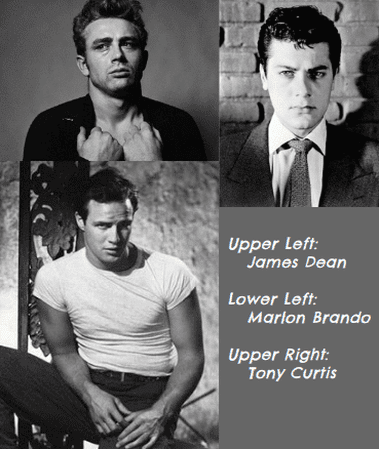
     Elvis actually had little interest in music in-and-of-itself other than as a vehicle to Hollywood to be the next
Marlon Brando or James Dean, a rebel on the big screen. Although Elvis would never become what he aspired to be, he learned the "No Smile Thing" from Brando, Dean, and Tony Curtis. Elvis was sure that not smiling was the key to their success, and he was sure he could achieve that same sultry look . . . Elvis spent hours practicing in front of a mirror.
Picture
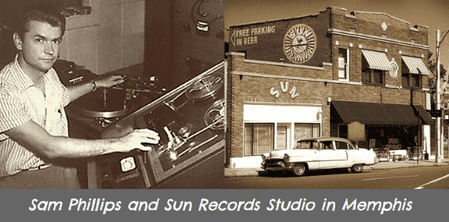
      Sam Phillips, the owner of Sun Records, a recording studio in Memphis, had been waiting for someone like Elvis, who was white but sounded like an African-American vocalist. It took Elvis a while to gather his courage to enter Phillips' studio, but he did so in the Summer of 1953. Ironically, he was sent to Phillips because another talent scout wanted to be rid of Elvis. Elvis was very eager to please, despite his nerves, when he entered Sun Records. Few Americans have been so rebellious in appearance but so polite with their manners, but that didn't bother Phillips in the least. 
     Philips liked Elvis' clothes. Elvis bought his clothes at Lansky's, a store on Beale Street whose customers were mostly flashy African-American men. Phillips also liked Elvis' sideburns. There is some dispute as to whether Phillips was actually in the studio when Elvis first walked in (Phillips' secretary took credit for the first recording). Phillips claimed he was there and recorded/pressed the first disc. Phillips knew Elvis had some kind of special talent, but he couldn't quite put his finger on it. 
     On 5 July 1954, Phillips brought in two musicians, and Elvis recorded "That's All Right Mama". It was a song from famed bluesman Arthur Crudup, but hadn't gone anywhere in terms of popularity. Elvis' blend of country with blues ("Rock-a-billy") would to right to the center of U.S. popular culture.
Picture
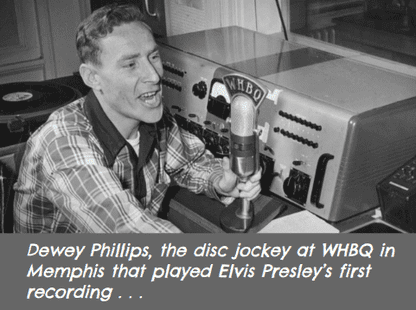
​     Phillips was sure the song was a winner, so he sent a copy to WHBQ to a disc jockey he knew, who had many listeners that were white kids. Dewey Phillips (no relation) was the conduit for the white kids of Memphis to hear African-American music with a powerful beat. The schools were still segregated, but the airwaves were not. Dewey wanted to know how popular his three hour radio show was, so he asked listeners to honk their horns if they were listening to his show at 9 pm, whether in the car or at home. At 9:05 pm the Memphis police chief called and told Dewey to stop his antics. So Dewey went back on the air and told his listeners that due to the police chief's call, he would not be able to say that he wanted his listeners to honk their horns at 11:30 pm.
     Not only was Dewey Phillips a passive-aggressive rebel, but according to Sam Phillips, Dewey had a "platinum ear", and was connected to his young listeners to an incredible degree. So it was no surprise that Sam sent Elvis' first recordings to Dewey. The songs were such a success that Dewey spent all his show alternating between Side A and Side B on the disc. In another bit of irony, Elvis could not read music, but he nonetheless could play guitar, and he could imitate any voice that he chose.
Picture
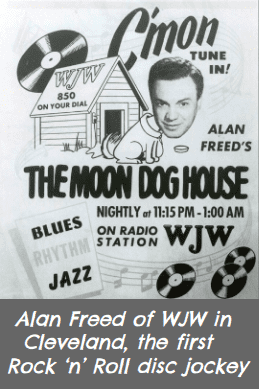
     Elvis grew up in a segregated world, but the radio dial was segregated. As the 1950s began, white kids had started to buy African-American Rhythm & Blues records, but no one saw it as a trend until 1951. Alan Freed was apprised of what was going on in terms of record sales among white kids by Lee Mintz, an owner of a local Cleveland record store. Mintz wanted Freed, a radio disc jockey, to change the format of his classical music show. And, if Freed did so, Mintz would advertise on the show, and work to find additional advertisers. 
     Mintz told Freed that the appeal of the music to white kids was centered around the beat. Freed had not yet found his special niche as a disc jockey on radio, but he not only found his niche, but secured his place in American music history. In the Summer of 1951, Freed started "The Moondog Show" on a 50,000 watt radio station in Cleveland, a station that was so powerful it reached most of the Midwest. Freed's success was immediate: it was as if an entire generation of middle class white kids had been waiting for someone to catch up with the times. On the radio, Freed became one of kids; he was on their side, opposite of their parents. When Freed endorsed concerts, thousands of tickets were sold, and more would be sold if he announced that he would be at the concert. In 1953, Freed had become incredibly popular in several states, while Elvis had graduated from high school, and had very limited options to pursue . . .
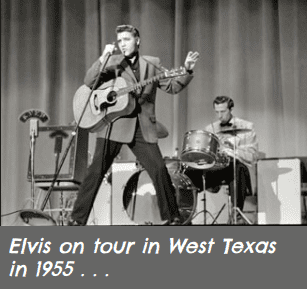
0 Comments

The 1950's: Elvis Presley, Part Two

5/13/2017

0 Comments

 
​                     Source: David Halberstam. The Fifties (1997)
Picture
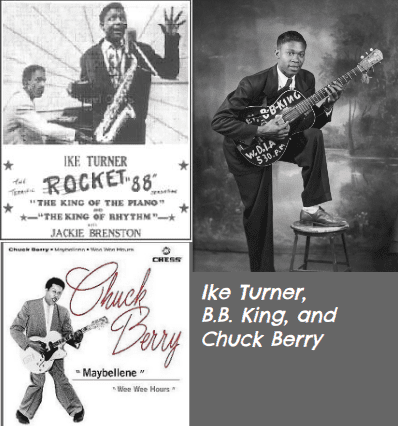
     After graduating from high school in 1953, Elvis drove a truck for Crown Electric, which was much more preferable to Elvis than working in a factory. Sam Phillips of Sun Records liked to record local talent, such as Riley B. King (who became the Beale Street Blues Boy; B.B. King). King told Ike Turner of Clarksdale, Mississippi of Phillips, and Turner became a de facto talent scout for Phillips in the region. In addition to Elvis, Phillips discovered Johnny Cash, Carl Perkins, Roy Orbison, and Jerry Lee Lewis, all American originals.
    While the music world was changing, the large recording companies had become more conservative, sharply disapproving of Rhythm & Blues. Until the 1950s, recorded music was only for sanctioned/approved artists, so those that liked Country or Rhythm & Blues had to listen to the radio. But the the improved recording technology democratized the music industry in large part because recording songs became very inexpensive. 
     In 1954, Bill Haley and the Comets did a version of "Shake Rattle and Roll" which sold over 1 million records by February 1955. Also in 1955, Chuck Berry became the first African-American to top the "white chart" at #5 with "Maybellene", and Little Richard soared up those same charts with "Tutti Fruitti". After Elvis was interviewed by Dewey Phillips on the air in Memphis, Elvis' musical career skyrocketed, first regionally, then nationally. Elvis became the star of a touring group that was managed by Colonel Tom Parker.

Picture
     Sam Phillips held out for as much as possible in selling Elvis' contract to a major recording studio, and Parker had connections with the Radio Corporation of America (RCA). Phillips called his best friend, Kemmons Wilson, who was in the midst of creating his Holiday Inn franchise (Phillips had got in on the ground floor with Wilson as an investor, and Phillips would become very rich down the road). Wilson told Phillips to sell the rights for Elvis, and RCA purchased the rights for Elvis for $35,000 . . . Elvis was now the property of RCA. 
     Presley's timing was perfect, with the crossover of Bill Haley, et al, in full swing. There was nothing parents could do about their kids listening/buying the new kind of music. Teens had more money to spend than any other previous generation of teens in US History, and the technology to play records was abundant and affordable. Elvis started to reach the stratosphere in 1955, when U.S. teens were starting to spend an incredible amount of money on the music of their choice. These teens didn't remember the Great Depression, and saving money didn't even remotely register on their horizon. A byproduct of the rising affluence was that the average middle class teen had $10+ a week ($90+ in 2015 dollars) to spend, a remarkable amount at that time.
     Teens no longer depended on the family appliances, and could listen to music away from home in their cars or with transistor radios (beginning in 1957). Disc jockeys became the most trusted adults for these teens. For the first time, teens had become their own separate, defined part of U.S. culture, and Elvis was the first major beneficiary, entering millions of American homes on the sly via the radio.

Picture
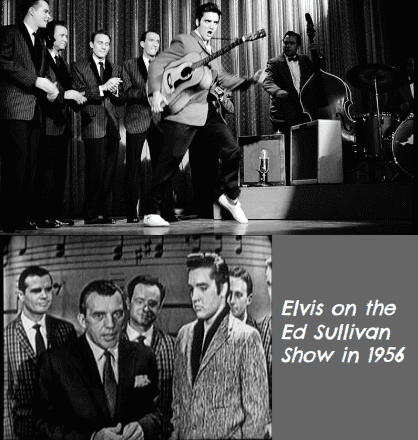
      By 1955, Ed Sullivan had become the unofficial "Minister of Culture" in America. The Ed Sullivan Show was the great variety show at 8 pm every Sunday, blending a safe array of variety acts . . . nothing would happen on the show that was remotely threatening. In 1956, Sullivan was at the height of his popularity and power, his show at the exact center of US mass culture, and he wanted no part of Elvis, in large part due to his gyrations while performing. Those gyrations started when Elvis needed something to do instead of standing still when he wasn't singing, and the crowds loved it.
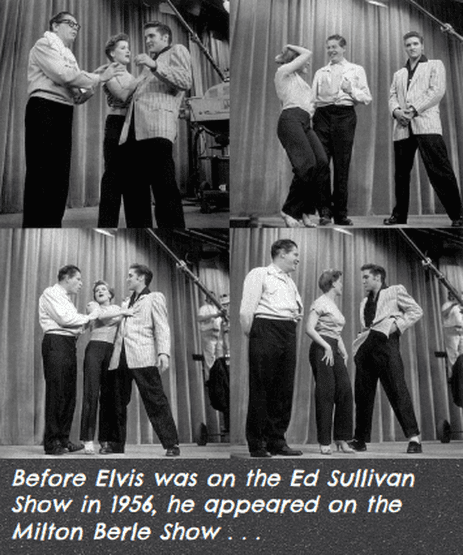
     By 1956, Elvis had become a national celebrity and a national issue, with his success defying imagination; "Hound Dog" sold 2 million copies, while "Don't Be Cruel" sold 3 million. Elvis was selling $75,000 worth of records each day. Elvis had appeared on Milton Berle's show twice, really cutting loose the second time, causing an uproar over the vulgarity of his act. Sullivan announced that Elvis would never be on his show . . . the Guardian of Public Morality had spoken.
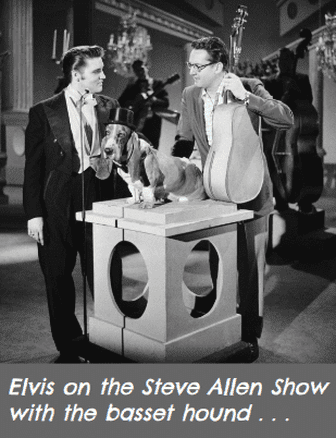
     Within three weeks of making that public statement, Sullivan had to change his mind after Elvis appeared on the Steve Allen Show on 1 July 1956. Allen had Elvis sing "Hound Dog" in a
tuxedo to a basset hound, and Elvis' fans hated it; the fans felt betrayed, and Elvis felt humiliated, wanting-and-needing another chance on television. Nevertheless, Allen had bested Sullivan in the ratings, and Sullivan immediately surrendered to the obvious.

Picture
​      Parker was contacted by Sullivan's representatives, and Elvis was signed to appear on the Ed Sullivan Show three times for a total of $50,000. Being the Guardian of Public Morality was good if it enhanced Sullivan's career, but it quickly went out the window if ratings slipped. The battle was over, and Sullivan had caved . . . the new music entered the U.S. mainstream. After the first of three shows, Sullivan was very pleased with the ratings (Charles Laughton hosted since Sullivan was recuperating from an auto accident). Sullivan also went out of his way to say that he hadn't lowered morals by having Elvis on his show. 
     After Elvis' third appearance, Sullivan sidled up to Elvis and called him a real, decent, fine boy, which was a televised surrender to the new order of things. Market economics had won, and unlike Jazz, the soon-to-be-called Rock 'n' Roll involved the masses in a visceral manner. New forces driven by technology had won, and teens didn't have to listen to their parents nearly as much anymore. Marlon Brando and Elvis were only the first of the new rebels in the world of entertainment. The common thread of those two, and their successors (e.g. James Dean), was that they projected the image of being misunderstood, especially by their parent's generation.


0 Comments

The 1950's: Lucille Ball and "I Love Lucy"

5/8/2017

0 Comments

 
                   Source: David Halberstam. The Fifties (1997)
Picture
    By the end of 1952, there were 19 million television sets in the United States, and a thousand new stores opened each month to sell TV's. More-and-more Americans felt closer to TV personalities than they did with their neighbors and distant families. Nothing showed the power of television to soften the edge between reality and fantasy than the coming of Lucille Ball, who by 1951 was 40 years old. Lucille Ball had a less-than-dazzling show business career to that point. In movies, she was seen as a comedienne rather than as an actress, and she drew "second banana" roles in B-movies (she was often called the "Queen of the B-Movies"). 
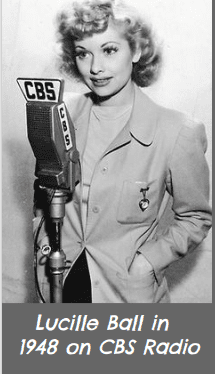
     In 1948, Lucille Ball was in a radio comedy called "My Favorite Husband", largely so she didn't have to travel very much. Also, she wanted to shore up her shaky marriage with the famous Cuban band leader, Desi Arnaz (he wasn't her husband on the radio).

Picture
     In 1950, CBS asked Lucille Ball to do a weekly situation comedy on TV, and no one involved was very excited about the venture. But Lucille Ball was destined for TV, primarily because she was a visual comedienne with a perfect sense of timing, a wonderfully expressive face, and her wackiness generated sympathy, not irritation. Lucy always managed to avoid total disaster, remaining lovable to not only the characters on the show, but especially to viewers.
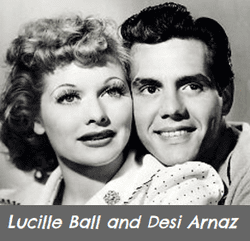
    Lucy insisted that Desi be cast as her husband, and CBS executives were appalled, from Bill Paley
on down to the advertisers. Lucy remained adamant, and Paley gave in. Lucy understood what the execs did not, that viewers would more than get it that Desi was her husband in real life, even though the character names were Lucy and Ricky Ricardo.
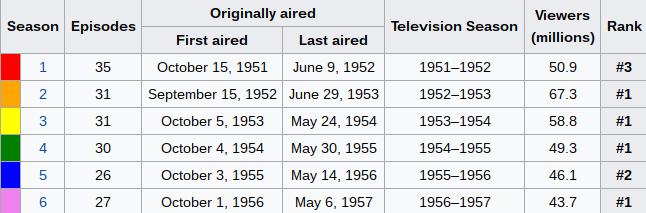
     Lucy cast herself as an ordinary housewife who longed to be a star. Ricky wanted nothing more than a noral life with a normal marriage. The Philip Morris Company became the sponsor, and the first episode aired on 15 October 1951. The executives at Philip Morris were not thrilled with the first episode, but were persuaded to give the show some time, and it wasn't long before "I Love Lucy" was in the Nielsen Top 10.

Picture
     "I Love Lucy" was the #1 show on television in four months, and soon, 2/3's of all TV's were tuned to the show. The show became so popular that even Marshal Field, the prominent Chicago retail store, shifted its Clearance Sale Night from Monday to Thursday since significantly fewer shoppers frequented the store on Mondays. 
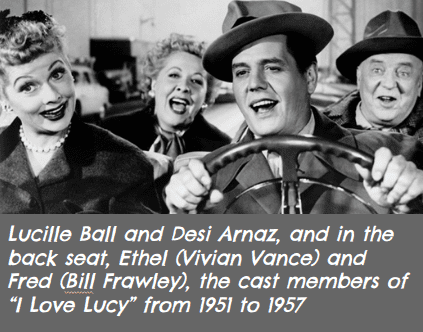
     Lucy insisted that her show be shot in front of a live studio audience, knowing that she played incredibly well performing live. Lucy appealed to all age groups, with children seeing Lucy as a childlike adult. To everyone's surprise, Desi was a great straight-man to Lucy, but Desi was the kind of straight-man that got laughs. Rounding out the primary cast was Vivian Vance as Ethel and Bill Frawley as Fred, Lucy and Ricky's screwball neighbors. 
     By 7 April 1952, 10.6 million households were watching "I Love Lucy", the first time that so many Americans watched the same TV show. By 1954, as many as 50 million watched certain episodes. The show became so popular that it lifted the entire TV industry to new heights; for example, during 1954 TV became the largest advertising medium in the world. 
 During the first few years of "I Love Lucy", the show was set in a city, but after ratings slipped a bit, all four characters moved to the suburbs in Westport, Connecticut.

Picture
Picture
     The great danger of TV was that of overexposure. TV brought the President into every viewer's home, endangering the illusion of heroic proportions created by distance. Jack Benny had a 15 year run on TV, beginning in 1950. Benny, even in his second year on television, understood that if the public felt that they had got too much of a TV personality, they'll get bored and tune out. Benny knew that on TV, a novelty can quickly become tedious and flat. Perhaps Lucille Ball understood that danger as well: "I Love Lucy" ended in 1957 as the
​#1 show on television.

0 Comments

Earl Warren and the Brown Decision (1954)

5/8/2017

0 Comments

 
                     Source: David Halberstam. The Fifties (1997)
Picture
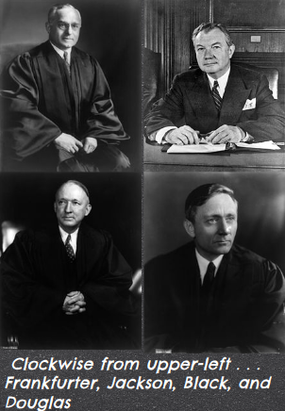
​     By the early-1950s, the Supreme Court was in chaos, mostly due to the long-simmering grudges/conflicts among the four FDR appointees: Felix Frankfurter, Robert Jackson, Hugo Black, and William O. Douglas. When Harlan Fisk Stone died as Chief Justice in 1946, Jackson accused Black of blocking his promotion to what he considered was his due. Black thought Jackson and Frankfurter (a relentless networker/schemer) had blocked his nomination for Chief Justice. 
     There were two political factions on the Court, the liberal Black/Douglas ring, and the conservative Jackson/Frankfurter ring. The four acted like spoiled children when decorum was the rule and expectation. The general atmosphere was poisonous: the Truman appointees, Harold Burton, Sherman Minton, and Tom Clark were not the intellectual titans of the other four, but they looked on aghast at the soap opera taking place in the Supreme Court.
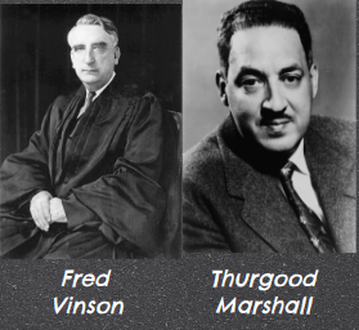
     Truman tried to make the Court more collegial, and nominated his old friend Fred Vinson as Chief Justice, whom Truman viewed as likable, gregarious, and a skilled conciliator. But Vinson's skill in bringing people together didn't present itself as Chief Justice, where the issues and people were far too complex for simple solutions and compromises.

Picture
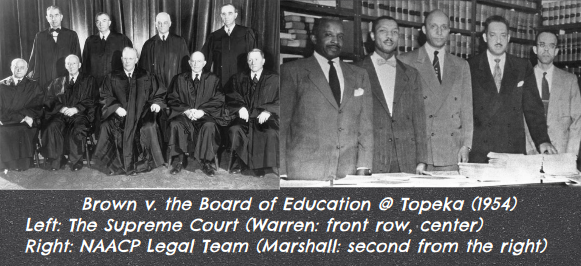
     Complicating things for Vinson was that the men he was dealing with did not have to run for re-election, and they were very different in temperament and background compared to the legislators to which he was accustomed. The four FDR appointees looked down on Vinson as their intellectual inferior, and the Vinson Court fragmented even further.  Meanwhile, the momentum for African-American Civil Rights was gaining speed, and Brown vs. the Board of Education at Topeka was heading towards the fragmented Court.
     Thurgood Marshall started working for the National Association for the Advancement of Colored People (NAACP) in 1936. By 1950, due at least in part to Marshall's efforts, the Supreme Court had outlawed discrimination in graduate schools, tilting away from Separate But Equal. During December 1952, Vinson was clearly very nervous about the Brown case. Frankfurter wanted segregation to end, but he predicted a 5 - 4 vote in favor, and that narrow margin would make implementation of the Court's order impossible; Frankfurter succeeded in delaying the Brown case until December 1953. 
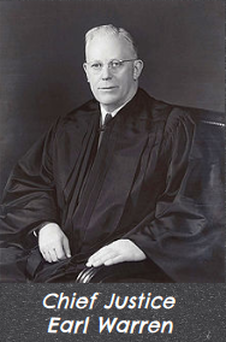
     In September 1953, Vinson suddenly died of a heart attack - who would President Eisenhower nominate as Chief Justice? Ike wanted a political moderate like himself. Ike offered the nomination to his Secretary of State, John Foster Dulles, knowing with almost 100% certainty that Dulles would turn it down. Speculation centered on Earl Warren, the liberal Republican Governor of California; it's historically debatable whether Ike owed Warren a favor from the Republican National Convention of 1952 (Warren supported Ike over Robert Taft). What bothered Civil Rights advocates was that as California Attorney General, Warren signed the order to relocate 80,000+ Japanese-Americans to internment camps not long after Pearl Harbor. 
During June 1943, California Governor Earl Warren reaffirmed his decision as attorney general in terms of Japanese-American internment. 

Picture
​     It was easy to underestimate Warren, who was a very good politician and very smart. Above all, Warren was an excellent listener, wanting people from many different perspectives to talk to him so he could expand his horizons. Warren seemed so relaxed and agreeable that it was very hard to see his ferocious sense of purpose. Warren was not a man that worried if others were smarter than him; in other words, Warren had no problem knowing that he wasn't the smartest man in the room.
     Warren as California's governor was both an optimist and an activist. Warren didn't bring an ideology to the Court, but his experience told him what government could do to help people. Warren wasn't intimidated by the four FDR appointees, even with their experience and intellectual capacities. They knew about the law, but Warren knew about the consequences of legal decisions. 
     Three things mattered most to Chief Justice Earl Warren: Equality, Education, and a Right to a Decent Life. Warren made an excellent first impression with his new colleagues, who were not easy to impress. Ike would soon discover that Warren was not the moderate he had sought for Chief Justice. Ike had long been removed form the reality of America, being in the military, and then as President. ike had been isolated from the changes in American society, where Warren had not.

Picture
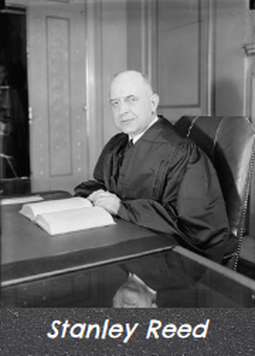
     Warren's greatest skill was cutting to the core of an issue, and Warren determined that the Court had to confront Plessy v. Ferguson (1896), and end Separate But Equal. For Warren, then, achieving that goal became a matter of strategy and tactics. Warren didn't want to inflame the South or unnecessarily divide the U.S.; Warren wanted a unanimous 9 - 0 decsion with a reasoned opinion(s). Warren framed the dialog among the other eight members of the Court to the point where if a justice was against reversing Plessy, that justice appeared to be a racist (Stanley Reed appeared to be the only segregationist on the Court).
     Warren also wanted to keep Frankfurter from writing a long concurring opinion that would water-down the impact of the unanimous decision. The first conference for Warren on the Brown case occurred on 13 December 1953, and Jackson still needed to be convinced, viewing Marshall's NAACP brief as mere sociology, not law, but he was gradually won over by Warren. Jackson wanted to write a second opinion, which on the one hand recognized social changes in America, but then Jackson went on about mixed-race people that could be viewed as actually be white. Jackson's heart attack on 30 March 1954 ended his effort at finishing his potentially controversial-and-dividing concurring opinion.

     Warren had eight justices in agreement, and he went after Reed to make it 9 - 0. Very politely, Warren kept up the pressure until Reed finally gave in; Reed asked that implementaion be gradual, not immediate. Warren's efforts/decision sacrificed brilliance for simplicity, and he deliberately sought to not offend. Frankfurter's glowing view of Warren wouldn't last long when a string of civil liberties cases descended on the Court. 
     The Brown decision ended legal segregation, and deprived segregationists their moral legitimacy. While most of the nation, especially Southern states, basically ignored the decision in terms of integrating schools, a change of consequence did indeed occur. After the Brown decision, the media felt obligated to cover stories about racial prejudice as never before . . . one era was ending, and another was beginning . . . 
Picture
0 Comments

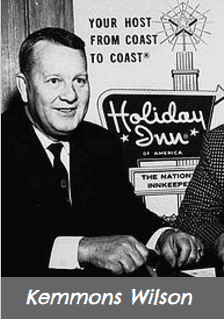
The 1950's: Kemmons Wilson and Holiday Inn

5/8/2017

0 Comments

 
                   Source: David Halberstam. The Fifties (1997)
Picture
     The vacation that changed the landscape of the American road occurred in 1951 when Kemmons Wilson, a successful home builder in Memphis, took his family to Washington, D.C. In 1951, the interstate system didn't exist, and it was a crapshoot at the end of every day of travel as to the quality and cost of a motel. Wilson was charged extra for his kids, and sometimes he spent $20 a night ($184 in 2015 dollars), and there weren't any restaurants handy.
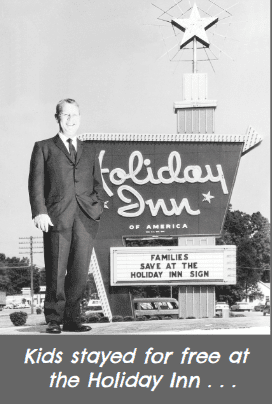
     One day during the trip, a very frustrated Wilson told his wife he was going into the motel business. Most everyone in America had a car and a family and Wilson saw the demand for roadside motels in his absolute frustration. Wilson envisioned 400 motels, and kids would stay free . . . it was the beginning of the modern American motel chain.
Picture
     Wilson was 38 years old, and he had always loved wheeling-and-dealing; even though he was a high school dropout, he had become a millionaire. Wilson also knew how big his motel room would be: 12 x 30 feet + a bathroom. The name for his motel chain, Holiday Inn, came from a Bing Crosby musical by the same name. Wilson decided that the perfect location for the first motel (120 rooms) would be between Memphis and Nashville, near where he owned a lumberyard. If he did everything right, Wilson figured the motel/restaurant would cost $325k.
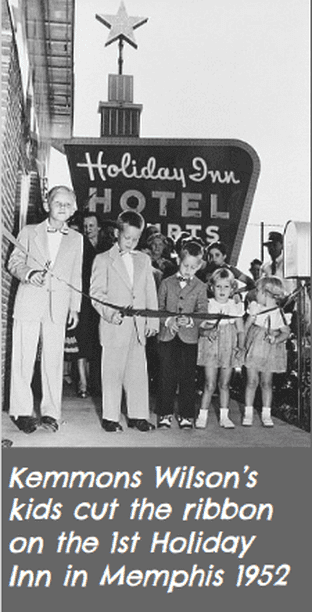
     Wilson took out a loan for that amount, and built his first motel/restaurant for $280k, using the remaining $45k as carryover for his next venture. The first Holiday Inn was built in just 90 days, and it opened in August 1952, a year after Wilson's immensely frustration vacation. The first Holiday Inn had a restaurant, gift shop, swimming pool, and in each room there was an air conditioner, as well as a rent-free television. Wilson charged $4 an night for single occupancy, and $6 for double, and children stayed free. Within two years Wilson built three more Holiday Inns, all on the main approaches to Memphis. Wilson wanted a large, highly visual sign for his motels, and the soon-to-be-famous sign soared to a height of 50 feet.

Picture
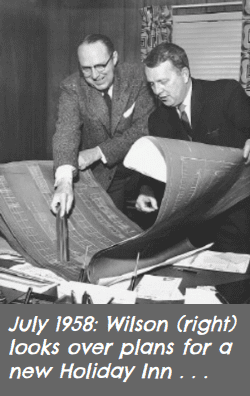
     But Wilson was 396 motels short of his goal, so he turned to the people he knew best, homebuilders. Each homebuilder that wanted to be part of Wilson's motel investment group would pay $500 for the right to own a Holiday Inn at their own location, plus a user's fee, plus .05 cents a night per room. At the first meeting, 70 homebuilders showed, and Wilson was sure that within a year every major U.S. city and major highway junction would have a Holiday Inn. Wilson's optimism was misplaced, in that only 3 builders accepted the proposal, but Wilson was actually lucky his colleagues didn't take him up on his bottom bargain-basement offer.
     Wilson realized that most of his fellow builders didn't see America changing as he did, so Wilson became the head of Holiday Inns, and he would franchise to others. Instead of homebuilders, Wilson contacted investors, such as doctors and lawyers (one of his investors was his friend Sam Phillips, who first recorded Elvis Presley). Wilson started building Holiday Inns for $3000 a room, and he franchised them out for $3500 a room, making a clean $500 per room during the construction phase. From the start, Holiday Inns were a success; the rooms always seemed to be filled. In 1954, eleven Holiday Inns opened, and that was also the year that the first franchised Holiday Inn was built.

Picture
     In 1956, the U.S. Interstate System was authorized at a cost of $76B, and America seemed to be coming to Wilson and his Holiday Inns. With the interstate, travelers could avoid going through cities altogether if they chose. In 1957, Wilson decided that he had to take his company public. Wilson and a handful of partners sold 120,000 sharea for $9.75/share on the Initial Public Offering. For awhile, Wilson had the roadside motel industry all to himself, in large part because Wilson could eye the perfect locations for a Holiday Inn in every area that didn't have a motel.
     Wilson wanted a highly visible venue that was on the right side of the highway leading into a city, with a lot of additional land just in case he wanted/needed to expand. Wilson had tremendous fun selecting locations and choosing franchises. When Wilson started to fly his own airplane, his ability to see traffic patterns greatly enhanced his selection of sites . . . Wilson's eye became a legend within the industry. 
     Eventually Wilson's Holiday Inn chain reached 1500 motels. At his peak, Wilson was building a new Holiday Inn every 2.5 days, and a new room every 15 minutes. By the early-1970s, Holiday Inns had triple the rooms of its nearest competitors, Ramada and Sheraton, and Wilson was receiving 10,000 requests each year for franchises.

0 Comments

Early Television: The Rise and Fall of Milton Berle

4/22/2017

0 Comments

 
                    Source: David Halberstam. The Fifties (1997)
Picture
     By 1949, radio was on the verge of being overtaken as a commercial vehicle by television. For over 20 years, radio had a monopoly on home entertainment, but now it was struggling as it tried to find its new role in the changing technological landscape. In startling fasion, one of the most popular and longest-running radio shows, the Fred Allen Show, died in June 1949, after an 18 year run.
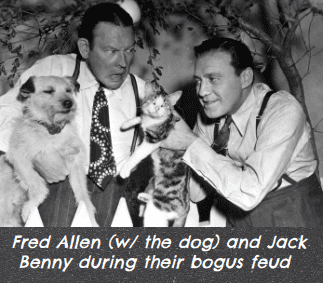
     For more than a decade, Allen owned his time slot as the foremost of radio comics. Allen was popular with the masses as well as the intelligentsia. Allen's most celebrated stunt was his fake feud with Jack Benny, also a top-rated radio comedian. Both would appear on each other's show to exchange insults. Allen's humor resonated with Americans during the Great Depression and World War II, but as prosperity exploded after the war, Allen's comedic attacks on the successful weren't as nearly well-received. By the late-1940s, Americans wanted to share in the success, not mock those that were already successful . . . the reality was that even without TV, Allen's schtick had worn thin.
Picture
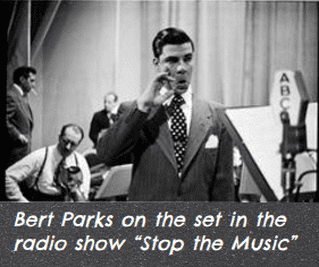
​     In 1948, Allen was still at the height of his popularity, but the radio show "Stop the Music!" with Bert Parks destroyed Allen's ratings. Allen tried TV, but he was one of the many radio personalities that didn't translate well to the new medium, and by December 1950, Fred Allen was off the air. 
     By 1950 there were 108 radio programs that had been on the air for 10+ years, with 12 of them being on the air for over 20 years. In 1953, when President Eisenhower ended the freeze imposed by Truman on awarding new TV stations, there were only 108 TV stations, with only 24 cities having two-or-more stations (it wasn't until 1951 that coaxial cable stretched across the U.S.). By 1953-54, people started to watch markedly more television, with massive toilet flushing in cities during commercial breaks, and people going to restaurants much earlier to be home for their favorite shows. Also, products advertised on TV soared in terms of public acceptance. The success of TV even threatened the movie industry, with theater closings being blamed on the new invader.

Picture
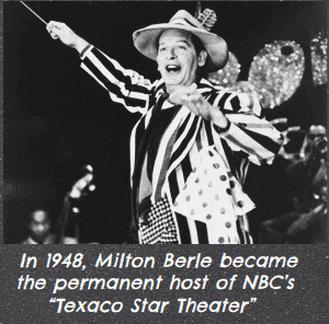
     The first example of the power of TV was the meteoric rise of Milton Berle, a slapstick   
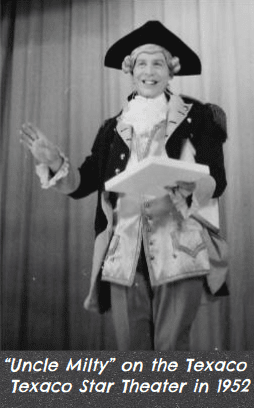
Vaudeville comic. Berle's humor was manic, sometimes even vulgar, and never droll. Berle arrived on TV in 1948 by chance: Texaco was looking for an emcee for their TV version of Texaco Star Theater, and Berle thought he would be a great fit for television. When Berle was hired, there were only 500,000 TV sets in the U.S.
     Almost from the start, Berle's show in Tuesday night became a weekly national event. The very success of Berle's show meant more TV sets were sold. A year into the show Berle was so famous he was on the covers of both Time and Newseek in the same week. The 42 year old Berle was America's first TV superstar. Where Allen was cerebral, Berle's comedy was very often over-the-top, which meant that he had to be seen.

Picture
     During the late-Autumn of 1948, Berle had a 94.7% rating (.947 of America's TV's were tuned to Berle). Early on, TV was an urban phenomenon: in 1949, almost half of America's 1.1 million TV's were in New York City (450k), with most of the remaining in Boston, Los Angeles, Detroit, Washington, D.C., Philadelphia, and Chicago. Berle appealed to the urban viewers, with 5 million watching him every Tuesday night (35% in NYC).
     Berle was paid $5000/week (nearly $50k in 2015 dollars) to do what he loved and did best. In 1951, NBC signed Berle to a 30 year contract for $200k/year, and it was at precisely that moment that Berle began to slip in the ratings. The further TV reached to non-urban areas, the lower Berle's rating became. As Berle's ratings decreased, his humor became more manic than ever, and he even changed the format of his show in the 1952-53 season. In essence, the show became more predictable and actually featured less of Berle. Texaco dropped its sponsorship when the show dropped to fifth in the ratings, and in the 1954-55 season, the show dropped to 13th, and soon Berle's show was only broadcast every 3rd week.

      In 1955, Berle was dropped from the show altogether, with his contract restructured to $120k/year, and he was allowed to appear on other networks. Berle was the first to experience the power and volatility of TV. The highs were greater than any other previous form of entertainment, generating an astonishing intimacy between performer and viewer. But the audience could quickly become less-enamored with the performer, and the star could crash as fast as he/she rose . . . it would be a lesson that entertainers, actors, and even politicians would learn the hard way in the passing decades.
Picture
0 Comments

The CIA Coup in Iran (1953)

4/9/2017

0 Comments

 
                     Source: David Halberstam. The Fifties (1997)
Picture
​     The Republicans, the minority party in national politics since the Election of FDR in 1932, constantly attacked the Democrats in the late-1940s/early-1950s for losing so much of the world to Communism. Once in charge in January 1953, President Eisenhower and the Republicans found that much of the globe was difficult/troubling, and those areas were very susceptible to Communism. The French were up to their necks with trouble trying to control Indochina (Vietnam) against indigenous communists, and the people of France were tiring of the whole affair, and the French government was asking the U.S. for more assistance.
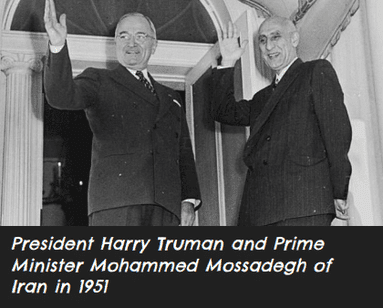
     World War II had hastened the collapse of Colonialism in the world, with Marxism finding very fertile ground. The Republicans didn't want to lose territory to the Communists, as they had accused Truman of "Losing China" in 1949 . . . but there were limits to American influence and power, as the Korean War was showing. Eisenhower thought he had found a solution to the dilemma with the Central Intelligence Agency (CIA), and its first chance to show what it could do occurred five months after Ike took office in June 1953 in Iran.  On 22 June 1953, the final meeting at the State Department concerning regime change in Iran occurred. The meeting in-and-of-itself was merely a formality, since the decision had already been made that the current leader of Iran, Prime Minister Mohammed Mossedegh, had to be removed.
Picture
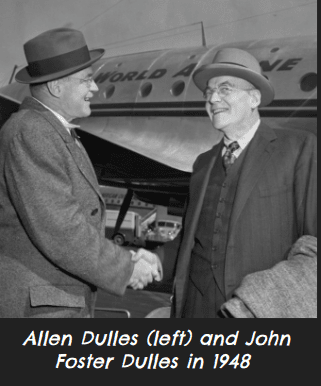
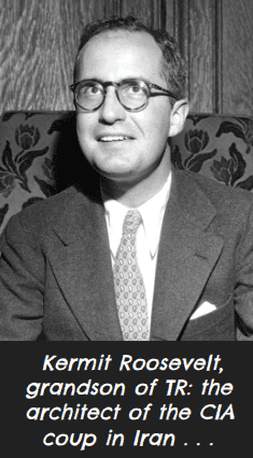
     In Secretary of State John Foster Dulles' office was his brother, Allen Dulles, Director of the CIA, as well was the CIA agent in charge of the operation in Iran, Kermit Roosevelt. The U.S. was moving into uncharted territory in terms of being actively involved in regime change in a sovereign nation. The Dulles brothers were able to bypass normal bureaucratic channels and procedures which would have interfered or slowed-down their planned covert operation. To both Dulles brothers, secrecy was essential in order to be effective in fighting the evils of global Communism.
     At the meeting as well was Walter Bedell
(Beetle) Smith, the Under Secretary of State. Smith, since WW II, had become one of Ike's most trusted-and-relied-upon men; no one admired Ike more than Smith. It was Smith's job to be Ike's "S.O.B.", and had become a true hard liner against the USSR after being the US Ambassador to Moscow from 1947-50. At the meeting, Smith was Ike's proxy. Kermit ("Kim") Roosevelt's plan was simple, in that if the Iranian people had to choose between Mossadegh and the Shah of Iran, Kim believed they would choose their traditional historic leader, the Shah.
     The stakes were high, given the oil in Iran as well as its strategic location bordering the USSR. The cost of the covert op would be $200k, at least half of which was for the "rental mob" to be used to protest against Mossadegh, who had been labeled an unstable maniac by the Eisenhower administration. Kim Roosevelt was TR's grandson, and he was very well-connected in D.C.; it had bee "Wild Bill" Donovan that brought Kim on board in the Office of Strategic Services (the forerunner of the CIA) during WW II. After the war, Kim's specialty had become the Middle East. Kim had become an expert on the relations between Iran and Great Britain; since the first successful oil strike in 1909, Great Britain had treated Iranian oil like it was their own.

Picture
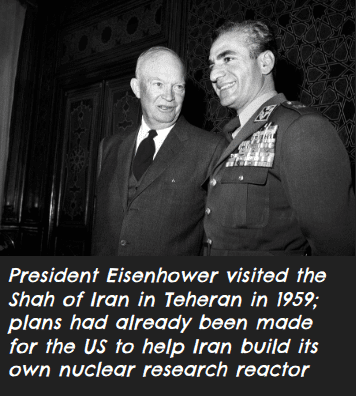
​     After WW II, Britain had become an unwitting/unwilling accomplice, and even an architect, of the rising Iranian nationalism which began to surface in the late-1940s/early-1950s. By the time Britain offered Iran a 50-50 split (after their initial offer of 67-33) in oil revenues, it had become too late for deal-making. The Iranian politician that took the most advantage of the rising nationalism was Mossadegh, the Prime Minister, and he was easily able to muscle aside the young Shah (Mohammad Rezi Pahlavi) , whom the U.S. government thought weak. 
     During October 1951, Mossadegh ordered all British oil employees out the nation, and then had Iranian troops occupy a huge refinery. A Western boycott on Iranian oil followed, and Mossadegh broke off diplomatic relations with Britain. It was during these developments that the U.S. government under President Truman thought Mossadegh was moving towards Communism. During November 1952, Britain sought out Kermit Roosevelt, who still had access to his high-level contacts in Iran, about a coup against Mossadegh. Kim held off Britain, since he knew Truman would be at best lukewarm to the proposal. 
     Kim had predicted that the Republicans would like the plan, and he was proven right when "Beetle" Smith, once apprised of the plan, wanted to get going immediately. The key of the covert operation was the Iranian army; to whom would their loyalties lie, since only a few top generals supported Mossadegh. Both Britain and the U.S. wanted to remove Mossadegh: Britain wanted Iranian oil, while the U.S. wanted the oil but also to contain the USSR.

Picture
​     During February 1953, meetings between Britain and the U.S. started, and Ajax became the name of the covert operation in Iran. Kim saw that a new USSR ambassador had arrived in Teheran, the same one that had been in charge of the USSR coup in Czechoslovakia in 1948. So, it had become a race as to who would strike first in Iran, the British/U.S in support of the Shah, or the USSR in support of Mossadegh. 
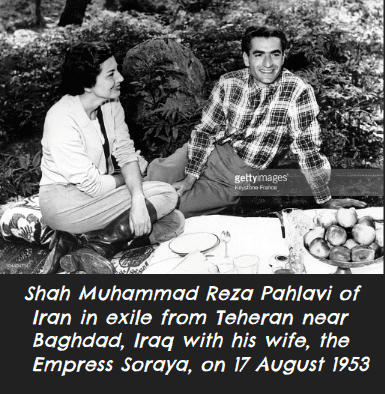
     Kim arrived in Teheran on 19 July 1953 to lead the covert op. Kim needed to move quickly and quietly in order to make all the necessary plans to mobilize-and-activate the pro-Shah mob. Kim even met the Shah in a car, with a blanket over Kim as the Shah got in the car. Kim told the Shah about the coded messages to be broadcast on the radio that were the signal to start the staged protests. By then, Kim had $1 million in Iranian currency, with only $100k earmarked for the mob. The Shah was instructed by Kim to be out of Iran when the coup occurred to not only reduce his visibility and perceived responsibility, but to also keep him safe if things went awry.
     On 16 August 1953, the coup started badly, with Mossadegh firing the first shot, claiming that the Shah had tried to fire him as Prime Minister. Mossadegh stated that his only recourse was to take all power in Iran, and for a day or so the pro-Mossadegh forces had control of the streets and the government.
​

Picture
     The pro-Shah mob took to the streets on 19 August 1953, and the tide quickly turned. When the pro-Shah forces made their move to take control, the Iranian army supported them and the exiled Shah, and Mossadegh went into hiding. The Shah of Iran was quickly returned and was back in power, and soon thereafter officially received Kermit Roosevelt. 
     Everyone involved on the U.S. side was delighted, since the coup was done quickly, cleanly, and cheaply. On 23 September 1953, President Eisenhower, in a private ceremony, awarded the National Security Medal to Kermit Roosevelt. In terms of Iranian oil, Britain formed the Anglo-Iranian Charter, which eventually became British Petroleum. Iranian oil was divided up, with the British receiving 40%, while Gulf, Standard, Texaco, and Mobil dividing another 40%. 
     Mossadegh was imprisoned for two-and-a-half years before being released. As the decades followed, the Shah was seen by his people as a mere pawn of the West, and his government collapsed in 1979, with barely a shot fired in his defense from his own people. Eisenhower and his loyalists were so encouraged by the successful coup in Iran that more covert operations were planned, and the role of the CIA was expanded . . . the seeds for the disaster at the Bay of Pigs were planted . . . 
0 Comments

1950s Consumerism, Television, and Madison Avenue

4/2/2017

0 Comments

 
                    Source: David Halberstam. The Fifties (1997)
Picture
      By the mid-1950s in terms of kitchen/household appliances, the price kept going down and the consumer kept buying more . . . it appeared that life in America would always get better. The great fear of manufacturers was that their sales/profits would decline, but just as with the automobile industry, the American consumer just had to have the latest appliance. Another fear was that Americans would save more relative to spending, but that also became an unfounded fear, in that Americans just kept buying.
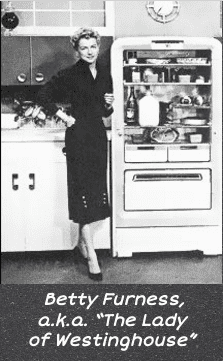
    Appliances quickly seemed to become outdated since the industry took the cue from General Motors by constantly updating models. In 1955, consumers spent $1.3B buying 4 million refrigerators, and the explanation was simple: frozen food. The figure that came to symbolize the dazzling new kitchen with appliances and advertising was Betty Furness, the Lady of Westinghouse. In 1949, Furness was 33 years old, and her career in over 30 movies (mostly B-movies) was winding down. Furness was attractive, but not in a way that made women jealous. Furness appeared as women wanted to be or envisioned themselves: bright, upbeat, confident, and modern without looking too glamorous. Furness exuded the kind of confidence that convinced women that their lives would be much easier with new appliances from Westinghouse.

Picture
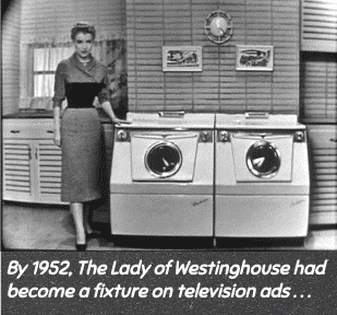
​     Furness became famous during the 1952 political conventions, since Westinghouse had purchased loads of TV commercial time; Furness was on the air about as much as Walter Cronkite, who made his reputation on TV during those conventions. Furness made 20 - 25 appearances each day during the week of each convention . . . thankfully by then the teleprompter had arrived. 
     Furness was not only famous, millions of women viewed her as a friend; to her surprise, to these women she was "Betty". The trademark phrase from the Lady of Westinghouse was "You can be sure if it's Westinghouse". Westinghouse signed Furness to a non-cancellable three year contract at $100k/year, and with that she became the Queen of American Appliances.
​     As she continued in her great job, she noticed that she began to shrink . . . the appliances were getting bigger-and-bigger each year. The only appliance that she advertised that didn't sell well was the dishwasher; women were afraid of losing their last "toehold" on the kitchen, according to industry research. Furness was with Westinghouse for eleven years; by the early-1960s, a the new Westinghouse CEO wanted a younger pitchwoman.

Picture
​     Furness was an example of the growing power of TV in terms of consumerism. In 1949, total TV billing from
Madison Avenue was $12.3m, in 1950, $40.8m, and in 1951, $128m. In the 1950s, advertising on TV compared with schools and churches with social influence. During the 1950s, the federal government started to close in on cigarette companies and their TV commercials. In July 1952, Reader's Digest (immune from advertising) published an article titled "Cancer by the Carton" that claimed a link between smoking and cancer. The cigarette industry, feeling at least somewhat cornered, introduced filter-tipped cigarettes.
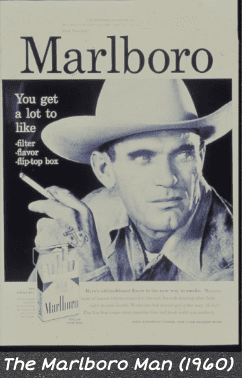
     It was at about this time that Philip Morris came out with Marlboro, originally a cigarette for women. But Philip Morris decided to push the product towards men; the problem was that at the time filtered cigarettes were considered to be effeminate. Philip Morris wanted an ad campaign (both print and TV) that showed that Marlboro was a masculine cigarette, for a real man. Over time, the brainstorming led from men with tattoos to a cowboy; the myth of the cowboy in the midst of fast-growing suburbs was a powerful lure to individualism. 
     The first Marlboro Man ad ran in January 1955, and the key to the campaign was the craggy-faced cowboy. Chesterfield cigarettes soon advertised with a cowboy as well, but as far as the American cigarette consumer was concerned, cowboys and the West belonged to Marlboro.

Picture
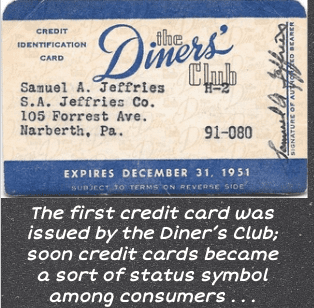
​     Capitalism in the 1950s was driven by ferocious consumerism, which had a different face than before WW II. Consumerism of the 1950s wasn't about need, it was about appearance, especially with neighbors. The target market were the millions surging into the middle class, and the preferred payment was credit, which was an important new development since the nation was prosperous, but not as prosperous as they may have believed. 
  Ordinary buyers were extended unprecedented credit limits. The Great Depression generation feared debt, but not the generation that came of age after WW II. But since millions of Americans in the 1950s had also endured the Great Depression and WW II, Madison Avenue had to find a way to balance the cautiousness of the past with the abundance and affluence of the 1950s. One thing that had to be sorted out on the advertising front was distinguishing between pleasure and guilt for those that were more affluent than their parents.

Picture
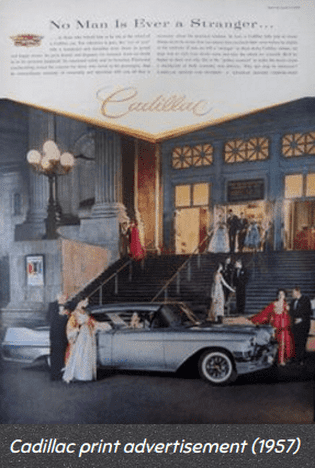
     The job of Madison Avenue was in essence to give moral permission to have fun without the guilt. Absolution had to be connected to gratification, and Cadillac had that aspect figured out. Cadillac was not only a top-of-the-line car, the best that money could buy, it was also a reward for a life's worth of hard work. The tone was set for more-and-more TV ads: the Head of the Household worked hard and selflessly, and he had earned the right to bestow these hard-earned fruits to his family, and to himself.
     That advertising strategy not only worked for Cadillac, but also for .15 cent hamburgers at McDonald's. America was slowly-but-surely learning to live with affluence, convincing itself that it had the right to new appliances, cars, and fast food, etc. For Madison Avenue, every year that went by in the 1950s, it became easier to sell compared to the "Puritan Past" before World War II.

  Addendum: The Plight of 1950s Suburban Housewives


0 Comments

General Motors: 1948 - 1956

3/18/2017

0 Comments

 
                    Source: David Halberstam. The Fifties (1997)
Picture
     By the early 1900's, the American Worker also became the American Consumer. The "Oil Man", unlike his predecessor, the "Coal Man", was the beneficiary of his own labor. With the advent of mass production and lowered prices, the working man of the early-1900's could afford what was produced. The "Oil Century" began in earnest in 1949, and the U.S., with its accessible and inexpensive domestic oil sources, was the first nation to truly cross the threshhold.
     During WW II vast systems networks were created for oil production, transportation, and refineries, and all were in place operating at full capacity in 1949. And the price for oil remained low, and oil drove the U.S. economy to great heights in all sectors. From 1949 to 1972, U.S. consumption of oil went from 5.8 million barrels/day to 16.4 million. In 1949, coal represented 2/3's of the world's energy, but by 1972, it was oil at 2/3's. World War II had diverted the American economy away from the consumer to the military, but after the war, the consumer was not to be denied.

Picture
      In the years immediately after WW II, a great seller's market existed, and there was also a desperate hunger by consumers to buy things after the Great Depression and WW II. A major symbol of U.S. economic might was General Motors (GM), a company so powerful the word corporation really wasn't all that accurate a description. GM was the largest/richest corporation in the world by far: GM was the first corporation to gross $1B. Ford, by comparison, was near bankruptcy after WW II due to the erratic-and-paranoid behavior of Henry Ford. GM actually helped Ford by basically giving top management executives to Henry Ford II so GM wouldn't have to deal with anti-monopoly charges from the federal government.
     During the 1950s GM made more cars than its competitors combined. The only thing that could possibly throw a monkey wrench into GM's colossal success was the possibility of labor unrest. During 1945-46 a bitter strike over low wages at GM lasted over 100 days. GM wanted to teach the United Auto Workers (UAW) a lesson, and held firm with only 0.01/hour separating the two sides. Charles Wilson, the CEO of GM, saw the fantastic future in terms of absolutely massive profits, and was also sympathetic to the workers.

Picture
     In 1948, Wilson agreed to an historic contract, knowing that virtually unlimited sales and profits were in the offing. Wilson offered an acceptable wage increase plus a cost-of-living index, which matched wages to inflation. The UAW was made, in effect, a junior partner of GM, since wages were tied to productivity . . . for a generation, GM had no labor unrest. Wilson also knew that he could pass the at least most of the burden of higher labor costs to the consumer.
     GM decided to manufacture big cars since they generated far more profits than smaller cars. Production costs stayed the same no matter the size of the car, so it was a no-brainer for GM to build big cars. GM had waited a long time for this "Market of Abundance", and GM wanted to take full advantage. Therefore, the yearly model change was crucial for GM, in that the goal was to make car owners restless with the cars they owned, and eager to purchase anothe GM vehicle.


Picture
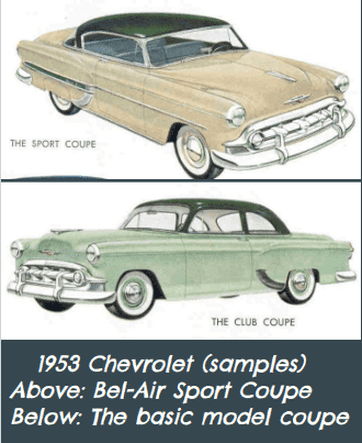
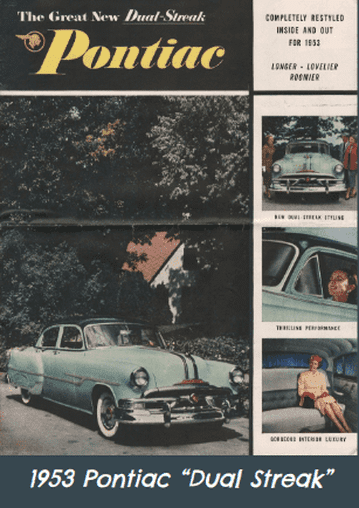
      GM's categories were the core of its success, making car owners restless by appealing to their broader aspirations in life. Chevrolet was for the blue collar worker and young adults in their 20's.
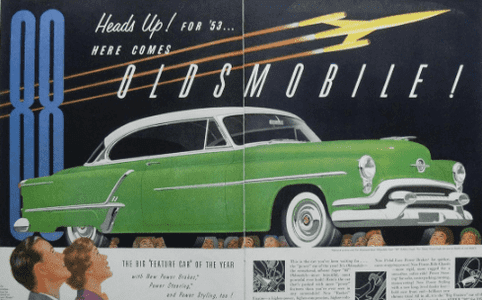
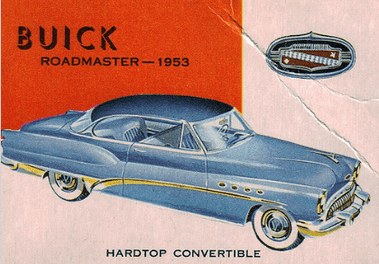
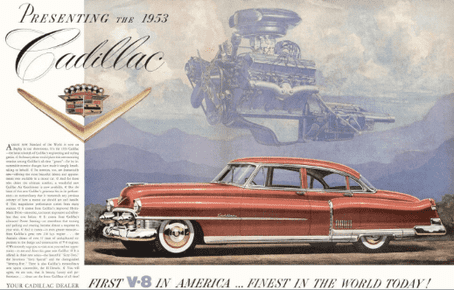
Pontiac was for those that felt successful/confident and that wanted something sportier. Oldsmobile was for the white collar manager or bureaucrat, and Buick was for the elite of the professional class (e.g. doctor/lawyer). The Cadillac was for the top executive or owner of a factory. A Cadillac signaled that a person had joined the proprietorial class; a Cadillac cost around $5000 ($49,745 in 2015 dollars), but it held its value, especially if it was traded in after a year or two.

Picture
     This was the 2nd Stage of the Automobile Era, in which the car was not only for transportation, but also for status. A car was not a permanent possession, but an economic benchmark signaling rising status. After WW II, GM decided that Americans wanted the following: Most important was design/style, second was an automatic transmission, and third was high compression engines. GM put out models that encouraged dreams at a time when most Americans believed their future would be nothing but grand. GM led the charge in terms of making design more important than engineering, which created a vicious cycle in the automobile industry: worship of the new at the expense of the old, even if the old was better.
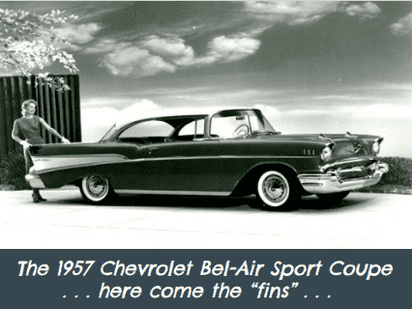
     GM, Ford, and Chrysler were forced to opt for less effecient/attractive cars just for the sake of exterior design changes. Among the consequences was that GM didn't extend its initial technological lead versus foreign competitors (e.g. the Volkswagen Beetle). GM fiddled with styles and design details, especially the "fins", which became the most famous-and-visual automobile detail of the era . . . the fins represented zero technological advance in GM's cars. A fin was "visible prestige", nothing more than an illusion of a more powerful car. That approach by GM, Ford, and Chrylser would come back and haunt the Big 3 in the 1970s during the Arab Oil Embargoes of 1973 and 1979. While GM was selling an incredible number of cars in the 1950s, the corporation, without knowing so, was speeding towards "Dynamic Obsolescence". 

Picture
     But in the 1950s, Bigger was Better, and Americans wanted bigger cars with every passing model year. High compression engines and higher octane gasoline was the key to producing those huge cars . . . those two developments took off in 1946. The major component of the high compression engine was confining the vapors of gas in the cylinders before exploding, driving back the pistons with greater force, but that would only be possible with higher octane gas. In 1947, high octane gas was developed separately from the non-responsive oil companies by a GM high compression engine specialist. The new V-8 high compression engine with high octane gasoline was first put in the 1949 Cadillac. While the GM engine specialist envisioned greaty efficiency, the GM execs envisioned bigger cars with more-and-more accessories, such as power brakes/steering and air conditioning.
     Dwight D. Eisenhower was the first Republican President in 20 years, and GM was no longer worried about being accused of monopolistic practices with more than 50% of the market share. The attitude of GM's execs was that if the federal government wanted to stop GM, they would have to find a way to stop GM. In 1953, GM had 45% of the industry's market share, and by 1956 it reached 51%, and that wasn't enough for the GM execs, whose goal was actually 75% of the total market of cars sold in the U.S. by 1958.

0 Comments

The 1950s: The Great Migration & the Mechanical Cotton Picker

3/4/2017

0 Comments

 
                   Source: David Halberstam. The Fifties (1997)
Picture
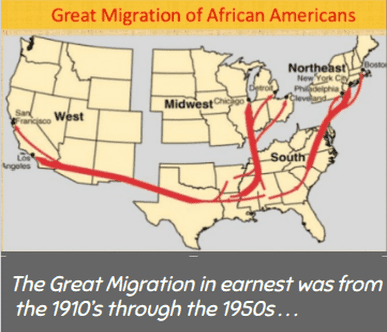
      The Great Migration of the 1950s of African-Americans moving north was a continuing evolution that went back decades (BTW, the media does a much better job covering revolution compared to evolution). The Great Migration that began before World War I ended a kind of racial American Colonialism: "Separate But Equal" was a brand of colonialism practiced on African-Americans by whites. 
     While African-Americans in the South were able to migrate, they did so at a terrible disadvantage in that they didn't have the level of education that would lead to an easier transition and a more prosperous life. When the supply if European immigrants drastically decreased during World War I, northern factory owners turned to African-Americans in the South. World War II caused the next giant surge in the Great Migration North, and the South desperately tried to hang on to their cheap African-American labor force.
     The Chicago Defender was founded in 1905, and the newspaper became the voice of African-Americans in the North and South. The publisher was Robert S. Abbott, who saw African-Americans in the South as being merely the possessions of the White Establishment. Abbott printed not only his rage, but the rage felt by African-Americans. By 1919, 2/3's of the Defender's readers lived in the South. The more whites tried to ban the Defender, the more legitimate the newspaper became in the eyes of African-Americans.

Picture
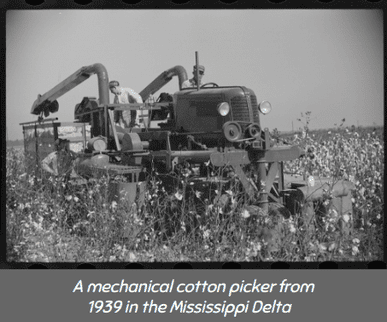
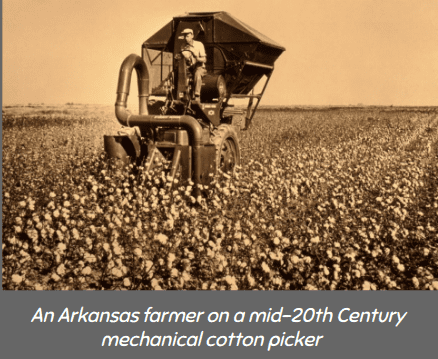
     Usually, a pioneer within an African-American family in the South went North to scout for work, and to at least have a place to live waiting for the rest of the family when they migrated North. The greatest reason for the accelerated surge in the Great Migration after WW II was due to technology - the mechanical cotton picker. Once the mechanical cotton picker was in the fields, white Southerners couldn't wait to see African-Americans go North, and in most areas of the South, it was actually encouraged. 
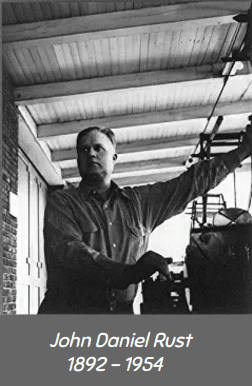
   The mechanical cotton picker changed the landscape in the U.S., but historically the invention hasn't really registered compared to other developments such as the television. The inventor of record was John Daniel Rust, who was among the countless number of Southerners over the previous decades that had tried to create a machine that separated the cotton seed from the boll without destroying the cotton.
     Rust always had an inventive mind, and the mechanical cotton picker became his obsession. Many before had figured out how to get the cotton out of the boll with spinning spindles, but then the problem was how to get the cotton off the spindles. The cotton seemed to obey its own physical laws, and the machines that Rust (and others) created made an absolute mess of the cotton. One night in 1927, Rust remembered that cotton tended to stick to his wet hands (due to the dew); Rust took a nail and wetted it, and cotton stuck to the nail. It was at that point Rust was sure he could be successful.

Picture
      Rust needed to build a machine that could work on rough terrain, and the possibilities of things going wrong were endless. Rust's furst successful prototype was in 1933, and it picked more cotton in one hour than a person could in one week. But in 1933, no one wanted a machine that would create MORE unemployment during the Great Depression.
     By 1936 Rust completed his prototype, and the initial response among whites in the South was that the machine should be dumped in the nearest river. By 1940, Rust was desperate and broke, yet he still worked on his machine; Rust went all-in with one more effort to succeed. Rust didn't know that Allis-Chalmers, a large company, was trying to contact Rust, since they had decided that his old patents were feasible.
     Rust sold his patents to Allis-Chalmers, and the company hired Rust as a consultant. But when Allis-Chalmers finally manufactured a mechanical cotton picker in 1949, it made so few that the company lost its exclusive rights to Rust's designs. All the while, Harvester was going down the same road, and had started to manufacture mechanical cotton pickers by 1948. By then the machine was seen as the solution to the labor shortage created by the post-WW II surge of the Great Migration North.

Picture
     What also increased demand for the mechanical cotton picker was that the cost of labor increased; for the first time land owners in the South had to offer competitive wages to attract workers. The cost of labor tripled, from .62 per 100 lbs of picked cotton in 1940 to $1.93 in 1945, and to $2.90 by 1948. And to make matters worse for Southern cotton growers, they found themselves competing against synthetics like Rayon. And worse-yet for the Southern whites, in their perspective, African-Americans after World War II had become "uppity", especially young African-American men.
     Southern whites agreed that their future was with the coming mechanical cotton picker, and Harvester had built a factory in Memphis, which boded well. Harvester built 1000 machines in 1948, priced at $7600 ($76,000+ in 2015 dollars), and was mounted on a tractor . . . and it was tax deductible. 1948 was the year that convinced cotton growers to go mechanical; they had a good cotton crop, but they didn't have nearly enough workers to pick the crop. 
     Competition for building mechanical cotton pickers started in 1949, and cotton growers in California had the best experience using the machine. However, conditions in the Mississippi Delta were not as manageable compared to California. Pearson built 50 mechanical cotton pickers in 1949, and the company hired Rust to improve their machine so it would work properly in the Delta. Delta planters had a narrow window to pick their cotton, from the instant the crop was mature in late-September to around 20 October, when the rains always came, which amounted to about four weeks.
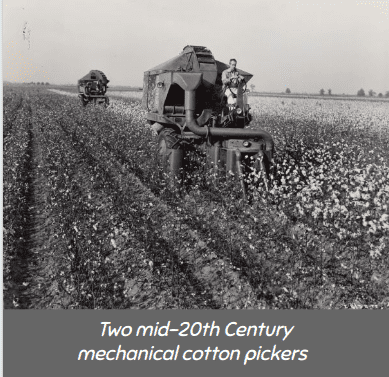
     Demand for the mechanical cotton picker among younger cotton growers was very high, and it was in this agricultural landscape that the competition for dominance among the farm implement companies. Pearson (with Rust), Harvester, and John Deere were all competing against each other to convince cotton growers that their mechanical cotton picker was supreme.

Picture
     By 1952, 10,000 mechanical cotton pickers were in use, and by 1955 the number was up to 20,000. By 1955, 25% of the total cotton crop was harvested by mechanical pickers, and by 1960, it was up to 55%. Also, it had taken 130 hours to pick a bale of cotton before, but with the mechanical cotton picker, it took 45 hours. From the beginning-to-the-end with cotton (seeds-to-harvest), mechanization meant that only 15 man-hours of work per acre were needed, compared to 155 man-hours of work per acre before the machine.
     Rust died in 1954, living long enough to see his invention roll off assembly lines. However, his mechanical cotton picker didn't help small cotton growers as he had envisioned. What occurred was that the mechanical cotton picker became a boon to corporate agriculture.

** Emmitt Till postscript: Sheriff Strider's nephew, Jesse, was elected sheriff in nearby Grenada county, and he was the antithesis of his uncle. Jesse helped rid the county of the KKK, and he hired African-American deputies. Jesse even appeared on TV to endorse an African-American candidate for Congress, which turned the election in favor of the candidate . . . slowly, very slowly, some social change was occurring in the American South in the 1950s.

0 Comments

William Levitt and Levittown

2/19/2017

1 Comment

 
                   Source: David Halberstam. The Fifties (1997)
Picture
     Home ownership was another sign of the abundance in America after WW II. With the explosion of the number of cars and roads, distances were opened up to the point where farmland around cities became desireable for suburban housing. $5000 became the base price of a new home, which equaled two years of family income (the typical automobile assembly line worker earned $3k/yr). Owning a home symbolized independence and security, and the home became the embodiment of the American Dream, as well as fulfillment and contentment.
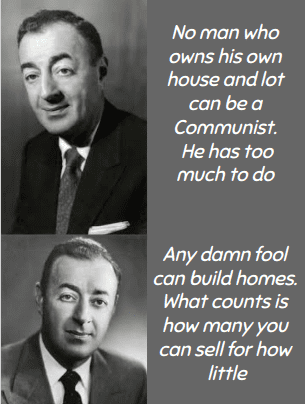
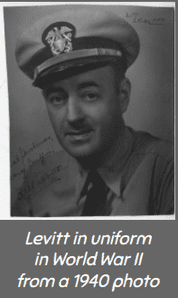
     The home brought families together in the 1950s, a decade when the car and television pulled families apart. While Henry Ford was the first "Great Figure" in American business in the 20th Century, William Levitt was the second. Levitt brought Ford's mass production techniques to housing, which up to then was among the most neglected of American industries. The typical pre-WW II builder constructed five houses a year; Levitt revolutionized the process, creating many affordable homes where Americans entered the middle class by the millions.
​

Picture
​     Levitt, perhaps more than any single person, made the American Dream a reality. Levittown was more of a social creation than architectural; according to Levitt, owning a home was Capitalism in the most personal sense. In 1941, Levitt and his brother Alfred won a government contract to build 2350 war worker's homes in Norfolk VA. At first it was a disastrous experience, with nothing going to plan, including uncooperative workers and subcontractors, which equaled less production and profits.
     Levitt broke down construction to its basic elements, and identified 27 separate steps. So, 27 seperate teams were trained, each specializing in just one step. Doing so not only allowed Levitt to find a way around the shortage of skilled carpenters, since the process needed far less skilled workers, but it also sped up the entire process. Also, Levitt calculated salaries instead of wages, in essence paying for pieceword at an advanced level. A worker could add to his base salary by producing more instead of just working longer hours.

Picture
     As World War II continued, Levitt and his crew became experts in mass building, and as such Levitt was transferred to the SeaBees (Navy Construction Batallion) in the Pacific. Levitt was commissioned to build instant airfields on an island taken from Japan for the Navy. Levitt was the only one that was capable of doing what the Navy needed; lives were in the balance if Levitt couldn't build those airfields on schedule. Not only did Levitt and his fellow SeaBees discuss how they would accomplish their work on the island, but also what they would do after the war. WW II allowed Levitt to experiment on the quickest, most efficient, and most profitiable ways to build low-cost mass housing, something that never would have occurred had Levitt been a civilian.
     After WW II, Levitt begged/borrowed money, knowing he just had to build homes and the massive profits would follow. Levitt understood that demand for those homes was immense; even before WW II, Levitt had purchased 1000 acres of agricultural land near
Hempstead, Long Island (NY). During WW II, Levitt told his brother (Alfred) to keep up the option on that land; while his brother the architect didn't see the potential in the land, Levitt did. "Housing Starts" fell from 1 million/year before the Great Depression to fewer than 100k/year before WW II. What Levitt also noticed was that at the same time, the marriage/birth rate increased dramatically . . . so after WW II, the US housing situation was extremely tight. In Chicago, 250 trolley cars were sold to be used for homes. Estimates for those that wanted new homes after the war exceeded five million.

Picture
     A federal housing bill was rushed through Congress that protected builders by using federal mortgage guarantees, which in essence subsidized builders so they would make money by constructing homes. The stored-up energy in America to spend money after WW II was unleashed: in 1944, 144,000 single homes were built, in 1946, 937k, in 1948, 1.18m, and by 1950, 1.7m. So Levitt had every reason to believe that he was on the top of the Wave of the Future in terms of building suburban housing. 
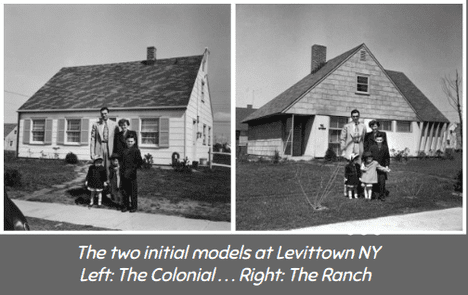
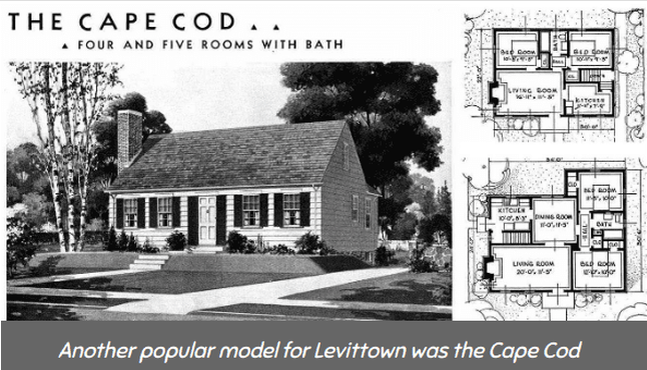
     In 1946, Levitt started building homes at Hempstead, adding more land to what he already owned, just 20 miles north from Manhattan. Levitt started to create the largest housing development in history to that point, and it was an astonishing success from the very beginning. The first houses had 4.5 rooms for a young family, with lots 60 x 100 feet and the house only taking up 12% of the lot. The living room was 12 x 16, and there were 2 bedrooms and a bath. A family could expand by adding on to the outside or finishing the attic. 
     Soon Levitt redesigned the house so the kitchen was located at the back of the house, so moms could watch their kids in the backyard. The basic Levittown Cape Cod model sold for $7990, with a later ranch model for $9500. And for an extra incentive to buy a home from him in the early period of Levittown, Levitt even threw in a TV and a washing machine for free, focusing on the needs of fellow returning veterans.

Picture
     Levitt was initially thunderstruck by the sheer number of veterans intending to purchase a house waiting in line to see the model home. When Levitt opened his office for business on March 1949, 1400 contracts were drawn the first day. Selling homes was easy, building them was not, but Levitt was ready. Right away, Levitt showed that he learned a lesson from buidling homes during WW II in Norfolk: his homes would not have a basement, but a slab foundation. Right away, the most difficult-and-complicated part of buidling a house was eliminated.A Long Island official actually denied Levitt a permit to build because he was a basement-lover, but a scathing editorial in a Hempstead newspaper made the official back down.
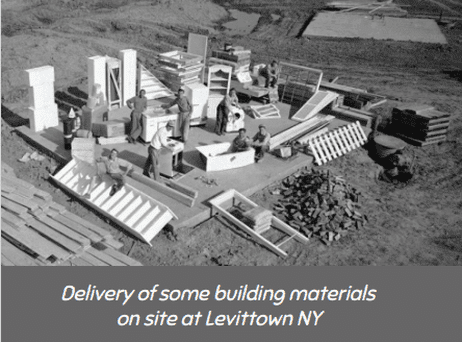
​     Levitt's genius was that he incorporated a moving assembly line like Ford, but since the home couldn't move, he moved the specialized crews to the buidling site: the construction site became the factory. Leviit learned that prefabricated houses were too limited in nature, so Levitt created his own kind of preassembly. Many critical parts of the house were preassembled at other locations, and  brought in, so ordinary workers with power tools (they were new on the scene) could assemble the home. It didn't take Levitt long to figure out that the first thing he had to actually construct was a road to the housing development so the delivery and construction trucks wouldn't get bogged down in the mud.
     By July 1948, Levitt's specialized crews were building 36 homes a day, 18 in the morning, and 18 in the afternoon. Nothing could be left ot chance, since even a delayed shipment of nails would ruin the tight timetable. Levitt made his own nails, lumber, and cement, doing his absolute best to create at least a partial vertical monopoly.

Picture
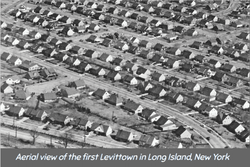
    The first Levittown in Long Island had 17,000 homes with 82,000 people; a swimming pool was built for every 1000 homes. The suburb of Levittown was not unlike a Massachusetts whaling port in the 1840s, but instead of being gone for months from home with the wife running the household, the men were back from their 20 mile commute to NC by dinnertime.
     Levitt hated labor unions, since in his view unions protected the slowest and most ineffecient workers. Levitt only hired non-union workers, and paid them top-dollar and provided many incentives. A Levitt worker earned twice that of a typical constrution worker, but he earned that money on Levitt's terms. Levitt bought appliances form Levitt subsidiaries, since the very idea of middlemen enraged him. And Levitt simplified the process of financing so people could purchase his homes much easier: no money down, and the price was the price, no debate, which was especially appealing to veterans. And, as an added bonus, Levitt's homes were high-quality and durable. Many that criticized Levitt were those in already traditional middle class homes while others attacked Levitt focusing on the perceived massive conformity of his housing development, saying he had sucked out any sembelance of individuality . . . but those "cookie-cutter" homes turned out to be islands of individuality in a sea of conformity.

Picture
     However, for the next 20 years, African-Americans could not buy a home in a Levittown. Levitt's father moved the family from their neighborhood when Levitt was a boy because an African-American family moved in nearby, afraid the value of neighborhood homes would plummet. Levitt understood that if one African-American family moved in, it would drastically reduce demand. Levitt stated that he could solve the housing problem, but not the housing AND racial problem. 
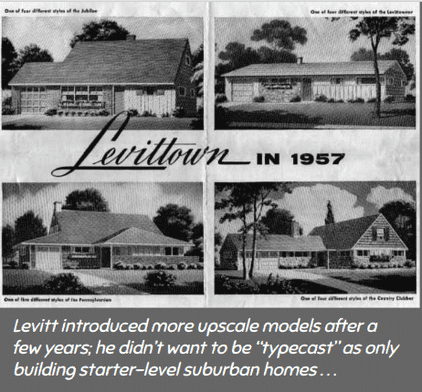
     Soon enough, Levitt understood that he needed to offer/build upgraded homes. In essence, Levitt took a page from General Motors with their models for different incomes (Chevy, Pontiac, Build, Oldsmobile, and Cadillac). But Levitt kept the down payment low, even with the increased price of the home. While Levitt still built base-level suburban homes, he wanted to profit from the more affluent buyer as well. 
     What Levitt (and other builders) started was a massive migration from the cities to the suburbs, a.k.a. "The Great White Flight". From 1950 to 1980, 18 of the top 25 US cities lost population, while the suburbs gained 60 million people . . . 83% of the nation's growth would occur in the suburbs during that time. By 1970, more Americans lived in suburbs compared to cities . . . Levitt started a social/economic revolution. The move to the suburbs also interrupted progress made by women in the workplace before/during World War II. For awhile at least, suburban housewifes were isolated in the Private Sphere, having to cater to her family's every need.

1 Comment

Richard & Maurice McDonald + Ray Kroc

2/3/2017

3 Comments

 
                    Source: David Halberstam. The Fifties (1997)
Picture
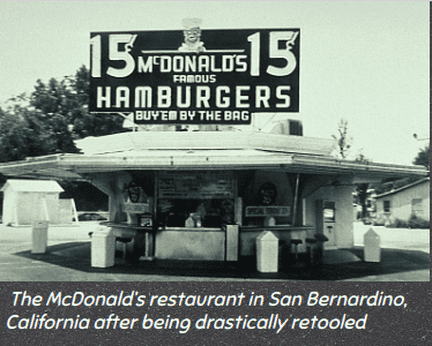
        Richard and Maurice McDonald
opened their first restaurant in San Bernardino CA (population 100,000) after getting a loan for $5000 from a major bank without collateral. The McDonald brothers wanted $7500, but the bank manager, against the wishes of the bank's board of directors, acted on a hunch for $5000. The restaurant was a drive-in, and it was an immediate hit, soon making a profit of $40k/year. Most customers were teen boys and young families; the McDonald brothers wanted to discourage the first group and encourage the second.
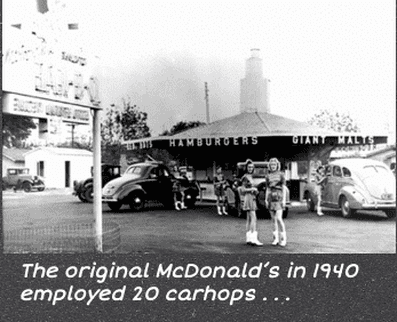
     Originally, customers waited 20 minutes, and the brothers wanted to quicken the pace, without carhops. The Macdonalds understood that people were far more mobile and lived farther from work than ever before; more-and-more Americans seemed to be in a perpetual rush, and they wanted to eat quickly. So the McDonalds looked for any weaknesses that delayed service, and the first to go were the carhops.
     To their surprise, the McDonalds discovered that their menu was far too large, and when they checked their receipts, they found that 80% of their business was hamburgers. That data meant that the brothers could get rid of the labor-intensive barbeque items, and that they could largely mechanize the process of making hamburgers. The McDonalds just wanted to maximize their profits, and it wasn't until years later that they realized that they had been at the forefront of a new US phenomenon . . . people wanted quality cheap food fast.

Picture
​     Suddenly the McDonalds were innovators in the one thing they knew well: fast food. In 1948 the brothers closed down for several months to reinvent their process. The brothers brought in two 6 foot stainless steel grills, which was not only easier to clean, but also distributed the heat better compared to the previous iron grills. Plates and silverware were no more, replaced by paper bags, cups, and wrappers, which eliminated the need for a dishwashwer. The menu was cut from 25 items to 9, featuring hamburgers and cheeseburgers, and they made the burgers a little smaller, getting 10 hamburgers from a pound of ground been instead of 8. 
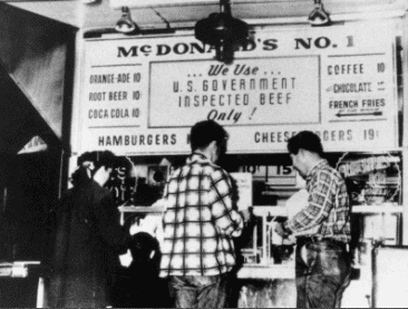
     Also, the McDonalds chose the condiments, not the consumer: ketchup, mustard, onions, and two pickles. The brothers found a machine to uniformly create hamburger patties by posing as candy makers, finding a peppermint patty press that was perfect for their needs. Under the new system, if a customer wanted something different than what was offered, they faced a delay in service. The McDonalds also figured out they could keep their hamburgers hot with infrared lights. The whole process was based on speed, lower prices, and making money on volume ("McDonald's Famous Hamburgers (Buy 'em by the bag): 15 cents).
     To their surprise, business at first fell off, but when they added milkshakes and french fries, their phenomenal succes began in earnest. By 1950, the teen thugs were elsewhere, replaced by working class families that, thanks to the low prices, could afford to take their families out to eat.

Picture
     The McDonalds put out the word to their employees to be great with kids, since they would demand that their parents take them back again and again. What the McDonalds did with food was what Henry Ford did with cars and William Levitt did with homes; they turned their kitchen into an assembly line. Due to the fact they were largely innovating on the fly, the brothers had to create much of their own equipment.
    Ed Toman was the McDonald's Charlie Taylor, and in his San Bernardino shop, Toman helped create a stainless steel Lazy Susan for hamburger preparation (12 patties), a stronger steel spatula, and a condiment pump that dispensed the perfect amount. In the kitchen were 3 hamburger cooks, 2 milkshake guys, 2 french fry guys, 2 hamburger wrappers, and 3 men at the counter. Slack time was the opportunity to get ahead of the next rush. 
     By 1951, gross receipts were 40% higher at $277k, and by the mid-1950s, the McDonalds were sharing profits of $100k/year, a dazzling figure when one considers that what they were selling cost 15 cents. The McDonalds were uncommonly generous in sharing their expertise and knowledge with others. The brothers also knew they would have to franchise their operation, and in 1952 the McDonalds reluctantly sold their first franchise rights. The brothers were content with their lives, and really didn't want the responsibilities that franchising and expansion entailed . . . the McDonalds wanted an awesome-but-limited future.
 ​

Picture
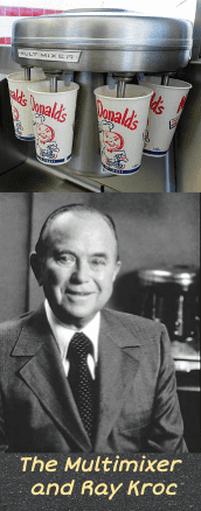
     Ray Kroc didn't have those self-imposed limits. Kroc boasted, with good reason, that he had the ablility to anticipate mass taste (the Hula Burger being an obvious exception). By 1939, Kroc was selling the Multi-Mixer, a 5 spindle milkshake machine, and set out to sell as many as he could nationwide. Kroc was on a holding pattern in terms of sales during WW II, but after the war orders for Multi-Mixers exploded. However, by the early-1950s, sales were diminishing, and Kroc faced stiff competition.
     Kroc realized that the growth of the suburbs meant that he would sell less machines to city drugstores. By 1954, Kroc noticed that there was one restaurant in San Bernardino that still ordered Multi-Mixers; the McDonalds were making up to 50 milkshakes at the same time. In early-1954, Kroc went to the McDonalds restaurant and was instantly stunned . . . and instantly liked what he saw. Kroc noticed that the McDonalds (Toman) had cut the spindles so the milkshake cups could be bigger. 
     After talking to the McDonalds, Kroc saw that his future was in hamburgers, not milkshakes. The brothers were looking for someone to manage their franchising, which was then up to 9 other restaurants. Kroc took over the franchising for the McDonalds at the age of 52, and his already legendary work ethic grew even more. Kroc had been in countless restaurants, and he knew the McDonald brothers were on to something big.

Picture
​     Kroc immediately saw that the prime customers were families, especially those with young children, who might not be comfortable at more traditional sit-down restaurants . . .  a family of four could eat for $2.50 ($22+ today). Kroc understood the connection between fast food and the growing suburbs; Kroc had absolutely no use for downtown locations in cities. Kroc also wanted no part of hot dogs, something he considered a regional food item (e.g. NYC and Philadelphia). Hamburgers could be assembled on his terms, while hot dog customers wanted to personalize their hot dogs. 
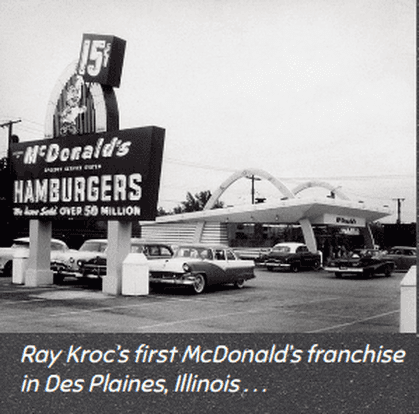
     Kroc wanted to make all franchise operators conform to his culinary/economic vision, famously saying that the organization cannot trust the individual, the individual must trust the organization. Kroc found that the franchise operators in the Midwest, unlike California, acceded to his demands far more readily. In April 1955, Kroc opened a McDonalds in Des Plaines in suburban Chicago, which was the area Kroc was from.
     Kroc was very hands-on with his very first store in Des Plaines, including personnel, often demanding certain grooming restrictions (e.g. no facial hair). Kroc also wanted Coca-Cola as the main beverage, and negotiated a sweet deal with the #1 regional Coca-Cola sales representative. By the second full year of the restaurant in Des Plaines, the store had a total volume of $200k in receipts. Second to Kroc's work ethic was his thrift, and waste drove Kroc crazy . . . it was a common site to see Kroc at the Des Plaines restaurant micromanaging his employees to minimize waste. Initially, Kroc made his money by taxing sales at the seemingly miniscule 1.9%. . . . eventually, Kroc would realize that much greater profits existed by taxing sales and becoming a de facto realtor for each new franchise.

Picture
      Kroc found that the best owners were those that hadn't yet made it, but were ready to bet everything on their new venture, just like Kroc. Kroc started franchising in 1955, and by 1956 he had opened 12 more stores, and by the late-1950s, Kroc was opening 100+ new stores per year . . . Kroc's whole life became McDonalds. By 1961, Kroc started preliminary talks with the McDonalds, wanting to buy them out.
    By then, the relationship between Kroc and the brothers had become strained. Kroc saw the brothers as nothing more than freeloaders, while the McDonalds wanted out of their deal with Kroc, but only on their terms. Kroc, in part because it was a smart business decision, and also because by then he was in an absolute fit over what he viewed as the brothers' intransigence, bought each brother out for $1 million each after taxes, $2.7 million total. It was a great deal of money, and Kroc was in debt from expansion, but he nonetheless put together a loan, sensing a bargain, especially looking at the long run.
     The deal meant that Kroc owned the name McDonald's, and the brothers had to change the name of their beloved restaurant to "The Big M". Kroc, a very vindictive sort, opened a McDonald's franchise just one block away to steal their thunder . . . and their profits (that first restaurant had to close down). The real glory years for Kroc and McDonald's was just beginning. The only thing Kroc really wanted to do with his profits was to own a major league baseball team, which came true in 1974 when he purchased the San Diego Padres for $12 million. 
      (Below: the movie trailer for "The Founder", starring Michael Keaton & Nick Offerman)

3 Comments

General Douglas MacArthur & the Korean War, Part Two

1/14/2017

1 Comment

 
                 Source: David Halberstam. The Fifties (1997)
Picture
​      Even as General Douglas MacArthur was promising Truman (at their meeting at Wake Island), that he could easily defeat any Chinese army that showed itself south of the Yalu River, the Chinese Fourth Field Army was entering North Korea. The Chinese Fourth was one of the greatest infantry forces of the era, despite being short hardware and heavy on peasants. Mao Tse-Tung's Fourth prevailed over Chiang Kai-Shek's more powerful military, despite having to move almost entirely on foot without modern communications technology. The Fourth's attacks were coordinated by bugle calls, which had the added dimension of terrorizing the enemy.
     The Chinese Fourth Field Army moved 286 miles in 18 days to their assembly point on the Yalu River, with each soldier only carrying 8 - 10 lbs. of supplies/weapons (a US soldier carried at least 60 lbs.). The Fourth was outfitted for the upcoming winter, and they were trained in particular for close-combat since the soldiers weren't marksmen, a method which usually led to very high casualties. The Fourth was divided into 6 armies of 30,000 each, and the Fourth started to cross the Yalu on 13 October 1950. The camouflage/movement of the Fourth was so good, and MacArthur's intelligence so bad, that none of their movements were detected by US forces. When MacArthur made his boast to Truman on Wake Island, there were already at least 130,000 Chinese soldiers in North Korea.

Picture
​      As the Chinese and US forces drew closer to each other on the southern side of the Yalu, MacArthur disobeyed orders which wanted him to stay south of the Yalu and only engage the North Korean army. In Tokyo, MacArthur ordered the US (and the token U.N.) forces to converge near the Yalu, and then told the US press that the war in Korea was for all practical purposes over. But nobody on the American side knew to where the North Korean army had escaped. On 24 October 1950, MacArthur clearly violated his orders by moving further north, and the powers-that-be in D.C. were absolutely stunned. 
     Despite taking Chinese prisoners, MacArthur had convinced himself into believing that he hadn't encountered any Chinese opposition. On 30 October 1950, MacArthur received clear intelligence that Chinese troops were in-country, but MacArthur dismissed the message as irrelevant. On 1 November 1950, a unit of the Chinese Fourth hit the US Army with full fury for the first time. The Chinese attack simply didn't stop, with wave-after-wave of Chinese soldiers attacking US positions . . . and then there were the Chinese bugle calls, ordering those repeated charges.
     In the face of this Chinese offensive, MacArthur continued to give orders to push further north, despite his men not being properly outfitted for winter. MacArthur remained in Tokyo, refusing to accept evidence that the war in Korea had drastically changed, none of which surprised MacArthur's peers. To the growing despair/frustration of his field commanders, MacArthur wouldn't allow for adjustments . . . MacArthur didn't want the Chinese to enter North Korea, so in his mind they simply hadn't done so.

Picture
​     On 3 November 1950, Truman started to get worried over reports of US losses in Korea. Also by that date, MacArthur finally admitted that there just might be a Chinese presence in North Korea, and once again exceeded his orders, this time ordering the bombing of the North Korean end of the 12 bridges that crossed the Yalu River. MacArthur sent a cable saying that if he didn't bomb the bridges, all would be lost, and he would refuse to accept responsibility for that possible outcome. Instead of denying China had invaded North Korea, now MacArthur was promising a slaughter of his own men. What MacArthur had claimed would never occur under his command was happening, and MacArthur made no effort to apologize or explain. 
     MacArthur had become more arrogant and volatile than at any previous point in his military career, and the Joint Chiefs of Staff caved, allowing MacArthur to bomb the 12 bridges. Bombing the bridges on the Yalu provided the clearest possible provocation from the Chinese point-of-view, and was a useless action in any event since the Yalu would totally freeze-over in just a few weeks. In Washington, D.C., Truman, Under Secretary of State Dean Acheson, and Secretary of State George Marshall felt that events in Korea were slipping beyond their control. Acheson later wrote that they had stood by like frightened rabbits while MacArthur ran amuck. On 17 November 1950, MacArthur told his superiors in the federal government and military that he was ready to make his final approach to the Yalu River. MacArthur was ordered to only take the high ground overlooking the Yalu River Valley and to go no further. 
     MacArthur, due to his arrogance, foolishness, and vainglory was about to turn a small-scale war into a much larger conflict, as well as adding two years to the Korean War. MacArthur's actions also fed the monster in the US in terms of paranoia towards internal subversion, and would also poison US/Chinese relations for many years.

Picture
     MacArthur thought only 30,000 Chinese troops were near the Yalu River, but the total was closer to 300,000. On 24 November 1950, MacArthur arrived at the front, wanting to see the results of his genius. MacArthur toured the lines, and then returned to Tokyo, somehow satisfied with what he saw. The US offensive to the Yalu started on 24 November 1950 in wind chills of minus 20-30 degrees. On 25 November 1950, the Chinese counterattacked, terrorizing US lines with a much larger version of the North Korean army (the Min Gun), and by 28 November 1950 it was clear that MacArthur had been outsmarted/out-executed by his Chinese counterparts, and that MacArthur's grand strategy was an epic disaster. Now the question was how many US soldiers and Marines could escape the Chinese attack.
     The Chinese held all the high ground, cutting to pieces the retreating US forces below in the Yalu River Valley. It proved to be a killer gauntlet for over six miles, with approximately 3000 men KIA, WIA, or MIA, and it was quite simply a miracle that the losses weren't worse.
During December 1950, the US losses were just as costly and ghastly, with the US 8th Army falling apart like the
French in 1940, and the British in Singapore in 1942. It seemed that MacArthur had forced two choices on Truman: victory in a very costly war or a complete route at the hands of the Chinese.
     Truman and his administration were fighting for their very legitimacy, and at the Pentagon, the spectre of another Dunkirk hung in the air. The Joint Chiefs of Staff were paralyzed under the never-ending barrage of bad news from Korea; the JCS no longer trusted MacArthur, but they were simply afraid to stand up to him. Finally,
Matthew Ridgway, the Army Vice Chief of Staff, demanded to know why MacArthur couldn't be removed . . . it was as if a light bulb was turned on over the heads of the JCS, and the collision course was set.

Picture
     By early-December 1950, the Chinese took the North Korean capital of Pyongyang. What actually saved the US/UN forces was a fluke: General Walton Walker was killed in a jeep accident. Walker had proven to be a liability as a field commander, and General Matt Ridgway was placed in command of the US 8th Army. Ridgway was simply a ringer, arguably the preeminent American solder of the 20th Century. Ridgway saw the military as a calling, and was more committed to his Army and nation than the vast majority of high-ranking officers in the US military. Ridgway had commanded the 82nd Airborne in WW II, and became a great combat commander at the division level before he was promoted to a corps commander.
     Ridgway was appalled at MacArthur's remoteness from the battlefields as he toured the front lines, the overall lack of commanders among the men, as well as the lack of daily intelligence reports due to minimal patrolling. The Army had completely lost confidence and its morale was at the bottom of an abyss. The US soldiers were poorly equipped, and depended far too much on vehicles in fighting an enemy that was on foot. Ridgway's #1 job was to restore morale and confidence; at the same time, Ridgway strengthened US forces around Pusan, making sure the 8th Army wouldn't be driven into the sea. 
     Ridgway was everywhere, and no unit, no matter how small, was immune from a visit. Ridgway worked on taking ground from the enemy a little at a time, which at least in part was designed to strengthen the American negotiating position when it came time for serious peace talks. As Ridgway was accomplishing the impossible, MacArthur was sending cables stating that unless the US widened the war, the US would be pushed out of the Korean peninsula.

Picture
​      By mid-January 1951, Truman started receiving positive reports about Ridgway's efforts, and it became clear to Truman, SecState Marshall, and the #1 ranking general in the Army,
Omar Bradley, that Ridgway was the difference . . . but in Korea, Ridgway was the exception. Ridgway turned the tide of the Korean War like no other general in no other war, and unsurprisingly, the more Ridgway succeeded, the more difficult MacArthur became. MacArthur started to give press conferences stating that the only way true victory could be claimed was by unifying all of Korea, and that limited war was unacceptable. Top British military leaders were convinced that MacArthur wanted a war with China. General Bradley saw that as well, believing that MacArthur had been humiliated by the Red Chinese and wanted revenge to regain his lost honor.
     It was true: MacArthur desperately wanted overwhelming military victories against the Chinese generals that had humiliated him on the global stage. It didn't seem to matter to MacArthur that his pursuit of reclaiming his "lost honor" could bring about WW III. Truman wanted to make an announcement that he would officially pursue a cease-fire in Korea on 24 March 1951, but MacArthur preempted Truman, making his own announcement which taunted the Chinese, labeling them a "defeated army". MacArthur's announcement wasn't only an insult the Chinese, but also a slap to the face of his Commander-in-Chief.

Picture
     It was at that point that Truman made the decision to remove General Douglas MacArthur from his command. The final nail in MacArthur's coffin (he was a political klutz) was the letter he sent to Joe Martin, the (Far Right) Republican House Minority Leader, declaring that Chiang Kai-Shek, basically marooned in Taiwan, should get involved to increase the chances of total victory. MacArthur almost certainly had to know that Martin would widely release the contents of the letter. 
     Truman was advised that firing MacArthur would lead to the greatest political battle of his administration. As a result, Truman tried to play nice, sending a personal emissary to MacArthur, but of course, word leaked out, and MacArthur heard news of Truman's intentions on a radio broadcast. MacArthur told Ridgway, who was going to replace him, that Truman was mentally unstable. In the U.S., everyone had an opinion on "Truman v. MacArthur", and most everyone was emotional and very vocal (fights in bars were common, and fights among friends commuting on trains often occurred). 
     It was to that outpouring of emotion that MacArthur returned to America. Starting in Tokyo, then Hawaii, and then in the continental US, MacArthur's farewell tour didn't seem to have an end. MacArthur, the victimized narcissist, was in rare form even before his address to a Joint Session of Congress. The response to MacArthur's Farewell Address was split among party lines, with Republicans seeing a wronged great military leader, and Democrats seeing an out-of-control egotist/poser. Truman's comment regarding MacArthur's Farewell Address: "It was nothing but a bunch of damn b*%$@$*t".


1 Comment

General Douglas MacArthur & the Korean War, Part One

1/2/2017

0 Comments

 
                       Source: David Halberstam. The Fifties (1997)
Picture
     General Douglas MacArthur was 70 years old in 1950, a towering figure that had worked hard to create/perpetuate his own legend. As President Harry Truman expected, MacArthur hungered for the White House, but he was a political klutz. MacArthur was the darling of the Republican Conservative Right Wing, and he corresponded regularly (and indiscreetly) with many of the of the Right Wingers . . . the "Lunatic Fringe" was all-in with MacArthur.
     MacArthur was an expert in editing/adjusting information from the theater of his command for his own benefit and image. General Dwight Eisenhower
thought a younger, more with-it commander was necessary as the early stages of the Korean War unfolded. Eisenhower and others saw potential trouble ahead with MacArthur, a general that felt that he was basically "untouchable". MacArthur believed that he was on a holy mission against evil Communists, and was at the summit of one of the most glorious military careers in U.S. History.

Picture
     Arthur MacArthur modeled extreme egotism, something his son Douglas emulated as well.
MacArthur's mother, Pinky, actually moved nearby to West Point during MacArthur's time there, and constantly interfered/dominated, even with the women her son was seeing. Pinky was also a pain-in-the-butt advocate for her son's advancement. At age 38, MacArthur became the youngest division commander in the US Army, but he was already paranoid about Army HQ not seeing the magic that was him . . . MacArthur badly wanted the Medal of Honor, which his father was awarded at age 18 during the Civil War. 
     In 1930, MacArthur became the Chief of Staff for the Army after a good deal of wheeling and dealing on his part, as well as Pinky's. MacArthur was a complete narcissist as well as brilliant, talented petulant, manipulative, theatrical, political, and given to wild mood swings. MacArthur's favorite pronoun was the 1st Person. MacArthur didn't share glory with subordinate commanders, and made sure that Army HQ gave him full credit for victories that occurred under his overall command. 
     MacArthur once commented to another general that he couldn't understand why Ike (Eisenhower) gave credit and publicity to Generals Omar Bradley and George Patton during World War II. Like other narcissists, MacArthur idealized his life and his role in it, and if he made a mistake, he refused to admit it and take responsibility. Blame was directed to rivals suspected of targeting MacArthur for a downfall: an example - the grossly unprepared US troops that first arrived at South Korea under his command was the fault of the Pentagon.

Picture
​     MacArthur was obsessed with appearance, especially to the degree it enhanced his myth. MacArthur was addicted to publicity/fame, and he went nowhere without his entourage of journalists and photographers. It was virtually impossible to take a photograph of MacArthur
when he wasn't posing. By 1950 (like George Washington), MacArthur needed glasses, but he wouldn't let anyone know that he needed them. 
     All that being said, MacArthur took an under-strength US Army in the Pacific in 1942 with little air and naval support, and charted a course of great military strategic originality. MacArthur rarely attacked Japan where they were strong, instead striking Japan on smaller islands where their defenses were weaker. MacArthur understood that the days of large frontal assaults (as in WW I) were over. MacArthur used air power to great effect, taking island that would be strategically significant then-or-later. 
     No general in WW II used airpower better than MacArthur; he seemed to have a sixth sense of what Japan would do, and when they would do it. As a result of his successes using airpower, MacArthur had an exaggerated sens of the usefulness/impact of air strikes, of which he would pay a steep dearly during the Korean War.

Picture
     After WW II, MacArthur served as the Viceroy of Japan for five years. Japan needed to worship the man that conquered them, and MacArthur needed to be worshiped. MacArthur, unlike other US Army generals stationed in Asia, had no experts that could keep him up-to-date on changes in Asia. MacArthur's
Victorian mind simply couldn't see (or comprehend) the revolution taking place against colonialism, particularly in China . . . the China that MacArthur felt he knew so well no longer existed.
    During August 1950, the tide at Pusan began to turn. The US position grew stronger, and the North Korean army was figuratively/literally running out of gas, as well as men and ammunition. And that was the moment for which General MacArthur had been waiting; the general had been waiting for a chance for an amphibious assault behind the North Korean line.
     This time, North Korea would be unprepared, since the vast majority of their army was well past the 38th Parallel. MacArthur would then move East-and-North to entrap the North Korean army. MacArthur even had a location selected, Inchon, the great natural port on the west coast of South Korea. To MacArthur, it was a no-brainer: North Korea would either have to pullout or surrender.

Picture
​     But hardly anyone agreed with MacArthur when it came to his plan at Inchon. The Navy thought the plan was impossible since there wasn't a natural beach; one sunken ship could block the entire harbor. Also, the tides were terrible, up to 32 feet, and there would only be three dates in the next 2 months where the tides would be suitable for large ships: 15 & 27 September and 11 October 1950. To the Navy, Inchon was a whole list of amphibious "don'ts", and to complicate matters even further, the USSR had helped North Korea mine the harbor (at the time Inchon was the most heavily-mined harbor in the world).
     But MacArthur was adamant, seeing Inchon as the way to avoid a "meatgrinder" of a war out of Pusan. On 23 August 1950, the critical meeting occurred concerning Inchon, where two members of the Joint Chiefs tried to talk MacArthur out of his plan . . . but MacArthur got his way. In September 1950, US Marines landed on Wolni, a small island guarding the mouth of Inchon harbor; 13,000 Marines poured on to the island and faced minimal resistance. For those US (technically United Nations) forces, it was a race to Seoul to trap the North Korean army. Inchon was MacArthur's finest hour; before Inchon, MacArthur was "untouchable", but afterwards, he was a deity. On 26 September 1950, Seoul was taken from North Korea, eleven days after MacArthur's forces landed at Inchon.

Picture
     But MacArthur failed to capture the North Korean army in mass; 40,000+ escaped, and MacArthur pursued the enemy to the 38th Parallel, and then on his own initiative, crossed the border in pursuit. George Kennan had told Truman and other significant figures in the government that China and the USSR would not stand for a US invasion of North Korea. But Truman, after being labeled by Republicans as "soft" on Communism, refused to order MacArthur to slow down or retreat.
     The problem, however, was that no one in the government or military had defined any objective after MacArthur crossed the 38th Parallel, and MacArthur (and most of D.C.) had no idea of the strength of Mao Tse-Tung's forces in China. On the
​7th of October 1950, US troops crossed the 38th Parallel, and the next day Mao ordered a massive mobilization towards the Yalu River, the border between North Korea and Manchuria. Finally, Truman was getting nervous, registering signals/warnings from Peking (now Beijing), and also, Truman believed that it was very likely that MacArthur was overextending his forces in his pursuit of the enemy in North Korea.

Picture
     President Truman arranged a meeting with General MacArthur at Wake Island in
mid-October 1950. Truman wasn't looking forward to dealing with MacArthur, who, like almost all egomaniacal narcissists, strutted while sitting down. Truman's poll numbers were very low, and Truman hoped to bask at least a little in the afterglow of Inchon. Truman had ordered MacArthur to leave his entourage behind; Truman wanted the White House press corps to have a monopoly covering the meeting.
     MacArthur went to greet Truman at the President's plane (Truman had serious doubts that MacArthur would do so), and the meeting was basically cordial, but both powerful men were wary of each other. MacArthur belittled the possibility of Chinese intervention, claiming that only 50k to 60k Chinese soldiers at most would cross the Yalu River. MacArthur had spent no time studying Mao's successful tactics against Chiang Kai-Shek's superior forces that resulted in Mao's Communist forces taking over China in 1949. MacArthur still believed that China had a weak army, just as in feudal times. 
     MacArthur was at his best before/during Inchon . . . after China's massive invasion across the Yalu River in late-1950, MacArthur would be at his worst.

0 Comments

Prelude to the Doolittle Raid (Late-1941 to Early-1942)

12/3/2016

1 Comment

 
       Source: James M. Scott. Target Tokyo - Jimmy Doolittle and the
                            Raid That Avenged Pearl Harbor (2015)
Picture
      By 1941, Japan's population was 73 million, and it had tripled in the last century. Japan was "materially bankrupt", needing to import virtually every necessity, even rice.  The growing military only increased Japan's reliance on imports and foreign resources in such areas as bauxite (planes) and cotton (uniforms) . . . but oil topped the list (by 1941, the U.S. was producing 700 times more oil than Japan). The hunger for natural resources led Japan to attack Manchuria in 1931, and then northern China in 1937.
     In response, FDR (57 years old in 1941) ordered the U.S. Pacific Fleet moved from California to Pearl Harbor, over the fierce objections from high-ranking admirals. In July 1941 Japan invaded southern French Indochina, which was a clear signal that next on the list would be Hong Kong, Singapore, and the oil-rich Dutch East Indies. FDR stopped US gasoline shipments to Japan, which took away 80% of Japan's oil imports. FDR also ordered Japan's assets in the U.S. frozen.

Picture
     But Japan had stockpiled raw materials, including a two year supply of oil/gas. In addition to a potential army of 5 million and 7500 planes, Japan had 381 warships featuring 10 battleships, 10 carriers, 18 heavy cruisers, and 112 destroyers. Japan's Imperial Navy not only outgunned the US Navy, but the navies of the US, Great Britain and the Netherlands combined. Japan's attack on Pearl Harbor destroyed/damaged 18 US ships: all 8 battleships, 3 cruisers, several destroyers, as well as 188 planes with 2403 killed and 1178 wounded. 
     Japan also attacked Guam, the Phillipines, Wake Island, Hong Kong, and Midway. FDR, who loved the Navy (he was a former Ass't SecNav as was TR) just couldn't get his mind around why US ships were nothing more than sitting ducks for the Japanese at Pearl Harbor. Half of America listened to FDR give his 518 word Pearl Harbor speech on 8 December 1941; it was the largest daytime audience for a radio broadcast in US History, with 62 million listeners. 

Picture
​     Secretary of the Navy Frank Knox submitted a report to FDR on the damage at Pearl Harbor within two weeks after the Japanese attack. Of the 8 battleships, the Maryland, Pennsylvania, and Tennessee were not badly damaged. The Nevada and California would be back in action in a few months, but the West Virginia would need two years to be overhauled, with its entire port side ripped open by nine torpedoes. As far as the capsized Oklahoma, Knox felt that it would be far too costly to salvage the outdated battleship. The Arizona by far fared the worst, sunk with over 1100 killed.
     Guam had soon fallen after Pearl was attacked, as had Wake Island. U.S. airpower in the Philippines was wiped out and Japan would soon take Manila. FDR understood that continued defeats would demoralize the US public. 50% of Americans believed that Japan would bomb U.S. cities; victory on the battlefields/sea was the way to allay public fears and improve morale so the unity after Pearl Harbor could be sustained (and that blame for Pearl would be lost in the rush of Patriotism). Many, many Americans were beyond-upset that the US Navy had been asleep at-the-switch at Pearl Harbor

Picture
​    As much as FDR wanted to take the fight to Japan in Asia and in the Pacific, the US was in no shape to do so. The long battle with the Isolationists was now coming home to roost. FDR wanted to know from his advisers when the US could fly operations from China, which appeared to be the only realistic location to retaliate against Japan, since the US had lost most of it strategic islands in the Pacific. Vladivostok was only 675 miles from Tokyo, but FDR knew that Stalin would not allow US planes on Russian soil since he had signed a neutrality agreement with Tokyo in April 1941. Also, Stalin didn't want to deal with Hitler PLUS Japan.
   Admiral Ernest King, the Commander-in-Chief of the US Fleet, badly wanted to take any kind of offensive against Japan, and by 10 January 1942, the normally-agitated King was even more agitated/worked-up than usual with the continuous string of bad news coming from the Pacific. While the official plan was to be on the defensive in the Pacific while fighting in Europe, King wanted to take any opportunity to go at Japan in order to keep them off-guard, and perhaps to forestall or delay future attacks on strategic U.S. possessions in the Pacific.

Picture
​     Captain Francis Low as King's Operations Officer, and it was Low's idea to try and get bombers to take off from a carrier to attack Japan, especially Tokyo. Instead of blowing up and yelling, King sat back and listened to Low, and then authorized Low to pursue his idea. Low then contacted Captain Donald Duncan, King's Air Operations Officer, and asked him if he would be interested in planning a carrier-based strike on Tokyo. Low wanted to know if a medium-size bomber could land on a carrier, and also if a land-based carrier could take off from a carrier. The answer to the first question was no, but Duncan told Low that he would get back to him on the second question. 
     Duncan was already thinking about landing planes on airfields in China, and also he would need bombers that could fly from outside the 300 mile range of Japan's patrol flights, strike Tokyo, and fly to China. Duncan viewed the B-25 (the Mitchell) as the best-suited for the mission, since it could handle the range, and also carry a heavy payload of bombs. As far as the carrier, Duncan had the USS Hornet in mind. The Hornet was a new carrier being readied for action in Virginia, and it could be ready in the Pacific at about the time (he figured) the bomber side of the plan was ready. 

Picture
     While Low thought one carrier would suffice, Duncan was thinking two carriers would be necessary, since fighter escorts would be needed, and they would also need to protect the support ships of the two carriers. In terms of when to attack, mid-April to mid-May would provide a traditional window-of-opportunity weatherwise over Tokyo. Low told Duncan if General Henry
"Hap" Arnold was on board, Duncan would be in charge of the Navy side of the operation. 
     On 21 December 1941, Arnold was ordered by FDR to find a way to bomb Japan, but Arnold had no clear idea how to accomplish that order. Adding to Arnold's travails was that only 79 of 231 planes in the Pacific were still in action after Pearl Harbor. And demand for US Army Air Corps planes far exceeded supply. On 4 January 1942, Arnold was part of a conference over North Africa with Admiral King. King suggested to Arnold the idea of using US Army bombers from carriers. The idea piqued Arnold's curiosity, and Arnold instructed his staff to immediately start examining the idea.
    By mid-January 1942, Low and Duncan appeared in Arnold's office and suggested B-25's instead of retrofitting cargo planes. Using B-25's would mean that two carriers wouldn't have to be nearly as close to Japan, and since the B-25's would be able to continue to China, the two carriers could turnaround and return home right after the B-25's took off.

Picture
      Arnold loved the idea, but he wanted to run it past his staff "Troubleshooter", Lt. Colonel James Doolittle. The 45 year old Doolittle was already famous as a stunt/race pilot, and also had an M.A. and a Ph.D. from the Massachusetts Institute of Technology; if anyone could figure out if the plan was doable, it was Doolittle. Arnold asked Doolittle if the USAAC had any planes that could take off in 500 feet with 2000 pounds of bombs and fly 2000 miles with a full crew. The next day Doolittle told Arnold that either the B-23 or the B-25 would work. but both would require extra fuel tanks. 
      Arnold then added another qualifier, in that the plane's wingspan couldn't exceed 75 feet. Doolittle told Arnold that the B-25 was the only option. Arnold was on the phone to King, and the plan was a go. The USS Hornet would depart the West Coast on-or-around 1 April 1942, and on that date the USS Hornet should be finished in Virginia, and en route to California via the Panama Canal.
     Duncan would oversee the trial takeoffs of the B-25's from the Hornet as well as organizing a naval task force in Pearl Harbor. Arnold would need to select someone to modify the B-25's and to train the aircrews . . . Doolittle was the man, and Arnold told Doolittle to let him know if anyone "got in his way" with the plans for the mission.

1 Comment

The Creation of the Standard Oil Trust (1882)

11/20/2016

1 Comment

 
             Ron Chernow. Titan: The Life of John D. Rockefeller, Sr. (1998)
Picture
​     On 8 July 1879, John D. Rockefeller turned 40, and was one of America's 20 richest men, and easily the most obscure. Rockefeller's worth was often underestimated, with his stock in Standard Oil worth $18 million alone ($405m in 2015; when Vanderbilt died in 1877, he was worth $100m in 2015 dollars). By 1878, Rockefeller tried to be "semi-retired", often taking off afternoons, knowing that he had control over almost all of the refineries/pipelines in the oil industry. 
    It was at this time that the press, finally, took notice of Standard Oil and Rockefeller. In November 1878, the New York Sun featured a full-length profile of Rockefeller, and among the article's assertions was mention of a secret railroad deal from which Rockefeller benefited tremendously . . . put no proof was offered. By the early-1880s, Rockefeller had universal notoriety, much to his great chagrin and irritation. 
     In 1883, Rockefeller moved from Cleveland to New York City, pulled to the city due to the heavy kerosene trade. By 1884, Cleveland had been relegated to inferior status in terms of refining, and NYC, with all its seaboard refineries and its great port, was the new epicenter for Standard Oil. The export boom of petroleum products meant that Rockefeller had refineries in Brooklyn, Bayonne (NJ), Philadelphia, and Baltimore.

Picture
     In 1879, Standard Oil couldn't own companies outside of Ohio, so three mid-level employees held stock in scores of subsidiary Standard Oil companies outside of Ohio. When these three received dividends, they were distributed to the 37 investors of Standard Oil as "individuals" in amounts proportionate to their holdings in the company. Rockefeller held three times the holdings of Henry Flagler, the co-founder of Standard Oil. So, even though Standard Oil owned the vast majority of refineries/pipelines in the industry, Rockefeller could honestly, under oath, say that Standard Oil didn't own property outside of Ohio. Rockefeller could claim that private individuals in Pennsylvania, New York, Maryland, and New Jersey owned the companies outside of Ohio; technically, the 3 mid-level employees, "trustees" owned the properties, but that makeshift arrangement was only able to last three years.
     In 1881, Pennsylvania tried to tax Standard Oil properties, and Rockefeller feared that other states would follow suit, which would in essence mean that Rockefeller and Standard Oil would be held hostage by state governments. Standard Oil's holdings had reached a point where consolidation had to occur just to keep track of what was going on in the company and to continue to maximize profits. One of Rockefeller's advisers offered a brilliant strategy in which Standard Oil would create a company in each state it wished to do so (e.g. Standard Oil of New Jersey), and these separate companies would need separate boards of directors.

Picture
     Based on that advice, an Executive Committee was created, and the stock of the various Standard Oil companies would be placed in the hands of trustees on that Executive Committee, who would then issue certificates of interest in the Standard Oil Trust estate, which led to being able to distribute dividends. This elaborate "stock swap" would create a union of stockholders which would not be the legally operators of the corporation. On 2 January 1882, the Standard Oil Trust agreement was drafted; the public didn't know about the new arrangement until the Standard Oil Trust emerged spawning an enterprise of $70 million, controlling 90% of the industry's refineries and pipelines.
     It wasn't until six years later, in Congressional Anti-Trust hearings, that all that information was made public. Today, the Standard Oil Trust would be classified as a holding company, but at the time it seemed to be an imaginary entity, wielding infinite power but actually unable to do anything specific. The Standard Oil Trust received stock from Standard Oil of Ohio and 40 other companies; Rockefeller held 1/3 of the trust certificates worth $19 million ($470 million in 2015 dollars). 
     Negotiable securities were created from this arrangement, which meant that many Standard Oil employees would benefit greatly from owning stock, something that Rockefeller encouraged and assisted. By doing so, Rockefeller created a more motivated and closer-knit business culture for Standard Oil, and it also helped that employees received huge capital gains and dividends.

Picture
​    


     In late-1883, Rockefeller started to assemble real estate holdings in Manhattan on Broadway, basically on property where the home of Alexander Hamilton was located. After spending almost one million dollars, Standard Oil moved into their new opulent building on 26 Broadway, the nine story granite building became the world's most famous business address. The relatively-grim exterior gave way to a dignified-yet-understated interior, which mirrored Rockefeller's personality. 
     Rockefeller delegated much and presided lightly and genially over his empire, invisibly asserting his will. In meetings, the quieter Rockefeller was, the larger his presence filled the room, which added to his mystique as an industrial genius. Rockefeller valued internal harmony among his chief executives, and often couched his decisions as suggestions or questions. Rockefeller operated by gaining consensus, rarely making outwardly unilateral decisions, which meant few missteps since every contingency had been analyzed. And somehow, Rockefeller accomplished all this despite the incredibly restrictive interstate laws concerning corporations, in that a corporation could only legally exist in one state.

Picture
     The general trend in big business after the Civil War was from freewheeling competition, to loosely-knit cartels, and then to airtight trusts. Oil prices wildly fluctuated with competition, but with the Standard Oil Trust, prices were stable, due to its enforcement and managerial powers. Rockefeller was at first an entrepreneur when he entered the oil refining business, but as the landscape changed, Rockefeller became a managing genius; Rockefeller basically anticipated the climate change in big business.
     Since Rockefeller never owned more than 1/3 of Standard Oil, he needed the cooperation of other people. Rockefeller understood that he needed to submerge himself in the complex layers of the Standard Oil Trust. The Standard Oil Trust introduced economies-of-scale that were impossible before 1882. Also, the quality of kerosene was improved, by-products were introduced, and costs across-the-board were cut.


Picture
    It was the Executive Committee that made all of that possible; they represented the 40+ companies that made up the Standard Oil Trust. Below the Executive Committee were specialized committees in such areas as pipelines, research-and-development, and efficiency (e.g. shutting down refineries), and incentives were created so the specialized committees actually competed against each other within the Standard Oil Trust. Rockefeller was always happy to purchase Standard Oil Trust Certificates from those willing to sell in that intra-competitive atmosphere.
​     Once Rockefeller made a decision on a specific goal, he pursued achieving it with all his skill, patience, and acumen. However, once Rockefeller made that decision, he was impervious and deaf to criticism, much like a rocket that could only keep going higher, never turning back as long as it still had fuel to burn.

1 Comment

Richard Nixon and the Election of 1968

11/2/2016

0 Comments

 
             Source: Evan Thomas. Being Nixon: A Man Divided (2015)
Picture
​    On 2 February 1968, Richard Nixon launched his campaign for President at the last possible moment, with the New Hampshire primary only a month away, planning on much more organization and sophistication compared to his run in 1960. Nixon was already planning on going to Moscow and Peking (Beijing) after being elected President to create "leverage" against North Vietnam in order to get them to meaningfully negotiate an end to the war. 
   
​     Powerful political columnists such as James Reston hailed the "New Nixon", who seemed calm and reasonable, a welcome contrast to the tumultuous LBJ. Nixon won the New Hampshire Republican primary with 80% of the vote . . . then Robert Kennedy announced his candidacy for the Democratic nomination in mid-March. A gloom was cast over the Nixon campaign, since the Kennedy dirty tricks with Dick Tuck would resume. H.R. Haldeman and John Ehrlichman, Nixon's top campaign advisers, wanted permission from Nixon to find someone, a "Black Advance Man", to return the favor on RFK. And then on 31 March 1968, a political bombshell: LBJ, in a surprise announcement on national television, stated that he would not run for President in 1968.

     After Dr. Martin Luther King, Jr. was assassinated in Memphis (TN) on 4 April 1968, Nixon visited Coretta Scott King . . . but since it was a secret visit, his genuine effort received no attention from the media. So, Nixon resigned himself to preparing to attend MLK, Jr.'s funeral on 9 April 1968 with other high-profile mourners. 
​     After the funeral, Wilt Chamberlain, all 7 ft. 1.25 inches of him, asked Nixon if he was going to march with the others to MLK, Jr.'s burial place. Nixon agreed, and joined in the 3.5 mile procession which included Marlon Brando, Robert Kennedy, and Jackie Robinson. Nixon walked about two blocks, and then told Chamberlain that he had to go to the airport . . . Chamberlain then asked if he could get a ride, also wanting out of the procession at that point.
Picture
Picture
​     Less than six years after being declared politically-dead, Nixon was on course to easily grab the Republican nomination. George Romney, the Governor of Michigan, had dropped out, and the liberal Republican Nelson Rockefeller was dithering and going nowhere . . . but the conservative California Governor, Ronald Reagan, was gaining support. Somehow, Nixon came to fear a Rockefeller-Reagan cabal against him for the GOP nomination, even though that was a political impossibility.
     Senator Strom Thurmond (SC), who had switched from a Democrat to a Republican in 1964 (and who would serve in the Senate the longest in US History) had organized a huge bloc of Southern delegates for the Republican National Convention. Thurmond actually had the gall to "audition" the GOP candidates to see if they "deserved" his support, and that of the delegates. Nixon knew he had to deal with the very powerful conservative Senator, but he wasn't going to backtrack on Civil Rights. While Nixon was in a car with Thurmond, Nixon finally asked Thurmond what he wanted. Nixon was extremely relieved to hear that Thurmond wanted Nixon to remain stout against Communism. Thurmond threw his support behind Nixon, believing him to be the most electable option in the Republican Party against the Democrats in 1968.
    
​     Then another horrible event occurred on 4 June 1968, when RFK was assassinated after winning the California Democratic primary . . . although he had many legitimate reasons for not attending the funeral, Nixon went anyway . . . if nothing else, to be seen with the other high-profile mourners. 
     Nixon's choice of Spiro Agnew, the first term Governor of Maryland, as his Vice-Presidential running mate surprised almost everyone. Nixon took particular delight in "stealing" Agnew from Rockefeller (he would soon "steal" Henry Kissinger as well). Nixon understood Agnew's appeal to what he would eventually call the Silent Majority of Americans that were turned-off by the liberal media. Nixon's plan in 1968 was to appeal to the voters that were tired of all the tumult of the late-1960s, who at the time he referred to as the "Silent Center".

Picture
     The loud-and-angry voice of the Election of 1968 belonged to the Governor of Alabama,
George Wallace, who ran as an Independent candidate. With a gleeful snarl, Wallace portrayed himself as the defender of ordinary Americans. Wallace was so keyed-up attacking the Establishment and "Them", that Nixon could portray himself as the much safer, saner candidate, yet Nixon subtly played on voter fears of lawlessness and disorder.
    
​     Nixon was indeed much more calm and seasoned, not only compared to Wallace, but also to the 1960 and 1962 Nixon. Even so, Nixon wanted a good "political packager" to smooth over any of his remaining personal/political rough spots. In early-January 1968, Nixon was a guest on the Mike Douglas Show, which aired in the afternoon, and whose main viewers were housewives. It was there that Nixon met the show's producer, Roger Ailes, who would become the mastermind of Nixon's media persona to America (the 1969 bestseller The Selling of the President by Joe McGinniss portrayed Ailes as a Svengali-like figure). 
     Nixon was smart enough to know that he didn't come across very well on television, and that he needed help. Ailes produced a series of televised "Citizen Forums" for Nixon, who this time had proper makeup, friendly audiences, and an isolated media (they were located in a separate area) . . . the Nixon campaign absolutely loved the forums.

Picture
​     The "New Nixon" had made some gains with the Establishment media, but he knew it would only be temporary, since their anti-Nixon bias was too deeply rooted, and an increasing number of reporters were liberal. 
     Political spying is as old as politics; campaigns spy on other campaigns. Dirty tricks are also a hallowed-yet-disreputable tradition, and after suffering from a myrad of Kennedy dirty tricks from 1960 and 1962, the Nixon campaign of 1968 decided to declare all-out war against the Democrats, including covert shenanigans.
    
​     Ehrlichman was worried that Nixon's bravery with hostile crowds could backfire. After the disastrous Democratic National Convention in Chicago in August 1968, Nixon was up 12% over
Hubert Humphrey. Nixon, not even quite a week after the violence and chaos, appeared in a motorcade in downtown Chicago with 400,000 cheering for him. Ironically, Nixon was greeted respectfully by Mayor Daley, who Nixon believed had stolen Illinois and 27 Electoral Votes from him in the Election of 1960.

Picture
​     By mid-September 1968, Nixon was up 15% on Humphrey, but in October Humphrey made a comeback as angry blue-collar voters "came back home" to the Democrats. Also in October, Nixon was privy to information that President Lyndon Johnson was making serious progress towards peace talks with North Vietnam. To Nixon, that was the ultimate dirty trick, using national security to help LBJ's man, Vice-President Humphrey, win the election. 
     To Nixon, the nightmare of 1960 was happening all over again; another Presidential Election was being stolen from him. Nixon wasn't going to tolerate it this time, and to him, fighting back with dirty tricks and shenanigans was the only way to respond . . . 

      Richard Nixon: The Election of 1968 continued . . . 

0 Comments

Richard Nixon: April 1961 to February 1968

10/22/2016

0 Comments

 
            Source: Evan Thomas. Being Nixon: A Man Divided (2015)
Picture
      On 20 April 1961, President John F. Kennedy summoned former Vice-President and former Presidential candidate Richard Nixon to the White House, seeking his advice on the Bay of Pigs fiasco. Entering the Oval Office, Nixon was shocked to see a "beaten, very wan, tired, harassed" JFK . . . Nixon recalled that JFK said "s@#$" six times while pacing. JFK asked Nixon what he should do; Nixon, and interventionist and internationalist to the core, told JFK that he needed to remove Castro from power in Cuba. JFK was reluctant to directly do so, but a very flattered Nixon told JFK that he would support him no matter what the President decided.
     
​     Nixon's passion and devotion to politics was renewed and re-energized by his visit with JFK. Party inspired by something JFK said during the visit, Nixon wrote a book titled Six Crises, in which Nixon was remarkably candid about Alger Hiss, the "Checkers Speech", and his loss to JFK in 1960. Again and again, Nixon struggled with how to reconcile his introverted nature with the necessity of being an extrovert in order to be successful in politics.
     Writing the book was mentally and physically taxing, in that Nixon again became worn down and lost 10 pounds. Nixon was living alone in an apartment in Los Angeles, then after a bit he rented a house in order to enhance the writing process . . . while he was writing the book, Nixon was technically working for a law firm, which provided necessary income.

Picture
​     Even though Nixon was an introvert, he still became lonely and bored, in large part because he missed the political arena and the public stage. Soon after the Election of 1960, Nixon decided to run for Governor of California. Even before he announced his intention to run, Nixon was ahead of the incumbent Democratic Governor in the polls. On 25 September 1961, Nixon told his family that he was running; Pat thought it was a colossal mistake, but she promised to campaign by his side as usual. 
     
​     Nixon was oddly flat while campaigning against a conservative Republican challenger as well as Edmund G. "Pat" Brown, the Governor of California. By the fall of 1962, Nixon was trailing Brown in the polls, and needed a debate against the Governor to try and catch up. On 1 October 1962 in San Francisco, Nixon debated Brown. A question was asked specifically to Nixon that dealt with the behavior of his (idiot) brother, who was trying to cash in on Nixon's celebrity with the "Nixon Burger". Time and again, Nixon was in a no-win situation in terms of the questions he had to answer compared to Brown, who kept getting relatively easier questions. 
     A Los Angeles Times reporter went after Nixon hard every time he claimed that Brown was soft on Communism. Dick Tuck, the dirty trickster hired by JFK/RFK to harass Nixon during the General Campaign of 1960, was doing so again, this time on behalf of Brown (and indirectly for the Kennedys). After the debate, Nixon knew he was going to lose, in part due to the unfair treatment by the California press, but also due to the Cuban Missile Crisis . . . whatever momentum Nixon had by early-October was halted-or-reversed by Election Day.

Picture
     During the Cuban Missile Crisis, JFK sent a jet to California to fly Governor Brown to Washington, D.C. to "consult" on the crisis. Doing so was an outrageous political stunt to boost the Democratic Governor in the polls; to Nixon, it was yet another dirty trick he had to add in the already bulging dossier of grudges against the Kennedys. 
     The morning after he lost the election to Brown, Nixon decided to confront the reporters who had antagonized and mistreated him during the campaign. During what he called his last
press conference, Nixon told the media how much they'll miss not having "Nixon to kick around anymore". The sadness of his loss in California and the aftertaste of the press conference stayed with Nixon for years, according to his daughter, Tricia.
     The Establishment press wrote Nixon off for good. ABC aired a show titled "The Political Obituary of Richard Nixon" hosted by Howard K. Smith, featuring Alger Hiss as a special guest. Three months later, Nixon was again audited by the IRS, as he was in 1961 and 1962. Nixon blamed Attorney General Robert Kennedy for the abuse, which meant more items were filed in his Kennedy dirty tricks ledger. Not long after the Assassination of JFK, Nixon decided to move to New York City in order to make a clean break from politics, but still be part of the action.
     Nixon joined a reputable law firm (but not one of the city's elite) where he was made a temporary partner; among the partners was Leonard Garment, who would remain connected with Nixon all the way through Watergate and beyond. Nixon learned to appreciate the telephone even more as his favorite method of communication and persuasion; the phone allowed Nixon to concentrate on the words instead of appearances and social niceties/graces. 

Picture
​     Nixon and Garment, while not identical in terms of personality, were both curious and restless and enjoyed each other's company. One of Nixon's contributions as a temporary partner was to line up Pepsi as a client for the firm. But Nixon's greatest moment as temporary partner occurred on 27 April 1966, when he argued a First Amendment case in front of the Supreme Court. 
     The Supreme Court case was Time, Inc. v. Hill: Time was accused of sensationalizing a home invasion suffered by the Hill family. Nixon delivered an excellent oral argument, but the   Supreme Court ruled against Nixon and the firm. Nixon viewed the result as another press conspiracy against him; Nixon told Garment that he never wanted to be reminded of the case.
Nixon believed that he should always look forward, but he constantly dwelled on the wounds from his past. 
     
​     By 1965, Nixon decided to make another play for President in 1968, and to do so, he needed to get back in the political arena. Nixon campaigned hard for Republican candidates in the Congressional Elections of 1966, and by doing so not only became politically visible again, but also earned many political chits in the process. After Goldwater's disastrous campaign in 1964, Nixon wanted to bring the Republican Party back towards the center. As Nixon campaigned for others, it became clear that he was a hawk in Vietnam, but moderate on social policy. Nixon also accepted the reality of "Big Government", but he wanted to see it trimmed down at least somewhat.

Picture
     On Election Night, 6 November 1966, the Republicans gained 47 seats in the House, 3 in the Senate, and 8 Governors. Nixon had backed winners in many states, and in almost 80 Congressional districts where he campaigned. On the day before Thanksgiving in 1966, Nixon was told by his fundraiser advisers that it was time to make the move for President (one of Nixon's "Money-Men" was Maurice Stans, who would be significant during Watergate). Nixon was advised that the time was now to head off the Liberal Republican Nelson Rockefeller and the Conservative Republican, Governor Ronald Reagan of California.
     But in early-1967, Nixon declared a personal "moratorium" on politics: Nixon didn't travel, make speeches, raise money, woo Republicans, or earn political markers for later use. Nixon's timing was beyond-shrewd, in that 1965 - 1967 featured political anger nationwide in the extreme. The Harris Polling Organization created an "Alienation Index" in order to measure public anger . . . and the results were off-the-charts. Politicians other than Nixon tried to ride the waves of anger without getting rolled, and largely failed while Nixon remained upright offstage. 

Picture
     In 1967, Nixon was once again invited to the Bohemian Grove, this time for a de facto audition to prove his Presidential bonafides to the powerful members. On a wall over the bar at one of the many camps at Bohemian Grove was a photograph of Ike surrounded by a group of admirers, while Nixon sat alone (as usual) across the table. But this time, Nixon wasn't a supplicant, but the center-of-attention. Nixon considered his speech in July 1967 to the members at the Bohemian Grove as his best, in large part due to the fact that there was no real media coverage. Nixon's words were a soothing tonic to those in attendance that felt incredibly threatened by the turmoil in America . . . the non-Elite Nixon had won the blessing of some powerful Establishment Elites.
     According to Leonard Garment, Nixon's yellow pad was his "best friend" . . . Nixon loved to analysis and strategy. On 22 December 1967, after the traditional Nixon Christmas Party, the yellow pad came out, and Nixon wrote down all the reasons why he should NOT run for President. The ambition was still there, but Nixon feared humiliation, and worse, no future in politics, and therefore no purpose in his life if he ran and lost again. Nixon went to Key Biscayne to spend "quiet time" with his best friend, BeBe Rebozo, and the Reverend Billy Graham was there as well, recovering from a lung infection. Simply put, Nixon viewed himself as a Man of Destiny, despite his faults, at least the ones that he actually acknowledged to himself. Nixon was never much into self-analysis, which Nixon believed was weak and phony . . . Nixon's greatest fear was to be thought of as weak.

Picture
     As Nixon pondered his run for President in 1968, he was drawn to the persona of one of the law firm's partners, John Mitchell. Nixon put Mitchell on a pedestal, believing that Mitchell represented everything he admired in a man (especially compared to the intellectual "Eggheads" and the Georgetown Set). Nixon knew he made a colossal mistake in 1960 when he tried to be his own campaign manager; Nixon asked Garment to see if Mitchell would be interested in running his campaign in 1968. Mitchell told Garment that he was interested, but he wasn't quite what he appeared to be, in that Mitchell had mislead many people concerning his background (e.g. claiming to have known JFK during WW II). Also, Mitchell was married to an unpredictable woman, Martha Mitchell, who was not only a social-and-political liability, but also caused Mitchell to drink more.
    
​     Nixon liked to be surrounded by vigorous-and-loyal young men, and his "Body Man" that kept Nixon apart from the rank-and-file, and that charmed those that needed to be charmed was Dwight Chapin. Chapin had the graces of an Ivy Leaguer (he was at USC) without the attitude, and was drawn to Nixon, and was willing to put up with Nixon's rare outbursts and many quirks. Chapin was the extension of the Nixon campaign's Chief-of-Staff, the handsome-and-chilly H.R. Haldeman, whose job was to basically be Nixon's "S.O.B.". As time went on, Haldeman would spend more waking hours with Nixon than anyone else, including his wife Pat.
     Haldeman was a Nixon volunteer in 1952, an "Advance Man" in 1956, and by the early-1960s he was in Nixon's "Circle of Trust". Haldeman's right-hand man was John Ehrlichman, who had worked for Nixon as a mole in Nelson Rockefeller's campaign in 1960. Both Haldeman and Ehrlichman were Christian Scientists, and they both brought discipline and a touch of arrogance to the Nixon campaign. With Haldeman and Ehrlichman, the "New Nixon" was a much colder politician . . . but also much "cooler" . . . 

0 Comments

Richard Nixon and the Election of 1960

10/8/2016

0 Comments

 
              Source: Evan Thomas. Being Nixon: A Man Divided (2015)
Picture
​     During the primary season, convention, and the General Campaign in 1960, Nixon was at his most noble and his most ignoble. On 16 July 1960, Nixon watched JFK gave his acceptance speech on television at the Democratic National Convention in Los Angeles, and he believed that JFK would be vulnerable on a televised debate. By then Nixon had found out about the "Kennedy Shenanigans" in the Wisconsin primary; John and Robert Kennedy sabotaged Hubert Humphrey's campaign with anti-Catholic literature postmarked from Humphrey's home state of Minnesota . . . Nixon put that information in his "never forget" file.
     Nixon made a major mistake in functioning as his own campaign manager, and ignored advice, foolishly promising to campaign in all 50 states. Very soon into the foolhardy venture, Nixon banged his knee on a car door (he was a tremendous klutz), and was hospitalized for two weeks with a serious staph infection that almost cost him his leg. Then, when Nixon tried to make up for lost time on the campaign trail, he developed a temperature of 103 degrees.
     Nixon arrived in Chicago just before midnight on 25 September 1960 for the first-ever televised Presidential debate with Kennedy. Nixon was still sick and exhausted, and had lost ten pounds. On the way to the studio the next day, Nixon again banged the same knee on a car door . . . Nixon was in agonizing pain wondering what could possibly go wrong next while JFK had spent the day sunning, napping, and listening to music.

Picture
     Before the first-ever televised Presidential debate, JFK looked great, and Nixon looked awful. JFK's political gamesmanship continued, when he tricked Nixon into thinking that he wasn't going to use makeup, which led Nixon to decide that he wasn't going to use makeup either (and then JFK went ahead and used makeup). Instead of makeup, Nixon had someone buy some Lazy Shave, a "shavestick" that would supposedly cover up Nixon's "5 O'Clock Shadow" . . . but it just created more of a disaster on Nixon's face when he was on television.
     Nixon and Kennedy were tied in the polls before their first debate, and 80 million Americans watched, the largest TV audience since Nixon's "Checkers" speech in 1952 and the Army-McCarthy Hearings in 1954. As later events would show, newsmen had been, and were doing the bidding of the Kennedys at Nixon's expense. While Nixon came across poorly on television during the first debate, Nixon more than held his own in the next three encounters with JFK. The debates were not decisive in the campaign
(despite what almost every news media outlet and political pundit has claimed), other than JFK being seen as a more mature leader as a result of the first debate . . . what really led to Nixon's defeat in 1960 occurred offstage.          
​                     
(Below: the entire first debate between JFK and Nixon)

Picture
     Nixon was raised to never be a racist, and as Vice-President he was Eisenhower's point man on Civil Rights (not that popular history remembers). Nixon became friendly with Dr. Martin Luther King, Jr. on a trip to Africa in 1957, and Nixon was also friendly with Jackie Robinson. On 19 October 1960, MLK, Jr. was arrested at a peaceful protest in Atlanta. MLK, Jr. was sent to the state penitentiary in chains on an old charge of possessing an expired driver's license. 
     One of JFK's advisers, Sargent Shriver, convinced JFK to call Coretta Scott King, who was understandably concerned for her husband's safety and life, in order to offer his assistance (RFK was livid when he found out, but quickly figured out that he could use the situation for political advantage). JFK, and especially RFK, were active in gaining MLK Jr.'s release . . . and letting the media know that they did so (as did MLK, Jr. on his release). Nixon, however, feared white backlash in the South, and he tried to get the Eisenhower administration to announce that the Attorney General would investigate MLK, Jr.'s arrest. 
    
     If the release of MLK, Jr. from prison was a 45 rpm record, side one would be titled "JFK Called Mrs. King", while side two would be called "Richard Nixon Did Not". The shift among African-American voters to JFK from Nixon was swift and significant, especially in the industrial Midwest and Northeast, where JFK would win key states by narrow margins. Nixon learned that he had badly miscalculated only when it was far too late (he was apprised of the situation from his African-American driver). Nixon was surprised and upset that he had lost what he considered to be a hard-earned and rock-solid constituency with the African-American voting bloc.

Picture
     Characteristically, Nixon turned his disappointment into anger at the Kennedys for stealing the African-American vote, as well as other tactics. Nixon was upset that the media was so busy fawning over JFK in a love-struck fashion that no attention was paid to the Kennedy dirty tricks. Nixon had solid evidence that the Kennedy Campaign was paying what was called "Walking Around Money", hiring hecklers to harass Nixon campaign efforts, sending out negative and inaccurate literature under Nixon's name, changing street signs on the way to the location of Nixon rallies, and so on, and so on, and so on. 
    
​     JFK lived very close and was friends with Ben Bradlee, at the time a Newsweek reporter (who became one of the great Nixon-haters at the Washington Post). JFK was also close to
Katharine Graham (soon to become the first female CEO in US History); Graham often threw parties for the Kennedys, and invited the Georgetown Set (of which she was part) as well as Establishment media figures as Walter Lippmann and James Reston. There wasn't a person at those parties that could stand the thought of a Nixon victory in the Election of 1960.
     Nixon couldn't possibly compete with JFK in the press, and reporters were often savage against him, their hatred and contempt open for all to see/read. Nixon's portrayal in the press had become so awful and distorted that he felt he had no choice but to suspend press conferences for the rest of his campaign for the Presidency.

Picture
​     Once again President Eisenhower delayed in supporting his loyal Vice-President in his bid to succeed him in the White House. Ike had delayed endorsing Nixon during the primaries, and he didn't commit to actively campaigning for Nixon until well into the General Campaign. Interestingly, Nixon actually declined Ike's offer to personally campaign for him; Ike was still tremendously popular, and with Ike in Nixon's corner, that may have put him over the top against JFK. Ike didn't at all like being told no by someone he didn't consider to be a "winner". It turned out that the First Lady, Mamie, had begged Pat Nixon to tell her husband that Ike's health was poor, and campaigning may lead to disaster. 
    
​    Nixon, in politely declining Ike's offer to campaign on his behalf, acted and behaved nobly without explanation. What was at work as well was Nixon's near-pathological fear of personal confrontation, which not only cost him in the Election of 1960, but also when he was President. Others have argued that Nixon wanted to win the Presidency on his own without Ike's help so he could be his own "political man", which was probably true as well. 
     Between the Republican National Convention and Election Day, Nixon traveled 65,000 miles and gave 180 formal speeches in his manic-and-foolhardy quest to fulfill his promise to campaign in all 50 states. In the end, three factors tipped the Election of 1960 to JFK's favor: first was Nixon losing far-too-many African-American votes due his far-too-passive pursuit in gaining MLK, Jr.'s release from prison. Secondly, JFK had 75% of the Catholic vote, which galled Nixon to no end, in that he believed the Kennedys made religion an issue to their advantage, while he never made being a Quaker a big deal at all. And third, there were nasty (and long since accepted as fact) rumors of shenanigans in Illinois (spearheaded by Mayor Richard Daley) and in Texas (led by JFK's running mate, Lyndon Johnson) . . . despite everything else, had Nixon won Illinois and Texas, he would have had 270 Electoral Votes, one more than what was needed (to be fair, there were Republican shenanigans in precincts in southern Illinois, so nobody really wore the halo of the politically righteous in 1960).

Picture
     Nixon vowed that he would never again enter an election at a disadvantage due to dirty tricks from an opponent. Example: the "Walking Around Money" from the Kennedy campaign featured large payments to African-American preachers and local politicians to make sure that people got out to vote for JFK.
    In Chicago, a switch of just 4500 votes would have given Nixon the state of Illinois and all 27 Electoral Votes. The charges against Mayor Daley were rampant (and again, have long since been accepted) of "Graveyard Votes"; in one mostly African-American precinct, there were more votes cast for JFK than there were people living in the district. Leading Republicans such as Senator Everett Dirksen (Ill) urged Nixon to challenge the results in Illinois and Texas. 
    
​     By mid-December 1960, Nixon had confirmed what he had originally thought: challenging the results would make him look like a sore loser while placing a cloud over JFK's Presidency (as well as forever disqualifying him for a future run as President). Even before then, Nixon met with JFK on 14 November 1960 at the Key Biscayne Hotel; JFK was extremely worried that Nixon would challenge results in states such as Illinois and Texas. Once again Nixon did the right and honorable thing, showing grace when in an awkward situation . . . Nixon told JFK that he needn't worry about any challenges . . . as far as he was concerned, the election was over. On 6 January 1961, in his last official function as Vice-President, Richard Nixon presided over the Electoral College vote, and announced the official results of JFK 303, Nixon 219, and Senator Harry F. Byrd (VA) 15 . . . ironically, Byrd was never a candidate for President, but received anti-Civil Rights "protest" votes from Democratic Electors.
            Below: Before JFK had to campaign against Nixon, he had to deal with
                     LBJ for the nomination of the Democratic Party for President

0 Comments

Vice-President Richard Nixon (1953 through early-1960)

10/7/2016

0 Comments

 
              Source: Evan Thomas. Being Nixon: A Man Divided (2015)
Picture
     President Dwight Eisenhower ran a "Hidden Hand" Presidency, in that he let Vice-President Richard Nixon (and others in his administration) take significant public roles, and when necessary, do the "dirty jobs" . . . Nixon wasn't a mere appendage for Ike. Nixon's first major mission as Vice-President was to make official visits to Chiang Kai-Shek, the leader of Taiwan, and Syngman Rhee, the leader of South Korea. Both leaders were rattling their sabres concerning their communist neighbors, and Nixon skillfully handled them.
     Nixon didn't like personal confrontation, but delivering a message from the President was very different. Nixon loved politics, the exercise of power, and finding ways to get things done. Nixon was absolutely thrilled to be acting on such an exalted and global stage, and the trip to Asia not only put him on the world stage with major actors, but also established him as an expert on foreign policy.
    
​     Nixon was Eisenhower's main "hit man" against Senator Joseph McCarthy. Nixon dealt with McCarthy face-to-face, but Ike also wanted Nixon to go on television and "ding" McCarthy without alienating anti-Communist conservatives . . . and to smile while doing so. Nixon often compared hunting Communists with rat hunting: one better shoot straight and play fair, because if one doesn't, the rats will escape, and innocent people may be hurt. Nixon was the straight shooter, while McCarthy was shooting indiscriminately, ruining reputations and lives of innocent Americans. 

Picture
     The press took notice of the difference, acknowledging that Nixon's bonafides versus Communism matched/exceeded those of McCarthy. Finally, in 1954, McCarthy brought himself down on national television, falling into Ike's trap during the Army-McCarthy Hearings (Ike and his beloved Army proved that McCarthy was nothing more than a cowardly bully on TV). 
    
​     
​     While Ike was vacationing during the Congressional Elections of 1954, Nixon campaigned hard for Republicans, traveling 26,000 miles in 6 weeks, visiting 95 cities in 30 states and speaking on behalf of 186 Republican candidates while Ike mostly took it easy and golfed, which galled Nixon (but he wisely kept quiet). What also galled Nixon was that he knew the Georgetown Set derided Nixon during their social gatherings, much like JFK's "Camelot Set" did with Vice-President Lyndon Johnson in the early-1960s. 
     As a result of the Congressional Elections of 1954, the Republicans lost control of both the House of Representatives and the Senate, and Nixon was despondent. Nixon had long had a nasty habit of wallowing in self-pity, and he believed that Ike may think his Vice-President didn't come through when it counted. But Nixon also had the habit of looking forward to future challenges, which would come in very handy soon enough.

Picture
     On 24 September 1955, Nixon received a phone call informing him that President Eisenhower had a heart attack. While Ike was recovering in Denver, Nixon understood that he was "walking on eggshells" in Cabinet meetings . . . Nixon (like Bush after Reagan was shot) intuitively understood that he should run Cabinet meetings from his Vice-Presidential chair rather than the President's chair. Secretary of State John Foster Dulles was Ike's #1 man in his administration, and Nixon was very grateful that he and Dulles worked well together. 
     
​     
​    Nixon had spent time with Dulles on numerous social occasions, and both were socially awkward. During their discussions, Nixon learned more about foreign policy while Dulles learned more about politics. As Ike was recovering, Nixon and Dulles kept the U.S. Gov't on course with minimal disruption, and thankfully the Cold War was at an ebb. Relatively speaking, Nixon was able to advance his political standing while Ike was recovering, showing that he indeed was made of Presidential timbre.

Picture
     Soon after Ike's return, the President and his Vice-President had a chat. It was clear to Nixon that Ike wanted another Vice-President; Ike floated the idea that it would be a good move if Nixon accepted a Cabinet post, such as Secretary of Defense. This discussion was the first of many in which Ike suggested that Nixon take another position during his 2nd term. Ike kept saying that the decision was Nixon's, but Nixon dug in, and during one meeting courageously told Ike that the decision was actually the President's to make, and that he would do what the President wanted.
     
     These discussion were deeply demoralizing for Nixon. Ike believed that a post such as Secretary of Defense would help the younger Nixon gain political seasoning, but Nixon saw options such as SecDef as a significant public demotion. Ike told the media that the decision was Nixon's, and Nixon's health started to suffer (both real and imagined). Nixon prepared a media release which stated, in essence, that he would not be Ike's running mate in 1956. But Pat, despite being tired of being a politician's wife, urged him to fight for his rightful place on the ticket, knowing that private life would be a de facto "living death" for her husband.
​     Again Nixon went to the only Establishment Elite in Washington, D.C. that he trusted, "Princess Alice" Roosevelt Longworth (TR's daughter). "Princess Alice" told Nixon that in the New Hampshire primary, he was receiving many write-in votes for Vice-President (which had been orchestrated by pro-Nixon Republicans in New Hampshire). What President Nixon would call the Silent Majority in the early-1970s sent a message to Ike, and Ike got the message, and he kept Nixon as his running mate. Soon afterwards, in a private meeting, Ike wanted to know why Nixon took so long to decide whether-or-not he wanted to remain as Vice-President . . . yikes!!!

Picture
     Nixon disliked (hated would be a better word) personal confrontation of any kind, but he seemed to like PUBLIC confrontation. Nixon was fearless in taking on hostile crowds when campaigning or representing the President on official business. Once again, Nixon was enjoying being out on the hustings, and even though he was cynical about voters, he identified with them more than most other national-level politicians. A metaphor is useful in describing Nixon the Campaigner: Nixon's fear of heights made him an excellent cliff diver. 
    
    Eisenhower and Nixon were re-elected in a landslide in 1956, and Ike continued to use Nixon as a "forward observer", sending his Vice-President abroad to scout out trouble spots and to report back. Nixon was very frustrated that he wasn't able to campaign for fellow Republicans during the Congressional Elections of 1958, in that Ike wanted Nixon to tour South America. Nixon faced dangerous crowds in Argentina and Venezuela, never backing down (he was in very serious danger in Venezuela with a hostile crowd that surrounded his car). 
     When Nixon returned to the U.S., he was seen as a heroic figure, a popular hero to most Americans. In July 1959, Nixon made his first trip to the USSR, with the memory of Sputnik still fresh in the minds of Americans. During his lengthy preparation for the trip, Nixon was introduced to Henry Kissinger, a prodigy of international security, and a "Harvard Man" . . . their future political marriage would be very significant in the late-1960s / early-1970s.

Picture
     On 22 July 1959, Vice-President Richard Nixon arrived in Moscow, and his first encounter with the Premier of the Soviet Union, Nikita Khrushchev, wasn't stellar. Nixon tried to be statesmanlike when they were taken to a trade fair, where they stopped at a TV studio built by RCA (Radio Corporation of America) to show the novelty of color TV to the Russians . . . Nixon felt that he allowed himself to be browbeaten by Khrushchev.
     
​     
​    The the "Mobile Debate" moved to a different set in the trade fair, an ultra-modern American kitchen. Nixon rallied and hit Khrushchev back in measure fashion, standing up to the Soviet leader with the world's media watching . . . Khrushchev figured out that he couldn't bully America's Vice-President. Nixon was granted the unprecedented opportunity of addressing the citizens of the USSR on state television. By standing up to Khrushchev in what became known as the "Kitchen Debate", Nixon showed his global mettle; Nixon kept his cool while Khrushchev blustered and ranted, and he didn't allow himself to be bullied.
     The trip to the USSR in 1959 was a tremendous confidence-builder for Nixon, and he showed that he was ready for the "Big Time" . . . Nixon had found his confident political identity. The "Kitchen Debate" was widely reported back in the U.S., and it was a turning point for Nixon, and he started to focus on getting ready for the Republican nomination for President in 1960 . . . 

0 Comments

Richard Nixon: U.S. Senator & Vice-President Elect (1949 - 1952)

10/2/2016

0 Comments

 
              Source: Evan Thomas. Being Nixon: A Man Divided (2015)
Picture
​     By 1949, Congressman Richard Nixon realized that in the House he was a "comer with no place to go". Although Nixon had thought about running for the Senate, he didn't decide until his most powerful ally, the editor of the LA Times, suggested that he run. The backing of the LA Times was of major benefit to Nixon, in that it meant no significant challengers in the primary as well as access to deep-pocket contributors.
    
​     On 3 November 1949 Nixon formally announced that he would run for the U.S. Senate from California. Nixon packaged himself as the "Champion of the Forgotten Man", and his campaign slogan was a "Fighting, Rocking, Socking Campaign". Nixon's opponent was Congresswoman
Helen Gahagan Douglas, who was a former actress and was married to the actor Melvyn Douglas. Douglas was very liberal, and an added benefit for Nixon was that she wasn't a very good politician or campaigner. Douglas' Democratic opponents had already labeled her "The Pink Lady", as well as "Pinko" and "Red Queen", and Nixon's campaign used the same labels and tactics. 
     Douglas slung back at Nixon indiscriminately; she actually attacked Nixon as being soft on Communism. Nixon's campaign put out the "Pink Sheet", attacking Douglas with a pink pamphlet that was sent throughout California. An increasingly desperate Douglas labeled Nixon as "Tricky Dick" . . . that negative nickname stuck with Nixon for the rest of his political career.

Picture
     Nixon mostly had a good time on the hustings (campaigning), driving 10,000 miles with his wife, Pat. While Nixon wasn't a great presser-of-the-flesh, he had an amazing memory for names. Nixon had thousands of note cards with names and details for each person. Nixon often astounded local politicians by calling them by their names while speaking to crowds. 
     On Election Day, 7 November 1950, Nixon was sure that voter turnout would be low and that he would lose (perhaps Nixon's greatest flaw was wallowing in self-pity, even when things were going well). But Nixon won in a landslide by over 20% of the vote, which was the largest margin of victory in the 30+ Senate races in the Congressional Elections of 1950. Nixon was only 37 years old, and was already a U.S. Senator from one of the most powerful states. However, among the Eastern Establishment, "Tricky Dick" became an object of derision. Herb Lock, a political satirist and cartoonist in the Washington Post, created a caricature of Nixon that featured dark jowls, a ski-jump nose, and beady eyes. Prominent Establishment magazines seemed to delight in poking fun at Nixon as a morality-free parvenu (a person of obscure origin that has gained fame and/or wealth). 
     These Establishment magazines were small in circulation, but were influential among intellectuals and academics, especially for "Ivy Leaguers". Georgetown society (the "Georgetown Set", among them was Katharine Graham, the first female C.E.O. in US History) became the most powerful and vocal against Nixon. In Nixon's mind, the Georgetown Set became "Enemy #1" . . . Richard and Pat Nixon weren't social outcasts, but getting to be included among the DC Elites (a.k.a. the "Swells") wasn't easy.

Picture
     Nixon's secretary on Capitol Hill was Rose Mary Woods ("Aunt Rose" to the Nixon family), who was smart, tough, tight-lipped, and fiercely loyal . . . she would be with Nixon until his resignation as President on 9 August 1974. Nixon was invited to Miami in December 1951 by Democratic Senator George Smathers, and in Miami Nixon was introduced to Charles "BeBe" Rebozo, who would become Nixon's closest friend. Rebozo made his fortune in real estate, and like Nixon was at heart a lonely man. Both men had to work hard at being part of a crowd; they found comfort and companionship in each other's company and silence. 
    
​      Nixon first saw Dwight Eisenhower during his homecoming parade after World War II. The second time Nixon saw Ike was when, as a member of the Herter Committee, Ike briefed the members on aspects of the Marshall Plan in Europe in 1948. The third time was when Nixon was invited to the beyond-exclusive Bohemian Grove, which was a two week closed retreat with some of the nation's most powerful men. Nixon was invited by former President Herbert Hoover, and Ike was there as well, basically being "checked out" by the Club as to his Presidential timbre. The fourth time Nixon saw Ike was in Europe during May 1951, where Ike personally told Nixon that he was impressed that he had got Alger Hiss "fairly". At that point, Nixon was an "Eisenhower Man", and by the spring of 1952, Nixon was hearing rumors that he might be Ike's Vice-Presidential running mate if Ike won the nomination at the
Republican National Convention.
​

Picture
     Thomas Dewey, one of Ike's top backers (and Republican Presidential Candidate in 1944 and 1948), wanted Nixon as Ike's Vice-President, which was key in leading Ike down the path of selecting Nixon. Nixon, knowing he was in play for Ike's VP slot, wanted advice, and there was one member of the Eastern Establishment Elite the he liked, trusted, and admired: TR's daughter "Princess Alice" Roosevelt Longworth. Alice had attended the Hiss hearings, sitting in the front row, rooting for Nixon the entire time. "Princess Alice" liked troublemakers and people that stirred things up. FDR had banned her from the White House in 1940, and by 1952, she was an unabashed admirer of Senator Joseph McCarthy. Despite the obvious social gulf between them, Alice admired Nixon, and personally told him to be prepared to be Ike's Vice-Presidential running mate. 
    
​     Nixon was indeed selected to be Ike's V.P. and he was summoned to meet Ike at his hotel. Nixon's attempt at bonhomie fell flat when he entered the room and greeted Ike with a hearty "Hi Chief"; Ike, like George Washington, harbored a certain reserve, and didn't appreciate informality. Nixon and Ike tried to bond at least somewhat (e.g. fly fishing, golf), but to no avail, largely because Nixon was an incredible klutz, and Ike only had so much patience. 
     Nixon's role in Eisenhower's Presidential campaign was to be the one on the attack against the Democratic candidate, Adlai Stevenson, so Ike could be "above the fray". Nixon was performing a part, but he enjoyed campaigning in that manner. Soon, however, a headline would bring about the greatest political crisis that Nixon had experienced to that point . . . the headline from the New York Post read: "Secret Nixon Fund!" with the subheading "Secret Rich Man's Trust Fund Keeps Nixon in Style Far Beyond His Salary". 

Picture
      At first Nixon wasn't worried, since the New York Post had a salacious reputation, and it was common knowledge that Nixon had a permanent campaign fund of $18,000 ($160k today) from private donors so Nixon could meet travel expenses. The fund wasn't a secret, and Nixon didn't use the money for personal benefit. The New York Herald Tribune ran an editorial that called for Nixon to step down as Ike's VP running mate, and that headline grabbed Nixon's attention, since that paper was an ally during the Hiss hearings and a traditionally Republican publication. Nixon thought the editorial could very well reflect Ike's thinking, and soon afterwards, Ike called Nixon, telling Nixon that he, not Ike, would have to decide what to do.
   
​     Ike suggested to Nixon that he use national television to make his case, which Nixon had also considered. Nixon wanted to know if he could have immediate and public support from Ike after his televised speech, and Ike held firm that he would wait a few days to see which way the wind was blowing. Nixon deliberated and thought, and then recalled that FDR in 1944 effectively ridiculed his Republican enemies using his beloved Scottie Fala. So, Nixon had his strategy, but he also knew that he and Pat would have to endure public scrutiny of their finances, which would show the nation (and the Establishment) how little they had in terms of assets relative to their debts. Nixon did not like the reality that he would lay bare his and Pat's relative pauperism to the Georgetown Set and the Establishment Elite. But most galling to Nixon was that Stevenson had the exact same campaign fund, but the press treated him with kid gloves.

Picture
​     In preparing for the televised address, Nixon was troubled-yet-thrilled, in that he was experiencing politics in the extreme, and he stood alone as the world watched. Republican officials paid $75,000 for 30 minutes of airtime on NBC at 8:30 pm Central time. Before Nixon went on television, Dewey called, informing Nixon that Ike and his supporters expected Nixon to announce during the broadcast that he was stepping down as Ike's Vice-President. Nixon was blunt,  telling Dewey that it was too late to make that kind of recommendation.
     
​     In what became known as the "Checkers Speech" (Nixon called it the Fund Speech), Nixon stated that the only gift that he or his family had ever accepted was a puppy that his daughters loved, and had named "Checkers". Nixon touted his success with exposing Alger Hiss, and stated that he wasn't a quitter. Nixon also discussed his finances, including debts, and closed with saying the decision whether he remained Ike's VP wasn't his, it was America's decision. 
​     After Nixon's speech, the verdict was unanimous within the Georgetown Set and the Establishment: Nixon was hammy, hokey, holier-than-thou, full of self-righteous pity and guilty of emotional fraud. Yet for most of America, Nixon's televised address was brilliant political theater; Nixon knew that the Establishment Elites would make fun of him, but the Average American would be moved. It's no wonder that hating Nixon became an obsession with the Liberal Elite, since he outfoxed them once again.

Picture
     Nixon's "Checkers Speech" was the origin of his later appeals to the what he would eventually call the Silent Majority, which would again leave the Establishment Elites (both Democrat and Republican) sputtering. Those with Ike that watched Nixon felt the same way as the Georgetown Set, but once Ike saw his wife Mamie crying during the broadcast, he knew he would (have to?) keep Nixon as his Vice-Presidential running mate. 
     Nixon's speech was the most-viewed telecast ever to that point on television, and it was a huge ratings smash on radio as well. Once Nixon returned to his hotel, he saw the torrent of support; Ike had sent a glowing telegram, but it was lost among the throng of the other telegrams, and Nixon was crestfallen that he didn't receive any positive feedback from Ike. Very soon after the speech, Ike summoned Nixon to meet him on board his train that was at
Wheeling, West Virginia. Ike told Nixon that "you're my boy", and they campaigned together for a brief time.
      
​     After the "Checkers Speech", Pat's political ambition waned, but she never stopped supporting her husband. Another result of the speech was that Nixon no longer cultivated reporters . . . it was official, to Nixon the media was pro-Establishment Elite and was now his main enemy. Eisenhower and Nixon won in a landslide in the Election of 1952, with the Electoral Vote 442 - 89, the popular vote 55.2% to 44.3% (34.1 million to 27.4 million) and 39 states to 9 states.

0 Comments

Congressman Richard Nixon and the Alger Hiss Case

9/3/2016

1 Comment

 
            Source: Evan Thomas. Being Nixon: A Man Divided (2015)
Picture
     Freshman Congressman Richard M. Nixon didn't know anyone in Washington, D.C. and was unsure of his place. Nixon wasn't a member of any "in" group, but as he always did, Nixon made do. Nixon actually made his own club (similar to what he did at Whittier College), and after a couple of years he was a charter member of the "Chowder and Marching Club". The 15 freshmen/junior Republican members of the Chowder Club got together once a month or so for food, drink,etc. Among the members was Congressman Gerald Ford (MI); Ford noticed that Nixon was fine during the actual gathering, but afterwards while waiting for a cab, he saw Nixon often mumbling to himself. Ford thought Nixon seemed sad, detached, and unconnected.
     
​     Nixon was placed on the House Education and Labor Committee, and was the lowest-ranking Republican  . . . the lowest-ranking Democrat on the committee was John F. Kennedy.
During April 1947, Nixon and JFK traveled by rail to locations where they became "debating partners" on issues chosen by the committee. But the two also spent time alone in their berth, where they discussed politics and foreign policy. Nixon discovered that like him, JFK wasn't a "backslapper"; they both hated superficial camaraderie, they were both shy, and both appeared aloof since they each guarded their privacy.

Picture
     Congressman Nixon was (surprisingly) selected to be on the 19 member Herter Committee that was to go to Europe and scout out the scene for the Marshall Plan; Nixon was the only Westerner. Nixon saw the Herter Committee as his chance to move up the House ladder and prove himself on a big political stage. The committee was Nixon's chance to work with some of the powerful people in Washington, D.C., while also showing them his insights on foreign policy.
     In Western Europe, Nixon saw nightmarish devastation and misery. On his return, Nixon was told by his main backer for his Congressional campaign that he shouldn't be swayed or pressured by the State Department into wasting taxpayer's money on non-US citizens. Nixon's main backer wasn't alone: 75% of the constituents in Nixon's district felt the same way. But Nixon followed his conscience on the matter, even though he was very tuned-in to his district.
    
​     Nixon possessed a long-range vision on foreign policy that most of his peers in Congress lacked. Nixon believed that the Republican Party would become irrelevant if it became the party of Isolationism; in other words, Nixon saw his (and his party's) future as an Internationalist . . . he believed in time the rest of the government and public would come around. During December 1947, Nixon voted for the Marshal Plan. Back in his district, Nixon's strategy was to argue that the billions of dollars spent in Western Europe would contain the spread of Communism. Not only was that a very persuasive argument on which to justify his vote, but it was also true.

Picture
​     The House Republican leadership place Nixon on the House Un-American Activities Committee (HUAC), hoping he would be a voice of moderation. Nixon not only did so, he also, with his legal training, steered HUAC to actual USSR spies. During Truman's Special Session of the "Do Nothing" 80th Congress, HUAC called in Whittaker Chambers to testify. Among others Chambers named as Communist agents in the U.S. was Alger Hiss. Hiss was a pillar of the Eastern Establishment Elite. Hiss had clerked for Associate Supreme Court Justice Oliver Wendell Holmes, and had worked his way up in the State Department with support from such Establishment titans as Dean Acheson and John Foster Dulles.
    
​     Alger Hiss was a member of FDR's entourage at the Yalta Conference in February 1945, and a member of the conference that created the United Nations in San Francisco . . . Hiss was on track for a glorious and lengthy diplomatic career. The morning after Chambers testified, Hiss demanded the right to publicly deny the charges in front of HUAC. On 5 August 1948, Hiss
testified in front of HUAC, not only denying that he knew Chambers, but that he had also never heard about Chambers. 
     Nixon thought that Hiss delivered a virtuoso performance, leaving the impression that in terms of Hiss, Chambers was guilty of mistaken identity. All the members of HUAC wanted to wash their hands of the Hiss matter, folding like the schoolyard bullies they were . . . all except their voice of moderation - Richard Nixon.

Picture
​     After further contemplation and reflection, Nixon thought that Hiss had overplayed his hand during his testimony, and he continued to investigate Hiss. Nixon had an instinct for the political "Big Play" that would launch his political career into the stratosphere, and Nixon also believed that Hiss was an "Establishment Phony". On 17 August 1948, Hiss appeared before Nixon and a HUAC investigator in the fancy Commodore Hotel in New York City. Hiss had that incurable need to let Nixon know that he was Nixon's social superior (e.g. Harvard v. Whittier), which many in the D.C. Establishment would continue to do over the subsequent years. 
     Nixon's political ambition plus his patriotism and an almost eerie sense of timing moved Nixon forward investigating Hiss. Nixon was acting alone, but he wasn't "swinging wildly"; Secretary of state John Foster Dulles confirmed that Hiss knew Chambers, and Dulles told Nixon that he would be derelict in his duty if he (and HUAC) didn't press on with Hiss. Dulles saw the "writing on the wall", and due to Nixon's investigation, decided to begin to distance himself from Hiss. 
    
​     F.B.I. Director J. Edgar Hoover wasn't much help, seeking to limit Nixon's power even then.
At least partially as a result, Nixon played the press, and Nixon arranged exclusive access to Whittaker Chambers for a New York Herald Tribune reporter, Bert Andrews. By the fall of 1948, interest in the press concerning Alger Hiss had mushroomed, leading to the first-ever televised Congressional hearing. Nixon and HUAC questioned Hiss, and slowly, under the hot lights and the TV spotlight, Hiss' veneer of aloofness and haughty innocence peeled away. Afterwards, Nixon saw himself as a fully-committed patriotic political warrior, and it affected him in terms of how he treated those around him, both positively and negatively.

Picture
     Nixon was on a long-delayed vacation with his wife Pat when he received a telegram which stated that specific evidence was found that showed that Hiss was a spy for the USSR. Nixon immediately returned to D.C. (much to Pat's consternation); Chambers had led investigators to the fields of his farm, took off the top of a pumpkin, and produced 5 rolls of microfilm which appeared to prove Hiss guilty of espionage . . . the "Pumpkin Papers" made Nixon famous.
     Nixon declared Hiss' crimes to be the greatest treason since Benedict Arnold, which was basically true. Then an expert from Eastman Kodak stated that the film was made in 1945, seven years AFTER Chambers had allegedly photographed the secret documents . . . now Chambers was the liar. Nixon braced himself for the biggest political crow-eating session in recent Washington D.C. history. Then, literally five minutes before Nixon was to make his public mea culpa, the expert from Eastman Kodak called to say the film was made in 1938, not in 1945 . . . he had made a mistake. Nixon now had in his hands credible evidence that Alger Hiss was a spy for the USSR . . . and he knew he was politically a "made-man".
​     The Hiss Case dragged on in the courts until Hiss was finally convicted of perjury (for lying that he wasn't a spy), since the statute of limitations for committing treason had expired. Years later, with declassified documents from the former Soviet Union, it was conclusively proven that Alger Hiss was a spy for the USSR . . . to his dying day in 1996, Hiss claimed he was innocent.

Picture
     Hiss was the turning point for Nixon and the nation . . . an increasing number of Americans was asking "who else is a spy?". Nixon viewed his triumph as a Pyrrhic victory, in that he felt the Eastern Establishment and the press, who he thought had largely backed Hiss, never really got over being wrong . . . especially when it was a socially-inept non-Elite graduate from Whittier College in California that was responsible.
     It was during-and-after the Hiss investigation where, in Nixon's mind at least, it had become Nixon v. the Media. Actually, most of the press coverage was positive for Nixon in the aftermath of the HUAC hearings and the discovery of the "Pumpkin Papers". But as far as Nixon was concerned, after the Hiss Case, he had become a target of the Establishment.
     The parallels of Nixon after Hiss and President George H.W. Bush after Desert Storm are striking, in that after significant victories in which they spearheaded, a sense of despondency followed. Their despondency was due, at least in part, to the feeling each had that the landscape had changed in a way that wasn't in their favor. Nixon, now the most famous member of the House of Representatives, seriously considered leaving Congress and government service for good . . . instead, Nixon doubled-down and ran for a seat in the United States Senate in California in 1950 . . . 

1 Comment

Sergeant Reckless Rotates to the U.S. And Is Celebrated

8/12/2016

0 Comments

 
       Source: Robin Hutton. Sgt. Reckless - America’s War Horse (2014)
Picture
​     After the cease-fire on 27 July 1953, Reckless spent her time running communications wire, and some of her Marine friends headed home. Gunnery Sergeant Joe Latham (Reckless' trainer and main guide) was worried what would happen to Reckless, since she wasn't listed on any official Marine rotation list. Latham didn't want Reckless to be left behind and alone; he was haunted by the idea that Reckless would become a broken-down cart horse.
     Adding to Latham's frustrations was that with new Marines arriving, the long-standing rule that nobody rides Reckless was ignored. During the day, Reckless had the run of the camp, but at night she was guarded by four Marines due to a rumor that she would be kidnapped for food. Reckless found a way to cut herself on barbed wire, and she needed stitches and bandages around her ear and head. Reckless was bady cut up, but she received top-notch veterinary care from her now-changing herd of fellow Marines. The stitches dissolved, and the bandages came off soon enough, but Reckless wound up with an ear that had a little notch on top

Picture
     Corporal Paul Hammersley was Reckless' new soulmate. Hammersley was able to keep Reckless calm when a Korean farrier re-did her shoes (Reckless hated people she didn't totally trust mess w/ her hooves). The Marines had to pay for Reckless' feed themselves, and Reckless loved to eat. And, with her great sense of smell, Reckless wasn't above ransacking a Marine's tent for food. 
      During February 1954, the official announcement that Reckless was promoted to a Sergeant in the U.S. Marine Corps occurred. Her fellow Marines paid $51 for a specially designed blanket for Reckless to show her stripes and honors-earned in the Korean War during the ceremony. 
     On 10 April 1954, Reckless was officially promoted to sergeant by Major General Randolph Pate (who would soon become the 21st Commander of the U.S. Marine Corps). Pate pinned the stripes on Reckless' (slightly chewed) blanket; shortly afterwards a whole new blanket with stripes was placed on Reckless.
     Reckless' military honors were as follows: 2 Purple Hearts, the Marine Corps Good Conduct Medal, the Presidential Unit Citation With Star, the Navy Unit Citation, the National Defense Service Medal, and the United Nations Service Medal. 

Picture
Picture
     Within a week of her promotion, Reckless was a household name in America, thanks to an article in the 17 April 1954 Saturday Evening Post titled, "Reckless, the Pride of the Marines".
The four-page spread with photos caused a sensation, and letters poured in wanting to know when Reckless would come to the U.S. Lt. Pedersen was quoted that he thought Reckless deserved rotation to the U.S., but the "rotation question" took months to be answered.
     The Navy offered transport, but not without official paperwork for Reckless, a handler, and feed. Due to the Saturday Evening Post article, "Operation Bring Reckless Home" began. A formal request was made asking that Reckless be assigned permanent duty at Camp Pendleton (just north of San Diego). But, of course, bureaucrats were a problem; these isolated military and government workers didn't want Reckless to have a "free ride", courtesy of the American taxpayer. 
     Lieutenant Colonel Andrew Geer called a family friend that worked for Pacific Tranport Lines, and the company arranged to bring Reckless to the U.S. free-of-charge. In exchange for the free voyage, the company wanted the Marines to provide a stall, feed, and a handler. The Marines had three weeks to deliver Reckless to Yokohama, Japan, where the SS Pacific Transport was scheduled to depart on 22 October 1954.

Picture
     On 17 October 1954, Reckless' rotation ceremony took place during halftime of a football game between the 7th Army Division and the 1st Marine Division. Reckless' life in her native Korea was soon to be over, and Lt. Pedersen was in San Francisco, awaiting the arrival of Reckless as were a host of her fellow Marines. 
     Pedersen was contacted by the SS Pacific Transport with an update about Reckless. The good news was that Reckless was eating again after being seasick (and almost being swept overboard in a storm). The bad news was that she ate her special "Sergeant Blanket". A press conference was set for 9 am on 9 November 1954 to cover the arrival of Reckless to the U.S., and Geer wanted Reckless to have a blanket with all her honors on display for the media to see.
     Geer found a very cooperative saddlery in San Francisco, and the company went above-and-beyond free-of-charge making a blanket, as did the companies that did the lettering and ribbons on the blanket. Kay Pedersen (wife of Lt. Pedersen) managed to sew the stripes and ribbons in place on the blanket just when the call came that the SS Pacific Transport was about to dock.

Picture
Picture
     That night Pedersen and other Marines went on board to see Reckless. It had been 18 months since Reckless had seen Pedersen, but that didn't matter. Reckless was elated to see Pedersen, burying her face in his hands, knowing that she was again safe. It was perhaps very likely that Reckless knew that she had arrived at her new home with her old friends.
     On 10 November 1954, Reckless was prepped, glistening, and beautiful, ready to be presented to the media on board the ship. An added benefit was that Reckless absolutely loved attention; for more than an hour, Reckless posed with Marines for the media, happily munching carrots. Soon enough, Reckless let Pedersen know that she had become bored with the proceedings. Reckless was put in an unloading stall with Pedersen, and the two Marines were lowered by a winch to the dock. When Pedersen opened the stall door, Reckless was on U.S. soil and greeted with the kind of fanfare that a great war hero deserved.


Picture
     Newspaper headlines across the nation heralded Reckless. Reckless arrived in the U.S. on the same day that President Eisenhower dedicated the Iwo Jima Memorial. In the San Diego Union, a photo of Vice-President Nixon with two mothers of Marines that were killed-in-action at Iwo Jima was right beside a photo of Reckless arriving at San Francisco. 
     Reckless was escorted to a gala in her honor at the Marine's Memorial Club and Hotel in San Francisco. Organized 1945, the Club was a living memorial, paying tribute to heroic Marines, both living or killed-in-action. Skeptics in the media didn't think Reckless could ride in an elevator, but in Reckless went, and she rode to the 10th floor in the freight elevator to the banquet dinner in the main dining room. 400+ Marines awaited Reckless in the banquet hall, and the keynote speaker was Lt. Col. Andrew Geer. 
     Geer regaled the Marines with how Reckless went from a Korean racehorse to a Marine Hero. While Geer was speaking, Reckless decided to enjoy the two-foot high anniversary cake. After eating the cake, Reckless then enjoyed the carnation and rose centerpieces on some of the tables. After dinner, Reckless went to the 11th floor for the 179th Anniversary of the U.S. Marine Corps dance plus official cake-cutting ceremony.


Picture
Picture
     The Marine cake-cutting ceremony symbolizes the renewed commitment of the Marines to serve their nation. Traditionally, the first piece of cake goes to the Guest of Honor, and Reckless eagerly ate the first piece (the second piece goes to the oldest Marine present at the ceremony). 
     On 11 November 1954, Reckless took her "Victory Tour" to the Cow Palace, giving one of her greatest strutting, whirling, and prancing performances. Then Reckless was taken to the very exclusive men-only Bohemian Club. Reckless was the first female to ever enter the Cartoon Room of the Bohemian Grove, the beyond-exclusive organization of incredibly powerful and influential men
. After the Bohemian Grove, it was time for Reckless to be loaded on her trailer, and travel to her new home at Camp Pendleton . . . 

               Epilogue: Reckless at Camp Pendleton . . .

            Below: a much longer (& better) documentary on Sgt. Reckless . . .

0 Comments

Sergeant Reckless Becomes a Marine

8/12/2016

0 Comments

 
      Source: Robin Hutton. Sgt. Reckless - America’s War Horse (2014)
Picture
     The Commander of the 5th Marine Recoilless Rifle Platoon, Eric Pedersen, gave the order that nobody could ride the platoon's horse, which by acclaim was
re-named Reckless. Private 1st Class Monroe Coleman (from Utah), who knew horses, would be the primary companion for Reckless. Pedersen ordered a bunker built for Reckless, as well as sufficient feed, and training for combat, which was referred to as "Hoof Camp".
     Reckless loved the attention from the Marines; she had never known so many wonderful comforts and company. She was brought into a Marine's tent to sleep by a stove during the hellishly cold Korean winter nights. 
Reckless was even given full rein of the camp, just like a Marine, and her favorite stop was the galley tent (mess hall). The Marines quickly became Reckless' herd.

Picture
     "Hoof Camp" began for Reckless, and she was a very fast learner, needing only one or two sessions before demonstrating at least basic proficiency. Reckless was trained to among other things come when whistled, to get in/out of a trailer, and to surmount barbed wire. When Reckless was nervous, a shrill whistling sound came from her nostrils, almost as if she was "smelling" danger. When Reckless sized up a new challenge, she would lower her head as if deep in thought, and then, if comfortable, move ahead. As would be seen during combat, Reckless would go anywhere with someone that she trusted.
     Reckless was also trained to "hit the deck" when under enemy fire (she also learned to do so when she heard "Incoming"). She also had to be trained to be calm when the Recoilless Rifles were fired, as well as never going behind the guns. Reckless was trained to head to her bunker when enemy shells hit near camp, but there were times when she thought that the Marines' bunker was more convenient. After experimentation, the 5th Marine Recoilless Rifle Platoon found that Reckless could safely/easily carry six rounds of shells in canisters, and if absolutely necessary, 8 to 10 canisters.

Picture
      To other soldiers in the area, the 5th Marine Recoilless Rifle Platoon was referred to as the "Horse Marines". When the 5th Marine Recoilless Rifle Platoon was held in reserve, the duties of Reckless changed, in that she became transport for what was needed, even barbed wire; she could also string more communications wire in a day than 10 Marines. In January 1953, the 5th Marine Recoilless Rifle Platoon returned to combat, and they were placed in support of outposts named East Berlin, Berlin, Vegas, Reno, Carson, and Ava . . . Reckless would more than earn her stripes in early-1953. It was also about then that Lt. Pedersen sold "shares" to other Marines; while he still had the largest individual stake out of his $250 purchase price, he wanted many other Marines to be directly involved in the "Reckless venture". 
     When the fighting was fierce, Marines used their flak jackets to cover Reckless from head to tail, since she had become incredibly special to the other members of her herd. Reckless made friends wherever she went, which was incredibly handy in that Reckless would often be supporting more than just her platoon. Reckless would serve the Marines on Hill 120, which was a brute of a hill, but she was losing weight since she was eating C-rations because there wasn't enough available winter feed. So Marines were put on "Grass Duty" in order to make sure that Reckless ate normally, and she was also given antibiotics (which she hated), but in a week, Reckless was at 100%.

Picture
      During that week, the new Marine commander of the region ordered a truck to return with winter feed for Reckless. That new commander, Colonel Lew Walt, sensed that Reckless had become as important to the Marines as had Traveller, General Robert E. Lee's horse, to the Army of Northern Virginia. Reckless' health was crucial in that the Marines were about to engage in daytime firing raids on Chinese positions. Col. Walt wanted to stop the enemy's "creeping offensive" toward Marine positions. Daytime firing raids would allow for greater accuracy, as well as support from the air, tanks, artillery, recoilless rifles, and flamethrowers.
     Reckless' job was to make sure that those that were providing covering fire had their ammunition. On 24 January 1953 the firing raids started, and on 31 January 1953 came "Raid Tex". What was different about "Tex" was that Reckless would be delivering ammunition from daybreak to sunset. The distance from her pasture to the ammunition loading site was an easy 1/5 of a mile, but from the loading site to the location of the guns was very difficult, in that it was very treacherous for Reckless and her guide to navigate. 
     The most daunting challenge was the narrow, twisting trail that rose at a grade of 45 degrees. Reckless preferred to meet the intimidating incline with a running head start, and the ammunition canisters were thrown around on her back as she galloped. Reckless' guide just dropped the reins and let her go; each time Reckless would make the ridge on the strength of a final urgent lunge.

Picture
      At the top of Hill 120, Reckless was winded, exhausted, but standing triumphant. Reckless waited for her guide, and then made her way to the guns without assistance. The gun crew would see her, and call her over; Reckless made the journey to Hill 120 fifteen times that day delivering over a ton of explosives, and the firing raid was deemed a tremendous success.
     Over the next month, Reckless supported ten smaller but still very dangerous firing raids. On 25 February 1953, "Operation Charlie" was put into effect. This firing raid needed 5 rehearsals and careful planning, and it would be a far-more difficult assignment for Reckless in terms of the sheer volume of ammunition she would carry-and-deliver from dawn to dusk. Reckless made 24 trips during "Operation Charlie", covering 20 miles and delivering 3500 pounds of explosives. Reckless needed to make two runs to the top of the ridge on her last delivery . . . after that last run, Reckless' head was hung low as she returned to the safety of her bunker, utterly exhausted, not even nuzzling fellow Marines for attention.


     Once in her bunker, Reckless perked up when given her favorite food of warm bran mash, but she ate unusually slowly. Reckless received a thorough rubdown and was covered in a blanket for the night, all safe-and-snug . . . but Reckless' finest day was yet-to-come. By the spring of 1953, Reckless was enjoying the fresh green vegetation, and she burned-off extra energy by chasing her own shadow, prancing around whether-or-not she had an audience (Reckless tended to become bored if she wasn't working or being tended to in some manner). Sadly, Reckless had to say goodbye to many Marine friends since they were rotated back to the U.S., but the good news was that with the new arrivals, Reckless had a chance to make new friends.
Picture
      Reckless ventured out of her pasture one night, and actually headed to the front lines. Word spread along the Marines on the front that she had arrived, and she was enjoying the attention and the C-rations. But those Marines didn't radio Lt. Pedersen that Reckless was with them, wanting to play a little joke on the 5th Marine Recoilless Rifle Platoon. Then the enemy started an intense artillery barrage, and Reckless was rushed to the deepest part of the Marine trench, where she surprised them by kneeling, and she was covered with flak jackets. Suddenly, it was no longer funny that Reckless was on the front lines.
     Pedersen was finally notified at daybreak when the shelling stopped, and after that nighttime experience, Reckless would never be that adventurous again, since she would have plenty of work. During March 1953, Reckless and her squad participated in 18 firing raids over 13 days, but it would be the Battle for Outpost Vegas in late-March that would make Reckless a legend . . .


        Below: a retrospective of Sgt. Reckless' heroic actions in the Korean War
0 Comments

Sergeant Reckless Joins the Marines

8/12/2016

1 Comment

 
      Source: Robin Hutton. Sgt. Reckless - America’s War Horse (2014)
Picture
     Kim Huk Moon (a pseudonym; he wanted to remain anonymous after the Korean War) bred his treasured racehorse named Flame to a stallion in Pusan (now Busan in South Korea), and in June 1948, a young Flame (the future Reckless) was born. After Flame (the mother) died after a race, Kim couldn't bear to look at the younger Flame, and took the young horse to another trainer to have a foster mother. Kim still raced horses, but he avoided seeing the young Flame until an impromptu reunion in November 1949. 
     Before a race, Kim (age 22) saw young Flame spinning around in a free-spirited prance entertaining onlookers, just like his mother, and Kim was once-again smitten with a horse named Flame. At that point, three dogs started to attack young Flame, and they were momentarily distracted by Kim's yelling, and young Flame broke free, sprinting towards Kim. 
     Kim threw himself between Flame and the dogs, kicking one of them away. When the dogs finally backed off, Flame nuzzled Kim while he stroked the frightened horse, calming her down. Kim put Flame in the same stall that his mother had used, and the younger Flame became the center of Kim's life. Flame was two years old, and Kim started training her to be a successful (and profitable) racehorse.

Picture
​      Kim discovered that Flame had more natural intelligence than normal horses; her curiosity made her seem almost-human. Flame was so eager to learn that training was effortless, and Kim admitted to himself that young Flame had qualities and abilities that her mother did not possess. Flame was only 13 hands, basically the size of a pony, and she was often referred to as a Mongolian mare due to her size. However, other than Flame's height, her other physical features were consistent with Cheju ponies that had long legs with horse-like proportions. Cheju ponies were resistant to disease and ticks, and were extremely strong, capable of carrying loads up to 230 pounds.
     During June 1950, Kim worked hard to get Flame ready for her racing debut, but Flame's racing career was not to be. On the very day Flame was to make her racing debut, North Korea invaded South Korea, and Kim and his family headed towards Pusan. Flame pulled a cart with the family's belongings and some family members. Flame learned to swim when the family caravan reached a river. Flame crossed the river multiple times, taking family members across, exhausting herself doing so.
     At Pusan, Kim and Flame unloaded American ships, hauling military supplies to huge depots. In the spring of 1952, Flame was once again hitched to a cart, and the family headed back to Seoul. On their return, they saw a city in ruin, but Kim and Flame were fortunate in that they found work hauling rice from fields to US warehouses. 
     One of Kim's friends was badly hurt due to a landmine in a rice paddy, and Kim vowed to find enough money to help his friend get an artificial leg. After a day's work in October 1952, Kim took Flame to the racetrack to gallop and prance around. As Kim and Flame were about ready to leave the stables, four U.S. soldiers drove up in a jeep with an trailer . . . Flame's life was about to change.

Picture
     The 75mm Recoilless Rifle sat on a tripod (no wheels) and was awkward and challenging to carry, usually needing 3-4 men. The recoilless rifle could fire a shell several thousand yards with precision, as long as there was line-of-sight. The 75mm recoilless rifle was 6'10" in length, and weighed 115 pounds; basically it was a metal tube with a breach on a tripod. No one could stand behind the weapon, in that similar to a bazooka, the 75mm had a tremendous backblast. 
     The 5th Marine Recoilless Rifle Platoon couldn't hide their position when firing, so after 4 or 5 shells were fired, the 75mm was moved to another spot, which further confounded the enemy. The 5th Marine Recoilless Rifle Platoon would "leapfrog" after firing; after the primary gun moved to another location, a secondary 75mm would begin firing, and the process would be repeated. "Leapfrogging" denied the enemy the ability to concentrate their fire on specific positions, but there was as much as 500 yards between guns.

     The 5th Marine Recoilless Rifle Platoon wanted to engage Chinese troops on favorable high ground (code-name "Molar", see the map below) with the "Freedom Road" at their back, which meant that the Chinese couldn't fire back on their position (a negotiated "no-fire zone" existed 100 meters on either side of the road, which led to Panmunjom, the agreed-upon neutral zone). But Chinese snipers spotted the Marine scouts, and the 5th Marines would have to move their cumbersome 75mm without going through any of the restricted area, which meant very hilly terrain, some of which was impassable by jeep.
     The rifle and ammunition (75mm shells) would need to be hauled by Marines on foot, and there would be the need for "repeat runs" to resupply the firing positions. Also, since the shells were designed ready-to-fire, dropping one would mean an almost certain explosion, with dead or badly wounded Marines. The distance from the ammunition to the firing location was about half-a-mile, but it was a treacherous trip which featured barbed wire, a rice paddy dike, a seven foot ditch, and then a steep climb to the ridge, all in perilous view of the enemy.
Picture
Picture
     The first success of the 5th Marine Recoilless Rifle Platoon was taking out a Chinese supply hut that housed weapons and explosives. After the firing raid, the most exhausted Marines were the ammunition carriers, which gave the commander of the platoon, Lieutenant Eric Pedersen an idea . . . what if the platoon used a horse or a mule to transport and deliver what was needed. Permission from above was given, and a one-ton transport trailer was provided. That was all well-and-good, but Lt. Pedersen needed a special horse, exactly the right horse, to place in the trailer.
     Lt. Pedersen was eventually advised to try the racetrack in Seoul. Kim was rubbing down Flame when Lt. Pedersen, who loved horses, appeared with his trailer and men. Lt. Pedersen had a good eye for horses, and Flame was the 5th horse that Pedersen inspected. Lt. Pedersen saw that Flame had an "intelligent eye", and a "fine head", which reminded him of his childhood horse. Lt. Pedersen approached Flame, and Flame wasn't in the least bit frightened; in fact, Flame moved towards Lt. Pedersen.
     When Pedersen (after just a bit of haggling) offered $250 in US dollars for Flame, Kim knew that he had enough money for an artificial leg for his best friend, Choi, who was there as well, assisting Kim. Kim had a private goodbye with his beloved horse, and when the Marines left, Kim wept alone in the now Flame-less stall.

1 Comment
<<Previous

    Archives

    May 2017
    April 2017
    March 2017
    February 2017
    January 2017
    December 2016
    November 2016
    October 2016
    September 2016
    August 2016
    July 2016
    June 2016
    May 2016

    Categories

    All
    18th Century
    19th Century
    20th Century
    Biography
    History

    RSS Feed

Powered by Create your own unique website with customizable templates.