Source: Paul Kennedy. Engineers of Victory: The Problem Solvers Who
Turned the Tide in the Second World War (2013)
Turned the Tide in the Second World War (2013)
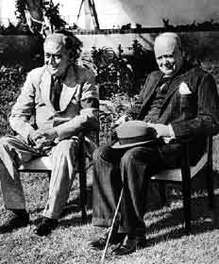
Winston Churchill stated in his memoirs that the Battle of the Atlantic was what he worried about most; if it was lost, Britain would have run out of everything, including fuel . . . and the will to fight. At the end of 1942, Admiral Karl Doenitz had 212 operational U-Boats; by the time Churchill met President Franklin Roosevelt at Casablanca (pictured), the Nazis were by far sinking more Allied ships than the Allied ships were sinking U-Boats.
In early-1943, Churchill's nightmare appeared to be coming true: 108 Allied ships were lost in March, with 2/3's of the total sunk in convoy on the single-most important route in the Atlantic. The Nazis came the closest to turning the tide in the Battle of the Atlantic in the first twenty days of March 1943 . . . the Allied strategy of using convoys was in doubt.
In early-1943, Churchill's nightmare appeared to be coming true: 108 Allied ships were lost in March, with 2/3's of the total sunk in convoy on the single-most important route in the Atlantic. The Nazis came the closest to turning the tide in the Battle of the Atlantic in the first twenty days of March 1943 . . . the Allied strategy of using convoys was in doubt.
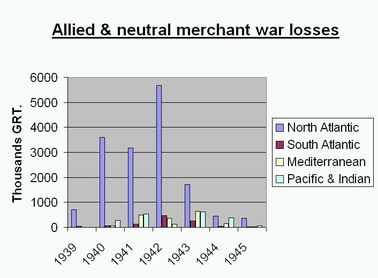
March 1943 started off badly for the Allies since Doenitz had four large wolf packs in the Atlantic; two of them in the Central Atlantic, with one each on the Northern and Southern flanks. Doenitz also held a significant advantage with intelligence and decryption; Germany even knew where Allied ships were going and when they were leaving their harbor. Bletchley Park was unable to do the same in assisting the convoy escorts in terms of locating German U-Boats . . . the wolves were preying on the shepherds.
On 5 March 1943, Convoy SC (Slow Convoy) 121 from New York City was slaughtered by U-Boats. 59 slow merchant ships were escorted by 5 ships without air cover facing 26 U-Boats. From 7 - 10 March, 13 ships were sunk without a single U-Boat being hit . . . it was the most one-sided encounter of the war, which explained Hitler's high-level of satisfaction after reading Doenitz's report. On 16-20 March 1943, Convoys HX (Fast Convoy) 229 and SC 122 went through the gauntlet of U-Boat wolf packs with a motley assembly of slow/ancient ships carrying crucial cargoes toward Britain. The convoys had become larger, with many more ships on the sea-lanes . . . while it was true that convoys with 60-90 ships had a greater chance of getting more cargo to Britain than 30 ships, the number of escort ships remained the same.
On 5 March 1943, Convoy SC (Slow Convoy) 121 from New York City was slaughtered by U-Boats. 59 slow merchant ships were escorted by 5 ships without air cover facing 26 U-Boats. From 7 - 10 March, 13 ships were sunk without a single U-Boat being hit . . . it was the most one-sided encounter of the war, which explained Hitler's high-level of satisfaction after reading Doenitz's report. On 16-20 March 1943, Convoys HX (Fast Convoy) 229 and SC 122 went through the gauntlet of U-Boat wolf packs with a motley assembly of slow/ancient ships carrying crucial cargoes toward Britain. The convoys had become larger, with many more ships on the sea-lanes . . . while it was true that convoys with 60-90 ships had a greater chance of getting more cargo to Britain than 30 ships, the number of escort ships remained the same.
Why did the Battle of the Atlantic go so poorly for the Allies in early-1943?
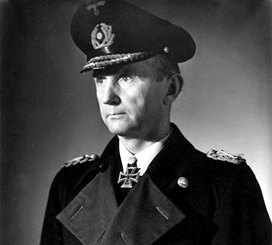
First, there were just too few escort ships protecting the convoys, and far-too-few aircraft providing protection. Also, the Nazis held an advantage with intelligence with their code-breaking/communications network, B-Dienst. Doenitz (pictured) was able to direct four major U-Boat orchestras thousands of miles apart, especially since Allied intelligence was slow and late.
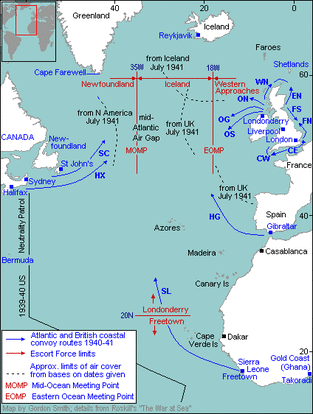
The lack of air cover in the "Air Gap" was beyond-significant; U-Boats were able to operate virtually unopposed . . . Allied planes just didn't have the capacity to fly far enough from their bases to provide air cover in that stretch of North Atlantic. By April 1943, Doenitz had 240 operational U-Boats with 185 more being retro-fitted or in the process of training crews. Doenitz was capable of sending 40 U-Boats against any single convoy . . . finally, on the Allied side, reality set in. Allied strategists/planners figured out that the convoys would need to fight their way across the Atlantic rather than evade the enemy . . . that crucial decision gave the Allies a much more clearer focus on how to deal with the wolf packs lying in wait.
First, there were just too few escort ships protecting the convoys, and far-too-few aircraft providing protection. Also, the Nazis held an advantage with intelligence with their code-breaking/communications network, B-Dienst. Doenitz (pictured) was able to direct four major U-Boat orchestras thousands of miles apart, especially since Allied intelligence was slow and late.
The lack of air cover in the "Air Gap" was beyond-significant; U-Boats were able to operate virtually unopposed . . . Allied planes just didn't have the capacity to fly far enough from their bases to provide air cover in that stretch of North Atlantic. By April 1943, Doenitz had 240 operational U-Boats with 185 more being retro-fitted or in the process of training crews. Doenitz was capable of sending 40 U-Boats against any single convoy . . . finally, on the Allied side, reality set in. Allied strategists/planners figured out that the convoys would need to fight their way across the Atlantic rather than evade the enemy . . . that crucial decision gave the Allies a much more clearer focus on how to deal with the wolf packs lying in wait.
What caused the change of fortunes in the North Atlantic?
The greatest factor was aircraft; World War II was the war in which sea power was affected by air power. Doenitz lamented after WW II that Germany waged war without an "Air Arm" to complement and protect his U-Boats. Increased Allied air power took two forms: VLR (Very Long Range) shore-based aircraft, especially the B-24 Liberator, as well as B-17 Flying Fortresses and the PBY Catalina.
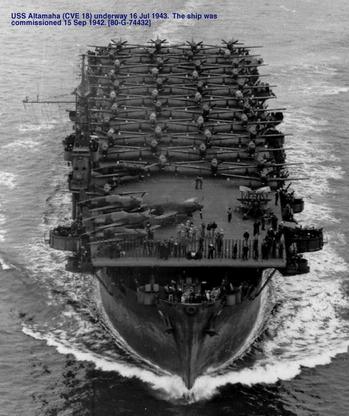
Secondly were escort carriers (pictured), which were modest in speed and striking power compared to the US full-sized fleet carriers in the Pacific, but were perfect for the North Atlantic. Aircraft from the escort carriers could patrol for miles around, and they had similar weapons systems as the VLR's to destroy U-Boats. These planes rearmed and refueled overnight on the escort carriers and were able to repeatedly engage U-Boats.
Doenitz never could cope with the increased Allied aircraft, which not only held an obvious speed advantage, but also had more accurate-and-lethal weapons necessary to destroy U-Boats. By mid-1943, a VLR B-24 Liberator could assist a convoy 1200 miles from it s base; Doenitz realized as early as 1941 that without air power, control of the seas was basically impossible, even for his vaunted U-Boats.
The greatest factor was aircraft; World War II was the war in which sea power was affected by air power. Doenitz lamented after WW II that Germany waged war without an "Air Arm" to complement and protect his U-Boats. Increased Allied air power took two forms: VLR (Very Long Range) shore-based aircraft, especially the B-24 Liberator, as well as B-17 Flying Fortresses and the PBY Catalina.
Secondly were escort carriers (pictured), which were modest in speed and striking power compared to the US full-sized fleet carriers in the Pacific, but were perfect for the North Atlantic. Aircraft from the escort carriers could patrol for miles around, and they had similar weapons systems as the VLR's to destroy U-Boats. These planes rearmed and refueled overnight on the escort carriers and were able to repeatedly engage U-Boats.
Doenitz never could cope with the increased Allied aircraft, which not only held an obvious speed advantage, but also had more accurate-and-lethal weapons necessary to destroy U-Boats. By mid-1943, a VLR B-24 Liberator could assist a convoy 1200 miles from it s base; Doenitz realized as early as 1941 that without air power, control of the seas was basically impossible, even for his vaunted U-Boats.
For a nation dependent on long-range oceanic commerce, it was somewhat surprising that an "Air Gap" existed in the first place. But once diagnosed, closing the "Air Gap" didn't occur because some "great person" decreed so. For example, a team of mostly Canadian air engineers in early-1943 pulled one bomb bay from a Liberator and replaced it with extra fuel tanks, at last creating an aircraft that could reach the "Air Gap". There were scientists that developed more effective fuses for more predictable depth charges, as well as scientists and armaments experts that created the air-launched acoustic homing torpedo, nicknamed "Fido", which was specifically engineered to search-and-destroy submerged U-Boats.
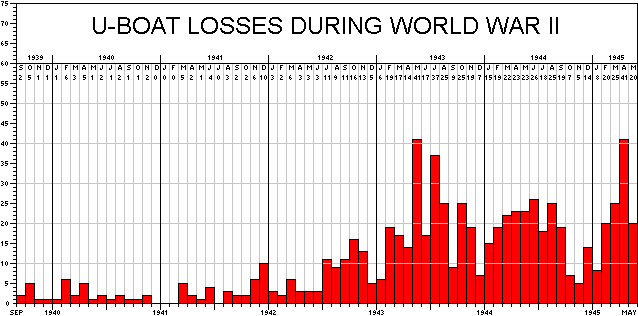
There were improvements to radar, escort carriers, and training schools that cranked out air crews. During 1943 in all theaters of WW II, 199 U-Boats were sunk, 140 of them by Allied aircraft; that trend would continue for the rest of WW II. The key task for convoy escorts, whether surface or aerial, was to prevent U-Boats from launching their deadly torpedoes at Allied merchant ships.
There were improvements to radar, escort carriers, and training schools that cranked out air crews. During 1943 in all theaters of WW II, 199 U-Boats were sunk, 140 of them by Allied aircraft; that trend would continue for the rest of WW II. The key task for convoy escorts, whether surface or aerial, was to prevent U-Boats from launching their deadly torpedoes at Allied merchant ships.
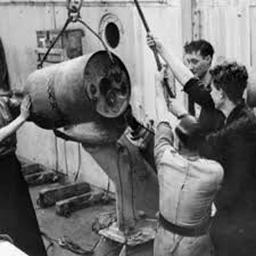
The main Allied counter-weapon, the MK6 Depth Charge, wasn't very reliable in early-WW II. The theory was that the large explosion, magnified under water, would rip apart the U-Boat's joints, since it wasn't a contact explosive. A depth charge was an attractive weapon in that it could be mounted on even the rear decks of a corvette, and used by anti-sub air patrols.
However, the MK6 had significant disadvantages. A ship had to steam over where a U-Boat was detected, which would give the U-Boat time to dive deeper; the British Admiralty and the US Navy were slow to realize how quickly U-Boats were able to dive. Proximity fuses needed to be set at the last moment at the estimated depth of the U-Boat . . . on average hundreds of MK6 Depth Charges over days were needed to destroy a single U-Boat.
However, the MK6 had significant disadvantages. A ship had to steam over where a U-Boat was detected, which would give the U-Boat time to dive deeper; the British Admiralty and the US Navy were slow to realize how quickly U-Boats were able to dive. Proximity fuses needed to be set at the last moment at the estimated depth of the U-Boat . . . on average hundreds of MK6 Depth Charges over days were needed to destroy a single U-Boat.
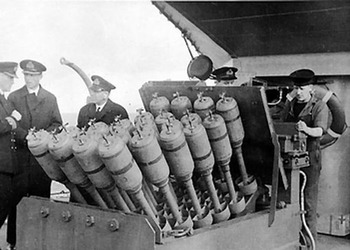
On the other hand, there was the Hedgehog (after the grenades were launched, what was left looked like the spine of a hedgehog), which was so simple one wonders why it wasn't created during WW I. A Hedgehog was a multi-headed grenade launcher that fired forward of the warship; usually, the four-inch gun was replaced with the Hedgehog. The Hedgehog had several advantages over depth charges, and its introduction in 1943 was widely welcomed by escort ships. The time it took to fire at U-Boats was reduced, and a fusilade of 24-30 grenades rained-down on the U-Boat, with delayed and/or contact explosions.
An added bonus was that the Hedgehog didn't distort sonar readings after the grenades were launched. By mid-1943, the British-invented Hedgehog was in wide use . . . by the end of WW II, the Hedgehog had destroyed about 50 U-Boats . . . and Allied weapons developers were in the process creating Hedgehogs that had projectiles that could search for submerged U-Boats.
An added bonus was that the Hedgehog didn't distort sonar readings after the grenades were launched. By mid-1943, the British-invented Hedgehog was in wide use . . . by the end of WW II, the Hedgehog had destroyed about 50 U-Boats . . . and Allied weapons developers were in the process creating Hedgehogs that had projectiles that could search for submerged U-Boats.
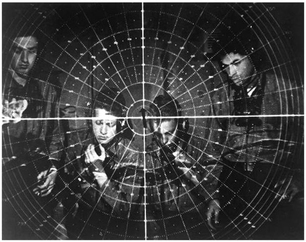
Centimetric Radar was even more of a breakthrough, maybe the greatest of the new or improved technology used in the Battle of the Atlantic. It was a miniaturized version of the large-scale and effective British on-land radar used v. the Luftwaffe during the Battle for Britain. A device needed to be invented that could hold the power necessary to generate the microwave pulses to locate specific/small targets AND be small enough to be put on an escort vessel or in the nose of a VLR.
Slowly, Centimetric Radar was introduced in Allied reconnaissance aircraft as well as corvettes. This new radar could spot a U-Boat's conning tower miles away, day-or-night . . . in calm water, the Centimetric Radar could even spot a single periscope. And, none of the U-Boat technology systems could detect the radar.
Slowly, Centimetric Radar was introduced in Allied reconnaissance aircraft as well as corvettes. This new radar could spot a U-Boat's conning tower miles away, day-or-night . . . in calm water, the Centimetric Radar could even spot a single periscope. And, none of the U-Boat technology systems could detect the radar.
More-and-more Allied escort commanders were thinking "kill" and "attack" far more than "protect" when facing U-Boats. The creation of "support groups" in addition to escort ships was key, in that the support ships could pursue U-Boats while the escorts guided/protected merchant ships. With more warships, escort carrier planes would do the air equivalent of a "Creeping Attack", in that two planes would strafe a U-Boat, while a third plane would go for the kill with bombs and/or torpedoes.
While the number of U-Boats sunk by carriers was much less than land-based aircraft, their presence and effectiveness was invaluable. By June-August 1944, Allied control of the air and sea-lanes in the North Atlantic was complete. For example, only 5 Allied vessels were sunk during D-Day by German U-Boats. Doenitz was still receiving and dispatching new U-Boats as late as April 1945; the submarines of the Kriegsmarine fought to the end of the war. During WW II, the casualty rate among U-Boat crews was 63% (76% if captured crews were included) . . . no other service in any other nation's military suffered so great a casualty percentage. (Below: Episode #1 of "The War Against the U-Boats")
While the number of U-Boats sunk by carriers was much less than land-based aircraft, their presence and effectiveness was invaluable. By June-August 1944, Allied control of the air and sea-lanes in the North Atlantic was complete. For example, only 5 Allied vessels were sunk during D-Day by German U-Boats. Doenitz was still receiving and dispatching new U-Boats as late as April 1945; the submarines of the Kriegsmarine fought to the end of the war. During WW II, the casualty rate among U-Boat crews was 63% (76% if captured crews were included) . . . no other service in any other nation's military suffered so great a casualty percentage. (Below: Episode #1 of "The War Against the U-Boats")
