Source: H.W. Brands. Reagan: The Life (2015)
Governor Ronald Reagan took special pleasure in attacking the University of California at Berkeley whenever possible. Reagan vowed to "clean up" Berkeley, citing a need to change the leadership at the university's administration, which he believed was enabling a minority of malcontents to disrupt the education of the majority of students.
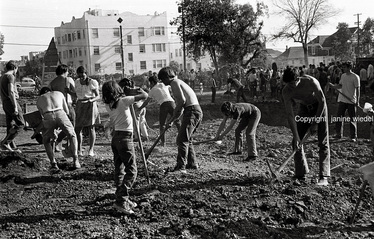
In February 1969, the Third World Liberation Front attempted to close down Berkeley's campus; Reagan responded by declaring an "extreme emergency", and sent state troopers to assist local authorities. Several weeks later, a property dispute arose at Berkeley, where a recently purchased lot remained empty; hippies and radicals squatted in the lot, proclaiming it to be the "People's Park" (pictured). Reagan had taken some criticism in California when he pursued the Republican nomination that he wasn't decisive-enough to be Governor . . . Reagan was itching to show that he was indeed decisive.
In February 1969, the Third World Liberation Front attempted to close down Berkeley's campus; Reagan responded by declaring an "extreme emergency", and sent state troopers to assist local authorities. Several weeks later, a property dispute arose at Berkeley, where a recently purchased lot remained empty; hippies and radicals squatted in the lot, proclaiming it to be the "People's Park" (pictured). Reagan had taken some criticism in California when he pursued the Republican nomination that he wasn't decisive-enough to be Governor . . . Reagan was itching to show that he was indeed decisive.
Reagan unilaterally ordered the area cleared, and then a fence erected to keep out the squatters. The fence was quickly erected, but a march to "take back" the People's Park started to move towards the area. Protesters threw rocks, concrete, and metal objects at the police, while police responded with tear gas and shotguns loaded with birdshot or buckshot (which was far worse, and its use was disputed by the police). Dozens of protesters were wounded, and one was killed; the California National Guard was called in, and remained under Reagan's orders.
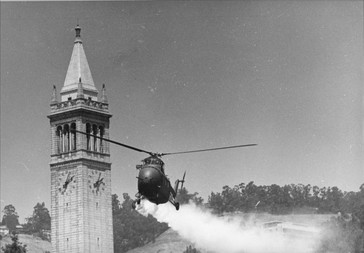
Reagan officially blamed the "street gangs" and "campus radicals" for the violence; Reagan's words exacerbated the crisis, and shortly afterwards, National Guard helicopters sprayed tear gas on the protesters (pictured: a helicopter spraying tear gas on 20 May 1969). The Berkeley faculty denounced Reagan's "military occupation", and demanded an audience with the Governor. In a televised address at the Commonwealth Club in San Francisco, Reagan held firm. He cited many examples of lawbreaking in the last year at Berkeley, and he specifically identified the leaders of the riots as political agitators, with "lemmings" as followers. Reagan also called-out the Berkeley faculty, blaming them for creating the current polarized atmosphere on campus.
Reagan officially blamed the "street gangs" and "campus radicals" for the violence; Reagan's words exacerbated the crisis, and shortly afterwards, National Guard helicopters sprayed tear gas on the protesters (pictured: a helicopter spraying tear gas on 20 May 1969). The Berkeley faculty denounced Reagan's "military occupation", and demanded an audience with the Governor. In a televised address at the Commonwealth Club in San Francisco, Reagan held firm. He cited many examples of lawbreaking in the last year at Berkeley, and he specifically identified the leaders of the riots as political agitators, with "lemmings" as followers. Reagan also called-out the Berkeley faculty, blaming them for creating the current polarized atmosphere on campus.
Reagan ran for re-election in 1970 while campus turmoil shifted to the University of California at Santa Barbara, where radicals were protesting the Military-Corporate Complex. Reagan once again declared a state of emergency, and again called in the National Guard. Reagan thought he knew the cause of the crisis: a small group of revolutionaries trying to rock the boat . . . Reagan was quoted as saying, "If it's to be a bloodbath, let it be now" (a comment which he obviously regretted).
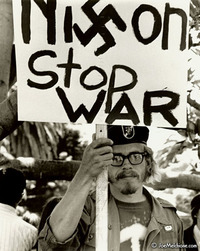
California voters liked Reagan and his pragmatism, but they weren't as enthusiastic in 1970 as they were in 1966: in 1966, Reagan had .580 of the popular vote, compared to .530 in 1970. Although the margin of victory in 1970 was half that of 1966, Reagan viewed it as a "win-is-a-win", and accepted the outcome (pictured: campus unrest increased in 1970 when Nixon ordered the invasion of neutral Cambodia).
California voters liked Reagan and his pragmatism, but they weren't as enthusiastic in 1970 as they were in 1966: in 1966, Reagan had .580 of the popular vote, compared to .530 in 1970. Although the margin of victory in 1970 was half that of 1966, Reagan viewed it as a "win-is-a-win", and accepted the outcome (pictured: campus unrest increased in 1970 when Nixon ordered the invasion of neutral Cambodia).
In 1964, Americans soundly rejected Barry Goldwater's ultra-conservatism, and in 1972, Americans soundly rejected George McGovern's ultra-liberalism; Nixon was right in the middle between the two extremes, which appealed to most Americans. Big government wasn't the enemy, and it wasn't a best friend . . . most Americans wanted a stable, calm status quo.
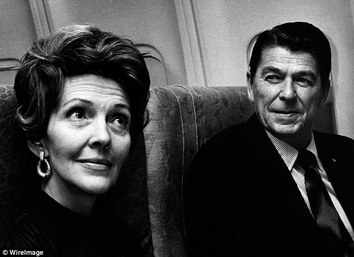
For Reagan, if there was a public role after serving two terms as Governor of California, it was in the White House, which was an unrealistic goal until Nixon's implosion during Watergate. Reagan (pictured with Nancy on 10 March 1974 returning to Los Angeles) turned 64 after his two terms, and Nixon was no longer in a political position to anoint a moderate successor . . . the road was wide open, and Reagan decided to make a run for the Republican nomination in 1976 (but not too eagerly . . .).
For Reagan, if there was a public role after serving two terms as Governor of California, it was in the White House, which was an unrealistic goal until Nixon's implosion during Watergate. Reagan (pictured with Nancy on 10 March 1974 returning to Los Angeles) turned 64 after his two terms, and Nixon was no longer in a political position to anoint a moderate successor . . . the road was wide open, and Reagan decided to make a run for the Republican nomination in 1976 (but not too eagerly . . .).
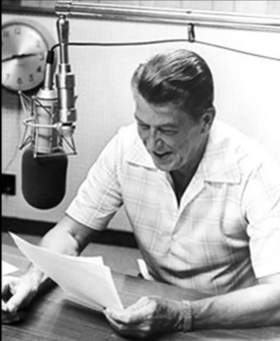
Reagan actually took a mini-gig on CBS Radio, five minutes twice a day during the commutes. Reagan was able to stay in the public eye, and avoid being on television; he believed that people would tire of seeing him on TV every day with Walter Cronkite (another reason was that Reagan thought the TV would magnify his age). By 1980, Reagan was speaking to at least 50 million people in the morning and afternoon.
Reagan wrote every one of his five minute radio broadcasts himself. Reagan remembered the intimate nature of FDR's "Fireside Chats", and re-created his version twice a day. Reagan wanted his words to be the focus, not images he would have needed to feature on TV. Reagan had no policy agenda beyond his basic conservative principles; he expected events to provide direction, and that occurred with the Fall of Saigon in 1975.
Reagan wrote every one of his five minute radio broadcasts himself. Reagan remembered the intimate nature of FDR's "Fireside Chats", and re-created his version twice a day. Reagan wanted his words to be the focus, not images he would have needed to feature on TV. Reagan had no policy agenda beyond his basic conservative principles; he expected events to provide direction, and that occurred with the Fall of Saigon in 1975.
Reagan blamed a lack of leadership in the federal government for the nation of Vietnam becoming all-Communist. Soon, in his radio addresses, he started questioning the wisdom of "detente" with the USSR. Reagan had a big problem with the US/USSR monster grain deal which lessened food shortages in Russia; mostly, he questioned the morality of the grain deal (why should the US assist a communist nation in any way?) admitting that there were economic gains, especially by US farmers.
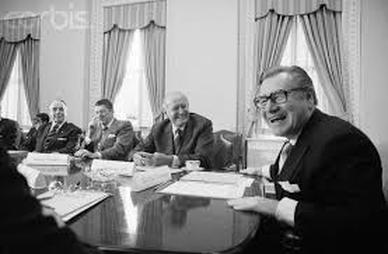
Reagan was appointed to the Rockefeller Commission, whose job it was to investigate the CIA. Reagan attended less than half of the 26 meetings (Reagan is pictured to the left of Vice-President Nelson Rockefeller); in the end, Reagan signed the Commission's findings, which were basically a "slap on the wrist" against the CIA.
But, the Church Committee (chaired by Senator Frank Church of Idaho) uncovered shenanigans by the CIA, including Iran in 1953, Guatemala in 1954, and the Bay of Pigs in 1961, as well as assassination attempts. Conservatives, like Reagan, didn't like any sunshine showing on the CIA; to Reagan, the CIA needed to stay viable and effective to guard against foreign threats . . . especially Communist foreign threats.
Reagan was appointed to the Rockefeller Commission, whose job it was to investigate the CIA. Reagan attended less than half of the 26 meetings (Reagan is pictured to the left of Vice-President Nelson Rockefeller); in the end, Reagan signed the Commission's findings, which were basically a "slap on the wrist" against the CIA.
But, the Church Committee (chaired by Senator Frank Church of Idaho) uncovered shenanigans by the CIA, including Iran in 1953, Guatemala in 1954, and the Bay of Pigs in 1961, as well as assassination attempts. Conservatives, like Reagan, didn't like any sunshine showing on the CIA; to Reagan, the CIA needed to stay viable and effective to guard against foreign threats . . . especially Communist foreign threats.
