Source: H.W. Brands. Reagan: The Life (2015)
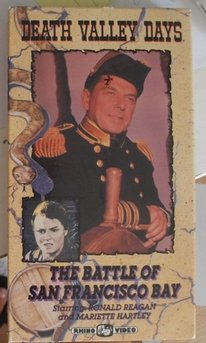
In 1964 Ronald Reagan needed work, and he was hired as the host of "Death Valley Days", a television show that had its roots in radio. Reagan was able to travel much as he did when he was the host of "General Electric Theater", but this time in service of his own political brand: "Reagan the Conservative".
Opinion polls had Reagan far ahead of any other challenger for the Election of 1966 for Governor of California, and the national media had started to notice. Reagan's main problem at this point was that he needed to keep the conservative wing of the Republican Party happy without scaring the devil out of everyone else in California, which was what Barry Goldwater was unable to do in 1964. Even though Reagan had previously attacked Republican moderates, he toned down his rhetoric in early-1966 concerning that wing of the party.
Opinion polls had Reagan far ahead of any other challenger for the Election of 1966 for Governor of California, and the national media had started to notice. Reagan's main problem at this point was that he needed to keep the conservative wing of the Republican Party happy without scaring the devil out of everyone else in California, which was what Barry Goldwater was unable to do in 1964. Even though Reagan had previously attacked Republican moderates, he toned down his rhetoric in early-1966 concerning that wing of the party.
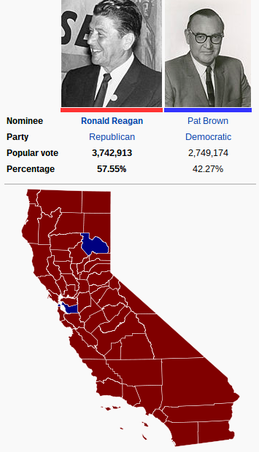
On 4 January 1966, Reagan felt it was time to formally announce his candidacy for Governor of California. Reagan did so with a 30m TV special that was broadcast to 16 stations around California. In the California Republican primary, Reagan won by a 2:1 margin; conservatives now had real hope for Reagan winning the gubernatorial election.
Reagan had a winning personality to go with his conservative credentials. Governor Pat Brown, by comparison, looked stodgy and slow. In a June 1966 poll, Reagan held an eleven point lead over Brown, and the Governor was never able to close the gap. On 8 November 1966, Reagan crushed Brown by tallying one million more votes; Republicans swept the statewide offices as well. Nationally, seven other Republicans were elected governor, and Republicans won three Senate seats, and forty-seven seats in the House of Representatives.
Reagan had a winning personality to go with his conservative credentials. Governor Pat Brown, by comparison, looked stodgy and slow. In a June 1966 poll, Reagan held an eleven point lead over Brown, and the Governor was never able to close the gap. On 8 November 1966, Reagan crushed Brown by tallying one million more votes; Republicans swept the statewide offices as well. Nationally, seven other Republicans were elected governor, and Republicans won three Senate seats, and forty-seven seats in the House of Representatives.
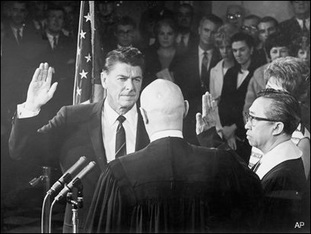
Reagan started his term as Governor on 2 January 1967, with his public Inauguration occurring a few days later (pictured). The details of governing would rarely interest Reagan; he was a man of ideas and principles . . . the details he left to others. The typical person that worked for Reagan did whatever he/she could to make life easier for Reagan, even though he never asked them to do so. Such was Reagan's personality - niceness, integrity, vision, etc.; people worked hard for him. Reagan's vision and philosophy was his strength, while an over-reliance on many others to carry out the necessary details of government was a weakness . . . both his strengths and weaknesses became apparent as he tried to balance California's budget.
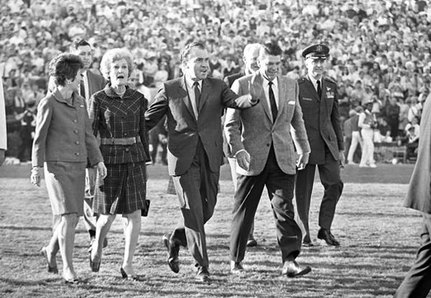
Although California law prohibited the state from running a deficit, accounting gimmicks from Governor Brown's administration meant that Reagan inherited a budget that was wildly out-of-balance. Reagan proposed a 10% overall slash in the budget; that proposal antagonized anyone that looked to state programs for assistance . . . Reagan's budget proposal created far more losers than winners. (pictured: Governor Reagan and President-Elect Richard Nixon at the 1969 Rose Bowl)
The Governor of California was expected to socialize, but Reagan was more of a loner by nature. Reagan went home every night, while state legislators, who were away from home in Sacramento, would "howl and the night". Reagan made some efforts at socializing, for example inviting legislators over for dinner, but his efforts didn't close the "social gap" between the branches of state government.
California Democrats in the legislature attacked Reagan's budget proposal; it turned out that the Democrats paid far more attention to details than the new Governor. Democrats pointed out that Reagan's proposed 10% cuts across-the-board wouldn't eliminate the state budget deficit, and therefore a tax increase was needed. Reagan was forced to compromise with the legislature; a $1 billion tax increase was featured, which went against Reagan's fiscal philosophy (two of his basic principles were smaller government and less taxes), but he had to take what he could get with the state legislature so soon after taking office.
The Governor of California was expected to socialize, but Reagan was more of a loner by nature. Reagan went home every night, while state legislators, who were away from home in Sacramento, would "howl and the night". Reagan made some efforts at socializing, for example inviting legislators over for dinner, but his efforts didn't close the "social gap" between the branches of state government.
California Democrats in the legislature attacked Reagan's budget proposal; it turned out that the Democrats paid far more attention to details than the new Governor. Democrats pointed out that Reagan's proposed 10% cuts across-the-board wouldn't eliminate the state budget deficit, and therefore a tax increase was needed. Reagan was forced to compromise with the legislature; a $1 billion tax increase was featured, which went against Reagan's fiscal philosophy (two of his basic principles were smaller government and less taxes), but he had to take what he could get with the state legislature so soon after taking office.
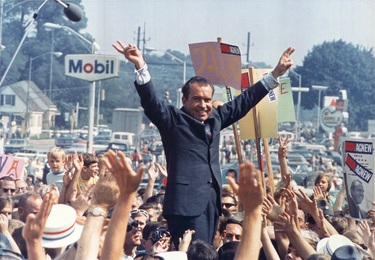
As the Republican National Convention (RNC) in Miami approached in the summer of 1968, Richard Nixon (pictured, in "Campaign Mode"), a moderate Republican, had positioned himself nicely for the nomination. Reagan looked around for the party's #1 conservative, and discovered that he was that man. Reagan allowed the California delegation to the RNC to nominate him as a "Favorite Son" candidate. With 86 delegates from California, Reagan hoped to develop momentum before the RNC.
Reagan, like Nixon, went on a multi-state speaking tour before the convention. Reagan campaigned like a candidate for President, even though he was technically non-committal. When Robert Kennedy was assassinated in June 1968, Nixon, the moderate, politically benefited far more than Reagan. Moderate Republicans evoked less emotional passions in the extremely polarized social and political landscape of 1968 compared to the conservative Reagan, who to many was still a very scary proposition, even among Republicans.
Reagan, like Nixon, went on a multi-state speaking tour before the convention. Reagan campaigned like a candidate for President, even though he was technically non-committal. When Robert Kennedy was assassinated in June 1968, Nixon, the moderate, politically benefited far more than Reagan. Moderate Republicans evoked less emotional passions in the extremely polarized social and political landscape of 1968 compared to the conservative Reagan, who to many was still a very scary proposition, even among Republicans.
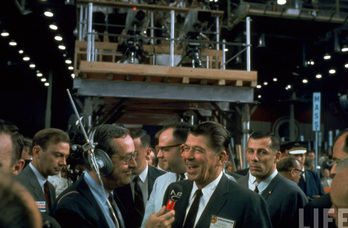
Nixon had enough delegates from the primaries to win the nomination as the Presidential candidate for the Republican Party on the first ballot. As the Republican National Convention convened in August 1968 in Miami, Nelson Rockefeller and Ronald Reagan both tried to sap Nixon's strength; Reagan's people tried to get a speaking appearance for Reagan in front of the entire convention before any balloting took place.
But Nixon was a savvy politician, and he was able to keep Reagan off the stage before the balloting while courting Southern delegates by promising that he wouldn't nominate a liberal Republican for the Vice-Presidential slot (Nixon selected Spiro Agnew as his running mate). As predicted, Nixon won the nomination on the first ballot with 692 delegates, while Reagan finished third with 182 (Nelson Rockefeller finished second with 277); only then did Nixon allow Reagan on the stage to address the convention, for the sole purpose of recommending that Nixon's nomination be unanimous (the final ballot, after "switching", was Nixon with 1238 delegates, Rockefeller with 93, and Reagan with 2; pictured above - NBC anchorman John Chancellor interviewing Reagan on the floor of the convention).
But Nixon was a savvy politician, and he was able to keep Reagan off the stage before the balloting while courting Southern delegates by promising that he wouldn't nominate a liberal Republican for the Vice-Presidential slot (Nixon selected Spiro Agnew as his running mate). As predicted, Nixon won the nomination on the first ballot with 692 delegates, while Reagan finished third with 182 (Nelson Rockefeller finished second with 277); only then did Nixon allow Reagan on the stage to address the convention, for the sole purpose of recommending that Nixon's nomination be unanimous (the final ballot, after "switching", was Nixon with 1238 delegates, Rockefeller with 93, and Reagan with 2; pictured above - NBC anchorman John Chancellor interviewing Reagan on the floor of the convention).
