Source: H.W. Brands. Reagan: The Life (2015)
Governor Reagan took special pleasure in attacking UC-Berkeley whenever possible (even when he was campaigning for Governor in 1966). Reagan vowed to "clean up" the campus at the University of California at Berkeley, citing a need to change the university's administration, which in his view was enabling a minority of beatniks and malcontents to disrupt the education of the majority of students.
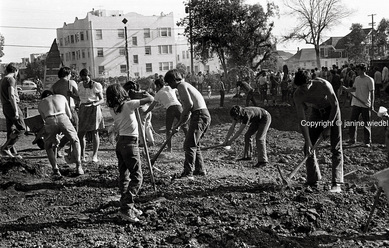
In February 1969, the "3rd World Liberation Front" attempted to close down Berkeley's campus. Reagan responded by declaring the situation an "extreme emergency", and he sent state troopers to assist local law enforcement. In the spring of 1969, a property dispute erupted, where a recently purchased lot by the university sat idle, and hippies and radicals squatted in the area proclaiming the lot to be the "People's Park" (pictured: squatters working to create the "People's Park" in the idle lot). Reagan had taken some criticism in California that he wasn't a decisive governor, and Reagan was itching to show his decisiveness to the entire nation.
In February 1969, the "3rd World Liberation Front" attempted to close down Berkeley's campus. Reagan responded by declaring the situation an "extreme emergency", and he sent state troopers to assist local law enforcement. In the spring of 1969, a property dispute erupted, where a recently purchased lot by the university sat idle, and hippies and radicals squatted in the area proclaiming the lot to be the "People's Park" (pictured: squatters working to create the "People's Park" in the idle lot). Reagan had taken some criticism in California that he wasn't a decisive governor, and Reagan was itching to show his decisiveness to the entire nation.
Governor Reagan unilaterally ordered the area cleared, and then a fence erected to the out the protesters. The fence was quickly constructed, but a march to "take back" the People's Park started to move towards the area. Protesters threw rocks, concrete, and metal at the police, while police used tear gas and and in some situations, used shotguns with birdshot (or buckshot, which was worse). Dozens of protesters were wounded, and one was killed. Reagan called in the California National Guard, and they remained until the crisis ended. Reagan officially blamed the "street gangs" and campus radicals for the violence. (Below: a short video segment that summarizes Reagan's response in Berkeley in May 1969)
Reagan's rhetoric exacerbated the crisis at Berkeley; helicopters were called in to spray more tear gas to disperse the protesters. The Berkeley faculty demanded an audience, and denounced Reagan’s “military occupation” on the campus. Reagan held firm as he addressed the Commonwealth Club in San Francisco, which was carried on live television.
Reagan cited many examples of lawbreaking in the past year at Berkeley, and he specifically identified the leaders of the riots as political agitators; Reagan also blamed those that followed the riot's leaders. Reagan also called out the faculty for creating the current polarized atmosphere on campus.
Reagan cited many examples of lawbreaking in the past year at Berkeley, and he specifically identified the leaders of the riots as political agitators; Reagan also blamed those that followed the riot's leaders. Reagan also called out the faculty for creating the current polarized atmosphere on campus.
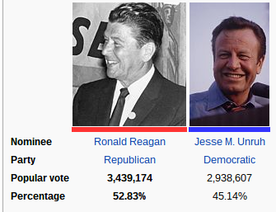
In the gubernatorial election in California in 1970, Reagan ran for re-election. Campus turmoil continued, this time at UC-Santa Barbara, where radicals were protesting against the Military-Corporate Complex. Reagan once again declared a state of emergency, and once again called in the National Guard.
Reagan thought he knew the cause of the riots in Berkeley and Santa Barbara: a small group of revolutionaries that enjoyed creating a crisis. Reagan was quoted as saying, on 7 April 1970, "If it's to be a bloodbath, let it be now" . . . Reagan regretted saying those words, especially since they were publicly reported. But a majority of voters liked Reagan and his pragmatism, but they weren't as enthusiastic in 1970 as in 1966. In 1970, Reagan garnered 53% of the popular vote, while in 1966 it was 58%. Reagan's margin of victory was about half of what it was in 1966, but Reagan accepted the results, saying a "win is a win".
Reagan thought he knew the cause of the riots in Berkeley and Santa Barbara: a small group of revolutionaries that enjoyed creating a crisis. Reagan was quoted as saying, on 7 April 1970, "If it's to be a bloodbath, let it be now" . . . Reagan regretted saying those words, especially since they were publicly reported. But a majority of voters liked Reagan and his pragmatism, but they weren't as enthusiastic in 1970 as in 1966. In 1970, Reagan garnered 53% of the popular vote, while in 1966 it was 58%. Reagan's margin of victory was about half of what it was in 1966, but Reagan accepted the results, saying a "win is a win".
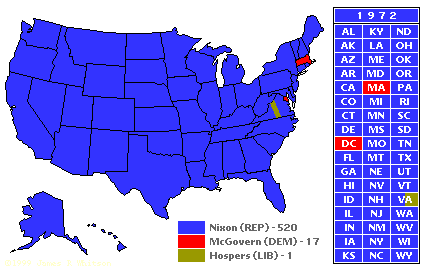
University and college campuses erupted in protest nationwide when President Nixon ordered the invasion of Cambodia; Governor Reagan continued to take a hard line against campus protests, regardless of the motivations. In 1964, American voters soundly rejected Barry Goldwater's ultra-conservatism; in 1972, American voters resoundingly rejected George McGovern's ultra-liberalism. Richard Nixon was right in the middle between the two political extremes, and he often appealed to both sides. To Nixon, big government was not the enemy, but it wasn't a best friend, either . . . most Americans wanted a predictable and stable status quo by the early-1970s. In the Election of 1972, Nixon won 49 states; only Massachusetts (and Washington, D.C.) the most liberal state in the nation at that time, voted for McGovern.
