Mr. Jensen's U.S. History Website
  • U.S. History Blog
    • U.S. History Blog (May 2026 - May 2027)
    • U.S. History Blog (May 2025 - May 2026)
    • U.S. History Blog (May 2024 - May 2025)
    • U.S. History Blog (May 2023 - May 2024)
    • U.S. History Blog (May 2022 - May 2023)
    • U.S. History Blog (May 2021 - May 2022)
    • U.S. History Blog (May 2020 - May 2021)
    • U.S. History Blog (May 2019 - May 2020)
    • U.S. History Blog (May 2018 - May 2019)
    • U.S. History Blog (May 2017 - May 2018)
    • U.S. History Blog (May 2016 - May 2017)
    • U.S. History Blog (May 2015 - May 2016)
    • U.S. History Blog (May, 2014 - May, 2015)
  • About

James Madison & the Constitutional Convention (May-Sept, 1787)

11/13/2015

0 Comments

 
     Source: Andrew Burstein & Nancy Isenberg. Madison and Jefferson (2013)
Picture
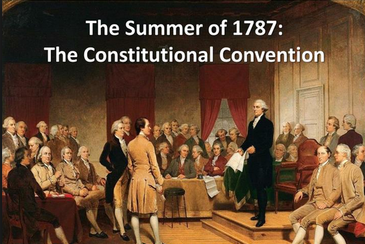
     James Madison and the Virginia delegation were ready for the Constitutional Convention to begin in early-May, 1787, but there was a problem: there weren't enough state delegations in Philadelphia to start the convention. Finally, on 25 May 1787, seven state delegations were present, which was enough to organize the convention. George Washington (a member of the VA delegation) was unanimously selected the President of the Convention "una voca" (by a voice vote). 
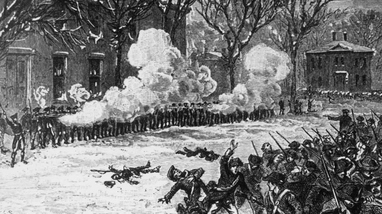
     Shays' Rebellion (pictured above is a depiction of the fire-fight at the Springfield Arsenal in early-1787) was still not only a fresh memory, but it had hit a nerve on the 50+ delegates, in that it raised the specter of class warfare in America (e.g. all the Massachusetts politicians that supported the tax increases and military response to the rebellion were voted out of office). To
James Madison, Shays' Rebellion was a major symptom of what was wrong with the Articles of Confederation (A of C). 
And, to Madison's absolute horror, some of the rebels even won elected office in Massachusetts.
​     The delegates at the Constitutional Convention hated paper money, and most, if not all, saw massive government debt as a catalyst that could cause social upheaval. For the delegates, a new government was needed to protect property, raise desperately needed revenue, and most of all to Madison, discipline rogue state legislatures.
Picture
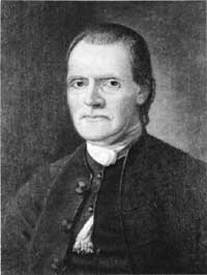
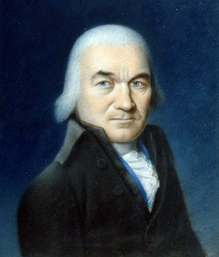
      If Roger Sherman (Connecticut, pictured) was the true maestro of the Constitutional Convention, then James Madison was the frustrated rival composer; as brilliant as Madison was, Sherman constantly bested him in terms of strategy and parliamentary procedure. To start, Sherman was able to pass a motion in which all 12 delegations (Rhode Island boycotted the convention) were given equal weight, as in all previous conventions, and in the A of C . . . Madison reluctantly agreed, in that he didn't want to immediately alienate smaller states.
     The most difficult aspect of the convention to enforce was preserving the secrecy of the proceedings. It was decided that nothing could be published or discussed with non-delegates; even correspondence (letters) were included. On 29 May 1787, Edmund Randolph (Governor of VA, and the "Voice" of the VA delegation) was the first speaker. Randolph focused on the need for greater national security against a foreign invasion. Then, after presenting a mild persona, he introduced the Virginia Plan to the Constitutional Convention.
Picture
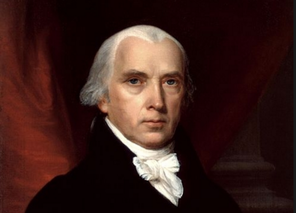
  The VA Plan featured a bicameral legislature, with both houses based on representation (or wealth). Those in the House of Representatives would be elected directly by eligible voters, and then the House would elect the members of the Senate (from nominations from state legislatures). To Madison (pictured from a drawing completed during the Constitutional Convention), the most important aspect of his VA Plan was the "Absolute Negative", where the Senate could negate any nefarious actions of what he considered "rogue" state legislatures. But Madison was not only frustrated by Sherman, but also by his fellow VA delegates George Mason and Edmund Randolph, in that they succeeded in noticeably reducing Madison's "Absolute Negative". 
     The VA Plan also had members of the Executive and Judicial branches chosen by Congress; the Chief Executive would serve a single term. Madison also insisted that Ratification of the future Constitution be conducted by specially-called state conventions, rather than state legislatures. One of Madison's main goals of the convention was to limit the influence of state legislatures on national policy.
Picture
       Under the Virginia Plan, states could only submit nominations to the House for Senators; Madison counted on a coalition of Southern states and large Northern states for passage . . . then delegates from Delaware, Connecticut, and New Jersey started to whittle away at the VA Plan. Delaware threatened to leave the convention; only the cajoling of fellow small-state delegations kept them in Philadelphia. Sherman introduced a plan in which the state legislatures would select members of the Senate (that proposal would eventually become part of the Constitution, which was eventually canceled by the 17th Amendment, which provided for the direct election of Senators). 
     The VA Plan's major weakness was that it only addressed the "shenanigans" of the state legislatures to the proposed national government; there was no reciprocal protection for the states against the national government. Also, under the VA Plan, Delaware would have a 1/90th share of representation, while Virginia and Pennsylvania combined would have 1/3.
​     Madison's main problem at this point in the convention was his lack of sympathy for the small states. He viewed states such as Rhode Island as holding the interests of the nation, and especially those of Virginia, hostage in the A of C. But what was really eroding Madison's influence in the convention was his insistence on his "Absolute Negative" (which would make the Senate the ultimate authority under the Constitution, able to discipline state legislatures); despite, or perhaps in spite of, his constant insistence, the "Absolute Negative" proposal was defeated 7 to 3. 
Picture
     On 19 June 1787, the New Jersey Plan (which basically wanted the A of C to continue) was voted down, but the significant end result of the vote was that Madison's VA Plan coalition was destroyed. On 29 June 1787, Oliver Ellsworth (CT, pictured) proposed that the House of Representatives be based on population, but that the Senate would be based on equal representation. Also, in what would become the Connecticut (or Great) Compromise, 3/5's of the African slave population in the South would be counted for representation in the House (that was not a new idea; it was originally proposed in 1783). 
     What was new was a proposal that the Southern states pay taxes on 3/5's of their African slave population for representation, which was mostly posturing since no one at the convention really anticipated any meaningful revenue from the new tax. On 16 July 1787, the Connecticut Compromise was adopted; the VA Plan coalition met, but it was clear that all their momentum was lost. 
     After all his preparation for the convention, Madison had seen most of his ideas rejected in only six weeks. To Madison, the worst development was that Senators would be the pawns of the state legislatures. Some delegates left the Constitutional Convention after the Connecticut Compromise, but not Madison, who regrouped and refocused his efforts. For the remainder of the convention, Madison did his best to reduce the power of the Senate. Madison looked to the House, and the Executive & Judicial branches to diffuse the power of the proposed Senate.
Picture
      Discussion then drifted toward electing the President, and again, Electors were brought up in the debate. General agreement existed among Southern delegates that a direct election would favor Northern states. In September 1787, it was decided that the President would serve a four-year term, and would be eligible for re-elections. Also, it was decided that Electors in each state would be determined by the state legislature, and that each would cast two votes. And, if there was no majority reached in the Electoral Vote, the Senate would decide the election among the top 5 that received votes.
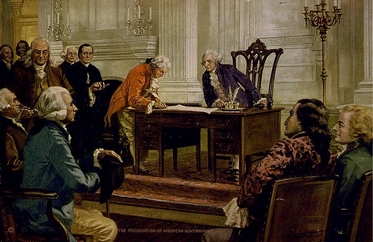
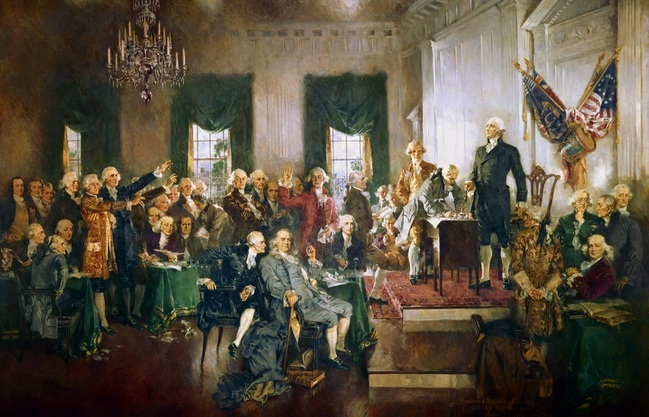
    To Madison, that meant that too much power rested in the Senate; ironically, it was Sherman's revision that suggested that the House of Representatives decide the Presidential Election if the Electors could not, with each state's Congressional delegation counting as one vote . . . Sherman's revision passed by a vote of 10 to 1 (pictured: a dramatization of the Signing of the Constitution).
     Madison now focused his attention and energies on vesting as much power as possible in the Executive, based on what had been decided in the convention. To Madison, the Presidential veto represented at least partial success for his defeated "Absolute Negative". However, Madison failed in his attempt to require a 3/4's majority in both houses of Congress to override a veto . . . he had to be satisfied with a 2/3's majority. But Madison was pleased that the President had more "latitude and discretion" than the other two branches.
Picture
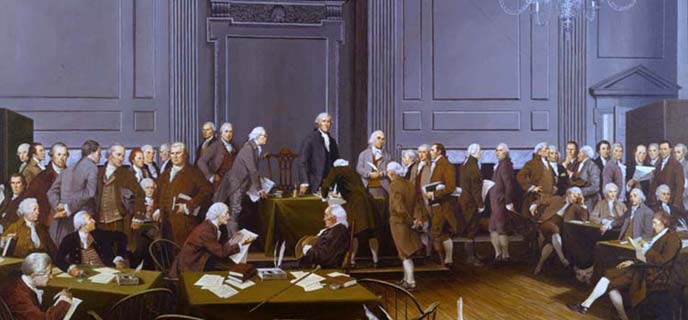
      Rufus King (MA) ignited the discussion of the Slave Trade; he was adamant that the convention end the practice. The Slave Trade Compromise was mostly crafted by a "Committee of Eleven", which included Madison. The committee's recommendation was that Congress should be prohibited from interfering with the Slave Trade until 1800 (but a duty on imported slaves was authorized; revenue was desired). The Lower South (NC, SC, & GA) held out until the year was extended to 1808 (keep in mind, African slavery was slowly ebbing away, due to the colossal expense, and no one at the convention could predict the impact of the Cotton Gin that was patented in 1793). Pictured: another depiction of the Signing of the Constitution
     George Mason and Edmund Randolph were so dispirited that they refused to sign the Constitution. Randolph wanted the state conventions empowered to add amendments, while Mason loudly called for a 2nd Constitutional Convention (Elbridge Gerry was the third delegate that was present on 17 September, 1787, that didn't sign). For those that did sign the Constitution, their experience was far more wearisome than glorious. Madison saw the President as the only vehicle in the Constitution that could be in line with Virginia's interests; Madison wanted to make sure that Virginia would remain the most preeminent state in the U.S.
Picture
     The President of the Constitutional Convention, George Washington, didn't speak out until the end, when he asked for permission to address the convention. His reason for doing so was to officially favor the proposal that each representative in the House be based on 40,000 people, rather than 30,000. It was his way to tell the delegates that he supported the Constitution, and he expected them to fall in line with his stance. 
     Madison succeeded in having the A of C send copies of the proposed Constitution to each state without a direct endorsement, or offering any proposed amendments. Madison also stood firm that state conventions should ratify the Constitution, not the state legislatures. Madison wrote Jefferson (who was still in Paris), expressing anger and frustration with the convention; he thought that the new government was far-too weak . . . soon, Jefferson, and even Madison, would view the new federal government under the Constitution to be too powerful at the expense of the states, especially towards their beloved Virginia.
0 Comments

Thomas Jefferson - "The Virginia Reformer" (Fall, 1776)

11/1/2015

5 Comments

 
Source: Andrew Burstein & Nancy Isenberg. Madison and Jefferson (2013)
Picture
      Thomas Jefferson felt like he was being held hostage in Philadelphia as a delegate to the 2nd Continental Congress in the spring and summer of 1776, in that he wanted to be in Virginia taking part in the creation of its constitution (he had no way of knowing the lasting impact of the Declaration of Independence at that point in time). On 3 September 1776, Jefferson was finally able to leave Philadelphia, and six days later he arrived at Monticello.
     Jefferson immediately assumed his seat in the newly-created House of Delegates under the Virginia Constitution (James Madison arrived in Williamsburg a week later). On 12 October, Jefferson introduced a motion to revise the laws of Virginia, focusing especially on criminal, religious, education, and property rights. 
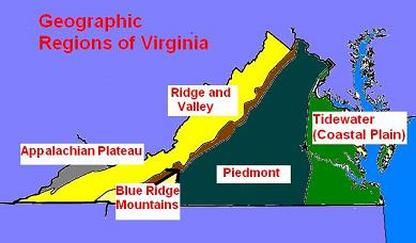
     Jefferson was trying to empower the "Rising Generation" in Virginia, which to him meant the non-Tidewater Virginians, who held most of the property and power (The Tidewater region of Virginia dominated the state, and Williamsburg was the state capital; eventually, Jefferson would relocate the state capital to Richmond, in his Piedmont region of Virginia).  On 26 October, Jefferson's bill passed, and was sent to a special committee, which included, among others, George Mason). Jefferson's big idea was to transform Virginia's laws, making the state an "Enlightened Republic". 

Picture
     Jefferson's conceit was that he wanted the other twelve (and future) states to pattern themselves after his vision of Virginia. TJ saw himself as a social engineer, and his laboratory was Virginia; his first priority in the Fall of 1776 was to disable laws that denied people their liberty, whether they were rich or poor.
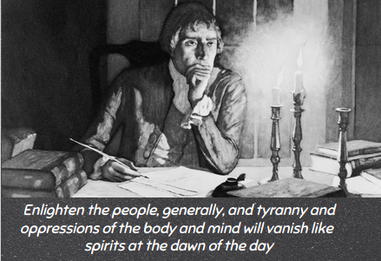
     In order to accomplish that goal, TJ wanted to spread (diffuse) knowledge among the white population in Virginia: all Virginians should be able to acquire land, civilize the wilderness, to experience and benefit from self-government. TJ wanted to create an Agrarian Society that would nurture Anglo-Saxon virtues for a Republic. TJ's definition of a republic meant that a majority of freeholders (whites) would have a real stake in society and a voice in government.

Picture
Reform #1: More Equitable Distribution of Lands
   TJ's first reform came under the heading of property law; he was trying to end the de facto system of feudalism in Virginia, which was labeled "Primogeniture" and "Entail". TJ believed that if so much land was in so few hands (especially the Tidewater Elite), African slavery would increase. Land reform was a very radical effort by TJ to socially and literally change the landscape of Virginia; to him land ownership was, at least in part, a "Zero Sum Game", in that if power was taken from the Tidewater region, more power should flow to his beloved Piedmont region of Virginia.
     By the Revolutionary War, most of Virginia's land was "entailed", which meant that lands were inherited generation after generation (10% of Virginia's population owned, through "entailing"  the land, the vast majority of the state). TJ wanted that land freed up for redistribution, which of course led to fierce resistance by the powerful Tidewater Elite.

Picture
Reform #2: The Gradual Abolition of African Slavery
     This reform would be no easier for Jefferson to achieve. TJ saw African slavery as a deterrent to good manners, morals, and laws. Weakening the slaveholding oligarchy "entailed" more than land redistribution; it would require radical social engineering taking into account that no one in Virginia advocated mass emancipation . . . there was zero support for freeing African slaves OR allowing them to acquire citizenship rights. 
     TJ's goal was to reduce the African slave population, which he hoped would lead to its future extinction. Ending the African Slave Trade to Virginia seemed to be the best way to start his attempted reform, and TJ wanted to grant freedom to African slaves after five years of labor. TJ also supported the voluntary manumission (formal emancipation) of African slaves; his goal in the end was to "Whiten" the population of Virginia. TJ believed that racial homogeneity was essential for a society to prosper and flourish.
    Jefferson had enough of the "Dead Hands" of Virginia's long deceased gentry influencing life in Virginia. He also saw that the practice of "Primogeniture" and "Entail" affected African slaves as well, in that their future was set in a negative, oppressive fashion. To TJ, Virginia in 1776 was a corrupt and disfigured state, with various factions at war with each other. TJ viewed African slavery as a social contagion, but abolition of slavery would be an unreliable solution. Rather, exiling Free Blacks from Virginia would establish a racial quarantine, making Virginia safe for future (white) generations. 
Picture
Reform #3: Universal Public Education + Reform of the Courts
     In Jefferson's view, education would suture the wounds created by the Tidewater aristocracy and African slavery. Education would transform the Virginia master class into an Enlightened Class with liberal, republican principles. TJ introduced Bill #79, which wanted primary schools for all free children, grammar schools for the more capable children, and college for the most gifted (those with genius and virtue). 
     
       TJ wanted the state to help subsidize the cost of his educational reforms, mostly the odds would increase that education wouldn't remain in the province of Virginia's Elite (this attitude would resurface in the 1790s and early 1800s with his battles with the Federalist Party . . . to TJ, the Federalists were unfit to rule since they were "corrupt"). Also, TJ wanted to weed out the poor lawyers in Virginia's county courts; he labeled them "insects" . . . in short, TJ wanted to create an Enlightened All-Male White Intellectual Guardian Class in his beloved state of Virginia.
Picture
Reform #4: Limit the Power of the Anglican Church (The Church of England)
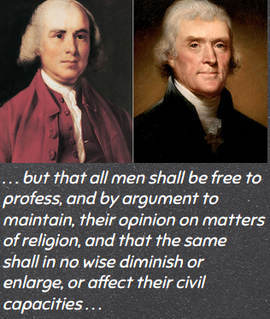
     In the Fall of 1776, Thomas Jefferson and James Madison were both on the Committee of Religion, which had a total of 17 members. They were only socially connected with each other at that point; they both knew an incredible array of prominent and powerful Virginians . . . it would take more interactions and time until they would discover that they were "Political Soul Mates". 
     TJ wanted to end what he termed "Spiritual Tyranny"; even with James Madison in support of creating an atmosphere of religious freedom (by reducing the power of the Anglican Church) in Virginia, powerful members of the Tidewater region blocked the bill in committee . . . the separation of Church and State 
would be delayed.

5 Comments

Ida Tarbell and John D. Rockefeller, Part Two

10/17/2015

0 Comments

 
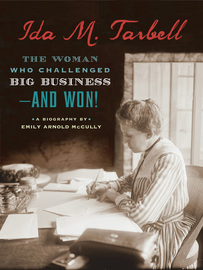
         Source: Emily Arnold McCully. Ida M. Tarbell: The Woman Who
                        Challenged Big Business - And Won! (2014)
Picture
      In November 1902, the first installment of "The History of the Standard Oil Company" (HSOC) appeared in McClure's Magazine, written by Ida Tarbell. Even though the HSOC series had started, Tarbell's research was very difficult and complicated in that Rockefeller insisted on anonymity and was mostly invisible in the relevant Standard Oil documents; Rockefeller ruled his empire with winks, nods, hints, and handshakes . . . all designed to derail any investigation.
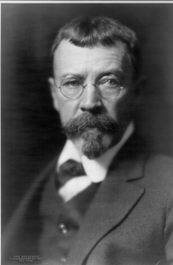
     Tarbell portrayed the independent oil producers as "Innocents" who risked everything in their ventures, and then a malevolent "Big Hand" (Rockefeller) came down and swatted them. Ida also wrote a separate article about the labor violence in the coal industry (Tarbell had little sympathy for labor union leaders), while Lincoln Steffens (pictured) wrote an article on the corruption in city governments for McClure's. All three articles were designed to show that the "American Contempt for the Law" negatively affected the public good.

Picture
        In effect, these three articles were the real birth of "Muckraking", which used the following formula: first, quality investigation exposes a major problem, then citizens read the article, then the citizens mobilize, and demand change. One of Tarbell's leading researchers discovered proof that Standard Oil had started manipulating prices in 1876; he found a memo from Henry Flagler (Rockefeller's major partner) which stated that an increase of a quarter-cent per barrel would net Standard Oil millions of dollars. Tarbell's goal in exposing the document was to show that Standard Oil's goal was to always artificially increase prices for the consumer, for the benefit of Rockefeller and Standard Oil.


    Tarbell contended that the independents welcomed competition (that basically wasn't true; Tarbell didn't have a great grasp on the mechanics and motivations within markets), and Rockefeller wanted to crush competition (that was absolutely true). Tarbell described a takeover by Standard Oil of an independent pipeline that used espionage, sabotage of a Buffalo refinery, and rigging an Ohio U.S. Senate election. 
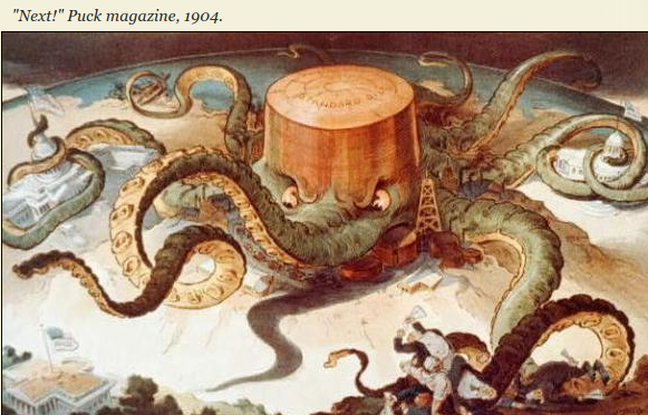
     Even though Tarbell extolled the virtues of the independents, in private she became disillusioned about her heroes; her wrath with them was as great as with Rockefeller. Ida thought that the independents always seemed to make the wrong decisions and flunk-out at every critical juncture, but she kept her official written focus on the Standard Oil Trust (SOT) and Rockefeller . . . she kept going after "The Octopus". 

Picture
      Rockefeller's extreme elusiveness was in part due to the fact that he had lost all of his hair; that elusiveness cost him in that it worsened his reputation with the American public. Henry Demarest Lloyd, the first journalist to expose Rockefeller's decisions and practices with Standard Oil, finally agreed to meet with Tarbell. Lloyd documented that the railroad rebates were still occurring and benefiting Standard Oil, and the records of the rebates were continually destroyed. Ida borrowed documents from Lloyd's files, and used what she discovered in her HSOC series. 
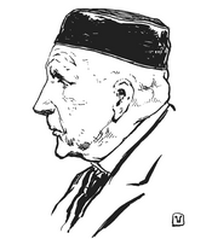
     By 1904, Ida and her researchers still hadn't found a recent photograph of Rockefeller, and to Tarbell, the HSOC wasn't complete without one. Ida and her main assistant decided to attend Rockefeller's Baptist church incognito, using other parishioners as "cover". Also, a sketch artist would be with them in the church as well, and his sketch from the "secret mission" is pictured above.

Picture
     Men like Rockefeller were accustomed to living and operating with no regard for public opinion. But privately, Rockefeller referred to Ida as "Miss Tarbarrel" during the run of the HSOC in McClure's Magazine (1902-1904). Rockefeller and his family fell ill with one ailment or another during the run of the HSOC; "Junior" suffered the most, suffering from a mental breakdown. After "The History of the Standard Oil Company" finished its run, Tarbell followed with a "Character Sketch" of Rockefeller, focusing on a key point in time: Rockefeller's decision to pursue the South Improvement Company (SIC) - to Tarbell, that was the point-in-time where Rockefeller chose evil instead of good (Ida used searing language in her "sketch").
     Tarbell stated that a man of Rockefeller's power and influence should not be able to "Live in the Dark"; he was the victim of "Money Passion", which blinded him to the good in life (according to Mark Hanna, Rockefeller was "Money Mad . . . sane in every other way . . . but "Money Mad"). Tarbell's only praises for Rockefeller were that he was a good husband and father, and lived far more economically than other tycoons (tycoon is based on a Japanese word that meant "Great Lord").
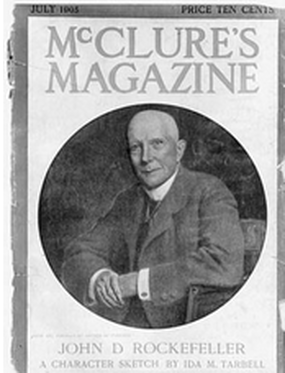
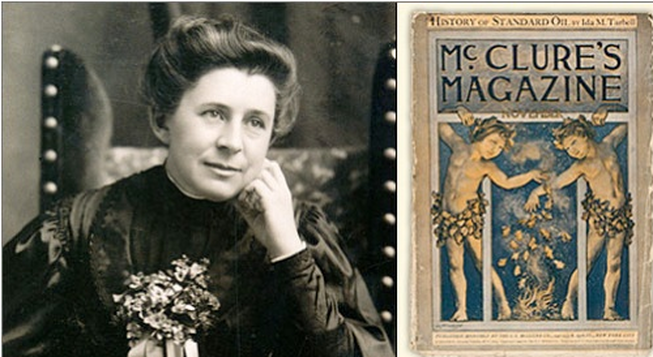
     In the second installment of her "Character Sketch" on Rockefeller, Ida found a formal photograph, and based the installment on her observations of Rockefeller's face, asking readers to do the same. To Ida, the photograph of Rockefeller (pictured on the cover of McClure's, above) combined with the "Church Sketch" showed concentration, cruelty, craftiness . . . a repulsive "Living Mummy", who was far too stealthy and secretive for the public good (Ida even proved that Rockefeller's father, a known scoundrel, had been indicted for horse theft and rape). After her "Character Sketch" on Rockefeller, Ida Tarbell became the most famous woman in America (in part that was also due to the decline in popularity of Jane Addams in the early-1900's).

Picture
     All the while, Rockefeller never personally disputed Tarbell's findings or assertions in public. He probably believed such public responses were "beneath him", but he also didn't want to open any door to other investigations. Rockefeller could have ruined McClure's Magazine (and 
S.S. McClure's publishing empire) by influencing and intimidating advertisers, but he was confident that his secret business methods would remain secret . . . he felt safe from further exposure.
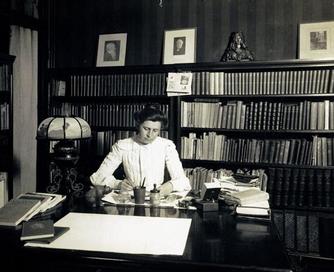
     Ida Tarbell (pictured at her desk at McClure's in 1905) condemned the practices of the Standard Oil Trust, but not the practice of Capitalism in general - Tarbell didn't have any problem with Combinations that used ethical means to earn profits. To Tarbell, Rockefeller's potential for greatness was ruined because he didn't played fair . . . in 1906, the Attorney General (Charles J. Bonaparte) agreed, in that he prosecuted Rockefeller and the Standard Oil Trust for unfair business practices under the Sherman Anti-Trust Act (1890). 

0 Comments

Ida Tarbell and John D. Rockefeller, Part One

10/17/2015

1 Comment

 
      Source: Emily Arnold McCully. Ida M. Tarbell - The Woman That 
                       Challenged Big Business, And Won! (2014)
Picture
      Ida Tarbell and her employer, S.S. McClure (McClure's Magazine) shared a longing for the bygone era of an "Uncorrupted America". Both wanted to do their part to restore that ideal, and in the process, assist working-class Americans as well as incoming immigrants. Exposing the ills of America would mean a huge investment in terms of money, time, and energy, and McClure's would be open to potential lawsuits as well. Therefore, Tarbell and McClure knew that the any articles that attacked big business would need to be exceptionally well-written and credible. Tarbell, McClure, and the staff at McClure's believed that reform-minded articles should be targeted to more than just the middle class and the "Upper-10's" (upper-10% of the population in terms of wealth). 


     After weeks of discussion and debate, the McClure's staff became convinced that Trusts (not a big business, but a board that supervised the operation of the big business) would be their focus for exposure and potential reform . . . but which Trust? Steel was considered, in that J.P. Morgan was in the process of creating the behemoth U.S. Steel, which would be the first "Billion Dollar Trust" . . . . but everything associated with that possible story line seemed too complicated. Tarbell told her colleagues about growing up in Northwest Pennsylvania around the emerging and expanding oil industry; given her skill-set and experience, it was a no-brainer that Ida Tarbell would write about John D. Rockefeller and Standard Oil (she reluctantly agreed to pursue the project). Tarbell wondered if readers would really enjoy a feature about interlocking corporations and their balance sheets; she didn't sense any potential for danger, just a desire to discover truth.

Picture
      John D. Rockefeller had, in essence, created the first modern corporation by establishing the Standard Oil Trust (SOT) in 1882. Even before 1882, the Standard Oil Company controlled the production and distribution of oil, as well as determining its use by the consumer. The SOT was created in that Combinations (big consolidated businesses) couldn't do business across state lines; Rockefeller wanted to consolidate even more power and influence in the oil industry.
     Rockefeller purchased tank cars, pipelines, banks, real estate, and even bribed politicians. He invested in newspapers so he could be portrayed in the most positive light; he never responded to criticisms and investigations of his methods or his Trust. New oil reserves were discovered in Ohio in 1885, and Rockefeller believed that this huge reservoir was a "Gift from God" given directly to him (even though the oil in Ohio had a strong sulfur content, but Rockefeller made it work as marketable fuel nonetheless). Ohio became the main source of petroleum for the SOT; not only had the SOT dominated refining, but by the mid-1890s the SOT became the dominant producer of oil in the industry.

Picture
      Rockefeller continued to crush the independent oil producers by underselling them, and by using unsavory methods, such as industrial espionage. By the mid-1890s, the SOT was a financial colossus, no longer subject to the market fluctuations in the oil industry. As late as 1900, most Americans still burned kerosene in their homes instead of electricity, and the SOT produced 86% of that kerosene - it seemed that no independent producer could survive (one survivor was the Pure Oil Company, and its treasurer was Will Tarbell, Ida's brother). 
     Ida's father told her not to publish the first three parts of "The History of the Standard Oil Company", in that he feared that Rockefeller's retribution would be fierce (e.g. buying McClure's Magazine). Tarbell's search for documents was difficult, in that the SOT and the railroads (esp. NY Central, Erie, and PA) destroyed as many documents as possible relating to the South Improvement Company (SIC). But she persevered, and found that while most documents were destroyed, some remained in scattered locations. Tarbell proved that the SIC was Rockefeller's tool, using not only rebates, but "drawbacks" (a percentage of the freight rates that the independents paid the railroads went directly to the SIC). Rockefeller promised that he would ship all his refined oil with the NY Central, Erie, and Pennsylvania railroads in exchange for the rebates/drawbacks; it wasn't illegal, but it certainly wasn't ethical . . . and to Tarbell, it was grossly unfair, and more-than-worth investigating further.

Picture
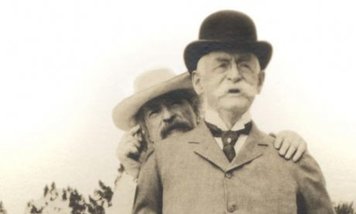
      Then, through a connection with Mark Twain (Ida had known him for quite a few years), Tarbell was able to meet with the Vice President of the Standard Oil Trust, Henry Rogers
(pictured below: Mark Twain with Henry Rogers, in front). Rogers admitted that the SIC was a mistake, and he even offered to arrange a meeting with Rockefeller. Ida visited Rogers at the SOT headquarters (26 Broadway in NYC) often for the next two years; she spent so much time there that some independents refused to talk with her, fearing that she was in league w/ Rockefeller. (Interesting fact: Tarbell earned $4000 per article, $107k today; by comparison, Rogers' secretary earned $10,000 per year at the SOT - $269,000 today). While Rogers cooperated most of the time, Tarbell still suspected that chicanery was afoot; she couldn't yet prove the espionage and criminal acts that she knew occurred due to the actions of the SOT. 

     The "breakthrough evidence" came from an unexpected source: a Standard Oil office boy. His job was to burn selected documents every night, and while doing so, saw the name of his Sunday School teacher on some documents. His Sunday School teacher was a refiner, and the documents showed that the railroads were warning the SOT well in advance of the oil shipments from the independent producers. As a result, the SOT could ship its product first, undercutting the competition.
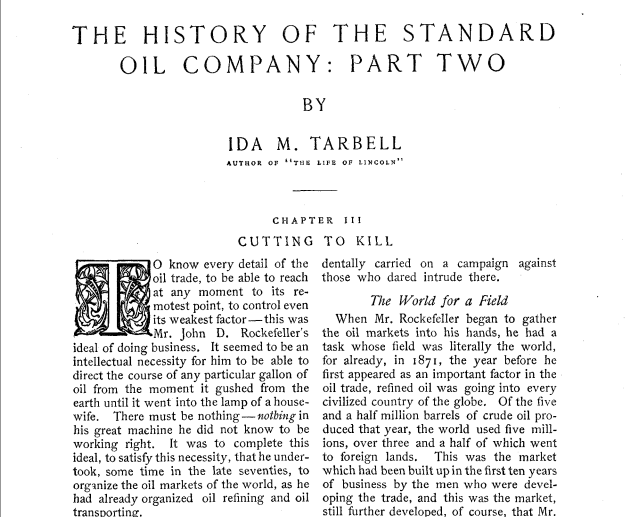
     The office boy took the documents to his Sunday School teacher, who had already read Tarbell's first three installments of "The History of the Standard Oil Company", and believed in Ida's integrity to the point where he gave her the documents. Those documents proved that the SOT was still engaged in unethical, and even illegal shenanigans, and in February 1904, McClure's published "Cutting to Kill" . . . Henry Rogers refused to meet with Ida Tarbell again.
Picture
1 Comment

Thomas Jefferson: Idealistic or Practical President?

10/11/2015

0 Comments

 
         Source: Jon Meacham. Thomas Jefferson: The Art of Power (2012)
Picture
     As President, Thomas Jefferson articulated ideals (theories), but largely acted pragmatically (practically) . . . especially helpful was his Secretary of State, James Madison. Jefferson used   Hamiltonian methods to achieve his goals; the 3rd President embraced power very subtly. In terms of military strategy, Jefferson preferred to focus on defense (e.g. reducing the Navy), except when it came to the Barbary Pirates. A shakeup in Congress helped Jefferson immensely as President. From 1801 - 1803, there were 17 Republicans and 15 Federalists in the Senate; in 1807 - 1809, there were 28 Republicans and 6 Federalists. Jefferson told his Cabinet that he needed to see all the information they had from their departments; Jefferson wanted and needed to know everything . . . he believed in "The Art of Power".

Picture
     Jefferson's favorite "political weapon" was hosting dinner parties, in that he used them as a tool for gathering political information and gossip. Many a Congressman's or Senator's vote was swayed by Jefferson during a dinner party. Jefferson's relationship with lawmakers kept information flowing between the Executive and Legislative branches. Jefferson was more a political chess player than a political warrior, hence the constant charges of "scheming" by his political opponents.
    Jefferson believed that sociability was essential to Republicanism, in that citizens would become more virtuous and act for the public good on a regular basis. However, Jefferson never invited Republicans AND Federalists to his dinner parties . . . he absolutely abhorred conflict in his presence. So, Jefferson used his dinner parties to create more personal and political attachment to himself; very often, he let his guests sit where they chose, except for his usual seat, of course. Jefferson encouraged free-flowing conversation (with plenty of wine) instead of guests "toasting" each other non-stop, which he saw as false bonhomie. Jefferson had the gift of making everyone at his dinner parties feel comfortable and respected, which led to the kind of conversations that Jefferson could at least potentially use politically. 

Picture
     President Jefferson authorized the rules of engagement with the Barbary Pirates; he controlled events while appearing to defer to Congress. That style was typical of Jefferson, in that he could achieve his goal without causing confrontation or a crisis with Congress. By the time Jefferson had to directly deal with the Barbary Pirates early in his first term, he had become a broad interpreter of the Constitution, which was a very Hamiltonian thing to do.
     On 31 October 1803, the U.S.S. Philadelphia was captured by Barbary Pirates based out of Tripoli. In February 1804, Stephen Decatur and a detachment of Marines torched the U.S.S. Philadelphia, which had been overrun and taken, denying the Barbary Pirates use of the frigate against the United States. After a successful "Black Ops" mission that was led by William Eaton (and authorized by Jefferson), a detachment of Marines, and a bevy of North Africans opposed to Tripoli, Jefferson announced to Congress that the enemy in the Mediterranean had, in essence, learned their lesson, and the U.S. would no longer have to pay "Tribute" . . . shortly thereafter, hostilities once again resumed.

Picture
     In the Spring of 1801, Spain ceded half of their North American empire to Napoleon in the third Treaty of San Ildefonso. France now had the Louisiana Territory, and a new U.S. political course was required. In a way, Jefferson was the perfect President at the perfect time for the   Louisiana Purchase; a less-courageous politician would have bungled, a too-idealistic politician would have been inflexible. 
     The Louisiana Purchase needed to be ratified by 30 October 1803; Jefferson called on Congress to meet on 17 October for "great and weighty matters". Jefferson's initial view on the purchase was that it required an amendment to the Constitution; his original intent was to formally ask both houses of Congress to propose the necessary amendment (Jefferson's initial thought was that purchasing the Louisiana Territory may have been in excess of his powers under the Constitution). In mid-August 1803, Jefferson received information that France was not as interested in the deal . . . that information changed the landscape dramatically, in that there was no time for an amendment, hence the "weighty matters" communication to Congress.

Picture
      The idealistic Jefferson wanted an amendment to justify the Louisiana Purchase, but the practical Jefferson wanted the land. In his mind, Jefferson saw a link in territorial expansion with increased Republicanism (virtue) and wealth. A Federalist U.S. Senator from Massachusetts, John Quincy Adams (who had known Jefferson since his childhood), suggested that Jefferson use the Executive's power of negotiation in Article 2 of the Constitution in order to justify the purchase. With the ratification in the Senate of the Louisiana Territory (24-7), the political tables had turned, in that the Federalists believed that Jefferson would become a "President-for-Life", in other words, a Monarch.
     After Vice-President Aaron Burr killed former Secretary of the Treasury Alexander Hamilton in a duel
on 11 July 1804, Jefferson kept silent, which was politically wise. Jefferson thought that Hamilton had possessed dangerous tendencies, yet he used Hamilton's institutions and methods to be the first President to drastically increase the power of the Executive branch. On 6 August 1804, Jefferson was informed that his Vice-President was interested in effecting a separation from the nation in Western states/territories. In the months that followed, Jefferson was re-elected in 1804 with an Electoral vote count of 162 to 14 for the Federalist candidate Thomas Cotesworth Pinckney.

Picture
     Jefferson knew that the now former Vice-President, Aaron Burr, was no longer a political threat, but he was convinced that Burr was a threat to potential disunion. Therefore, Jefferson was willing to go to extraordinary methods in order to deal with Burr and his activities in the West. On 22 January 1807, Jefferson publicly announced that Burr was guilty of treason "beyond reason"; it was the same approach that he used in 1778 as Governor of Virginia against Josiah Philips. 
     On March 1807, Burr was arrested for treason; Jefferson was deeply involved with the prosecution, but from a distance. During the trial, Jefferson was subpoenaed to testify against Burr . . . Jefferson refused to submit himself and the office of the President to the control of others. Jefferson did agree to submit "relevant documents", which were mostly copies of documents that the presiding judge, Chief Justice John Marshall, refused to allow into evidence. Burr's acquittal enraged Jefferson; to him, it was yet another in a line of incorrect decisions made by Federalists in the Supreme Court. Added to Marbury v Madison, and the     failed removal of Associate Justice Samuel Chase, Jefferson's distrust of the newly self-empowered Judicial branch increased.

Picture
     On 22 June 1807, the H.M.S. Leopard attacked the U.S.S. Chesapeake off the coast of Virginia. The Leopard fired 22 times before the Chesapeake could respond; 3 Americans were killed, and 17 more were wounded. Not long afterwards, another U.S. ship was fired upon; aboard that ship was Vice-President George Clinton (former Governor of New York). Jefferson had guessed that Congress would choose an embargo over war in response to the British attacks.
     Jefferson was willing to use force, but he knew in this situation he couldn't act unilaterally. Jefferson was also practical, in that the U.S. Navy was nowhere-near the strength of the Royal Navy. "War Fever" had subsided overall in America, and the only realistic alternative seemed to be the embargo . . . Jefferson reluctantly agreed that an embargo was the "least-bad" alternative.

Picture
     Jefferson's big gamble with the embargo was that he thought that time was on his side. By keeping ships in their ports, he thought that might lead to a faster conclusion of the war between Britain and France, and then "Freedom of the Seas" would return. On 22 December 1807, Jefferson signed the embargo into law: it was now the Embargo Act of 1807. The scope of the act surpassed even that of the Federalist Alien & Sedition Acts in 1798. Jefferson was given broad executive authority to enforce the embargo; U.S. exports decreased by at least 75% (some historians argue that the percentage was even greater). 
     In the early stages, Great Britain felt some of the effects of the embargo, and actively encouraged U.S. ships to try and sail to Europe despite the rigid enforcement. What Jefferson didn't know was that embargoes are impractical over the long-term, and Great Britain, while inconvenienced, was able to procure most of what they imported from the U.S. elsewhere. 
     The Embargo of 1807 turned U.S. politics on its head; now even loyal long-time Republicans believed that Jefferson had become a de facto Monarch, since he was now negatively affecting the lives of regular citizens (the embargo led to a severe economic downturn). Federalists (who were concentrated in New England) focused more-and-more on state's rights, and discussions to explore the possibility of secession intensified. Yet, as time would determine, any other decision but the embargo would have been madness or cowardice.

Picture
     In 1808, Jefferson was well-aware of his unpopularity with most Americans due to the Embargo of 1807, and as he had done before in the face of such political hostility and conflict (as Virginia's Governor during the Revolutionary War and as Secretary of State), he returned to his beloved Monticello. In effect, Jefferson was an "Absentee President" to close out his second term, and Secretary of State James Madison ran the Executive branch for the duration of Jefferson's second term, which was great training since he won the Election of 1808, and would serve two terms of his own as President.

0 Comments

John D. Rockefeller and the Great Railroad Strike of 1877

10/3/2015

0 Comments

 
        Source: Ron Chernow. Titan: The Life of John D. Rockefeller, Sr. (1998)
Picture
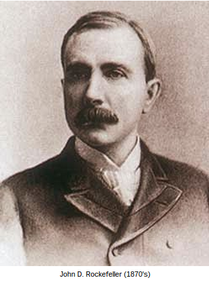
      In 1875, more oil fields were discovered near Oil Creek (NW Pennsylvania), and the market soon experienced another glut, from $4 a barrel in 1876 to .70 a barrel in 1878. Those that tried to deal directly with John D. Rockefeller (President of Standard Oil, pictured in 1872) during this crisis were frustrated, in that he only worked through trusted agents (one rival described trying to deal with Rockefeller as "boxing with a ghost"). 
     A large controversy erupted during this glut in the oil market in 1878. The major causes were, first, that Standard Oil (SO) wanted to retain its monopoly on it share of pipelines (SO controlled nearly half of the pipeline network). In order to continue to do so, SO connected new oil wells to their pipelines free-of-charge. Standard Oil constructed as much as 5 miles of new pipeline a day, PLUS built huge tank farms for surplus oil, which increased the storage capacity from 1 million to 4.5 million barrels. However, the oil producers had no discipline (or memory of past gluts), and produced far more oil than the system's capacity could hold. These very same "Over-Drillers", when their oil spewed on the ground since there was no place to transport or store it, blamed Rockefeller for their travails.

Picture
     While Rockefeller didn't create the crisis, he saw something in the hullabaloo in which to take advantage. Rockefeller stated that he would only accept oil for immediate shipment to refineries (his refineries, of course). Standard Oil quoted a price for crude oil that was 20% below the market price, then stalled on payments to the desperate oil producers. This was a terribly high-handed and insensitive way to respond to the problems of the producers, even though the producers were the main reason for the crisis. 
                            
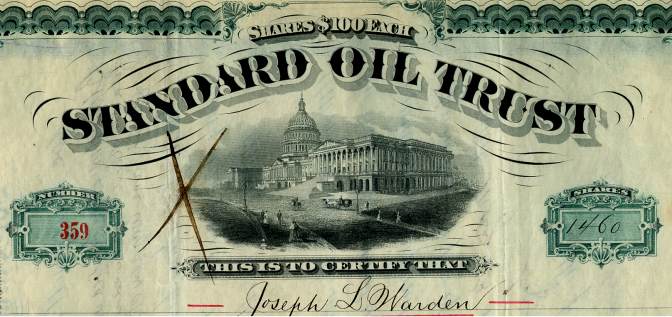
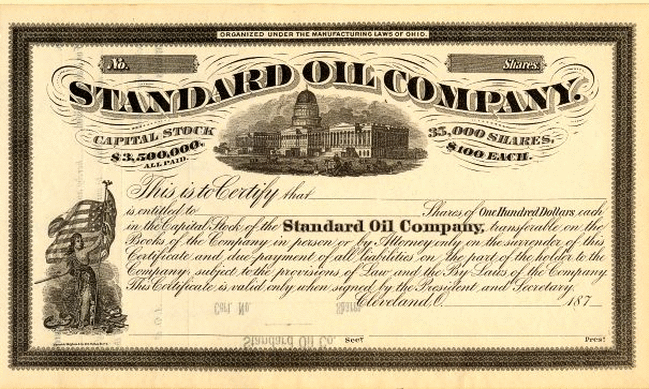
​                       (Pictured: A Standard Oil Company Stock Certificate)

     The oil producers responded with a tsunami of rage; to them, the pipelines were behaving in the same conspiratorial manner as the railroads. To most Americans in the 1870s, the railroads were to be equally available for all to use, and the oil producers felt the same about the pipelines . . . interestingly, it's the same argument that Natives used in dealing with whites - no one truly owned the land, it should be available to all. Rockefeller saw the entire situation much differently, in that he was taming a wild and unpredictable industry. Soon, intimidating Ku Klux Klan-like protests by union hotheads occurred at night, threatening Standard Oil with all sorts of nasty and violent retribution.

Picture
     In October 1878, the Pennsylvania state government officially exonerated Standard Oil of any wrongdoing in the crisis. To most involved, that decision proved that shenanigans were afoot (e.g. the investigator was bribed, etc.). Rockefeller saw the oil producers as malcontents and ingrates; he couldn't fathom how the producers failed to make the simple connection that their oil was worthless without his pipelines. To Rockefeller, these oil producers were behaving like five-year-old children that didn't understand how markets worked (e.g. "How dare you not take all that we produce"; and "Why don't you just pay us in 1876 prices?"); he was convinced that the oil producers were unreasonably hostile.


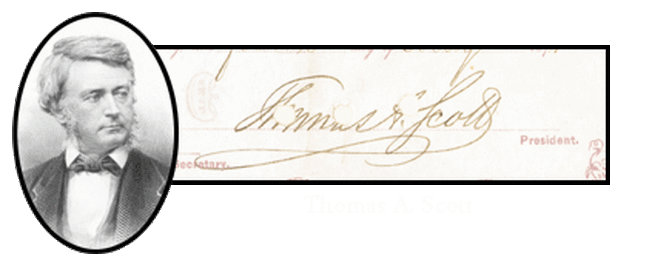
     Rockefeller had the forward vision to position himself to profit from either surplus or scarcity in the oil market; but despite that foresight, he wasn't invulnerable. Tom Scott, the President of the Pennsylvania Railroad, entered the fray against Rockefeller again, this time using his refining and pipeline subsidiaries. Scott tried to win-over new refiners with bargain transportation rates, and he actually authorized construction of new pipelines from the new oil fields to seaboard refineries, which was a direct challenge to Standard Oil. Scott was trying to chop down Rockefeller despite the fact that 2/3's of all the oil the Pennsylvania Railroad carried was from Standard Oil. 

Picture
      Rockefeller interpreted Scott's actions as a declaration of war, and he decided to take on the most powerful corporation in America in the 1870s. Rockefeller threatened to ship his oil with other railroads (NY Central and Erie), but Scott didn't flinch, so he went on the attack. Rockefeller starved the Pennsylvania Railroad by idling the refineries he controlled in Pittsburgh while increasing production in those he controlled in Cleveland. Also, Standard Oil would undersell Scott's refineries in every market in which they competed.
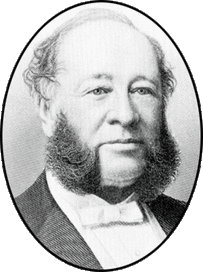
     Rockefeller had the New York Central and Erie Railroads trim their transportation rates to pressure the Pennsylvania Railroad to lower their freight charges. Also, Standard Oil purchased 600 oil tank cars from William Vanderbilt (pictured); Rockefeller had covered all his bases during his frontal assault against Tom Scott. Rockefeller had quickly humbled the world's largest freight carrier, which everyone assumed was invincible, including Tom Scott. In order to compete with Standard Oil, the Pennsylvania Railroad actually paid oil producers to let them ship their product. 

Picture
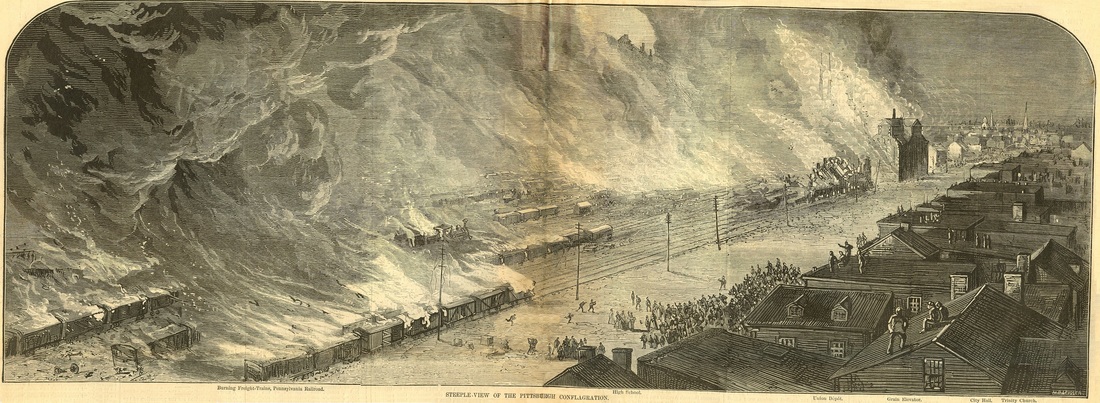
     Tom Scott responded by slashing rates and firing hundreds of workers, while reducing wages by 20%. He doubled the length of trains without expanding crews, which led to workers in the Pennsylvania Railroad walking off the job in protest. The Baltimore & Ohio Railroad cut their wages as well, which created the critical mass that precipitated the Great Railroad Strike of 1877, which featured an incredible amount of violence. In Pittsburgh alone, 500 tank cars, 120 locomotives, and 27 buildings were destroyed by union vandals. It became so costly that Tom Scott needed emergency loans from Wall Street financiers . . . and the cost & violence worsened.
                 (Pictured: the main Pennsylvania Railroad yard in Pittsburgh in flames)
     President Rutherford B. Hayes 
sent federal troops to support state militias; American citizens watched in horror as the conflict intensified. After burning 2000+ freight cars, the strikers finally capitulated, but they had introduced America to a new era of labor strife. 
Rockefeller had come VERY close to Standard Oil's property in the affected areas being taken or destroyed . . . in that respect, he was powerless, and very fortunate. Reeling, the Pennsylvania Railroad skipped paying out their scheduled dividend to investors, which sent the price of its stock plummeting. Finally, Tom Scott communicated (via intermediaries) that he was ready to negotiate a settlement with Rockefeller to end the nightmarish scenario.

Picture
     The spoils of victory for Rockefeller were immense. Tom Scott was so desperate for cash that he offered to stop refining oil AND he offered the refining assets of the Pennsylvania Railroad at fire-sale prices (refineries, storage tanks, pipelines, steamships, tugboats, barges, loading docks) . . . even so, it was more than Standard Oil could pay. Scott refused to budge on two points, however: Standard Oil had to buy ALL the assets in which he offered, and he wanted $2.5 million of the $3.4 million purchase price to be paid by certified check in 24 hours. 
     That last demand taxed even Standard Oil's financial reserves, in that Rockefeller only had half of the $2.5m on hand. As a result, Rockefeller toured Cleveland's banks, telling each banker that he needed all the money they had, immediately. Yet, through all this, Rockefeller actually STRENGTHENED his alliance with Scott; his goal was always, if possible, to be conciliatory and to expand his influence.
     Standard Oil agreed to ship at least 2 million barrels of oil per year via the Pennsylvania Railroad, while SO received an additional 10% rebate. Standard Oil (once again) became the "Oil Umpire" for the railroads, deciding on the percentage of oil shipments for each (PA 47%; NY Central and Erie, 21% each; Baltimore & Ohio 11%). And, to top it off, Standard Oil demanded that the Pennsylvania Railroad pay Standard Oil .20 per shipped barrel, like the NY Central and Erie Railroads. In the end, Rockefeller insured that the railroads could never again challenge his power and influence in the oil industry . . . Rockefeller's next big move to consolidate even more power and profit in the oil industry would come in 1882, with the creation of the Standard Oil Trust.

0 Comments

John D. Rockefeller and the "Cleveland Massacre"

10/1/2015

0 Comments

 
  Source: Ron Chernow. Titan: The Life of John D. Rockefeller, Sr. (1998)
Picture
     Why were there severe economic depressions in the decades after the Civil War? First, inflationary booms swamped the nation with goods. Next, big gluts (surpluses) developed from overproduction, and it became impossible for businesses to recoup their investment. The expanded supply led to lower prices, and a cruel deflationary bust, which led to unemployment . . . and a brutal economic depression. In the decades after the Civil War, economic advances were always followed by severe economic downturns, as seen in the depressions that started with the Panics of 1873, 1893, and 1907, and of course the Great Depression.
     As a result, the incentive for many powerful men in business and industry was to try and crush competition by forming monopolies (aka Combinations). Oil was the most volatile of the major industries; being in the petroleum business was a nerve-wracking and unpredictable venture. Low kerosene prices were a boon to consumers, but they were a bane, especially to refiners, in terms of profit margin. 

      By 1870, refiners had a problem, in that total refining capacity was three-times the amount of oil that was pumped from the wells. Refiners and oil drillers were like farmers when the price went down, in that they produced too much crude / refined oil, trying to make money by sheer volume. In 1869, Rockefeller was in a panic; his fear was that his already immense wealth (he was only 29 years old) might disappear due to the volatile market, despite his under-the-table deal with rebates (discounts on shipping oil by rail) with the NY Central & Erie railroads. 
           (Pictured: A small part of Oil Creek in Northwest Pennsylvania in the 1860s)
Picture
     Rockefeller studied the entire market, and figured that a "systematic" solution would rescue the industry . . . and protect and increase his wealth. He thought in terms of "Cooperation" (his word for monopoly); to him that meant strategic alliances and long-term planning. Basically, Rockefeller wanted to reduce the number of refineries to better match oil production. He envisioned a giant oil cartel that would reduce overcapacity and stabilize prices, and of course he would be the one to accomplish that feat, as well as being the primary beneficiary. Ironically, the independent oil companies at Oil Creek (NW Pennsylvania, where the first oil well was erected in 1857), tried to enact the same strategy in terms of limiting the amount of oil that was extracted from the reserves . . . but that coalition fell apart due to a lack of leadership.
Picture
      In order to accomplish his goal, Rockefeller needed oceans of money . . . but how to supplement the company's existing capital and also keep control? His partner, Henry Flagler (pictured), found the solution via incorporation, which allowed them to sell shares to select outside investors. There was a problem with incorporation, however, in that a corporation couldn't own property outside of its state of incorporation ("Trusts" were created by Big Business to bypass this inconvenient law).
     On 10 January 1870, Standard Oil was created, with Rockefeller as President, and Henry Flagler as Secretary and Treasurer (a third partner, Samuel Andrews, was Vice-President). The name of the company referred to their "standard" uniform quality of kerosene which had no impurities of note compared to the competition. Standard Oil already controlled 10% of America's refining capacity, and also had a barrel-making factory, warehouses, shipping facilities, and a fleet of railroad tank cars. Rockefeller's goal was to simply refine ALL of America's oil.
     Rockefeller and Flagler refused a
 salary; their profit was to be solely from the appreciation of Standard Oil's shares and dividends (Rockefeller made sure that he was the largest single shareholder, holding about twice the shares of stock to Flagler and Andrews). Rich investors did not bang on Standard Oil's door, in that it was a very unstable time for new ventures, and the oil industry was too unpredictable for most that were looking to invest. In order to prove the naysayers wrong, Rockefeller paid out 105% on the company's dividends, which was absolutely unheard of in those days in an uncertain economic landscape.

Picture
     Rockefeller's first targets for "Cooperation" were the 26 refineries in-and-around Cleveland, Ohio. His strategy was to become the "Oil Blob" by taking over these refineries, one-by-one. This move would be his first, and most controversial, during his multi-decade career in the petroleum business. To Rockefeller's supporters in 1872, Standard Oil was the birth of a benevolent giant; to his detractors, the company was a monster (soon to be portrayed as an octopus). His rivals saw a brutal power grab; to Rockefeller, he believed that what he was doing would lead to the salvation of the oil industry.
    To "save" the industry from itself, Rockefeller covertly acquired New York's premier oil purchasing company in 1871 (it also had a refinery). This acquisition gave Rockefeller a sophisticated purchasing agency at the perfect time. Publicly, the firm looked like it stood in opposition to Standard Oil, but in reality, it was Rockefeller's pawn. On 1 January 1872, Standard Oil expanded it capital from $1m to $3.5m in just a couple of days. Among the new shareholders were the luminaries of Cleveland banking, with prominent railroad men as well. Also, on 1 January, Standard Oil's Executive Committee decided to purchase "certain refining properties" in Cleveland and elsewhere. It was the start of what historians call the “Cleveland Massacre”.

Picture
        The excluded refiners were from New York and Oil Creek (NW PA). Standard Oil was the driving force behind the SIC; Rockefeller held 900 of the 2000 total shares, and 100+ shares were owned by "Rockefeller Men", which meant that Rockefeller had the controlling interest. As a result, Cleveland refineries were more powerful within the SIC, as well as in the overall marketplace. 
     One might ask - how did the railroads benefit from the from this agreement with Rockefeller and the SIC? Rockefeller helped the railroads arbitrate their vicious rate disputes; Standard Oil also guaranteed that the three railroads had specific percentages of the SIC oil shipments (PA 45%; NY Central and Erie 27.5% each) . . . Rockefeller had become the railroads "Oil Umpire". The railroads were able to run lines of cars at full capacity while making far-fewer stops, which significantly increased their profit margins. Also, the railroads were fully aware that Rockefeller had accumulated MANY oil tank cars; in short, the three railroads badly needed John D. Rockefeller.
     Both refiners and railroads were struggling with excess capacity and suicidal price wars. Rockefeller figured out that he could fix the refiners' problems and those of the railroads in one fell swoop. Rockefeller knew exactly what he wanted, and he had a knack of knowing what the OTHER party wanted as well. Rockefeller saw the whole picture, and figured out how to save the railroads from themselves, and create greater wealth and power for himself.

Picture
      The mayhem began when Rockefeller entered a secret compact with the head of the Pennsylvania Railroad, Tom Scott (pictured). Rockefeller wanted to drive a wedge between the Pittsburgh and Philadelphia refiners and Scott. The result of their agreement was the creation of the South Improvement Company (SIC); the Pennsylvania, New York Central, and Erie Railroads and the refiners that joined the SIC agreed to keep their deal secret. 
     The three railroads (that controlled the rails from NYC to Cleveland) raised the freight rates by 50% for all refiners that weren't part of the SIC (to Rockefeller and the railroads, "Fair Warning" had been given to all refiners). Those in the SIC would receive 50% rebates off crude/refined oil shipments. Also, those in the SIC would receive "Drawbacks", which were further rebates given SIC members for every barrel shipped by non-member refiners (Rockefeller felt totally justified in receiving drawbacks, in that Standard Oil was the de facto warehouse for the oil that was to be shipped . . . he believed he should receive payment for services rendered).
     The railroads also gave members of the SIC inside information on oil shipments from the independent (non-member) refiners, which meant that the SIC could under-sell the independents. The drawbacks (and the other features of the SIC) were an instrument of competitive cruelty, which was unparalleled in US History up to that point; to many Americans, it was the grandest scheme of collusion and knavery they had ever seen.

Picture
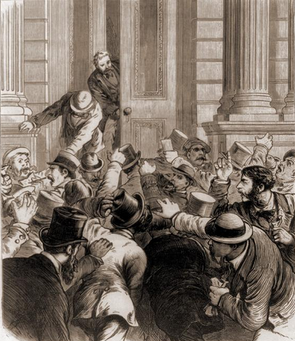
     Not long after the SIC was created, the secret was out among the independent refineries in Oil Creek. On 26 February 1872, Pennsylvania newspapers reported the rate hikes for those that weren't in the SIC; it was the death warrant of the independent refiners, and the protests were large, intense, and sometimes ugly. The Petroleum Producer's Union (PPU) was created, and the group of independents only sold crude oil to Oil Creek refiners (the embargo didn't last long, in that their pockets weren't as deep as Rockefeller's; he was awash in cash reserves). The Oil City Derrick listed the names of those in the SIC on its front page, and Rockefeller's name was clearly visible. It was the first time that most Americans heard of John D. Rockefeller, and it was a negative debut.
     Ida Tarbell was 14 years old during this scurrilous hoo-haw, and the controversy was a negative frozen moment in her life (her father was one of the independent refiners). Eventually, she would write The History of the Standard Oil Company, which appeared in installments in McClure's Magazine from 1902 - 1904 (to Ida, Rockefeller didn't "play fair"). 
     Rockefeller always believed that his enemies were axiomatically wrong, and he was right; not just right, but Righteous. To Rockefeller, the furor over the SIC confirmed his view that the oil industry needed to be brought under control . . . his control. Rockefeller's silence during the uproar confirmed, to the public, that he was not only arrogant, but guilty. Rockefeller told the few that were close to him (e.g. Henry Flagler), "You can abuse me, you can strike me, so long as you let me have my way".

Picture
       As always, the greater the tumult, the more calm Rockefeller became, and the more firm he held his ground. The PPU was, in the short-run at least, well-organized and well-run; the PPU had 16 districts that blocked all oil sales to the SIC (there were even night patrols in each district to make sure there wasn't any clandestine night-time drilling). The PPU embargo / boycott took a toll on Standard Oil, in that Rockefeller temporarily laid-off 90% of his workforce.
     The fatal mistake that Rockefeller and the SIC made was omitting refiners in the state of New York; almost immediately the NY refiners joined their Oil Creek brethren in opposition to the SIC. On 25 March 1872, the three railroads, under severe pressure from the PPU and the general public, agreed to cancel their contract with the South Improvement Company. The SIC didn't violate any laws of the day, but it did violate a collective sense of what was considered "Fair Play". 
     On 8 April 1872, Rockefeller surrendered to the obvious, instructing those in the SIC that all contracts with the three railroads were null and void. Rockefeller tried to explain (through intermediaries, since he refused direct contact w/ most anyone) that there was no conspiracy against the refiners . . . the conspiracy was against the consumers. Rockefeller claimed that he wanted a "United Front of Refiners" in order to keep the consumer from negatively affecting the oil market . . . few believed the President of Standard Oil. However, Rockefeller owned 20 of the 26 Cleveland refineries, and already had enough control of at least the regional market to continue to negotiate secret rebate deals with railroads on his own . . .

0 Comments

"The Rise of the Octopus": John D. Rockefeller

9/17/2015

0 Comments

 
Source: Emily Arnold McCully. Ida Tarbell: The Woman Who Challenged 
                                     Big Business, And Won (2014).
Picture
     In Cleveland, Ohio, 1855, John Davidson Rockefeller earned $25/month ($626 today) as a grocery store bookkeeper. Rockefeller was the son of a con man, and he had startlingly opposite traits from his father, such as personal discipline, determination, religious conviction, and sky-high ambition. To Rockefeller, acquiring wealth meant that he had to gain strict and total control of himself, and the market (which would eventually mean a monopoly . . . in something). 
     The only characteristic passed on from his father was a willingness to take gigantic risks. Rockefeller felt superior in his virtue, and came to despise men that thought they were better than him. Once he got the upper-hand, sudden vengeance would belong to Rockefeller.
     Rockefeller arrived in "Oil Country" in 1860. "Oil Country" (in terms of drilling for oil) was Northwest Pennsylvania, and the center of region was Titusville, a city of 10,000+. Rockefeller almost immediately saw that refining oil to make money involved little expense and high potential profits compared to drilling for oil. 

Picture
     Soon, there were fifty refineries crowded around Cleveland, Ohio, including a refinery owned by John D. Rockefeller, and his partner Henry Flagler. Consistent with his belief of strict control over a market (to increase efficiency, production, and, of course, profits), Rockefeller started to absorb his rival refiners (in this "horizontal monopoly", Rockefeller gave his rivals a choice: sell for some level of profit, or be forced out of business). 
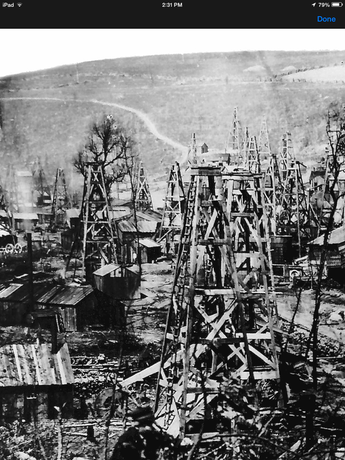
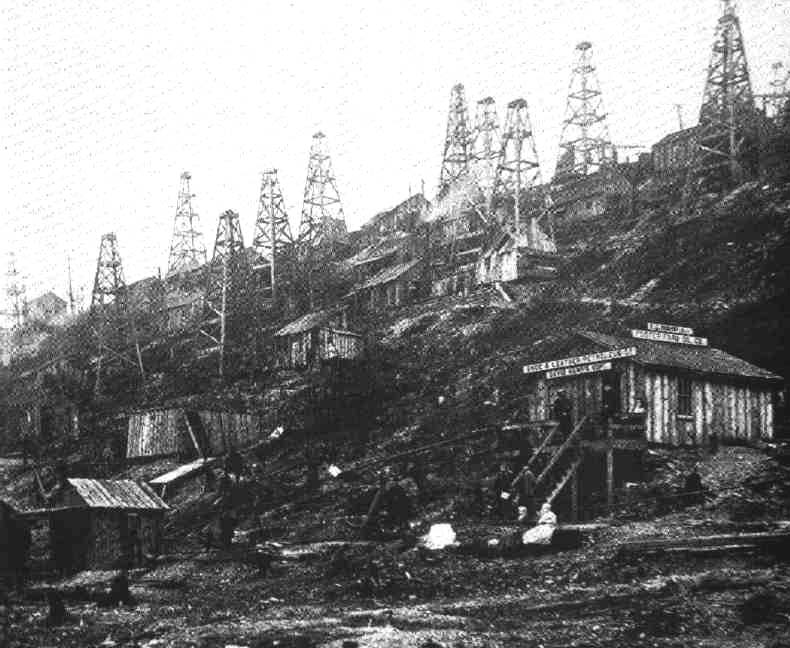
     The other key to controlling the refining market was transportation of the refined product (initially kerosene, a.k.a. coal oil), which meant dealing with the railroads. A transportation monopoly existed in the Oil Region, in that the Erie, Central, and Pennsylvania Railroads were in collusion with each other. In an effort to extract even more control over the oil industry, these three railroad behemoths created the South Improvement Company. (Pictured: oil derricks in close proximity in NW PA in the 1860s).
     Through this new company, this railroad Combination increased freight rates by 250%. However, the Combination let it be known that if an oil refiner joined the SIC, then that refiner would get a "rebate" (discount) on freight charges (they were pledged to secrecy, since it was against the law) . . . among the few refiners that joined the SIC was John D. Rockefeller (he also helped create the SIC). The 250% rate increase hit the refiners living in Titusville, Pennsylvania between the eyes, and these independent refiners made sure that the SIC was exposed to the daylight of public awareness. 

Picture
     The Oil City Derrick newspaper printed the names of the refiners that had joined the South Improvement Company, and Rockefeller's name was on the list. Franklin Tarbell (Ida Tarbell's father), a partner in one of the independent refining companies, became a changed man: he stopped whistling, no longer played his harmonica, and stopped making jokes. Franklin even joined vigilante groups that wrecked SIC railroad tank cars. More effective (for a short while) was the embargo against Rockefeller's Standard Oil, in which Franklin Tarbell enthusiastically participated. 
     Franklin personally turned down Rockefeller's offer to buy a full year's output from his refinery (which was a way to start the process of "absorbing" a rival refinery). Franklin simply dismissed Rockefeller's strategy/tactics as morally wrong; both Franklin Tarbell and John D. Rockefeller believed they were on the side of "right". Rockefeller believed that Standard Oil had rescued the oil industry, and had emerged as the "fittest" company ("Social-Darwinism" was in the nation's bloodstream by that time in history); the term that Rockefeller used to describe his intervention (and collusion with the railroads) was "Cooperation". Franklin Tarbell believed that the railroads were to serve the public (as did most Americans), not a select group, such as the Southern Improvement Company.


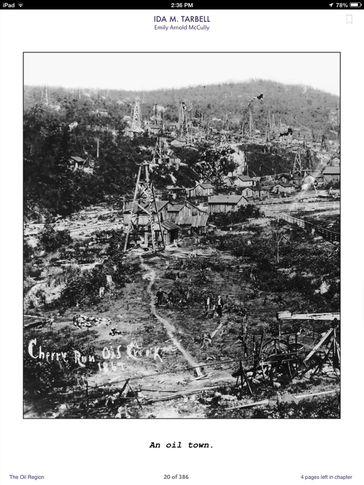
              (Pictured: an "Oil Town")

Picture
     To Ida Tarbell (Franklin's daughter), the dispute over the SIC hit home very hard, seeing how it had affected her father. In her mid-teens, Ida developed a hatred of the "Privileged Class", the unchecked wealthy and powerful that had negatively altered her life and that of her family. It became obvious to the independent refiners (and a young Ida Tarbell) that if the SIC controlled the transportation of oil, they were soon to be forced out of business. 
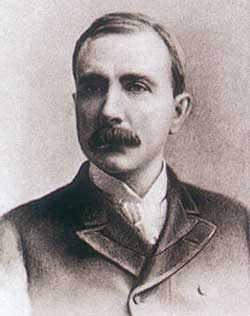
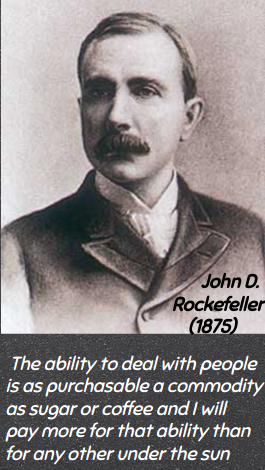
     On 25 March, 1872, the Railroad Combination (Erie, Central, PA) conceded defeat, and canceled the SIC contract. In their euphoria from (a perceived) victory, the independent refiners did their best to exclude and ostracize Rockefeller, since he was the alleged (and actual) leader of the SIC. Little did they know at the time that the fall of the SIC wasn't going to slow down Rockefeller in the least. He already controlled 22 of the 26 refineries in the Oil Region, which meant that Rockefeller (pictured above in 1875) was in a position to keep making secret deals with the railroads. To Ida Tarbell, her father represented the "Noble Underdog" who was overwhelmed by the "Evil Empire" . . . and Rockefeller was her Darth Vader. 
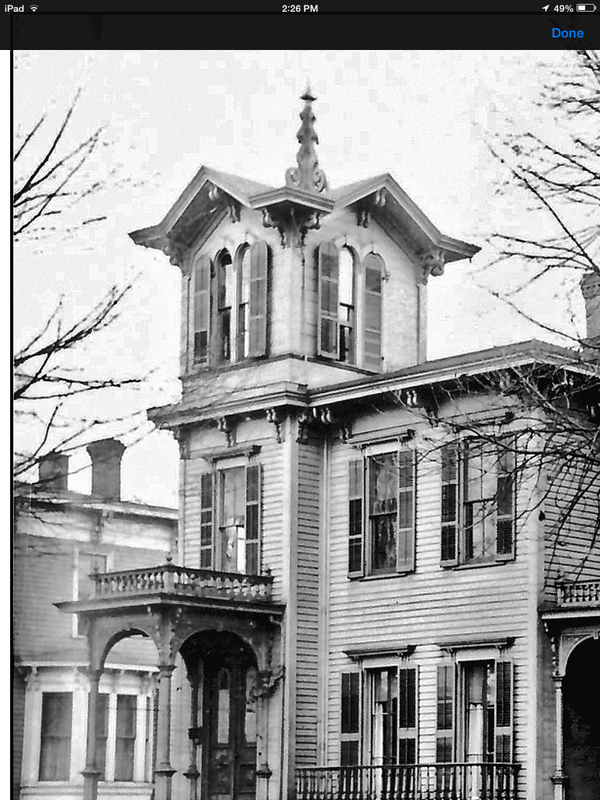
(When times were good for Franklin Tarbell, he moved his family to a better location. He purchased an abandoned hotel in a nearby oil ghost town for $600 ($10k today) and had it transported piece-by-piece to a plot of land he had just purchased . . . below, you see the new Tarbell home, which was completely reassembled in the early-1870s in Titusville, Pennsylvania)

Picture
Picture
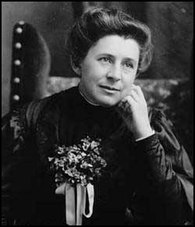
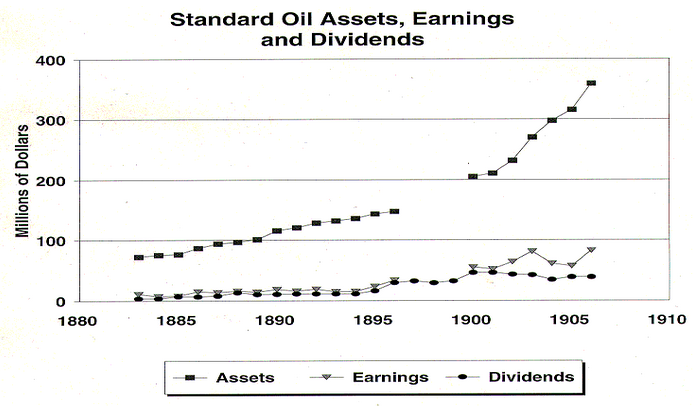
     For the rest of her life, Ida Tarbell viewed many Combinations as malevolent, and John D. Rockefeller was at the top of her "list". By 1868, Rockefeller owned the largest oil refinery in the world, and by 1877, Rockefeller controlled 90% of the nation's oil production. In 1882, Rockefeller established the Standard Oil Trust (his Oil Combination was made "legal"), which was designed to determine (fix) prices in the industry. Those that succumbed to Rockefeller were offered stock in the Standard Oil Trust, or the cash equivalent (the smart ones chose the stock option); Franklin Tarbell refused to join Rockefeller's Oil Combination, and he struggled financially for the rest of his life (he died in 1905). Ida Tarbell (pictured) would expose the shenanigans of Rockefeller in her 19 part series titled The History of the Standard Oil Company (1902 - 1904).
(Below: a visual representation of Rockefeller's wealth since 
 the inception of the Standard Oil Trust in 1882)

Picture
0 Comments

George Washington: The Whiskey Rebellion and the Jay Treaty

9/4/2015

0 Comments

 
                Source: Ron Chernow. Washington: A Life (2010)
Picture
     In June 1793, The Royal Navy started intercepting neutral ships heading towards France (the French Revolution had started, and once again Britain was at war with France). Also, Great Britain started the practice of Impressment; in the process of boarding US ships looking for those (suspected / supposed) AWOL from the Royal Navy, British ships also kidnapped US sailors. A political firestorm swept across the U.S. as a result of these British actions.
     Yet Congress resisted creating a national standing army, again relying on state militias for collective security. President George Washington needed to send an emissary to Britain to try reduce the escalating tensions between the two nations through negotiations. GW's first choice was his Secretary of the Treasury, Alexander Hamilton, but he lacked the necessary credibility in order to be sent (he had paid a tremendous political cost in working most of his economic plan through Congress). GW then selected John Jay, the nation's first Chief Justice, and his selection was greeted with much hostility and opposition . . . but Washington stuck by Jay.

Picture
    On 20 August 1794, the Battle at Fallen Timbers (near Toledo, Ohio) occurred; General "Mad Anthony" Wayne and 3500 troops soundly defeated a coalition of Native tribes (among them, a young Tecumseh). The U.S. victory largely ended Britain's influence with the dominant tribes in the region, ebbing (not ending) their power in the American Frontier. The reason Fallen Timbers needs to be mentioned is that General Wayne and his troops WERE the American standing army, and they had orders from President Washington to remain in the frontier. 
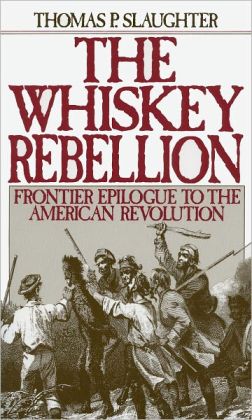
     In 1794, the Whiskey Rebellion occurred, which was not only the largest domestic uprising before the Civil War, but also the first time a federal law was enforced. Western Pennsylvanians were beyond-incensed with SecTreas Hamilton's excise tax on whiskey, but far-more so with the investigative powers of the new federal government. 6000 Whiskey Rebels mobilized at Braddock's Field (site of the Battle of Ft. Duquesne in the F&I War) in order to organize and launch their revolt. 
     GW urged the Pennsylvania government to deal with the rebellion, but Governor Thomas Mifflin refused to use his militia (Mifflin had been a thorn in General Washington's side during the Revolution as well). As a result, GW federalized 13,000 men, mostly from the Virginia, New Jersey, and Pennsylvania militias, and he sent his Attorney General west with the lead troops. GW's SecWar, Henry Knox, was unable to accompany GW to Western Pennsylvania in that he had huge estate problems in what is now the state of Maine. Washington then made SecTreas Hamilton his Acting SecWar in Knox's absence.

Picture
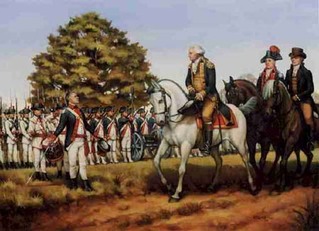
       Although Washington was hoping for a diplomatic non-violent solution to the rebellion in Western Pennsylvania, he agreed that a show of force was necessary. On 25 September 1794, GW issued his final warning to the Whiskey Rebels to stop their insurrection; then, at the age of 62, GW became the only President to not only organize, but also to supervise troops in a combat situation. GW planned to supervise troops as far west as Carlisle, Pennsylvania, and then to survey the situation in terms of the rebellion. 
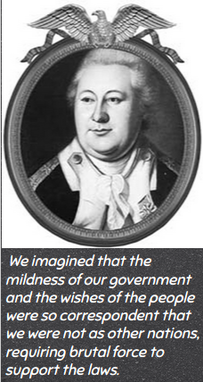
     Washington was irked that SecWar Knox hadn't yet returned . . . he hadn't even written to let his Commander-in-Chief know his whereabouts or his situation. Therefore, it was SecTreas / Acting SecWar Alexander Hamilton that took charge as the federal commander of the assembled militias at Carlisle so GW could settle back and focus on supervision. SecWar Knox finally returned to Philadelphia, and waiting for him was a letter from GW which told him to stay put; the letter was a rather harsh rebuke. 
     GW believed that the Whiskey Rebels were defiant only when the army was distant; he wanted unequivocal proof of absolute submission before he ordered the federalized militia to stop marching. Therefore, GW decided to keep going west of Carlisle with the troops, often running point on horseback.

Picture
     On 21 October 1794, Washington issued instructions that civilian authorities had command of the federalized militias, which meant that Hamilton was placed in charge so GW could return to Philadelphia. Soon after his return, GW addressed Congress; he clearly asserted his belief that the "Democratic-Republican Societies" were the main cause for the Whiskey Rebellion. Virginia representative James Madison, a former supporter & confidant of GW, started to openly condemn his former mentor. To Madison (the de facto leader of the House) and former SecState Thomas Jefferson, Washington was now the open leader of the Federalist Party. 
     The Whiskey Rebellion ended when the rebels themselves voted (using private ballots) to accept President Washington's offer of amnesty (a Presidential pardon for a group). Soon after the Whiskey Rebellion ended, Hamilton resigned as SecTreas effective January 1795. GW was very sorry to see Hamilton leave; he was the only Cabinet member that never let him down. Also, the 20+ year relationship between Washington and SecWar Henry Knox was over; Knox resigned on 28 December 1794, and GW made no effort to keep Knox in his administration. GW's new Cabinet was a truly Federalist Cabinet, with Oliver Wolcott the new SecTreas, and Timothy Pickering the new SecState . . . but why did GW need to find a new Secretary of State . . . the Jay Treaty caused a firestorm in American politics.

Picture
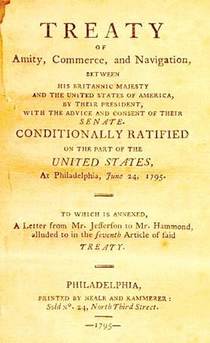
      The Jay Treaty arrived on Washington's desk in March 1795; it was a very one-sided agreement that favored Great Britain. There was no mention of stopping Impressment, yet British imports were given Most-Favored-Nation status; reciprocation was not an overall theme in the treaty. That being said, Britain did agree to evacuate ports on the Great Lakes, and the West Indies were once again open to US shipping (only small ships were allowed; Britain didn't want true competition). Overall, the Jay Treaty's only true accomplishment was that it stopped the inevitable drift towards war with Britain. 
     The Senate ratified the Jay Treaty by the slimmest of margins (20-10); the 2/3's majority was only reached due to a crucial adjustment in the clauses related to trade in the West Indies (Southerners desperately wanted no limit on the size of ships sailing the Caribbean). Washington reached out to Hamilton for advice as to whether-or-not to sign the Jay Treaty . . . Hamilton responded by crafting a 53 page analysis supporting the treaty.

Picture
      As the mostly negative reaction to the Jay Treaty in America increased, Washington found himself without any trustworthy advisors (not counting Martha); finally, he turned to his Vice-President, John Adams for political advice (whom he had largely ignored). Ironically, it was also during this period that Washington recognized the talents of a young John Quincy Adams. Washington was beyond-irritated in that he couldn't find suitable replacements for those that left the Cabinet, mostly because, by this time, no one of significance was willing to serve GW in that capacity. The replacements that Washington eventually found were mediocre at best, and they also made up the Cabinet of President John Adams; they served both Presidents poorly, focusing mainly on party politics
     Washington even turned to Hamilton to be the next Chief Justice of the Supreme Court after John Jay resigned. Hamilton turned down Washington's offer, mostly because the position was not yet prestigious. After the controversial success of putting down the Whiskey Rebellion, and the furor over the Jay Treaty, Washington was the most politically isolated he had ever been, whether as General or as President . . . he couldn't wait to get free of the shackles of the Presidency, which wouldn't occur until March 1797 . . . 

Picture
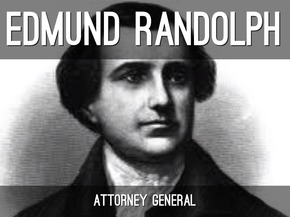
      On 1 July 1795, the Aurora (a Jefferson/Madison Republican newspaper) published the entire Jay Treaty, and other Republican newspapers followed suit; Republican paranoid fantasies (e.g. Monarchy; Anglophobia) exploded on the American political landscape. In addition to the Republican vitriol over the Jay Treaty, Washington had an additional problem: his SecState, Edmund Randolph. In effect, prominent Federalists accused Randolph of treason, which was a common charge to make in that era on those that had opposing political beliefs. 
     Randolph wasn't guilty of treason, but it turned out that he wasn't as loyal to Washington as he portrayed himself to be, and that he had definite Republican political leanings; so therefore, treason was the "default" charge. When confronted (ambushed is a better description) by Washington and those prominent Federalists, Randolph, the Narcissistic Egomaniac, surfaced (yet again) . . . the overall theme of his defense was "How Dare You Question Anything I Do". SecState Edmund Randolph was the first Cabinet member to leave the Cabinet involuntarily. Randolph, as a private citizen, savaged Washington in a very public defense of his actions. In short, Randolph betrayed Washington, in particular after he left the Cabinet, in that GW was the main reason for Randolph's ascent, relevance, and influence in the new federal government. 

0 Comments

The U.S.S. Indianapolis, Part Two

8/16/2015

1 Comment

 
Source: Doug Stanton. In Harm's Way: The Sinking of the U.S.S. Indianapolis and 
                                       the Extraordinary Story of Its Survivors (2003)
               Also, here is a full television movie, "Mission of the Shark" (1991)
Picture
     While the Indianapolis was sinking, an emergency SOS message HAD reached Naval Command at Leyte in The Philippines from a makeshift get-up from Radio Room #2. Commodore Jacob Jacobsen was awakened and apprised of the SOS, but no effort was made beyond that point. The SOS had reached another Leyte naval outpost, and the Officer of the Day dispatched two fast Navy tugboats to the site . . . but Commodore Norman Gillette recalled the tugs, since they sent without his authority. That SOS reached a THIRD Leyte outpost (a landing craft in the harbor); that craft signaled Leyte's Naval Operating Base, but did not receive any instructions . . . in the end, there were no immediate responses to the SOS.
     
     The U.S. Navy's protocol was to treat messages that couldn't be confirmed as pranks, and it was a pro forma procedure by late-July, 1945; The Japanese often tried to confuse and expose the Navy in many locations. It was estimated that about 300 men died on the Indianapolis, and a little over 900 men entered the Pacific with Captain McVay. McVay had been sucked down with the ship, but a large air bubble brought him back to the surface. From the moment the first torpedo hit the ship to when the Indianapolis sank, only twelve minutes had elapsed . . . and the ship sank in one of the deepest ocean trenches on Earth.

Picture
Day One: Monday, 30 July, 1945
     About half of the 900 in the water had a life vest or an inflatable life belt, but those belts were useless, since the fuel oil in the ocean had weakened the seams. For awhile, Captain McVay was by himself; he was in absolute hell, in that he assumed that he was the only survivor. Other than fuel oil on his face (and some in his eyes), he was in good physical shape.
(Pictured: a screen capture from the 1991 made-for-television movie "Mission of the Shark")
     Once clear of the oil slicks, bobbing around in the Pacific was like being in a mildly acidic bath. Also, since most were getting constantly splashed in the face, the survivors were unwillingly ingesting seawater, their red blood cells were breaking down (leading to dehydration), and their lungs were slowly filling with water. One of the very few positives was that some survivors (including McVay) discovered that the fuel oil made an excellent sun screen.
     By dusk on Monday, the sharks arrived, most likely attracted by the blood trail. There were hundreds of sharks, including tigers, makos, white-tips, and blues . . . the survivors thought that the bumps they were feeling were from their fellow crew mates.

      (Below: a segment from "Mission of the Shark"; Captain McVay finds another survivor)

Picture
Day Two: Tuesday, 31 July, 1945
     The sharks attacked around dawn, prowling in frenzied schools. There were two reasons why there was a high probability that many sharks had shadowed the Indianapolis for awhile. First, the ship's low-grade electrical current was an attraction, and secondly, there was a constant stream of refuse thrown overboard . . . the sharks were most likely a presence even before the Indianapolis was sunk. (pictured: a screen capture from "Mission of the Shark"; Captain McVay is in the center).
     So far, the sharks had fed on the dead, but that was soon going to change. The sharks started to hone in on those that were partially clothed (white in blue water was also an attraction). To these sharks, the sailors most likely seemed to be similar to wounded fish. As the shark attacks increased, so did the frenzy and ferocity, since there was blood in the water.
     Then, all of a sudden, the sharks stopped attacking, and returned to the lower levels of the Pacific; sharks prefer to attack (and feed) during dusk and dawn. Between attacks, more-and-more survivors were thinking about drinking seawater.

Picture
     Although the water was 85 degrees, slow hypothermia still occurred, in that there was a ten-degree differential between the water and air temperature. Shivering quadrupled the rate of oxygen consumption, which caused the rate of hypothermia to occur faster. The body starts to slowly shut down under those circumstances (e.g. kidney failure), and in combination with ingesting seawater, many survivors would make fatal future judgments.
     At Leyte, the Indianapolis was marked as "Arrived"; it was always assumed so if there was no information to the contrary. The current Navy policy was that the "arrival of combatant ships shall not be reported." So, there was no help for the survivors in the offing from Leyte, or anywhere else. (pictured: Capt. McVay and one of his crew on a life raft in "Mission of the Shark").
     The survivors had reached the 40 hour mark since the Indianapolis sank, and there were probably only 600 or so still alive. "Will I Live" or "Will I Quit" were the questions among the survivors, and for those that gave up, suicide was common. By nightfall, many dehydrated survivors started to drink seawater, gorging themselves. In most cases, in only two hours, each survivor that did so died, since the body was overloaded with saline. Those that were most likely to resist drinking seawater . . . those that had families. 

Picture
Day Three: Wednesday, 1 August, 1945
     That morning, some survivors started killing other survivors . . . for them, there was no more hope left. In their hallucinations, they saw "Japs" everywhere, and they used their knives to attack and defend. In just one ten-minute span, fifty were killed - it was like a flash-fire. For the past three days, survivors had been dying on an average of one every ten minutes. McVay's survivors were relatively untouched by the madness that gripped the other groups (the survivors were scattered over miles of ocean). The overriding concerns of McVay's group was exhaustion . . . and sharks (pictured: screen capture from "Mission of the Shark").

Picture
Days Four & Five: Thursday/Friday, 2 - 3 August, 1945
     A small bomber plane was on patrol, looking for Japanese submarines, and its crew was struggling with its long-range radio antennae/sensor that extended behind the plane. It was weighted with a "sock", but that "sock" kept falling off, and they were in the midst of trying to solve the problem. 
     It was during this struggle for a "Plan B" that one of the crew members saw something that looked like an oil slick in the water as they flew by . . . to them, that meant there was probably a Japanese submarine in the area. The plane turned around, and prepared for a bombing run; they even had their depth charges ready to drop. On their first pass, they saw bodies in the water . . . it didn't matter whether they were friend or foe, the plane's crew had to think and act fast. (pictured: another screen capture from "Mission of the Shark").
     The bombing run was aborted, and they readied for another pass. The pilot had to calculate their position by "dead-reckoning", since they had a loose antennae. At 11:25 am, the plane radioed-in their approximate position, making it clear that survivors were sighted . . . it was the first report of the Indianapolis disaster. 
     The survivors had drifted incredible distances, some over 100 miles in just four days. Using a piece of rubber hose, the plane's crew weighted down their loose antennae, and calculated an accurate fix on their position. A second, far-more-accurate position message was sent, and US forces at Peleliu (SW of their position) were mobilized for rescue. Radio traffic was heavy, and news spread to US Naval Command in Guam. 

     As a result of the first radio message, floating planes (PBY Catalinas) were sent to the area. One was to relieve the spotter plane, and the others were to land in the water for immediate assistance. But, since a Catalina was unable to get immediately airborne, a Ventura bomber was the first plane that was dispatched. Also, there were orders from Guam (NE of their position) to send two destroyers to rescue the survivors. 
     A separate amphibious plane spotted the survivors, and dropped all their gear in the ocean. They radioed for permission to put-down in order to assist the survivors . . . and permission to do so was actually denied. At least at this point Naval Command in The Philippines (CINCPAC) ordered all ships to break radio silence in order to report their position.
Picture
     One of the Catalinas (pictured) decided to land in the ocean against orders; it was very risky; planes in that class were rarely successful in putting down in the ocean, as opposed to an enclosed bay or harbor. The crew landed despite almost tearing their plane apart, and they were taking on water due to torn rivets. Once in the water, the crew's goal was to collect as many survivors as possible before dark.
     B-17's dropped much more equipment in the water, including larger rafts and wooden lifeboats. The Catalina in the water brought 56 survivors on board, many strapped down on the wings. The destroyer Cecil J. Doyle arrived at 11:45 pm, and started with rescuing the 50+ men on the Catalina. At 12:52 am (3 August) the high-speed transport ship Bassett arrived, and then the destroyers Ralph Talbot and Madison were on the scene, with the destroyer escort Dufilho soon to arrive as well. During the pre-dawn hours, the Bassett picked up 152 survivors, and then under orders returned to Leyte.
Picture
Day Five and After: 3 August, 1945 . . .
    Top Navy brass (including Admiral Chester Nimitz) feared a "controversy" over the Indianapolis would mar the Navy's "Finest Hour" . . . they didn't want the Indianapolis disaster to take anything away from Hiroshima and Nagasaki. As soon as 3 August, the aftershocks of the Indianapolis disaster were rippling through Navy command. New rules were issued: no ships were allowed in the Pacific without escort, and every ship that was five-hours-or-more overdue were to report to the port from which they started . . . this was all far-too-late for the men of the Indianapolis.
     By early morning on 3 August, Captain McVay had still not been found by rescuers. At 10 am, a ship (the high-speed transport Ringness) arrived, and by a stroke of good luck, their radar pinged on an ammunition can that McVay had tried to use as a beacon. Now that he was rescued, McVay’s thoughts drifted towards his imminent court-martial.

     The last of the survivors pulled from the Pacific had been in the ocean for 112 hours, or more than four days. They had no food, water, or shelter from the sun, and they had drifted 124 miles from where the Indianapolis had sunk. Of the 1196 crew members, only 321 survived; 67 of the 81 officers and 808 enlisted men. 
     Four survivors would soon die in navy hospitals, reducing the number of survivors to 317; while there was no way to be certain, estimates were that as many as 200 survivors were killed by sharks. There was also the strong possibility that there were some survivors that were never rescued, despite the relentless and tireless efforts of plane-and-ship rescue crews during the following days and nights. 
        (Below: an actual photograph of some of the survivors of the Indianapolis on Guam)
Picture
      Here is the full television movie, "Mission of the Shark" (1991);
                 Stacy Keach portrays Captain Charles McVay III
1 Comment

The U.S.S. Indianapolis, Part One

8/16/2015

0 Comments

 
Source: Doug Stanton. In Harm's Way: The Sinking of the U.S.S. Indianapolis and 
                                        the Extraordinary Story of Its Survivors (2003)
Picture
      Captain Charles McVay III (pictured) was the only captain in the US Navy to have been court-martialed whose ship was sunk by an act of war (there were nearly 400 captains whose ships went down under attack in WW II). In the early-1990s, declassified intelligence reports surfaced, and they showed Captain McVay's innocence. The U.S. Navy still refused to reconsider its decision; McVay still stands convicted to this day . . . and he is also listed as a convicted felon.
     Of the original 317 men who survived, 38 are still alive (as of the last reunion in 2014). These survivors of the U.S.S. Indianapolis have met every two years to revisit the sinking, and to remember Captain McVay. To a man, they insist that McVay wasn't responsible for the Japanese submarine torpedo attack and the subsequent nightmare of sharks killing hundreds of survivors in the Pacific. 

    The USS Indianapolis was a wounded ship; repairs were necessary after the 31 March, 1945, near-fatal kamikaze attack off Okinawa (the southern-most Japanese island, northeast of Taiwan). The Indianapolis limped 6000 miles back to San Francisco with damage to propellor shafts, a fuel tank, and the water distillation system. Those on board had grumbled that the Indianapolis would never be the same, that she had "turned poor" . . . many thought that the Indianapolis had become an unlucky ship.
Picture
Picture
     The Indianapolis was commissioned in 1932, and FDR made it his "Ship of State", basically an Air Force 1 on water (pictured: FDR on the Indianapolis in 1933). Technically, the Indianapolis was a heavy cruiser; it wasn't quite in the battleship class, although it certainly looked and acted like one. The top speed of the Indianapolis was 32.75 knots; few ships in her class could keep up with her. However, the downside with that speed was a lack of armor; battleships had 13 inches of steel amidships, while the Indianapolis only had 4 inches.
     The Indianapolis was FDR's favorite ship (remember, he was a former Ass't SecNav), but by 1945 she was considered past her prime; the newer heavy cruisers were bigger, faster, and better-armored. The Indianapolis was a replacement ship for a top-priority, top-secret mission in the Pacific. The USS Pensacola was the initial choice for the mission, but she failed her trial run (the engines failed in rough seas), and the Indianapolis, in for repairs in San Francisco, became the ship tasked with the secret run in the Pacific.

Picture
    Very shortly after the Trinity Test 
(pictured: the first atomic bomb that was tested at Alamogordo, NM on 16 July, 1945) McVay received orders that originated from President Truman (had the Trinity Test failed, the Indianapolis would have stayed in port to fully complete repairs). Truman ordered the Indianapolis to deliver its cargo at any cost. The secret cargo was in a crate, secured on deck . . . it was the atomic bomb that would be dropped on Hiroshima ("Little Boy"). 
     Secured elsewhere in the ship was a big black canister that contained U-235. That uranium represented half of America's supply, and it had a "street value" that would be $4B adjusted for inflation. Once the Indianapolis delivered the cargo to Tinian Island, the first atomic bomb would be dropped on Hiroshima inside of three weeks . . . McVay was ordered to head to Leyte Gulf in The Philippines.

      On 28 July, 1945, Captain McVay stopped his zig-zagging route due to rough seas, which his orders allowed him to do, between 7:30 and 8 pm (Zig-Zagging was the authorized, and not very effective, method to try and avoid enemy submarines). Also, McVay's intelligence report indicated the he was alone in his area of the Pacific (his superiors failed to provide McVay the information he needed to keep his ship and men as safe as possible . . . his superiors knew there were Japanese submarines on patrol, McVay did not know ).
            (Pictured below: The USS Indianapolis, officially classified as a heavy cruiser, 
                      departing San Francisco on its mission to the Tinian Islands)
Picture
      At 10 pm, it was 95 degrees, and many crewmen chose to sleep on deck. Due to the heat, and the lack of any threat due to the latest intelligence report, the Indianapolis was in a "Yoke-Modified" state which meant that many of the interior doors/spaces were open to let in as much air as possible. If the Indianapolis had been in a state of "Zed", all the interior doors and spaces would have been closed . . . in short, the Indianapolis would sink fast if it was hit hard by a Japanese submarine. 
Picture
       The I-58 was only one of six Japanese submarines that were still operating in the Pacific. It was 356 feet long, had a seaplane and a machine gun, and it also had the latest in torpedo technology. Her sausage shape was coated in a rubber girdle, which confused US Navy sonar listeners. The I-58 had 19 magnetic torpedoes, and six kaiten (manned kamikaze torpedoes). 
The I-58 hadn't sunk a US ship yet in the war, and the captain and his crew were beyond-anxious to do so.
Picture
     The I-58, spotted the Indianapolis six miles away, after 11 pm. It was a very complex business working up a firing solution for a torpedo, in that distance, speed, and direction needed to be carefully and quickly calculated . . . every moment that passed meant advantage to the Indianapolis. At 11:39 pm, six torpedoes were ready to fire; it was also at that moment that Captain Hashimoto (pictured) discovered that the ship he had targeted was all alone. 
     The Indianapolis was three miles away, and Captain Hashimoto wanted to know the identity of the US warship that he was going to sink. He had a classified reference book of silhouettes of US ships; he wanted to know the ID of the ship in order to know its capabilities, but the reference book was little help. At last, he was able to see the signature battleship class outline of the Indianapolis (again, the ship was a heavy cruiser that looked like a battleship) - he lined up to fire on the broadside of the US warship (he had forgotten about his kaitens). At 12:04 am on 29 July, 1945, Captain Hashimoto gave the order to fire a regular torpedo.

Picture
       The torpedo traveled at 48 knots, 13 feet below the water, with 1210 pounds of explosives; it was enough firepower to take out an entire city block . . . and Hashimoto fired five more identical torpedoes. It took less than a minute for two torpedoes to hit the Indianapolis. The first torpedo hit the ship's forward starboard bow, and it was obliterated. The Indianapolis was still traveling at 17 knots, and it was scooping up massive amounts of water. The second torpedo hit midship, and that explosion was even more horrific. With only 4 inches of armor amidships, the Indianapolis had no chance to remain afloat.
     The ocean itself seemed to be burning, due to a ruptured fuel tank near the bow. In just one minute after the second torpedo hit, the Indianapolis was effectively cut in half. Captain McVay had little time to asses the situation, because the massive warship was going to quickly sink. The ship was listing at 15 degrees, and still moving forward at 14 knots.

Picture
       At 12:13 am, Captain McVay gave the order to abandon ship, eight minutes after the second torpedo exploded. There was no time to abandon the ship in an orderly fashion; naval protocol was not followed in the least, as one would expect under the conditions. Of the 35 life rafts, only 12 made it to the sea, and on those rafts there were few provisions. But, there was a surplus of life vests . . . however far too many crew members went in the Pacific without one. 
     
     Complicating the nightmare was that no emergency radio messages had been sent (it was common practice for the Navy to order radio silence for its ships in WW II, especially in the Pacific . . . no one in the Navy from San Francisco to The Philippines knew the location of the Indianapolis). Before both radio rooms became inoperable, short, cryptic messages were sent; McVay knew it was crucial to transmit their location to Naval Command in Leyte in The Philippines. 
     For those that entered the ocean on the starboard side, lifesaving equipment existed . . . but for those on the port, there was no such luck. And all those that entered the Pacific had to deal with the massive amount of black oil that surrounded the ship, much of which was on 
fire . . . 
Below: First, an incredible account from one of the 300+ survivors of the Indianapolis.
          After that is famous scene from "Jaws" where Quint recounts his experience after the
          USS Indianapolis was hit by the two torpedoes from the Japanese submarine. 

0 Comments

The Battle of Little Bighorn, Part Two (25 June, 1876)

8/1/2015

0 Comments

 
         Source: James Donovan. A Terrible Glory: Custer and the Little Bighorn - 
                                                    The Last Great Battle of the American West (2009).
Addendum: Here is the other (largely forgotten) part of the Battle at Little Bighorn 
Picture
     Captain Frederick Benteen was a good soldier, and he followed Lieutenant Colonel George Armstrong Custer's orders . . . to a point. Benteen had become frustrated due to the seemingly neverending scouting / tending-to-the-pack-train mission. Benteen kept going over ridges to try and find Natives, and he didn't see any "hostiles". 
     To Benteen, this mission felt like a wild goose chase designed to keep him from sharing in any of the glory from the upcoming victory. He didn't send a messenger to Custer, since he was ordered only to do so if he saw Natives. Benteen ordered his men to take a longer-than-normal break for the horses (and the men) before moving on. Despite the order to hurry back after accomplishing his mission, Benteen sauntered on; the horses were capable of a faster gait, but Benteen would not hasten his pace.

Picture
        A messenger then appeared, sent by Custer (Private John Martin, an Italian whose English was substandard); Custer's written message was "Big Village, Come Quick, Bring Packs". After reading the message, Benteen (pictured to the right) chose to be confused . . . he asked those around him how could he be quick AND bring the pack trains at the same time . . . yet he moved towards Custer, but not at a brisk pace.
     Benteen wound up joining Major Marcus Reno (pictured left of Benteen), who was on a bluff after his disastrous retreat; Reno's men had their hands full dealing with attacks from warriors. Major Reno ordered Benteen to wait with him, and for the pack train; Benteen chose to follow the orders of an inferior officer instead of those of his superior, Custer. 
     Benteen spoke against sending troops towards the (loud) gunfire; he claimed that Custer and his men could handle what they were facing. In the absence of any orders from Custer, Reno made no effort to ride towards the sound of the fighting. Due to alcohol, shock, and a severe lack of command skills, Reno didn't even order reconnaissance to ascertain the situation that Custer and his men faced.

Picture
      Meanwhile, Custer had given up on Benteen, and was moving, surrounded on most flanks. Custer ordered Captain Myles Keogh to take three companies to hold the nearby high point; he would take the rest of the troops to try and kidnap Native civilians . . . to him it was the only chance for success (holding Native noncombatants hostage was a useful strategy to force warriors to stop their attack). If Custer would have given the orders to dig-in and/or retreat, he would have renounced any hope of victory, and any claims of glory thereafter. 
     Once on the move, Custer saw that he didn't have nearly enough men to corral a large number of Native civilians, and he was under fire from multiple angles. Custer moved half-way up a rise, and ordered a halt. His idea was to hold on for Benteen and Captain Myles Keogh (pictured, who was ordered to defend the high point above the rise) to provide support. It was at this point that Custer had surrendered the offensive to the Native warriors, and the three companies under Keogh's command at the high point were mostly surrounded, and suffering heavy casualties.

Picture
      Native warriors attacked from the East, West, and the South, converging on Custer and his men. Then suddenly many of the warriors moved to the remaining soldiers to the North at the high point - Captain Keogh's men. Keogh saw no other option than to try and join Custer's force, but before he could give the order, he was shot in the knee. Both Keogh and his horse (Comanche) went down, and the warriors descended on what was left of his men on the high point. 
     Crazy Horse and White Bull challenged each other to "make a run" (a "Courage Run"); they started the process of cutting off the rest of Keogh's men from joining Custer. Custer didn't have any warriors closer to him than 200 yards, too far to be under direct attack, but he saw that warriors were gathering and closing on his position from all sides. 
     Custer ordered his men to prepare a skirmish line, but they were still very vulnerable since there was little-or-no cover. Custer ordered all the horses shot, and placed in a semicircle to provide primitive breastworks . . . it was a stark declaration (and admission) of the seriousness of their situation (some historians argue that Custer didn't pace his horses properly, and by this point they were too fatigued to make a run to try and escape).

Picture
    Surrounded by more than 1000 warriors, Custer's men were running out of ammunition. They were fighting for their lives, hoping that Benteen and/or Keogh would come to their rescue. Custer was down to about 50 men (counting some of Keogh's men), but he was outnumbered at least 20 to 1. 
     No one, with the exception of Custer, could really hit what they aimed at (few in the Army or among the Natives could truly claim to be a sharpshooter), but the Natives had far more guns, and by volume alone, they were able to pick off Custer's men on the high ground (since the Natives had no real opportunities for practice, anything beyond point-blank range was guesswork).

            A segment from "Son of the Morning Star" (1991 TV Miniseries): 
  a) Reno's Retreat Across the Little Bighorn; b) Private John Martin & Benteen;
  c) Custer Makes His Final Push

Picture
     Custer was shot in the right breast, which knocked him back. He dropped his rifle, and drew his two English Bulldog pistols, and at that point, a bullet hit him in the right temple - that shot instantly killed Custer. The remaining survivors of the 7th Cavalry made a run for the nearby ravine, but most were killed before they could go 100 yards (those killed included two of Custer's brothers, Thomas and Boston, and a nephew, Autie). The rest made it halfway to the Little Bighorn before they were overcome by warriors. 
     Crazy Horse reached the area before the fighting was over, taking down one fleeing soldier. Very soon after the battle, noncombatants (especially Native women) had the job of mutilating the slain U.S. soldiers. They crushed skulls, tore out eyes, severed muscles/tendons, hacked off limbs and heads; the goal was to deny the defeated white soldiers any comfort at all in the afterlife.

         The end of the Battle of Little Bighorn ("Son of the Morning Star", 1991)
   a) The 1st Segment ends with Custer's death
   b) The 2nd Segment ends with inaccurate accounts of what was done to 
        Custer's body as well as the death of Crazy Horse . . .

Picture
0 Comments

The Battle of Little Bighorn, Part One (25 June, 1876)

8/1/2015

0 Comments

 
         Source: James Donovan. A Terrible Glory: Custer and Little Bighorn - 
                                                    The Last Great Battle of the American West (2009).
       The village on the Little Bighorn numbered over 1000 lodges, with over 8000 Natives, and around 2000 warriors. And, unlike the 3 columns of U.S. Cavalry that were heading their way in a 3-pronged advance, these 2000 warriors had extensive experience with guerilla warfare on the Plains.
Picture
Picture
     Members from all seven tribes of the Lakota were in the village (Hunkpapa, Sans Arc, Two Kettles, Oglala, Brule, Minneconjou, and Blackfoot), as well as some Dakota, Nakota, and Cheyenne. The list of war chiefs was the equivalent of the U.S. Men's Basketball Team from the Barcelona Olympics in 1992 - they were all superstars to the "nth" degree. 
     Lieutenant Colonel George Armstrong Custer (his superior officer was General Alfred Terry) only had about 660 men (he was part of a single column), including only 31 officers, 578 enlisted men, and 45 or so scouts/guides (most of them Natives). Each soldier had the single-shot breech-loading 1873 Springfield carbine, which had an Achilles Heel - the copper cartridges would heat and jam upon firing, and had to be pried loose, usually with a knife. Other than that, the Springfield was a relatively cheap and reliable carbine with stopping power (each soldier had 100 rounds of ammunition). Also, there was the Colt .45 sidearm (24 - 74 rounds issued), and the pack mules carried 26,000 more carbine rounds.

Picture
     Custer told his officers that he expected to deal with between 1000 and 1500 Native warriors. When the regiment of the 7th Cavalry under Custer's command started advancing in earnest, Captain Frederick Benteen was put in charge of the pack mules. Benteen's orders were to assist the movement of the pack train, and to provide rearguard protection (up to then, he had been in charge of the lead element of the regiment, the "Point of the Spear").
     Custer saw many diverging trails, but the Native scouts knew that they were actually CONVERGING trails, instead. Custer (and the other officers in the 3 columns) was too obsessed with the belief that the Natives were in the process of scattering, like cowards, in their view; there was a collective sense among the officers that if they took too long to engage, they would miss their chance at a decisive victory since the Natives would scatter and disappear. Custer calculated that he was only one day's march from much-desired and much-delayed glory . . . he ordered his regiment to follow the trail leading to the lower reaches of the Little Bighorn River.

Picture
      Custer divided his regiment into three wings (battalions); he would take command of the right wing (the horses of those soldiers were the most fatigued of the regiment). Custer assigned Major Marcus Reno and Captain Benteen three companies each; his plan was that his right wing would be the attacking force, driving fleeing Natives into the other wings. 


     Benteen was ordered to move toward the bluffs, deal with whatever he came across, and then rejoin Custer's right wing, all the while tending to the pack train. Custer expected Benteen to return fairly soon (as in an hour or two) if he didn't find any Native warriors. Benteen had gone from leading the regiment on the initial advance to being given a secondary mission; to him, it was the playground football equivalent of being told to go long, and the QB would fake a pass towards him. Benteen firmly believed that Custer was getting his long-delayed revenge against him for voicing concerns about Custer's decision-making at the Washita in 1868.

Picture
      Custer ordered Major Reno (pictured) to chase the escaping Natives that he believed were only two miles ahead. Custer also promised Reno that he would provide support if Reno engaged Native warriors. Reno had 175 men (140 troopers and 35 scouts), and after advancing three miles, he came in sight of the Little Bighorn River.
     Custer had about 220 men; he not only didn't have enough enlisted men, but he was short officers as well. Although the officers he did have at this point were inexperienced, they were accepted as members of the "Custer Family" (a.k.a. Custer's "Circle of Trust"; officers such as Reno and Benteen hated Custer). Custer knew Reno was under attack, and he changed his mind about directly supporting him; Custer decided to attack the Native warriors from the flank . . . the perceived benefit to Custer was that he could secure even more glory. 
     However, Custer never sent a messenger to let Reno know of his change in tactics. Back with Reno's wing, the major gave the order to attack, but his speech was slurred . . . he had been drinking whisky from his flask (Reno was an alcoholic). 

Picture
       The village that Custer suddenly saw had at least 1000 lodges; it was much larger than he had envisioned. Meanwhile, Major Reno should have kept charging into the village from the east/southeast to disrupt any organization from the Native warriors, but he ordered a halt in the open. The decision was a combination of no elan, no experience, and his "liquid courage" had dissipated. 
     Reno's 100+ men dismounted about half-a-mile from the nearest teepees; they were spread out across 250 yards, and Native warriors were advancing towards their skirmish line. When Custer saw Reno and his men retreat to the timbers and scrub by the Little Bighorn, he decided it was time to make his glorious attack.

Picture
     Crazy Horse finally entered the picture, leading up to 1000 warriors against Major Reno and his men in the timber/scrub by the river. Reno gave the order to retreat from that position, but since he didn't arrange for a bugler, most of his men didn't hear his order. The order was passed down verbally, and lost quite a bit in the translation - his men were under fire, and were panicked and confused. Reno in rapid succession ordered "Mount" and "Dismount"; it made sense to him, but it didn't to anyone else that was nearby.


     Reno then gave his "Come With Me" order, but didn't arrange for any rearguard action, which was standard military procedure, and more-than-warranted in this situation. To the pursuing Native warriors, it seemed like a '"Buffalo Chase"; Reno lost about half his men on the badly organized-and-led retreat to the bluffs across the Little Bighorn River.

Picture
       At about 4 pm on 25 June, 1876, Custer was informed of Reno's retreat, and that he was out-of-action. Custer had a dilemma, in that he needed to cut off the escaping Native civilians (he wanted them as potential hostages, leverage to use against the warriors), and he also needed to provide (delayed) support to Major Reno. 
     As Custer surveyed his situation, he saw a dust cloud in the distance; he believed that it was Captain Benteen's wing, and that he was no more than 30 miles away. Custer thought that victory was still possible with an attack, not so with a retreat. So Custer once again (for the third time overall) split his troops (this time, he divided his battalion) - his goal was to help Reno, and stay on the offensive . . . 

  A relevant segment from "Son of the Morning Star" (1991 TV Miniseries)
     a) Benteen's frustration at being "sent long"
     b) Reno's initial attack on the village . . . notice how there is a bugler . . . inaccurate!
     c) Reno stops his charge and forms a skirmish line; Custer goes for glory
     d) Reno orders a retreat to the timbers/scrub by the LBH
     e) Custer makes his flanking move on the village; the village gets more organized

0 Comments

Path to the Battle of Little Bighorn, Part Two (1860s - 1876)

7/17/2015

0 Comments

 
         Source: James Donovan. A Terrible Glory: Custer and the Little Bighorn - 
                                                   The Last Great Battle of the American West (2009).
Picture
     In June, 1866, a treaty was signed at Fort Laramie between the U.S. Government and Chief Spotted Tail, the Brule Sioux Chief. Chief Red Cloud (of the Oglala Sioux) and many other chiefs warned the U.S. Gov't what would happen if forts were built on the Bozeman Trail. In December, 1866, a large number of Sioux warriors descended on Fort Phil Kearny, and on 21 December, they lured Captain William J. Fetterman (with about 80 men, mostly raw recruits) out of the fort. 
     Fetterman had (supposedly) loudly boasted that he could defeat any number of Native warriors with only 80 men; he and all of his men were killed by the Lakota, Cheyenne, and Arapaho warriors (to the U.S. Government, it was known as the Fetterman Massacre). Crazy Horse (Oglala Lakota) was the war chief that led Fetterman into the lethal trap; Crazy Horse's reputation as a warrior was so secure, he would drop back and let other warriors count coup. 

      When news of the Fetterman Massacre reached the East, the clamor for retaliation reached a fever pitch. General William Tecumseh Sherman called for the extermination of Natives on the Great Plains, but President Andrew Johnson had other plans. Sherman was sent to negotiate another treaty at Fort Laramie in 1868 to find a solution to the violence. As a result of the treaty, many separate reservations were created; the idea of one big reservation (colony) was dead in the water. However, U.S. Government efforts to force Natives to assimilate (to become "white") intensified, in terms of education, agriculture, and culture. 
Picture
     In the treaty, the U.S. Government actually agreed to abandon all three forts on the Bozeman Trail, and to also concede the Powder River country to the Natives. Only when the three forts were destroyed, and the troops withdrawn, did Red Cloud sign the treaty . . . it was the only time Natives defeated the U.S. Government in a war.
Picture
      The Fort Laramie Treaty of 1868 created the Great Sioux Reservation west of the Missouri River in the Dakota Territory; even for the victorious Red Cloud, he and his people lived on a de facto reservation . . . the land that Red Cloud fought to defend would only be theirs temporarily. 
     The treaty stated that Natives could follow the buffalo if the animals were in such numbers to justify pursuit, but they couldn't occupy lands outside of the reservation area (General Sherman was advised that the buffalo wouldn't be in great numbers very much longer). The treaty even allowed the U.S. Government to build a railroad through the reservation to the Pacific Ocean. In only a few months after the Fort Laramie Treaty of 1868 was signed, Sherman (largely on his own initiative) declared that any Natives that located outside of a reservation should be declared "hostile".

Picture
      In December, 1868, the Washita Massacre (the U.S. Gov't called it a battle) and the subsequent roundup of warring Cheyenne secured the Southern Plains for white expansion and settlement. Very soon after his inauguration as President, Ulysses S. Grant halted U.S. Gov't hostilities in the Northern Plains as the first step towards his "Peace Policy". While assimilation to whites continued, he favored locating Native reservations further away from heavily trafficked / settled areas. The true essence of Grant's "Peace Policy" towards Natives was that he would try to conquer them nicely, with more kindness and less brute force than his predecessors. 
     The War Department disagreed with the President; the "kind treatment" was mostly followed on reservations, but they viewed "hostiles" in an entirely different light. The War Dept. assumed that the strategies and tactics used in the Southern Plains would translate to success in the Northern Plains . . . it would not turn out to be the case.
     In 1871, a Congressional squabble led to legislation that actually forbid ratifying treaties with Natives. As a result, Grant used Executive Agreements as a substitute for negotiating treaties, and those Executive Agreements were then ratified by Congress. These agreements were treaties by another name (everyone involved understood), but ironically, the House of Representatives had more input with the actual negotiations under Grant's strategy.

Picture
       Congress immediately classified Natives as wards, not a foreign sovereign power in the U.S. as stated in the Constitution. The U.S. Government would use that distinction in justifying its actions during the next several years. In the early-1870s, the Transcontinental Railroad was completed (it wasn't fully transcontinental until a major rail link was build in Colorado), the already-lacking supplies in terms of annuities on reservations were cut back further . . . and worse yet, the buffalo had largely vanished on the Great Plains (the major reason was sky-high demand for quality leather in Europe). More Natives retreated to the Powder River country; it was their only realistic course of action other than surrendering and going to a reservation.
     The fuse to the Northern Plains powder keg was lit in the Black Hills region. Knowledge of gold in the Black Hills dated back to the early-1850s, but after the Panic of 1873 ushered in the worst economic depression in U.S. History (to that point), many men traveled to the region.  This search for gold by these desperate men in the Black Hills would be backed-up by the presence of U.S. soldiers.

Picture
       Lieutenant Colonel George Armstrong Custer, the nation's favorite and most famous "Indian Fighter", led the Black Hills Expedition of 1874. Custer made sure that detailed dispatches were sent back East, chronicling what he saw and what he accomplished. Custer led the East to believe that there was "Gold in Them Thar Black Hills", and it resulted in the biggest gold rush since California (Below: the Black Hills Expedition of 1874).
     In short order, over 10,000 gold mines were established in the Black Hills; there were too many rushing to the region for the Government to keep out illegal squatters; to the Lakota, all the whites in the Black Hills were illegal squatters. By tradition and treaty, the Black Hills belonged to the Lakota. Red Cloud and Spotted Tail made it clear that they (and other prominent chiefs) would not sell the region to the U.S. . . . Red Cloud and Spotted Tail were "summoned" to Washington, D.C. to negotiate terms for selling the land, but they adamantly refused to sign. 
     The U.S. Government then sent a commission to the Black Hills region to try and purchase the land, and over 5000 Lakotas met with them in Nebraska. The non-treaty faction of the Lakotas, led by Sitting Bull and Crazy Horse, stated that the Black Hills would be defended to the death. The commission barely escaped the area with their lives, and returned to Washington, D.C. in high dudgeon. 

Picture
     President Grant was in a dilemma, in that what was good for the nation was expansion, but that expansion was in conflict with his "Peace Policy" towards Natives. On 3 November, 1875, Grant met with General Phil Sheridan and General George Crook
(pictured). After the meeting, Grant decided (it's more likely that he was convinced) to claim that the Sioux abrogated (broke) the terms of the Fort Laramie Treaty of 1868. 
     The U.S. Army had been waiting for any excuse to have all-out war in the Northern Plains against the "hostiles"; now the Army's hands had largely become untied . . . all that was needed was the requisite ultimatum. Generals Sherman and Sheridan ordered that any Natives that were not in a U.S. Government reservation by 31 January, 1876, would be officially classified as "hostile" to the U.S. Government. The timing and seasonal conditions made the deadline a practical impossibility to meet in any regard, and most (potentially "hostile") Lakotas (and other Natives) had no intention of going to a reservation anyway . . . so the deadline passed, and Natives outside of a reservation became classified as "hostile".

Picture
     On 1 February, 1876, General Sheridan once again (as in 1868) envisioned a major Winter Campaign against the ("hostile") Natives. It was to be a 3-pronged attack designed to encircle, capture, and if necessary kill "hostiles". By this time, only a relatively few Native tribes in the Northern Plains stood against the U.S. Government: Over 3000 Lakotas, Cheyennes, and Arapahos (among them 800 warriors) refused to comply.
     In opposition to these superb guerilla fighters, Sheridan could only muster 3000 soldiers in the Departments of the Dakota and the Platte. These soldiers were ill-equipped, poorly motivated, and most were malingerers, criminals, worthless "bounty jumpers" (those paid to join the army, and then ran away) . . . basically the scum of American society. To command this riff-raff, Sheridan called on a handful of Civil War officers that were vying for the few top-ranking positions in the shrunken post-Civil War Army. Among them were George Crook, Nelson Miles, John Pope, John Gibbon, Eugene Carr, Wesley Merritt, Ranald S. Mackenzie, and Sheridan's favorite attack dog, George Armstrong Custer (pictured, 1876).

0 Comments

Path to the Battle of Little Bighorn, Part One (1763 - 1860's)

7/17/2015

0 Comments

 
     Source: James Donovan. A Terrible Glory: Custer and the Little Bighorn - 
                                                The Last Great Battle of the American West (2009).
Picture
    For white Americans and the United States Government, it became known as "The Line"; it was the point from where Natives were forced to relocate West. One of the first "Lines" was the 
Proclamation of 1763, which was the last time that Native sovereignty (in the interior) was considered important to the causes of peace and trade; of course it was only considered, not respected, by Colonial whites (e.g. Washington).
     The demand for land by white Americans was enormous, and "The Line" kept moving West after such events as: The Battle of Fallen Timbers (1794) / Louisiana Purchase (1803) / 
Indian Removal Act (1830; where white expansion picked up serious momentum) / 
Indian Intercourse Act (1834; defined "Indian Territory") / The 1st Wagon Train to Reach the Platte River (1841; it was the origin of the 
Oregon Trail) . . . by the early-1840s, Native removal was largely accomplished in the view of white America.

Picture
        By 1845, 5000 immigrants were on various trails West, but by 1850, the number increased to 55,000, many of whom traveled through Lakota Territory. Of course disease spread through Native populations, and increased violence against whites was the logical result. 1845 was the same year that the phrase "Manifest Destiny" first appeared (in the 
Democratic Review); it provided political, social, economic, and even religious justification for whites to expand West.
     The Mexican War (1846 - 1848) finalized most of the U.S. Government's claims in what would become known as the contiguous states (the Gadsden Purchase of 1853 was the last land purchase from Mexico). The Gold Rush in California dramatically increased expansion, and it also proved that "The Line" was no longer an effective solution to the "Native Problem".
Picture
      As the 1850s progressed, the Reservation System from the East was applied in the Great Plains, and "Native Colonies" were established. There, in these "Colonies", Natives would be kept out of the white settlers' way, and taught to become "white". Thus began the U.S. Government strategy of negotiating (and forcing) treaties with Natives, taking what it wanted; the legality of most of the treaties were beyond-dubious.
     An example: A treaty was signed between the Cheyenne & Arapaho Nations and the U.S. Gov't in 1851 where it was agreed that the Cheyenne would relocate to a reservation south of the Arkansas River, giving up all their lands. But, only 6 of the 44 Cheyenne and Arapaho chiefs signed the treaty . . . therefore, most Cheyenne and Arapaho didn't feel that they were bound by the document. Also, "Annuity Payments" on reservations were designed to wean Natives from buffalo, but the system was steeped in corruption, since it was headed by the Bureau of Indian Affairs. Despite all the dishonesty and corruption with the treaties and on the reservations, major warfare had been avoided in the Midwest and the Great Plains.
Picture
      In August, 1862, a massacre occurred in SW Minnesota that resulted in Natives killing over 800 whites; it started over a dispute between Natives and a white farmer over access to the farmer's hens' eggs. The Great Sioux Uprising (a.k.a. Minnesota Massacre; Great Sioux War) of 1862 was the first sign of large-scale, organized Native resistance. 
     General John Pope, then in charge of the Missouri Division, vowed revenge; he ordered 
General Henry Sibley's troops into action, and they defeated a large number of Santee warriors at Wood Lake. Over 2000 were captured, and 38 were publicly hanged on 26 December, 1862; President Lincoln actually commuted over 300 Native executions. The Lakotas were stripped of their land in SW Minnesota by the Minnesota River, and moved to a reservation on the Missouri River. Sioux resistance (Lakota, Dakota, Nakota, and others) spread westward with the fleeing warriors, and violence on the Great Plains increased.
Picture
      The Sand Creek Massacre occurred on 29 November, 1864 under the command of Union Colonel John M. Chivington (pictured). Chivington attacked "Peace Chief" Black Kettle's sleeping Cheyenne village (about 100 lodges); even children were massacred under Chivington's orders. Over 200 Cheyenne were killed and mutilated by Chivington's men, and they proudly paraded through Denver (175 miles away), displaying Cheyenne body parts to cheering white Coloradans. 
     Enraged Cheyenne, Sioux, and Arapaho warriors raided towns, stage stations, ranches, wagon trains . . . they burned, looted, and killed wherever they could in retaliation for Sand Creek. During the Winter of 1864-1865, these warriors joined kinsmen in the Powder River country, which was the area between the Black Hills and the Bighorn Mountains, which the Lakota claimed as their homeland (although the Lakota had taken it from the Crow Nation a few decades earlier). 

Picture
     The Union Government initiated the Powder River Campaign in 1865; it became a fruitless endeavor to try and clear out marauding Natives in the region. Over 6000 soldiers in 3 columns stirred up the Lakota Nation for good, especially Chief Red Cloud (pictured; who had tallied over 80 coups by the age of 16, and coups were counted very carefully, much like confirmed kills for pilots in WW I and WW II) and the Oglala Nation. Red Cloud and his warriors reeked havoc over U.S. soldiers and whites foolish enough to enter the Powder River country, especially if they used the Bozeman Trail, which was the best route to the Montana gold mines.

0 Comments

Sitting Bull and Crazy Horse Before Little Bighorn

7/17/2015

1 Comment

 
         Source: James Donovan. A Terrible Glory: Custer and Little Bighorn - 
                                                   The Last Great Battle of the American West (2009).
Picture
     
     Before Sitting Bull became a warrior, he was a very deliberate boy, and his name before he entered adolescence was "Slow" (his first name was "Jumping Badger"). When he reached maturity, he was 5'10" with a heavy muscular frame, and possessed a deep bass voice with a deep, penetrating stare . . . even as a young man he was a commanding presence. 
     By 1855 (at the age of 25), Sitting Bull was a leader of a Hunkpapa elite military society, the "Strong Hearts". This group (like others) was a combination of warrior and military police; their mission was to not only protect the Hunkpapa tribe, but also its culture and social order. Collectively, these groups were called an akicita; Sitting Bull had joined a type of military fraternity.

Picture
      
     Soon, it became clear that Sitting Bull was more than just a warrior; he possessed other traits in addition to bravery, including generosity, fortitude, and wisdom (which was especially hard to acquire). In Sitting Bull, each of these traits had been developed to an incredible degree. By his late-20s, Sitting Bull was made a war chief of the Hunkpapa tribe (within the Lakota Nation). 
     Sitting Bull earned the reputation as a Wichasha Wakan (Holy Man) before he was 30 years old. By the Summer of 1857, six of the seven Lakota tribes gathered at Bear Butte in the Black Hills for a council. Present among the tribes were the Hunkpapa, Minneconjou,
Two Kettles, Blackfeet, Sans Arc, and the Oglala (the Brule tribe was busy in the South, making war on the Pawnee along the Platte River).

Picture
     
     At least 5000 attended the council at Bear Butte, and Lakota leaders pledged resistance to white expansion on their lands . . . as long as whites stayed out of what they considered their land, all would be well. After the Great Sioux Uprising in Minnesota in December, 1862, the fleeing Dakotas traveled West to join their Lakota brethren. U.S. Army columns were in pursuit, and Lakota and Dakota warriors united to fight the U.S. force. 
     Gradually, Lakota warriors perfected the hit-and-run guerilla tactics would would become so successful in the Great Plains. By the end of 1864, there were running battles in the Badlands and the Upper Missouri area; Sitting Bull and the other Lakota war chiefs attacked whites to forestall the invasion from the East.

     Sitting Bull refused to participate and sign the Fort Laramie Treaty of 1868. Soon after Laramie, an unprecedented decision was made among the Lakota; a Supreme Chief would be selected (instead of the independent chiefs from independent tribes). Sitting Bull was named Supreme Chief for the entire Lakota Nation with much ceremony. 
     Almost all non-treaty Lakotas (what General Sherman termed "hostiles") gathered around him, at least in spirit. While most Lakota were already on reservations, Sitting Bull led the "Free-Roamers" against the U.S. Government. He refused all efforts by the Government to have him negotiate and sign a treaty; Sitting Bull didn't change his stance for 17 years, until his people were starving.
Picture
Picture
     In 1865, Crazy Horse (Oglala) was named a "Shirt-Wearer", which was the highest honor a Lakota warrior could receive. Not only was Crazy Horse an elite warrior, but being a "Shirt-Wearer" also meant that he had governing responsibilities as well; he was expected to put the tribe's interests ahead of his own. However, in 1870, Crazy Horse was with a woman that wasn't his wife, and the enraged husband shot him in the face just below the left nostril. Crazy Horse survived with a broken jaw and a scar on his left cheek (the husband, as well as most everyone else in the tribe, believed that Crazy Horse had died). 
     As a consequence of his actions, Crazy Horse lost his status as a "Shirt-Wearer", but he 
looked far more intimidating as a warrior. Crazy Horse first met Sitting Bull in 1871, and by then, Sitting Bull's Hunkpapa tribe had moved to the Powder River country, and waged a defensive war against the U.S. Government and white settlers.

Picture
     In August, 1872, several thousand Lakota gathered for their traditional Sun Dance in Southeast Montana, which was a combination social and religious celebration. Then, on 14 August, 1872, Sitting Bull and Crazy Horse took part in an attack on a railroad survey crew that was protected by U.S. troops. Crazy Horse led an attack in the open against the troops, while Sitting Bull, inspired by Crazy Horse's charge, just sat down, well within rifle range of U.S. Cavalry, calmly smoking his pipe while bullets were hitting the ground all around him. 
     Crazy Horse, inspired by the actions of Sitting Bull, made one more charge against U.S. troops, and his horse was shot out from under him. Both men had covered themselves in glory in their respective tribes, and within the Lakota Nation, on that mid-Summer day in August, 1872.

Picture
     In the late Summer of 1873, an even larger railroad / government survey expedition (2000 men) headed out to the Powder River country (the Yellowstone is one of the major rivers in the region). In charge of the troops was Lieutenant Colonel George Armstrong Custer; he and his men were based out of Fort Abraham Lincoln (pictured: the restored blockhouse) on the Missouri River near Bismarck, North Dakota. The Northern Pacific Railroad had just reached Bismarck, and the next stretch of track was heading to Montana . . . Powder River country. 
     A very desirable trek existed for the tracks, in that all the Northern Pacific had to do was follow the Yellowstone River to the Rockies, and then find a navigable pass through the mountains. On 4 August, 1873, Custer experienced his first contact with Natives in Montana; he was by himself (most likely either hunting or target shooting), and had a close call with Native warriors. Thus began a series of encounters where the Lakota dictated the rules of engagement (guerilla tactics). Custer used cannon to disperse Lakota warriors; Custer equated cowardice with the withdrawal of the warriors.

Picture
       The Northern Pacific's plan to go west of Bismarck was canceled due to the Panic of 1873 (which led to the worst economic depression in US History at that point). It seemed that the Lakota (and other Natives) in the Powder River country would get a reprieve from the white "Invasion From the East", but another trespass would begin the final chapter in the Great Plains (gold), and it would involve Custer, and the Black Hills region.
     To the Lakota, it didn't matter that they had taken the Black Hills from the Cheyenne, and the Cheyenne had taken it from the Comanches/Kiowas, and that they had taken the area from the Crows over a century ago. To the Lakota, the Black Hills represented their "Food Pack", which they could access when needed (the region also had religious significance). Other than protecting railroad surveys, the U.S. Cavalry hadn't really dealt with Natives in the Powder River country in any significant manner.
(Pictured: President Grant trying to help America, depicted as a woman in distress as a commentary on the severity of the Panic of 1873)

Picture
     U.S. troops attacked a peaceful sleeping village of mostly Cheyenne, with some Oglala and Minneconjou as well. This attack started a chain of events that caused the groups led by Sitting Bull and Crazy Horse to band together. That large gathering of Cheyenne, Oglala, and Hunkpapa Natives moved northwest in April/May, 1875. "Free-Roamers", made up of Sans Arc, Blackfeet Lakota, and more Minneconjou, joined the entourage.
     In early-June, 1875, this gathering of Natives had 500 lodges, 1000 warriors, and thousands of Natives were leaving reservations to join this growing number of Natives. The U.S. Government, military, and the general public had no idea what Sitting Bull, Crazy Horse, and the Dakota Chief Inkpaduta (pictured, who had been resisting white incursions far longer that the other two) meant to their people in terms of inspiration and direction. All three shared an unyielding desire to defend, to the death, their homelands, people, and their way of life.

            Addendum: The Deaths of Crazy Horse and Sitting Bull . . .
1 Comment

George Armstrong Custer After the Civil War (1866 - 1868)

7/17/2015

0 Comments

 
     Source: James Donovan. A Terrible Glory: Custer and Little Bighorn - 
                              the Last Great Battle of the American West (2009)
Picture
      In July 1866, Congress expanded the mounted cavalry with four more regiments (a rare expansion in the climate of Post-Civil War military downsizing), and they all headed West. George Armstrong Custer was a Lieutenant Colonel in the 7th Cavalry; he was once again in command, even if not the overall commander. In the next decade, Custer would only command in one battle (Washita, 1868), with the rest classified as skirmishes . . . until Little Bighorn in June, 1876.
     The fawning press still loved him, and Custer was always accommodating to the media. By 1872, his letters were regularly published in newspapers and magazines under his own name. Custer enjoyed his celebrity enormously . . . much to the chagrin & irritation of some. 


(Pictured: Lt. Colonel Custer shortly before the Battle at Little Bighorn)

Picture
      In October, 1866, Custer (and his wife Libbie) went to Fort Riley (KS) to organize and train his new regiment within the 7th Cavalry. Under Custer's command was 
Captain Frederick Benteen (31, 5 yrs older than Custer), a cantankerous Virginian that served with distinction in the Civil War. Benteen took an instant dislike to Custer when he first met him in January, 1867; many historians have argued that this may have been due to similarities in their personalities. Benteen viewed Custer as a blustering, bragging, press-created peacock . . . he was jealous, upset that he wasn't in command. Benteen's bitterness would infect the 7th Cavalry all the way to Little Bighorn on 25 June, 1876.
     The 7th Cavalry was ordered to protect settlers and railroad crews pushing West. In the Spring of 1867, Custer joined up with General Winfield Scott Hancock's 1400 soldiers, cavalry, and artillery, but the joint mission was an abject failure, in that hostilities actually increased in the Great Plains.

Picture
      On the Great Plains, Custer was introduced to guerilla tactics for the first time, and he became very frustrated with the lack of success. He was also experiencing supply problems, inferior rations, desertions, excessive heat, deceitful Native guides/scouts, but most of all, he missed Libbie. As a result, Custer the "Tyrant" resurfaced, alienating many of his men, and then he went back to see Libbie in Fort Riley (pictured: the front of the Custer home in the fort) without permission . . . Custer went AWOL (he missed her, but he was also concerned that she was cheating on him with a captain stationed at the fort).
     Custer was court-martialed two months later, and he basically dug his own grave. The Court of Inquiry gave Custer multiple chances to help himself, but Custer remained imperious. After a month of deliberation, Custer was found guilty on all but three charges, and was suspended from rank and command without pay for a year. It was actually a very mild verdict, and at the time, being convicted in a court-martial was not the career-ending humiliation that it would become in the 20th Century. Custer blamed many others in the 7th Cavalry for his situation, never once reflecting on his own decision-making . . . it widened a rift that would never heal in the regiment.

Picture
       On the surface at least, the Custers treated the year as an extended vacation. Custer's suspension would only last ten months, because General Philip Sheridan (pictured, now in overall command of the departments on the Plains) requested that his sentence be reduced. The War on the Plains was going poorly, and Sheridan (still a huge Custer supporter) gave Custer a virtual "blank check" in terms of what he could do on the Plains. 
     When Custer returned, he was energetic, purposeful, and itching to find Natives. Custer was allowed to retain his regiment, and Sheridan made sure that the regiment was properly supplied. Custer was still the disciplinarian: officers late to meetings actually had their tents put on fire.  One month after his return, the 7th set out to find Natives . . . during the winter. Sheridan calculated that it would be easier to find Natives along their winter camps by rivers and creeks.

Picture
     The 7th Cavalry headed towards the Washita River on 23 November, 1868. Custer followed a trail of over 100 Cheyenne warriors from Kansas to a winter camp. He didn't know if the Native camp was hostile, but the trail of the Cheyenne warriors led straight there; Custer assumed that the 100 warriors were in the village's 51 tepees.
     Custer led the charge from the north (with the rising sun at his back) into the village, but he had ordered multiple simultaneous charges from different directions. The engagement lasted a mere ten minutes, but there were two alarming developments. First was Major Elliott and his sixteen missing men, and Custer had reports that some warriors were heading his way. The village Custer attacked was actually one of several that had over 1000 warriors (very poor reconnaissance), and they were advancing in mass. Custer decided to burn the village, kill 900+ ponies, and abandon Major Elliott and his men on the field (Elliott and his men were eventually found, dead and frozen, riddled with arrows and badly mutilated).

Picture
     Instead of retreating as the 1000 warriors advanced, Custer (pictured in 1868) gave the order to move TOWARD the warriors, and the Cheyenne retreated (Native warriors preferred to chase down their enemies; they often retreated when advanced upon, preferring guerilla tactics). The Washita was heralded as a major triumph by the U.S. Government, military, media, and Westerners. Some denounced the Washita as a massacre on defenseless and peaceable Natives. 
   Of the 40-50 Natives killed, over half were noncombatants; Osage scouts, not troopers, were the main reason for the deaths (to the Osage, it was a chance to gain revenge against the Cheyenne from past events). The Washita was harsh, but it wasn't a wholesale massacre; Custer actually halted some of the killing. Custer's superiors were pleased with the result, in that it was the first piece of good news to come from the Plains after the Civil War. While it was a morale-booster for the government, it demoralized Southern Plains Natives . . . no longer could Natives feel safe during the winter in their camps by rivers.

Picture
      The 7th Cavalry continued rounding up hostile Natives in the Southern Plains during that winter (1868-1869). Captain Benteen took Major Elliott's death very hard, and blamed Custer; he even wrote a scathing letter that was published in Eastern newspapers. Custer just couldn't believe or understand why one of his officers could be so disloyal (when Benteen freely admitted in an officer's meeting that he wrote the letter, Custer, disbelievingly, walked out of the tent). 
     From that point on, there was a Custer "Clan", and Benteen's "Anti-Custer Clan"; however, most officers remained neutral, wanting nothing more than to do their duty (and when off duty . . . drink). Benteen would continue to rail against Custer, loudly, for the next seven years . . . 


0 Comments

George Armstrong Custer: Before/During the Civil War

7/17/2015

0 Comments

 
   Source: James Donovan. A Terrible Glory: Custer and the Little Bighorn -
                    the Last Great Battle of the American West (2009)
Picture
     George Armstrong Custer had the ability to process a lot of information and make a considered decision in short order. Time and again during the Civil War, Custer made split-second decisions that turned out to be correct. By the end of the Civil War, Custer's skeptics among the Union officers were the older and less successful. The Custer of the Civil War inspired loyalty and shared the danger with his men, and they followed him where he went.
     Few would have predicted that level of success for Custer at West Point, where he had the highest number of demerits in his class. He was very popular, despite graduating at the bottom of his class in June, 1861 (Ironically, his worst grades were in cavalry tactics). His class's graduation was accelerated by over a year (the last year was condensed to one month) due to the onset of the Civil War.

Picture
     2nd Lieutenant Custer's first assignment was with the 2nd Cavalry, which was in General 
Irvin McDowell's division. Custer was at the 1st Battle of Bull Run, but was only an observer from a distance, not a participant. He was cited for bravery, however, for directing aspects of the Union rearguard action on the retreat. For over a year, Custer served as 2nd Lt. as an aid to various officers in the Union Army. 
     Custer often volunteered for combat assignments, and as a result, impressed the General of the Army of the Potomac, George B. McClellan . . . McClellan promoted Custer to Brevet Captain (during the Civil War, there weren't many medals issued, but promotions that were in effect during the war, "brevets", were very common . . . with no increase in pay, of course).
     Above: the earliest photograph taken of 2nd Lt. Custer during the Civil War in 1862)

     Custer made himself indispensable to McClellan; Custer worshipped the General from afar.
When Lincoln removed McClellan in the Fall of 1862, the 22 year-old Custer was without a position of significance. Custer's rank reverted to 2nd Lt. when he was reassigned to the Army of the Potomac in the Spring of 1863. 
     General Joseph "Fighting Joe" Hooker acted on good advice, and finally created a unified cavalry corps in the Army of the Potomac. Once again, Custer made himself indispensable, this time to the cavalry commander, Brigadier General Alfred Pleasonton . . . Custer was fearless, had an inclination and desire for battle, and proved to be a natural leader in combat
      (Pictured below: Custer and General Alfred Pleasonton after the Battle of Gettysburg)
Picture
Picture
       On 28 June, 1863, Custer was promoted to Brevet Brigadier General (Pleasonton was also promoted to a higher-rank). Unlike his previous two promotions, this one was based solely on merit, no political connections were needed. Custer had learned much about command in terms of organization, strategies, and tactics . . . he had also learned to "toot his own horn" rather effectively (probably from McClellan).
     Few Brigadier generals led their men into battle; most preferred to stay back. But Custer led his men, believing that if he shared the danger, his men would fight harder. At this point, Custer had started to craft his own uniform, featuring multiple colors (e.g. a red scarf). Custer claimed that he wanted his men to know where he was at all times in battle 
            (Pictured: Brevet Brigadier General Custer)

Picture
      The Battle of Gettysburg occurred just a few days after his promotion, and his first charge was a disaster. Custer knew he received rash advice from a reckless junior officer, but he authorized and led the charge (depicted in the painting) on the principle that he wanted to prove himself in his new rank. Custer was almost killed (his horse was KIA), and he was rescued by one of his privates; although the charge was disastrous, he did prove his mettle to his men.
     On the climactic day of Gettysburg ("Day 3"), Custer charged into Jeb Stuart's much larger and more vaunted cavalry TWICE. Custer was outnumbered at least 8 to 1, but ordered and led the second charge anyway, halting Stuart's flanking efforts. It was the first time in the Civil War that a Union cavalry won AND held the field against a Southern force. After Gettysburg, it was mostly triumph-after-triumph for Custer and his Michigan brigade - they proved to be the best of the Union cavalry corps. Custer's reputation and fame grew, and his likeness became common in newspapers and magazines.

Picture
     On 9 February, 1864, Custer married Libbie Bacon. Libble was able to stay near her husband during the Civil War in that General Sheridan had ordered a special dispensation for Custer's wife (Custer was apparently back in Sheridan's good graces). By now, Sheridan was in command of the entire Union cavalry, which meant when General Grant ordered that Jubal Early's forces be crushed (he was a constant menace to Washington, D.C.), it was Sheridan's responsibility to do so. Sheridan ordered his Union cavalry to engage in "total war" in the Shenandoah Valley (west of DC), denying Early any easy chances to forage for supplies.
     In September, 1864, Custer was given command of the 3rd Cavalry, and the soldiers of the 3rd were thrilled. General Jubal Early's surprise attack led to great disarray and a Union retreat for all the cavalry corps except Custer's 3rd, which had an orderly and effective rearguard action. When Sheridan arrived after his famous 11 mile ride to the front, the situation had markedly improved due to Custer taking active command. After Early was crushed, Custer was promoted to Brevet Major General in the Union cavalry.

Picture
      Later in 1864, Custer was taken by surprise by a Confederate advance (after pulling in his pickets too early), and was almost captured at an inn (similar to 
General Charles Lee during the Revolution). In what was a common practice with high-ranking officers during the Civil War, Custer twisted and altered facts in his reports to avoid taking responsibility (which he would continue to do after the war);  even General Phil Sheridan was on Custer's case after the near-debacle. 
     At Appomattox, Custer talked to Confederate officers, some of whom he knew from West Point. General Sheridan purchased Wilmer McLean's table on which Lee surrendered to Grant for $20 ($300 today), and gave it to Libbie with a very complimentary note about her husband.

Picture
     At the close of the Civil War, only General Ulysses S. Grant, General William Tecumseh Sherman, and General "Li'l Phil" Sheridan were more popular than Custer. However, his popularity with his men would soon plummet; he would be viewed as a tyrant during "Reconstruction Duty". After the Civil War, Custer was posted in Louisiana and Texas, and his men lacked provisions and motivation. Nevertheless, Custer demanded that his men follow his orders and rules to the letter, which led to the "tyrant" label. 
   Sheridan supported Custer wholeheartedly, but his new reputation as a tyrant would shadow him to his death at Little Bighorn on 25 June, 1876. Custer's commission in the Union Army expired in January, 1866, and he was mustered out of the Army at age 26. Custer was now only a cavalry captain in the regular (peacetime) army . . . what would he do with the rest of his life . . . 

(Pictured above: General Custer during the Civil War with one of his dogs; he absolutely loved dogs. After the Civil War, it was common for him to claim to have between 20 and 40 dogs in his "entourage")

0 Comments

Thomas Jefferson: The Leader of the Opposition (1790 - 1797)

7/7/2015

0 Comments

 
     Source: Jon Meacham. Thomas Jefferson: The Art of Power (2012)
Picture
     Thomas Jefferson officially became America's first Secretary of State on 22 March, 1790.  TJ was flexible on many political points (even, initially, with the National Bank), but he never changed his views that the U.S. was susceptible to a monarchy. TJ was in favor of a stronger federal government, but not one that opened the door to a monarchy. In other words, TJ was adamantly opposed to Monocrats (rule by one), and he saw multiple threats, visible and invisible, to America's republican government.

Picture
      On 31 October, 1791, Jefferson convinced his journalistic pitbull, Philip Freneau (pictured), to use his National Gazette as a Republican platform . . . in doing so, TJ became the leader of the opposition against the Federalists (and especially Alexander Hamilton, the first Secretary of the Treasury). In 1793, James Madison (the leader of the Republicans in the House) wanted TJ to remain as SecState, but Jefferson believed that his debt of service to the new federal government had been more than paid.
     Jefferson told Madison that the battles seemed endless, and victories had been too elusive; in effect, TJ was making a political tactical retreat to Monticello. Jefferson may have been retreating to Virginia, but Democratic-Republican Societies were emerging and spreading in New England and New York in 1793. 
     These very aggressive pro-Jefferson / anti-Federalist groups were organized and led by working-class and middle-class citizens, and also featured a strong immigrant presence. These societies were viewed by Hamilton and President Washington as very dangerous groups that were a serious threat to the social order. By 31 December, 1793, the friction was too great for Jefferson, and he officially resigned as SecState to Washington; Washington officially accepted the resignation on 1 January, 1794.

Picture
     Jefferson's strategy on his return to Monticello in early-1794 was to wait, and be summoned to come to the rescue . . . the outcry for his return would be the Election of 1796. Madison (among others, such as James Monroe), kept TJ abreast of domestic and foreign affairs while he was in retreat at Monticello. What worried Jefferson the most was the growing accumulation of power by the Federalist Party, and of Alexander Hamilton.
     Although Jefferson was happy at Monticello, he needed to be in the world of politics and consequence, which meant holding office, articulating beliefs, and championing Republicanism over Monarchy. In the Fall of 1795, the rising star of New York politics, 
Aaron Burr (pictured), visited Jefferson at Monticello . . . in Burr, TJ had a potential rival to Hamilton in the state. When the Jay Treaty was ratified in 1795, Jefferson and his Republican Party had the issue they needed; it was a rallying point, leading to momentum and purpose. Jefferson felt he was close to being "summoned" in order to block the rise of Monarchy in America.

Picture
     On 19 September, 1796, President Washington's
"Farewell Address" was published, and it opened the floodgates in terms of candidates pursuing the Presidency in the upcoming election. Jefferson wrote Madison that it might be best if he was elected Vice-President, given the current domestic and foreign policy issues. 
     Meanwhile, Hamilton hatched a strategy to try and keep BOTH John Adams and Thomas Jefferson from being elected (he thought Adams was too headstrong, and that Jefferson's vision of an Agrarian America was flat-out wrong). Hamilton urged key Federalist electors (with letter-after-letter) to vote for South Carolina's Thomas Pinckney (pictured). He hoped to deny Adams the Presidency by siphoning away several crucial electoral votes, while also costing Jefferson crucial Southern electors. 
     Jefferson knew that it would be a close call in 1796 between himself, Adams, and Pinckney; so much so that TJ asked Madison to be his advocate in case the election had to be decided in the House of Representatives. Madison, in at least one letter, told Jefferson that if he was elected Vice-President to accept it, arguing that "close proximity to the President critical."

Picture
     On 8 February, 1797, the Electoral Votes were officially tallied in the U.S. Senate, with Vice-President John Adams presiding. Adams received 71 votes, with TJ receiving 68; Jefferson, by finishing second, was America's second Vice-President (TJ is known as the "1-2-3 Man", in that he was the first SecState, second VP, and third President). One reason why the Election of 1796 was so close was that the 3/5's Compromise (still in effect) meant that there were more Southern Electoral Votes. 
     Before the results were official, on 1 January, 1797, Jefferson sent Madison a draft letter addressed to Adams. It was very nice letter, pledging his support as Vice-President to President-Elect Adams. Madison sent a letter to Jefferson, basically scolding him as to the contents, and told him to NEVER send the letter, in that he believed that TJ needed to immediately set the tone of OPPOSITION! Later, as Washington exited the stage as President, Jefferson thought that GW was lucky to leave just before the bubble burst on the Federalists.

Picture
     The only time President John Adams consulted Vice-President Thomas Jefferson was before the Inauguration, concerning U.S.-French relations. Adams wanted TJ to convince James Madison to be the U.S. Minister to France. Not long after Adams took the oath of office and became the 2nd President, TJ told Adams that Madison wouldn't accept the position (both TJ and Madison felt that it would be worse-than-stupid to try and help the Federalist Party in any way). 
     President Adams' Cabinet was a very mediocre group (with the exception of 
John Marshall), which he inherited from Washington (GW wasn't very enamored with the group either). But that middling Cabinet gave their Adams a very hard time over making the offer to Madison via Jefferson; for the next four years, Adams never consulted TJ on a political question. Adams understood that he was being pressured to be a partisan President by powerful Federalists . . . and Jefferson came to understand that, even as VP, criticism was inevitable in politics.

0 Comments

Thomas Jefferson: The Road to the Declaration of Independence

7/7/2015

0 Comments

 
       Source: Jon Meacham. Thomas Jefferson: The Art of Power (2012)
Picture
     For most of the Colonial Elite, revolution was the most shrewd economic choice. The "Rich Eastern White Guys" were restricted from land speculation in the West, and (non-British) paper money was worthless. And, since Thomas Jefferson and the Eastern Elites were in debt (for TJ, it was hereditary debt plus his own), a revolution meant a chance to wipe the slate clean and start over. 
     TJ likened the debt of the Eastern Elites to being the property of the London creditors (George Washington
wholeheartedly agreed with that viewpoint). TJ believed that not making payments to London creditors was a type of boycott, which had become an accepted strategy of resistance to the Crown to many in the Colonies. It would be a rich man's revolution . . . the lower classes would be much slower to respond in kind. To the Jefferson and the Eastern Elites, separation from Britain representedtti an attractive economic and ideological future.

Picture
     On 19 May, 1774, a Virginia newspaper announced the Boston Port Act (it would be the first of "The Intolerable Acts"). TJ's "Summary View" in response was the first time an item that he wrote spread through the Colonies (and even to London). He didn't advocate separation; he expressed a desire to return to the way things were done before all the current hullaballoo. On 6 August, 1774, Washington paid for several copies of what he called "Jefferson's Bill of Rights"; TJ's "Summary View" moved TJ to the forefront of the brewing revolt in Virginia and beyond . . . it also placed him in a position to be among the few that could write a declaration concerning independence.
     Jefferson was elected to the 
2nd Continental Congress (an engraving is to the right) on 27 March, 1775 as the Colonies were drifting towards armed conflict with Britain. Lord Dunmore, the Colonial Governor of Virginia, confiscated gunpowder, which effectively denied Virginians their arms . . . he also threatened to emancipate Virginia's slaves if the scurrilous hoo-haw continued. As a result, Virginia and the 2nd C/C accelerated their preparations for war. TJ came of political age not from certitude, but from the rising conflict with King George III and Great Britain.

Picture
      On 11 June, 1775, Jefferson left for Philadelphia and the 2nd Continental Congress; a larger world beckoned. TJ was reluctant to speak in public (like Washington), so therefore he held his tongue while the 2nd C/C was in session. The events of 7 November, 1775, would do much to produce the Declaration of Independence. Lord Dunmore declared martial law (from the ship in which he was hiding) in Virginia; he also decreed that any African slave that took up arms against the Colonies would be freed. 
     These declarations led to many neutrals becoming revolutionaries, at least in spirit. There was also the sense that the property of the Virginia Gentry would soon become the property of the British Crown. On 4 February, 1776, Jefferson read a copy of Thomas Paine's Common Sense . . . he agreed with most every one of Paine's tenets and concepts. 

Picture
      During the first week of June 1776, a motion to dissolve the union with Great Britain was made in the 2nd C/C. The motion focused on the practical domestic and international applications of independence. A vote was delayed until 1 July in order to get New York, New Jersey, Pennsylvania, Maryland, and South Carolina on board. 
     But the question was: who should write a draft of the declaration of independence . . . 
John Adams said Jefferson should be the primary author (he based this assertion on a conversation he had with TJ two years prior). TJ thought Adams should write the declaration, but Adams stood his ground, and refused, and Jefferson agreed to write the draft (Adams & Franklin helped TJ edit the draft . . . Franklin suggested the term "Self-Evident"). Jefferson drafted the document for neutral Americans, soldiers in arms, and potential global allies. A satisfied TJ turned into a frustrated TJ when the 2nd C/C cut out about 1/4 of his draft, including negative clauses concerning the slave trade.

Picture
      The Declaration of Independence was formally introduced to the 2nd Continental Congress on 28 June, 1776, and on 1 July, the debate started. Again, large portions of TJ's draft were cut, this time including a denunciation of slavery. TJ hated being edited by such a large group; he silently writhed in agony at suggestions of rewording or deleting passages. Jefferson took the proposed changes to the Declaration of Independence as attacks on him, not constructive criticism . . . which is a common trait with those that have incredible ambition, like Jefferson.
     On 2 July, 1776, the 2nd C/C voted to adopt a resolution for independence from Great Britain, and on 4 July, they ratified the Declaration of Independence. Later, a jealous John Adams said the Declaration of Independence was a theatrical show, not a substantive document.

Picture
     The Declaration of Independence was one of many things with which Jefferson was involved as a member of the 2nd Continental Congress. He faced daunting tasks that included dealing with real-or-imagined conspiracies, such as Loyalist plots and Native attacks in the frontier. TJ also wrote a proposed constitution for Virginia, and closely followed the debates concerning the Articles of Confederation. 
     Jefferson (like Theodore Roosevelt) saw politics as a kaleidoscope . . . loyalties and positions often changed . . . who was an enemy in the morning may be an ally in the afternoon. As a result of his experience in the 2nd Continental Congress, Jefferson was very knowledgeable on political methods and strategies. And, in the Fall of 1776, a 33 year-old Thomas Jefferson met, for the first time, the 25 year-old James Madison in the Virginia Assembly . . . their first battle together: Freedom of Religion in Virginia.
(Below: John Trumbull's revisionist painting of the Signing of the Declaration of Independence. TJ and Trumbull were friends, which explains why TJ is the star of the painting . . . if you look closely, you'll see Jefferson stepping on the left shoe of John Adams, which was most likely Trumbull's idea, according to our Capitol Tour Guide in June, 2014)

Picture
0 Comments

The Repeal of Prohibition

7/1/2015

0 Comments

 
     Source: Edward Behr. Prohibition: 13 Years That Changed America (2013)
Picture
     In 1927, perhaps 50,000 Americans died from drinking "Moonshine" liquor during Prohibition. Hundreds of thousands of other Americans suffered from blindness, paralysis, and other very serious conditions; much of the alcohol that was consumed was just flat-out dangerous. The main poisons were wood alcohol and, "denatured" (and tax-exempt) alcohol. Usually, the denaturing substance was methanol (sometimes kerosene); three glasses could kill a person. 
     Wayne Wheeler (President of the Anti-Saloon League), so powerful and influential for so long, was finally on the defensive. He had supported the use of methanol for "denaturing" alcohol, and he had actively and aggressively lobbied against mandatory poison labels (pictured: a local warning label from a pharmacy). Wheeler actually denied responsibility in any way over the deaths from "denatured" alcohol; he stated that those that died from drinking that type of alcohol deserved it, since they were breaking the law . . . at long last, Wheeler's enemies 
(the "Wets") sensed that his "Prohibition Power" was starting to ebb away.

Picture
      
     As the Anti-Saloon League was losing it influence with Congress, Wheeler's health was slipping. He had made many enemies in America, but also in the Anti-Saloon League. But Wheeler's downfall actually started in 1925 when President Coolidge replaced the Assistant Secretary of the Treasury with someone that wasn't loyal or beholden to Wheeler. This new Ass't SecTreas made sure that the Commissioner in the Prohibition Bureau was no longer a lackey for Wheeler (pictured). At the first sign of weakness, some members of Congress pounced on Wheeler, and long-dormant anti-Prohibition groups started to regain political traction.

Picture
     There were many groups that continually voiced their opposition to Prohibition. Two of note were the American Bar Association (which challenged the legality of the Volstead Act) and the American Federation of Labor. What worried Wheeler the most was the strong possibility of a new "Women's Crusade", and he had reason to worry - the effort to form the crusade was led by the most famous female Republican in the U.S. . . . Pauline Morton Sabin
(pictured).
     On 23 April, 1927, Wheeler (who was very ill with heart and kidney problems) debated Clarence Darrow, one of the most famous and influential "Drys", at Carnegie Hall. Wheeler didn't acquit himself well, in part because of his health, but also because Darrow was a far superior opponent. After the debate, Coolidge kept replacing more top-level administration officials that were anti-Wheeler, and in essence the "wheels came off" for Wheeler, in that no one in the federal government was afraid of him any longer. Wheeler died only five months after his debate with Darrow, in September, 1927; he had been in the process of making plans to try and influence the outcomes of
 both political conventions.

     When the Great Depression started, the consumption of liquor didn't decrease by much at all, but there was a great awareness of the lost tax revenues that existed before Prohibition from liquor sales. Due to the Depression, some of the most staunch "Drys" were at the forefront of trying to repeal Prohibition; to these conservatives, the federal government was facing a fiscal, not a moral, issue. 
     The Great Depression didn't initiate the repeal for Prohibition, but it did markedly accelerate the ratification of the 21st Amendment. Many wealthy "Drys" wanted liquor to be once again legal so it could be taxed, hoping that the resulting revenues would lower their income tax. Many "Dry" farmers also changed their tune so they could sell more grain at a better price.
Picture
Picture
     Al Smith ("The Happy Warrior", pictured) won the 
Democratic nomination for President in 1928, after Wheeler thwarted his bid four years earlier . . . the "Wets" finally had some momentum. However, Prohibition and his Catholicism dogged Smith during the General Campaign against the Republican candidate Herbert Hoover. In the Election of 1928, the "Drys" won their last victory, electing Hoover to the White House in a landslide (pictured below), while also sending the highest percentage of "Drys" to Congress during Prohibition. 
     President Hoover stated that he opposed any effort to repeal the 18th Amendment, but the political mood would drastically change in the next four years, due to the Great Depression. Also, the new leader of the Anti-Saloon League, Bishop James Cannon, proved to be brazenly bigoted and hypocritical. The "Wet" media confirmed that he was a black-marketer during the Great War, and was guilty of multiple counts of "moral turpitude". 

Picture
      On 5 December, 1933, hard liquor was again legal to drink, but there was a problem, in that hardly any speakeasy / bar had a liquor license to legally dispense alcohol. Ironically, few wanted to tangle with any legalities after Prohibition was repealed. In New Jersey, the governor extended Prohibition a few more days so those that wanted to celebrate could do so "legally". 
     On 6 December, 1932, the 21st Amendment to repeal Prohibition was officially proposed in Congress. In December, 1933, Utah became the 36th state to ratify the 21st Amendment (the Nebraska Unicameral took "no action" with the proposed amendment), officially ending Prohibition in America. The implementation of the repeal of Prohibition occurred in two steps: first, "real" beer once again became legal, and after that process was started, then hard liquor became legal. 
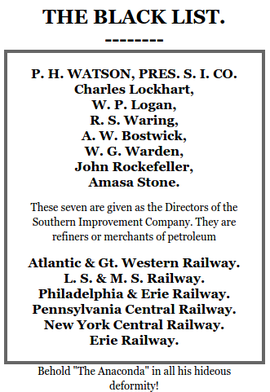
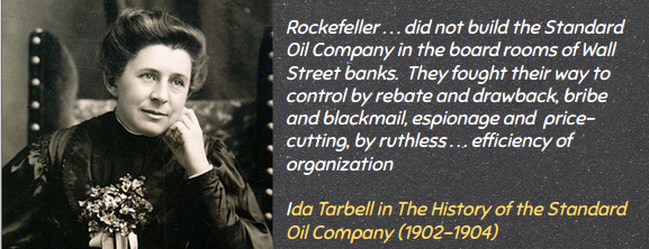
Picture
      The Significance of Prohibition: Most Americans wanted to forget the 13+ years of Prohibition . . . not only that, but Prohibition remains the least-studied area for historians. It's almost impossible to stamp out "Tolerated Vices", and if an attempt is made, organized (and even unorganized) crime will thrive as a result. 
     The least-learned lesson of Prohibition is that legislation alone is no cure for our nation's problems. America's social conservatives were proven wrong in at least their politics and predictions concerning Prohibition. Repression is like morphine, in that it masks the pain, but it doesn't cure the sickness . . . and Prohibition was a dose of national morphine that lasted 13 years, 5 months, and 9 days, and left an indelible mark, both positive and negative, on America.
Picture
0 Comments

Prohibition: The Volstead Act,  Ratification of the 18th                                              Amendment, and the Immediate Aftermath

7/1/2015

1 Comment

 
     Source: Edward Behr. Prohibition: 13 Years That Changed America (2013)
Picture
     The many weaknesses and omissions of the Volstead Act and the 18th Amendment were due to the powerful influence of Wayne Wheeler (pictured), the leader of the Anti-Saloon League. Congressman Andrew J. Volstead (R; MN), was merely the facilitator of the law that bore his name. On 27 May, 1919, the bill was introduced to the House of Representatives, and after a three month debate, was passed 255 - 166. Shortly thereafter, the Senate also passed the Volstead Bill, and then President Woodrow Wilson vetoed it on Constitutional and ethical grounds. On the same day, Congress overrode Wilson's veto; at that point, the Volstead Act replaced all previous "Dry" laws in the states.

Picture
Picture
      The Volstead Act (pictured: Representative Andrew J. Volstead) had many exceptions with alcohol, such as brewers could stay in business with "Near Beer" (.05 % alcohol). There was no liquor advertising, and the implements to manufacture liquor were illegal as well, but it was legal to drink in a private home. 
     The Volstead Act was a hopeless piece of legislation, in that it didn't take into account the willingness and ingenuity of regular citizens and lawbreakers to get around the feeble enforcement provisions. The "Drys" naively assumed that the "Wets" would actually honor the law.

Picture
Picture
    It was a forgone conclusion that 3/4's of the states would ratify the proposed 18th Amendment, making Prohibition part of the Constitution (Nebraska would be the 36th state to ratify the 18th Amendment). One year after ratification, the 18th Amendment was officially enacted on 17 January, 1920 (immediately, the Bahamas became a "Bootleggers Paradise").
     On the night of 16 January, 1920, the level of drinking by the nation's "Wets" was somewhat muted. On 17 January, the celebration of the "Drys" was off-the-charts; it was vitriolic and self-congratulatory hyperbole . . . to the "Drys", they had totally defeated the "Wets"; those that consumed alcohol had become a "conquered people". 

Picture
Picture
      During that "Grace Period" between ratification and implementation of the 18th Amendment, the government had to prepare for the enforcement of Prohibition. But Congress only allocated a measly $3 million, and there were only 1500 agents in the newly-created Prohibition Bureau (pictured: agents from the Prohibition Bureau in action).
     Adding to the future futility of enforcing Prohibition was Wayne Wheeler's idea to put the agents in the Prohibition Bureau under the authority of the Treasury Department, not under Justice (Wheeler had lobbied Ohio Senator Warren Harding very hard for that decision). Very early, that proved to be a disastrous decision, in that since the agents were civil servants, they were poorly paid and equipped . . . the conditions were ripe for corruption at the enforcement level in the federal government during Prohibition.

Picture
     Immediately after Prohibition was enacted in January 1920, sprouting up like daisies, were speakeasies, bootleggers, and hijackers. The "Drys" were, of course, surprised, but these shenanigans had been going on at the state level for a long time. "Medicinal" liquor was legal under the 18th Amendment, and in Chicago alone, 15,000 doctors and 57,000 druggist were prescribing liquor to "treat" various ailments. 
     The ingenuity of clandestine liquor manufacturers / brewers was impressive; it was worth their while to supply that product, in that demand for illegal alcohol was sky-high. Defying Prohibition became the "thing to do" with college students, "Flappers", and much of America's middle class (also, the cocktail was invented during Prohibition, in order to disguise the taste of bad liquor). 
        Below: America's most famous columnist, H.L Mencken of the Baltimore Sun,   
                   openly and enthusiastically violating Prohibition in a speakeasy.

Picture
     Prohibition meant that the U.S. was all set for a wild drinking spree that would last 13 years, 5 months, and 9 days. Prohibition would transform the nation's morals, and alter attitudes towards all those in authority; it would also usher in a new "Era of Cynicism". Political immorality flourished at the federal, state, and local levels during Prohibition, which allowed lawbreakers, bootleggers, speakeasies, hijackers, and a new breed of gangster to flourish.
                           (Below: A segment from Ken Burns' "Prohibition", 
                      tracing the last few years before the 18th Amendment)
1 Comment

Temperance: "The Women's War" (featuring Carry Nation)

7/1/2015

0 Comments

 
      Source: Edward Behr. Prohibition: 13 Years That Changed America (2013)
Picture
     
     Women's Temperance was the first mass-movement involving women in U.S. History. It also featured the world's first large-scale non-violent protest movement (like Gandhi' efforts decades later). These "Women Crusaders" used arrests and insults in the early-1870s as a way to gain guilt-ridden converts to their cause. The behind-the-scenes mentors were men, and the logistics came from Protestant churches. There was some success in the Midwest in terms of non-stop picketing and protesting, but while awareness was raised, only a relatively small percentage of saloons actually closed their doors.

Picture
       While this specific "Women's Crusade" was a a media success, it had a short shelf-life. When the interest from the media waned, the Crusaders went back home, and the affected saloons reopened. As a result, the Women's Christian Temperance Union (WCTU) was formed in 1874. Frances Willard (pictured) was eventually elected as WCTU President; she was not only an ex-Crusader, but also a university professor. 
      The WCTU believed that moderation was a "shoddy lifebelt", which promised safety, but only tempted danger. Willard was one of the first to work for nationwide Prohibition; she organized a petition effort to lobby Congress in 1875. The WCTU made every effort to educate kids on the evils of alcohol, featuring such Sunday School publications as "Counting Fingers". 

Picture
     At the turn-of-the-century, Carry Nation would steal the WCTU's formidable thunder. Nominally a member of the WCTU, Carry Nation was determined to protest in her own way. Born into an eccentric (insane?) and rebellious family, Carry Moore (pictured) was very likely a mentally unbalanced person. Carry spent a lot of time with African slaves, looking for human connections, since her mother didn't want much to do with her at all. 
     She married Charles Gloyd in 1867, who was a heavy drinker, and her life took a major turn as a result. Gloyd's two main vices were drinking and smoking, which were the very vices that Nation attacked in the future. She married again, this time to a man named David Nation, partly so she could legitimately call herself Carry Nation. David was not a strong man, and failed at most everything, including preaching. During unsuccessful sermons, Carry would embarrass him by saying such things out loud as "That will be all for today, David".

Picture
     Carry Nation soon started busting up saloons in St. Louis, Cincinnati, Philadelphia, and New York City, and as a result, she became a "Media Star". By 1901, Nation was so far removed from reality that she publicly celebrated the Assassination of President William McKinley; it was at that point that she started her sharp decline. Soon, the WCTU stopped funding her, and the media stopped covering her "Hatchetations". 
    Nation resorted to reenacting her "Hatchetations" on stage, but there were no crowds of note. She even tried stage performances in Britain, and tried to break up pubs, but was arrested and heavily fined. Nation was totally unaware that she had become a complete caricature, a figure of ridicule. Soon after her unsuccessful "tour" in Britain, Nation had a mental breakdown, and died at the age of 65 in a mental institution.

Picture
     One day, Nation entered a Kansas saloon with another WCTU woman, and a sledgehammer; she smashed a keg of whiskey, and hurled invectives in a rage . . . no one dared trifle with her. After busting up a few saloons in Kiowa, she bought a large hatchet, which was to become her signature. Her raids on saloons were sudden, fierce, and violent: few dared face her directly as she destroyed bars and furniture. 
     Law enforcement was in a dilemma as to what to do with Carry Nation, since Kansas was officially a "Dry" state. Nation was destroying property, but those properties were violating state law. Nation rarely stayed in jail more than one night; very often, she used her short periods of incarceration for media exposure.
   (Below: if the embedded video doesn't play, click on "Women of Prohibition Carry Nation")

0 Comments

The Origin of the Temperance Movement

7/1/2015

0 Comments

 
Source: Edward Behr. Prohibition: 13 Years That Changed America (2013)
     In 18th Century America, alcohol in one-form-or-another was so plentiful and so cheap that most Americans went through life in a semi-perpetual alcoholic haze. An American tradition was not only plentiful alcohol, but plenty of time-off (as in hours/days) for consumption. This was a tradition carried over from Europe, especially Britain; in 1720s England there was a "Gin Craze" that was similar to the Crack Cocaine epidemic that ravaged 1980s America. In Colonial America, it was rum, not gin, that was king, and hard liquor (and even beer) was consumed far more than wine.
      (Below: American Colonists enjoying a concoction commonly known as "Rum Punch")
Picture
     In contrast to Europe, Colonial America, despite its factionalism, didn't have nearly the same level of strife, which allowed Temperance (and then Prohibition) to slowly take root. Also, there was a link between liquor and politics in Colonial America, especially in taverns. 
     Colonial tavern owners were economically and politically powerful; they not only delivered votes by providing (often free) liquor, but their taverns were the epicenter of politics for the area. Politicians, to be taken seriously, basically had to be an engaging presence in a tavern(s) in order to be elected/re-elected. The tavern keeper would buy votes and politicians that matched his ideology with liquor. 

                (Below: an "election" involving alcohol in Colonial America)

Picture
     Tavern keepers (and the clergy) were the key opinion-makers long before the development of modern media . . . however, the status of the tavern keeper would sharply decrease after the Civil War, in that the percentage of tavern keepers that were foreign-born would rise significantly.
  (Below: a depiction of an apple press - the first step in making hard apple cider)
Picture
Picture
       Hard apple cider was the staple alcoholic beverage since the early-1700s for most Colonists, and then whiskey made its debut in the 1760s. As the 19th Century progressed, rum and gin became working-class staples, while for those with greater socio-economic status, madeira, port, or malaga were consumed (Beer wasn't heavily consumed until German immigrants came to America in significant numbers starting in the 1830s).
    By 1810, the population of the U.S. was 7 million, and among those millions, alcohol consumption was rampant. One estimation, based on the somewhat measurable data of the day, was that the average per capita consumption of alcohol was 10-12 gallons of distilled spirits a year (a more realistic estimate would be in the 3 to 4 gallon range: by 1830, citizens over the age of 15 consumed 7 gallons of alcohol per year). Here is another way to measure the alcohol consumption from our early history: In Washington's first four months as President, 25% of his budget was spent on various varieties of liquor.
     From early Colonial times, some Puritans, such as Increase and Cotton Mather, favored Temperance (limiting, or tempering, the consumption of alcohol). By the 1740s, the small percentage of people that classified themselves as Temperance leaders had, in their minds, linked drinking alcohol with spiritual neglect. To these Temperance leaders, excessive drinking was the source of the lack of adherence to religion and social order.

Picture
      Dr. Benjamin Rush (pictured) was the first to clinically analyze the negative effects of liquor. Rush's study was an early-1800s equivalent to the Surgeon General's warning with cigarettes in the 1960s. The crux of Rush's argument was that people needed to switch from hard liquor to wine or beer (and drink less). As a result of its publication, Temperance societies started to sprout up in the U.S. (the diminutive President James Madison still drank a pint of whiskey before breakfast every morning). 
     The first Temperance publication in Boston was The Philanthropist in 1826; by 1829, there were at least a thousand Temperance Societies throughout America. There were so many Temperance Societies that the clergy were forced to take notice. By 1836, Dr. Rush's study had become "lost in translation", in that with the clergy running point, Temperance Societies were on the warpath against all liquor for religious reasons - in parts of the U.S., there was already open support for Prohibition.


Picture
      From the 1830s-on, Temperance focused on the moral cost of drinking - it was a "Mortal Sin". More clergy were comparing drinking with eternal damnation and sobriety with salvation. In America, drinking alcohol became a religious problem, not a political or social problem. 
      To Temperance leaders like Reverend Justin Edwards (pictured), the alcohol industry represented a vast Godless conspiracy to undermine traditional society . . . Americans, then as now, were susceptible to conspiracy theories. As the Temperance Movement began to grow, the rate of alcohol consumption actually decreased; by 1850, per capita consumption of alcohol was down to a little less than two gallons per year.

Picture
     On 2 June, 1851, the Maine legislature made the sale of liquor illegal throughout the state; decades later, it would become the basis for the 18th Amendment. The leader of the Prohibition movement in Maine was the "Napoleon of Temperance", Colonel Neal Dow (pictured). He was among the first to believe that a legislative solution was the best method to drastically reduce alcohol consumption, and improve society.
    In opposition were the "Wets", which were mostly staunch conservatives backed by brewers, distillers, and saloon keepers. Not only did "Wets" oppose Temperance / Prohibition, they also opposed the emancipation of African Slaves. To these social conservatives, Temperance and Abolitionism came from the same brood of trouble-makers: they believed that their status and influence were under attack.

     The Maine Prohibition law was easily circumvented: it didn't actually prohibit drinking, it just outlawed saloons. Alcohol could be imported and consumed - a common way around the law was to sell a five-cent soda cracker, but the rum was "free". Also, code phrases such as "do you want to see a Blind Pig" meant "do you want a glass of rum"; it was the beginning of what would become known during Prohibition as a "Speakeasy".
     In the 1850s, the momentum of the Temperance Movement ground to a halt due to the increasing likelihood of Civil War. During the Civil War, taxes on liquor and beer were deemed essential in order to help fund the war effort, especially in the Union. However, the Civil War would prove to be a very useful springboard for what would eventually become the first powerful Prohibition lobbying group, the Anti-Saloon League (ASL) . . . 
               (Below: A Temperance poster called "The Drunkard's Progress" from 1846)
Picture
0 Comments

President Washington & the 3 Branches of Gov't (1789 - 1791)

6/13/2015

0 Comments

 
               Source: Ron Chernow. Washington: A Life (2010)
Picture
    President George Washington, as a Virginia Planter, found it hard to adjust to a sedentary job in an urban setting; it very may well have weakened his  overall health (pictured: a list of GW's serious health problems). In June, 1789, a fast-growing tumor appeared on his left thigh, accompanied by a high fever. It became excruciating for GW to even sit down - as it turned out, GW was in mortal danger of dying. He most likely had a carbuncle, which was a cluster of boils connected to each other under the skin. 
    On 17 June, 1789, Dr. Samuel Bard operated on GW's left thigh. The tumor was very large, and Bard had to excise the infected tissue and pus. It was an enormously painful procedure, but GW remained unfailingly courteous. GW was bedridden for weeks, and many wondered if he would ever regain the strength necessary to lead the nation as its first President. By early September, GW told Dr. Bard that the inflammation was almost gone.

Picture
     In June, 1789, Congress tried to pass a law that required GW to get the permission of the Senate if he wanted to remove a member from his Cabinet. The Senate vote was a tie, and Vice-President John Adams voted against the bill. The significance of VP Adams' vote was that it prevented the emergence of a Parliamentary-style Democracy in the U.S. 
    President Washington appeared in the Senate twice. The first was to personally ask why one of his appointments was being blocked. The second (and last) time was to inquire (with his Secretary of War, Henry Knox) the status in terms of ratification of a negotiated treaty with the Creek Nation. The Senate obfuscated by referring the proposed treaty to a committee for further study; GW responded by saying "that defeats the whole purpose of my coming here" - Washington never again returned to the U.S. Senate.
   From that point on, President Washington sent missives to Congress, notifying them of his decisions. These actions did more to define the Presidency and the conduct of foreign policy than an entire shelf of Supreme Court decisions on the separation of power among the three branches.
       (Below: From the 15:12 - 18:57 mark, watch GW in the Senate w/ the Creek Treaty)

Picture
       President Washington made the Executive the principle actor in the federal government, negotiating treaties and nominating people for confirmation. GW knew that one man could make and take decisive action, as opposed to a legislative body. Among his decisive actions, and an enduring mystery of GW's Presidency: why did he relegate Vice-President John Adams (pictured) to a minor role in his administration   . . . Adams was clearly excluded from Washington's inner circle of advisors. 
     Adams was probably a casualty of being identified, by Washington, as the nominal head of the Senate. GW also had a long memory of those that criticized him during the Revolution, and Adams was one of the names at the top of Washington's list. GW believed that criticism was a lack of loyalty, and many people paid a price for what they said about Commander-in-Chief Washington when he was President. Meanwhile, Adams was secretly exasperated by GW's success and prestige as President; John Adams' greatest fear was that Washington and Franklin would dwarf him in American History.

Picture
      What hurt Adams was that Washington preferred to tap the talents of younger men, such as Hamilton, Madison, and Jefferson. What hurt Washington's focus in his early months as President was that he was absolutely besieged with office seekers, since he had to fill over 1000 posts in the new federal government. GW tried to be as impartial as possible with his selections because he wanted to strengthen the legitimacy of the new government. 
     Washington set up five departments that were designed to provide advice: Treasury, War, State, Attorney General, and Postmaster General. With the Constitution mum about Presidential advisors, GW created the first Cabinet (not pictured; the Postmaster General, Samuel Osgood); by doing so, he created a major shift from Legislative to Executive (in effect, he found another way to bypass Congress). Jefferson viewed the first Cabinet as a wheel, with Washington as the hub, and the others as the spokes . . . but those spokes featured an incredible array of talented young (relative to GW) men.

Picture
       SecWar Henry Knox was Washington's closest friend (kind of his "Work-Wife") and ally, which he desperately needed, since he wasn't really close to anyone else but his wife Martha. Typically, GW wasn't an original thinker or policy-maker, but he was very comfortable helping Knox supervise the War Department. For the Treasury, GW first approached Robert Morris, but he felt he was too busy (and also didn't want to mess w/ his prosperity), so he recommended Alexander Hamilton (pictured left below with Jefferson). GW knew Hamilton's faults, but he had worked with him twice before during the Revolution and the Constitutional Convention. It's hard to believe, but Hamilton, the great Secretary of the Treasury, wasn't Washington's first choice for the position.
     For the crucial position of Secretary of State, GW offered the post first to John Jay, but Jay had his eye on being the first Chief Justice of the Supreme Court. GW then "settled" for someone he knew from his days in the Virginia Assembly: Thomas Jefferson. Jefferson took months to decide whether-or-not to accept the position; he took so long that both GW and James Madison had to pressure him hasten his decision (to accept!). 
     Hamilton practically burst through the doors of the Treasury Department with sky-high enthusiasm and a desire to do his best to make the new federal government a long-term success. Jefferson, on the other hand, was not very enthusiastic in carrying out his duties as the first SecState. A possible reason for his delay for accepting the post, and his lack of energy in heading State was that he wasn't very comfortable with the federal government as envisioned, written, and ratified.

Picture
     A main source for the problems and friction between Hamilton and Jefferson was that GW wanted his Cabinet to advise him on all fronts. For example, GW would often ask Hamilton for input on foreign affairs, which obviously rankled Jefferson. It also meant that Cabinent members often tread on each other's turf, and rivalries and resentment were the consequence. 
   The Attorney General was Edmund Randolph (pictured; he was only 36), and he was frustrated in that he really didn't have a department to run like the others . . . it was basically GW and him. Randolph had so little to do that he actually took private clients as a lawyer. 
     There was high turnover in the early years of the Supreme Court under the Constitution; "Riding the Circuit" was the main reason. Supreme Court justices spent a long time away from the comforts of home, and also had to endure miserable working conditions and substandard lodging. The lack of prestige alone lead to resignations and a low-level of interest in serving on the Court. GW would appoint 11 justices to the Supreme Court (in the early decades, there were only 6 justices) . . . the Supreme Court was an institution searching for a mission.

Picture
     For Washington, the good news about being President was, unlike being Commander-in-Chief during the Revolutionary War, he was able to take his time in making most every decision. Washington, therefore, made far-fewer mistakes as the Chief Executive. GW worried more about committing an error than making a brilliant decision that would lead to a cacophony of "Huzzahs".  
     For example, Washington deliberated quite a while on the pros and cons of the proposed 
Bill of Rights; he then actually changed his previous stance in opposition to adding amendments to the Constitution. GW's open support of the Bill of Rights broke the logjam in Congress in terms of their proposal for ratification.

0 Comments
<<Previous
Forward>>

    Archives

    May 2016
    April 2016
    March 2016
    February 2016
    January 2016
    December 2015
    November 2015
    October 2015
    September 2015
    August 2015
    July 2015
    June 2015
    May 2015

    Categories

    All
    18th Century
    19th Century
    20th Century
    Biography
    History

Powered by Create your own unique website with customizable templates.