Source: Marc Eliot. Steve McQueen. 2011 (Steve McQueen's filmography)
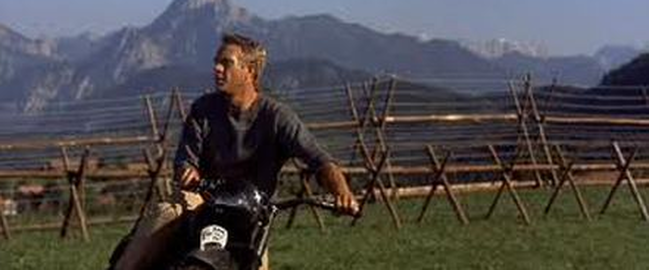
Screen capture from The Great Escape (1963), my favorite Steve McQueen movie . . .
Since I was old enough to remember, Steve McQueen was a Hollywood superstar, even though I didn't see any of his movies until after his death from lung cancer in 1980 (at the age of 50). Among the interesting things I learned from reading Marc Eliot's biography was . . .
** McQueen had a rough childhood, never really able to experience anything close to a
traditional upbringing; basically, he ran away from home, joining a carnival of all things, at the age of 15, and eventually joined the Marines
** He was a "Method" actor, which basically meant he totally immersed himself with the
role he was playing (the style was en vogue in the 1950s & 1960s, in particular). A by-
product was that he was very difficult to work with on-and-off the set, from the POV's
of directors, producers, and fellow actors (especially fellow method actors, such as
Dustin Hoffman in 1973's "Papillion"). It was ironic that he had a life-long antipathy
towards authority, but when he had authority, he basically abused it as an actor. He was
married three times - his second marriage was to the most successful actress of the late-
1960s/early-1970s, Ali McGraw, and his first marriage lasted over 15 years.
** McQueen, like most Hollywood superstars, turned down roles in movies that would
have made him an even bigger star. A sampling of the roles he turned down for various
reasons include: Butch Cassidy & the Sundance Kid, 1969 (Robert Redford); Dirty Harry,
1971 (Clint Eastwood); Play Misty for Me, 1971 (Clint Eastwood); The French
Connection, 1972 (Gene Hackman won his first Oscar in this role); Superman, 1978
(Marlon Brando); Apocalypse Now, 1979 (Marlon Brando). To be fair, this kind of
thing does happen often enough in Hollywood. Some famous examples include: Tom Cruise
turned down "Ghost" (1990, Patrick Swayze benefited from that decision), while Julia
Roberts turned down both "The Proposal", and "The Blind Side" (2009), to Sandra Bullock's
great benefit.
** The lung cancer that he died from at the age of 50 was guaranteed to happen, it turns out,
due to an extended period of time removing asbestos as a Marine, for one of the many
times he was disciplined in the Corps. The first inkling of that cancer appeared in 1972
while he was making the movie "The Get Away" w/ Ali McGraw; he made the last few
movies of his career, and life, and tremendous pain and discomfort. The lung cancer
wasn't diagnosed until he was making the movie "Tom Horn", in 1979.
** He had a chance with 'Bullitt" (1968), to franchise that action "anti-hero" to multiple
movies, much like Clint Eastwood did w/ Dirty Harry; no one in Hollywood understood
why he didn't take advantage of that role with future sequels, but instead focused on
choosing roles that his fans didn't support at the box office (largely through his production
company Solar, which was a financial albatross)
** The highest-grossing movie in which he starred was 1974's "The Towering Inferno", in
which he finally appeared in a movie w/ Paul Newman (McQueen was incredibly jealous
of Newman's super-stardom). He chose the role of the chief firefighter, in part, in order
to literally have the last line in the movie over Newman (Ironically enough, it was Newman
himself, in 1968, that offered McQueen the role in Butch Cassidy and the Sundance Kid,
but McQueen apparently didn't want to work w/ Newman at that point)
** McQueen was surprisingly lazy when he wasn't on the set, or racing cars or motorcycles.
A life-long drug addict, philanderer, and couch potato, he wanted to drift through life
in his 40s, "letting himself go", never making another movie. His financial realities kept
him making movies just to live the life he wanted to live (e.g. his last movie, "The Hunter",
1980)
** Like Denzel Washington and George Clooney, McQueen was a TV star before he became a
movie star. McQueen starred in 94 episodes of "Wanted: Dead or Alive", for CBS in the
late-1950s, portraying a bounty hunter, which makes his last movie, "The Hunter", kind of
an ironic last movie for his career.
** The movies that are considered to be the "Essential McQueen" are:
- The Magnificent Seven (1960)
- The Great Escape (1963)
- The Cincinnati Kid (1965; a poker-player version of Newman's "The Hustler" in 1961)
- The Sand Pebbles (1966)
- The Thomas Crown Affair (1968; a role turned down by Sean Connery)
- Bullitt (1968; to this day, this movie has what is considered by most movie critics as the
greatest car chase in movie history)
- Papillion (1973)
- The Towering Inferno (1974)
